Monday, 18 April 2011

April Butterfly Survey

Now that April has arrived I've gone out into the 2km squares I have been allocated by STERF and chosen my exact transects for surveying. I have tried to get a range of habitats, both good and bad, to provide a true picture of the state of the butterfly population in the Touraine du Sud.

A Swallowtail Papilio machaon (Le Machaon) taking nectar from a
wild violet on the edge of the woods.
My survey sites are:

  1. An area of unimproved grassland on the south facing slope of a limestone spur, surrounded by broadleaf woodland, once probably pasture, now mown perhaps once a year.
  2. The steep grassy north facing slope of a limestone spur, being overtaken by conifers, junipers and other scrub, surrounded by mixed broadleaf and conifer woodland, once probably sheep pasture and now abandoned.
  3. A rural track with improved pasture one side, broadacre crops the other.
  4. A rural track through intensive broadacre cultivation.
  5. A rural track through semi-improved pasture with a well vegetated ditch along one side.
  6. An area of damp natural calcareous grassland, not grazed by domestic stock but may be occasionally mown, and wild boar forage extensively, surrounded by stands of broadleaf woodland, conifers and heath.
  7. An area of damp natural calcareous grassland, not grazed by domestic stock, but wild boar forage extensively, surrounded by broadleaf woodland and beginning to revert to woodland.
  8. An open ride through tall (2m+) heath scrub.
  9. An area of flat open natural herb and flower rich calcareous grassland, mown periodically for hay.
  10. A forest track along the edge of broadleaf woodland on one side and semi-improved haymeadow on the other.
A female Short-tailed Blue Everes argiades (L'Azuré du trèfle)
- she and her habitat (below) are in serious decline.
The species seen were (numbers refer to habitat list above): Dingy Skipper (8); Swallowtail (10); Brimstone (1, 5, 6, 7, 8, 9, 10); Small White (1, 2, 3, 5, 7, 8); Orange-tip (1, 2, 5, 7); Wood White (1); Violet Fritillary (1, 2, 5, 8, 10); Short-tailed Blue (9); Holly Blue (2); Small Heath (1, 9); Comma (8); Peacock (3, 5). Not only was the Brimstone seen at the most sites (7 out of the 10) it was also far and away the most frequently sighted in terms of individual butterflies, with 53 being recorded. Small Whites were encountered at 6 of the sites, but in fewer numbers than Violet Fritillaries overall (13 Small Whites and 18 Violet Fritillaries). High numbers of Brimstones is to be expected at this time of year, as they overwinter as adults. The average number of individual butterflies seen per transect was 10 and the average number of species 3.2. Each transect is 5m wide and as long as it takes to walk in 10 minutes whilst counting butterflies (in practice about 100 - 200m).

The lovely plum, ochres and shining white underside pattern
of a Violet Fritillary Clossiana dia (La Petite Violette).
Orange-tips have been recorded in exceptional numbers this year, but by the time I did my survey their numbers were dwindling somewhat (they are an early spring species), and perhaps my choice of habitats did not favour them. You tend to encounter them along ditches and damp patches with plentiful supplies of Cuckoo-pint, the host plant.

Habitat number 9 (those readers who travel between
Preuilly and Yzeures on the D104 may recognise it).
The poorest habitat was number 4, a track through broadacre crops (at the moment wheat). This transect produced no butterflies at all. The most productive habitat was number 1, a south facing calcareous grassland slope surrounded by woodland. Neither of these results is unexpected for this time of year. Intensively cultivated broadacre farms are generally poor butterfly habitat, whereas a nice warm south facing slope with some nearby woodland for protection is ideal for early spring.

Susan

Sunday, 17 April 2011

Fête de la Saint Georges

Yesterday was our second Fête de la Saint Georges.

Last year we were surprised by how big and bustling it was, this year less so. Because this year St Georges Day (23 April) falls on the Easter weekend, the fete was brought forward. This had the unfortunate consequence of making our special day clash with everyone else's special day, so many of the stallholders had to decide whether to come to us, or the 4 other fetes held in the area yesterday.

It was a nice day for a wander.
Unfortunately, Preuilly missed out this year. Still - it was nice wandering down the middle of the road and not holding up traffic, and sitting with our friend Louisa having our now traditional sausage and chips lunch, courtesy of the public school association.

Last year you couldn't move for stalls and people.
The fête is also the traditional time for renewing one's membership of the Archeological Society, which we have done.

Hopefully next year, with the fête returned to its proper weekend (the first Saturday after the 23rd April), everything will be big and bustling again. The bike race should also be held on fête day again - this year it will be held on the weekend the fête would normally be: next weekend.

Simon

Saturday, 16 April 2011

Who's Been Busy?

We have!!

This past week we have painted, cleaned, plastered and sanded. Not necessarily in that order, and not necessarily only once (in fact many times... many, many times).

We have also almost, but not quite, finished the kitchen walls and wiring: all the wall cladding except one piece is in place, and all the wiring bar one power-point wired.

On the old kitchen wall I had stuck various pieces of paper with important information - when the milk lady visits, the opening hours of the dechetterie, my work plan for September 2007, the library opening hours, the frequencies for various English radio stations, and the instructions for the dry rot detectors.

I have left these in place behind the new plasterboard wall as a little treat for the next people to work on the house.

Pictures of the finished works will follow another day. I am having a little lie-in, then inspecting the fete St. George (which is being held a week early this year).

Simon

Friday, 15 April 2011

Frost Candles at the Ready

The lid of the frost candle tin has instructions for
calculating how many you need to put out.
After an extended and unusually warm spell the weather has been considerably cooler the last few days. Although the days eventually warm up to maybe 18 - 20°C, the nights are getting down to very low digits (1 - 3°C). The winegrowers are worried that after an early period of rapid growth in the vines, we may yet have a frost which sets them back disasterously because they already have significant tender new shoots.

Frost candles set out in the vineyard.
Consequently, the bougies antigel have been deployed in the vineyards near Ken and Walt's, just in case. This is the first time we have seen them, and Ken said he had never seen them before in the years they have lived there. According to the StopGel lid, the candle inside is parafin wax and needs to be placed at different densities in the vineyard, depending on the temperature expected. It seems that the candles work by heating the air just enough to prevent freezing, but they are not suitable to use if there is any breeze, or if the temperature drops below -4 to -6°C (depending on how much moisture there is in the air).

In the event, I assume they weren't used, as we haven't had a frost, and the day we saw them there was a stiff cold north-easterly breeze. I suppose in the Loire, where frost damage is sporadic and limited, these candles are the only practical and economical solution. Frost protection is clearly a very technical affair, and the infrastructure is expensive. Other, colder, places in France have traditionally used wood-burning funnel stoves, but I assume the somewhat counter-intuitive modern sprinkler systems for preventing frost damage that I have read about cannot be used in France because it is illegal to irrigate wine grapes here.

Susan

Thursday, 14 April 2011

Pattes d'asperges

In early May last year I purchased 10 asparagus crowns from a local grower who comes to Preuilly market in the summer. She only sells asparagus, walnut oil and cherries. Most of her asparagus is the thick white type that the locals prefer, but she also brings some thin green shoots too. When she had crowns for sale (called pattes or griffes in French, meaning limbs or claws) I asked her what type of shoots they would produce, saying that I preferred the thin green ones. She said that's what they would do if I didn't blanch them by piling dirt over them as they grew. The crowns cost 30c each (a third of the price of crowns at Loches market). At the beginning of the season she was charging a very reasonable 5.50€ / kilo for the spears.

A spear of asparagus emerges through
the straw mulch last year.
Almost immediately after planting most of the crowns had produced a shoot. They all had to be left to produce ferny growth so the plants would establish vigorously.

Sadly, I think our lack of water means that asparagus is not going to thrive for me. This year they have produced a couple of weedy shoots each. All very unpromising, especially since my visit to Nick Freeman at La Maloterie in the Brenne. I'd gone over there to discuss developing a nature walk for his farm, which he runs as a chambre d'hôte with his wife. He has so much asparagus he is quite bored with blanching and freezing. The asparagus bed is in quite a damp area, on what was a cowyard. Amazingly, he grew the plants from seed last year, and is already harvesting kilos of spears. He very kindly gave me a fresh bunch and it was the best asparagus I've had for a long time. I barbecued a few spears for dinner that night and steamed the rest for lunch the next day.

Asparagus that has escaped into the vineyard.
A couple of days ago we visited Ken and Walt and I photographed some 'wild' asparagus in the vineyard. This rugged looking stuff, which can be seen at this time of year all over the Touraine on roadsides, ditch banks and fallow land, is not really wild, but the progeny of garden escapees. Genuine wild asparagus is actually a much more prostrate plant, and only found on the north-west coast of France. The local roadside asparagus can be harvested and eaten, but it is likely to be stringy and bitter.

Susan

Wednesday, 13 April 2011

What Are the Magenta Coloured Orchids?

At the moment there are 5 species of orchid that I know for sure are flowering in the Touraine, including the first Early Spider Orchids in our orchard, which came out yesterday.

The most common orchid you will see in April is a strong magenta colour, easily spotted on the side of the road as you drive by. You may also encounter them in damp areas of open grassland. What you and most of the locals don't realise is that there are actually two species of magenta orchid that flower at this time. Unless you look closely you can't tell them apart.

The ones on the roadside are usually Early Purple Orchids Orchis mascula or Orchis mâle in French. Usually they have leaves with big purply brown spots on them.

Early Purple Orchid
The other species, more likely to be encountered in open grassland that is prone to be a bit wet, is the Green-winged Orchid Anacamptis morio or Orchis bouffon in French. Its leaves are always unspotted and its upper petals always have fine green or dark red veins. My observation is that Green-wings have more spotted lower petals too.

Green-winged Orchid
Both can have flowers that vary in colour from white to deep purple red, and the Early Purples sometimes don't have spotted leaves (but they never have the strongly marked veins on the upper petals).

The Green-wings are particularly associated with old vine parcels,
like here near Ken and Walt's, where they are abundant.
I've written more extensively on these two species over on Loire Valley Nature. The page on Early Purple Orchids is here and the one on Green-winged is here.

Susan

Tuesday, 12 April 2011

Progress on a Couple of Fronts

Yesterday was not a bad day at all.

The weather improved, although it was still misty when I left on my pre-breakfast visit to BricoDepot. I managed to buy everything on my list (although I did do some angsting about buying a 68mm electrical box when previously I have been buying 67mm boxes) and was home in time to finish undercoating the attic bathroom before lunch. It now looks super white and snowblindness is a real risk - just as well we are painting the walls green.

On my way to Dissay I noticed this house for the
first time. I have only driven past 20 or so times...
Talking of green: it took us ages to decide on a colour to paint the bathrooms walls. It has to be tonally similar to the bronzed mirrors of the sliding doors we bought last year (mentioned here, yes, we did buy them). We decided on what BricoDepot call "Khaki Vert" as a nice strong colour. After lunch I took the can of paint, which we bought last week, up to the attic bathroom to start on the wall I managed to finish before the undercoat ran out. Lo and behold - it was yellow. Obviously the mixing machine wasn't functioning properly when we bought the paint.

This meant that after lunch Susan went to BricoDepot to change the paint, while I started work on sanding and undercoating the office. I have never sanded plaster before (yes, I wore a mask...) and am pretty pleased. There are one or two patches, but I can sort them out tomorrow. We both completed our tasks by arvo smoko time (4.00), which was pleasing.

We also solved our stove hood problem: after reading Saturday's blog post Angela and Dennis delurked and offered to bring over anything we ordered from the UK. They have a house just across the Creuse (I know - it may be another department, but people who live that close to the border are OK) and are coming over at Easter time, so it works out quite nicely.

As I said - not a bad day at all.

Simon

Monday, 11 April 2011

Out of Paint

Wouldn't you know it - the moment I get motivated enough to do all the painting that needs doing, I have run myself out of paint - on a Saturday evening.

This means I couldn't do any painting yesterday (hardware shops don't open on a Sunday) and as this blog entry posts I am on my way to Bricodepot so that work can continue. I only need about 30 litres of undercoat and 20 sheets of 300grit sandpaper and I can move on to the next stage.

At the moment I am working on two rooms: the attic bathroom and the office. I had some trouble with the attic bathroom ceiling: I was using a bathroom ceiling satin paint and any imperfections show really clearly: when youre working two metres above your head roller control isn't all it could be so there were plenty of imperfections to be seen. This meant that after using all the ceiling paint (claimed to be "one coat") I had to do a second coat, and for this I used the equivalent paint but for walls rather than ceiling. I assume it is the same things juts not as gloopy. It went on OK, and looks pretty good, so that's that!

All gawn....
In the office I have to sand back the plaster joints and then apply undercoat. The office will be painted in our usual chalky white matt paint, so it shouldn't be too difficult. I am, however, contemplating buying a tint to add to the paint and having a colour up to wainscoting level and white above.

There is one little job I could have finished - the office window. Unfortunately the weather yesterday conspired against leaving a window open for 8 hours while paint dried: whereas on Saturday we had June weather with 28°C and clear sunny skies, yesterday we had March weather, all overcast and cool. It's too early today to say what the weather will be like, but it's not as completely overcast as yesterday was.

Simon

Sunday, 10 April 2011

Chapeau à Descartes

Or, at least, hats off to one orchid loving roadside maintenance person.

I had to spend an hour in Descartes the other day, while I waited for new front tyres to be fitted to our less glamorous car. I walked into the centre of town from the garage and on my way spotted a bank that had been strimmed back to the dirt in a frenzy of spring gardening neatness. All except a flourishing Lizard Orchid leaf rosette, which had clearly been carefully strimmed around.

Lizard Orchid in Descartes saved from
the strimmer.
Later in the day I mentioned this to my friend Pauline. Her mower man, Fréderic was there when I visited, whizzing around the lawn on the ride-on, dodging the canes she had put in to mark the orchids in the grass. She told me that he has been rather struck by this practice and has started mowing around the orchids in his own lawn too. She also said that Descartes is particularly conscious of its status as a ville fleurie, especially now that it has gained its third flower.

All this made me think I'd better go and check on the state of the orchid patch by the mediatheque in Preuilly. So far, so good. The commune hasn't mowed, and there are about 50 orchid leaf rosettes in amongst the wild thyme. But what really surprised me was that one of the Spider Orchids was actually flowering. None of the Early Spider Orchids in our orchard is closer than 10 days or a fortnight away from flowering I reckon.

One little Spider Orchid, gamely flowering on the
mediatheque naturestrip.
It looks like an ordinary Early Spider to me, but just to make absolutely sure it isn't the rare, very early flowering Small Spider Orchid, I have called in the local expert. Monsieur Pelle's response when I told him where I found it was 'Oh la !' and he is coming over on Monday morning to check it out.

Susan

Saturday, 9 April 2011

A New Hood

One of the many things that have been taxing my brain is the matter of the kitchen extractor fan.

My original idea was to have a fan that took the hot air and grease from the cooker, up the old chimney, and into the fresh air. A certain kitchen shop told us this is illegal (which it isn't*) in the attempt to sell us a €1600 recycling fan, but it's OK, I took against them for a number of reasons and we weren't going to go with them anyway. Still - it put the idea of a recycling fan into our heads. These have apparently improved massively over the years and now actually work (the one we had in London had the efficacy of an asthmatic ant).

We have decided we want an inclined hood. Our ceiling is rather low and I am tall (a giant by local standards) so the normal type of hood wouldn't work for us - I would be looking down on the cooktop through the top of the hood, and forever bashing my head. As I am grumpy at the best of times, this may not be helpful.

So I have decided on the AEG HD8795, a shiny shiny piece of design that claims to work, will fit between the stovetop and the ceiling respecting all laws about space between things. Of course, these are cheaper in the UK than in France (by about €150), but there is a shop soiled one for sale not too far away. We may take ourselves off to look at it over the weekend, but if it is too scratched we will have to find someone who can bring us a big cardboard box from the UK - the sort of UK electrical places that have massive discounts won't deliver to France.

Hey ho...

Simon

*It's illegal to send extractor fan stuff up a chimney that is being used as a chimney, but we told them it was not in use and they still wouldn't shift on the issue.

Friday, 8 April 2011

8 April Twelve Months On

What was happening chez nous twelve months ago? Alex was working on the coin d'apéro. It wasn't nearly as warm as today, the maximum temperature was 25° C (80°F) yesterday, as opposed to 13° C (56°F) last year, and todays ranges are likely to be the same. The first orchids still had a week until they flowered (this year the first roadside orchids have been out for a couple of days).


Susan

Thursday, 7 April 2011

Paint 'n Plaster

I said yesterday that we were in a bit of a painting frenzy before my parents arrive (actually, it's unfair to blame them, really it's because we can open windows and doors and air the place). The attic undercoat is drying nicely, and shows up the beams to good effect.

Also yesterday, Patrick arrived to do the joints in our office. He returns this morning to do the second stage - patching the little bits he missed yesterday. After that I will be sanding it and painting the walls prior to laying a tile floor.

In the post I linked to above I wrote "We bought 30 litres of undercoat yesterday evening, so we shouldn't run out!" Needless to say, at some time this week we will be returning to Bricodepot to buy another 30 litres.

Simon

Wednesday, 6 April 2011

Busy Days

It feels like spring has arrived: we had our second BBQ of the year yesterday (pork chops this time, with grilled asparagus for Susan), things are growing in the garden (mainly garlic and onions, but the beans and peas are starting to show serious intent), and we have had all the windows open and are in a painting frenzy.

My parents will be visiting us this summer - they were last here in June 2007, before we had started work on the house. While they were here they helped me strip out the old lambris (the wooden panel stuff seen on the left in this picture) so they will certainly notice some difference, and we hope by the time they arrive there will be even more difference to notice. Hence the painting frenzy.

Another task that was done in June 2007 was weeding the back garden. This meant my mother and Susan chipping out every last strand of bitey things. As bramble and nettles were the only thing growing in the garden this was quite a task, and one that everybody involved thought would be only temporarily sucessful. Luckily were were wrong, and the garden has just about stayed under control.

Today I take a break from painting the attic bathroom - the undercoat takes 2-3 days to cure. That gives me time to paint the office window and window ledge we put in last year.

Simon

Tuesday, 5 April 2011

Morels

In early April last year several morels popped up in the gravelly area where we park the car at the orchard. I picked them, dried them and used them in a risotto. I'm hoping that they will appear again this year. The spores are windborn, so, according to what I've read, the mushrooms usually appear a little distance away from the previous emergence, in the direction of the prevaling wind. They seem to like orchards and stony places such as our car parking spot, but they are not easy to see amongst the stones.

Susan

Monday, 4 April 2011

Easter Gifts

A selection of handmade textile gift items at l'Audemoire.
Over the past few weeks I've been sending out flyers to all the local gîte owners to publicise my guided nature walks and workshops. Mostly they just go off in the post and I won't hear anything more, but sometimes a gîte owner will get in touch with me with a question or an idea, or just to network.

Nelly showing me some of their wares.
Nelly Coustham from l'Audemoire was one of the latter. She sent me an invitation to her open day, where she and a couple of friends were going to be selling their hand stitched decorative items. They make bears, photo frames, embroideries, lampshades and other little textile fripperies, and are having another open day to sell gifts with an Easter theme this weekend (9 & 10 April) from 10am to 6pm at 22 rue du Bourg, Montreuil en Touraine. Nelly and her friends Raymonde Singer and Elisabeth Derolez would be delighted to see you there. They will also be at the Ferrière-Larçon Christmas market later in the year, and can be contacted by email at any time.

One the husbands makes these very nice bird
and insect nest boxes.
While I was visiting l'Audemoire, Nelly invited me up to see her guest rooms. They are spacious and very tastefully decorated in pale neutral colours. Audemoire is deep in the Touraine countryside, very quiet and tranquil. As Nelly said, the only traffic noise is the occasional tractor passing. They are also just down the road from an excellent ferme auberge where we dined on home produced pork and cherries with Ladybird a couple of years ago.

Susan

Sunday, 3 April 2011

Mousse Expansive

I wrote in December about the joy of goo. Ken emailed us to say he was having trouble finding it in his local Brico shop, which surprised me, because for me, it is everywhere.

Or at least, it was everywhere. On Thursday we went to Bricodepot for various stuff, and I went to pick up a couple of cans of their 2Euro goo. Imagine my surprise (and confusion) when the cheapest goo there was 7Euros.

I passed on the opportunity to buy it there, and on Friday morning went instead to Bricomarché in Yzeures. It was even weirder there. The goo (which had previously been available in 4 different brands and on a shelf) was now in a locked cabinet, and 3 times the price it previously was. As I needed to use it, I called for the lady with the key, who confirmed this was the new law.

Not the DALEK army.
This may be the last mousse I ever buy.
I assumed it was a solvent and kids thing, but apparently it has a new recipe which reduces the amount of MDI (methylene diphenyl diisocyanate) in the product. MDI is a serious irritant and not good for us, so from 11 February the old style nasty mousse is no longer available, and new healthy mousse is on the shelves. Which is probably a good thing.

Even if it is an expansive* change.

Simon

*sorry

Saturday, 2 April 2011

Doing What Australians Do Best

What do Australians do best? Barbecue of course. It's a well known fact that Australians never eat indoors if they can eat outdoors and all Australians barbecue all their food every day.

The new Weber barbecue.
We haven't owned a barbecue for years, which was clearly a situation that needed rectifying if we were to maintain our status as true blue. Thanks to a generous birthday gift of cash from Simon's parents we have bought (amongst other things) a smallish Weber, from LeRoy Merlin, costing €79.

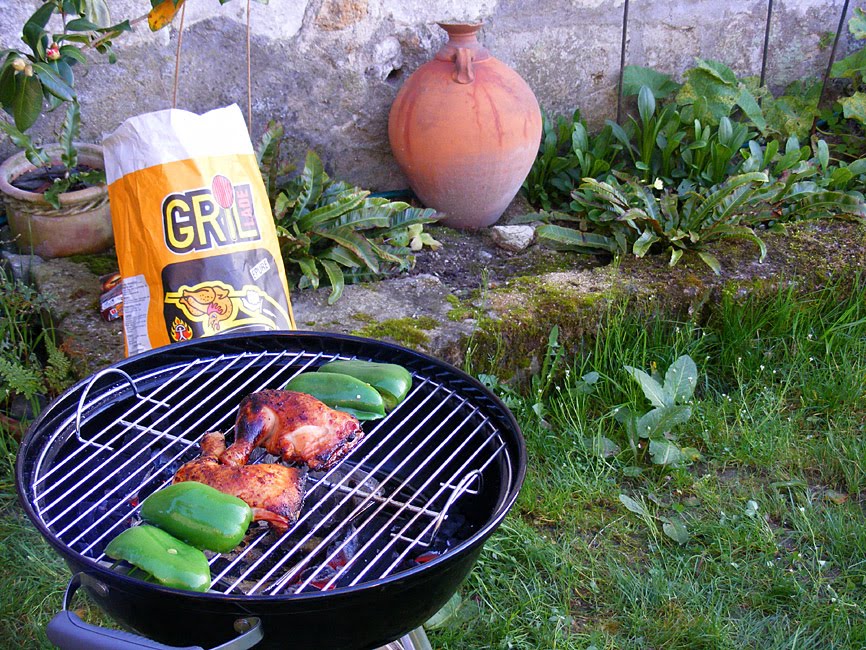
Simon put it together yesterday, and since it turned into a lovely warm day and fine balmy evening we decided to barbecue some chicken legs we had purchased the day before in ED for something like €3.50 / kg. Simon, being the bloke, was obviously in charge of the barbecue. He marinated the chicken in a mixture of soy sauce, sweet chilli sauce and a dash of balsamic vinegar. After a slow start with much worrying about how much charcoal was enough, he left the chicken under the dome to cook, along with a quartered green pepper.

The peppers went on at half time.
Being the sheila, I was in charge of salads. I had some home made Russian dressing already in the fridge, so I cooked some potatoes to make potato salad. Then I used my newly acquired vegetable spaghetti tool (purchased on Thursday from the Asia Store in Poitiers) to make strips of carrot and cucumber, dressed with a cumin spiced vinaigrette. I washed some oak-leaf lettuce and put out the slow roasted tomatoes I had made a few days earlier.

All piled on a plate. The drink is ginger syrup
(also from the Asia Store) and fizzy mineral water.
We sat outside in the coin d'apéro and watched the redstarts and bats catching their supper. The sky slowly turned from intense bright blue to pearly pink. It was magic.

Susan

Friday, 1 April 2011

Things to Look Out for Around Preuilly in April

Of all the months, April is perhaps the time when the natural world changes the most. It is clearly a month of two halves.

Cherry blossom in our orchard (with almond behind).
Early April will reliably bring out the hibernating homegrown Brimstone butterflies, followed by the African migrants: Hummingbird Hawkmoths, Painted Ladies, cuckoos, swallows and martins. A few will already have arrived, but the bulk will come in early April. Also the European Orchard Bees Osmia cornuta will be on the wing, so important for the pollination of early blossoming fruit trees. The roadside ditches and banks will be covered in Cowslips. In the ancient and undisturbed forest, Violet Oil Beetles congregate to mate in the flowering Wood Anemone patches. Bumblebee queens quest for suitable nest sites, zigzagging low over the leaf litter and investigating tree roots. Fields will be covered in yellow dandelion flowers and white Common Daisies. Morels can be found in old orchards and gardens.

Oil Beetles have been getting a lot of publicity lately in the UK, with Buglife launching their Oil Beetle Hunt. Members of the public are invited to submit their sightings of these remarkable creatures to help establish their current distribution and abundance. Please contribute data if you can, as these beetles are becoming rarer. Buglife's information on how to identify them, their life cycle and behaviour is excellent.

Mating Violet Oil Beetles in the Forêt de Preuilly.
By late April, they are joined by flitting Orange Tips and Violet Fritillaries, the Green Frogs croaking and the Swifts will have arrived. Overnight all the dandelions transmogrify from egg yolk yellow petals to ephemeral spheres of seeds. The Orchard Bee's better known cousin, the Red Mason Bee O. rufa is flying now too.

On the roadsides, the Early Purple and Lady Orchids will be flowering, along with the Common Star of Bethlehem, Cuckoo Pint and Primroses.

A friend emailed us a few days ago to remind us that we are coming up to the season for baby hedgehogs. Fewer than half of young hedgehogs make it to one year old. Many will die on the roads. Hedgehogs are by far the most common roadkill species here. Over a quarter will be poisoned (by slug pellets and other garden chemicals usually). Baby hedgehogs are unbelievably cute, so if you want an awwwwwwgh moment, check out these images. Please drive carefully at night, and leave the slug control to the hedgehogs.

Look out for La Banque Alimentaire volunteers in early April, collecting food aid at the supermarket. Please contribute something if you can.

There is a newly formed club for people who want to improve their French or English. It's called Café Franco-Anglais and is part of l'Association Nomades set up by Marie-Nicole Suzanne. I went to their last meeting, which was centred on an English afternoon tea (complete with proper clotted cream, scones, fruit cake and cucumber sandwiches). It costs around €6 per person per meeting to cover the refreshments and meetings are held at Au Paniers d'Alice in La Celle-Guenand. Marie-Nicole can be contacted by email. The next meeting is 30 April. I am planning to go, and they are a fun bunch of people, so why not join us. It doesn't matter if you can't come regularly - a number of people who attended last time don't live fulltime in France. Association Nomade also co-ordinate a system of placing English and French language books in small restaurants and libraries around the area. You can find their books at Au Panier d'Alice in La Celle Guenand, l'Image in Preuilly, le Jean Bart in le Grand Pressigny, Chez Gigi in St-Senoch and the library at Abilly. They hold regular literary (or sometimes history) themed meetings.

Susan

Thursday, 31 March 2011

Another Car Bourse

Last Saturday we met up with Tim and Pauline to go to the Chatellerault car bourse. This is held over the weekend, and includes an enormous exhibition hall and outside area full of car bits, and two halls full of cars: one subject based (this year a display of Renaults) and the other full of private cars for sale.

There were plenty of things to like, so I will let the pictures do the talking.

Célestine looks on whilst I covet another...
The car hall - with an ID21 wagon for
sale at a very reasonable price: €5000
A Matchless motorcycle
After trawling the bourse we went and picnicked in the Parc du Verger. This is a park surrounded by a wall on the road to la Roche Posay. Like a lot of places we have visited this month, we have often driven past but never stopped before. Once again, it has been a really pleasant surprise. Not an outstanding park, but nice.

Simon

Wednesday, 30 March 2011

Chateaux - dozens of 'em!

We have written before about Foulkes Nerra (The Black Falcon),Comte d'Anjou from 987 to 1040 and our local badman. (Read more about him here, here, and here)

Whilst working on ideas for future tours, I came across a list of the building he caused to happen, and a mighty impressive read it is too.
991 to 994
Tour de Montbazon
Château de Montrésor
Château de Sainte-Maure
Château de Langeais
Tour de Chérament (disparue)

After 1005
Château de Montrevault
Tour de Trève
Abbaye de Beaulieu-les-Loches
Tour de Mirebeau
Motte de Cornillé (disparue)
Château de Montrichard


1007
Château-Gonthier

1011
Motte de Montboyau (actuel Fondettes, disparue)

1013
Saint-Rémi-sur-Loire
Château de Montjean-sur-Loire
Beaupréau

1016
Saint-Nicolas d'Angers

1020
Saint-Aubin
Saint-Martin d'Angers
Prieuré de Châteauneuf

1025
Château de Chemillé
Château de Montfaucon

From 1028 or unknown dates:
Abbaye de Ronceray à Angers (14 July 1028)
Château du Lude
Château de Durtal
Château de Beaufort
Tour d'Allones
Monastère de Saint-Jean-du-Grais
Château de Seiches
Tour de Montglonne ?
Château de Baugé
Château de Segré
Château de Brissac
Château de Mouliherne
Château de Pouancé
Château de Moncontour
Château de Faye
Château de Montreuil-Bellay
Château de Passavant
Château de Maulevrier
Château de Briollay
Château de Saint-Florent-le-Vieil et église
Tour de Loudun
Château de Vihiers

renovations and enlargements
Château de Semblançay
Château d'Amboise
Château de Chinon
Abbaye de Saint-Maur-sur-Loire
Château de Loches

Most of these buildings still exist in one form or another. Many were destroyed in 700 years of warfare, some were left to rot by owners who couldn't afford to maintain them, but many of the ruined chateaux were restored in the 19th century and are now hotels or private homes. My new project (one of many) is to visit all of these places and photograph them, and I have no doubt that in the process I will find some that are not on the list.

In addition to all this construction work, he travelled to Jerusalem 3 times (remember, this is 1000 years ago), was married twice, and was constantly battling the Count of Blois, the Bretons, and the Dukes of Normandy. This, no doubt, is why he only managed to father three children (legitimate ones, anyway).

Both photos are of our nearest Foulkes fortess, the Donjon at Loches. If you have a look through previous blog posts you will find photos of some of the other chateaux as well.

Simon

Tuesday, 29 March 2011

Journées Nationales des Métiers d'Art

This coming weekend is the Journées Nationales des Métiers d'Art.

When Susan and I were at Retromobile last year we saw a stand for a car restoration place in Veigné, a place we travel through often. We were amazed, because the only place we could think of in Veigné is a tin shed on a roundabout. Admittedly we had seen the occasional Jaguar outside, but that was it. That isn't the car workshop this post relates to though - it is one we have never notice before, here.

The cars on their stand told another story:

A Delage
and an Hispano Suiza
Even more amazing, when we got home I did some research and found this amazing video. Yes, it's in French, but look at those cars.:

By my estimation, for the price of any one of those cars you could buy half the town of Veigné. So next Saturday, we are off to Veigné (maybe in Célestine) to have a look at their workshop.

This isn't the only event on, there is chocolate making, piano restorers, potters, ebonistes (furniture makers) and a whole lot more. The website is here.

Simon

(I have corrected my spelling of Veigné, thanks Ken!)

Monday, 28 March 2011

A Granola from the Touraine

Making your own granola (toasted muesli) is easy and means that you can control the ingredients, adjusting for personal taste, and for health considerations. No more horrible banana chips or sickly bits of nasty indeterminate tropical fruit. Also the potential for lower fat, sugar and salt content than the supermarket choices.

My idea with this particular mix was that it could all be sourced locally (or at a pinch, only a few hours away). It features the grains, seeds, nuts and fruits commonly grown in the Touraine, and so I can feel doubly righteous when consuming it. The cereals, nuts and seeds are suggestions only and can be used in any proportions you fancy or have to hand.

The 'raw' granola.

Ingredients:
5 cups cereal grain flakes (rolled oats, barley, wheat)
5 cups seeds and/or nuts (walnuts, hazelnuts, almonds, sunflower seeds, flax/linseed)
½ cup light brown sugar (vergeoise blonde) - optional
1 tsp sea salt - optional
1 cup unsweetened fruit purée (I used apple)
½ cup homemade candied fruit with syrup or fruit jelly (I used candied cherries)
¼ cup honey (choose a mild flavoured one like Acacia)
2 tbsp oil (walnut, hazelnut, sunflower, colza/canola/rapeseed, flax/linseed, hemp, grapeseed)

Method:
  1. Preheat the oven to 150°C.
  2. Mix together the dry ingredients.
  3. Gently warm the fruit purée, candied fruit or jelly, honey and oil (2 minutes on low power in the microwave is good).
  4. Thoroughly mix the resulting syrup into the dry ingredients.
  5. Divide the mixture onto two baking trays and spread out thinly and evenly.
  6. Bake for about 45 minutes, stirring every 10 minutes until the granola is golden brown.
  7. Remove from the oven and cool.
This makes about 1kg of granola, or enough to fill a 2l container.

All toasty and golden.
If you want to add an exotic touch you can add a teaspoon of ground cinnamon and a teaspoon of ground ginger to the dried ingredients.

Susan

Sunday, 27 March 2011

Pick up Sticks

A few weeks ago we encountered a crew picking up tree trunks from the side of a country lane. The poplar trees were stacked in a neat pile on the grass and a crew with two big trucks had arrived to load them up and take them away.

Poplar is widely grown on damp ground by water courses, planted in regimental style rows. Once harvested it is used for cheese boxes and construction. We have written about it before here.

Susan

Saturday, 26 March 2011

Right on Cue

With the vernal equinox only a few days ago, my pretty Vernal Pea has burst into flower. This unscented cousin of the sweet pea only has a brief season of flowering, but because it is so early, it is always welcome.

Vernal Pea Lathyrus vernus (la gesse de printemps)
Out now in the orchard are some little wild Grape Hyacinth Muscari neglectum (le muscari à grappes). These are native to dry calcareous grasslands like our orchard, and make a subtle alternative to a bluebell wood, especially as they succeed the Common Dog Violets Viola riviniana (la violette de Rivin). These wild grape hyacinth are very compact, and a darker blue than their garden cousins M. armeniacum. They are also apparently plum scented, although I can't say I've noticed.

Wild Grape Hyacinth.
The weather here has been magnificent the past few days, more like summer than early spring. All the spring bees and butterflies have now emerged and are busy on peach and almond blossom, dandelion and lawn daisies.

Célestine at Chenonceau
Thursday was particularly bright and warm, and as luck would have it, our first clients of the 2011 season came down from Paris to spend the day motoring around in Célestine, visiting Loches and Chenonceau. I have never seen so few people at Chenonceau either, so it was a real treat.

Susan

Friday, 25 March 2011

30,000 green bottles..

sitting in a cave

and if one green bottle should accidentally fall

There would still be enough for a weekend on the Fizz

We were at Chateau Gaudrelle yesterday evening, for a very pleasant evening tasting. While we were there we had a tour of the caves, where we were shown this rack of 30,000 bottles of last year's Vouvray sparkling.

Our job has all sorts of compensations!

Simon