Showing posts with label Richelieu. Show all posts

Wednesday, 25 February 2026

Walking Around Chaumussay in Early Spring

On Friday 20 February Simon and I did a 2 kilometre circuit at Chaumussay. We wanted to check on the river water level of the Claise and the colony of wild daffodils that grows by the voie verte (greenway). The temperature was 12°C, there was no wind to speak of, and it wasn't raining. Since France has been experiencing the longest period of continuous rain since records began (36 days and counting) having an afternoon when it wasn't raining was noteworthy. The walk took us about half an hour.


The Claise is high but not unusually so for this time of year. Some riverside gardens and fields are flooded, but there is no real threat to life or property.

Claise River at Chaumussay, February 2026, France.


Silky Wall Feather Moss Homalothecium sericeum (Fr. Homalothécie soyeuse) on a low garden wall.

Silky Wall Feather Moss Homalothecium sericeum, France.


Grey Cushioned Grimmia moss Grimmia pulvinata on a low garden wall.

Grey Cushioned Grimmia moss Grimmia pulvinata, France.


Colony of Wild Daffodil Narcissus pseudonarcissus (Fr. Narcisse jaune).

Wild Daffodil Narcissus pseudonarcissus, France.


Primrose Primula vulgaris (Fr. Primavère acaule).

Primrose Primula vulgaris, France.


Lesser Celandine Ficaria verna (Fr. Ficaire fausse-renoncule), one of the most important sources of pollen for early emerging bees.

Lesser Celandine Ficaria verna, France.


Cherry-plum Prunus cerasifera (Fr. Prunellier de Myrobolan) blossom, with a male non-biting midge from the Chironomidae family of flies. The larvae of these midges are known as blood worms (Fr. vers de vase).

Cherry-plum Prunus cerasifera with male non-biting midge Paratendipes sp, France.


European Ash Fraxinus exelsior (Fr. Frêne élevé) flowers.

Common Ash Fraxinus exelsior, France.


Crocuses in a public garden.

Crocuses in a public garden, France.

Saturday, 31 May 2025

Beetle Mania

The other day I was waiting for clients at la Maison des abeilles/Happyculteurs on the outskirts of Champigny sur Veude. Next to the picnic table where I was sitting is a mature Horse Chestnut, no doubt planted to provide shade back in the days when this site was the railway station. 

I spotted a beetle at the base of the trunk, a very striking red and metallic blue creature, and quite a size (more than 20 mm). I could see at a glance that it was a longhorn (Fr. capricorn) beetle of some sort, but a species I had never seen before. It was struggling to climb up the tree as it had lost its foot and tibia on one back leg. I was able to take lots of photos with my phone (but I didn't have my camera with me).

Rhamnusium bicolor, France.

Once home I identified it as Rhamnusium bicolor. It doesn't have an English name, but its French name is le Rhagie ermite. There was a flurry of excitement amongst my coleopterist friends, who were not at all jealous...ahem...

The French National Natural History Museum page for the species tells me that this is a widespread but uncommon species, favouring old deciduous trees such as Horse Chestnut, Poplar and Beech in damp environments, often in towns. So where I found it was exactly its preferred habitat. Most observations are in May or June.

Rhamnusium bicolor, France.

The head, thorax (pronotum), legs and base of the antennae are brick red. The elytrae (wing cases) are blue, but in some individuals, can also be brick red. There are no lookalike species, so it is easy to identify. 

The larvae develop in cavities in old deciduous trees. They eat the damp decaying wood that lines the cavities or damaged parts of the tree. They slice the wood in very characteristic long thick strips of fibre. The adult beetle is rarely observed, except occasionally at the opening of a sunlight cavity. Their life cycle, from larva to adult takes one to three years.

The species is present throughout Europe, to the Urals. In France it is widely distributed but rarely seen, because it tends to be active at dusk or at night. It is found more frequently in parks, tree-lined allées and gardens than in the forests. It is assumed to be dwindling in population, linked to the increasing rarity of trees with cavities.

Thursday, 23 January 2025

Visiting the Happyculteurs Site

 Alain Pageard has established a fantastic beekeeping interpretion and education centre in the old railway station at Champigny sur Veude. Recently I went there with some colleagues to scope out the site with a view to organising a multidisciplinary outing in May. The site is partially a wetland because half of it is a flood meadow sitting between the Mable and the Veude Rivers.


A painting that Alain acquired from the Pussifolies (an art festival during which the streets of Pussigny are decorated by artists. They have 8 hours to produce a giant canvas each).

Bee painting, France.


Christian attempts to photograph a territorial male Mute Swan. The swan is fed by a local resident, but is not tame.

Photographing a swan, France.


A flooded poplar plantation next to the Veude River.

Flooded poplar plantation on the Veude River, France.


Many poplar trees have uprooted, snapped or fallen, the result no doubt of successive drought then flood. They are shallow rooted and often planted in regimented rows, so more vulnerable than other trees.

Fallen poplars in a plantation, France.


Flooded poplar plantation along the Veude River.

Flooded poplar plantation on the Veude River, France.


The flood meadow between the two rivers doing its job. The Veude is two metres higher than the Mable so at its peak the flood waters flowed from where I was standing to take the photo, towards the middle of the picture.

Happyculteur beekeeping interpretation centre, France.


Flooded poplar plantation, with a willow and the Veude River in the foreground.

Veude River in flood, France.


We head out across the flood meadow. The info board asks 'Wetlands, what are they for?'

Flood meadow, France.


Ice on the surface of the village pond (Fr. plan d'eau). The temperature never got above 1°C the whole day.

Ice on village pond, France.


The beautiful Chapelle de Saint Louis, a 16th century replica of la Sainte Chapelle in Paris, reflected in the pond. Alain tells me the pond is always still, always the same level. The Chapelle is part of the Chateau complex, and the Mable joins the Veude in the grounds. Unfortunately the American owners of the Chateau have seemingly abandoned it. The Chapelle and boundary walls are in an increasingly derelict condition and the French State has begun proceedings to wrest ownership from the Washington based couple.

Chapelle de Saint louis, Champigny sur Veude, France.


The Mable River.

Mable River, Champigny sur Veude, France.

Monday, 15 April 2024

Touraine Asparagus

Green asparagus, Touraine, France. Photo by Loire Valley Time Travel.
Steamed green asparagus.

At the end of April and the beginning of May, asparagus is the flagship product on people's plates at home and in restaurants. This year, because of the weather, producers are expecting a bumper crop.

White asparagus, France. Photo by Loire Valley Time Travel.
Locally produced white asparagus at the market.

The epitome of seasonal produce, asparagus features on the shelves between April and June. In Indre et Loire one finds Touraine asparagus, especially grown around Bourgueil and Richelieu. The label 'Coeur de Touraine' is the most prized, only held by 17 producers around Richelieu, who produce between 200 and 250 tonnes per annum, depending on the year, with 90% white asparagus and the rest green.

Green asparagus, France. Photo by Loire Valley Time Travel.
Locally produced green asparagus at the market.

Did you know that whether white, green or purple it is all the same plant? The colour depends on the method of cultivation. White asparagus grows underground, with out seeing the sun's rays. Purple asparagus is the same variety as the white, but the tip emerges from the soil to see the sun, which gives it the purple colour. Finally, the green grows entirely in the fresh air. 

White asparagus, Touraine, France. Photo by Loire Valley Time Travel.
White asparagus from Braslou, near Richelieu.

Personally I never buy asparagus from the supermarket, always from a local producer who I can trust to have cut the stems no more than 24 hours before bringing his asparagus to market. According to my asparagus producer of preference, asparagus in the supermarket has been cut about three weeks before it hits the shelves, due to how the supermarket supply chains work. This means it has lost moisture and its sugars have converted to starches, meaning it is a less tasty, tougher vegetable.

Wednesday, 31 January 2024

The House of Bees

Recently I was invited to a private group visit of the Maison des Abeilles at Champigny sur Veude. It is a community project led by beekeeper Alain Pageard. 

View of the greenway, with crossing keeper cottage on left, the Sainte Chapelle centre and the plan d'eau beyond the vegetable garden on the right.

View of the greenway and Maison des Abeilles site, Champigny sur Veude, Indre et loire, France. Photo by loire valley Time Travel.

The former railway line between Richelieu and Chinon has been turned into a greenway (Fr. voie verte). At Champigny the old station building has been renovated and is now a small exhibition space to inform the public about the local area. The agriculture of the Pays Richelois was featured -- melons, asparagus, saffron, truffles and goat cheese. 


Eric (naturalist), Christian (president Botamyco37), Jean-Paul (maker and nature lover), Eric (nature lover), Jacqueline (artist), Alain (beekeeper), Francoise (beekeeper) and Cyril (naturalist).

Meeting of naturalists, Indre et loire, France. Photo by loire Valley Time Travel.

The goods shed has been taken over by the Maison des Abeilles, and Alain explained how the intention is to have a site which is integrated with the adjoining public spaces or attractions such as the plan d'eau (village pond) and La Sainte Chapelle de Champigny sur Veude. The land around the station is slowly being turned into a pollinator garden, with picnic area. Further down the track is the old crossing keeper's cottage, which may get turned into holiday accommodation. There are plans for a footbridge over the Veude to give better access to the plan d'eau from the Maison des Abeilles. And I was there to provide advice about an insect hotel.


 A bed sown with crops that are nectar rich, including flax (Fr. lin), phacelia, canola (Fr. colza), and field beans (Fr. fèves). Alain commented on how slug munched the canola was and how it showed why farmers treat canola with so many pesticides, which is problematic for beekeepers. Personally, I never buy canola honey.

Nectar plant seedlings, Indre et loire, France. Photo by loire Valley Time Travel.


Inside the Maison des abeilles (House of Bees). The idea is that it represents the inside of a hive. The wax comb is made of paving reinforcing grids for gravel paths. Genius I thought, and Alain was quite pleased with himself for having discovered it in yellow at the hardware store.

Inside the Maison des abeilles, Indre et loire, France. Photo by loire Valley Time Travel.


Old style bee hives. From left, made from cattle manure; wicker; chestnut staves with wicker and mud daub fill; woven rush (I think, but it might be hemp).

Old style bee hives, Indre et loire, France. Photo by loire Valley Time Travel.


Feral bee hives. On the left, in a tree trunk. The forester who cut this tree was very surprised to discover an active bee hive. On the right, two-thirds of a hive that had been living in a chimney for a decade. The wax at the top is black, old and no longer in use. The bees abandon sections of the hive successively as it gets dirty and unhygenic.

Feral bee hives, Indre et loire, France. Photo by loire Valley Time Travel.


Visible bee hive. This glass cabinet is connected to a regular hive outside by a tube and the bees will enter the cabinet and treat it like part of the hive. They'll fill it with wax comb and start storing honey and raising a brood there. Visitors can see the activity, and are invited to put their ear to the special holes to hear the activity.

Visible bee hive, Indre et loire, France. Photo by loire Valley Time Travel.


Beekeepers suits. Alain runs beekeeping workshops here which I'm told are excellent.

Beekeeping suits, Indre et loire, France. Photo by loire Valley Time Travel.


Wednesday, 30 June 2021

Clafoutis

Apricot clafoutis. Photo by Loire Valley Time Travel.
Apricot clafoutis.

Clafoutis is a dessert for the all too brief cherry season. I make it about once a week when we have cherries, and all the traditional workers restaurants serve it. It’s a home baking classic here, not something that you buy at the patisserie. 
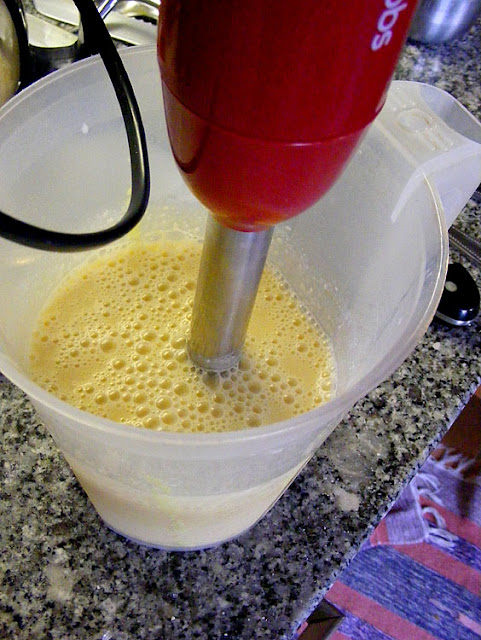
Mixing the batter for clafoutis. Photo by Loire Valley Time Travel.
Mixing the batter.

It is a sort of riff on the Dutch Baby style of thick puffy pancake. It's really a pancake batter with fruit in it and baked in the oven. I habitually spiff it up a bit by replacing some of the flour with almond meal.

Individual clafoutis ready for the oven. Photo by Loire Valley Time Travel.
Individual clafoutis ready for the oven, in old paté dishes.

Clafoutis is a dialect word from central France, dating to the middle of the 9th century. It's a contraction of the old French claufir(from the Latin clavo figere, which translates as 'to fix with nails' (because the batter is studded with cherries, like a hobnailed boot). It's also derived from the word foutre, in the sense of 'to stuff full'.
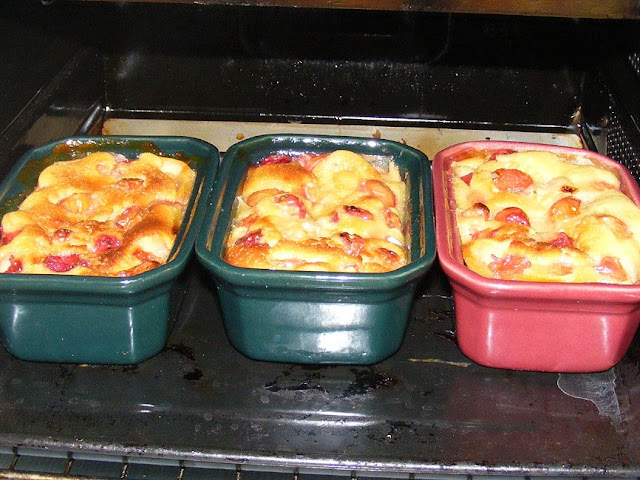
Individual clafoutis. Photo by Loire Valley Time Travel.
Individual clafoutis in old ceramic pâté dishes.

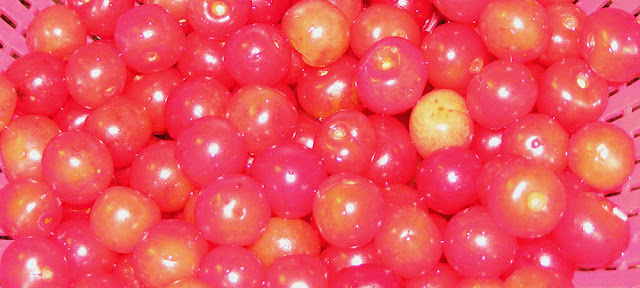
The original recipe for this cake (in the Limousin, where it comes from, it is referred to as a gâteau) is a type of thick batter poured on the black sour cherries known as griottes noires du Limousin (ie a type of Morello cherry). Here in the Loire Valley, we have adopted the clafoutis as our own, but we use a different sort of sour cherry, one which is ruby skinned and yellow fleshed, known as a uigne. I have four guigniers (sour cherry trees) in my orchard, which is one reason why I make a lot of clafoutis. 

Classic clafoutis. Photo by Loire Valley Time Travel.
Made in a quiche dish, with sour cherries from my orchard and fresh out of the oven.

Once upon a time it was cooked in the bread oven, after the bread was baked [see my post on bread ovens for the history of this practice]. The cherries are traditionally not stoned because to do so would result in the loss of a great deal of juice during cooking. The stones also enhance the flavour, by boosting the cherry flavour and adding a woody note. A good clafoutisrises during cooking, but inevitably drops once cool.

Clafoutis, ready for the oven. Photo by Loire Valley Time Travel.
The quantity in the recipe fits perfectly in a standard 24 cm ceramic quiche dish.

The aim is to contrast the creamy batter and the juicy cherries. These days you can get all creative and make savoury clafoutis, with tomatoes, peas, carrots or fennel. Nevertheless, a cherry flavoured clafoutis remains a must during the French summertime. 

Stoneground flour. Photo by Loire Valley Time Travel.
Flour made from locally grown wheat. Christophe Chaussé is a craft miller operating the last traditional family run windmill in Indre (Berry).

 The basic ingredients are flour, eggs, sugar, milk, fruit and if you like, a dash of eau-de-vie de cerises. It's quick and easy to prepare, often traditionally using the windfall cherries, and is best eaten warm.

Sour cherries (left) and sweet cherries (right). Photo by Loire Valley Time Travel.
Sour cherries (left) and sweet cherries (right) picked in my orchard.

 Another speciality of the Limousin, the flognarde, is a winter version, with the batter poured over apples, pears, dried fruit or nuts. One of Brittany’s classic desserts is Far Breton, basically clafoutis with prunes. The tartouillat from Burgundy and the millard from the Auvergne are both dishes made from flour, eggs, sugar, milk and cherries, bearing a remarkable resemblance to clafoutis. In the Loire Valley, and other parts of France it is very common to make a variant with the small yellow plums called mirabelles, which are only slightly larger than cherries. Lots of people (including me) also make it with sweet cherries, but Grandma probably tuts at this sort of behaviour.

Lait ribot (buttermilk). Photo by Loire Valley Time Travel.
Lait ribot (buttermilk).


Recipe for Clafoutis 

Ingredients:
Butter, to grease the dish/es
50 g plain flour
50 g almond meal
2 eggs
100 g castor sugar
250 ml milk or buttermilk (Fr. lait ribot)
300g cherries, washed, stems removed

Method
1. Turn the oven to 180°C and set your baking dish or dishes on a baking tray. You can make one large clafoutis, round (eg in a quiche dish) or retangular (eg in a gratin dish), or 3 - 4 individual clafoutis (eg in souffle dishes).
2. Butter the dish/es.
3. Put flour, almond meal, eggs, sugar and milk into a tall jug and mix to a batter with a stick blender.
4. Pour the batter into your prepared dish/es.
5. Drop the cherries on top.
6. Cook for 30-40 minutes.
Can be frozen and gently reheated in a very low oven .

Clafoutis aux mirabelles. Photo by Loire Valley Time Travel.
Mirabelle clafoutis (mirabelles are small plums).

Sour cherries prepared for clafoutis. Photo by Loire Valley Time Travel.
Sour cherries from my orchard, destemmed and washed, ready for clafoutis.

Sour cherries. Photo by Loire Valley Time Travel.
Unlike the Limousin griottes, Tourangelle sour cherries are pale fleshed and red skinned, and known locally as guignes.


Yum

************************************************

For details of our private guided tours of chateaux, gardens, wineries, markets and more please visit the Loire Valley Time Travel website. We would be delighted to design a tour for you.

We are also on Instagram, so check us out to see a regularly updated selection of our very best photos.