- The Common Garden Snail is called l'Escargot Petit-gris in French. Its scientific name is Helix conspersa.
- Snails absorb water through their skin, like a sponge.
- They don't have a nose. They breath through a hole under their shell.
- Snails can do 9 metres an hour. Their mucus forms a soft carpet on which they can slide without injuring themselves.
- Their rasping tongue is covered with thousands of tiny teeth to shred their food into small pieces.
- Snails sleep all winter in their shells, sealed by a cover of hardened spit.
Wednesday, 11 March 2026
Six Snail Secrets
Friday, 20 February 2026
Cherry Galls
Cherry Galls (Fr. Galles-cerise du chêne) are caused on Oak trees by the tiny gall wasp Cynips quercusfolii. I've never seen the wasp, which is only 3 mm long, but I regularly encounter the galls on oak leaves in the forest.
The wasps develop on the oak trees, where they are responsable for the formation of spherical galls on the underside of leaves.
This abundant gall was appears each year in two forms, one which reproduces sexually and one which reproduces asexually ie by parthenogenesis. In the summer, after mating, the female wasps lay their eggs on the oak leaves. Then their larvae develop in the galls on the underside of the leaves, a single 2 mm larva in each gall. The galls start off as yellow-green and transform into red-brown.
Spangle and Cherry galls on oak leaves.
The adult parthenogenic female wasps emerge from the galls in winter, and in the spring they lay eggs on the new leaf buds on oak trees. A gall forms, but it is very different, being only a few millimetres across and covered in red filaments. The sexual wasps emerge from these galls in May and June. In the past it was believed that the parthenogenic and sexual wasps represented two different species.
Thursday, 19 February 2026
Water (Snap!)
Tuesday, 17 February 2026
Another Snow Episode!
View Sunday morning from our spare bedroom, looking west.
I got up on Sunday morning and was truly astonished to look out the window and see that it had snowed over night. By the time I saw it the drizzling rain had set in for the day, but the snow lasted in patches until lunchtime. So this is the third (or maybe fourth) snow episode of this winter. We've also had 100 ml of rain in the past fortnight and all the rivers are full. The flood meadows along the Indrois, Indre and Creuse all look like lakes. Some roads have been cut and we have a yellow flood warning.
View from our attic window, looking north.
Tuesday, 3 February 2026
Look Out for Snowdrops in the Touraine Loire Valley
Galanthus nivalis, commonly known as the Snowdrop (Fr. perce-neige, which translates as 'snow piercer') is one of those plants that people look forward to seeing, and it has many folkloric associations. The scientific name translates as 'milk flower of the snow'. The English name probably comes from a German word 'schneetropfen', which is the name of the teardrop shaped pearl earrings popular at the time snowdrops were introduced to Britain, in the 16th century.
It is native to central and southern Europe, from the Black Sea to western France. The natural northern distribution limit is debatable, because there has been so much cultivation and naturalisation, but it's probably southern Belgium.
In France it is classed as rather rare in the West, Centre (Loire Valley) and Pyrénées. Elsewhere it is rare, or naturalised, especially in the East. The flowers appear in early spring, no matter what the temperature. Thanks to the natural 'anti-freeze' in the plants they can withstand frost and snow, and push through regardless. Snowdrops can flower as early as December and as late as May, but generally flowering will be around Candlemas (Fr. Chandeleur) in early February up until the vernal equinox in March. Snowdrops are threatened in their natural habitats due to habitat destruction, illegal collecting and climate change.
When it's sunny the flowers open and the interior reflects ultraviolet light, alerting the few early emerging pollinators. Along with hazel and willow catkins, they are the most important source of pollen (food) for early flying solitary bees. You can find them on the edges of cool damp woods or sometimes open grasslands with nitrogen rich soil. I often find them in ditches.
The species is widely cultivated, and there are many varieties as well as other species. The bulbs have been known since antiquity as both toxins and antidotes.
Symbolically the plant is associated with heralding spring and hope, as well as purification and the Christian festival of Candlemas. Conversely it is also associated with sorrow, and considered a harbinger of death, possibly because it was widely planted in cemeteries. Some people are superstitious about bringing the flowers inside for this reason.
Snowdropping, by the way, is Australian slang for stealing women's underwear off clotheslines.
Tuesday, 27 January 2026
A Walk in the Forest
On 14 January I went for a walk in the Forest of Preuilly with Ingrid and Huub. It was 3.5 km, 14°C and took an hour and a half. Huub was vastly amused to be accompanying two women who spent half their time with their arses in the air, photographing small fungi at ground level. Here is a small selection of what we saw. There were a lot of bracket fungi.
A waymarker (Fr. borne) for the Chemin de Saint Martin (the Way of Saint Martin, an important pilgrim route).
Ochre Bracket Trametes ochracea (Fr. Tramète zoné) is not uncommon, but not abundant either. It is usually found on Aspen.
Sporodophoron cretaceum, a lichen that grows on the bark of mature oak trees.
Common Green Shield lichen Flavoparmelia caperata (Fr. Parmélie froncée) is widespread and abundant. The leaf like lobes don't adhere to the substrate they are growing on, and can be lifted up like flaps. The underside is black.
Cherry Gall (Fr. Galle-cerise) made by the wasp Cynips quercusfolii on the underside of an oak leaf.
Golden Ear fungus Naematelia aurantia (Fr. Trémelle orangée) is an irregular jelly like blob of yellow that parasitises Hairy Curtain Crust fungus.
Possibly Fence-rail Cladonia lichen Cladonia parasitica, which seems to be rather rare overall in Indre et Loire and virtually impossible to tell from C. caespiticia without doing a chemical reaction test.
Luminescent Panellus Panellus stipticus (Fr. Panelle astringente), an abundant beige mushroom growing in layered groups on dead wood of deciduous trees.
Gilled Polypore Trametes betulina (Fr. Lenzite du bouleau) is a slightly downy dirty white bracket fungus. They can appear more coloured, but that is algae growing on the surface. They are mostly found on birch, oak, beech, alder and hazel.
Rusty Swan-neck moss Campylopus flexuosus (Fr. ) is an attractive moss that is relatively common all over France and observable all year round. Underneath the bright green cushion is usually rusty red, and the leaves have a very distinctive wide central vein.
Stinking Hellebore Helleborus foetidus (Fr. Pied-de-griffon), a toxic wild flower of oak woodland understorey. Touching it releases an unpleasant smell. The flowers produce a lot of nectar, no doubt very welcome for early emerging bumble bees, who love hellebores.
Monday, 19 January 2026
Truffles in the Touraine
Black Truffle Tuber melanosporum (Fr. Truffe noire) is native to the Touraine Loire Valley, but has long since disappeared from the wild. According to the experts and old timers the best place to find truffles was under isolated oak trees in the middle of wheat fields, but seventy years of modern farming practices and fungicides sprayed on wheat crops have destroyed the habitat for truffles. The truffles benefitted from the disturbance of the soil with the plough and the minor damage done to the tree roots, allowing the truffle mycelium to latch on, providing the conduit for a symbiotic exchange of nutrients. It may explain why isolated mature oak trees in the middle of fields continue to be a not uncommon sight in the Touraine.
![]() |
| Oak trees dotted about the fields. |
Nowadays, because of their extirpation in the wild, truffles are cultivated, in orchards planted with inoculated oak trees. Black Truffles fruit in the winter, and over winter there is a series of specialist markets, traditionally in the otherwise undistinguished village of Marigny-Marmande, and nowadays in several others.
![]() |
| Truffle orchard. |
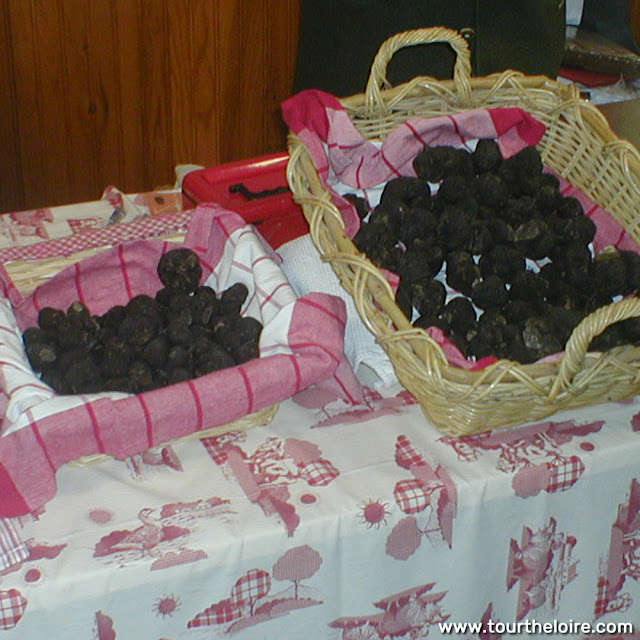
Local growers tell me that alternating wet and warm weather from May to July is crucial to ensuring a good truffle harvest over the winter, from November to February, so I assume the harvest this winter is expected to be poor because of the hot dry conditions last summer. The markets before Christmas double as general seasonal gourmet markets, with other producers there to sell their venison, snails, nuts and dried fruits, preserves, winter pork and poultry products and cheeses, speciality breads, honey and wines. The markets after Christmas are all about the truffles, with far fewer stalls, and tree whips inoculated with truffle spores available for those who want to try a few in their garden for fun. Serious truffle buyers come in January, when the quality of the truffles is at its best. About six tonnes of truffles, 10% of national production, are harvested these days in the Loire Valley, from 400 ha of truffle orchards, making the area a major player nowadays. Back in 1900 the harvest of wild truffles here was a thousand tonnes.
![]() |
| Black truffles at the specialist market in Marigny-Marmande. |
Anyone with a truffle orchard is playing a long game. The trees will take at least ten years to produce a truffle, and some may never do so. Others will go on to produce truffles for thirty years or more. My friendly local truffle guru, now deceased, told me that a good truffle orchard has a mixture of the local species of oak, and the evergreen species that is native to the south of France. The local oak is small, deciduous and adapted to the local poor dry chalky soils and will produce truffles earlier than the evergreen species, but is weakened by the truffles and has a shorter lifespan than the evergreens. He owned two lively truffle hounds, a Jack Russell called Pierre, and a wire haired dachshund called Odile. Truffle hounds can be any breed of dog, and are trained by getting them to play fetch with a truffle oil impregnated sparkling wine cork.
Me buying a truffle some years ago in Marigny-Marmande.
The cultivation and commercialisation of truffles came about in the late 19th century because so many vines were grubbed up due to phylloxera. Instead of vines, farmers planted oaks. They understood that the trees would quite likely have truffles attach themselves to the roots. But by the end of World War One there was no labour to work on the land, then the Depression and another World War, and the trees had reached the end of their productive life. So truffles became once again scarce and expensive.
Truffle orchard near the Chateau de Marigny-Marmande.
Truffle orchards began being planted again in the 1970s, often by bourgeois enthusiasts at their country homes, keen to revive a tradition. INRA, the French national agronomy research institute, developed a technique of inoculation of oak and hazel saplings that resulted in a quarter of the trees producing truffles within a decade. Today 90% of French truffles are cultivated and there are about 20 000 truffle farmers in France. Drought and wild boars are the biggest problems that they face. The reason pigs are such good truffle hunters is that the aroma of truffle is the same as boar pheromones, so the sows go crazy for them. In the wild it means the truffles can spread due to the boars ploughing.
Further reading: Touraine Truffle Association (in French, with a list of markets where you can buy truffles) https://www.latruffedetouraine.fr/ .
Monday, 5 January 2026
Couronne des rois
The tradition of 'Kings Cakes' at Epiphany is strong in France. In the north we have Galette des rois, made with puff pastry and almond cream (a half and half mixture of frangipane and creme patissiere). Usually I make a galette, but last year I decided to make the cake that is favoured in the south, which is brioche based. I used this recipe from Pardon Your French, and I thought it turned out rather well.
Ready to eat.
Glazed and decorated.
Just out of the oven.
Ready for the oven.
Monday, 29 December 2025
Turkey at Christmas in France
Stuffed roast turkey is a dish that might be prepared for Christmas Eve in France. It's not something that everyone will choose but Christmas is the only time in France that you can find whole turkeys for roasting.
A turkey in my local butchery. Just a few kilos in weight, and certified Label Rouge, which is the most trusted independent poultry quality certification in France, ensuring good welfare standards and the best husbandry practices.
Traditionally the main Christmas meal would have been poultry of some sort, usually goose. This is a hangover from pagan winter solstice festivities, where the goose represented the Sun dying in winter before rising again, Phoenix-like, guaranteeing protection to those who eat it.
The Spanish brought turkeys to Europe, and by 1570 their reputation as a delicious treat was established. These first turkeys were called 'poule d'Inde' (Indian hen) in France as they were believed to have come from India.
Turkeys in one of the local supermarkets the week before Christmas. Under 4 kilos, 6 euros a kilo, from a well known large scale producer.
The turkey surplanted the goose at Christmas because it represented an exotic fowl that because of its rarity was only eaten at the most important feasts.
The first turkey served in France at a banquet was at the wedding feast of Charles IX and Eleanor of Austria in 1570.
Chestnut stuffing for turkey is traditional in France.
Friday, 26 December 2025
A White Christmas
France Météo and social media had been predicting snow for lowland central France for a couple of days. I'd passed the départemental (county) snowplough heading in the opposite direction to me on Tuesday. The weather got very cold and windy on Christmas Eve.
View from our attic at 9 am.
Simon came to bed at a quarter past midnight on Christmas Eve and said there had been a light dusting. I got up at 8 am on Christmas Day and looked out our bedroom window. It wasn't properly light yet, but I could see enough to be disappointed. The street gutters were lined with snow, but the road surface was bare.
Our front courtyard, as photographed by me in my pyjamas at 8 am.
Nevertheless, I checked out the spare bedroom window just in case. This faces west, over our neighbours yard and across a small valley with village houses. Much better! All the roofs were covered in snow, as were our neighbour's cars and lawn. I took several photos then went upstairs to try my luck from the attic.
Our backyard at 8 am, with half our recent firewood delivery under a snow covered tarp, waiting for me to stack it in the garage out of the weather.
The local news media are saying that it has been 14 years since we had a white Christmas in the Touraine. That would make it 2011, but looking back on the blog, we made no mention of snow, so I suspect it did not snow in Preuilly on Christmas Day itself. It certainly did snow that year on other dates and close to Christmas. So this year has been my first white Christmas.
By mid-afternoon all the snow had gone.
Thursday, 25 December 2025
Happy Christmas
Happy Christmas to all our readers.
Thank you for loyally following us for all these years.
Wednesday, 24 December 2025
The Chateaux Need Christmas
The chateaux of the Loire Valley are finding it is hard to make enough money to stay on top maintaining the buildings and remain relevant. Increasingly they are relying on Christmas visitor numbers and activities to get them through the year financially. And they have to spend increasingly to create the sort of spectacular displays that the public are drawn to. Chambord has spent 200 000 euros this year and hopes to bring in a million euros, which will go towards saving the Francois I wing from collapse. It is currently closed to the public for safety reasons.
Chateaux like Chambord and Chenonceau are constructed on wooden piles driven into a swamp and a riverbed respectively. Climate change is contributing to structural problems caused by subsidence and cracking which will require a serious injection of funds.
This problem and how you manage it is part of what I talk about to clients. Opening to the public is a double edged sword. On the one hand you make some revenue from the sale of entry tickets, but not enough to cover the increased costs of having thousands of visitors tromp through a fragile centuries old building which was not designed to take that many people every day.
What you are actually doing by opening to the public is creating a brand, and you hope to break even by engaging in a variety of auxiliary revenue streams - gift shop, restaurant, pay parking, entertainment shows, concerts and events, filming, guided tours including behind the scenes, workshops to pass on traditional skills, boat or carriage rides or hire, and so on.
The public have a right to visit these places. It is their heritage too, so you cannot put it out of their price range. You also cannot flog the very heritage fabric you are sharing into oblivion or even shabby disrepair. It is a very challenging tightrope to have to teeter across.
In a multicultural and or class tiered society another emerging problem is that this is not everyone's heritage, and so large parts of the population don't care about these places, or are positively antagonistic.
Photos show the Christmas decorations at the Chateau of Chenonceau this year.
Monday, 22 December 2025
Civet de sanglier
Ingredients:
1kg wild boar meat, cut into 2cm cubes
100 g blood sausage, removed from the skin and crumbled
Olive oil
200g salt and smoke cured pork belly, cut into 2cm cubes
A large onion, chopped
4 cloves of garlic, crushed
2 carrots, cut into chunks
A bouquet garni made of parsley, celery leaves, bay leaves, sprigs of thyme and a strip of orange peel
10 juniper berries, roughly crushed
A bottle of red wine
2 tbsp tomato paste
1 tsp Lapsang souchong tea, ground to a fine powder
200g mushrooms (ideally wild forest mushrooms such as porcini or black trumpets)
Method:
- If your wild boar is genuinely wild and not farmed, put it in the freezer for 3 weeks to kill any parasites.
- Defrost overnight in the fridge, ideally in a marinade made of the wine, some oil, the bouquet garni and juniper.
- Drain the meat and brown in some oil. Transfer to a casserole dish.
- Brown the vegetables and cured pork belly and add to the casserole.
- Deglaze the pan with the marinade and tip the hot liquid into the casserole, along with the bouquet garni, the juniper berries and blood sausage.
- Add the tomato paste and the smoky tea powder and stir to mix all the ingredients.
- Cook at a slow simmer for 2 hours, either on top of the stove or in the oven at 150°C.
- Sauté the mushrooms and either add to the casserole for the last half hour of cooking, or serve them as an accompaniment.
- Adjust the seasoning to taste by adding salt and pepper.
- Serve the civet with mixed root vegetable mash (celeriac and swede is particularly good).
PS. This recipe will work with venison (biche or chevreuil in French) and I reckon you could do roo meat like this and it would be very good indeed.


.jpg)


