Showing posts with label French Language. Show all posts

Monday, 17 November 2025

Finessing Your French

Most people, when they arrive in France, have enough French to negotiate shopping adequately enough. Je voudrais ('I would like') followed by reading the name of the item off the label and pointing will get you what you want most of the time. The trickiest bits of the transaction when you are a newbie are remembering to say bonjour before making your request and working out how much it is if you have bought multiple items and there isn't a cash register readout to take a sneaky peak at.

Fairly soon, especially if you live here, you realise that shopkeepers and market stallholders are asking you questions too. Usually these questions are easy to get the gist of because of the context, but what are they actually saying?

  • avec ceci? -- literally 'with that?', meaning 'anything else?' The problem is it sounds like avec soucis?, which would mean 'with worries?' and doesn't make any sense at all. This one had me so bemused in the early days that I eventually asked a bilingual friend to explain.
  • ce sera tout? -- literally 'that will be all?', meaning 'will that be all?' This one sounds like ça ce ratou, but 'ratou' isn't actually a French word, so it doesn't mean anything. It took me ages, but I did eventually figure this one out myself. It can also be used as your response when asked 'avec ceci?' -- 'non, ce sera tout, merci'.
  • ça va aller? -- literally 'that's going to go?', meaning 'is that alright?' You hear it a lot, not just at the market, and it too can be either a question or a response depending on intonation. It usually sounds like ça va les, which I couldn't make mean anything particularly sensible, although I got very quickly that the phrase meant something similar to ça marche ('that works') when used as a statement. This one took me the longest to figure out, but it finally dawned on me, without having to ask anyone.
 And then there is the question of how to pronounce the names of the supermarkets. Here is my take on it:
  • Auchan -- pronounced Oh-shuh, with the stress slightly on the second syllable. As an Anglophone you will really struggle not to give it a nasalised 'n' on the end, but try your best. It is not pronounced 'ocean', and doing so (not by me, thank goodness) has been known to make French people laugh.
  • Carrefour -- pronounced Carr-foor, with a slight stress on the last syllable and a proper gargling French 'r' in the middle, but not too much 'r-ing' at the end. It is not pronounced 'carry four' or 'care for'.
  • SuperU -- pronounced Su-pair-u, with fairly even stress on each syllable and the final 'u' pronounced so you are almost whistling. It is not pronounced 'super you'. The 'u' is a sound that doesn't exist in English and you will just have to listen to native speakers and practice it.
  • Intermarché -- pronounced uhn-tair-mar-shay, with a slight stress on the last syllable. It is not pronounced 'intermarsh' or 'intermarshay'.
  • LeClerc -- pronounced luh-klair, with the stress on the second syllable. It is not pronounced 'lee-clerk'.
Note: This is a reworking of a post I wrote more than a decade ago. The main changes I've made are to incorporate some points made on the original post by linguist Ken Broadhurst regarding how one could express in non-technical writing the pronunciation of the supermarket names.

Friday, 24 January 2025

Walking Around la Roche Posay

On Monday 20 January Simon and I joined Fabrice, Monique, Danielle, Aline, Beryl, Annie, Jane and David on a 5 kilometre walk in 4°C sunshine. The route took us in a circuit from the carpark in la Roche Posay, through the golf course, past l'Oréal's spa, laboratory and magic water collection plant, down to the greenway (Fr. voie verte), across the viaduct and around over the road bridge back into the old centre of la Roche Posay.


The former Hostellerie du Prieuré, a wobbly old house at the entrance to town as you come over the bridge. Sadly such a patchwork of materials today that it is rather ugly.

House in la Roche Posay, France.


Looking upstream along the Creuse river, from the bridge towards the viaduct.

River Creuse, France.


The Castel, a grand 19th century house built on medieval ramparts overlooking the River Creuse.

la Roche Posay, France.


Looking towards the church from the bridge.

la Roche Posay, France.


This sign says you may fish for Black Bass from the bridge and along this stretch of the Creuse River, but strictly on a catch and release system. There is clearly no French expression for this, and they use the English 'catch and release' or 'no kill'.

Fishing sign, France.


The bridge and the Castel seen from across a flood meadow.

la Roche Posay, France.


The viaduct across the Creuse River, once a railway bridge, now part of a greenway.

Former railway viaduct, France.


Looking from the viaduct along the Creuse River towards la Roche Posay.

Creuse River at la Roche Posay, France.


The Creuse River, with quite high water.

River Creuse, France.


Awwww....an abandoned child's Croc...along the greenway.

Abandoned child's croc, France.


L'Oréal's facility, with magic water storage tanks in the foreground, the spa behind. The original spa is the pink building in the distance.

l'Oréal facilities, la Roche Posay, France.

Monday, 22 May 2023

French Bars, Cafes and Bistrots

The numbers of cafés in France have tumbled, according to a recent study. In 20 years over a quarter of Parisian cafés have disappeared. A symbol of the French 'art of living', they have gone from 1907 in 2002, to 1410 in 2022. France wide, there were 600 000 bistrots in 1960, and 35 000 in 2016. Similar has happened to the roadside restaurants known as routiers. In 1980 there were 4500, today only 700. These types of cafés which operate as bars and bistrots are one of the most iconic aspects of French life, and if they are on the way out, then so is the morning coffee taken at the comptoir, the demi of draught beer in the late afternoon after work and the aperitif in early evening. In the old days this is where you picked up a 'casse-croute' (snack) such as a jambon beurre (ham in a buttered baguette) if you were pushed for time and needed to eat. Another popular snack was a hard boiled egg, which you took from a rack on the bar and banged against the 'zinc' to shell, until it was deemed unhygienic and the practice ceased. Children might have a boiled egg and a glass of milk with grenadine syrup, or a diabolo menthe (mint with limonade). Adults might have a vin limé (wine and limonade) in the summer, or a café-calva (coffee with calvados) in the winter. (Limonade is a still clear sweet drink and is not lemonade.)

Bar, Indre et Loire, France. Photo by Loire Valley Time Travel.
Preuilly was briefly amongst those villages that had lost all its cafés and bars. This is the good old days, at l'Image, with the Chedozeau brothers behind the bar.

And it is where innumerable conversations on innumerable topics between friends, strangers, and visitors take place. It is where French people would have had their first taste of Coca Cola, in the 1950s. And in the 1960s, televisions appeared, so clientele could watch press conferences with General de Gaulle or the horse races at Longchamp. In the mid-20th century, people would not have had a coffee machine at home and only have consumed Coca Cola at the café, not at home.

Market bar, Pyrenees-Atlantique, France. Photo by Loire Valley Time Travel.
This bar, offering casses-croutes, is in the market hall at Saint Jean de Luz. It offers a robust ambiance not for the faint hearted tourist, but beloved by the regulars.

The 16th arrondissement in Paris is the most affected, with the loss of 68% of its bars and cafés, followed by the 19th (60% loss) and the 8th (58% loss). Only two arrondissements have increasing numbers of bars and cafés. The 2nd has 17% more and the 3rd has 15% more, due to how popular with tourists they are. Concurrently, fast food outlets and coffee shops are multiplying, and it is this which is contributing to the demise of the bar/café. In the 8th arrondissement there is a 90% increase in the number of fast food outlets, and in the 3rd, an 86% increase. Nowadays, the clientele of cafés and bars are not so much workers, who can't afford them any more, but tourists. The bistrots have become brasseries, the cafés have turned into trendy tea rooms.
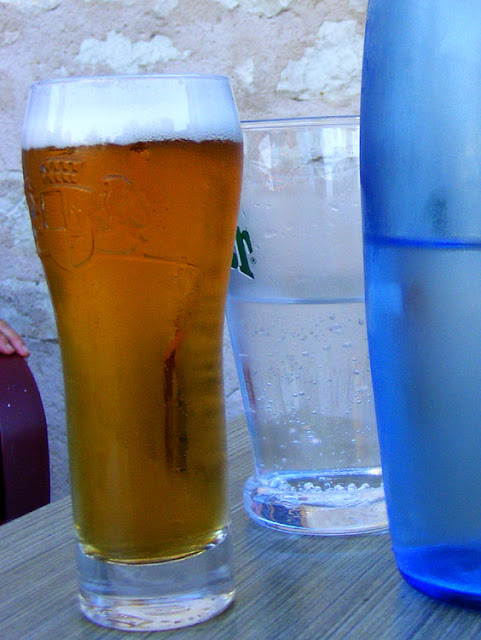
A galopin (125 ml) draught beer, Indre et Loire, France. Photo by Loire Valley Time Travel.
A galopin (125 ml) of draught beer at a bar restaurant in the Touraine.

But the rise of fast food outlets is not the only reason bars and cafés are disappearing. French workers are taking less time for lunch, not working in the centre of town, and the pandemic didn't help. Many clients have not returned to their old haunts because they now work from home. Even when bars were allowed to reopen once it was deemed safe, initially customers were not allowed to stand at the bar, and that changed consumption patterns too.

Bar, Indre et Loire, France. Photo by Loire Valley Time Travel.
A typical local bar in Preuilly, now also closed. L'Esperance is, or was, opposite the Abbey, and closed in August 2022.

Ironically, one of the great advantages of the old style bar is the speed of service. Nowadays it is more usual to seat yourself at a table, then wait for the server to come to take your order, and again for them to come with the card machine at the end of your sojourn. Not so good for anyone who just wants a quick drink and has told their wife they are just nipping out to get the daily baguette. 
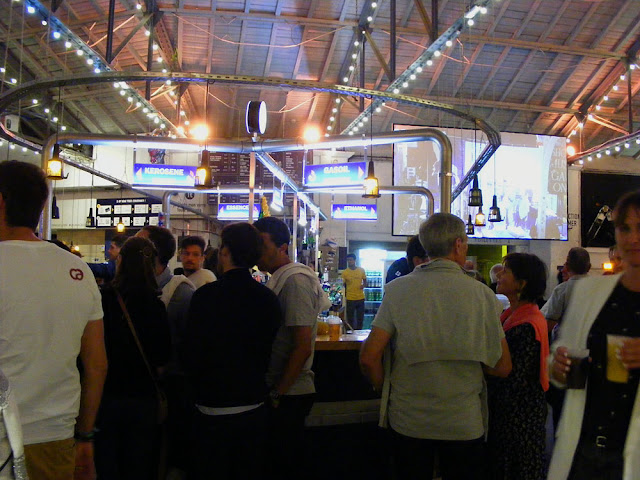
Le Garage, Saint Jean de Luz, Pyrenees-Atlantique, France. Photo by Loire Valley Time Travel.
Le Garage in Saint Jean de Luz, a modern bar which succeeds in being both community oriented and buzzy enough to entice tourists in.

Sometimes the problem is that bars are in rented premises and the landlord decides to sell the real estate for re-development.

The bar counter is known as a comptoir, often referred to as le zinc. These 'zincs' appeared at the end of the 19th century. They were always set up so they were exactly the right height for a man standing at the bar to lean his elbows on, 110 mm. Even once drunk, men could retain a dignified appearance, propped up by their elbows. Typically the 'zinc' covered bar would be equipped with a beer pump and behind the bar, underneath, there would be refrigerators, with a coffee machine on the other side. Nowadays, many bars are set up in such a way that does not encourage customers to stand propping them up in the old way. Now they are expected to take a table.
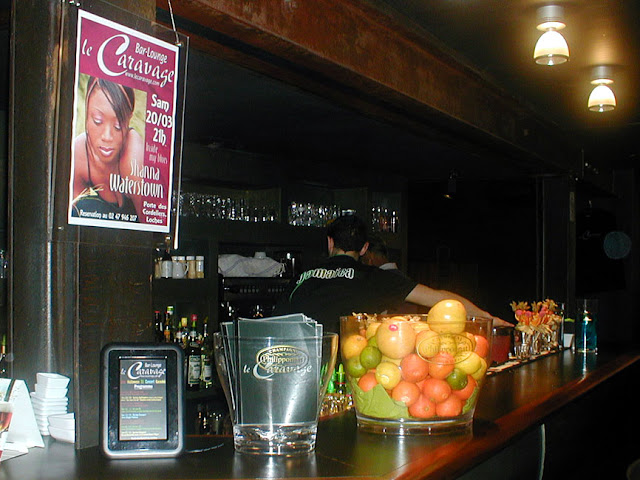
Le Caravagge bar, Loches, Indre et Loire, France. Photo by Loire Valley Time Travel.
Le Caravagge in Loches, where they do intimate jazz concerts and great mocktails.

The 'zinc' of the bar is in fact galvinised (zinc coated) steel. Many old 'zinc' bars didn't survive the German occupation of the Second World War.  They were requisitioned by the Germans to melt down for munitions. They made a bit of a comeback in the Trente Glorieuses (the 30 years post-World War Two, when France experienced economic growth) but by then formica was the fashionable work surface treatment. Nowadays the 'zinc' (or brushed stainless steel) is back in fashion and formica out, and the patina and lustre of the metal much admired for its practicality, durability and attractiveness.
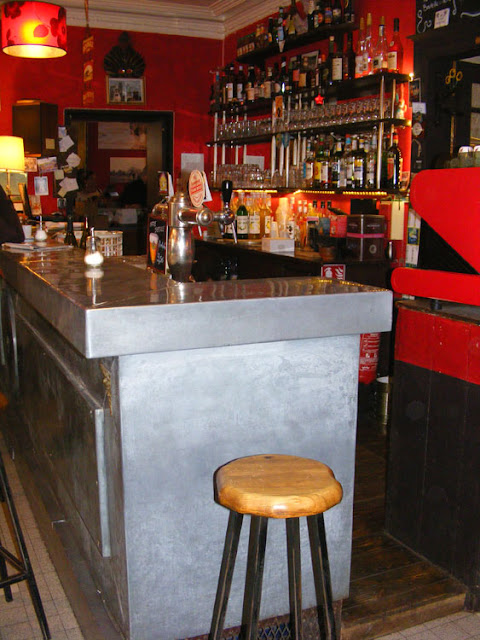
Zinc bar, Indre, France. Photo by Loire Valley Time Travel.
A restored zinc bar in Berry.

In the 1930s there was one bar/café/bistrot for every 85 people. Nowadays it is one for every 1500 people. In the inter-War years these places were where you went for life milestone celebrations (promotions, weddings, birthdays, retirements).

In the early 20th century, absinthe was cheaper than wine. The outlawing of absinthe in 1914 brought a significant reduction to the prosperity of bistrotiers (café owners), as did the outbreak of war and the mobilisation of their clientele (not to mention that so many of them never came back...).  It prompted the Pernod brothers to develop the first aniseed flavoured pastis.

Some of the drinks were creatively named (or nicknamed). A 'fond de culotte' is the bitter orange aperitif Suze with cassis (blackcurrant liqueur).  It's a sort of French version of Cockney rhyming slang: 'car le fond de culotte ne s'use qu'assis !' (because the seat of the trousers only wears out when sitting, and 's'use qu'assis' is pronounced the same as 'Suze cassis'). A 'soutien gorge' was milk with strawberry syrup, so named because it was the same colour as bras (Fr. soutien gorge) of the time, although sometimes this drink was called a bébé rose (pink baby). A beer is usually a chope (500 ml) or a demi (250 ml), but could be a galopin (125 ml), and can be adulterated with a syrup or cut with limonade like a shandy, in which case it's called a panaché.

Generally speaking, a bistrot is a bar which offers simple dishes, which could be served at the bar. In other words, a pub which offered counter meals.

The etymology of the word 'bistrot' is still disputed. Some people think it is a corruption of a regional word which arrived in Paris in the 19th century. It might come from a Poitevin word 'bistraud', which initially meant a domestic servant, then came to mean a wine merchant. Or it might come from the northern French word 'bistouille' which is a coffee with eau-de-vie added. Or maybe it is from 'bistingo' a slang word for cabaret.

But the popular legend of the word's origin is that it comes from the Russian occupation after the campaign of 1814. The cossacks, stationed in Paris after the fall of Napoleon, would while away their time in the cafés. Fearing discovery by their officers they would cry 'bistro! bistro!', meaning 'quick! quick' when they wanted a drink. The exoticism of the word appealed and many cafés were renamed. The problem with this explanation is that it appears that the first usage of the word only dates from 1884.

And maybe it is 'bistroquet', which is actually a portmanteau word, combining 'bistrot' and 'mastroquet' or 'troquet', a 19th century word from the Flemish for 'cabaret master' or 'bar', and first used in 1926.

Women who remember the good old days of traditional 'zincs' are not always so overcome with nostalgia. They were a haven for alcoholism, and definitely male dominated. And of course, the smoking ban has inevitably altered the atmosphere in these places, with conversations being interrupted whilst the smokers exit for a quick desperate drag (or no longer frequent their local bar at all).

Thursday, 2 March 2023

Ciclic

Ciclic is a government agency created to provide a cultural service to the public. They offer a wide variety of activities designed to encourage the creation and diffusion of books, digital arts and images. Probably their most high profile activities are their mobile cinema, and their amateur film archive.

Their remit is to encourage diversity and emerging creators in the fields of cinema and the audiovisual arts, from creation to diffusion, throughout Centre Val de Loire. They host a short film festival, a documentary film festival, have a special section for animations and provide grants and a mentorship programme for image makers, authors, producers and technicians.


Headquarters of Ciclic, the regional government agency to promote literature and audiovisual arts, Indre et Loire, France. Photo by Loire Valley Time Travel.
The headquarters of Ciclic, in Chateau-Renault.

As well as the mobile cinema in a semi-trailer, they have an art class truck and an essay writing truck.

Their education and teaching division gives young rural students access to significant cultural works, gets them involved in artistic practice, and develops their critical sense. There are programmes for senior high school students and apprentices to write and develop a series or an animated film, with both workshops and YouTube training videos. There are also special programmes for the vulnerable and disadvantaged. Students can learn about image creation and the use of images in the media, using their voice, writing for screen or publication, or gain insight into becoming a librarian.

There is a section for 'living literature' and support for authors. Ciclic helps to promote living authors, involving industry professionals including libraries and bookshops with authors who aren't well known, to get their work noticed by the public. 

An important part of Ciclic's work is to collect, safeguard and promote the amateur films made in Centre Val de Loire so that they a regional audiovisual 'living memory'. These films are available to view on line and they form an important archive of material showing daily life as filmed by ordinary families in the Touraine.

I'm a big fan of their amateur film archive [link], and of their 'Mille lectures d'hiver' ('a thousand winter readings') programme (which, sadly, Covid seems to have put a stop to).

Further reading: Ciclic have produced a 5 page infographic in English to describe what they do [link].

Wednesday, 22 February 2023

Flapi

I photographed this memorial in the park of the chateau/town hall in Chateau-Renault, in case the subject turned out to be an amazingly interesting person. I couldn't be sure at the time though because I'd never heard of Yves Leroy, and had no idea why his nickname might be 'Flapi', or what a crossman was or the USR.

Memorial to Yves Leroy, cross country runner, Indre et Loire, France. Photo by Loire Valley Time Travel.
The memorial says: Sports trail Yves Leroy called 'Flapi'. Cross country runner national level. Facilitator at the USR from 1947 to 1978.

It turns out that the memorial was erected for the centenary of the Cross Country and Athletics Sporting Union of Chateau-Renault, in 2020. Yves Leroy was a great cross country champion who devoted his life to the club, from 1947 to 1978, becoming a trainer, and then the president. So, 'cross' is French for cross country running, and a 'crossman' is a cross country runner. So far so good.

Leroy was dubbed 'Flapi' because at the end of a marathon in 1927 he declared to a journalist that 'je ne suis pas flapi'. It would be like an anglophone athlete saying something like 'I'm not knackered'.

The USR is the Union Sportive Renaudine, ie the sports club to which he belonged all his life.

Thursday, 2 February 2023

Tomber dans les pommes

Recently Simon had a vasovagal faint and passed out just before having an angiogram. The colloquial phrase for fainting in French is 'tomber dans les pommes' and I wondered why. Various people told me various things, so here it is.

It appears to be widely believed that the phrase comes from being overcome by the fumes when distilling calvados or fermenting cider. Whilst at first glance this seems plausible, there doesn't appear to be any real evidence for it being the origin of the phrase. It smacks to me of a back formation, conflating the strong green apple smell of malic acid you get when fruit is fermenting (including grapes for wine) and the danger of CO2 in the process, then associating it with a phrase that mentions apples.

Organic heritage apples at a market, Indre et Loire, France. Photo by Loire Valley Time Travel.
Organic heritage apples at our local market.

According to another explanation, it comes from an expression by George Sand to indicate extreme fatigue. George Sand apparently wrote about 'etre dans les pommes cuite' (to be in the cooked apples) in a letter to a relative. In her day it was common for disgruntled theatre goers to chuck apples (baked or spoiled) at performers. Tomatoes were too expensive in those days to consider chucking, but it might have been baked potatoes (pommes de terre)... The idea is that cooked apples are structurally weak, collapsing easily. It just doesn't seem a satisfactory explanation to me as the two phrases don't seem close enough in meaning to me. I feel George Sand's intent was more like 'pédaler dans la semoule' (to pedal in semolina -- to be working hard but getting nowhere).

The most convincing explanation I have seen is that the expression is a corruption of the medieval phrase 'tomber dans les pâmes', which means to lose consciousness. The only reservation I have is that the medieval expression went out of use in the 15th century, and 'tomber dans les pommes' doesn't appear in the lexicon until 1889. On the other hand, there is still the literary phrase 'tomber en pâmoison' which means the same thing and continued in usage into the 17th century before becoming obscure but not disappearing entirely.

Homegrown apples, Indre et Loire, France. Photo by Loire Valley Time Travel.
Homegrown apples.

The 'proper' French word for fainting is 's'évanouir' (to faint).