Showing posts with label Paris. Show all posts

Thursday, 16 January 2025

France, Queen of the Roundabouts

One of the things some visitors to France comment on is just how many trafffic roundabouts there are in France. And they are not wrong. The statistics bear this out and show that France is a world leader in roundabouts. 

 This roundabout, in the industrial boondocks of Amboise, has an abandoned helipad in the centre.

Roundabout with abandoned helipad in the centre, Amboise, France.

According to the painstakingly calculated figures on the blog 'Beyond the Maps', the most roundabouts per population are to be found in mainly western France (Vendée, Loire-Atlantique, Landes, Mayenne) plus Pyrénées-Orientales in the south. The fewest roundabouts per population are around Paris and in the north east. We in Indre et Loire appear to sit in the middle. 

 A plane on a stick. To be precise, a Dassault Mirage IIIB two seater training jet previously of the French Air Force, now a roundabout decoration in Saint-Amand-Montrond

a plane on a stick. This is a Dassault Mirage IIIB two seater training jet previously of the French Air Force, now a roundabout decoration in Saint-Amand-Montrond


In terms of actual numbers of roundabouts there is a roughly east-west divide in the country, with the west being generally much more heavily endowed with roundabouts than the east. Toulouse takes the prize as the municipality with the most roundabouts (499 at last count). Virtually everywhere roundabout numbers are going up.


 A roundabout in the middle of le Blanc, a town about half an hour to the south of us.

Roundabout, le Blanc, France.


France is the European record holder for roundabout density, easily outstripping neighbouring countries. The most famous roundabout in the country is of course the horror known as the Etoile, a six lane roundabout in central Paris, surrounding the Arc de Triomphe.


Arc de Triomphe and the Etoile.

Arc de Triomphe and Etoile roundabout, Paris, France.

This post is dedicated to entomologist Simon Leather, who loved aphids and France, but sadly died while being treated for colon cancer a few years ago. His blog is called 'Don't Forget the Roundabouts'.

Wednesday, 3 April 2024

Agnes Stays Put

There is currently a big temporary exhibition on Art in the Time of Charles VII at the Cluny Museum of Medieval Art in Paris. The star piece was to have been the alabaster tomb effigy (Fr. gisant) of Agnes Sorel, 15th century mistress of Charles VII. Her permanent home is the church of Saint Ours in Loches and she has never been lent before. As it turns out, neither is she this time, despite everyone's best intentions.

The statue was commissioned by Charles VII in 1450 when his beloved Agnes died suddenly at the age of 28. Forensic investigations of her remains in 2004 revealed that the cause of death was undoubtedly mercury poisoning, but whether it was accidental or deliberate murder is impossible to say for sure. 

Effigy of Agnes Sorel, loches, France. Photo by loire Valley Time Travel.

On 19 February a group of specialist art transporters arrived to pack her up and take her to Paris. The effigy alone weighs a bit over 200 kg, quite apart from the black marble slab she lays on, and the conservator assigned to oversee the job was nervous, just because of the prestige of the sculpture.

Despite all possible care being taken, an old crack started to open up as the team began to manipulate the sculpture and lifting it by just a few millimetres. Like many tomb monuments of this type, the effigy was badly damaged in 1793 during the Revolution. She lost her hands, a prayerbook she had been holding and reading, the canopy over her head, and the sculpture was shattered into several pieces. She was put back together in the 19th century and new hands added (now meeting in pious prayer and without the book). The break at her waist was repaired and during a conservation restoration in 2015 remained stable. But the museum and heritage professionals present were shocked to see how much it started to open up during the recent activity. The effigy was clearly much more fragile than they had expected.

Effigy of Agnes Sorel, loches, France. Photo by loire Valley Time Travel.

Several solutions were tried, including inflatable supports, but moving her was finally deemed too risky. The preparations and loan negotiations for the exhibition had been going on for a year prior to this, so it was a hard decision to have to make.

The Loches town council were hoping that the focus on Agnes would lead to good publicity with the potential for a higher profile for this lovely rural town that is just a bit too far off the current Loire Valley tourist trail.

The exhibition at the Cluny runs from 12 March to 16 June. But if you want to see Agnes you will have to come to Loches. The Cluny's reaction to this blow was extremely gracious and professional. They understand the objects in loan arrangements like this can never be put at risk, and as the borrower, they had the legal and financial burden of responsibility for the operation. But it means a frantic last minute rearrangement of the exhibition for them, and because of the short time frame, no other image of Agnes Sorel will be on display. There will however be illuminated manuscripts, paintings, sculptures, goldsmithing work, stained glass, and tapestries to flesh out this often overlooked period. The exhibition hopes to show how the innovative Flemish style blended in France with the Italian awareness of their antiquities, creating a distinctive aesthetic ideal, particularly in the Loire Valley with the influential presence of Jean Fouquet.

I have to say that I am rather relieved. She is a major part of my presentation of the Royal Citadel when I do tours of Loches and to have had to say to clients that the star attraction was away on loan for the whole spring would have been a bit disappointing.

For now, the crack in Agnes's side is very visible, but a conservator will be commissioned to make an aesthetic repair.

Saturday, 7 October 2023

Eglise Saint Severin, Paris

The church of Saint Séverin in Paris is in the 5th arrondissement, near the Seine. It has been the parish church for this part of Paris since the 9th century, and there has been a chapel on this site since the 6th century. After being razed by the Vikings in the 9th century, a new church was built in the 13th century, then added to in the 15th. The bell from this period is the oldest in Paris and the gargoyles are rather marvellous.

Eglise Saint Severin, Paris, France. Photo by Loire Valley Time Travel.

Its main claim to fame is that it is the last intact charnel house in Paris. The cemetery opened in 1250 and in 1430 was formed by galleries on three sides of the courtyard. Today the bones have been removed, and the galleries look like a cloister. The priests lived in rooms above the galleries. 

Eglise Saint Severin, Paris, France. Photo by Loire Valley Time Travel.

There were two ways you might be interred in the cemetery. If you were poor you would be tossed into a communal pit. If you were rich your body would be laid out to rot until there was nothing but a skeleton. Then your bones would be stacked up in one of the galleries.

Eglise Saint Severin, Paris, France. Photo by Loire Valley Time Travel.

But in 1674 the charnel houses were banned because of the collapse of parts of the Cimetiere des Innocents due to the weight of bodies, and the galleries did indeed become cloisters. The bones were removed to the Catacombs and by the 18th century the galleries were even closed in with glazing. In the 19th century the western galleries were demolished.

Monday, 22 May 2023

French Bars, Cafes and Bistrots

The numbers of cafés in France have tumbled, according to a recent study. In 20 years over a quarter of Parisian cafés have disappeared. A symbol of the French 'art of living', they have gone from 1907 in 2002, to 1410 in 2022. France wide, there were 600 000 bistrots in 1960, and 35 000 in 2016. Similar has happened to the roadside restaurants known as routiers. In 1980 there were 4500, today only 700. These types of cafés which operate as bars and bistrots are one of the most iconic aspects of French life, and if they are on the way out, then so is the morning coffee taken at the comptoir, the demi of draught beer in the late afternoon after work and the aperitif in early evening. In the old days this is where you picked up a 'casse-croute' (snack) such as a jambon beurre (ham in a buttered baguette) if you were pushed for time and needed to eat. Another popular snack was a hard boiled egg, which you took from a rack on the bar and banged against the 'zinc' to shell, until it was deemed unhygienic and the practice ceased. Children might have a boiled egg and a glass of milk with grenadine syrup, or a diabolo menthe (mint with limonade). Adults might have a vin limé (wine and limonade) in the summer, or a café-calva (coffee with calvados) in the winter. (Limonade is a still clear sweet drink and is not lemonade.)

Bar, Indre et Loire, France. Photo by Loire Valley Time Travel.
Preuilly was briefly amongst those villages that had lost all its cafés and bars. This is the good old days, at l'Image, with the Chedozeau brothers behind the bar.

And it is where innumerable conversations on innumerable topics between friends, strangers, and visitors take place. It is where French people would have had their first taste of Coca Cola, in the 1950s. And in the 1960s, televisions appeared, so clientele could watch press conferences with General de Gaulle or the horse races at Longchamp. In the mid-20th century, people would not have had a coffee machine at home and only have consumed Coca Cola at the café, not at home.

Market bar, Pyrenees-Atlantique, France. Photo by Loire Valley Time Travel.
This bar, offering casses-croutes, is in the market hall at Saint Jean de Luz. It offers a robust ambiance not for the faint hearted tourist, but beloved by the regulars.

The 16th arrondissement in Paris is the most affected, with the loss of 68% of its bars and cafés, followed by the 19th (60% loss) and the 8th (58% loss). Only two arrondissements have increasing numbers of bars and cafés. The 2nd has 17% more and the 3rd has 15% more, due to how popular with tourists they are. Concurrently, fast food outlets and coffee shops are multiplying, and it is this which is contributing to the demise of the bar/café. In the 8th arrondissement there is a 90% increase in the number of fast food outlets, and in the 3rd, an 86% increase. Nowadays, the clientele of cafés and bars are not so much workers, who can't afford them any more, but tourists. The bistrots have become brasseries, the cafés have turned into trendy tea rooms.
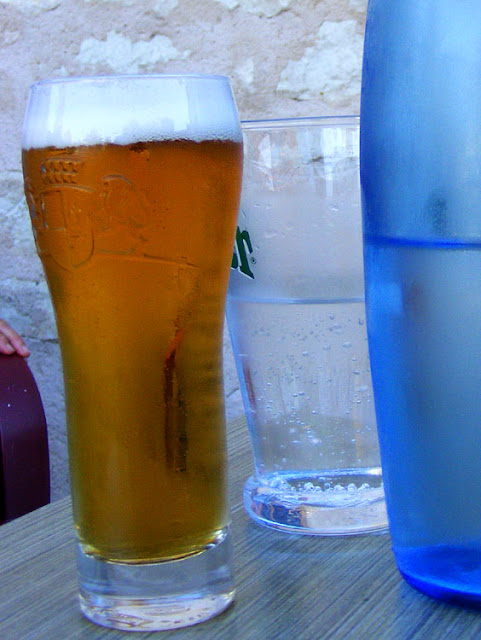
A galopin (125 ml) draught beer, Indre et Loire, France. Photo by Loire Valley Time Travel.
A galopin (125 ml) of draught beer at a bar restaurant in the Touraine.

But the rise of fast food outlets is not the only reason bars and cafés are disappearing. French workers are taking less time for lunch, not working in the centre of town, and the pandemic didn't help. Many clients have not returned to their old haunts because they now work from home. Even when bars were allowed to reopen once it was deemed safe, initially customers were not allowed to stand at the bar, and that changed consumption patterns too.

Bar, Indre et Loire, France. Photo by Loire Valley Time Travel.
A typical local bar in Preuilly, now also closed. L'Esperance is, or was, opposite the Abbey, and closed in August 2022.

Ironically, one of the great advantages of the old style bar is the speed of service. Nowadays it is more usual to seat yourself at a table, then wait for the server to come to take your order, and again for them to come with the card machine at the end of your sojourn. Not so good for anyone who just wants a quick drink and has told their wife they are just nipping out to get the daily baguette. 
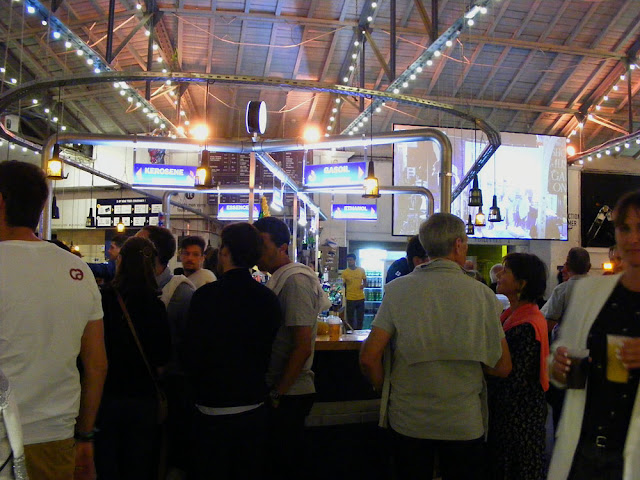
Le Garage, Saint Jean de Luz, Pyrenees-Atlantique, France. Photo by Loire Valley Time Travel.
Le Garage in Saint Jean de Luz, a modern bar which succeeds in being both community oriented and buzzy enough to entice tourists in.

Sometimes the problem is that bars are in rented premises and the landlord decides to sell the real estate for re-development.

The bar counter is known as a comptoir, often referred to as le zinc. These 'zincs' appeared at the end of the 19th century. They were always set up so they were exactly the right height for a man standing at the bar to lean his elbows on, 110 mm. Even once drunk, men could retain a dignified appearance, propped up by their elbows. Typically the 'zinc' covered bar would be equipped with a beer pump and behind the bar, underneath, there would be refrigerators, with a coffee machine on the other side. Nowadays, many bars are set up in such a way that does not encourage customers to stand propping them up in the old way. Now they are expected to take a table.
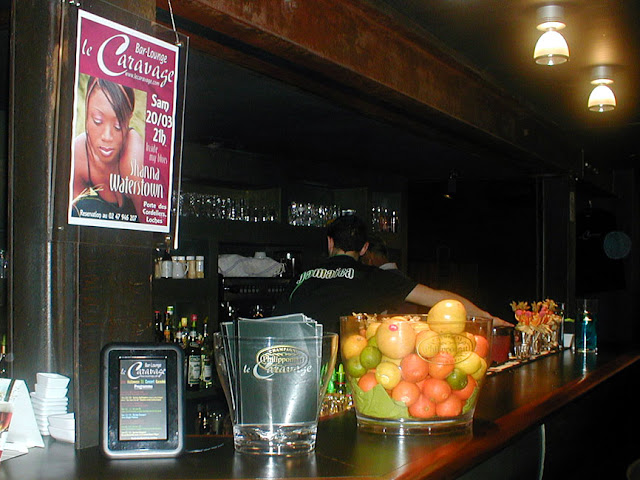
Le Caravagge bar, Loches, Indre et Loire, France. Photo by Loire Valley Time Travel.
Le Caravagge in Loches, where they do intimate jazz concerts and great mocktails.

The 'zinc' of the bar is in fact galvinised (zinc coated) steel. Many old 'zinc' bars didn't survive the German occupation of the Second World War.  They were requisitioned by the Germans to melt down for munitions. They made a bit of a comeback in the Trente Glorieuses (the 30 years post-World War Two, when France experienced economic growth) but by then formica was the fashionable work surface treatment. Nowadays the 'zinc' (or brushed stainless steel) is back in fashion and formica out, and the patina and lustre of the metal much admired for its practicality, durability and attractiveness.
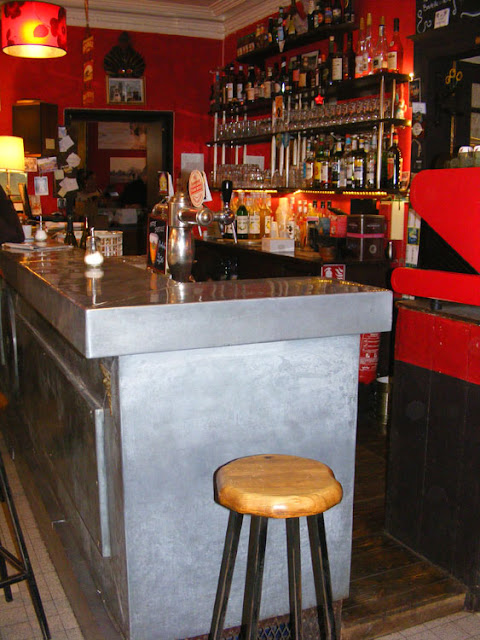
Zinc bar, Indre, France. Photo by Loire Valley Time Travel.
A restored zinc bar in Berry.

In the 1930s there was one bar/café/bistrot for every 85 people. Nowadays it is one for every 1500 people. In the inter-War years these places were where you went for life milestone celebrations (promotions, weddings, birthdays, retirements).

In the early 20th century, absinthe was cheaper than wine. The outlawing of absinthe in 1914 brought a significant reduction to the prosperity of bistrotiers (café owners), as did the outbreak of war and the mobilisation of their clientele (not to mention that so many of them never came back...).  It prompted the Pernod brothers to develop the first aniseed flavoured pastis.

Some of the drinks were creatively named (or nicknamed). A 'fond de culotte' is the bitter orange aperitif Suze with cassis (blackcurrant liqueur).  It's a sort of French version of Cockney rhyming slang: 'car le fond de culotte ne s'use qu'assis !' (because the seat of the trousers only wears out when sitting, and 's'use qu'assis' is pronounced the same as 'Suze cassis'). A 'soutien gorge' was milk with strawberry syrup, so named because it was the same colour as bras (Fr. soutien gorge) of the time, although sometimes this drink was called a bébé rose (pink baby). A beer is usually a chope (500 ml) or a demi (250 ml), but could be a galopin (125 ml), and can be adulterated with a syrup or cut with limonade like a shandy, in which case it's called a panaché.

Generally speaking, a bistrot is a bar which offers simple dishes, which could be served at the bar. In other words, a pub which offered counter meals.

The etymology of the word 'bistrot' is still disputed. Some people think it is a corruption of a regional word which arrived in Paris in the 19th century. It might come from a Poitevin word 'bistraud', which initially meant a domestic servant, then came to mean a wine merchant. Or it might come from the northern French word 'bistouille' which is a coffee with eau-de-vie added. Or maybe it is from 'bistingo' a slang word for cabaret.

But the popular legend of the word's origin is that it comes from the Russian occupation after the campaign of 1814. The cossacks, stationed in Paris after the fall of Napoleon, would while away their time in the cafés. Fearing discovery by their officers they would cry 'bistro! bistro!', meaning 'quick! quick' when they wanted a drink. The exoticism of the word appealed and many cafés were renamed. The problem with this explanation is that it appears that the first usage of the word only dates from 1884.

And maybe it is 'bistroquet', which is actually a portmanteau word, combining 'bistrot' and 'mastroquet' or 'troquet', a 19th century word from the Flemish for 'cabaret master' or 'bar', and first used in 1926.

Women who remember the good old days of traditional 'zincs' are not always so overcome with nostalgia. They were a haven for alcoholism, and definitely male dominated. And of course, the smoking ban has inevitably altered the atmosphere in these places, with conversations being interrupted whilst the smokers exit for a quick desperate drag (or no longer frequent their local bar at all).

Thursday, 15 December 2022

Les Entresols

An entresol is a level usually between the ground floor and the first floor of a building. They were originally designed to gain space above rooms that were not high status and did not require high ceilings. This type of entresol is often completely hidden on the facade, or presents an assymetrical facade. Entresols are distinguished from mezzanines because they are intermediate floors which are enclosed on the interior too, not open.

Entresol, Tours, Indre et Loire, France. Photo by Loire Valley Time Travel.

Entresols are essentially utilitarian, therefore their appearance on the exterior of the building is traditionally supposed to be as discreet as possible. But sometimes private houses have entresols that are obvious from the outside and decoratively treated.

Entresol, Tours, Indre et Loire, France. Photo by Loire Valley Time Travel.

Architects generally take the view that entresols should be as low on the building as possible, and it is considered ugly and out of proportion to set two entresols directly above one another.

Entresol, Tours, Indre et Loire, France. Photo by Loire Valley Time Travel.

Historically entresols are accessed by hidden staircases and discreet entrances. Often, for example there would be a shop on the ground floor, and residents could pass from there to an apartment in the entresol.

Entresol, Tours, Indre et Loire, France. Photo by Loire Valley Time Travel.

Initially designed for storage with lots of cupboards, they sometimes also had apartments for servants, with small but comfortable rooms. In some really big buildings the entresol was entirely dedicated to housing the staff who worked there.

Entresol, Tours, Indre et Loire, France. Photo by Loire Valley Time Travel.

In Paris, grand carriage entrances meant that the ground floor of 19th century buildings was very high and the first floor apartments were an entresol to compensate. On the exterior the facade was designed to look like the ground floor was one and a half times the height of the other floors, thus creating the characteristic appearance of Parisian avenues. Entresols had been used extensively in Paris since the 17th century, but the Haussmannian style of architecture really took advantage of them to create the unique architectural identity of Paris.

Entresol, Tours, Indre et Loire, France. Photo by Loire Valley Time Travel.

Tours, being a major provincial city, promptly copied the look along its main avenues, and all these photos come from central Tours. In all cases the entresol features big semi-circular windows.

Monday, 7 November 2022

France Won.


French rugby fans at a railway station, Indre et Loire, France. Photo by Loire Valley Time Travel.

On Saturday I encountered these fine gentlemen at Saint Pierre des Corps railway station. I was waiting for clients who were arriving on the train from Paris, they were waiting for their train to get to Paris. They were off to see the France - Australia rugby match, and were quite surprised to meet an Australian so early in the day. They got a bystander to take a photo of us all together with one of their phones.

Saturday, 2 April 2022

We're not in Paris

We weren't in Paris last weekend, either.

Usually at about this time of year we visit Paris to go to Retromobile. The past two years it was cancelled due to the plague, and this year it was held a month later than normal. We didn't go, because we were working that weekend, but I am not sure we would have gone even if we hadn't had that excuse.

In fact, it's two and a half years since we were last in Paris. The biggest city we have been to since then is Tours. We have plans to visit Lyon in July, so let's hope we don't get scared by the idea of a big city.

In the meantime a photo of the Elvis Presley inspired gargoyle at the Église Saint-Séverin in Paris' 5th arr.


Wednesday, 22 September 2021

Wrapping It Up

Paris is currently admiring the final work planned by the artists Christo and Jeanne-Claude, both of whom are now dead. The Arc de Triomphe has been wrapped in a specially woven fabric and the work will be on display for a fortnight.

Arc de Triomphe being wrapped for the Christo art project, Paris, France.
The Arc de Triomphe in the process of being wrapped. (Photo courtesy of Wendy van der Beek).


The pair are much admired in France and the work has received a good deal of fanfare. American tourists, on the other hand, are mostly unimpressed. They want the monument they have in their guide books back, and have barely heard of Christo. 

Wrapped bridge in the style of Christo, Preuilly sur Claise, Indre et Loire, France.
The bridge in Preuilly wrapped in 1985.


One of Christo and Jeanne-Claude's previous projects in Paris involved wrapping the Pont Neuf, in 1985. Much to my amusement, I discovered recently that Preuilly sur Claise got in on the act and created a copycat version. Our own Pont Neuf was wrapped in pink as a sort of publicity stunt.

Australians may remember that one of the couple's early works was Wrapped Coast, where they wrapped the coast at Little Bay in Sydney Harbour in 1969.


Thursday, 16 September 2021

What Happened to All Those Messages? (Repost from 13 November 2017)

As you may have seen in the news, the trial of the Paris terrorists is underway. This has brought back a lot of memories for many people. I thought I would repost a blog I did as a response to the two year anniversary of the Bataclan attack. We were in Paris about a week after the Charlie Hebdo attacks, staying just around the corner from where they took place. Later, we were in Paris about a week before the Bataclan attacks, again staying just around the corner.

********************************************

In late October [2017] I was whiling away the time at the ophthalmologists, reading a copy of Grazia from November 2016. Inside, the article that really caught my attention was a two page spread about saving all the thousands of messages and tributes that had been left by people at the sites of the terrorist attacks in Paris twelve months earlier. I was fascinated and moved so I thought I'd pass on the story via the blog.

Today in the Archives de Paris there are two shelves which are home to the 7689 documents that they collected from the streets after the attacks on 13 November 2015. This collection was the brainchild of a man called Gérôme Truc. He felt it would allow historians and sociologists to have access to another dimension of the event ie how ordinary individuals experience these things and respond to them.

Place de la Republique, Paris, France. Photo by Loire Valley Time Travel.
Place de la République, Paris.


The documents come from the Bataclan, la Belle Equipe, the Café Bonne Bière, Casa Nostra, the Carillon, the Petit Cambodge and the Comptoir Voltaire. Ten volunteers collected the messages of love from Parisians, French people and foreigners, bit by bit from 17 November.

In addition two archivists and a conservator made 17 visits to the sites. According to them the most affecting was visiting the Bonne Bière because there was a message found there from an intensive care doctor, who apologised for being unable to save a young man.

Tributes left in Boulevard Richard Lenoir after the Charlie Hebdo attack, Paris, France. Photo by Loire Valley Time Travel.
Tributes placed in Boulevard Richard Lenoir after the Charlie Hebdo attacks.


The archive staff assessed the condition of the messages, children's drawings and poems. The main problem was plastic pockets. They were useless because the rain quickly got into them and turned the contents to mush.

Back at the Archives, the documents were dried in two sorting rooms. Usually overnight was enough to dry them out. They were then sent to be fumigated to kill mould and other fungi before being left for three weeks to stabilise. Once returned to the Archives, the documents, from metro tickets to A3 in size, were dusted with a microfibre cloth then sorted by place and date before being digitised (thanks to a donation by Arkhênum).

Tributes left in Boulevard Richard Lenoir after the Charlie Hebdo attack, Paris, France. Photo by Loire Valley Time Travel.
Tributes placed in Boulevard Richard Lenoir after the Charlie Hebdo attacks.


The archivists didn't look at the documents. They had no time and they needed to maintain a certain distance emotionally. While they worked the tried to be calm and converse normally, even crack jokes.

The Museum of Paris, Carnavalet, conserved all the objects (soft toys, guitars, flags...) but those that didn't carry a meaningful message were thrown away. There was a debate about what to do with the wilted flowers. Gerôme Truc suggested that like in London in 2005, the flowers should be collected, composted and a tree planted in the compost.

Bataclan Theatre, Paris, France. Photo by Loire Valley Time Travel.
Bataclan Theatre.


A hundred and fifty documents were recovered from the temporary memorial in the Place de la République. The rest of the messages from this spot were kept by the collective known as 17 Plus Jamais, created the day after the Charlie Hebdo attack in January 2015.

At the time of the Charlie Hebdo attacks the archival work was not able to be applied to the messages to the murdered cartoonists and they were deposited at various sites. At the time the Mairie de Paris just didn't think of preserving and cataloguing them. Eventually Harvard University launched an appeal to collect the messages after the event, and many of them are now in the US.


Tributes laid at the Charlie Hebdo offices after the attack, Paris, France. Photo by Loire Valley Time Travel.
Tributes laid at the Charlie Hebdo offices in Paris, after the attack.

The Nice attack happened just after the Archives had finished their digitising project, but despite calls from those involved, the Mairie de Nice did not initiate a similar project and the messages were not collected there.
 

900 of the messages were published by Michel Lafon in Je suis Paris.


Saturday, 24 July 2021

Two Terrible Towers


Eiffel Tower at dusk from Trocadero, Paris, France. Photo by Loire Valley Time Travel.
The Eiffel Tower at dusk, photographed from Trocadero.

The Eiffel Tower was constructed for the 1889 World Fair. Today it's the most visited paid entry monument in the world, with 7 million visitors annually. But more or less everyone at the time it was constructed hated it. It was derided as skeletal, as if it was just the framework for an unfinished building. It was a 'skyscraper' in a low rise city. It was metal, in a city built of white limestone. So unattractive that 'even the Americans wouldn't stomach it'. It was so reviled that it took 70 years for permission for another skyscraper to be built to be granted. That was the equally reviled Montparnasse Tower, which is still considered a blot on the landscape. It does claim, with some justification, to have the best views in Paris though.

Eiffel Tower with the Seine in flood, Paris, France. Photo by Loire Valley Time Travel.
The Eiffel Tower, from the other side of the Seine, in flood and threatening nearby houseboats.

Tour Montparnasse photographed from the Eiffel Tower, Paris, France. Photo by Loire Valley Time Travel.
The mid-20C Montparnasse Tower in the distance, photographed from the Eiffel Tower. You can see why the Montparnasse Tower is not loved.


Saturday, 5 June 2021

Le Clos-Montmartre

Le Clos-Montmartre is a vineyard planted on the north side of the Montmartre butte (the 18th arrondissement, or district, of Paris). It is between Au Lapin Agile cabaret and the Montmartre Museum, the artist Auguste Renoir's former home. 

Le Clos-Montmartre vineyard, Paris, France. Photo by Loire Valley Time Travel.

Vineyards were recorded as being present in Montmartre from 944. In the 12th century vines were planted by the women of the Montmartre Abbey. When the Abbey subsequently needed money the parcels of vines were sold. In the 16th century Montmartre was still outside of Paris, the vines stretched as far as the eye could see and its inhabitants were mostly vineyard workers. In the 17th century the production had dwindled and the wine was not highly regarded, having gained a reputation as a diuretic. Only the locals drank the stuff.

At the beginning of the 17th century there was a guinguette, an open air bar and dance venue, on the site of the current Montmartre vineyard. By the 18th century the Montmartre hillside was once again covered with vines, because Montmartre was outside the Paris tax collection boundaries. This made the area a favourite for taverns and cabarets. Once Montmartre was annexed by Paris in the 1860s though, the vines made way for houses. The site of the current vineyard was a house and garden, belonging to the writer and performer Aristide Bruant, who would also own the neighbouring Au Lapin Agile cabaret in the early years of the 20th century.

When Aristide Bruant died in 1925 the City of Paris bought the land, with the intention of building four houses on it. But the locals objected strongly and the local authority caved in and declared the land protected from being built on.  The last vines in Montmartre had gone in 1928 but five years later Montmartre planted 2000 pinot noir and gamay on the 2 hectare site that would become the Clos-Montmartre. In 1933 another 1.5 hectares was planted to vines and more than 25 old varieties brought in. Nowadays they are in the process of being replaced by varieties from Switzerland. 

The grapes are harvested very late, in mid-October, and up until recently the wine itself continued to have a less than stellar reputation. But that is changing. These days, since 2016, there is a professional winemaker and vineyard manager, and the wine is considered excellent. The public is not allowed into the vineyard, except during the autumn garden and harvest festival, when local community groups and wine clubs are invited to pick the grapes and there are guided visits. There is no particular fanfare about the grape harvest, and they are pressed in the cellars of the Montmartre town hall. Once the wine is ready it is sold by auction, with the proceeds going towards social projects in Montmartre.


************************************************

For details of our private guided tours of chateaux, gardens, wineries, markets and more please visit the Loire Valley Time Travel website. We would be delighted to design a tour for you.

We are also on Instagram, so check us out to see a regularly updated selection of our very best photos. You may also like to check out our YouTube channel. 

Saturday, 29 May 2021

Au Lapin Agile

 Au Lapin Agile ('at the Agile Rabbit') is the Conservatory of Living French Song (chanson), describing itself on its website as 'the mythic Lapin Agile, doyenne of the Montmartre Cabarets, reviving our heritage every evening'.

Au Lapin Agile cabaret, Montmartre, Paris, France. Photo by Loire Valley Time Travel.

They also nuture and present new talent. There is no sound system, no lights -- just the raw performance. Audience participation is more or less encouraged, as is conversation, since you can hear each other speak.

Basic entry, which gives you the show and a drink, is €28. You can also eat there, but I don't think many people do. The space is distinctly intimate. I've never been inside but I've been to places with a similar ambiance, including our own Bar le Caravage in Loches.

Au Lapin Agile was opened, as an inn, under another name, in 1860, but its heyday was the early years of the 20th century, before the First World War. It became one of the bohemian hangouts and a real cultural institution. Its rather curious name comes from the iconic sign depicting a rabbit in a red scarf  and brandishing a bottle of wine, leaping out of a saucepan. At the time the sign was painted by André Gill the place was called the Cabaret des Assassins, but from the moment the sign was erected everyone spoke of going 'au Lapin à Gill' ('to the Rabbit by Gill'), which ultimately became 'au Lapin Agile', which is pronounced the same.


************************************************

For details of our private guided tours of chateaux, gardens, wineries, markets and more please visit the Loire Valley Time Travel website. We would be delighted to design a tour for you.

We are also on Instagram, so check us out to see a regularly updated selection of our very best photos. You may also like to check out our YouTube channel. 

Saturday, 22 May 2021

A Montmartre View


Montmartre, Paris, France. Photo by Loire Valley Time Travel.
Montmartre is on a hill so lots of the streets slope, and Sacré Coeur is in the background.


************************************************

For details of our private guided tours of chateaux, gardens, wineries, markets and more please visit the Loire Valley Time Travel website. We would be delighted to design a tour for you.

We are also on Instagram, so check us out to see a regularly updated selection of our very best photos. You may also like to check out our YouTube channel. 
 
**************************************
 
UPDATE -- RESPONSES TO COMMENTS
Simon -- yes, we have several English friends in the same situation. It's very frustrating.

Saturday, 15 May 2021

Le Moulin de la Galette, Montmartre

The windmill in Montmartre known as the Moulin de la Galette is in fact one of a pair, but only one is visible and accessible these days. Together they once formed the venue for a weekly dance that was hosted by the milling family Debray in the 19th and 20th centuries. They acquired the site for very little in the early 19th century, when the windmills were in a very sorry state. The two windmills are actually called le Blute-fin and le Radet, but the venue created by the Debrays became known as la Galette because that is what was served there (along with donkey milk, and later, the sour local wine...). The windmill we can see is le Radet, gutted of its milling equipment and moved here in 1924 when the Debrays opened a restaurant and put the windmill on top. The singer Dalida was a regular in the 1980s, and her table has been preserved.

Moulin de la Galette, Montmartre, Paris, France. Photo by Loire Valley Time Travel.
Le Moulin de la Galette in 2002.

Montmartre is on a butte, outside of Paris proper, and these two windmills are the last survivors of a group of twenty-five on the hill. In the 19th century the Debray family used to claim that their windmills were built in 1295, citing as evidence the date scratched into the wood on the gable. But other sources indicate that they were probably constructed in 1621. But there may well have been windmills on the site earlier, and the spot was certainly used as a lookout in the 14th century. By 1834 the Debray family opened their property as a dance venue on Sundays and holidays, from three o'clock in the afternoon until nightfall. This sort of pop up venue was known as a guinguette, and the dances were referred to as bals populaires. The place was officially named the Moulin de la Galette from 1895, by which time milling activities had been abandoned for twenty-five years, and in 1914 the venue opened four days a week. On Tuesdays, actors and actresses, often well-known, would come in droves to eat galettes washed down with a glass of muscadet.

In the first half of the 19th century Montmartre was home to winemakers, ploughmen, quarrymen and millers and it was an established tradition for mills to also act as the venues for cabarets or dances. These cabarets had a bad reputation due to the quarrymen getting a bit carried away, and because the quarries offered shelter to thieves and vagabonds who also frequented the cabarets. By the middle of the 19th century Parisians were making the trip up to the more rural Montmartre to walk in the vines and hang out in bars or guinguettes and dance halls. The enterprising millers used their donkeys, which during the week were carrying flour down to the city, to carry tourists up the hill.

Initially the festivities at the Moulin de la Galette were held outdoors, in the courtyard between two of the three windmills owned by the Debray family, but over the years it developed into something more like an outdoor fun fair attached to a big covered ballroom decorated with chandeliers and potted palms. On top of the Blute-fin windmill was a wooden platform where tourists could sit and look at the view over Paris. The Blute-fin is still in its original position and in working order (the last of its kind in Montmartre) but privately owned and not open to the public. 

Auguste Renoir, who lived in the area, painted the by then gaslit scene at the Bal du Moulin de la Galette in 1876, and the painting now hangs in the Musée d'Orsay. By the end of the century, many painters who would become famous had frequented the place, and several famous cabaret dancers made their debuts at the Moulin de la Galette. The management was strict about ejecting drunkards and women were expected to be smartly dressed and behave with decorum (no soliciting...).


************************************************

For details of our private guided tours of chateaux, gardens, wineries, markets and more please visit the Loire Valley Time Travel website. We would be delighted to design a tour for you.

We are also on Instagram, so check us out to see a regularly updated selection of our very best photos. You may also like to check out our YouTube channel. 
 
*******************************************
 
UPDATE -- RESPONSE TO COMMENTS:
chm -- the Moulin Rouge is a different kettle of fish. It was never a working windmill, but a purpose built cabaret venue, cashing in on the popularity of venues such as the old Moulin de la Galette, and the newly developed cabaret format of Rodolphe Salis at Le Chat Noir. The Moulin Rouge is at the bottom of the hill, not where a real windmill would be sited, but more convenient for Parisian patrons.

Saturday, 8 May 2021

The Montmartre Museum

Renoir's studio, Montmartre, Paris, France. Photo by Loire Valley Time Travel.

In 2002 we did a guided walk around Montmartre and called in at the Musée de Montmartre. It has since been given a makeover. This building was artists' studios, used by several of the well known Impressionists, particularly Renoir.


************************************************

For details of our private guided tours of chateaux, gardens, wineries, markets and more please visit the Loire Valley Time Travel website. We would be delighted to design a tour for you.

We are also on Instagram, so check us out to see a regularly updated selection of our very best photos. You may also like to check out our YouTube channel. 
 
***************************************
 
UPDATE -- RESPONSES TO COMMENTS
chm and Colin & Elizabeth -- absolutely no idea now -- it was a long time ago!

Saturday, 1 May 2021

A Wallace Fountain

There are 103 Wallace fountains in Paris, supplying fresh drinking water in the streets. They were a gift to the City of Paris by long time resident Sir Richard Wallace, an Englishman. Wallace, the illegitimate son of the 4th Marquess of Hertford had inherited a fortune in 1870. Both Wallace and his father were considerable art collectors, bring together not just paintings, but furniture, sculpture and armour in their houses, including at Chateau Bagatelle in the Bois de Boulogne. When he commissioned the fountains he wanted them to combine practicality with beauty. I'm not sure if he realised how iconic they would become.

Wallace fountain, Paris, France. Photo by Loire Valley Time Travel.

Installation of the fountains started in 1872. They are cast iron and painted in the dark green approved for streetscape furniture by the City. The biggest ones are 2.71 metres tall and weigh 610 kilograms. Wallace himself sketched his idea of how they should look, and decided on their size, construction and cost before taking his design to a professional sculptor for refining. Their principle design feature is the four caryatids, in four slightly different stances or attitudes. They offer an aesthetic element, but also prevent horses from poking their head in for a drink. Dogs likewise are out of luck as the fountains are too high. Wallace supplied the fountains, the City of Paris supplied the plumbing and decided where the fountains would be installed. At the time they cost about 1000 francs each.

Because of the damage that had been caused in the City by the Prussian War and then the Commune, many sources of fresh water had been contaminated in the early 1870s. Unlike many of his friends and peers, Wallace stayed in Paris through all of this upheaval, and funded field hospitals and soup kitchens. The fountains, which guaranteed rich and poor alike access to potable water were immediately welcomed. They meant people did not have to risk water from the Seine or resort to beer or wine to quench their thirst. And they were free, which other water supplies were not necessarily.

Today visitors and residents of Paris are encouraged to use the Wallace fountains to refill their water bottles, and reduce plastic waste. At the moment the fountains run a continuous stream of water into their basin and users simply put their bottle underneath to catch it. But in today's world that is wasteful so experiments are underway to see if pressing a button to dispense set quantity of water will work.  

And if you are in London, don't forget to visit the Wallace Collection, in Manchester Square. It is free, and is Richard Wallace's collection that he hastily sent to England for safe keeping when trouble broke out in the streets. 

************************************************

UPDATE -- RESPONSE TO COMMENTS:

Carolyn -- an Irish friend tells me she encountered one in Tbilisi! You can buy one for yourself from the foundry apparently!

Saturday, 24 April 2021

Abbesses Metro Station

Abbesses is a Paris Métro station in Montmartre (18th arrondissement or district), on Line 12 (green). It is between Pigalle and Larmarck-Caulaincourt, with just this single entrance/exit. The platforms are the deepest of any Paris Métro station, 36 metres underground and 2.35 million passengers use the station every year.

Abbesses Metro station entrance, Paris, France. Photo by Loire Valley Time Travel.

Today, the entrance has one of the last two surviving original glass covered Art Nouveau style édicules designed by Henri Guimard, but when the station opened in 1913, it had a completely different entrance cover. This one was moved here from Hotel de Ville in 1974.


************************************************

For details of our private guided tours of chateaux, gardens, wineries, markets and more please visit the Loire Valley Time Travel website. We would be delighted to design a tour for you.

We are also on Instagram, so check us out to see a regularly updated selection of our very best photos. You may also like to check out our YouTube channel. 
 
**************************************
 
UPDATE -- RESPONSE TO COMMENTS:
chm -- I haven't checked but I'm sure they must be listed.

Saturday, 17 April 2021

Swan Island in the Seine

 This view is looking down the Seine from the Eiffel Tower.

View down the Seine and Ile des Cygnes from the Eiffel Tower, Paris. Photo by Loire Valley Time Travel.

The curved building is the Australian Embassy. The area on this part of the Left Bank is known as Grenelle, in the 15th arrondissement (district). The bridge at this end of the Ile des Cygnes is the Pont de Bir-Hakeim [link] and the bridge at the far end is the Pont de Grenelle-Cadets de Saumur. At this end of the island is a dramatic equestrian statue of not Joan of Arc [link] and at the far end is the Statue de la Liberté Paris [link].


************************************************

For details of our private guided tours of chateaux, gardens, wineries, markets and more please visit the Loire Valley Time Travel website. We would be delighted to design a tour for you.

We are also on Instagram, so check us out to see a regularly updated selection of our very best photos. 

Saturday, 3 April 2021

The Eiffel Tower Gets a Facelift

With the Olympic Games coming up in 2024 for Paris the decision has been taken to really spruce up the Eiffel Tower. It is normally repainted every 5 - 7 years but this time it will be taken back to bare metal, and the colour changed to be more like the original paint job. Too high a presence of lead particulates has stopped work on the repainting of the Eiffel Tower. For this 20th repainting it was decided to take the old paint off down to bare metal. The problem is that prior to 1995 all the layers contain lead, and despite the precautions they are finding too high levels of particulates in the air. The Eiffel Tower has lost 52 million euros during the pandemic, but is in receipt of government aid and has not sacked any of its 340 employees.


Eiffel Tower, Paris, France. Photo by Loire Valley Time Travel.


The Greek industrial coatings company that won the contract appears to have underestimated the health and safety requirements of the Paris City Authority. Taking the paint off, even with a chemical gel type paint stripper, has meant that the paint layers prior to 1995, which all contain lead, are being exposed and lead is being released into the air at higher than the safe levels.

Eiffel Tower, Paris, France. Photo by Loire Valley Time Travel.


So far, a solution has not been found.

Eiffel Tower, Paris, France. Photo by Loire Valley Time Travel.


Work halted in February.

Note: these photos date from 2002, and are just for illustrative purposes. They do not reflect the current situation.


************************************************

For details of our private guided tours of chateaux, gardens, wineries, markets and more please visit the Loire Valley Time Travel website. We would be delighted to design a tour for you.

We are also on Instagram, so check us out to see a regularly updated selection of our very best photos. 

Saturday, 27 March 2021

Bastille Metro and the July Column


Bastille, Paris, France. Photo by Loire Valley Time Travel.

This photo shows the Place de Bastille surrounds, where the famous prison stood until it was stormed in July 1789 in the early days of the French Revolution, and subsequently destroyed. In the foreground is one of the Art Nouveau Métro entrances/exits for Bastille station. Beyond, in the middle of the intersection, is the July Column, topped by a gilded representation of the Spirit of Freedom. It commemorates the July 1830 Revolution which toppled the restored monarchy. Bastille is pronounced 'bah-steey'.


************************************************

For details of our private guided tours of chateaux, gardens, wineries, markets and more please visit the Loire Valley Time Travel website. We would be delighted to design a tour for you.

We are also on Instagram, so check us out to see a regularly updated selection of our very best photos.