Showing posts with label Towns and Villages near Preuilly. Show all posts

Wednesday, 12 August 2026

Revisiting Saint Benoit du Sault

 Once again we ended a lovely day trip into the Anglin Valley in the very attractive small town of Saint Benoit du Sault. We'd been here once before, on a wet day exactly twelve months before. This time it was stinking hot. It's very picturesque, well worth visiting and wandering around its medieval sandstone streets. 

Saint Benoit du Sault, France.


Medieval gateway into the old town centre.
Medieval gateway, Saint Benoit du Sault, France.


Saint Benoit du Sault, France.
Belfry, Saint Benoit du Sault, France.

Belfry.


Saint Benoit du Sault, France.


A medieval street.

Medieval street, Saint Benoit du Sault, France.


Further reading: Simon's post on Saint Benoit du Sault from last year https://daysontheclaise.blogspot.com/2025/07/saint-benoit-du-sault.html

Tuesday, 5 May 2026

The Church in Saint Flovier


The 19th century church in the village of Saint Flovier, 15 minutes down the road from us.
Church, Saint Flovier, France.

Until last week I had never set foot inside the church in Saint Flovier. It is 19th century and I assumed that the interior would be faux medieval wall paintings and saccharine 19th century Madonnas. Well I was right. But the church also has a couple of decent 17-18th century paintings, and some chunky 15th century choir stalls with a range of misericords. There is another, 20th century treasure contained in this church, but I'll write about it another time.


Finial on one of the 15th century choir stalls.

15C choir stall detail, France.


The church was constructed in the 1880s in the Romanesque style. It replaced a 12th century church which was in a poor state of repair and too small. The architect was well known for his historic restorations and came from Paris. Inside notable artists of the day from Tours, Orleans and Paris created the decoration, including stained glass from the workshop of Luc Fournier in Tours. The paintings from the old church were transferred to the new one.


Finial on one of the 15th century choir stalls.

15C choir stall detail, France.


The 15th century oak choir stalls had come from the old abbey church in Beaulieu les Loches which had been destroyed in the Revolution. As was the norm for the time they feature misericords, or a sort of hinged ledge which functioned as a seat but allowed the monks to appear to be standing whilst they suffered through long services, or 'offices'. The misericords are carved with a variety of quirky subjects, mixing the sacred and the profane, clowns and devils, and illustrations of proverbs. Images such as 'green men' swallowing or spitting leaves symbolise the renewal of Nature. Debauchery is depicted by a pig's head or performing clowns.


The end of one of the 15th century choir stalls.

15C choir stall detail, France.


There is also a set of much more staid 17th century oak choir stalls. They were made during the reign of Louis XIII and feature acanthus leaves, angel's heads, pomegranates, swans and fish, in the style of their time.


A misericord depicting fish on a 17th century choir stall.

17C misericord, France.


A misericord depicting pomegranates on a 17th century choir stall.
17C misericord, France.


Misericord on a 15th century choir stall, depicting a jester with a rattle.
15C misericord, France.


A misericord on one of the 15th century choir stalls, depicting a man in bed I think, although he's got his eyes open and wearing a tunic or doublet.
15C misericord, France.

A 15th century misericord, depicting a man with a fashionable forked beard.
15C misericord, France.


A 15th misericord depicting a boar's head.
15C misericord, France.


A 15th century misericord depicting an acrobat exposing his backside. Images such as this are surprisingly common in medieval churches.
15C misericord, France.


Thursday, 12 March 2026

La Roche Posay in the Sun

As part of my recovery I'm supposed to be walking 3 kilometres every day, but for the last 6 months that hasn't been possible. It took me ages to recover from radiotherapy, and then we encountered one of the longest unbroken periods of rain on record. And it was winter and grey.

On Sunday I finally managed 3 kilometres, non stop apart from taking photos. It's obvious that spring is here.


Wednesday, 11 February 2026

A Descartes Memorial

There's a plaque in Descartes, in a slightly out of the way car park, that we have noticed, but never stopped to read.


In the 1930s, André Goupille was a veterinarian living with his family in La Haye-Descartes (now Descartes). When France was divided during the Second World War, the German demarcation line passed close to their home. Because of his profession, André held a permanent pass allowing him to cross the line. From 1940 onward, he organized a clandestine network to help people cross, involving his wife Jeanne, their four teenage children, and their housekeeper, Odette Metais. Together, they assisted approximately 2,000 individuals, including Jews fleeing persecution, escaped prisoners of war, Allied pilots, and members of the Resistance. They also transported messages and intelligence to London and sometimes sheltered refugees for several days.

Their courage is documented by letters of gratitude from those they helped, including Jewish refugees who had escaped from Drancy. In January 1942, André was arrested for carrying incriminating documents but managed to secure his release by claiming they were linked to black-market activities. He then continued his work from the southern zone, joined later by Jeanne. After the German invasion of the southern zone, their resistance activities expanded to include receiving parachute drops.

In February 1944, the entire group was arrested and deported to Nazi concentration camps. Remarkably, all survived. In 2000, Yad Vashem honored André and Jeanne Goupille, their children, and Odette Metais as Righteous Among the Nations.

Pierre and Denise Renard also lived in La Haye-Descartes during the Second World War. Pierre was involved in the French Resistance and helped escaped prisoners of war and downed Allied airmen cross into the southern zone. His actions expanded when a local hotel owner informed him that the Freudman family, Belgian Jews seeking refuge in France, had been abandoned by smugglers after being robbed of their money.

Pierre rescued the family—two parents and their two-year-old twin daughters—and brought them to his home, where they were temporarily hidden in a small hut in the courtyard. Denise, a schoolteacher, cared for them and ensured they had food and basic necessities. One morning before dawn, she provided the family with supplies and forged identity papers before bidding them farewell. Pierre then guided them by indirect routes across the demarcation line and placed them on a bus bound for Vichy. The following day, he visited them to make sure they were safe.

Pierre Renard sought no reward for his actions, motivated solely by resistance to the occupation and compassion for the persecuted. In 1944, he was arrested by the Gestapo and deported to Dachau. Though he survived the camp, he died shortly after the war due to illness and suffering. In 1969, Yad Vashem recognized Pierre and Denise Renard as Righteous Among the Nations.


Friday, 30 January 2026

The Foundry in Abilly

We were saddened to learn that the foundry in the middle of Abilly will close permanently in a weeks time, with the loss of around 30 jobs. In a small community that is significant. Also significant is the loss of technical knowledge and skill. 


The village of Abilly.

Abilly, France.

Joseph Pinet established the foundry in the town in 1820 to manufacture agricultural machinery parts. In 2020 it was still going strong and employed 27 people, making parts for tractors and trailers for 150 clients. The workers skills in metallurgy are no longer supported by the State Education system, so on the job training is really important now. The management was very conscious of the impact a foundry has on a small village, both in a positive sense as an important employer, but also the potential negatives such as pollution. The factory by this time was recycling all its waste and reusing the sand used to make moulds. They had also installed chimney filters and caps to capture particles, and replaced the old furnaces with induction furnaces using clean energy.

Many foundries closed in the 1980s, victims of Chinese competition. The foundry at Abilly survived by diversifying into home decor, making candelabras for the North African market. They also successfully promoted their park benches and rubbish bins to municipalities. They made parts for locks and hydraulic pumps, but rarely the complete product in these sectors.

Thursday, 7 August 2025

Stylish Street Lights

When we were in Prissac a couple of weeks ago we didn't notice the stylish street lighting, but Susan did take a photo of them coincidentally.


It wasn't until I was looking on Streetview that I realised how good they were - kind of stylised medieval torch.


I like interesting street furniture, especially when proper thought has gone into it.

Tuesday, 15 July 2025

Low Food Miles Apples

Our ComCom (Communauté de communes Loches Sud Touraine) has joined a network to allow small local producers to distribute within our local area more efficiently. The platform, which originated in Lyon, is called la Charrette ('the cart'). It connects and matches producers, distributors and social canteens (schools, aged care facilities, etc).


Tony at the market in Preuilly with organic apples.

Organic apples at a market in France.

In the Sud Touraine 80% of consumers do most of their food shopping at the supermarket. The supermarkets do sell local produce, 'playing the game'. However, most supermarket shoppers may like the idea of 'local' but are motivated by other concerns when spending. 

There are exceptions within the supermarket franchises, with several managers of local supermarkets convinced of the value of stocking local produce. They've done deals with nearby breweries, dairy co-operatives, orchards and graziers. They acknowlege it takes more time, and the products have to be carefully positioned, but they find it rewarding both personally and financially.


Sandy at the market in Preuilly with organic apples.

Organic apples at a market in France.

Buying 'local' is an act of political and social responsibility. Thus the local authority is keen to encourage and facilitate it.

I buy my organic apples from local orchardists Tony and Sandy, who own Fruit Ô Kalm, just outside of town. They deliver a small part of their production to the primary school canteen in Yzeures sur Creuse. Tony says that when he delivers €50 worth of apples to the school, it's not really financially rewarding, but it's about contributing to the education of the kids, and acting on his and Sandy's personal values. Tony and Sandy's fruit can now also be found at Saveurs Lochoises, thanks to the ComCom's new network. He's happy, but if he could sell enough in Loches he would not bother to go all the way to Tours to sell his produce. Distributing his own produce several times a week is really time consuming, and can be expensive. The new network can help with that, bringing producers together so they can share deliveries. At the moment there are 80 members of the network.


Bus stop advertisement for Centre-Val de Loire produce.

Advertisment for Centre-Val de loire produce, France.

Tony and Sandy are already used to working with similar networks and use the regional network Bio Centre-Val de Loire to get their produce to Paris. It costs them €150 per pallet, but it's worth it when that is transporting €2000 worth of produce.

The schools and other social canteens (Fr. restauration collective) are important drivers of the project, as since the beginning of last year they have to be working with good quality ingredients that are at least 50% from sustainable sources, and 20% organic.


Information from the ComCom newsletter No 12 été 2025.

Monday, 26 May 2025

Green Asparagus in the Loire Valley

Everyone looks forward to the new season asparagus appearing at the markets in France. The beginning of the asparagus season can vary by about a month. Sometimes it is available from the beginning of April, but sometimes you have to wait until May. Then it has all finished by the end of June.


Asparagus.

In the Loire Valley the asparagus you get at the market is mostly white, and mostly grown in the Sologne or around Richelieu, where the soil is sandy. If like me you prefer the green you quickly learn which producers will sell a bit of green in addition to their white. I'm currently getting my green asparagus from a producer from Loudun who comes to the markets in the Loches area. I never buy asparagus from the supermarket, as it will be three weeks old. It is important to buy asparagus that has been freshly harvested. If you buy from the producer you can check when it was harvested.


Yesterday's lunch.

Asparagus .

Cook your green asparagus the same day as you buy it, or the day after. Prepare by bending each stem so it snaps just at the natural point where the tender tip meets the woody stem. Steam for about 5-8 minutes depending on thickness. Once plated, season with sea salt crystals, freshly ground mixed peppercorns, a few crispy lardons, a squeeze of lemon juice, a knob of butter and some grated parmesan cheese. Place a poached egg on top.

Tuesday, 11 February 2025

Getting My Shingles Vaccination

Last year several friends got shingles. We didn't like the sound of it and we learnt that it was recommended that anyone over 65 is vaccinated for it. We weren't 65 at that point but we asked our doctor for a prescription and took it to the pharmacy. They were never able to source the vaccine, even though we were prepared to pay for it.

Shingles vaccination, France.

Then a couple of weeks ago our pharmacist mentioned that she was now able to get a new shingles vaccination. She said we would need new prescriptions but she would be able to fill them once we handed them over. So off we went to the doctor again, got our prescriptions and passed them to the pharmacist.

It turns out that once you are 65 the French State health system will reimburse for the vaccination, so I was able to have my first one the other day. Simon will wait until the summer when he has reached the required age. The pharmacist will remind me when to come in for my second dose in two months time, and when Simon can come in for his. 

The vaccination is a powder that is mixed with an oil just prior to injection, so the pharmacist took quite some time to get the two ingredients to mix properly before she injected me.

Wednesday, 11 December 2024

A Calvary Emerges

We have mention in passing that in the 19th century a Calvary was erected on the hill behind Chaumussay. We assumed that it had disappeared, because we've neither see it, nor trespassed up the mosquito infested path to find it.

Imagine our surprise, then, when on visiting just before we left for Australia, we noticed a cross at the top of the hill.


Whether this is because trees have died or been removed, or we have never been there in winter (unlikely) I don't know. But I assume it is one of the original crosses emerging from the undergrowth rather than a new erection.

Wednesday, 25 September 2024

The Festival of OZO

This is an oldified (rather than old) photo.

Susan wrote last week about the restoration of the OZO Station Service at Bellevue, south of Sainte Maure de Touraine. 

On Saturday afternoon TimB and I took Claudette to have a look. We missed the opening ceremony, but there was still plenty to see.

Claudette amongst her near contemporaries

The concrete petrol pumps have been detailed

Not all of the vehicles there were show queens

This sort of view would have been familiar to anyone heading off on holidays on the 1960s

Some of these photos are courtesy of Tim.

Saturday, 17 August 2024

A Thousand Years

The chateau of Boussay has been lived in by the same family for a thousand years. (I'll just let that sink in for a while.)

They are celebrating this weekend with a series of events:


At the height of the plague we made a video about the village of Boussay, its  chateau and church. I drove Susan mad making it, but we're quite proud of it.


Monday, 12 August 2024

Shellfish in the Stream

Most years I go to the summer fete at Séligny (population 250). This is because I have several friends who live there, the natural history association Botamyco37 that I'm a member of puts on a display, and one of the best melon producers in the area sells their delicious Charentais melons at their peak. 


This bloke had excellent saucisson, from Maine et  Loire to our west. I bought wild boar, wild mushroom and bull.

Saucissons at a village market, Indre et loire, France. Photo by loire Valley Time Travel.


This year I had lunch with friends Jean, Michel and Michelle. The menu was melon, moules frites and tarte fine aux pommes. Simple and classic. 


The Charentais melons on this stall come from a farm just outside the village. I bought three.

Charentais melons at a market, Indre et loire, France. Photo by loire Valley Time Travel.


My friend André lives in a house on the edge of the village that was his grandparents before him. Everyone in Séligny not only knows one another, but they are related. Jean told me his grandmother married three times, so almost everyone is greeted with 'ah, mon/ma petit.e cousin.e !'. This term is used in French to indicate a familiale link that is not as close and direct as first cousin, but might be several times removed.


The village restaurant.

Village restaurant, Indre et loire, france. Photo by loire Valley Time Travel.


André informed me that the mussels for the fete menu had been stored overnight in the brook that runs through his garden. He also told me that back in the day, his grandfather used to keep the community oysters fresh in the same brook. But in those days many people's untreated sewage discharged straight into the stream, and André's house is downstream of the entire village...


The remains of our meal.

Remains of a meal of mussels, Indre et loire, France. Photo by loire Valley Time Travel.


The menu for the day.

Menu board, Indre et loire, France. Photo by loire Valley Time Travel.

Thursday, 6 June 2024

Pouillé

It's quite amazing to a man who grew up in a city designed in 1913 (and whose oldest building dates to 1833) that I am now surrounded by hundreds of buildings built more than 500 years ago. This may also include part of our house.

Because there are so many old buildings we are constantly stopping to investigate and photograph places we catch glimpses of. But also because they are so common they may be relatively undervalued locally as historic structures, and information about them may not be easy to find.

Take, for instance, the farm of Pouillé, near Tournan Saint Pierre. I first saw last year it as I cycled past with TimB, who pointed it out. I was surprised, because I'm pretty certain I had been down that road before but never noticed it. A couple of weeks ago Susan and I drove past, and this time I remembered to stop and take photos.


This is all I have managed to find out. It's from the lieux dits de touraine blog, translated from french.

"The Grand-Pouillé private farm, a former noble residence dating from the 14th and 15th centuries, is built of Brenne sandstone (or grison). It has a massive circular tower housing a stone staircase. The entrance door features a pointed arch and jambs adorned with prismatic mouldings. Inside, in the corridor, we can see a fragment of the mantelpiece of a fireplace that has been cut through by a partition. A very splayed loophole illuminates a vast cellar. The lower part of the gate's pillars is decorated with lozenges. This place was a fief under the barony of Preuilly. Its earliest known owner was Jean de Chauvigny. He was succeeded by the d'Aloigny du Poitou family."


Thursday, 23 May 2024

The Pont de Bonneuil-Matours

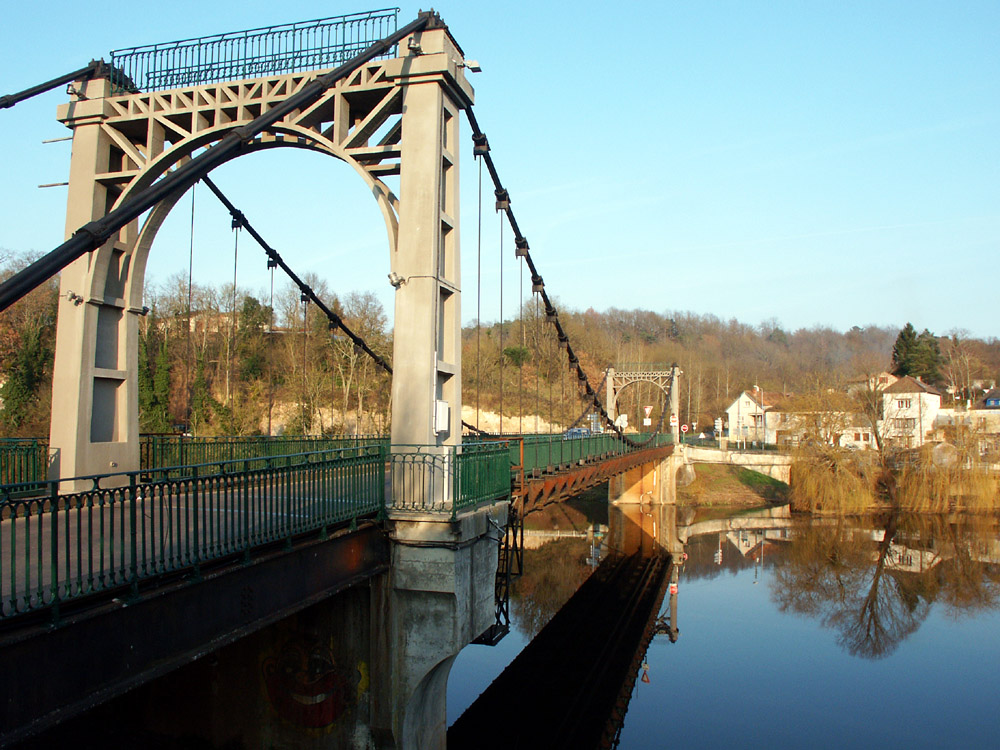
The Pont de Bonneuil-Matours has done sterling service for over a century but has been closed for the past 4 years.

The original bridge was built in 1846 as a toll bridge. It was initially a wooden structure with a single cart lane and limited to a weight capacity of 5,500 kg. The need for an upgrade arose in the early 20th century due to wear and tear and increased motorized traffic.

The bridge in 2008


In 1931-1932 Etablissements Arnodin Leinekugel Le Coq renovated the bridge, preserving the original foundations but replacing the deck and upper structure to meet modern needs. It's the oldest operational suspension bridge in France with contiguous cable bundles (don't ask me, I'm stumped), a design now seen in larger suspended bridges like Tancarville and Aquitaine. It's the second bridge in France to adopt this technique, following the example of the now replaced Vicq sur Gartempe bridge of 1931.

In 2019 the bridge was closed for a two year refurbishing as part of the "Grand Travaux du Schéma Routier". The real world intervened in events, but it was reopened on the 7th December 2023.

Soon after the reopening we saw the bridge for the first time since the work was done. It wasn't finished (they were doing something with hydraulics) but at least our shortest and quickest route to Poitiers has reopened.

The Bridge in December 2023


We don't often go to Poitiers these days. When we first bought this house we thought we'd be whizzing down to Poitiers at a drop of a hat. But it appears that psychogeography affects even people who are new to a place and don't have inbred opinions. We're in the Touraine, so we go to Tours. The route to to Poitiers is the same distance and leads to the same shops and services but we don't go there. The diversion caused by the bridge being out of commission has hardly affected us.