Wednesday, 19 December 2018

Growing Exotic Mushrooms on an Old Army Base


A couple of weeks ago, on a really miserable blustery wet day I drove over to Nouâtre on the Vienne to meet other members of the Association de botanie et de mycologie de Sainte Maure de Touraine. Nouâtre, in case you don't know it, is home to a ginormous army base used as a materiels repair, storage and supply hub. It used to be bigger and the part that is no longer in use by the military is an industrial estate. We were off there to visit Bio-Champi, a company producing half a dozen organically grown species of mushrooms for the pharmaceutical industry, but (not yet) for culinary purposes.

Mushrooms growing outdoors.
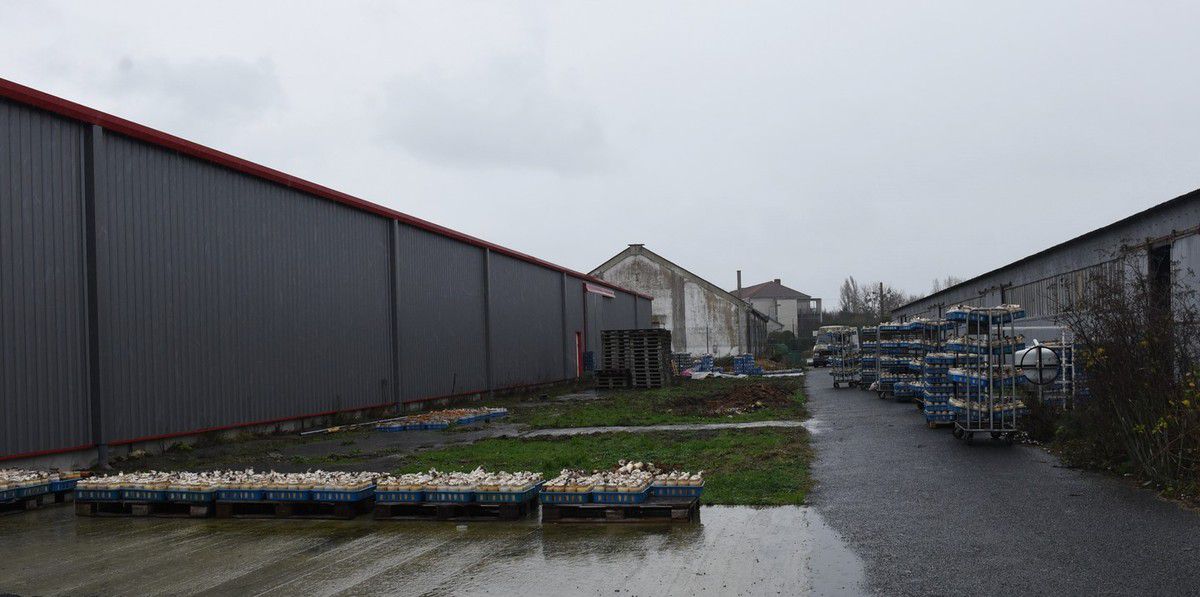
Photo courtesy of Louisette Chaslon.

The business was established 15 years ago by Chinese born microbiologist Guanglai Zhang and they specialise in cultivating rare species using a Japanese technique that no one else in Europe is using. The mushrooms are grown in transparent plastic pots, which in earthquake prone Japan mean that you do not lose your crop when the ground trembles. The clear pots also mean that any contamination by diseases can be seen early.

There are machines made for the various processes involved in the cultivation and designed specifically to deal with these plastic pots. The polypropylene pots are sterilised in autoclaves and can be reused 18 times, which makes them eco-friendly.

White Ferula Mushroom Pleurotus eryngii var nebrodensis 
growing in its special Japanese pot.
Photo courtesy of Louisette Chaslon.

The species we focused on for our visit was the White Ferula Mushroom Pleurotus eryngii var nebrodensis (Fr. Pleurote du panicaut).

There are thirty species of Pleurotus (oyster mushrooms) which are grown commercially. The best known is the Grey Oyster Mushroom P. ostreatus, which you can buy in almost any supermarket these days, but the most highly prized is the White Ferula Mushroom. The variety P. e. ferulae (White Elf Mushroom) is found in the wild in France, associated with thistles, and recognisable by its slimmer stem. Another well known variety is the King Oyster Mushroom P. e. eryngii, which has a bigger slightly paler cap.

Guanglai Zhang, holding a tube of mycelium.
Photo courtesy of Louisette Chaslon.

Four varieties of P. eryngii are native to Europe and one to China, all growing at different altitudes above sea level. All are edible. The rarest is P. eryngii var nebrodensis, the White Ferula Mushroom, growing in the wild only in the high rocky mountains of Sicily (1200 - 2000 m), where it is always associated with the umbellifer Cachrys ferulacea. It is also one of the top ten most highly sought after edible mushrooms in the world. Although it is Red Listed there is no protective legislation in place and it can still be harvested in the wild. Consequently, it is believed that fewer than 250 mushroom fruiting bodies per year reach maturity in the wild due to over harvesting and the picking of immature mushrooms. Bio-Champi is therefore developing and refining a method of cultivation for the species, to supply the culinary and medicinal demand and take the pressure off the wild population. They also grow the ordinary Grey Oyster Mushroom at their facility.

The thick stem is diagnostic for P. eryngii var nebrodensis, and many mushrooms on the market purporting to be this species turn out to be one of the other more common varieties of P. eryngii. This species is heat and cold resistant, making a crusty cracked skin on its cap in hot weather, as the flesh grows more quickly than the skin. This cracked skin is a sign of the best quality with the most flavour. The mushrooms will appear in the wild in April-May and September-October.

Showing us the outdoor mushrooms.
Photo courtesy of Louisette Chaslon.

The White Ferula Mushroom P. eryngii var nebrodensis is also associated with another umbellifer, Sea Holly Eryngium spp. In Spain the mushroom is cultivated outdoors in rows of Sea Holly but it is a lot of work and the crop is plagued by disease. The aim of the cultivation and research at Bio-Champi is to select strains with good stems. They've found there is no need to provide Sea Holly and that the mushroom is content to grow indoors on a mixture of sawdust and straw, which is full of cellulose and lignin which the mushroom will feed on. Another advantage of growing it indoors is that less water is required and it is much easier to keep everything clean and disease free.

Commercial production of the White Ferula Mushroom is mainly concentrated in Asia, with one million two hundred thousand tonnes grown in China. Japan, Korea and Taiwan are also significant producers. Only one hundred tonnes are produced in the whole of Europe.

Bio-Champi propagate by using secondary mycelium in test tubes, not spores. The secondary mycelium is harvested from the section between the stem and the cap of the mushroom. If you want to create hybrids you need to work with spores and create primary mycelium. It takes about ten years to produce a good mycelium.

Bio-Champi, along with Greek and Italian experts, are also trying to establish why the mushroom occurs only in Sicily and why it is rare. A lot of the extant literature will say that it also occurs in China, in the province of Sin-Kiang, but this turns out to be an unfortunate misidentification.

In mushroom cultivation producers have the choice of pasturising or sterilising the substrate. Pasturisation (the technique used at the mushroom caves at Bourré for example) does not kill certain microbes, but is suitable for species such as button mushrooms Agaricus bisporus. However, the White Ferula Mushroom is much more disease prone and the sterilisation process was developed to combat that. The pots and substrate are put in the steam vaporisor autoclave for 10 hours at 100C, then mechanically inoculated and closed for incubation. The sterilisation kills all bacteria and the inoculation machine can process three thousand pots in an hour. Viruses would not be killed, but are not a problem for the cultivation. The pots spend 10 months in the incubation chamber, until the mycelium and little fruiting bodies start appearing. To begin with the temperature is controlled to be within 12 to 18 C but once fruiting starts this is not so crucial. At this point they will be transferred to another shed if it is summertime, but in the winter they are simply put on wheeled racks and trundled outside to grow naturally. Neither rain nor frost damages them, but in the summer parasitic flies are a very big problem.

For the future of the industry Bio-Champi is busy working on all aspects of production:
  • the appearance of the mushrooms
  • their commercial quality (in bulk, in punnets, presentation)
  • ease of culinary preparation
  • technical production (mechinisation)
  • varietal performance (speed of growth, disease resistance)
  • environmental issues (eg waste)
  • health and safety of workers
They are also keeping a close eye on new developments in China, where they are cultivating new species such as Summer Cep Boletus reticulatus, the morel Morchella vulgaris and Chinese Truffle Tuber indicum.

More photos by Louisette on her blog.
Photos by André on his blog.

Tuesday, 18 December 2018

A Bomb Under the Bridge at Blois


I September an unexploded bomb was discovered under the third arch of the Pont Jacques-Gabriel in Blois, during a fire brigade swift water training exercise. It was dropped mid-June 1944 by an American plane, causing no damage to the bridge. The bridge had already been deliberately damaged by explosives earlier in the war to slow the German advance in June 1940, and later it was again deliberately blown up, in August 1944, when the Germans retreated to Vienne. After the war the bridge was restored and we've all  been driving over it and boating under it ever since.


To render the bomb safe took the mobilisation of 120 people on Sunday 2 December. Present were the bomb disposal squad of course, but also local administrators, fifteen or so fire officers to extract the bomb from the river, and forty or fifty police of different flavours to ensure public order and safety. Some were stationed at the bridge, others at the site north of the city where it was to be exploded under controlled conditions.

The security cordon was fixed at 135 metres, so no one could cross the bridge on Sunday after 7 am. Nor could you take a boat under, or fly over the zone. No boating or fishing allowed. About 70 residents were evacuated to the Town Hall, where they were welcomed with breakfast. Businesses in the area were alerted, the disabled were offered the services of three ambulances on standby and gas and water cut off.


The 250kg bomb contained 124kg of active TNT. The bomb squad had already disarmed the two fuses but there was still a risk because this type of explosive can be unstable if moved. Removing the bomb from the river bed required a crane to lift it up onto the bridge and onto a truck. It was then transported to a quarry where it was buried three metres deep under sand, to reduce the noise and shockwave of the explosion.

Monday, 17 December 2018

The Annual Foie Gras Preparation 2018


As usual a group of us gathered at Rosemary and Jean-Michel's house to prepare foie gras for Christmas. I had picked up the foies fresh from the producer's abbatoir the day before. Here are some pictures of the day:

I've separated the two lobes of the liver.

Me, Jean-Michel and Paul, digging deep for veins.

Newbie Tamsin is helped by Rosemary, who has years of experience.

Seasoning the foie gras before wrapping in gauze for curing.

Six people attended -- three Australian (me, Rosemary and Tamsin) and three French (Jean-Michel, Paul and Françoise). Four foies were prepared and are now ready for consumption, although we will keep ours until Christmas celebrations really get underway. This year I've got English onion marmalade and a jar of something labelled piperade de Noël which claims to be ideal with foie gras. Both were opportunistically bought at Noz in anticipation of Christmas foie gras.

Here is a link to a previous post about making foie gras, and another for if you are uncomfortable with the idea of foie gras.

Sunday, 16 December 2018

The Agapanthus Thief


The house next door to Simon's brother's place has been unoccupied for years. Every New Year (or thereabouts) Jon jumps the fence, steals half a dozen agapanthus stems from the garden and brings them back for Rosy. It is one of those charming and romantic traditions that couples create for themselves.

Saturday, 15 December 2018

Alpine Chough


The Alpine Chough Pyrrhocorax graculus is a member of the crow family. They have happily adapted to the tourist presence in the high alpine areas and I photographed these youngsters hanging out on the roof of the café at Nufenen Pass. Their natural food is invertebrates or berries which they forage in the alpine grasslands, but they aren't proud. Scraps from restaurant tables and rubbish bins are also enticing and in ski resorts the birds will stay at high altitudes all year round now whereas in the past they would have descended to a lower altitude during winter. They nest in crevices in the rocky cliffs.

Australian White-winged Choughs are members of the same family and look similar, but are not all that closely related.

Friday, 14 December 2018

Drive Slowly in Preuilly, Please


These '30 Zone' signs painted on the road have appeared on every road leading into the centre of Preuilly. No lollipop style 30 kph signs on poles have appeared though, probably on the grounds that in these small French streets you can't afford to have too much street furniture. Hopefully the signs will be effective and slow people down. Other villages have adopted them too, so presumably they are the latest thing in traffic calming. I'd quite like one at the bottom of our street.

Thursday, 13 December 2018

A Walk From Le Grand Pressigny Along the Aigronne


Our walking club outing on 29 November took us from Le Grand Pressigny, out along a ridge following the north (right) bank of the Aigronne River, down and across the river then back up on the ridge the other side. This second ridge is the one proposed as the site of the dreaded wind turbines, although they will be closer to Le Petit Pressigny as there are too many houses along the part we walked I think. I can't see how the wind turbines could meet the requirement to be 500 metres away from buildings along the section we walked. Here are some pictures from the walk:


The chateau of Le Grand Pressigny next to the new Museum of Prehistory, 
taken from rue de la vieille poste.

A troglodyte home.

The home of one of Louis XIV's mistresses according to local lore.
This house might not look much from the outside but I'm told that inside it is four huge rooms, elegantly and sympathetically restored and furnished by the current owners, who are friends of friends.

A billhook stuck into a telephone pole.

An abandoned limestone quarry in the cliff.
I have been within metres of this cave pictured above and not known it was there. The entrance must be obscured by bushes if you are on the nearby path.

We were amused by this turnstile entrance to a plot of land in the middle of nowhere.

The once mighty Chateau of Etableau.
The chateau is owned by the recently retired pharmacist from Le Grand Pressigny, who lives in a more modern house down the hill beyond the chateau and overlooking the Claise Valley. The Chateau of Etableau has looked like this, with the iron bands holding the great tower together, for as long as anyone can remember.

View from the market place in Le Grand Pressigny.

Wednesday, 12 December 2018

The Best Eclairs in the Touraine


Recently La Parisienne patisserie in Loches won 'Best Chocolate Eclair in the Touraine' so naturally we hot-footed it there to try them. The shop was packed and when I congratulated the woman serving me she thanked me but shrugged and I got the impression she was a bit fed up with complete strangers walking in and only being interested in the chocolate éclairs. If I'd been a regular and loyal customer the reaction would have been warmer. And quite right too. I am pleased for them, but in fact, I habitually use a boulangerie patisserie round the corner in Loches, and will continue to do so (because I like their bread, quiches and viennoiseries, which are more my thing). I almost never buy an éclair, from anyone.

La Parisienne bakery in Loches.

The shop the prize winning pastry chef occupies is charming. An old building with visibly genuinely aged beams, painted a tasteful very pale grey. The display of cakes and pastries was enticing and a little bit unusual, indicative of a keen and creative baker out the back. I will happily take clients there if they want to experience a really good patisserie with a bit of cachet now they are officially the best éclair makers. I am lucky to be spoilt for choice though with my own purchasing and can flit from one baker to another, depending on convenience of locality and what I'm shopping for. There are nine artisan bakeries listed in the phone book for Loches, and three in Preuilly. I'm familiar with four of the Loches establishments and all three in Preuilly. All of them do good bread, pastries and cakes.

The chocolate éclairs are in the middle of this photo, slightly obscured by their trophy.

If you want to try the prize winning éclairs, La Parisienne is at 4 rue Picois (near the fountain).

Tuesday, 11 December 2018

The Davos 2019 SwissAlpine H20

We have mentioned before that we're doing the excecise thing in order to do an event in Davos. I've been keeping my eye on the website, and at the weekend was delighted to see the route for next year has been released.


It is 20km, starting in Davos at 1533 metres above sea level, and topping out at 2571 metres. The climbing starts at 6.35km, and then it's one long uphill slog of 5.3km, climbing 948 metres at an average gradient of 18.6%. Once we're at the top though, its downhill all the way. (If all the previous was a bit too technical,: it starts slowly, there's a thumping big climb in the middle, then we go back to where we started.)

The uphill starts in the gap in the trees on the right.

You can see the path zig-zagging up the hill in the centre of the photo.
Later we will be walking along the ridge on the left.

We are doing our training on roads. I'm not sure that's ideal preparation
 for this track, which we will be on just below the peak

Talking of training: last week we managed less than 10km of walking, and 1200 metres of swimming. A combination of stuff got in our way.

If anyone wants to join us in our stroll through the alps, more info is here.

Monday, 10 December 2018

Herby Nuts


A pan of nuts waiting to be roasted.

I'm working through the bumper walnut crop and recently made this recipe from Simply Recipes, using half homegrown walnuts and half almonds. Not bad, although to be honest the herbs didn't add much. Next time I'll up the salt and spices and ditch the herbs. Despite the comment in the original recipe about consuming as soon as they are ready, we found that they were nice the next day unheated too.

Glazed, seasoned and ready to eat.

Sunday, 9 December 2018

Little Corellas


Corellas are a type of cockatoo, three species of which occur in Australia. This one, the Little Corella Cacatua sanguinia, is by far the most abundant and visible because of its presence in urban areas. You can encounter them anywhere except thick forest, from the arid inland deserts to the coast. They like lawns, playing fields and crops (where they are a pest). Congregating in flocks, sometimes numbering hundreds of birds, they roost communally in trees overnight then fly out some distance to feed together on seeds. Depending on where they live they may also fly long distances twice a day to water. They are noisy, gregarious and clownish. In the past they were popular caged birds (although if you owned one in town your neighbours hated you and your bird).


Saturday, 8 December 2018

Alpine Bartsia


At first glance, when I was scrolling through my Swiss photos, I thought this plant was more of the amazing purple Pyramidal Bugle I'd photographed a few metres away. But on closer inspection it turned out to be Alpine Bartsia Bartsia alpina, an equally amazingly purple plant of high rocky limestone grasslands.


Friday, 7 December 2018

The Villandry Lindens


Linden trees have long been believed in Europe to have medicinal benefits. They have been planted around hospitals since the Middle Ages to purify the air, and linden tea, made from the nectar rich flowers is still very popular as a calmative. Since the 17th century they have been one of the key plants in French formal gardens, being used to line paths and create 'living cloisters', in a way that demonstrated the gardener's mastery over nature.


Linden trees are native to much of Europe and especially the lime rich soils of areas such as the Loire Valley. They are easy to cultivate and live to around 400 years. In the formal gardening style of places such as Villandry the trees are pruned to create green curtains and to direct the eye to certain views. The Villandry lindens are two different species -- Small Leafed Linden Tilia cordata, with its heart-shaped leaves, and Large Leafed Linden T. platyphyllos. 


There are 1016 lindens at Villandry and pruning takes place over winter. For eight weeks four of the gardeners do nothing but prune linden trees. They use a style known as 'cats head', named after the effect of pruning at the same point year after year and producing a nodule which resembles a cats head. It has been found that trees pruned like this are able to store extra reserves of starches and sugars in the mass of scar tissue produced. This is another reason the trees are so long lived. The position and spacing of the cats heads is part of the gardeners skill. Too close or too far and the tree will not thrive. Dead branches are cut out and new vigorous young shoots chosen to replace them every year as necessary.


The trees at Villandry get the deluxe treatment every year. The gardeners prune from the vantage point of a cherry picker and use pneumatic loppers to individually cut each spur of annual growth. In public plantings such as street trees a cruder method is used, where the trees are mechanically scythed each spring. This weakens them and every few years they have to be pruned properly in order for them not to appear spindly and thin. Sadly, either method of pruning means that these trees do not flower. If they did you would be able to smell the garden before you saw it in mid-summer, and hear it because of the quantity of bees attracted. 


Lindens may be robust, but they do come under attack from certain pests. At Villandry they are protected against aphids by an army of ladybirds. In 1995 the trees were severely infested with two-spotted spider mite, which turned the leaves into lace then caused them to fall in mid-summer. Chemical sprays were ineffective and a research facility was called in to provide a biological control. The management felt that they could not justify the risk to the health of the gardeners or the visitors if they continued to spray the mites with pesticides. As they discovered, the answer was already on their doorstep. In the forest around the chateau there was already a predatory mite living happily in the wild lindens and preying on the two-spotted mites. These were introduced to the gardens and by 2002 the problem was under control, with the predatory mites having established a thriving colony in the Villandry lindens.


Thursday, 6 December 2018

The Moat's a Bit of a Mess


A couple of months ago I heard through the grapevine that the retaining wall for the moat at the Chateau of Boussay had collapsed. It took me a few weeks to get over there to see for myself and photograph it and in the meantime the chateau posted photos on their Facebook page, along with an appeal for donations of suitable stone to help the repairs.


This is par for the course if you own a crumbling medieval chateau. Last year it was a chimney and fireplace collapse. I've no doubt the roofs and windows are a constant worry. Imagine trying to heat the place. Chateaux look romantic, but it takes real determination to keep them maintained using private (as opposed to State) funds.


The rubble from the collapsed moat wall has been cleared out, the moat drained and scaffolding erected. Work is slowly starting on the rebuilding of the wall, but they have discovered that they don't have enough suitable stone, hence the appeal for donations. They are asking for anyone local who has moellons (a sort of large brick sized piece of roughly dressed limestone) that they don't want to please get in touch.


Wednesday, 5 December 2018

Creamy Aged Goats Cheese


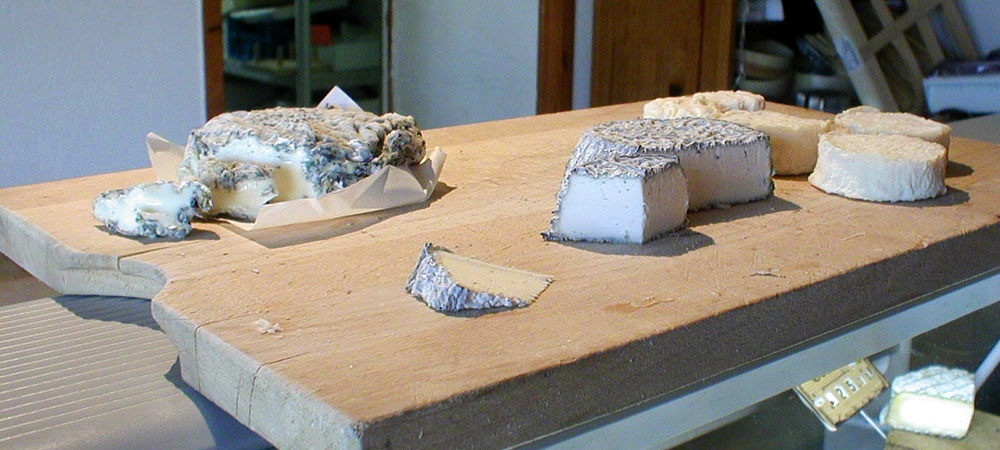
When we visited our favourite cheesemaker in late November he was in full Christmas production mode. One of his premium products is a positively evil looking creamy goats cheese (top left) in the Selles sur Cher disc style.

 A selection of cheeses in the boutique at Fromagerie Moreau.

The Fromagerie Moreau, owned by Jean-Luc Bilien, is based in Pontlevoy and sells almost all of its output to speciality cheese shops in Paris. His clients and their customers are sophisticated and educated. They know that the evil looking creamy goats cheese he produces is in fact delicious.

 Jean-Luc turning the creamy aged cheeses that will be ready for the holidays.

Initially I was really skeptical. I've had goats cheese achieve this look in my fridge if I've kept it for a bit long. It isn't delicious, but slimey and lactic. However, the secret is in controlling the atmosphere where the cheese is aged and carefully turning each cheese every couple of days. Jean-Luc's cheese may look off-putting, but trust me, you should try it. The flavour is not overly powerful, especially if you compare it to a 100 day aged cheese, which is hard and peppery. By contrast, the texture is smooth and unctuous, with complex savoury flavours.

Jean-Luc hosting a tasting session with some of our clients (this is Jordan from New York).

Tomorrow we'll be calling in to buy one of the special cheeses to take to our annual foie gras workshop lunch.

Tuesday, 4 December 2018

Wartime Inscription


I noticed this inscription carved into a wall at about waist height in Les Viaullières, a hamlet near Chaumussay. I asked one of my companions, Joël, if he knew the story behind it. He usually knows the history of this sort of thing, but in this case, he did not. What he did tell me was that German prisoners of war had made the road we were standing on, but that would be a few years after 1940. So the date remains a mystery unless some knowledgeable reader can enlighten me.

The reference to German prisoners of war building roads in the area was the second conversation of this sort I'd had in the space of a few weeks. Jacky Foucher had also mentioned to me that they had built the road down from the Preuilly - Le Grand Pressigny road to Chaumussay, past her grandfather's farmhouse at Les Reuilles. As usual, she chipped me about my pronunciation of 'Reuilles'. It should sound something like 'rher-yuh' but I have a tendency to pronounce it 'rher-yee'. According to her it is an old word or a corruption of the word for 'stream', which is 'ruisseau'. I wonder if 'reuilles' is connected to the English word 'rill' in that case?

Monday, 3 December 2018

Lay Broonies


French native speakers really struggle with 'ow' in English. They tend to pronounce it like the French 'ou', which sounds, more or less, like the 'oo' of 'soon'. So brownies, which are very popular here, is pronounced 'broonee'. There is no French word for brownies -- they've adopted the American English word for these delicious squidgy chocolate squares, spelling it the same, but pronouncing it completely differently.

Artisanal hazelnut butter.

I've been working on recipes to use the locally manufactured hazelnut butter made by La Berrinoise and sold by La Croisée des Terroirs at the Saturday market in Preuilly. Chocolate hazelnut broonies seemed like a possibility and in a recent Clandestine Cake Club newsletter there was just the recipe.

 The brownies straight out of the oven.

Substituting the Berrinoise Praliné Noisettes makes a great alternative version of this recipe and it was easy and successful.

Sunday, 2 December 2018

Australian Pied Oystercatcher


These two black and white birds waiting out the high tide on a jetty at Woy Woy are Australian Pied Oystercatchers Haematopus longirostris. They can be observed almost anywhere on the coast of Australia, especially on sandy beaches. They use their scarlet beaks to flip up bivalves from under the sand and break them open to eat them. Different birds use different techniques so it is believed that they learn how to break into a shell by observing their parents.

Saturday, 1 December 2018

Creeping Avens


You would think that these seed heads are distinctive enough that the plant species would be easy to identify, but it took me a good hour struggling on the internet to come up with a species.

Creeping Avens Geum reptans is a rare upland species, growing on moraines, rock falls and north facing scree slopes at an altitude between 2000 and 3000 metres.

Photographed at Nufenen Pass in Switzerland, July 2018.