Friday, 14 October 2011

Letter From a Car

11 October 2011:

I am writing this sitting in Célestine in the car park at Chenonceau, which is pretty high tech for me.

Unfortunately I am writing it in a word processor rather than in the blog, then will transfer it later. I walked up to the local hotel, where I had wi-fi signals showing, but they are all expensive pay ones rather than free wi-fi provided by the hotels. The Hotel de la Gare in Montrichard has free wi-fi, but that isn't where I am. It's a pity I can't find a free connection in Chenonceau, because I would not be tied to sitting in the car in the cold car park, but rather in a nice warm café having a coffee, writing. I could go to a café and write in the word processor, I guess, but that might be sensible.
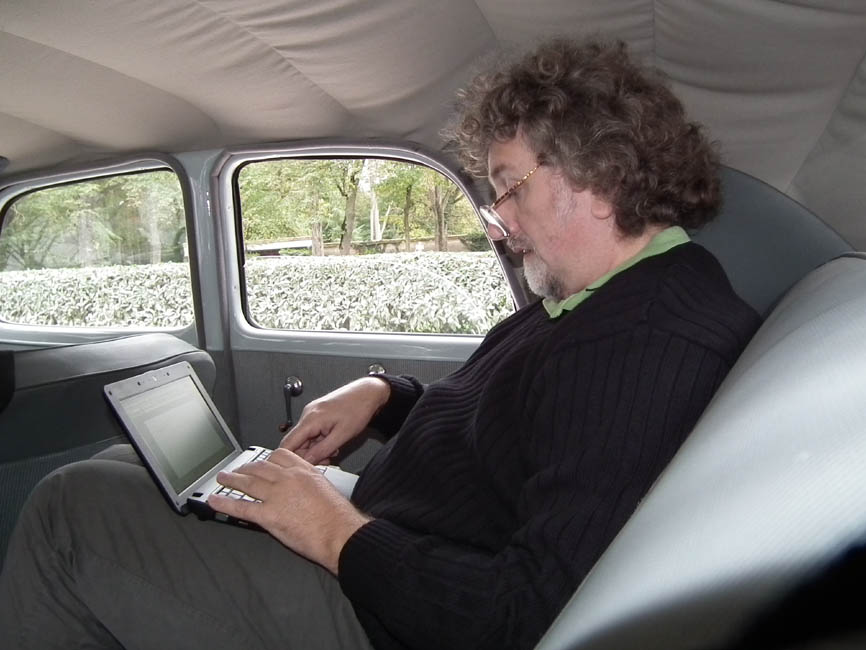
The computer I am using is an Asus EeePc, which I recently bought online from England. It was very inexpensive and runs Windows XP, both very important considerations for me.

Having a wireless laptop means that I had to get our home internet connection and router sorted out: for years we have been connecting to the internet via a modem that has always claimed that we weren't connected to the internet. No matter what I did, the internet showed as disconnected, even when I was reading web-pages.

Luckily Stéphane knows computers (is there no end to the man's talents?) and didn't switch off when it came to learning about networking (unlike me, who decided that I knew enough and didn't want to be bothered with that kind of stuff). We spent an afternoon saying “but I don't understand” to each other, then suddenly everything cleared itself up. I don't think either of us really know what the modem thought it was doing, but it decided after prompting to do it all differently. This means we can now move files between computers without using a data key, and the internet can be used on more than one computer at once.

The most important implication of this is that I can listen to the cricket online while Susan does grown up business emails and the like.

Technology – sometimes it is a great thing...

Simon

Thursday, 13 October 2011

Action Men

Early on Tuesday morning we met some clients at their chambre d'hote in Amboise, which was situated on the island facing the château.

The street the chambre d'hote is in is very narrow, so I waited with Célestine just in case someone wanted to actually use the road for the purpose for which is was intended. Whilst standing there I looked out over the river and noticed that the pompiers were having what I assumed was a training exercise.

They were taking it all very seriously, but I have no doubt that even in the cold of a Touraine October morning they were also enjoying just messing about in boats.

For photos of Preuilly sur Claise's pompiers having a training exercise, click here.

The Pompiers' weren't the only boats on the river


Simon

Wednesday, 12 October 2011

Finishing the start of that job.

It's weeks since I wrote that we were starting to finish the insulation of the staircase tower. Since then the job has been finished, but what with spending all my time in the car park at Chenonceau I really have not had time to write about the next steps.

After putting the framework in place, Stéphane first applied a very rough 50/50 mixture of cement and chaux (lime) with enough water to hold it together. This was to give the chaux chanvre something to grip onto and was applied from a distance by being thrown at the wall. It wasn't a thick layer, nor did it give complete coverage.

The first layer of cement isn't really a layer
After that had dried, it was time to apply the real insulation. The next 2 layers were a real treat - a light, foamy mixture with the consistency of Chantilly cream. The recipe is:
50 litres of chopped chanvre (hemp)
25 litres of chaux aérienne (CAEB 90)
25 litres water

After the first layer of chaux chanvre. You can
see how messy the process is.
These layers were also thrown at the wall from a distance, but because of the looseness of the mix it involved constantly pushing the mixture back into the voids. Just like working with whipped egg whites, however, it was important to avoid working the mixture too much and losing the air. We allowed three days between layers, each about 5cm (2 inches) thick.

The second layer of chaux chanvre in place.
By this stage there was gunk everywhere.
Another three days later it was time for the final coat. This was a mixture of:
½ bucket chaux aérienne
½ bucket fine (0-2mm) white sand
1 bucket chanvre
½ bucket water (more or less)

This was of a more traditional gloopiness, more like cement, and trowelled into place. This involves plenty of muscle power as you are trying to get a slightly glazed looking finish.

Before the final layer was applied the wood was cleaned.
You can now start to see the final effect.
This will eventually dry to almost white - a process that will take a couple of months to complete. This means that wall of the staircase tower will have 20cm (8 inches) of glass wool and 15 cm (6 inches) of chaux chanvre insulation and provide as much insulation as the other walls, which are one metre thick.

Simon

Tuesday, 11 October 2011

Cyclamen

It's that time of year again - the cyclamen are out. On this blog we like to establish traditions, so for the nth year running (I'm not doing counting today) we have a photo of the cyclamen at the Chateau du Lion in Preuilly.
There are a couple more photos here.

Simon

Monday, 10 October 2011

The Next Generation

Despite the fact that I saw very few Glanville Fritillary butterflies Melitaea cinxia (la Mélitée du plantain in French) this year, on 2 October I found my first 'nest' for the season. Glanville caterpillars live communally when they are young, building a web which serves as a shelter from the cold and wet of winter at the base of their food plant, plantain. They will sallie out on all but the coldest days to eat and by the spring they will have gone from 10mm long to about 40mm and be ready for the transformation into adult butterflies.

You can just see a little caterpillar under the web at lower right.
Since then I've found another web. As I've discovered, they can withstand very cold weather, but the dry spring seems to have affected them greatly. I think the drought caused a loss of their secondary food plant, speedwell, just when they needed it in the spring this year. Hopefully next year will go better for them.

Susan

PS I saw the first orchid leaf rosette for the season, at le Petit Pressigny, on the side of the road, when I was there for L'Art et Lard.

Sunday, 9 October 2011

Sparkling Strawberry Jelly

Homemade jellies are easy and a great way to ring in the changes with a glut of fresh fruit. At the moment we are getting nearly a kilo of strawberries every few days. In the spring I made sorbet, now in the autumn I am making jelly. This recipe works equally well with nectarines, peaches, cherries, grapes, blueberries or raspberries.

Homemade jelly and sparkling Gaudrelle rosé.
Ingredients:
8 leaves of gelatine, soaked in 2 tbsp cold water
1 cup sugar
1½ cups hot water
½ good red fruit based cordial/syrup/squash (Pulco is my choice in France)
100g strawberries or other fresh fruit
1 tsp lemon juice
1 bottle sparkling wine, chilled

Method:
  1. Mix the gelatine, sugar and hot water together until everything is dissolved.
  2. Add the cordial, lemon juice and 1 cup of the sparkling wine.
  3. Leave in the fridge for 30 minutes to an hour until gelling has commenced.
  4. Stir in the strawberries and spoon into glasses. Leave to chill until set.
  5. Drink the rest of the sparkling wine with smoked salmon for apéro.
Susan

Saturday, 8 October 2011

Chenonceau Events

I have written before about the car park at Chenonceau, and how much time I spend in it.

This past week is no different: having visited the chateau three times in seven days I am even more au fait with the happenings in the car park, many more of which you can see now the visitor numbers have dropped. Six weeks ago you couldn't get into the carpark for cars, but now you have a choice of parking.

It also means that you can see more of the wildlife: last week I saw a woodpecker working over the crevices in the stonework of the moat, and on Thursday a squirrel was busy checking out every tree but stopped to see who it was making the clicking sound.

On Wednesday I was in danger of being out styled: this 1926 Rolls Royce Twenty doctor's coupe was in the carpark (coachmakers name unknown to me). It was driven by a very nice English couple from Brittany, who towed it to the Loire Valley behind their ordinary car so that they could use it visiting chateaux.


We are at Chenonceau again next week - I wonder what other delights the car park will have for me?

Simon

Friday, 7 October 2011

Peacocks at Rivau

The flock of peacocks which is given the run of the garden at the Château du Rivau add an element of charming elegance. They arrange themselves decoratively on the furniture and pop up like living works of art in the long grass.

This little one was a bit bemused at being photographed.
I liked the way they have been provided with a secret peacock refuge, hidden away under a large tree with a canopy that reaches down the ground behind a garden bed. If you peer in you can see a feeding station and some water tucked in behind the shrubbery, but allowing the peacocks to strut solemnly about through the vegetation and out into the open, or retreat into their safe haven where visitors cannot bother them, as and when the mood takes them.

Just because you are halfway through moulting doesn't
mean you can't flaunt what little you've got.
This must be how you see them in the wild in India
(minus the plant label of course...)
Too bad if you want to sit - it's now a peacock perch!

Susan

Thursday, 6 October 2011

Peering into Dark Corners

We wrote on Tuesday about the Fontaine St Mandé in Ferrière-Larçon, which we only discovered on our second walk around the village.

Likewise, this interesting little troglo is something we had not looked at before despite having driven past dozens of times. We have probably seen it without noticing, but in our defence it is on quite a tricky little corner which incoming traffic like to take in the middle of the road, thus dragging our attention away from the passing scenery.

From the road it's just a little dark patch under a large fig tree, but walking past you become aware that something lurks within.

I don't know when someone last lived here, but it is quite an atmospheric little reminder of days gone.


Simon

Wednesday, 5 October 2011

The Metro Lamp Post

The Paris Métro has always had lamps by the station entrances, which are often referred to by the people who refer to this sort of thing as totems. These have been in a variety of styles, becoming less ornate over the years. This example is from the second re-imagining in 1924, and replaced the Val d'Osne style in the 1930s.

Metro Richelieu – Drouot
The "Dervaux style" was art deco based, and designed by Adolphe Dervaux, who was also responsible for mainline stations in Rouen and other places. When the Paris Metro celebrated their centenary they also celebrated the architecture of the system, placing plaques at various places across the network giving details of the details.

This one says
The lampost you can see at the entrance to this station was designed by the architect Dervaux and first installed in 1924 at Sèvres-Babylone station.

The model spread rapidly. Very sober, it replaced the wrought iron Val d'Osne lamp or the Art Nouveau post created in 1900 by Hector Guimard. It could be set either on a simple post also designed by Dervaux or stone posts. More rarely, it could finish off a Guimard post.

The cut out letters of the abbreviation 'Métro' are typically Art Deco. Generally inscribed in white on a red background, the sign is surmounted by a white lamp lit at night.

Simon

Tuesday, 4 October 2011

Fontaine St Mandé

St Mandé was a Celtic saint said to be from Ireland, but who travelled to Brittany in the 5th century. He set up a monastry on the island now named after him - Isle Maudez - banishing the snakes in the process. In the 9th century his relics were in danger from Viking raiders and were taken to Paris, this being the reason there is a commune called St-Mandé just outside the French capitol.

All of this has no bearing on the reason why in Ferrière-Larçon the local magic well bears the name of St Mandé's well (marked here, point A). In other places, the St Mandé's wells are said to cure worms, (a symbolic repeat of the banishing of snakes) but in local legend this particular well is capable of curing fevers, rickets, and unhealthy pallor.

Four years ago we walked straight
past this without seeing it.

Important Notice
The water from St Mandé's fountain is capable of delivering miracles - at least, that's what the legend tells us.

However, an analysis done by the Touraine Laboratory revealed that it is totally unsuitable for human consumption. We therefore strongly advise that it is not drunk, taken away to drink or used in any other way that could put health at risk.

This fountain is a monument greatly enjoyed by both locals and visitors. You are urged to respect it and to respect the crystal clearness of the water by refraining from throwing in flowers, vegetation or fish, or adding other things which don't belong there.

Thank you for your understanding.

The Mayor
Limpid waters.
The water in the well is about 4' (1.2 metres) deep, but looks a lot deeper due to the reflection of the ceiling. It is beautifully clear, as the mayors notice states, and is set up so that it just magically appears - not seeping through the soil as at Chaumussay, but apparently directly into a pool.

St Mandé has many names, including Maudé, Maudet (Breton French), Maodez or Modez (Breton), Maudetus (Latin), and is commemorated in Cornwall as St Mawes.

Simon

p.s. Some people might think they have seen this before. You haven't, but are obviously psychic.

Monday, 3 October 2011

Eaten Up

We are busy so I thought you might like to take a look at the Canadian poet Pearl Pirie's food blog Eaten Up. I like it a lot. It's got beautiful pictures and the poet in her can't help but express her delight in the sensory pleasure food gives at all stages from garden to kitchen to plate to mouth.

Louisa's charming gîte, where Pearl and Brian
were staying, in a hamlet near Preuilly.
I'm pleased to see that apéro at our place featured recently, after she visited with her husband Brian and our friend Louisa.

Susan

Sunday, 2 October 2011

Autolib'

Today is quite an interesting day, especially if you're in Paris:

Autolib' is the motoring equivalent of Velib', the communal bike hire scheme in Paris. As its name suggests however, this is all about cars - and electric cars at that. The scheme goes live today (maybe an unfortunate choice of words for something dealing with electricity) and has the potential to change the way that many people think about car use in Paris.

While we were in Paris last week we walked past one of 33 Autolib' stations being built, and I was interested to see how advanced the works were as I had heard the scheme was starting in November.

A bit of noise today for more quiet tomorrow.
One of the hire stations.
You need to join the scheme, which can be done online as can booking the car (and interesting for those used to Boris-Bikes, booking a place to return the car so you don't have to go looking for a space). Once you join you are issued a contactless card which acts as the ignition key or whatever we call what electrics have instead.

There is a fee to join the scheme of €12 per month for an annual subscription, after which you pay 5 € the first half-hour, €4 the second and €6 for every half hour after that.

For a 7 day subscription the fee is €15, then € 7 the first half-hour, €6 the second and €8 for every half hour after that.

The package that will most interest us (and I suspect many other visitors) is the "discovery package" for 24 hours, with a joining fee of €10, with hire costs the same as for the 7 day package.

There are expected to be 1,120 spaces for the cars to start with, with the scheme eventually expanding to 3,000 of the little electric beasties, each of which comes complete with inbuilt GPS. The cars carry 4 adults and have ISO fitting for baby seats.

I imagine that I will use this system. I have been tempted by the idea of the Velib', but a bike around Paris? Not for country bumpkins like me, but driving? That's a completely different matter: who wouldn't want to do the Etoile in complete silence?

The Autolib' website is here.

Simon

Saturday, 1 October 2011

What's Happening in October Around Preuilly?

October has been International Breast Cancer Awareness Month since 1985. The awareness campaign in France is called le cancer du sein, parlons-en ! ('breast cancer, let's talk about it!') and there is a 5km fundraising walk/run. Students have been staging awareness raising events too.

Last year's poster.
Saturday 8 – Latin swing jazz music in a pub atmosphere at la Forge, between Preuilly and Chaumussay, hosted by Mahé Girard and starting at 20.30. Pascal Martin on piano and Anaïs Vaillant on clarinet will perform Miles Davis, Richard Rodgers, Tom Jobim. Selected beers available to sample. Entry 6€.

The orchids will reappear this month after
their summer dormancy.

L'Art et Lard - incontournable !

This time last year we were working on
the office. It looks like this now.
Susan

Friday, 30 September 2011

Château du Rivau

The Château du Rivau is between Chinon and Richelieu, and of all the gardens we visited in our whirlwind week of garden touring in mid-July, I think this one was my favourite.

It was originally recommended to us by our friend 'Henri Proust', who writes the blog for l'Eminence Rouge. The website, slightly irritating Disneyesque fairies bouncing across the page notwithstanding, is informative and well laid out, and HP assured us some time ago that the garden had some interesting design elements.

Last year the château suffered a devastating fire in the roof of the private apartments. None of the rooms on show were damaged, but the family lost quite a lot of personal possessions I think. I read an interview in the paper with Patricia Laigneau the owner and thought she was remarkable. The award winning château restoration had been finished only weeks before. It had been years of hard work, creative thinking and pouring money at the place. It must have been heartbreaking to see it go up in flames, but Patricia put the most incredibly brave face on it. She encouraged visitors to continue to come and just stoïcly prepared to repair the roof.

The memorial to the fire.
When she and her husband purchased the château, Patricia decided that she needed to train as a garden designer, because not only did the buildings need to be rescued, but if they were to be shown off to best advantage they needed a garden to enhance them. The garden she has created uses many of the tricks of formal French grand gardens, but she has had enormous fun too. The garden is relaxed and in some places a bit cheesey even.

Gigantic rubber boots frame the château in this view.
The Laigneaus and their team have done a vast amount of archaeological research to aid their restoration. The story is presented in the stable block and is well worth spending the time to read. The château is believed to be constructed from stone extracted from the area by the entrance, now planted with a clever knot garden, made entirely from different types of lavender. The grand stables were built in the Renaissance to replace a much simpler vernacular building which housed the great war stallions bred on the estate and said to be crucial to the success of the French army lead by Joan of Arc.

Who would have thought lavender varieties were so different in colour?
The main château building is a beautiful fairytale creation with turrets and pointy bits. Patricia has been unable to resist hanging a long hank of 'hair' out the window of one of the towers. The complex is a rare example of a blend of decorative and defensive architecture from late medieval times, the precursor to the almost purely decorative Renaissance examples such as Chenonceau.

This beautiful roof detail is just to the left of the gatehouse.

Susan

Thursday, 29 September 2011

One Room Down

..a few to go.

We have almost finished (as in nothing more to do) the guest bathroom. This past week I have repainted the floor and then varnished it, painted skirting boards, done the window dressing and generally scrubbed it up.

We're quite chuffed.

Quite a change from a month ago. All we need do now is paint the door and that is one room, absolutely finished: painted, insulated, electrified, plumbed, usable and cleanable. The last of the qualities is maybe the most important one, because most of the other rooms are building sites still.

Simon

Wednesday, 28 September 2011

Leccinum aurantiacum - an edible cep

On Sunday I did my final butterfly survey for the year, competing at times along transects with blokes in camouflage gear carrying shotguns and accompanied by lolloping retrievers. Yes, hunting season has begun, so I decided wearing a hi-viz vest was prudent.

Halfway along transect 8, a ride in the Parc de Boussay, I came across some Bolete mushrooms (also known as ceps, cèpes or porcini) growing in the grass near aspen, birch and pine trees. I could see they were not the highly prized Boletus edulis, but I had a strong hunch they were an edible species, so I picked 7 or 8 and took them home.

Leccinum aurantiacum of various ages and sizes.
Once home I looked them up with the limited fungi resources I have in the library of field guides, and on the internet. I concluded that they were Leccinum aurantiacum, called Boletus aurantiacus in any guide older than a couple of years. Bolete taxonomy is a nightmare, but those great guys and gals at Kew are working on it. L. aurantiacum is called the Red-capped Scaber Stalk in North America, but its French name is le Bolet orangé. I telephoned my friend Louisa, who has lots of fungi books and has often been foraging for fungi. She wasn't home so I left a message.

Fortunately my specimens seemed to be very typical examples of the species, which is quite common and relatively easy to identify, at least sensu lato (all the good fungi sites discuss closely related and similar species). The key features are a chestnut cap, beige pores (boletes have a spongy underside, not gills like regular supermarket mushrooms) which are pale in young mushrooms and darken with age, an overhanging cuticle, brown scabers on the stipe (stalk) which go black with age and cream flesh which stains blue-black when cut. They are considered good eating.

Just to make sure I put them in the fridge overnight and took them to the pharmacy on Monday. One of the pharmacists was clearly used to being asked to identify mushrooms and her reference book was just under the counter. She checked all the diagnostic features, as did our doctor's practice nurse, who happened along during this process. We all agreed that it was B. aurantiacus.

A young one, freshly sliced.
Just to make extra sure I paid a visit to my friends the Chedouzeau family, who run a local restaurant. Christophe informed me that he had found some himself the day before and they were edible. Martine and a male customer in the bar agreed that they weren't les Bordeaux (as B. edulis is known in French) but then proceeded to give me several recipes for preparing ceps and Christophe warned me to cut most of the stems off, as they would likely be full of maggots.

Everyone was very relaxed about the idea that I was planning to eat them. Just to make extra double sure though I sliced them and put them in the oven on a low heat with the fan to dry them. Many mushrooms are safer to eat if they have been dried and/or cooked than they are to eat raw. It also meant that I didn't have to commit to eating all of them immediately or wasting them.

By now the mushrooms are starting to stain black.
I'd no sooner popped them in the oven than Louisa arrived, with a couple of Canadian visitors in tow. She had brought her books and we went through them, again arriving at the conclusion that this was B. aurantiacus. We both tasted a tiny piece, just to check there was no bitter taste - a characteristic of a couple of inedible boletes. She said that some years B. aurantiacus was very common here. Her opinion was that they are very good eating, although because they go an unappetising looking black colour, they are not considered as good as B. edulis.

After 2½ hours drying in the oven, the kitchen smelled very satifactorily mushroomy and the ceps were leathery. I've put them in a jar in the pantry until I decide on how I want to cook and serve them. I'll probably start with some in a simple milky soup as a good way of testing them.

Susan

Tuesday, 27 September 2011

Mistress or Madonna?

As the French monarchy became more stable in late medieval times, the king, Charles VII created the position of 'official mistress'. Agnès Sorel was the first successful applicant for the role, and one of the most romantic. As the official mistress she was more or less another queen, living like a member of the royal family and involving herself in politics.

In the 15th century marriage was an economic and political union of families. Love had nothing to do with it, and there was an extremely high tolerance of extra-marital relationships. Prostitution was not condemned and indeed, the King owned at least one brothel.

An early 15th century carved and
painted wooden statuette of Saint Agnes.
Even so, in contemporary depictions, Agnès is represented in disguise as the Virgin Mary. The most famous portrait of her is The Virgin and Child Surrounded by Angels, from the right hand panel of the Melun Diptych, commissioned in 1452 by Etienne Chevalier from Jean Fouquet. Etienne Chevalier was the King's secretary, and in the year he commissioned the Diptych, became Treasurer of France and Secretary of State. He and Agnès were close friends and he discussed matters of state with her in the King's absence. Curiously, the Diptych was hung over the grave of Chevalier's wife, in his home town of Melun.

Despite the name of the painting, a note on the back states that this is 'the Holy Virgin, with traits of Agnès Sorel, mistress of Charles VII, king of France, died in 1450', and most scholars agree that this is a likeness of Agnès. She is portrayed as the Queen of Heaven, richly apparelled and wearing a crown set with pearls. There is very little depth of field in Heaven apparently, so the baby is rather alarmingly perched. The startlingly blue and red seraphim and cherubim crowd in on her. She gazes solemnly and modestly towards the floor.

A copy of Jean Fouquet's Virgin and Child.
(The original painting is in Antwerp).
The artist's intention is to compliment Agnès by taking her as the model for the Virgin. He is also honoring the Virgin by associating Agnès' grace, beauty and high social standing with the Madonna. She is depicted exposing a breast, a motif known as Madonna Lactans (the Suckling Virgin). It was a symbol indicating that the Madonna is someone that mothers can identify with (in fact, in the case of the Virgin Mary, breastfeeding was the only part of the biological act of motherhood that she was required to participate in). By extension she is offering comfort and sustenance to all Christians with this commonplace and loving act. She is an intermediary between God and man. Also, as character traits were believed to be acquired through the breast milk, breastfeeding was a sign of a good mother.

Nudity at this time was a symbol indicating humility, and it had been a tradition for several centuries to depict the Virgin bare breasted. Of course, this had some pitfalls as far as the Church was concerned. A bare breast could incite somewhat less holy thoughts if not carefully 'de-sexualised'. Fouquet does this by painting an unnatural nippleless sphere, slightly too high and too far to the left.

An anonymous 17th century 'portrait' of Agnès.
Later portraits of Agnès continued the tradition of the exposed breast and it became associated not with the Virgin, but as a sign that the woman depicted was a royal mistress. As French kings became more powerful the position of their mistresses was more and more assured, allowing women like Diane de Poitiers to be depicted outside the Christian tradition, as a Greek goddess, and by the time Gabrielle d'Estrées was the incumbent, the King and by association, his mistress, was powerful enough that she could be depicted as herself.

Susan

All these works of art are to be found in the room dedicated to Agnès Sorel in the Logis Royal, Loches.

Monday, 26 September 2011

Avertissement, voleur!

The Basilica of St Denis is where many of the Kings of France were buried, and the place where many of the funeral monuments of Kings that weren't buried just north of Paris were moved to in the late 19th Century.

We visited there last week, and were standing in the large square at the front of the Cathedral taking photos (difficult, with the sun behind the building) when a lady walking into the Mairie warned us to be very careful of thieves, who would snatch our cameras and run away. We have read warnings that this is a problem in the area, but were surprised to have someone French (and presumably local) say it to us.

The front of the church
Of course, the warning made us look around for a potential thief, but the square appeared to be almost deserted except for other tourists taking photos, and it wasn't that busy when we left after visiting the tombs, either.

One of the portals
Still - you have been warned. The Basilica is worth visiting, but keep your street smarts happening at all times.

Simon

Sunday, 25 September 2011

A Place in Paris

When we were in Paris last week we were really lucky to be able to stay in an apartment just off rue du Faubourg Montmartre. This was entirely thanks to our friend Di from Australia.

We have never used an apartment in Paris before, mainly because we go to Paris to relax and let someone else do all the running around - no cooking, washing up, bedmaking or cleaning involved when you stay in a hotel. We have to admit, however, that we really enjoyed being able to just buy a whole heap of food at the local Greek deli and slowly munch through the whole evening while watching TV, and all for less than the cost of one meal at a restaurant. It also meant that coffee wasn't a shock to the wallet that had to be endured every couple of hours!

The apartment is beautifully furnished: very stylish and full of real designer stuff, but comfortable as well (too many designers are guilty of making beautiful stuff that just doesn't work for people shaped bodies) and the sofa bed is one of the most comfortable beds I have slept in. There is wi-fi (and a resident mini-laptop) and about 70billion channels of TV. It's on the 5th floor, but there is a lift: especially welcome after a big dinner or when carrying shopping bags and suitcases.

We really enjoyed being close to the centre of town: we walked to les Halles one evening, and Printemps and Galleries Lafayette the next day. There are a number of Metro stations serving various lines within a 5-10 minute walk, and a velib (hire bicycle) station right outside the front door, which means that if you're feeling lazy or slightly foolhardy there is a range of transport options.

The English speaking owner, Pascal, and his partner have clearly thought hard about what works for a short break in Paris, and he was keen to get our feedback (all positive!) when we left.

The apartment's website is here.

Simon