Wednesday, 25 July 2012

Party Pics

It was Simon's birthday on Monday, so here are some pics from the party. Half the guests had gone home by the time anyone got round to taking any photos, so all the food is eaten and all the remaining guests feature several times in the photos. Also there but not pictured were Tim B, Gaynor, Antoinette, Niall, Colin and Elizabeth. It got quite chilly and most of us were dressed for the high 20 degrees it had been in the early evening.

Tim, Huub, Rob, John McI, Alice, John E-W, Pauline.

Candlelight.

John McI and Alice.

Huub and Tim.
Rob, John McI, Alice, me, John E-W, Jill.
It was held in the orchard and we supplied max strength Aerogard because the mozzies and horseflies were enjoying themselves on some of the guests (not me though - I didn't get a single bite and I wasn't wearing repellant). The menu was pissaladiere and dolmades with pineau des charentes or sparkling Montlouis for apéro followed by Simon's marinated barbecued smoked chicken with salads (from Antoinette, Elizabeth and the charcuterie in Preuilly). Then there was fruit salad from Gaynor and red and black currant ripple meringues (except I forgot to serve the coulis that went with them - oh well - party leftovers are always handy).

Susan

Tuesday, 24 July 2012

Schmallenberg Virus

Dairy goats near Onzain.
Some months ago a notice appeared on our town noticeboard at the mairie. It said that if you had any suspicion that you might have Schmallenberg virus in your herd of cattle, sheep or goats you had to report it to the authorities. I meant to photograph it and write about it, but never got round to it and now the notice is gone. However, a few nights ago I was relaxing in the bath listening to ABC Radio National and Dr Peter Kirkland was interviewed. He is an Australian expert veterinary virologist and he talked about having been to Europe 3 times in the last 9 weeks to advise on the new virus that has emerged in Europe. It reminded me that I really ought to write a blog post on the subject.

Solognote ewes and lambs in the Brenne.
Schmallenberg virus is so called because it first appeared in the town of Schmallenberg in Germany near the border with the Netherlands. It is a new virus, of a type never seen before in Europe, but similar to a number that occur in Australia and Asia (such as Akabane virus which originated in Japan). The vector is a small biting midge and the disease causes birth defects or abortions of foetuses. If your herd is pregnant at the time of the outbreak you can expect up to 50% losses. If the virus hits at other times of year then there is no impact, and it does not infect humans.

Limousin cows and calves next to one of my butterfly transects.
I'm told that one of our local vets was the first to identify it in the Touraine, earlier this year. It first arrived in France on 25 January, after turning up in the Netherlands, Belgium and Great Britain. The first case in Indre et Loire was in a flock of sheep at Abilly, in February. By April it had become widespread in the Touraine. The newpaper reports indicate that it was only prevalent in sheep here, and losses were up to 35%. By late April 1303 farms in 49 départements had reported the disease, of which 1098 cases were in flocks of sheep. Just recently a report showed that 10% of ewes in our region test positive for Schmallenberg virus, but natural immunity is high and there will be no need to mass vaccinate with the recently developed Dutch vaccine. Sales of sheep and lamb meat have not been banned and the PR men have been mobilised to explain to the public that there is no risk to human health or the flavour of the meat.

Susan

Monday, 23 July 2012

Biodiversity in the Vineyards - some background

First, some buzzwords to get you into the swing of this biodiversity malarkey:

Agroecology - agricultural practices that take the ecology into account.

Farmscale - an individual whole farm management approach.

Landscape scale - a management approach that is scaled up to focus on an entire area, not just individual farms. Sometimes referred to as 'regional scale'. It necessarily involves many more stakeholders, both private and public.

Sustainable agriculture - an approach to agricultural practices that takes into account economic, environmental and social aspects.

Conservation Biological Control - the use of landscape scale management practices to control pests and diseases. Naturally occurring indigenous predators (as opposed to introduced native or exotic predators) are provided with food sources and shelter throughout the year to ensure their numbers are maintained and they are available for pest control in an effective and timely manner.

Ecological Compensation Area - often abbreviated to ECA. Uncultivated areas such as hedges, crop margins and stone walls. These are key to Conservation Biological Control techniques.

Ecosystem services - elements of the environmental matrix such as decomposition, nutrient cycles, soil formation, water, climate and aesthetics.

Agroecosystem - an agricultural environment which incorporates a natural community of plants and animals.

And finally, the biggest buzzword of them all:

Biodiversity - the most widely accepted definition today comes from the 1992 Convention for Biological Diversity and is 'the variability among living organisms...and the ecological complexes of which they are part; this includes diversity within species, between species and of ecosystems.' It is generally accepted that the higher the level of biodiversity and the more complex the inter-reactions between species and their environment, the more stable and sustainable the ecological system is. It is further generally accepted that high biodiversity and sustainability is a Good Thing.

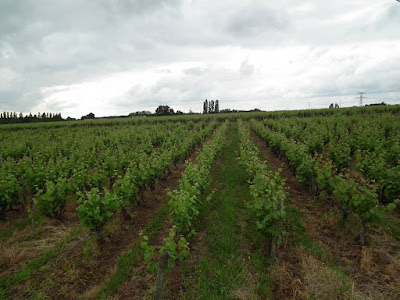
Vines with green cover between the rows - becoming the norm.
So, how does all this relate specifically to vineyards?

In 2000, vineyards covered 3% of French farmland, but soaked up 20% of the pesticides used in agriculture here. ('Pesticides' is used in the current sense of the word, meaning herbicides, insecticides and various other biocides.) Ten years later, the situation regarding pesticide use was changing very rapidly, and it was the Loire vineyards leading the way. Nowadays, sustainable agricultural practices are considered very normal, even the common sense no-brainer approach, although even today, not all vineyards have taken up the challenge and you still see 'nuked' bare-earth parcels of vines dotted about.

The use of acaricides (miteicides) has been widely replaced by the biological control of using predatory mites. Green cover in vineyards is now common, used to reduce the vigour of the vines and to act as a sponge, soaking up excess moisture.

The biodiversity quickly builds up in a recently abandoned vineyard.
In 2005 the 120 winemakers within the 65km² Saumur-Champigny wine appellation created an appellation wide flagship project to encourage biodiversity and control vine pests. The appellation sits in a triangle between Saumur, Montsoreau and Chacé, north-west of Fontevraud, with the Loire river as the northern boundary. The average production per winemaker is 85 000 hl per year. From the beginning, scientists from the Institut National de la Recherche Agronomique (INRA) have been involved, but the fact that the project was initiated by the growers themselves makes it very different to one which is delivered and managed by a government body.

To a large extent the project has an economic basis. The growers were seeing the cost of pesticides spiralling ever upward, and they were conscious that the use or otherwise of pesticides can alter the consumer's perception of the appellation. Being pesticide free can be used as a marketing tool.

A vineyard in early spring. Note the nearby woodland, providing
shelter to beneficial insects in winter when the vines are exposed.
Today roughly half the winemakers in the appellation are fully onboard and actively involved in the project. Why does it matter? Well, that is the subject for another blog post later.

Susan

Source: Protection des Paysages Viticoles, a paper by G. Pain et al, 2010, Mission Val de Loire.

Sunday, 22 July 2012

Feeling Blue?

Surely impossible in the Garden Festival at Chaumont-sur-Loire!

This garden from last year featured two colours of agapanthus, perovskia, eryngium, geranium, catnip, asters and salvia, and in mid-July was absolutely blueautiful.

Susan

Saturday, 21 July 2012

A Ceramic Footrest

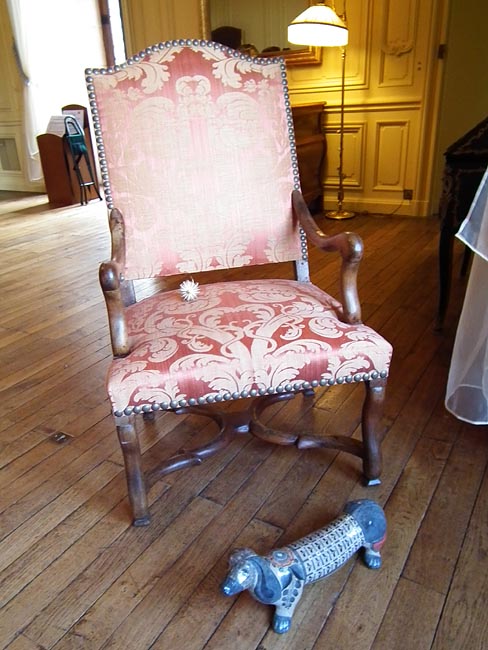
This adorable footrest is in Fern Bedaux's bedroom at Candé. We have a soft spot for mini dachshunds (or teckels, as they are called in France). In London we were aunty and uncle to sisters Tiger and Sponge, and got to look after them sometimes when their doting owners were on holiday or away on business.

The docent told me that Fern didn't actually use it as a footrest, but to hold the pages of books open.

If you are interested in Fern Bedaux (if you know her name at all, it will probably be as the hostess of the Duke and Duchess of Windsor's wedding) there is a well researched blog post here. She was a fascinating person, full of unexpected redeeming features and contradictions. Wallis Simpson liked her, and I doubt you could say that about many women, although I'm not sure if it is necessarily a positive attribute.

Susan

Friday, 20 July 2012

An Annual Photographic Challenge

As you know, if there is an attractive insect around, Simon and I will usually try to photograph it. One of the most challenging subjects at this time of year is the Broad Bordered Bee Hawkmoth Hemaris fuciformis (called le Sphinx gazé in French). Between us we got some nice shots of it feeding on lavender at the Prieuré d'Orsan last year, and I got this single lucky shot (below) while doing my July 2011 butterfly survey in the Parc de Boussay.

Susan

Thursday, 19 July 2012

Weeding the River

There is an invasive water plant here called jussie. It establishes itself in the still, quiet sections of the rivers and fills up the étangs. In order to control it, it is necessary to carefully pull it out. Strimming it simply causes it to spread, when fragments take root after floating downstream. One of the local river technician's major tasks is co-ordinating the war on jussie. Recently he has put an information board up by the bridge in Preuilly.

It says:

...act to preserve your environment

Rivers Plan 2011 - 2015

Water Primrose Weeding

Invasive Water Primrose:
South American in origin
Without predators and very persistent
Grows rapidly and spreads by cuttings (5cm = a new plant)

Work done:
Thorough manual weeding of all the plants
Disposal by drying
They did a good job. I couldn't see any jussie down by the bridge, and there used to be some there. The only evidence of their work was a few trampled looking reeds.

Susan

Wednesday, 18 July 2012

The stuff you learn...

... and can't use.

We have been following the Tour de France on TV this year, and really enjoying what is basically the world's longest travel advert. Along the way I have learnt stuff, like I really want to visit the Alps in Célestine, and I really do want to see the Pyrenees.

I have also learnt about hill climb classifications.

The classification range is from 4 through to 1 and h.c., with 4 being the easiest hill (I have met speed bumps, particularly the one at Artannes-sur-Indre, that probably rates as a 4) and hors catégorie being the hardest. Today's stage (stage 16, 18 July 2012) is in the Pyrenees and has two catégorie 1, and two h.c. climbs.

The term hors catégorie for hills was originally used for mountain roads which it was expected motor vehicles wouldn't be able to climb.

And catégories 1 to 3? Simple. That's the gear you need to use to climb the hill in your Traction Avant.

Maybe I will be able to use that information after all.

Simon

Tuesday, 17 July 2012

Snakes on the Plain

After several conversations, both online and face to face, about snakes in the Loire Valley just recently I feel it is time to write about them again. I quite like snakes, but they make many people nervous. This is presumably based on the fact that, globally, many snakes are venomous.

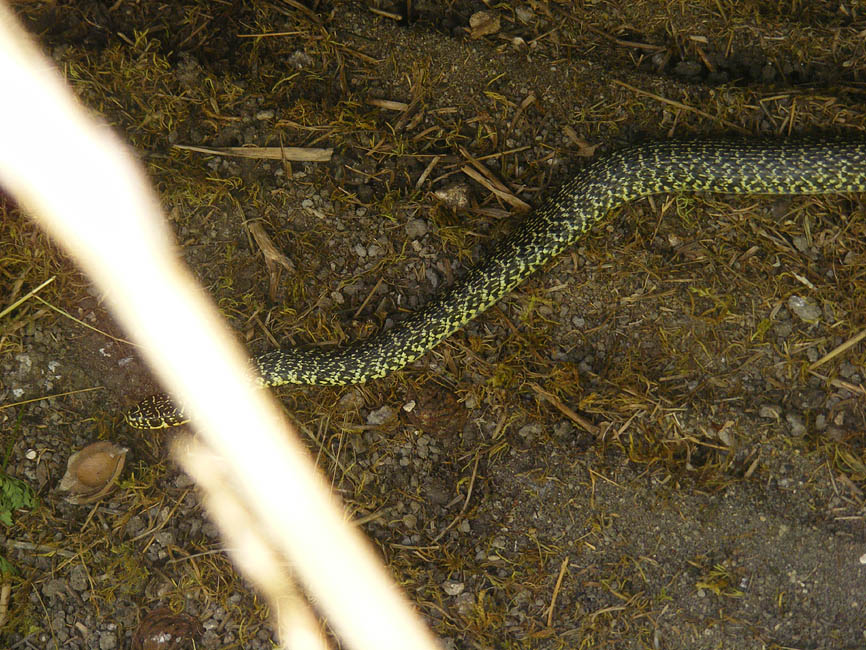
Our orchard resident Western Whip Snake.
I am here to reassure you about the Loire Valley snakes. Those signs at Montpoupon that say 'Danger vipères'? - wishful thinking. Your French neighbours who warned you about les vipères in your very first week staying in the Loire? - they may have lived here all their lives, but they don't know any more about snakes than you do.

Detail of the back of a Western Whip Snake
(brought to an outing by Marc Fleury).
The Adder Vipera berus (aka Common Viper or la Vipère péliade) is extinct in the Loire Valley, although it occurs to the north of us and in the mountains. The only venomous snake in the area is the Asp Viper V. aspis (la Vipère aspic). They are uncommon and rarely seen, and they don't waste their venom on defense unless desperate. I've never seen one. If you see a small (less than 50cm) brown snake with a pattern of offset black bands or zigzags, it might be an Asp Viper, but it is far more likely to be a young Viperine Snake Natrix maura (la Couleuvre vipérine). Natrix spp (les Couleuvres) are grass snakes, and as such, non-venomous.

Marc drawing our attention to the round pupil (venomous species
in France have vertical slit shaped pupils).
If you see a snake at all here (most people rarely or never do) 9 times out of 10 it will be a Western Whip Snake Hierophis viridiflavus (la couleuvre verte et jaune). I've seen very young ones several times in the streets of Preuilly, and we've had one in the house. We also have at least one adult resident in the orchard.

Close up of the head.
Western Whip Snakes often put on a fine show of agression, but they are effectively non-venomous, like the rest of the grass snakes. Your dogs, cats and small children are not at risk except from a bit of a fright.

The belly, showing the cloacal slit and the junction between body and tail.
By all means email me if you have seen a snake and want to know what it was, but don't expect me to believe you about how long and thick it was. Those of us who work in the field know that most people over estimate the size of creatures they see in the wild by about 3 times. This is so common a human error that even experienced naturalists find themselves doing it sometimes. I probably won't be able to identify your snake from just a description either. If you have a photo, though, and some details about where and when, I have a reasonable chance and am happy to help.

Susan

R.I.P Jon Lord

One of my true music heroes died yesterday. Jon Lord was a founder member and the keyboard player in Deep Purple.


Simon

Monday, 16 July 2012

Bad News on the Bakery Front

Yesterday when I called in for our daily bread there was a notice stuck to the counter explaining that the bakery was in liquidation and would open for the last time on Tuesday. The other customer in there at the same time as me is a young woman much the same age as Carene Pichard, who runs the bakery with her husband. The two of them have always appeared to be on quite friendly terms, but she was as shocked as me to hear the news.

Carene herself seemed calm and matter of fact about it. I suspect it was a relief to have it out in the open and the end in sight. I did not attempt to get any real details from her, but based on a conversation we had some time ago, I presume it brings to an end an ongoing dispute with their landlord (they don't own the bakery premises) about who should spend the money to upgrade the plumbing and other problems. The landlord would have been perfectly happy for them to plough their money into his real estate and improve it, but he wasn't interested in even meeting them halfway with the expenses, or giving them any sort of equity, and they felt it was too much of a risk.

As far as the Pichard's are concerned, it may well be the best thing that could have happened. It leaves Jean-Luc free to get a salaried job as a baker in one of the big supermarkets. This would give the family financial security and according to Carene, the bakery departments at the big Auchan and Leclerc supermarkets are proper boulangeries ie making the bread from scratch, not from frozen dough. At some stage they may move to Le Blanc, where Carene's family lives, but for the moment it seems they will stay in Preuilly and keep the children in school here (parents of primary school age children will be relieved, as it is always worrying when numbers drop in small rural schools). I suppose they will move house though, as they currently live over the shop.

As it happens I had a conversation with their boy (Florian I think his name is...) on Bastille evening. He asked me what I was doing when he saw me heaving a shutter up onto a side door of the house. He was just passing with a group of kids, including his sister, armed with bangers and cigarette lighters (which he proudly showed me). I would guess he's about 7 or 8. He and his big sister are confident, polite and lively children, easily recognised around town by their white blond hair and alabaster pale skin, and often in the shop 'helping'. Their parents too are involved in town life outside of the bakery. Both of them help with fundraising events for the school and I am always having to come up with good excuses as to why I can't attend fundraising belote (a card game) or loto (bingo) gatherings with Carene - ce n'est pas mon truc.

As far as the customers are concerned, it will mean going to the other boulangerie patisserie in town for 5 days of the week, and using the depot de pain at the Vival supermarket on the baker's day off. We will probably make our own bread on these days. Their part time employee, who only works a day and a half a week, can't have been earning very much, but I don't know what her situation is, so I don't know how much it will impact on her.

According to someone I ran into on the way home, the third bakery in town only closed in about 2003 or 04. A few years later, it was one of the places we looked at when we were house hunting. It would have been a real challenge to renovate, and is right on the main road, so it is a good thing we didn't buy it (we almost did). It seems incredible that a town with a population of under a thousand could support more than one bakery, much less two or even three.

Susan

Sunday, 15 July 2012

Lesser Purple Emperor

In last year's drought some species of butterfly did poorly, but many of the forest dwelling species did exceptionally well. The shade provided by the trees seems to have helped reduce the impact of the lack of water on the habitat. This year, however, with the cold and damp, they are not doing nearly so well, so you might be lucky to see an Emperor Apatura spp or one of the white Admirals Limenitis spp.

One of the loveliest of the arboreal species is the Lesser Purple Emperor Apatura ilia (or le Petit Mars changeant in French). The males of this large (in European terms) butterfly are a gorgeous irridescent purply blue on their upper sides. Generally they are not all that common, but will often visit gardens in areas with suitable damp woodland (I have seen them at Villandry, for instance). Their main caterpillar host plants are poplars (including aspen), willows and occasionally alder. Their numbers are threatened by modern forestry practices, which clear out all non-commercial tree species (such as aspen and willows).

This photo, taken at la Châtonnière, is not perfect, but I
like the way it shows the butterfly's yellow tongue.
Males are most often seen, because they descend from the treetops to suck moisture and minerals from damp patches on the ground. They are famously attracted to faeces and entomologists studying them regularly lay the most disgusting baits to lure them close. Females are less frequently seen because they are not so easily tricked into coming down to earth.

Susan

Saturday, 14 July 2012

Bastille Day 2012

Yesterday was the 5th Bastille Day Retraite Aux Flambeaux I have been to in Preuilly sur Claise, and the first that looked like it wasn't going to happen due to rain.

Luckily, the best weather of an extremely miserable day arrived at 9.00pm, allowing us the opportunity to samba around town.


The fireworks were cancelled because of lack of opportunity to set them up this afternoon, and there were less people on the retraite than normal, but we maintained the tradition and that's what matters.

Simon

Friday, 13 July 2012

A Magnificent View, but where is it?

Taking my cue from various blogger friends who like to post a puzzle now and then, I thought I would post this gorgeous photo taken by Simon recently and see if anyone could name the spot it was taken from. Remember to click to enlarge for full magnificence.

No prizes for guessing correctly, but you will have my admiration.

Susan

Thursday, 12 July 2012

Like Putting the Clock Back 50 Years

Moving to rural France from urban England, like moving from the east coast of Australia to New Zealand, is often said to be like putting the clock back 50 years, to some halcyon period when the sun always shone, adolescents were always polite, you could leave your front door unlocked and family life was important, but you couldn't get very much in the shops.

This photo no doubt bolsters the myth. We don't know the man with the 2CV, we just happened to pull up behind him at the pumps in la Ville aux Dames.

Susan

Wednesday, 11 July 2012

Salvage Operation

The clipped box bushes on our front courtyard came through the cold winter variously. Some look completely unscathed, but two were à-peu-près mort, as our neighbour Edouard noted. He said they weren't quite dead, but I needed to prune them hard, back to where the new shoots were coming underneath. I forgot to take before photos, but basically all the visible leaves were yellowy brown and the bushes were the same size as the green ones.

Hey ho - 10 plus years of growth into a ball about a foot in diameter, down the drain in minutes. I don't suppose it will take more than a couple of years for them to catch up again though. After all, they now have very little top growth and a substantial root system. I've fertilized and will try to keep the water up to them (one thing this weather will help with...)

I'm also having a lot of trouble with ant colonies moving in to the bigger pots. They really cause the plant to slow down, and then start to die off, I guess because they are disturbing the roots constantly. It's not obvious that they have moved in until the plant starts looking sickly. I'm trying to keep the soil too moist for them, but I don't think it's working (I'm not consistent enough).

Susan

Tuesday, 10 July 2012

A Dent in the Plans

If you read other French based bloggers, or indeed live in France (or the rest of the world) you will know that the weather this year has been crazy. The way this has manifested itself in Preuilly sur Claise is as a pattern of a couple of wet, chilly days, followed by the weather clearing up.

Sunset last week. This blog post is illustrated
with pictures not connected with the story.
This has played havoc with my sinuses, and for much of the past six weeks I have had pain of the face, mainly around the jaw. (This quite common with serious sinus cases - a dentist friend of mine once told me that about 10% of people who visited him at certain times of the year didn't have bad teeth, they had a sinus infection). Then one morning, I did have bad teeth - overnight I had clenched my jaw and gritted my teeth so hard (to make the pain go away) that I had cracked a tooth. This is seriously bad news, because I have a fear of dentists. It isn't a phobia - it's reasonable - and they are expensive.

I have had to just put up with the pain for 2 weeks because we have been working so much - no sick days for self employed people, dontcha know. Eludril pro anaesthetic mouthwash and RhinAdvil used in combination with the occasional panadol usually managing to keep the pain at a bearable level, but it wasn't much fun and there were one or two sleepless nights.

The Chateau of Cheverny, looking
like Moulinsart (Marlinspike Hall)
Yesterday we managed to contact a dentist in La Roche Posay (the dentist in Preuilly being on holiday this week) and made an appointment for Thursday at 15.30. Half an hour later the dentist rang back and said "I can see you in an hour". This was both good and bad news, because I knew things would get a whole lot worse before they got better.

Well blow me down... Half an hour after arriving the chunk of broken tooth was removed, a filling was in place, and we were out the door. Did I impress myself with my bravery? You bet - I even managed it all without anaesthetic. Me - having my teeth drilled without at least 3 jabs!

Love is...
I am told that I will get occasional reminders of the pain for a few days yet as the nerves settle down, but so far so good.

The other amazing thing is that the whole proceedure cost me €28.92, of which we should get about half back from our health insurance.

Simon

Monday, 9 July 2012

La Reine des Glaces

French people eat a lot of fresh raw leafy greens. And they are very precise about nomenclature. Laitue can be translated as 'lettuce' but to a French person, laitue is a quite specific type of lettuce, and the generic term for what in English would be lettuce or salad greens is salade in French. Within the salade section of a market stall you could get labels for laitue, batavia, scarole, mesclun, mache, feuilles de chene, endive, frisée, romaine, roquette and no doubt a few more that I've forgotten or don't know about.

One that I hadn't noticed before is reine des glaces. I was alerted to its presence on Madame Morin's stall on Saturday by the woman behind me in the queue. 'Oh!' she exclaimed, 'You have reine des glaces! You hardly ever see it these days! It's so good to see someone growing the old varieties! My husband loved it and used to grow it! It has such a distinctive taste!'

Reine des glaces and tomato baguettes.
It is a cut leafed lettuce and I thought it looked like an escarole type, which are a little bitter. 'No, no', I was assured. 'It's a batavia.' This is the variety I usually buy, as it is crisp, mild and keeps well (we don't eat nearly as much lettuce as your average French person). Monsieur Morin seemed very pleased with all the attention his reines des glaces were getting and handed me one saying 'Here, try one. Take it, it's a little gift for you'.

So I brought it home and we had some in a simple tomato sandwich for lunch. Very nice - very crunchy and a flavour as if it has been seasoned with salt and pepper.

It turns out, now that I've googled the subject, that batavias are iceberg lettuces. This will give anglophone readers a vision of a melon sized ball of tightly packed pale green leaves with no taste but plenty of crunch. French batavias are picked before they get to that stage and are a small loose head of bright green leaves. It further turns out that reine des glaces is an extremely popular 200 year old variety that everyone raves about. It is reliable no matter what the weather, and particularly so in the cold (hence the name, which means 'ice queen') making a small round head and best if not watered. Those who are particularly enamoured even talk about its unique 'hazelnutty' flavour. Its only drawback seems to be that it sets very few seeds and so can be difficult to source if you want to grow some.

Susan

Sunday, 8 July 2012

June Butterfly Survey Report

A Ringlet, at rest. When flying they are very difficult to tell
from the male Meadow Browns also flying around the grass.
I finally got to do my June butterfly survey, on the very last day of the month. It was quite hot (25C) and fairly cloudy but the wind was not too bad.

The ubiquitous Marbled White (a male).
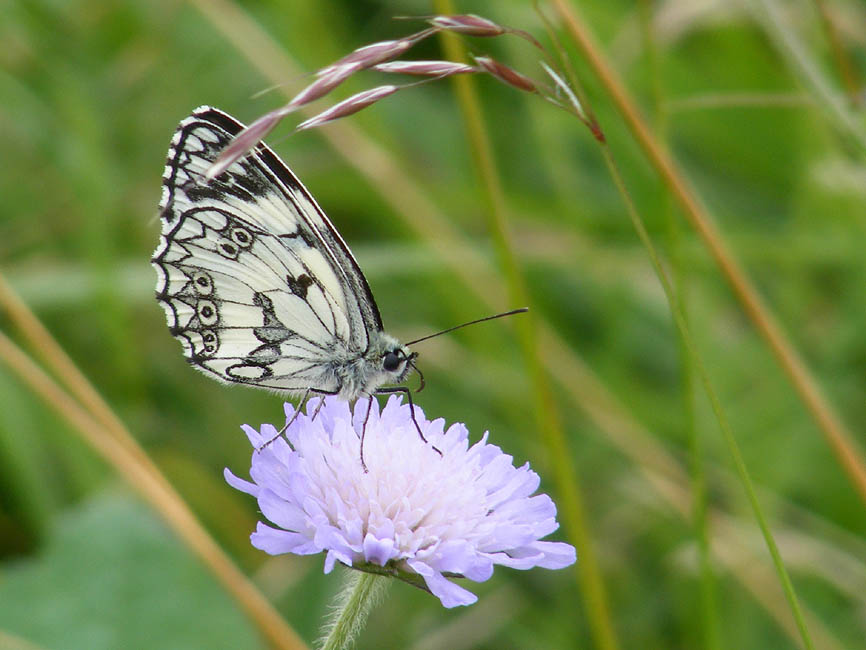
According to Luc Manil, who co-ordinates us STERFistes, it is the worst butterfly year for 7 years. The only species doing notably well across France is the Marbled White. My observations certainly back that up. On my June survey I saw 289 individuals of Marbled White and there was not a single transect where I didn't see more than one. This is more than twice as many of this one species than of all the other 30 species put together. The next nearest in abundance was the Small White, with 23 individuals. The only other species I would note as being more numerous than usual is the Peacock. They are always common, but seem to be a bit more so this year.

Skippers always strike me as cheeky little blighters, but this
Large Chequered is having a laugh - resting on my trousers.
The reason for the absence of several of the Fritillary species, most of the blues, the White Admirals (who had an outstanding year only last year) and the Swallowtails, is the weather. An exceptionally dry 2011 followed by a very cold snap in February killed many caterpillars. Then after a hot dry start to the 2012 spring, it turned cool and wet. The temperature in June was one degree lower than the average for this month. We only received 70% of average sunshine, and around 80mm of rain (that's nearly twice the monthly average I think).

An Ilex Hairstreak walks across some
clematis between two oak saplings.
It was so consistently cold and wet in April that I never got to do a survey that month - no point if the weather means no butterflies will be about. My first attempt in May I abandoned halfway through because of a storm and because my Boussay transects were so waterlogged I couldn't access them without rubber boots - again not ideal butterfly conditions. Now in June, two of my Boussay transects have shoulder high grass and all of the rest (bar one which has been mowed) are so tangled and overgrown I could have done with a machete. Miraculously, I had only picked up two tiny ticks by the end of the day!

A beautifully fresh male Short-tailed Blue.
Still, mustn't grumble - it may have rained a lot, but we needed it, and it hasn't flooded here (unlike many places in Europe). I've got a couple of new species for the survey since last year, with (not terribly good) photos. And it's turning out to be a good year for dragonflies (they had a poor year in 2011 with the dry). And the orchids have been good (still a few of the late flowering ones around too - they have also appreciated the cooler, wetter conditions).

Susan

Saturday, 7 July 2012

Arrêt Minutes

In France it is understood that stopping at the baker's is essential. No matter what the street configuration or time of day it is clearly perfectly OK (in social terms, if not strictly legal) to park the car right outside the boulangerie and nip inside for your daily bread.

Un panneau d'arrêt minutes outside a boulangerie in the
Tours agglo, presumably installed by the bakery themselves.
Sometimes you see this arrangement semi-formalised, either by the bakery themselves or the commune. The signs saying arrêt minutes actually have no legal standing, but the rule of thumb is that you can park for no more than 15 minutes (and the expectation would be that you were there for a much shorter time usually). Similar signs can be found outside pharmacies and pick-up / set-down zones at stations and airports. The parking places are generally not in spots you would want to leave the car for any length of time anyway.

However, if the sign specifies a time limit, you can be booked for overstaying.

Susan

Friday, 6 July 2012

Scarce Swallowtail - Iphiclides podalirius

Although this large (in European terms) and showy butterfly is called the Scarce Swallowtail in English, as anyone who observes Lepidoptera in France should be able to tell you, it isn't scarce at all (except maybe this year, which is poor for many butterflies). Its English name reflects its English status, that of an occasional migrant, turning up in Britain only about a dozen times in the last 300 years.

In France it is le Flambé ('the Singed') due to its pattern of charcoal stripes, as if it has had a flame passed over it. They appear in gardens in the spring, but it is the second generation, emerging in July, that is most noticeable in lowland central France. This one was photographed in Elsie's garden in Chinon last July. The caterpillar was photographed in le Petit Pressigny, in the garden of some friends. It was traversing the gravel to find somewhere to pupate in the leaf litter, where it would overwinter. The September caterpillars are browner in colour to provide better camouflage. Earlier in the year, when they pupate in the fruit tree host plant, they stay green.

Scarce Swallowtail caterpillar, from September last year.
It is often seen in organically managed orchards and gardens, as it will use a number of cultivated fruit tree species and their wild counterparts as caterpillar food plants. They like warm open slopes dotted with bushes, where they will glide from nectar source to nectar source, or engage in 'hill-topping'.

Susan

Thursday, 5 July 2012

You Can't Escape Them!

Last year we wrote about discovering the Impasse du Faubourg Saint-Pierre in Beaulieu-lès-Loches. We happened to be up there again last month with some clients, when I took this photo of a door with a cute heart shaped cutout in its shutter. The heart shaped hole must be traditional around these parts because you see them quite often here, including the shutters at l'Image in Preuilly sur Claise.

And that white thing lodged in the cutout? That's a request from the electricity company for a meter reading.

Simon

Wednesday, 4 July 2012

Wipers

When Célestine first came into our life, her windscreen wipers were both humourously vague and vaguely humourous.

When started they would wave like an unsophisticated two year old, wimbley wombley flapping rather than gliding, until they either clashed and locked together, or the right hand one wandered off the windscreen altogether and got caught on the windscreen surround. An added "bonus" of this behaviour was that the passenger only had a partially clear screen.

September 2009
I had various attempts over the next couple of years to modify this behaviour by moving the resting place of the passenger's side wiper, but no matter where I moved it to it would eventually run off screen and catch. Then earlier this year I realised that I could use the manual wiper control knob to, if nothing else, move the driver's side wiper to the end of its travel so when not in use the wiper wasn't in front of me the whole time.

This had an added bonus of the wipers not clashing as soon as I started them - for some reason the driver's side wiper wouldn't start until after the passenger's, and they would just mash horribly.

This looked... well, weird.

April 2012
As this didn't stop the wipers clashing, in May I asked The Doctor about how the wipers should be. I had seen other cars where the wipers lay flat at the bottom of the windscreen, but I just couldn't get Célestine's to do that - the wiper arms were the wrong shape. Jean-Louis just removed one arm, bent it to the required shape, and voila - fixed.

June 2012
Now the wipers actually wipe the parts of the windscreen we look through, they aren't in front of our faces the whole time, there is no danger of them clashing or running off screen, and the little part of the windscreen that doesnt get wiped is hidden by the rear vision mirror. They also look more purposeful, and don't appear just to flap at the rain.

Bonus.

Simon

Tuesday, 3 July 2012

A Pair of Sèvres Vases

The Sèvres porcelain factory was established in the mid 18th century. From the first Louis XV and Madame de Pompadour took an interest in the business and more particularly, in their output.

A Sèvres vase at Cheverny...
Sèvres is very definitely the haute gamme of French ceramics, famous for its extensive gilding and beautiful artwork. Several distinctive highly pigmented ground colours, such as turquoise, deep blue and rose pink became strongly associated with the look of Sèvres pieces.

...and its pair.
Like the Gobelins tapestry factory, the money eventually ran out and it was only the appointment of a brilliant director in the mid 19th century that saved the porcelain factory. Nowadays, like Gobelins, it is part of the Manufacture nationale, state owned and providing professional training for young artists as well as conservation and curatorial services for the many collectors and museums world wide.

If you are interested in learning a bit more about Sèvres porcelain, I found quite a good article in the Auction Central News here. There are some nice photos of a range of Sèvres attached to the article.

Susan

Note that I resisted the temptation to call this post Deux Sevres Vases, on the grounds that it would be too confusing. The département of Deux-Sevres is so called because it lies between two rivers called the Sevres and has nothing to do with the porcelain.

Monday, 2 July 2012

Pissaladière

Ingredients for Pissaladière.
If your onion crop is good Pissaladière (Provencal Onion Tart) is a delicious way of using up the bounty. Sadly, my onion crop this year has been hardly worth harvesting, but I think I'll make Pissaladiere anyway. For a light lunch for 4 people you will need a kilo of onions. Cook them very slowly in a little olive oil, with sprigs of thyme and a good pinch of salt until they are reduced and very soft, almost like a purée. It should take about an hour. Increase the heat a bit at the end and boil any liquid off.

Ready for the oven.
While you wait for the onions make a pizza dough. Once the onion is cooked and cooled a bit, roll out the pizza dough and spread it with onion purée. Decorate with anchovies and olives then bake in the oven for 30 minutes at 190°C.

Ready to eat.
Serve warm or room temperature with a salad or as a snack.

You can also use the onion puree to make a delicious feuilletée. Take some rounds or triangles of puff pastry about 10-15cm across and spread the onion in the middle, leaving an edge of about 2-3cm. Add 2-3 slices of goat cheese on top of the onion and push up the edges of the pastry to make an open parcel. Bake in the oven at 200°C for 15 minutes.

Susan

Sunday, 1 July 2012

Wildlife Watching in the Claise Valley in July

Statistically July is the driest month here, so it's a good time to visit some of your local étangs and check out the draw down zone. That's the area between the highest and lowest water levels. In July you can usually walk across the draw down area without it being too muddy. If you are interested in botany, this is where you will find many unusual and uncommon plants.

Lesser Water Plantain flowers and Marsh Pennywort leaves
in the draw down zone of the Etang de la Ribaloche
in the Foret de Preuilly
In the grassland and along woodland fringes there will be a variety of umbels flowering. These are often called Queen Anne's Lace when they get adopted by gardeners, but the most ubiquitous species here is Wild Carrot. It really is the plant that our modern carrots were developed from, and many of the umbellifers are edible (parsley, celery, parsnips, fennel) but beware - many are deadly poisonous (hemlock water dropwort) or can cause a serious rash if handled (giant hogweed).

Many aromatic grassland plants will be flowering in July - thyme and oregano, but also wormwood. The fine grey leaves of wormwood contain the famous hallucinogenic ingredient in absinthe. Look out for southern species growing on the northern edge of their range here flowering in July too, such as the intense blue of Italian Alkanet. Lime trees will be flowering and abuzz with feeding insects - bumblebees, honey bees and hoverflies. At a lower level, along ditches and on waste ground the many species of flowering thistles provide a hugely important source of food and shelter to a remarkable range of insect species.

It's peak period for many dragonflies, like these Banded Demoiselles.
The so called golden skipper butterflies are flitting about now. They are a group of very similar looking small very gregarious butterflies. You rarely see just one, and they are very common on roadsides, in grassland and woodland clearings. Joining them will be another gregarious species, the Marbled White. This is one of the few that is having a good year this year. Otherwise, it is the worst year since 2006 for butterflies (due to the cool and then the wet conditions).

Along with the butterflies on the grassland and bramble flowers you should see some small longhorn beetles also enjoying the nectar bar, and July is when many hoverfly species peak in numbers. Sitting in the sun on leaves or on the ground the short tongued beefly species will have emerged in good numbers. They are dark and velvety and like to soak up the rays.

Anthrax anthrax, a beeflyHappy wildlife watching in hot dry conditions (assuming the weather doesn't stay quite so weird...)

Susan