Showing posts with label Dragonflies. Show all posts

Thursday, 4 June 2026

Insects on the Eperon

 On a recent outing to the Eperon de Murat nature reserve I saw a range of insects.


Forest Fly Hippobosca equina (Fr. Mouche plate). 

A blood feeding parasite of bovines primarily, but often also found on horses and dogs. It causes no discomfort to its hosts and is not a vector for disease. They do tend to freak people out though because of their scuttling movement.

Forest Fly Hippobosca equina, France.


Golden-ringed Dragonfly Cordulegaster boltonii (Fr. Cordulégastre annelé). 
A dragonfly that breeds in small fast tumbling streams often on hillsides. It is present throughout most of Europe but always uncommon.
Golden-ringed Dragonfly Cordulegaster boltonii, France.


Female Beautiful Demoiselle Calopteryx virgo (Fr. Caloptéryx vierge). 
This species also likes small cold swift streams and is very sensitive to oxygen levels in the water. Numbers are dwindling as water is increasingly warm and eutrophic (full of algae that use all the oxygen). 
Female Beautiful Demoiselle Calopteryx virgo, france.


Male Beautiful Demoiselle. 
Males are very territorial and are often to be seen perched on vegetation along the banks of their stream. Their flight is languid with quite slow wing beats, so people don't always recognise them as damselflies.
Male Beautiful Demoiselle Calopteryx virgo, France.


Dance flies Empis sp and pollen beetles Meligethinae all over Bath Asparagus Ornithogalum pyrenaicum. The dance flies are predatory. Bath Asparagus is foraged in the wild and sold as a great delicacy in fresh markets for about 15 euros a small bunch during its brief season.
Dagger flies Empis sp and Meligethinae pollen beetles on Bath Asparagus Ornithogalum , France.


A small carpenter bee Ceratina sp on Field Scabious Knautia arvensis. 
These bees nest in hollow plant stems, making cells containing a stock of pollen for the larva, and divided by plant pith.
Small carpenter bee Ceratina sp on Field Scabious Knautia arvensis, france.


Ferruginous Bee-grabber fly Sicus ferrugineus on Field Scabious. This fly is quite common throughout Europe but so weird looking that people usually don't know what they are looking at. They have strange yellow swollen heads and sit with their abdomens curled up under themselves. They are parasites of bumble bees.
Ferruginous Bee-grabber Sicus ferrugineus on Field Scabious Knautia arvensis, france.


Female Azure Blue butterfly Polyommatus bellargus (Fr. Azuré bleu-célèste) ovipositing on Horseshoe Vetch Hippocrepis comosa
They are a species of hot dry calcareous grasslands, quite dependent on sheep grazing to keep the habitat suitable for them. Where they occur they are usually abundant, but because of destruction or degradation of their favoured habitat their population is declining.
Female Blue Argus Polyommatus bellargus ovipositing on Horseshoe Vetch Hippocrepis comosus, France.


Rusty Tussock moth Orgyia antiqua (Fr. Etoilée) caterpillar on Downy Oak Quercus pubescens
This is a species that will eat a wide variety of plants, but for reasons that are not understood it has become rare. The caterpillar is amongst the most distinctive of any Lepidopteran. Be careful not to touch them as those hairs are urticating and can cause skin irritations on people who are sensitive.
Rusty Tussock moth caterpillar Orygia antiqua on Downy Oak Quercus pubescens, France.


Orchard Ermine moth Yponomeuta padella caterpillars and cocoons inside the web communal nest on Blackthorn Prunus spinosa. These poor Blackthorns have been munched twice this season. Earlier in the year it was Small Eggar Eriogaster lanestris caterpillars all over them. But they will recover. 
Orchard Ermine moth pupae Yponomeuta padella on Blackthorn Prunus spinosa, France.


Thursday, 8 June 2023

A Nature Outing to La Cabane

On Saturday 27 May I led an outing for the Association de botanique et de mycologie de Sainte Maure de Touraine to La Cabane, Bossay sur Claise. This outing was scheduled for last year, but it was so hot and dry at the time I cancelled the outing. I was quite worried that no one would turn up, but in the end there were 15 people, which was perfect. Luckily they included expert botanist Dominique, and good all round naturalist Corinne. Neither of them had been to the site before, so they were very keen to see what was there, and why it has recently been declared as a Zone d'Interet Ecologique, Faunistique et Floristique (ZNIEFF).


 La Cabane is the only site in Indre et Loire where Tongue Orchids Serapias lingua (Fr. Sérapias langue) are present. There are hundreds, if not thousands on the site.

Tongue Orchids Serapias lingua, Indre et Loire, France. Photo by Loire Valley Time Travel.

Tongue orchids.

Tongue Orchids Serapias lingua, Indre et Loire, France. Photo by Loire Valley Time Travel.

Greater Butterfly Orchid Platanthera chlorantha (Fr. Platanthère à fleurs verdâtres).

Greater Butterfly Orchid Platanthera chlorantha, Indre et Loire, France. Photo by Loire Valley Time Travel.

Sulphur Clover Trifolium ochroleucon (Fr. Trèfle jaunâtre).

Sulphur Clover Trifolium ochroleucon, Indre et Loire, France. Photo by Loire Valley Time Travel.

The habitat at La Cabane.

La Cabane habitat, Indre et Loire, France. Photo by Loire Valley Time Travel.

Drone Fly Eristalis tenax (Fr. Eristale gluante), male, on Oxeye Daisy Leucanthemum vulgare (Fr. Marguerite). You can see the bands of hairs on his eyes.

Drone Fly Eristalis tenax, Indre et Loire, France. Photo by Loire Valley Time Travel.

Peletaria iavana, a parasitic fly, on Oxeye Daisy. You can see the 'Peletaria bristles' on its cheek and the middle antennae segment is 'yellow' which is the diagnostic for this species.

Peletaria iavana, Indre et Loire, France. Photo by Loire Valley Time Travel.

Azure Damselfly Coenagrion puella (Fr. Agrion jouvencelle).

Azure Damselfly Coenagrion puella, Indre et Loire, France. Photo by Loire Valley Time Travel.


The sawfly Macrophya montana (Fr. Mouche-à-scie à trois bandes jaunes) on Corky Fruited Water Dropwort Oenanthe pimpinelloides (Fr. Œnanthe faux boucage).

Macrophya montana, Indre et Loire, France. Photo by Loire Valley Time Travel.

A tiny male dance fly Empis sp in a Narrow-leaved Flax Linum tenuifolium (Fr. Lin à feuilles étroites).

Empis sp, Indre et Loire, France. Photo by Loire Valley Time Travel.

Naturalists at work.

Naturalists on an outing, Indre et Loire, France. Photo by Loire Valley Time Travel.


Wednesday, 23 November 2022

Buried in the Forest

This is a reworking of a post about a walk in the Forest of Preuilly from June 2019.

*************************************

In June 2019 Simon and I, Gaynor and Tim, and Bob did a 7.5 kilometre walk in the Forest of Preuilly. The highlight was going to see the Resistance encampment, with its graves and remains of their mobile kitchen, deep in the forest. We already knew the graves at Péchoire, but none of us except Simon had ever been to the other site connected with the World War II skirmish of 23 July 1944. 

Photographed by Susan Walter. Tour the Loire Valley with a classic car and a private guide.
Goldsmith beetle Carabus auratus (Fr. le Jardinière) on one of the forestry tracks. It sat like this for at least a minute -- amazing for a beetle that hitherto I only have blurry photos of one disappearing.

The day of the walk started off cool, but after lunch the humidity and heat soared. Later, in the middle of the night we had a very energetic summer storm. All of us picked up quite a few minute ticks from the long grass on the unmown forest rides (the record was Tim, with 16!), and horse fly season had started, so no more walks in the forest were advisable for a couple of months. 

Photographed by Susan Walter. Tour the Loire Valley with a classic car and a private guide.
Female Moustached Darter Sympetrum vulgatum (Fr. Sympétrum vulgaire).

Photographed by Susan Walter. Tour the Loire Valley with a classic car and a private guide.
The graves of three of the eight Resistance fighters killed in the forest by the Germans on 24 July 1944. Arrested at the nearby Chateau de Bossée they were brought here to their encampment in the forest, tortured and finally shot. They are buried more or less where they fell. 

Photographed by Susan Walter. Tour the Loire Valley with a classic car and a private guide.
Photograph of Sergeant Gaston Goblet on the cross marking his grave.

Photographed by Susan Walter. Tour the Loire Valley with a classic car and a private guide.
The remains of a mobile military cantine at the Resistance encampment site. Meals for the maquis troupes Carol and Epernon were prepared on it and it marked the central bivouac for both groups. The Germans used explosives to render it useless, and the wheels and stockpots were later stolen.

Photographed by Susan Walter. Tour the Loire Valley with a classic car and a private guide.
One of a number of old pollarded Hornbeam trees in the area of the Resistance encampment.

Photographed by Susan Walter. Tour the Loire Valley with a classic car and a private guide.
Wild native Foxgloves Digitalis purpurea (Fr. Digitale pourprée) in a glade.

Photographed by Susan Walter. Tour the Loire Valley with a classic car and a private guide.
Bundles of firewood awaiting collection.

************************************************

For details of our private guided tours of chateaux, gardens, wineries, markets and more please visit the Loire Valley Time Travel website. We would be delighted to design a tour for you.

We are also on Instagram, so check us out to see a regularly updated selection of our very best photos. 

Thursday, 17 September 2020

European Bee Eaters

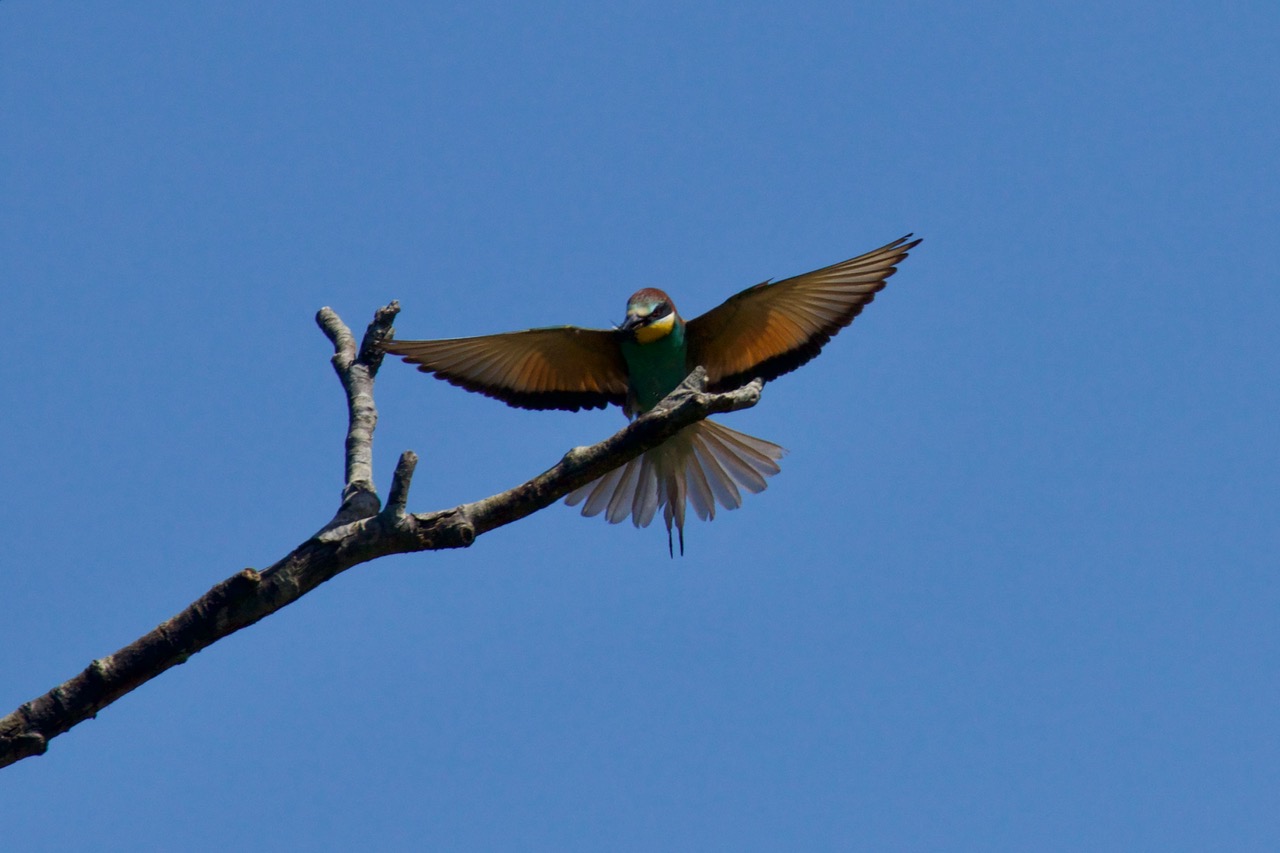
These beautiful pictures of European Bee-eaters Merops apiaster (Fr. Guepier d'Europe) were taken by our friend Ingrid near La Roche Posay in mid-July. I think these bee-eaters must be Europe's most colourful avian species!

European Bee-eater Merops apiaster. Vienne. France. Photo by Ingrid de Winter for Loire Valley Time Travel.
Photo courtesy of Ingrid de Winter.

It sounds like bee-eaters had a good breeding year and friends in the Pyrenees have reported large feeding flocks going over on their way back to tropical Africa for the winter.


European Bee-eater Merops apiaster. Vienne. France. Photo by Ingrid de Winter for Loire Valley Time Travel.
Photo courtesy of Ingrid de Winter.

A very gregarious species, you rarely see just one. You usually hear them making their prrpp prrpp call before you see them too. They nest in colonies in the sandy banks of some of the big rivers here, such as the Vienne and the Creuse. 


European Bee-eater Merops apiaster. Vienne. France. Photo by Ingrid de Winter for Loire Valley Time Travel.
Photo courtesy of Ingrid de Winter.

As their name suggests, they eat bees, and studies show that honey bees make up the bulk of their diet. But they don't really pose a threat to apiarists, as they only get about 1% of the managed honey bees. They also eat wasps, hornets and dragonflies, catching them on the wing.


European Bee-eater Merops apiaster. Vienne. France. Photo by Ingrid de Winter for Loire Valley Time Travel.
Photo courtesy of Ingrid de Winter.

To catch their prey bee-eaters perch out on a high exposed bare branch and make sorties, bringing the prey back to bash against the perch before eating it. Studies show bee-eaters do best with a mixed diet of bees and dragonflies.


European Bee-eater Merops apiaster. Vienne. France. Photo by Ingrid de Winter for Loire Valley Time Travel.
Photo courtesy of Ingrid de Winter.

European Bee-eater Merops apiaster. Vienne. France. Photo by Ingrid de Winter for Loire Valley Time Travel.
Photo courtesy of Ingrid de Winter.

European Bee-eater Merops apiaster. Vienne. France. Photo by Ingrid de Winter for Loire Valley Time Travel.
Photo courtesy of Ingrid de Winter.


************************************************

For details of our private guided tours of chateaux, gardens, wineries, markets and more please visit the Loire Valley Time Travel website. We would be delighted to design a tour for you.

We are also on Instagram, so check us out to see a regularly updated selection of our very best photos. 

Friday, 31 July 2020

Wildlife Rich Walk, Part II


These are some photos from a walk we did near Yzeures-sur-Creuse on 1 July. [Link to Part I.]

Wild blackberries Rubus fruiticosus complex (Fr. les mûres).
We were quite surprised to find ripe, tasty blackberries so early.
Wild blackberries Rubus fruiticosus complex. Indre et Loire. France. Photo by Loire Valley Time Travel.

Rampion Bellflower Campanula rapunculus (Fr. Campanule raiponce).
Rampion Bellflower Campanula rapunculus. Indre et Loire. France. Photo by Loire Valley Time Travel.

A carpenter ant worker Camponotus sp.
A carpenter ant worker Camponotus sp. Indre et Loire. Photo by Loire Valley Time Travel.

Until recently both sides of the track would have been lined with a ditch and a wild hedge like this forming the field boundary. This side remains intact...
Field boundary wild hedge. Indre et Loire. France. Photo by Loire Valley Time Travel.

Teneral (juvenile) male Common Darter dragonfly Sympetrum striolatum (Fr. le Sympétrum fascié).
Teneral male Common Darter Sympetrum striolatum. Indre et Loire. France. Photo by Loire Valley Time Travel.

The hedge has been grubbed up and the field converted from being mown for hay to being ploughed and sown with maize. This is a sad loss for the environment and for biodiversity.
Hedge removed along field boundary and field converted from hay to maize. Indre et Loire. France. Photo by Loire Valley Time Travel.

Male Small Pincertail dragonfly Onychogomphus forcipatus (Fr. le Gomphe à forceps).
Male Small Pincertail Onychogomphus forcipatus. Indre et Loire. France. Photo by Loire Valley Time Travel.

Fiery Clearwing moth Pyropteron chrysidiforme (Fr. la Sésie de l'Oseille).
Fiery Clearwing Pyropteron chrysidiforme. Indre et Loire. France. Photo by Loire Valley Time Travel.

The tumbling flower beetle Variimorda villosa (Fr. la Mordelle veloutée à pointe).
Tumbling flower beetle Variimorda villosa. Indre et Loire. France. Photo by Loire Valley Time Travel.

European Hornet Vespa crabro (Fr. le Frelon européene) gathering wood pulp from a burnt stump.
European Hornet Vespa crabro. Indre et Loire. France. Photo by Loire Valley Time Travel.


************************************************

For details of our private guided tours of chateaux, gardens, wineries, markets and more please visit the Loire Valley Time Travel website. We would be delighted to design a tour for you.

We are also on Instagram, so check us out to see a regularly updated selection of our very best photos. 

Wednesday, 10 October 2018

First Fungi Foray of the Season


Photos from the Association de Mycologie et de Botanique de Sainte Maure de Touraine fungi foray in the Foret de Preuilly on Sunday 30 September 2018. It has been so dry that we recorded a mere six species. No one can remember the species numbers being so poor before. Ten times that number would be normal.

Paul rummages in the grass amongst the oaks for bolets.


Paul and Jean debate the identity of these large mushrooms.

Armillaria tabescens.
Like all the Armillaria species (honey fungi) this is a parasite on tree roots. It's not fussy and will attack almost any tree. After I had photographed it Garance (aged three) asked if she could crush (écraser)  it. I said no, because Paul and Jean wanted to look at it. We then discussed if the strip of asphalt was the road. I said yes it was and if we went down that way (pointing to the left) we'd get to my place. 'You live down there do you?' queried Garance. 'Yes', I said. 'Et moi, j'habite chez moi !' ('And me, I live at my place!') she responded. This made me and her pharmacist father Loïc laugh, but as I pointed out to him, it was perfectly logical. Garance was getting great Dad time and Loïc is starting early to introduce his daughter to the wonders of nature (a praying mantis was a great hit later). She was also out with Dad in order to give her little baby brother Basil a bit of peace and quiet.

Looking at a plant in a ditch. Loïc and Garance in the middle.

Spindleshank mushroom.
The Spindleshank Gymnopus fusipes (Fr. souchette) looks like it has some weird deformity or mutation, but this strange swollen and ridged stem is normal for this species. It is a parasite of oak trees.

Small Spreadwing.
The Small Spreadwing Lestes virens (Fr. leste verdoyant) is a common late flying damselfly in this area. At least one other species of spreadwing was flying, as well as a couple of darters (Sympetrum spp) and Skimmers (Orthetrum spp).

Chantal admiring a fine stand of Wood Small-reed.
Wood Small-reed Calamagrostis epigejos (Fr. calamagrostide commune) can be found growing as a native from Great Britain to Japan and Africa. It is a large and attractive species of grass which is also cultivated as an ornamental in gardens.

Arboreal grafitti.
H.L. presumably carved this partridge into a hornbeam tree in 1995.

The pathetic haul for this outing.

Oak Artichoke Gall.
Oak Artichoke galls are caused by the cynipid wasp Andricus fecundator laying its eggs in oak shoots. The plant reacts by forming a growth around the 'invader', which in this case resembles a miniature artichoke flower.

For more photos of the outing you can see Andre's photos and Louisette's photos