For maximum cuteness, click on the photos. They will enlarge into a new window. To learn more about Red Squirrels go to the species account in Loire Valley Nature.
Susan
 For maximum cuteness, click on the photos. They will enlarge into a new window. To learn more about Red Squirrels go to the species account in Loire Valley Nature.
 Tree pruning in particular is in full swing in Preuilly and the other day I spotted the father of one of our neighbour's up a ladder with loppers and a hatchet. And yes, he is climbing a tree whilst wearing rubber boots!
 This particular tree is a Common Lime (Linden) Tilia x europaea. It is pruned like this every two years, keeping it just the right size to provide shade over the small terrace it stands next to. Non-Europeans are usually horrified at this type of highly interventionist style of gardening. They don't like to see nature so rigidly controlled and find the pollarded branches ugly.
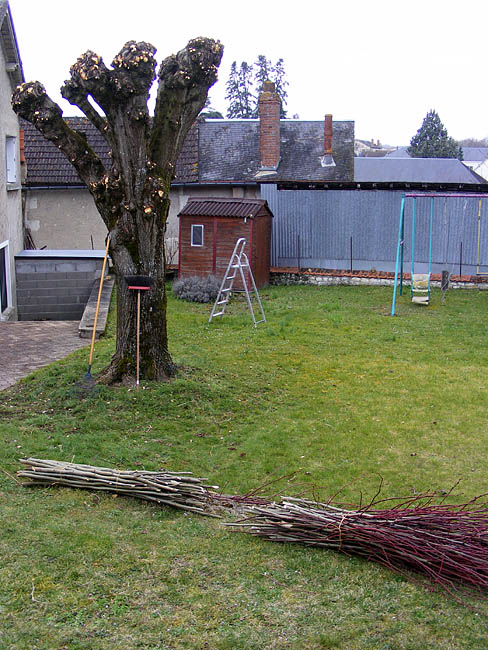 The counter to this is that this tree remains manageable because it is regularly pruned. It is healthy too, because it never develops a huge head to be buffetted by the wind and drain all the moisture the roots can suck up. It will live maybe three times as long as an unpollarded tree, and in the summer its green lollipop shape is ideal for the smaller garden.
 That always makes her smile
 I don't recommend you ever break a gearbox in your Traction Avant, but if you do, we know the right man.
 To start ours I first 'confitted' some duck legs. These are lightly cured by rubbing a mixture of salt, herbs and spices into the meat and leaving over night or even over 2 nights. Then they were put into a pan of melted duck fat and cooked extremely slowly (poached in the fat, not fried) for 4 hours on our wood stove. After cooking they were taken out of the fat and put aside to cool. It's easiest to cook them the day before you want to cook and eat the garbure.
 Then diced cured belly pork was fried in the boiler, joined by diced onion and crushed garlic. Once they are soft, add diced root vegetables such as celeriac (celeri rave), carrots (carottes), potatoes (pommes de terre), turnip (navets), swede (rutabaga) and leek (poireau) along with copious quantities of cabbage, a large can of white beans and pieces of meat such as lumps of confit de canard, shredded chicken meat and roughly chopped gizzards (gésiers) . Tuck in a bouquet garni and cover with stock. Bring to the boil, cover and simmer for an hour.
 Wikipedia has a very comprehensive entry on folding harpsichords, featuring these very examples. Apparently making them portable meant compromising the sound quality and musicians are generally rude about them. They are called clavecin brisé in French.
 Made in 1677 and decorated with ivory and engraved mother of pearl it was ideal for accompanying a singer. The exterior is a trompe l'oeil, painted to fool you into thinking it is pietra dura (inlaid semi precious stones).
 Small, neat and not nearly as ostentatious as most of the others, this instrument was made in Venice in 1543.
 Although this instrument is called the Lépante clavichord, not much is known for sure about it. It is probably 16th century and probably Italian - although it might be German. The somewhat unusual choice of lid underside decoration is possibly a depiction of the naval battle of Lepanto, fought between a coalition of European Catholic states and the Ottoman Empire, off the coast of Greece in 1571. The outcome of the battle prevented the Ottomans invading Italy and dominating the Mediterranean. It was also the last major battle fought using galleys and caught the popular imagination of the time.
 The Ruckers family were based in Antwerp and made harpsichords for several centuries. Their instruments are highly regarded for their beautiful resonant tone and the family's methods of construction are still used today by instrument makers and restorers.
 And this is my photo, taken at 19.47 Wednesday evening.
 It is predicted to be this warm for a few days yet, before settling down to a more normal March weather pattern (i.e. rainy). In the meantime we have caught up with the laundry because drying it outside is so much quicker, thoughts have turned to painting because I can do it outside if necessary, and sitting in the garden isn't the act of a masochist.
 In the distant past this area was under a warm shallow ocean. It advanced and retreated several times until finally, millions of years ago, it retreated never to return and leaving us with what geologists call the Paris Basin. Some of the Paris Basin is still under water - for instance the English Channel (aka la Manche). Other parts, such as south-east England and northern and central France are now high and dry.
 According to the local newspaper, the Renaissance Lochoise of Wednesday 7 to Tuesday 13 March 2012, GPs are getting older (43% of GPs in France are 55 years old or over), and young practitioners fewer and anyway they want to work in the big cities and prefer to be salaried rather than self-employed. The paper says that if you are going to get sick, try to do it in the Ile de France (the Paris region) or PACA (Provence-Alpes-Cote d'Azure region) and definitely not in Picardie or Centre (that's where we are). PACA has 370 GPs per hundred thousand of population compared to Centre's 242 GPs. The national average is 306 GPs per hundred thousand people.
 Pine Processionaries Thaumetopoea pityocampa (or les Processionnaires du pin) owe their English and French names to the remarkable behaviour of the caterpillars. The adult moths are good flyers, but only live a short time, as they do not eat at this stage. Everywhere they occur they are kept under surveillance and control of their numbers is attempted, as they can cause considerable damage to commercial forestry. A single colony can eat 2kg of needles, and it only takes 4 or 5 colonies for a 20 year old tree to be denuded. The consequence is that the tree can't photosynthesise, so it doesn't grow, and repeated defoliations therefore have an economic impact. The trees also become more likely to succumb to other stresses, such as drought or wood boring beetle larvae.
 The caterpillars eat all types of conifers, including cedars, Douglas fir and larch. The female lays her eggs on the trees which get the most light. If the plantation is mixed, she will target Black Austrian Pine over cedars. The adult moths emerge in July and August and can fly as far as 25 km away. They are very dull grey night flying creatures.
 At the beginning of winter each group of a hundred or so caterpillars construct a big nest on a twig well exposed to the sun. This nest is a double layer of silk strands, without an opening. To come and go the caterpillars work their way through the matrix of strands without cutting a hole in the structure. The nest acts as a sun trap and the interior can reach over 20°C more than the outside. The caterpillars spend all day huddled together in the top of the nest, whilst their droppings accumulate in the lower part.
 Where there are large plantations a biological control is now being used. A bacteria* is being aerially sprayed onto the trees to kill the caterpillars. For isolated trees, mechanically cutting the nests out and burning them is the most effective. Although not really recommended (or strictly legal) some people deal with the problem by shooting the nests with buckshot. If they don't succeed in bringing the nest down it doesn't matter because the wounded caterpillars become infected and transmit the infection to the others. Once they are down on the ground, pouring boiling water over the caterpillars will kill them, but there will still be hairs floating down from nests and in the surroundings. No method of control is guaranteed however, because of the long diapause.
 He had a number of different vanilla products - powder, essences and paste as well as the pods. In the end I settled on a conservative purchase of a pack of 6 pods for €5, after considering getting 25 for €20 and/or some paste. I also bought a €2 little packet of pimento (allspice) berries, poivre de jamaique in French, which I have found impossible to source elsewhere in France.
 Simon cleaning her engine bay.
 Fastidieux is a false friend. It does not mean fastidious, although in this case the English sense also applies. He was putting half a dozen pieces together, testing them, taking them apart, adjusting and repeating as necessary until perfect. He described it as fastidieux, meaning it was tiresome or tedious.
 Spring is just around the corner, and the garden plants that were flowering before the snow arrived have just started to recover their vitality. The Hyacinths have new blooms, and the daffs are that close. We also have many tulips sprouting, and Susan has just done our first lettuces of the year. Weather wise it has been typical late March really : a bit sunny, a bit windy, some rain, a little mist, and one or two frosts. Temperatures have been around the 0°C mark overnight, and between 10° and 16° during the day.
 This jester adorns a Renaissance window high up on the citadel walls in Loches. You can only see it from the street below. It would be interesting to know why the window is topped by a jester, as opposed to another character or motif.
 No doubt it is part of the extensive remodelling done on the Logis Royal by Charles VIII in the late 15th century, so not a window from which la dame de beauté might have gazed out.
 Once the virus is there, it is very difficult to do anything at all with the computer - the screen image continually reappears, and it corrupts your explorer file (the one you use for navigating windows) so that "ctrl-alt-del" doesn't work either.
 So - plenty of coffee and a steady hand, I'm going in. Wish me luck...


 Click on the photos to enlarge in a new window. If you want further information about this butterfly please go to the species page on Loire Valley Nature.
 I don't think I have ever had such a meat laden meal in my life - the only vegetables available being what we took, and a jar of cornichons. It was all incredibly tasty, and a bit unexpected: it appears that if you drive a classic Citroen you also need to be able to make smallgoods from wild boar that a friend has shot. Or at least méthode champenoise wine.
 These onions are very much sweeter than their round rivals and make by far the best onion gravies, tarts and marmalades. They are a bit softer at the stem end, so don't have quite as good a storage life as hard round onions and for that reason are not generally exported. If you want real French onions outside of France you will probably have to grow your own.
 After coming home to tell Simon I felt it was worth buying I went back there the next day and purchased it and a serfouette for €16. I don't know for sure what you call this smaller tool in English (according to Reverso it's a weeding hoe). It is a sort of cross between a hatchet and an ice pick. I bought it because the man we bought the orchard from had one that he used to plant the half dozen tomatoes he gave us when we exchanged.
 I am very pleased to report that the grelinette is just as I had hoped. Two of its tines are shorter than the other three and offset, which I think allows it to slide easily into our quite stony soil. I like the fact that I can properly stand on it if necessary to get it all the way in (I've never mastered the art of doing this with an ordinary fork). The main advantage is that to dig you do not need to bend, lift and twist all at the same time. For people like me, who aren't particularly strong or athletic, it is so much less exhausting to use the broad fork with its step back, press down action. The hardest work is shaking it from side to side, which you need to do if your soil is clumpy like ours. I'd like to be able to leave it down at the orchard too, as it is heavy to carry, but even in Preuilly I think I would risk getting it stolen.
 Maybe the term foodie is like the term muso. I have never met a professional musician (or even a serious amateur) who described themselves as a muso. Other people may do so, and so may people who listen to a lot of music and occasionally dabble with an instrument, but never in a professional situation have I heard someone describe themselves as a muso. Most musicians I have met hardly ever listen to music unless they're looking for inspiration, and never have background music playing. To a musician, music is never "background", it's there to be properly listened to, even if it is clearly rubbish. Anyone who spends 18 hours a day plugged into their i-thing and calls themselves a muso is usually dismissed as a wannabe.
 Some species of solitary bees such as Mining Bees Andrena spp, Sweat Bees Halictus spp and Nomada spp will be out. Several of the early emerging species of Andrena depend greatly on the Sallow catkins that appear in March, and the Nomadas will be out because they parasitise the Andrena. Several Andrena spp are also important early pollinators of fruit trees (they look like small Honeybees). Honeybees Apis mellifera themselves will become active at this time too, visiting what ever they can - fruit tree blossom, daisies in the lawn and the shiny yellow flowers of Lesser Celandine Ranunculus ficaria. The odd bumblebee queen will cruise about looking for suitable nesting sites.
 Take care around conifers, as the notorious Pine Processionary Thaumetopoea pityocampa caterpillars will be active. They are clearly spreading and we got our first infestation ever in the single Scots Pine in our orchard over the winter. Remember that their irritant hairs float in the air and you and your pets will pick them up even if you don't touch the caterpillars. For more information about them, see my species account on Loire Valley Nature.
 One of the cheeriest butterflies you could see this month is the Orange Tip Anthocharis cardamines. The males emerge very early (late March or early April) and have to hang around for the females for a week or so . In this time they can be seen purposefully flying up and down ditches and hedges, in the hope of bumping into a female.