Sunday, 31 August 2008


Saturday, 30 August 2008
Buildings on the Market Place - No 6
 According to Roger Lezeau, the clockmaker Fanon always wore a grey jacket and had two competitors - Niebling, directly across the square, and Liot, who had a shop a little further away in Preuilly. Amongst Fanon's responsibilities was the prestigious job of adjusting the municipal clock on the façade of the town hall.
(Roger Lezeau's comment translated from his article in Les Cahiers de la Poterne, No34. Monsieur Lezeau was born in 1912 and is a great source of knowledge about the history of Preuilly.)
Susan
Friday, 29 August 2008
Two Plant a Garden in Preuilly
In May I bought some seeds that I thought would grow into plants that would survive considerable neglect and provide a bit of wildlife food. I bought radishes because they would grow quickly and many insects like the flowers of the mustard family of plants, and small finch type birds are reputedly quite keen on the seeds. We didn't want to eat the radishes ourselves -- neither Simon nor I are particularly fond of them. I also got a variety of flowering plants with proven attractiveness to insects and suitable drought tolerance -- Marguerites (ox eye daisies), Jacobs Ladder, annual cornflowers, sweet rocket and sunflowers. Then I added some herbs -- basil and coriander, and salad leaf, zucchini and sweet corn, just to see if they would survive and produce something edible.
Our back yard was previously the stableyard, and doesn't really have any proper soil -- it's more like hoggin and quite compacted and gravelly. We had some loose limestone blocks from the demolished chimney that were of a manageable size and were just lying around doing nothing, so we laid them out as a border to the planting area, just to delineate where the seeds were and encourage people not to trample willy-nilly across the area, but give the little plants a fighting chance. Then I brought out the pickaxe and hacked away at the ground for a while. This was clearly going to take quite a while, so Simon hooked up his chisel blade to the hammer drill and used it like a jackhammer -- job done in minutes!


 In went the seeds, on went a mulch of 20+ year old straw left over from the days when there were actually horses here (hope we all haven't got farmers lung as a result of handling it!) and the new garden watered.
After 3 weeks we got this:

 and after 8 weeks it was this:
 then 10 weeks and looking pretty and cottagey:
 and last week we got this!!
 and it looked like this (the sunflowers are a good 2m high!)
Susan
Thursday, 28 August 2008
La Vache Qui Rit*
 Isn't this the most smugly contented cow you have ever seen? She is a Maraichine, a breed developed in the Marais Poitevin** from the blond Limousin breed, and she lives on an island in the network of canals around Coulon. She is a beef breed (or perhaps a dual purpose breed). According to the official breed description the usual number of horns is two. (I checked other breeds for 'usual number of horns' -- disappointingly, they all seem to be zero or two -- I was really hoping to come across 'three' or 'six' or something a bit more out of the ordinary.)
I did wonder whether I should call this post 'Les Vaches Maigres et les Vaches Grasses'. The phrase comes from the story in Genesis about Pharoah's dream of the seven thin cows and the seven fat cows. In French the expression is used to indicate a state of penury or plenty. She is clearly the fat cow and we are the thin cows just at the moment. Apparently, all sorts of animals can be used to create this metaphor, including, to my surprise, les ornithorynques (platypuses). My source for this information does admit, though, that some animals are easier to slip into the conversation than others.
Susan
*La Vache Qui Rit (the Laughing Cow) is a brand of processed cheese, most commonly encountered in the UK as the snack-sized red-wrapped cheese disks sold as Babybel.

**The Marais Poitevin is one of the top three most important wetland habitats in France, situated to the west of the Touraine, in the Vendée between la Rochelle on the coast and Niort. Much of the land is reclaimed.
Wednesday, 27 August 2008
Un Concert de Trompes de Chasse...
In May we came across the local Trompettes de Chasse ensemble and noticed that there was a concert being advertised for July, so we resolved to go. Our friends Adrian and Caroline and their little boy Cory were staying and it seemed an ideal, very French, evening out.
The venue was the Château de Boussay and the grounds at the front of the château were laid out with rows of wooden benches for the audience and a slightly raised platform for the performers. When we arrived just before 8.30 pm it was still perfectly light, and quite a few people were already there. Cory practiced his 'bonjour' and 'merci' on the ladies selling tickets and they thought he was utterly adorable. Over by the stable block some men in hunt uniform were milling about and a couple of beautifully turned out horses were visible. The hounds were still locked up, and not many trompettes were on view.
 Eventually everyone settled down and the musicians trouped out onto the stage. They stand with their backs to the audience to perform, presumably so the horn, and therefore the sound, is directed towards the listeners and doesn't just bounce off the château walls in an alarming way. There was a lady compere, who described each piece of music, giving its history and the name of the composer. She spoke slowly and clearly, so I found her fairly easy to understand. I expect all the French people in the audience found her style dull and plodding, but I didn't mind.
At the end of each piece the musicians turned to face the audience and removed their hats. They played some old pieces, some newly composed and indeed, at least one that was being performed for the very first time at this event. The compere was occasionally drowned out by screaming, wheeling swifts, baying hounds or the church clock bell. When not required to play, the musicians twist their instruments around and around to drain them. After a while, there was considerable spit flying, and you could observe the musicians discreetly soothing their lips by pressing them against the cool brass of the side of the instrument.
 We learnt from the compere how the sound was made, how the musicians learn and remember the tunes. During the interval we came across a group of them standing in a circle and singing their parts, which is how the tunes are practiced, arranged and memorised. Occasionally, the musicians sang as part of the performance. We were told that there are trompettes de chasse ensembles in Australia and England. She stressed the importance of the traditions of the hunt and its long history in France.
The huntsmen's quarry is deer and boar, and in the old days, wolves. Unlike in England (prior to the ban) foxes are not hunted by mounted équipages (hunts) like this, but on foot and with a different breed of hound. Rabbits and hares are also hunted on foot, and with different dogs again. Hunting with horses and hounds is la chasse à courre, hunting in the wider sense is la vénerie. No guns are used in la chasse à courre and the prey is dispatched with a dagger. Hunts average about one kill for every two outings. All aspects of hunting are strictly regulated, and the season is October to February i.e. hunting is only allowed in the winter months. A pack of hounds will number from 20-80 hounds, depending upon the target prey. I think the hounds in this pack are a type known as Anglo-French tricolores. French hunts take place in woodland, and riders are not expected to be nearly as fearless as in England, as apparently one rarely has to jump obstacles. The horses are employed more as a convenient means of covering the ground for the 3-4 hours duration of the hunt.
After a while we noticed that the hounds had been let out and were being shepherded out onto the road by two horsemen. Finally, they arrived, the maître d'équipage (Hunt Master) in the lead at a fast trot down the driveway and the melée of dogs followed by the second mounted huntsman. The audience was seated either side of the driveway, so this was a very dramatic entrance right through the centre. There was an old man in a wheelchair with rather stylish lime green tires, who had parked on the hard surface of the driveway rather than try to struggle on the grass. He was right in their path, but neither he nor the horsemen blinked and they swept past him without mishap. The dogs were kept under control by the maître and half a dozen whippers in on foot. A few of them slipped off to the side and through the audiences' legs, but they all came together at the front again. The hounds were a swirling mass of tail-wagging, tongue-lolling, snuffling lollopers, out having a great time with their buddies. The group was a mixture of dogs and bitches, with many of the bitches appearing to have pupped recently.
 Once at the front and expected to stay more or less in the same spot, the hounds were totally focused on the maître (except for one who escaped to sit in the crowd until dragged back by a whipper in). Both the riders and the whippers in used a long whip that could be cracked over the dogs' heads like an Australian stockwhip. One of the dogs got accidentally injured in all the excitement, and slunk into the crowd with a cut oozing blood above one eye. A whipper in pounced on it and carried it off to the stable block. These are big dogs (I would guess in the region of 40kg), and it did look funny, but the dog submitted meekly to the indignity. The compere talked about the tack, including something about a special hunting saddle that I didn't quite get. The mounted huntsmen and the whippers in carried trompettes too, and played a couple of numbers.
 Then the maître wheeled the hounds around the audience a couple of times, going at a faster and faster trot, then breaking into a canter. Finally, back through the middle and off up the driveway -- the old bloke in the wheelchair still imperturbably sitting there. By this time it was quite dark, and the compere was reading her lines by torchlight, struggling with a fading microphone as the battery started to run low.
 Young Cory had as much fun as the hounds did milling around. His pack was made up of the dozen or so local children who spent much of the evening rushing up and down an area of mown grass to one side of the seating. As is so often observed with children, language was no barrier to having a good game.
Nous espérons que vous avez passé une agréable soirée. Merci à tous et à bientôt.
Susan
PS The National Trompes de Chasse Championships are this weekend (30-31 August), at the Hippodrome (Racecourse) de la Roche Posay, just down the road from us. One of the highlights will be a retrospective on wolf hunting, with a demonstration Saturday evening. The last wild wolf in France was killed in the late 1930s in the Limousin, the more mountainous region to the south of the Touraine.
PPS We had hoped to upload a couple of movies with sound tracks made on the night but for some reason they would not upload. Once we've figured out what the problem is we will add them in a new post.
Tuesday, 26 August 2008
Le Château de la Celle-Guenand
It sits in the middle of the village, and quite a good view can be had from the footpath looking through the railings of the gate. It particularly attracted our attention because the roof of one of the wings was being repaired -- and it is one of those proper château roofs, with pointy bits.
 The turrets at different stages of completion.
 A detail of one of the turrets showing how the base of wood is laid before the slate is applied.
Being able to see the work in progress was fascinating and we stood in the gateway looking and photographing. There were three men up on the scaffold, and when one of them came down to fetch something he asked us if we would like to go in and look around. "Oooooh, yes please", we said, "we're roofing fetishists."
 Here the roofer's all-purpose machine is lifting up small beams for the next stage of the frame.
The driveway curves around to the right and the grounds stretch away up the slope. There is a potager with a glasshouse on the lower terrace and an arboretum cum ride on the upper terrace. Behind the main part of the château was a surprise -- it is built on one side of a small limestone gorge, which you cannot see at all from the front, and behind the main block, the land drops away vertically, creating a small hidden valley. On the other side, cut into the rock, were a number of caves -- some for wine, some for the storage of other odds and ends of château life. There was also a large pile of partially burnt wood in the gorge itself. It was clear that these were the old roof timbers from the wing that was being repaired and that there must have been a fire that damaged the roof.
 The main block of the château. The picture is taken from the driveway near the potager, and the wing under repair is just out of the picture to the left.
Once we re-emerged around the front, we went over to thank the man who had invited us in. He turned out to be the owner. He told us that he and his two sisters had inherited the place when their parents died. They run a chambres d'hôte (bed and breakfast style holiday accommodation) in one of the stable blocks. (The other stable block I got the impression houses the local hunt, but I might have been mistaken.) The roof of the wing being repaired had indeed had a fire, but the charcoaled wood we saw was only the unuseable remains. Many of the very big, very old beams had been salvaged and were carefully stored in a safe place, having been so hard they were just a bit scorched in the fire, and would be reused.
The block being repaired was the original entrance to the château, and is connected to the main house by an elevated, enclosed walkway, under which is the original carriage gateway. The main house once had a drawbridge too, above what is now the front door. You can see that this area has been altered when the entry level changed from first floor to ground level.
 Note that one of the turrets is hexagonal, whilst the others, including the beautifully finished lower one, are conical.
We were introduced to M. Frelon*, the roofer, a big, well-built man in a tightly fitting orange tee-shirt and his assistant Dominique. They were relaxed, charming and friendly, and offered their elbows (this is a politeness one comes across often when greeting artisans. It is in lieu of shaking hands, because they were worried their hands were dirty.) It was a real pleasure see such skilled traditional work at close quarters, and we wished them bon continuation.
Susan
*Apologies that I can only show you tantalising glimpses of M. Frelon's manly frame, working up on the roof. I do have a picture of him on the ground and smiling at the camera, taken by my mother, but it's on an external drive that I don't have access to at the moment.
Monday, 25 August 2008
Why Has My Baguette Gone Up?
In translation, it says:
- from 0.035 euros worth of wheat in the price of a baguette, now it represents 0.088 euros.
 How the price of your baguette is made up. Please note that I measured the baguette carefully and cut to the nearest millimetre, in order to give our readers the best possible understanding of the components that make up the cost of a baguette. The actual percentages can be obtained on request.
Sunday, 24 August 2008


Saturday, 23 August 2008
Buildings on the Market Place - The Hairdresser

Roger Lezeau says: The Peanut Bazaar was really something! Father Peanut (we didn't know his real name) was an old man, sensitive to the cold, who, despite wearing several jackets one on top of the other, still dreaded the least current of air.
He claimed to have everything. He was proud that in addition to the peanuts, the goods ranged from liquorice paste on spools; socks and galoshes; curry combs for horses; night caps up against clogs; violet pomade for the grandmothers' hair as well as postcards in his name.
He sent his loyal employee, Marguerite, out to the fairs in the area in an uncovered cart yoked to a donkey. One day she found herself caught in a rainstorm and got soaked; whereupon the 'bones' in her corset, made of steel, rusted - but no matter - the Peanut Bazaar also sold corsets and corset 'bones'!
(Roger Lezeau's anecdote translated from his article in Les Cahiers de la Poterne, No34. Monsieur Lezeau was born in 1912 and is a great source of knowledge about the history of Preuilly.)
Those of you familiar with France will know that small French towns seem to have a remarkable number of hairdressers. Preuilly has a population of less than 2000, serviced by three salons and at least one other hairdresser who does not have a salon, but visits her clients in their homes. I would say that Preuilly is slightly below average on the French hairdressers/head of population scale but the town doesn't seem to be suffering a crise des coiffures as a result, thank goodness. Au contraire - we also seem to be slightly lower on the French national scale of ill-advised use of red hair dye/head of population.
Burgundy is a fine colour...in a wine...but a curious choice of hair colour (and, ahem, door fitting).
Susan
Friday, 22 August 2008
Roc-aux-Sorciers
It seemed amazing to us that we had never heard of something that claimed to be "the sculpture equivalent of Lascaux", especially when it was only 20 minutes from our house. It first came to our notice when Simon was reading about caving lessons given by the "Spéléo Club Anglois", but he had real difficulty finding any details.
 Well - no longer. Since March '08 there has been a Museum "Roc-aux-Sorciers". We visited the museum with Susan's parents in May, and were well impressed with the exhibition.
 At present all the information is in French only, but the very nice young man at the front desk who spoke English suggested that we walk straight through the son et lumière and around the back to where the carvings have been reproduced in fibre glass. He said that once we had looked at them, the audio visual presentation would make much more sense. Good advice, and the son et lumière is very nicely done, evocative enough to get across the idea of the caves changing occupancy and form over time without the need for too much language.
The importance of the caves and their carvings is that they are an extremely rare example (perhaps unique) of people living in the cave they decorated. The hunters and artists who lived here were Cro-Magnon, from the Magdalenian period (18 000 to 10 000 BC). The caves were only occupied for a short period, then filled up with sediment, thus preserving the traces of human occupancy and the detail of the carvings.
They were discovered by Suzanne de Saint-Mathurin in 1950 and there are some charming photographs of a number of locals as children helping with the original dig. It reminded Susan of photographs of the early dig at Sutton Hoo.
Simon and Susan
Thursday, 21 August 2008
Hawkmoths
 This one is the day flying Hummingbird Hawkmoth, Macroglossum stellatarum, photographed at the municipal flowers in the main street of La Roche Posay. Note how it holds its tongue rolled up like a watch spring as it approaches a flower (left), then extends the tip using the hinge half way along the tongue (right).
Uncle Geoffrey, who is genuinely petrified of moths, found this one so cute and interesting that he happily stood within feet of it while it worked over this bush.
The scientific name means something like 'big tongued starry backside'.
Hummingbird Hawkmoths make a soft hum as their wings whirr. I have never seen one at rest -- they even sunbath on the move, soaking up the warmth of sun-drenched walls by hovering in front of them. They are common in France, especially in gardens and floral parks. They are appearing in Britain in increasing numbers, right across to Northern Ireland, but they are migrants. The hotter the summer, the further they get. In a good summer they will reach Scandinavia.
Their large green caterpillars, with their sharp little 'tail', characteristic of the family, feed on bedstraws Galium spp and Valerian Centranthus spp. With a wingspan of 4-5 cm, they can be seen in all but the coldest months in central France.
 The second photograph shows a Lime Hawkmoth Mimas tiliae. These are quite variable in colour and pattern. This one is a rather intermediate greeny brown. They have rather a short sad life as adults, having no mouthparts, so they cannot feed. Their sole purpose is to find a mate, after which they slowly starve to death. The caterpillars are very similar to the Hummingbird Hawkmoth's, only lacking the racing stripes down the sides and substituting fine orange flashes. They feed mainly on Lime Trees Tilia spp but also on Elm Ulmus spp and Alder Alnus spp, transforming into adults during May to July. This is a lowland species, living in woodland, parks, gardens and even street trees. This species is nocturnal, but often seen because it is attracted to bright lights. They are slightly larger than the Hummingbird Hawkmoths at 6-8cm.
Susan
Wednesday, 20 August 2008
High Above the Seine
They both love to produce delicious meals and are very knowledgeable about all manner of beverages. For instance, who knew that there are some very fine Canadian beers?
Christian was in charge of the evening meal, as Edith was hobbling from a recent knee operation. He served a variety of salads to start, then enquired how we liked our steak cooked. This opened the way for the usual joke from a French person to my father about well done being like the sole of a shoe. Then there was some very fine cheeses and to finish a pear and chocolate tart. In amongst all this food was a variety of drinks. Before dinner both red and white wine (an organic Colombard from a friend's vineyard), beer from the north of France and an orange coloured aperitif that I can't remember the name of. During the meal, more red, more white, a bottle of champagne, and at the end of the meal the star of the show -- an Armagnac.
Christian is from Gascony. When he was 17, he made and laid down some Armagnac with his family. On his 40th birthday it was opened, and he is now (not quite) 50. It was such a privilege to be offered this precious liquor, and Christian was tremendously generous with it! Both he and Edith have the gift of making guests feel totally comfortable and welcome in their home.
The next morning we were out for a quick look around their 'paradise' as Edith quite rightly calls it. Christian built their spacious home himself, and has a large workshop full of tools and machinery -- some of which are his own invention. Edith and I are friends because we are both interested in nature, and she is a fine nature photographer. We 'met' on an online nature forum, and now I practice my French on her and she practices her English on me.
 Here we all are watching Simon take a photograph -- you can just see the cerise dot that is his subject in the grass. You will observe that Christian is the archetypal Frenchman -- elegant, groomed, stylish and conscious of appearances (sorry Dude, but Edith said I could tease you...)
 And here is the Pyramidal Orchid that Simon photographed.
Susan
For more on orchids, please click here
Tuesday, 19 August 2008
St Pancras
What a disappointment!!
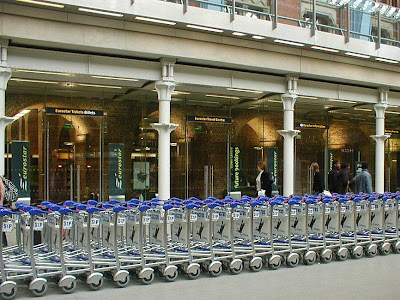
I was already familiar with St Pancras in its old, under-used guise as an extension of King's Cross station, and I had been shown around the adjoining Grand Midland Hotel some years ago, to see its abandoned Gothick splendours and catch a glimpse of a by-gone age of travel.
Revisiting, I expected to see sensitive and clever re-use of a marvellous and decoratively splendid space. What I saw was plate glass and polished steel, chopping up my sight lines in all directions. Everything, from the jumble of goods in the array of high street shops (chain stores), to the new bronze statuary, had to be viewed at least partly through the plate glass which was being used to divide up the space into different functionalities.
 [rant]Architects**! -- plate glass is not invisible! It has edges and fittings and reflections upon reflections. If there is a large feature statue, one needs to be able to stand some distance away from it and look at it through open space (even if it is of dubious artistic quality) -- NOT only be able to see it through one or more layers of plate glass or have to stand so close to it you are looking up the subjects' noses! Slotting shops into arched colonnades and fronting them with plate glass does not allow me to experience the full expanse of a magnificent architectural space -- it merely allows me to see the haphazard arrangement of commercially available goods that I could see in any shopping street in Britain! Please remember that the occupants of your architectural space will put randomly placed objects in your building with no regard for colour or proportion, they will stack cardboard boxes against your glass and they will respond instinctively to the real look of the place, not your fantasy on paper. Think about Stansted Airport and the difference between Sir Norman's empty hangar and the real thing in use today***, teaming with people and luggage, with the clean lines of the check-in desks cluttered with corporate branding from a dozen or more airlines and scuffed and chipped by relentless use. Did no one say to you at the start of the job -- 'Look, your mates ruined the Royal Exchange, but you have a chance to redeem yourselves here -- do something clever that will make peoples' hearts sing, not sink'.[/rant]
 And while we are on the subject of sinking -- the statue of Betjeman is quite sweet, and you can at least get an unimpeded view of it, but what's with all the nautical references in the quotations from his poems? Surely the man wrote enough about train travel? -- there must have been something that could have been used that wouldn't have mystified travellers, even when those not familiar with his work are presented with a single line with no context to help make sense of it.
Susan
*Turns out to be rather 'much hyped'.
**That's architects of this ilk, not the architects I know are out there and understand how to set an old building up for modern use. I am also well aware that once the designer hands the project over to the men with the chequebooks, they often no longer have any influence.
***The caption on this picture, which I got from e-architect, says 'Concourse once airy and calm is overflowing with people and shops'.
Monday, 18 August 2008
LOOK!!! That's me!
Like all people of that ilk, I can't resist looking for myself. So when I received the videos of the Tour de France I had to go through them frame by frame. All three sets. Although the picture feed is the same for the coverage in Australia, France and the UK, the editing is different. They all go to ads at different times, and the UK broadcast went to a special feature just at the wrong time.
On the Australian broadcast though.... THAT'S ME!! You can tell that, because I am at least a metre taller than anyone else in town.
 Yup, it isn't a good image. It's a photo of the TV screen. But that is definitely me.
Simon
Sunday, 17 August 2008
One for the Roofing Fetishists
At the moment, there is a huge amount of building work happening at the chateau. The outer defensive wall is being rebuilt, and it is being re-roofed.

It isn't the only chateau we pass on a semi-regular basis that is being re-roofed, and whenever I see one of them I think "aren't I glad I'm not paying for that".
Not that I would mind owning a place like this.
Simon
Saturday, 16 August 2008
Buildings on the Market Place - The Veterinary Clinic
 According to Roger Lezeau, the ironmonger Doucet, with the mechanics' workshop off rue des douves (one street behind the market place) wanted to be a man of importance. His crewcut hair contributed to his fine presence.
(Roger Lezeau's comment translated from his article in Les Cahiers de la Poterne, No34. Monsieur Lezeau was born in 1912 and is a great source of knowledge about the history of Preuilly.)
Susan
Friday, 15 August 2008
Le Blanc
As the road from Preuilly enters le Blanc, it passes under the viaduct built in 1886 that used to carry the railway between Poitiers and Argenton sur Creuse. The railway closed in 1994, and in 2005 the route was opened as a footpath.
 I visited Le Blanc with my parents in June last year and Susan's parents in May this year. Both times we parked on the D3 (rue de St Aigny) where the railway line can still be seen crossing the road and walked about 1km to the bridge.
 From there you get great views of le Blanc and the Creuse river valley (locally renowned as one of the prettiest in France) as well a a little exercise.
 Both times I have attempted a walk across the bridge it has hammered down rain; with my parents we had two failed attempts to reach the bridge in-between showers before we made it, and when I was there with Susan's parents........... Well - the pictures tell the story.
 Soon after I took the above photo it rained heavily enough to cause the river to flood some houses in town and cause major consternation. Even a week later the river was still flooding fields further downstream in La Roche Posay. I have some before and after photos of that I will search out and post later.
Simon