Monday, 8 August 2011

What a Difference Some Rain Makes!

We've had several inches of rain in the last month. Not enough to end the drought, but it's been good steady rain on occasion and has boosted the orchard and vegetable garden tremendously.

Brugnons blancs (white fleshed nectarines).
Suddenly, we are harvesting nectarines - small, but not too bad. Our big old tree has a worthwhile crop ready now. I am amazed it didn't drop all its fruit like the other nectarine trees did in the dry.

Doyenne de Comice pears and nashis (Asian pears)
grafted onto the same tree.
The Doyenne de Comice pears look fantastic, of good size, but not yet releasing when I move them, so they are not ripe enough to pick. The nashis are small, like little golden apples. I don't know if they will swell up with the rain, but I hope so.

Ripe apples on our Ballerina.
Several of the apples have some ripe fruit already, and it is much better quality that the previous two years. There is relatively little disease or insect infestation. Time to make apple jelly!

Pêches des vignes
(white peaches that are ripe at the same time as the wine grapes).
The peaches are coming on, still hard, but no unsightly black spots this year, so I assume there has been no hail.

The white table grapes have burst and gone mouldy on the vine. The red ones are still green but looking very healthy.

In the vegetable garden we are at last getting decent zucchini. I've started digging the potatoes, but the crop has been severely reduced by the dry. The garlic failed and I've dug all the onions. One box of medium sized onions for cooking and a box of small ones which I will pickle. Nothing like the fabulous harvest we got last year. The chard (silver beet) has self-seeded widely and is now doing very well in response to the rain. I blanched and froze 1.2kg of it a couple of days ago. That doesn't sound like much, but believe me, it's quite hard work, and there is still more to pick.

At the moment the orchard is carpeted in flowering wild carrot, wood sage and agrimony and the butterflies are at last returning to my side of the fence. It's all a bit too straggly for a working orchard though and I am going to have to mow some of it.

Susan

Sunday, 7 August 2011

Brocante Washout

Preuilly's big annual brocante (jumble sale) was yesterday. Every French village organises an annual brocante, which is a mixture of professional dealers and local people emptying the contents of their attics and garages.

Parapluies not parasols.
Unsurprisingly, in the light of yesterday's deluge in Paris (seen here on Frogsmoke) and with the weather coming in threateningly from the east the night before, the brocante started off badly. It rained heavily enough for stallholders to have to cover their goods, which is hopeless for making sales.

This garlic crop clearly didn't fail.
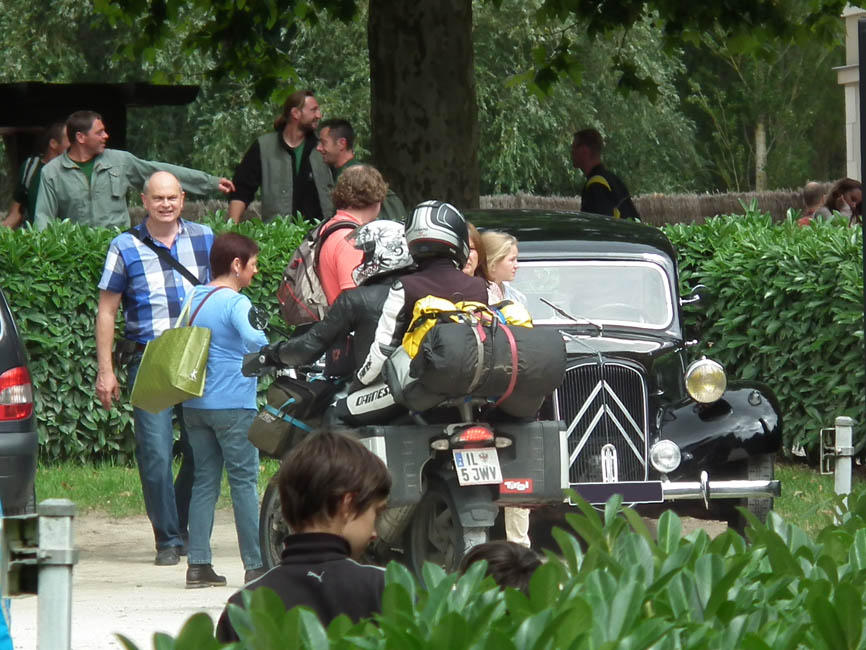
The extra pressure of brocanteurs and holiday makers on the traffic caused the biggest bouchon I have ever seen in Preuilly. The whole of la Grande Rue and rue du Chaumont-Patin was gridlocked. It seemed to just be a result of the quantity of vehicles trying to get through a section of the village which is effectively only one lane wide. Tout le monde was sitting going nowhere, including a transporter with a broken down ute from the Parc Régional de la Brenne and a rather natty vintage bike and sidecar. There was lots of sighing and drumming of fingers but no hooting or shouting. Eventually, I don't know how or why, a few cars moved off, then a few more, and in minutes it was all over.

Going nowhere in Preuilly.
And by lunchtime the sky was clearing, so I hoped the afternoon would go more pleasantly for the brocante vendors, but it was not to be. It rained lightly most of the afternoon. Personally, I was very happy to get a bit more rain.

Susan

Saturday, 6 August 2011

A Sad Farewell

Yesterday we attended a simple ceremony to inter the ashes of our friend Jean-Pierre Lartigau in the cemetery at Preuilly. Only last year at Simon's birthday party he was hale and hearty and enjoying retirement. Sadly, just after Christmas, having had several years of remission, cancer returned. The cremation had been performed the day before in Paris, where he lived and was attended by many of his friends from his days as the Director of the Parc Floral de Paris.

Jean-Pierre grew up in Preuilly and his 91 year old mother lives just up the street from us. His two sons came down to preside over the interment and to support their grandmother. Jean-Pierre was an only child and it was very sad to see Madame Lartigau. Anne, his widow, was just too exhausted to make the trip, after many nights of very little sleep at the end.

J-P at Simon's 50th.
He was always so kind and generous with his time and expertise. When my parents visited in May 2008, he volunteered to give them a personal guided tour around the Parc Floral. I wrote a long post about the visit and J-P here. He was restoring his family home in Preuilly and so we would see him and Anne from time to time when they visited. Last year I decided to create a fernery in the apéro terrace. J-P loved ferns, and on hearing my plan, contacted a specialist nursery and presented me with a dozen or more little ferns for the new garden. Now whenever I water them I will think of him.

Plants and gardens were clearly his passion, and if you were interested in these subjects he was eager to help you pursue your interest in any way he could. His knowledge and network of contacts were extensive, and although he struggled with my poor French, he always endeavoured to answer my questions. Apart from the Parc Floral, he was particularly involved with the Conservatoire des Collections Végétales Specialisées (the equivalent of the British National Council for the Conservation of Plants and Gardens).

We will miss him, and our hearts go out to Madame Lartigau, Anne, Marc and Frédéric, and to Dylan, who won't understand why J-P isn't around any more to take him for walks in the forest.

We would also like to extend our sympathy to Bertrand and his family. Bertrand's father, who had the same name as my own father, was buried yesterday too.

Susan

Friday, 5 August 2011

Le Coq gaulois

The rooster as a symbol of France is well known, but recently at the Café Franco-Anglais we had a discussion as to why, and I thought it was worth doing a bit more research and reporting on the blog - especially as we have recently been given the ideal thing to illustrate such a post with.

Eggcups, purchased at the Assemblée Française
gift shop by friends from Sheffield (not London).
Le coq gaulois is a play on words, as gallus is the Latin for rooster. The association between the rooster and the Gauls began, as so many of these things do, as an insult, swiftly adopted by the recipients and turned around to express power and pride. Just at the time the Catholic Church was fighting for survival against the wave of Protestantism during the Renaissance, the coq began to be deliberately promoted by the Catholic French kings as an expression of renewed and strengthened faith because of its association with Saint Peter. This is why it is always depicted crowing. Le coq gaulois symbolises the resurrection and Christian readiness for the second coming, and is seen on every church in the land, usually as a zinc weather vane.

The symbol survived the Revolution because of its (purely imaginary) association with the ancient Gauls, and today is more often encountered than Marianne, the official symbol of France born from the blood and ideals of that Revolution. These days as well as on top of every church you will see the coq at national sporting events and at the movies. It is the most recognisable symbol of French national pride both within and outside of France.

Susan

Thursday, 4 August 2011

The Bells of Loches

We mentioned the new camera the other day. One of the things it does really well is video - hi-def, stereo sound, widescreen and everything. Now I have to get the old Mac revved up so I can use a professional video editing package.

But until then, an interim effort.


Simon (posting as Susan, because that just the way it was...)

Wednesday, 3 August 2011

Worktops

I mentioned the other day that we are buying a granite worktop for the kitchen. This is coming from Plan de Travail Direct, a company I found during an online search when I was unhappy about the "service" we were getting from certain kitchen shops. This company appears to be the supplier that the kitchen shops use, but a lot cheaper if you buy direct rather than via a third party. One thing I liked about their site is that you can get an online devis (estimate) for your worktops.

When we were about to leave for Paris in June it suddenly occurred to me that this company was based "in Paris". At first I feared that this meant "from here on a clear day you can see Paris" or even "on the same planet as Paris", but what they actually meant was "IN Paris". I noted the address, and as soon as we arrived in Paris and dropped our bags off at the hotel we hotfooted it across town to the showroom. There we found them to be friendly and helpful, the ordering process was explained, and a devis done that corresponded with what I had calculated for myself.

The granite in situ (from the
Plan de Travail Direct website)
The granite we chose is a building quality granite that comes from a town in Portugal called Pedras Salgadas, with which it shares a name. It's a bluey/grey fleck, and we like the fact that it is quite local, and isn't from a warzone or country with dubious human rights/work practices.

A couple of weeks ago we contacted the company to say that we had installed the kitchen units, and a few days later a team arrived from Portugal to measure the kitchen for the worktops. This had to wait until after we had installed the basic units so the measurements could be absolutely precise. We were impressed by how professional and quick they were - they had obviously done this kind of thing before. There was no head scratching or rummaging for tools, which is always a good sign.

Measuring the kitchen
We now have to wait until the factory is back from their August holidays before the granite can be cut, delivered and installed, but September is only 4 weeks away...

Simon

Tuesday, 2 August 2011

2011 Festival des Jardins, Chaumont-sur-Loire

Every year for the last 20 years the château de Chaumont-sur-Loire has hosted a garden festival. The intention is to showcase contemporary landscape gardening. The best of the show gardens display new talent, new ideas and new materials to the public. Because the gardens are on display from April to October they have to be real gardens. Budgets vary, but are most appear to be relatively small - probably a few thousand euros, making the ideas that appeal interesting and achievable for the home gardener.

The Memory Library.
This year's theme is 'Gardens of the future, or the art of happy biodiversity'. Some of them didn't seem to be taking the biodiversity part too seriously, including the big name Chinese designer. I only realised he was a big name because one of the gardeners at the Prieuré de Saint Cosme asked me if I had seen his garden. My response was that we had seen it, but there were other gardens we liked better.

I Miss You.
Our favourites were:

Scultptillonage with its fun compost bins in the shape of mushrooms. Of course, as our landscape gardener client pointed out, they were completely impractical* if you wanted to use the compost, but she really liked the spray painted chicken wire 'allium' balls and yellow 'daisies'. The flowers were full of woollen yarn, for use by nesting birds, and the sunflowers had tubes for solitary bees at their centres.

The Garden of Extinct Plants.
I Miss You where I pedalled energetically to power the water jets, which kept a toddler entertained for some time. The central platform and steps are made of recycled pallets and it is a very pleasant water garden.

The Memory Library. We like this one because we used mirrored Christmas baubles on canes in our London garden, so we appreciated the design aesthetic. It was also very nicely positioned so that you glimpsed the château itself in the background, making a quite fairytale scene.

The Nature of Things.
The Garden of Extinct Plants, laid out like the war cemeteries of northern France, with row upon row of simple black and white plant labels.

The Nature of Things, with the best integration of a bathtub in a garden that I have seen.

Some of the gardens were very attractively planted, and exactly what one could envisage living with at home. Others didn't work at all, with ambitious ideas not being achieved on the ground. There were a number where it was all about the blurb on the information board and the garden itself was unsatisfying. The designers had obviously spent too long hanging out with the sort of conceptual artists who think it's ok to have a not very original thought and express it in a poorly executed installation.

Sculptillonage.
It seemed to be a year (or perhaps just the month) for blue. Many of the gardens featured asters, lavender, agapanthus, lobelia, eryngium, catnip, perovskia and salvias, all flowering like mad in the July sun. Gorgeous.

Susan

*I had an email from Claude Pasquer, the designer and maker of these Champicomposteurs, who assures me they do function, so I'll blog about them again in more detail sometime.

Monday, 1 August 2011

What to do in and around Preuilly in August

Friday 5 - Les Amis du Chatelier are putting on a concert of classical music at La Grange des Protestantes, 5.30 pm. For more information telephone 06 99 01 62 62.

Friday 5 - l'Association Nomade has organised a meal to follow a session with the author Alain Borer in la Celle Guenand, Au Panier d'Alice at 18.30. Telephone 02 47 94 99 93 to reserve your place (although Christine tells me she only has 4 places left). Alain Borer speaks English. Christine, Au Panier d'Alice, understands English, although she doesn't speak it much.

Last year's brocante in Preuilly.
Saturday 6 - Brocante Vide-Grenier (Jumble / Car boot sale), Preuilly-sur-Claise, at the Plan d'eau (recreation ground). Restauration buvette (food available). You can book a stall for 1€ a metre (local residents get 5m free). For more information phone 02 47 94 40 46 or 02 47 94 61 19.

Sunday 7 - Fête annuelle du Val de l'Indre at Saint Jean Saint Germain (between Loches and Verneuil-sur-Indre. There will be a brocante vide grenier; snacks available, with a communal picnic at 1.15pm (€8 - €10); clay pigeon shooting at 2.30pm; outdoor bingo at 3pm and the winner of the raffle will be announced at 6pm. At 7.30pm there will be a caberet dinner, with my friend Tina Marty performing Latin Jazz with Luc Daé, and les Chats de Gouttières doing 60's Rock. You can see the performance for free. Later, at 10.30pm there will be fireworks. There is something for everyone all day long.

Monday 15 - Assomption, a public holiday.

Twelve months ago, this is what the attic looked like. Now it looks like this.
Monday 15 - Le Société archéologique de Preuilly is holding a viola, flute and organ concert in the Abbey of St Pierre (the church in Preuilly), commencing 17.00.

A Comma Polygonia c-album (or Robert-le-diable in French)
butterfly, usually abundant in August.
Friday 19 - Le Comice d'Agricole (agricultural show) kicks off with a concours de labour (ploughing competition) at Bossay-sur-Claise. An open air cinema will be set up in the grounds of the château de Boussay to show Home.

Farmland with harvested crops last August.
Saturday 20 - Le Comice d'Agricole in Preuilly includes a fair; organic market; decorative arts stalls with blacksmiths, potters, stone sculptors and painters; display and lecture on sustainable building materials; farm machinery display; animals will be shown on the champ de foire; display of old vehicles; the Charolais society is sponsoring the midday meal; you can win a flight in a hot air balloon at 5pm if you buy a raffle ticket (available at the shops in Preuilly) drawn at midday; have a free glass of wine at the vin d'honneur; at 9pm there is a dinner with entertainment by the singer and comedian Noël Suzann, adults 20€, children 10€; fireworks; open air dance.

Sunday 21 - Le Comice d'Agricole stages a grand parade through the streets of Preuilly, finishing at the plan d'eau. There will be 250 participants in traditional costumes from Berry, Auvergne, Brittany, Alsace, Antilles and les Landes, with singing, dancing and music from those regions.

Sunday 27 - Touraine History Walk - Paulmy to le Châtelier. Sets off from l'Union Bar-Restaurant in Paulmy at 2pm and finishes at le Château de Châtelier at about 3.30pm with refreshments. The commentary along the way will be in English and French. More information is available on Social History in the Touraine or you can contact Jim McNeill on 02 47 59 37 26.

Susan

Sunday, 31 July 2011

The Tattiest Creature

I think this is the tattiest butterfly I have ever seen, and yet it was clearly unimpeded by the loss of at least half of all four wings. I encountered it on my July butterfly survey, happily feeding on a Wild Teasel Dipsacus fullonum (or la cardère sauvage in French).
This is what a Silver Washed Fritillary Argynnis phaphia (in French Le Tabac d'Espagne ie 'the Spanish Tobacco') ought to look like.

Susan

Saturday, 30 July 2011

Where's the kitchen at?

We have been dropping hints about the kitchen - we mentioned the floor and the buying process, we even mentioned how I built the furniture. So far, however, we haven't posted actual kitchen photos.

This is because the kitchen isn't finished. The worktops (granite "Pedras Salgadas", more on which another day) don't arrive until September, and who wants to see the job half finished? We only have cheap melamine scewed to the top so far, so although you can see what it's meant to be, it isn't yet. The oak doors do look good though, and we like the hidden fridge feature and glass fronted upper units. In fact, we're pretty chuffed with the whole deal.

Still - the kitchen is looking almost there (if not quite) so a photo or two just to prove we haven't been slacking:


This is one corner of the kitchen - the preparation area. You can just see the cabinet next to the yet unconnected except for the oven cooker, and we also have a set of cabinets where the sink will one day be. We worked really hard on a method of filling in the gaps between cabinets so you dont see the carcass of the furniture between, and are really happy with the results. It did use more "filler" panels than I wanted to, but the result is worth it.

Simon

Friday, 29 July 2011

Jussie

Water Primrose Ludwigia spp, or la Jussie, as it is known in French, is an invasive plant in a number of regions of France. It comes from South America and was introduced to France in the 19th century as an ornamental. There are actually two species: L. peploides (Jussie peploïde) and L. uruguayensis (Jussie à grandes fleurs).

It is a rooting aquatic plant with alternate leaves and yellow flowers 2-5 cm across, which come from the leaf axils. It flowers from June to September. The plant is very variable, with several forms possible.

Jussie growing along the shore of the Vienne river in Chinon, on a bend between two bridges (below). A typical site to find the plant, where the water is slow.

Jussie likes stagnant or slow moving water (étangs, marshes, irrigation canals, water courses, wetlands) and grows best in full sun. Plants can develop in up to 3m depth of water and sit up to 80 cm above the surface of the water. The principal mechanism of reproduction is by cuttings - the smallest fragment will create a new plant, resulting in a carpet of vegetation. They first appear in the shallows, but soon move out to the centre of a body of water, choking out the native yellow waterlilies and water knotweed and interfering with the activities of wild animals.

A thick blanket of Jussie.
This means that handling the plant in any way can create new colonies, which poses a real danger for aquatic and wetland habitats. There are both economic and ecological consequences.
  • It can harm certain species of fish by depriving them of food and egglaying sites.
  • It accelerates the process of siltification with its accumulation of organic material and by trapping material in suspension.
  • It disturbs other animal species such as waterfowl, depriving them of retreats and nesting places.
  • It alters the quality of the water.
  • By its rapid takeover it supplants other aquatic and semi-aquatic plant species, causing them to disappear in a few months!
  • It renders some activities difficult or near enough impossible eg. fishing, boating, hunting waterfowl.
The public is being asked to help in the following ways:
  • Owners and managers of ponds - prevent the propagation of plants when draining by placing filters or nets over the drain. Not to do so risks a rapid colonisation downstream in water courses or other connected ponds. You must also meticulously clean your equipment (nets, boots, etc).
  • Aquarium owners - when cleaning your aquarium put all plants and rubbish in a sealed bag before throwing it in the garbage bin.
  • Fishermen and walkers - don't cut, transplant or trim it. Any handling of the plant contributes to its propagation.
A pretty picture, but a problem plant.
The authorities are considering three ways of fighting this beautiful but problematic plant:
  • Mechanical weeding - used to re-open very densely covered areas. The effect is immediate, but must be finished manually and the work must be maintained to limit the return of the Jussie. Everything must be carefully controlled to prevent cuttings from re-establishing themselves.
  • Hand weeding - effective and advantageous for small surfaces or ecologically sensitive sites. The weeding must start the moment the first plants appear. Every single fragment of plant must be removed off the site. This technique can be used on its own or to maintain control following mechanical weeding.
  • Herbicides - these substances, even if approved, can impact very strongly on an aquatic habitat. Their use is not recommended.
In brief:

DON'T use techniques that break the plant up and thus help to propagate it eg. strimming.

DO act quickly, as soon as possible, when the first plants appear. If you wait it will be too late.

Susan

Thursday, 28 July 2011

Pears - Yum

Despite the drought, the pear crop looks like being excellent around here this year. I've just picked our Beurre Hardy and they are sitting in a box to finish ripening. I'll poach them and make sorbet from the syrup in about a week's time. Later on, after they've swelled some more on the tree I'll pick our Asian pears (nashi, or pomme-poire, as they are known in French) and Doyenne de Comice (perhaps to coincide with the local Comice d'Agricole, or agricultural show, as their name implies).

Meanwhile, we've been photographing other people's pears. Birds and insects love pears, and often get to them first.

Below a peaceful scene of co-existance, with two species of ladybird and a greenbottle enjoying the flesh of a pear growing in the potager at the Prieuré de Saint-Cosme after a blackbird has broken it open.

Contrast with this scene of fury below. These hornets at the Prieuré d'Orsan were determined to kill one another over this scrap of pear skin. The greenbottle just ignored them.

Social wasps, lined up like suckling piglets to get their share of juicy pear flesh, below. Once again, a greenbottle lurks.

Susan

Wednesday, 27 July 2011

The Carpark at Chenonceau

As you can imagine, at this time of year we spend quite a lot of time at Chenonceau. While Susan is in the château I usually sit in the carpark. Quite often there are some interesting cars to look at (like these), and last Monday afternoon was no different. Often it is a car club, but this week the Citroën 2CV world meet is at Salbri Salbris, an hour east of Chenonceau and there were plenty of cars calling in (and passing) on their way to the meet.

The cars were mainly Citroën 2CV and their
derivatives, including 3 Meharis from Denmark
There was also rather a nice modern car. Anyone
want to buy me a Maserati? I won't complain.
It isn't just cars - many people visit Chenonceau
by bike, including this rather natty trike
Of course, it's Célestine who attracts the most attention.
Although I am a bit worried - should I admit to going to one of the great châteaus of France and enjoying the car-park more?

Simon

Tuesday, 26 July 2011

A New Camera

I have recently bought a new camera as a reward for the work we have done on the house.

It's a Fuji HS10, which I bought because: it has a long telephoto lens (28-720mm), it does manual focus, and the zoom is a manual zoom, not a whizz whirr button that doesn't do the exact lens length you want.

I was playing around with the camera the day after I received it, and took the following photos from the courtyard of the chateau at le Grand Pressigny.

Full wide angle: I have highlighted the
area covered by the zoom lens
A detail of the wide angle photo at 100% sizeFull Zoom lens from the same position.
A detail of the zoomed photo at 100% size
It isn't the perfect camera by any means: it's slow to auto focus and takes a while to start up, and the image stabilisation is a bit weird (the camera clunks in your hand when the stabilisation is on) but for under £200 a bloke has to be happy.

Simon

Monday, 25 July 2011

Simon's Birthday

Saturday was Simon's birthday, so we had a party. It wasn't the barbecue extravaganza in the orchard that we had last year for his 50th, but it included many of our good friends who live or holiday locally.

Even though I had said 'no presents' in the invitation, no one turned up
empty-handed, and you can see they've got Simon sussed.
Simon spent most of the party upstairs in the new bathroom, giving each couple as they arrived a personal guided tour. Everyone was fairly impressed, which is pleasing.

The washing up (minus most of the glasses). The old dishwasher
has died and the new one is not plumbed in yet.
I got to use 'the Italian Job Mark II', the new oven*, for the first time, to cook slow roasted shoulder of lamb with vegetables for those who stayed to dinner after the initial round of drinks and nibbles.

Susan

*The new range cooker will get a post of its own in due course.

Sunday, 24 July 2011

Flint Knapping

Preuilly sits at the heart of a prehistoric factory. The soil here is chalky, with many limestone outcrops. With this type of geology comes veins of silex (flint) - a material vital to prehistoric man. In some areas of the world, man's pattern of settlement is dictated by the availability of water. In the south Touraine water is abundant everywhere, so it was undoubtedly because of the flint that man came to live in the Claise and nearby valleys in the Early Paleolithic period, and the evidence of flint tool making has been found in many places in the district. Occasionally specialist tools made of shell or other material are found, but most tools from this time are flint.

Flint is very heavy - much heavier than the limestone, therefore it is worked where it is found. Very often, archaeologists notice that there are two piles of waste, that have fallen each side of the flint knapper's leg. These piles of waste can tell you how high the individual was sitting and what type of tools they were making. Archaeologists are able to reconstruct the flint nucleus by studying the pattern of detritus at some sites. This type of examination of the evidence gives a good understanding of the technical aspects of flint tool manufacture.

Recently I attended a flint knapping demonstration at our local museum. The flint knapper was a local teacher and archaeology enthusiast, Bertrand. He taught himself the technique, based largely on observation of ancient tools and 'factory' sites, which can reveal much about how the flint was worked in prehistoric times.

He uses the tools available to prehistoric man: 3 sizes of red deer antler, a boxwood club or hammer, hard river stones (hammer stones), smaller abrasive sandstones, some deer antler tips and a deer hide to protect his left thigh and knee.

Bertrand using the antler hammer on a flint nodule.
Step one for the modern exponent of the art of flint knapping is to remove your mobile phone from your pocket. It seems being walloped with a hammer stone never does them much good.

Next, inspect your lump of flint closely. It may be a dalle (thin and flattish) or a rognon (nodule). The dalles will strike like a bell if they are sound and without flaws. It is more difficult to judge the quality of a nodule, but you hope for a nucleus that will strike a variety of tools from alternating sides. Each lump of flint is coated with a cortex of limestone, which sometimes needs to be removed before you can assess the best way to strike. The flint is dark grey, brown or orangey, somewhat translucent looking. The limestone cortex is pale and a few millimetres thick.

A large feuille de laurier in the foreground, with a smaller one behind,
some polishing stones, antler 'nibbling' tools and a couple
of lames (blades) to the right.
The first tool he made was a scraper, done by striking the fat end of the nodule and causing a piece the size and shape of a scallop shell to shear off. It was quickly neatened along the edge with some deft taps from the antler. This type of tool, and evidence of its manufacture, has been found in great numbers in the Brignon valley not far from Preuilly. Simple tools like this can be retouched several times in their useful lifetime.

Turning the nodule over, he then created a knife with a fine, very fragile edge. This was followed by using the face created to strike off a series of long thin flakes using the antler hammer. These types of tools were all typical of the Early to Middle Paleolithic, Bertrand said, or up to 40 thousand years ago.

Clockwise on the hessian mat: flint dalle, flint nodule,
polishing stones, antler nibblers and hammers, boxwood club / hammer
and a couple of pieces of tuffeau (soft limestone) to sit on.
When producing the lames or lamelles as they are called in French, it is important to prepare the striking platform each time between hammer blows, to ensure that the stone will shatter along a regular and predictable line. Here in the Claise Valley they apparently made a special style of lame in the late Paleolithic (40-30 thousand years ago) known as livres de beurre, a technique specific to this area. Striking off lames allows a multitude of sequential tools, from scrapers to burins. The little flakes could be glued into a bone handle and used to cut sinew and blood vessels when butchering game.

In the latest phase of flint tool making, the techniques evolved to produce bifacial points, often of considerable size (30+ cm and 1cm thick). In French these are known as feuilles de laurier. They are essentially a big knife, which could take a whole day to make. The feuilles de laurier differ from the earlier blades because they are symmetrical. This means they can be retouched when they lose their keeness. Earlier sliver like blades have a different angle on each side and cannot be retouched. Small 'laurel leaves' can be glued to a lance to form a spear tip using resin or wax and twine. Such spears are designed to wound an animal, which would then have been tracked until it collapsed from loss of blood and exhaustion.

So much flint was used in prehistoric times it is now difficult to find big pieces suitable for making the larger tools. The toolmaker's level of skill is also nothing like the prehistoric artisans - even as a modern experimental archaeologist, you simply don't get enough practice at working the material. The quality of modern flint working tools is poorer. Modern deer are much smaller than the giant creatures that lived in prehistoric times.

It is clear that the southern Touraine and adjoining northern Vienne, from Bossay to the confluence of the Claise and Creuse rivers, was a significant tool making location. Not everywhere had a local source of flint and tools from this area were traded and circulated widely throughout France, especially to areas like Brittany, which has much harder rock and no flint.

Susan

PS Bertrand and I share a family name. He and I have a theory that we have a common ancestor from Germany, so are distantly related. Members of the family probably reached England and France due to the widespread practice of hiring German mercenaries from the Middle Ages onwards.

Saturday, 23 July 2011

Prieuré de Saint Cosme

Those of us learning French are always looking for ways of keeping the hard slog of learning fresh and engaging. One way I quite like, but don't really use often enough is to read poetry. The trick is to find the right poet, and Pierre de Ronsard (1524 - 1585) the French Renaissance court poet is a surprising contender. Even for someone with just about functional French like myself, the language of his poems is clearly beautiful, with charming imagery (rather like the sonnets of his contemporary, Shakespeare, would be if one was learning English, I think). Ken wrote a little post about Ronsard and translated one of his poems a while ago over on Living the Life in Saint-Aignan.

The Prieuré de Saint Cosme, looking from the
remains of the transept across to the graveyard.
Ronsard spent a good deal of time in his latter years at the Prieuré de Saint Cosme, where he was the Prior, and where he came to die. During his lifetime he acted as the hub for a group of thinkers and writers, and the Priory thrived, as it is on the pilgrim route for Santiago de Compostela. After his death, financial mismanagement meant the decline and eventual closure of the site and the land became a sort of communal resource. Local people divided it up into allotments and used the buildings as barns or salvaged the stone for other building projects.

Looking from Ronsard's grave to the refectory.
In the early 20th century La Sauvegarde de l'Art Français (the equivalent, I suppose, of the Churches Conservation Trust in the UK) spearheaded by wealthy French and American women, discovered the Priory and over a period of time bought up individual parcels of land to bring the site under their control and protection. The locals at the time took a fairly dim view of this activity, which deprived them of access to good land, and for their part, the new owners looked upon the residents as yokels with no sense of heritage or culture.

The great arch had been bricked in, but in the 1950's the
'sauvegardistes' opened it up in order to give a truer
impression of the place in Ronsard's time.
Today the site is managed by the Conseil Général, and after extensive archaeological digs, is open to the public so they may enjoy the romantic ruins and the beautiful garden now maintained there. Ronsard loved roses and refers to them often in his poetry, so the garden features many lovely roses. Bruno, the Head Gardener, told me that gardening on an archaeological site has some challenges. They are not allowed to water in certain places because of the risk of damage to the remains, and because it is an organic garden, they must painstakingly hand weed all the walls, rather than spray with herbicides. He said they would like to allow some of the garden to go a bit wild, but after repeated complaints from the public about how certain areas were looking scruffy, they have had to give up providing long grass to shelter wildlife.

Apples in the potager, trained as cordons on the angle.
We, and our guests, get in for free because we have joined the Conseil Général's Ambassador scheme. The Priory is in the village of La Riche, now part of the Tours agglomeration, and a very interesting visit if you are in the area, especially if you want a peaceful stroll in a lovely place, easy to get to from the centre of Tours.

Susan

Friday, 22 July 2011

We Need to Know More

A male Gymnosoma sp, golden and globular, about the size of a house fly.
This lovely little fly turned up in the orchard in early autumn last year. It's a type of parasitic fly from the Tachinidae family, called Gymnosoma. This one is male. I can tell that because it has a pattern of spots on its abdomen. Females have a broad irregular black stripe down the middle of their abdomen, or are even entirely black. Sadly, I can tell you very little more about it. Gymnosoma are impossible to identify to species level from photographs. They are not uncommon, but not overly abundant either, usually seen between July and September. Because they are difficult to identify precisely, even if you have a specimen in the hand and under magnification, we don't even know exactly how many species we have in Europe.

I will be collecting any I see this year and sending them to an expert to identify. Sadly, this does mean that they will have to be killed, but the ends justify the means in this case. What we do know about Gymnosoma is that some species are parasitoids (ie parasites which kill their hosts) of shield and stink bugs (punaises in French). Some of these bug species are serious horticultural or agricultural pests. It would obviously be useful to know as much as possible about each Gymnosoma species, after all, perhaps there is the possibility of using them as biological pest controllers. To do that, we have to start by identifying specimens in the laboratory. These specimens are kept, with all the data relating to their capture carefully recorded, so eventually we can build up a picture of where species occur, at what time of year, what their preferred habitat is and so on. As the taxonomists in the lab learn more and pass the information on, workers in the field will start building up a picture of the various species behaviour too. Ultimately, we may even be able to identify some specimens in the field by a combination of physical characters, behaviour, time of year, location and jizz. For example, my specimen has golden dusting which runs to the tip of the scutellum (the little projection between the thorax and the abdomen). This allows me to eliminate some species, but still leaves me with about 3 possible identifications, which I cannot at present separate. Neither can even the best experts just from the photos. At the moment they need the actual fly, to compare tiny details to other named specimens in their collections.

If you see a fly like this and fancy helping to further scientific knowledge on the subject, please catch it. You can get in touch with me and I will arrange for it to be sent on to an expert for identification. For the specimen to be of any value you need to record a minimum of location (latitude and longitude preferably) and date. Other information, such as type of habitat and weather conditions are also useful. Even if these flies have no potential on a commercial level as biological controls, it is important that we know how they fit into the ecological network.

Susan


The photos below show a lookalike you may encounter. They are a close relative of Gymnosoma called Ectophasia crassipennis, and quite common. They are easy to distinguish from Gymnosoma because they are bigger, more the size of a bluebottle, and have dark patches on their wings.

Thursday, 21 July 2011

Drive Through Brocante

On 14 July / la Fête Nationale / Bastille Day we happened to be driving through the village of Ardentes in Indre. They were using the national holiday to hold a street brocante.

Usually when an event like this is staged in the street there is a diversion set up so that cars do not drive through the middle, but not here in Ardentes. We crawled through town, narrowly avoiding fragile items that were set out in front of stalls, creeping along behind groups of pedestrians strung out across the road and having to perform some creative positioning whenever we encountered vehicles coming the other way.

Utter mayhem and madness - whatever possessed the town authorities to dispense with the diversion?

At one stage, when we were clearly going to be at a standstill for several minutes, I lent out the window and bought 3 melons from the nearest stall. I suspect I was not the first customer the stallholder had served in this way.

The locally grown melons' perfume saturated the interior of the car on a hot day and we ate them with friends over the weekend, perfectly ripe and delicious.

Susan