Monday, 17 May 2010

Bathroom Floor part II

I mentioned the other day that the bathroom floor isn't in as a good a condition as I expected. At some stage there has been a leak in the roof and the windows haven't been watertight. As a consequence, not only has the wood been water damaged, but it obviously became very appealing to wee beasties of the burrowing kind.

Playing in the dust to make the floor smooth

The sort of damage we are dealing with
After posting about this before we received lots of good advice, all of which we considered carefully. In the end, we decided to paint the floor with an exterior paint and then use an exterior varnish over the top. This gives us (we hope) a waterproof but interesting floor that shows its age without being too rickety looking. The one thing we really didn't want was a perfectly smooth and bland new looking floor.

Susan applying the first coat of paint.

After two coats of paint and one of varnish.
By the time we have finished the floor will have had two coats of paint and three of a clear exterior varnish. The varnish has slightly yellowed the colour, but the floor feels smooth underfoot, with no danger of splinters.

Simon
__________

RIP Ronnie James Dio.

Sunday, 16 May 2010

A New Window Sill

The masons have been gone for 3 weeks now, but we still have the dust to remember them by. While we are doing so much work on the house it hardly seems worthwhile trying to clean away any dust - you know you will just be making more dust tomorrow.

One of the little jobs we had done while the masons were here was replacing the window sill to our bedroom. When we bought the house the sill was cracked and unstable, so while M. Douady was here building the chimney we had him remove the loose piece.

The remains of the sill, January this year

Removing the remains of the sill

Don't try this at home, kids.*

Finished!

Simon

* the roofers did a similar thing

Saturday, 15 May 2010

L'Eperon Barré de Murat

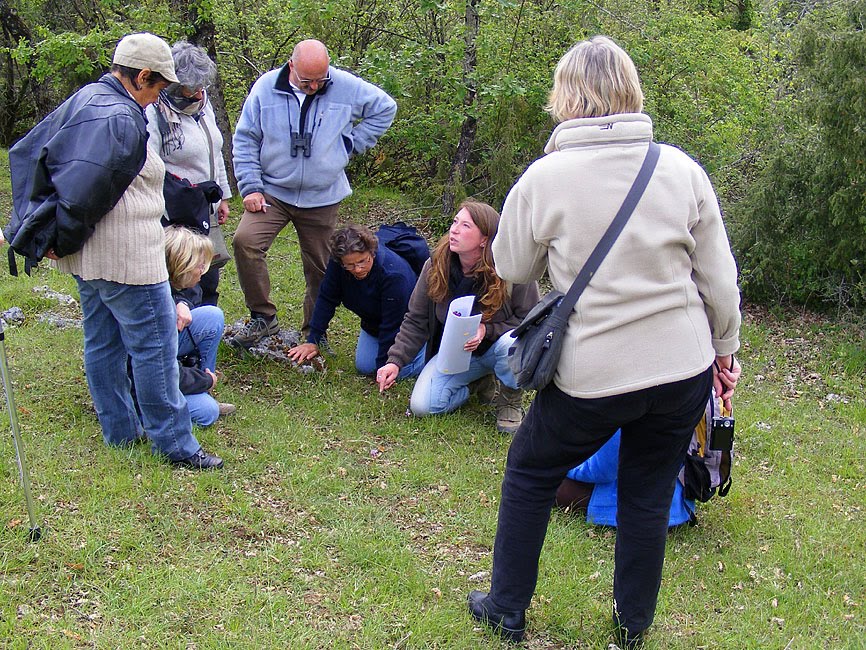
L'Eperon Barré de Murat ('the barricaded spur of Murat') lies just outside the village of Ferrière-Larçon, about 20 minutes drive from Preuilly. It's owned and managed by the Conservatoire du Patrimoine Naturel de la Région Centre, and yesterday I went on a walk there guided by Manuella Vérité, the Conservatoire's animateur for Indre-et-Loire, our département. I was very keen to see this site, as it has the reputation of being the best orchid site in the département, and I was curious to see how it compared to my own favourite site, also on a ridge, on the outskirts of Boussay. I'd taken private clients there the day before and seen 7 species (later in the season it's possible to see 10 species here). Could the Eperon de Murat beat that? Well, yes it can – with 1 extra species and a clear example of a hybrid (and 14 species possible).

The group with Manuella pointing at an orchid.
The Conservatoire manages the grassland by slashing part and having sheep graze the other part. The slopes have many juniper bushes, a sure sign that sheep have grazed here for many years (the juniper flourishes because the sheep won't eat it) and are essential to maintain the stability of the ecosystem.

Juniper.
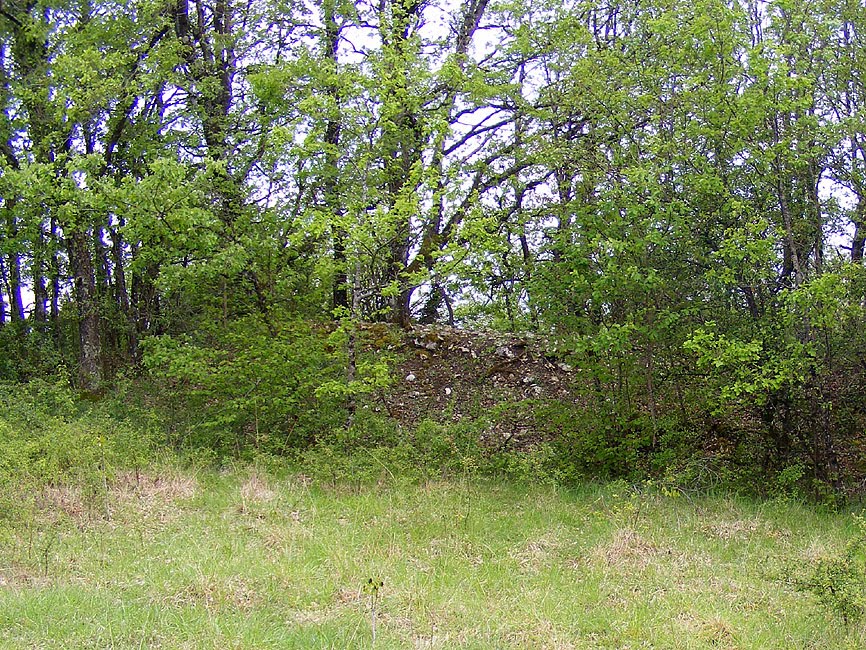
The site is remarkable from a number of points of view. It's a plateau between the Brignon and the Larçon rivers, at the point where they join. The slopes face north and south. The tip is formed by yellow tuffeau (a grainy, sandy limestone with pellets of clay), separated by iron rich hard ground. The tuffeau has been quarried, and huge man-made caves now tunnel under the plateau. In Prehistoric times, the Eperon was ideal as a defensive camp, and two walls were built to close off the tip from north to south (hence it is barré).

Part of the prehistoric wall.
The soil is calcareous, shallow and poor, and the vegetation consists of species characteristic of pelouse calcicole, including juniper, chalk milkwort, and Fly Orchid. The soil is too poor for it to have been ploughed for growing cereals. Burnt Orchid and Narrow-leaved Helleborine also thrive. Right in the middle of the plateau is an enormous and very old Woolly Oak.

Burnt Orchid.
On our walk we saw Lady Orchid, Common Twayblade, Monkey Orchid, Fly Orchid, Greater Butterfly Orchid, Narrow-leaved Helleborine, Burnt Orchid, Early Spider Orchid, as well as a hybrid Monkey x Lady. The Fly Orchids are Manuella's favourite. She likened them to poupées gonflés (blow-up dolls), because they are pollinated by male bees, which fool themselves that the pheromone emitting flowers are female bees.

A hybrid Monkey x Lady Orchid.

Susan

Friday, 14 May 2010

The Bathroom Floor

I had hoped that we would be using the new bathroom by now, but it looks like it may be a week before that happens. This is because we have encountered one or two delays, the latest of which is the floor.

The floor on the 1ème etage is wood, I had always thought (or hoped) that it was waxed chestnut, mainly because of its dark colour. It was difficult to say though - there was so much stuff on it: wax, grease, dust, water stains, paint drops...

By Tuesday Susan had finished painting the walls and ceiling, and we removed the sheets of cardboard we had put down to catch the drips. This gave us our first opportunity to check what the floor was made of - it just hadn't occurred to us before then. What we thought was chestnut with a thick layer of wax turns out to be pine, with a thick layer of wax over polyurethane. I experimented on the patch of floor that will be under the shower with various solvents as to the best way to clean the boards: vinegar, vinegar with cream of tartar (an idea taken from a page on the internet), white spirit, paint stripper, and paint stripper especially bought that is supposed to remove polyurethane. All of these products cleaned the floor, but didn't get us down to bare wood, leaving me with only one option - sanding.

You can just about make out the bit I have done.
Because the room is so small - about 5 sq meters - we decided it wasn't worth hiring a floor sander, so I set to with a hand sander. It isn't fun, and it adds a whole new strata of dust to our collection. It also introduced a new problem to the mix: the floor has had worm at some stage in the distant past, and not only has the sanding made the holes more obvious, but it has also exposed a lot more of the damage. It has also revealed the fact that at some stage the floor has been sanded across the boards, leaving deep grooves.

Dust, in epic quantities.
Our next problem, and one we hope to solve today, is how to treat the floor now. As I see it, we have four options: follow our original plan and treat the bare wood with an oleofuge/hydrofuge solution, varnish with a couple of thick coats of marine varnish, paint or stain the floor and then use marine varnish, or board the floor and lay either vinyl or tiles.

Neither of us really like pine, but although we can't deny the boards have character at the moment we are tending towards the paint/varnish option. I figure (or hope) that we don't need to get too paranoid about it being a bathroom with a wooden floor as we are putting in a large shower cubicle and no bath, so we dont need to put down a completely waterproof floor.

Decisions decisions...

Simon

Thursday, 13 May 2010

Les Producteurs Bio

Bio in French is short for biologique, and is used in the same sense as 'organic' is used in English to describe a farming and food production philosophy which eschews the use of synthetic chemicals to control pests and diseases in agriculture, animal husbandry and artisanal foodstuffs.

From left to right (and missing out some people whose names I don't know) there is Simon (camera), Guy (beard, at the back), Greg (pork pie hat), Aurélien (cap), Laurent (beard and topknot on the right).
We were invited to attend a meeting and information session of organic farmers on Tuesday night. A group of them have set up AMAP Chèvrefeuille (Association Honeysuckle), to combine their marketing and sales. AMAP stands for 'association for the maintaining of traditional farming practices' or association pour le maintien d'une agriculture paysanne. The meeting was held at Joe's farm, la Pouillère, between Preuilly and le Petit Pressigny. The weather was terrible, but we enjoyed apéros and the group discussed tactics. There was apple juice to drink and the nibbles were some fromage blanc with herbs to spread on crackers, dried apple rings and some saucisson with nuts made by a friend of Joe's over at Tournon St Martin. The saucisson was particularly good, made from an old breed of pig, half wild half domesticated, called Cul Noir (Black Bottom). They are slaughtered at 2 years.

Saucisson made by Fred Gagnot at Tournon St Martin.
Joe produces vegetables and goats' cheese. Last year he started a small scale box scheme, and this year says he hopes to produce 20 boxes of mixed vegetables a week from mid-June to the end of October. The boxes contain 5kg of vegetables (aubergine, topinambour, concombre/cucumber, melon, poivron/sweet peppers, etc) and cost 15€. Subscribers pick them up on Thursdays. Joe's goatshed was damaged in the tempête, losing its roof, but cheese production started two months ago. He had hoped to be producing the first vegetables by mid-May, but the cold weather has delayed everything, and now he is saying mid-June.

Baker Laurence is going to come to la Pouillère on Thursdays too, so you can buy bread and pizzas from 18.30 onwards.

Beef and veal producer Aurélien is going to let everyone know when he has meat available. He raises grass fed Limousins. I learnt from him that the auburn colour of their coat is known as rousse, and that haylage is called enrubannage in French. His veal is slaughtered at 6 months and costs 14€/kg. The meat of the cows is 11.80€/kg. Both can only be bought in bulk, in 10kg lots.

Joe is going to ask Angélique, who has a stall selling organic groceries at Preuilly and some other local markets, if she will come by once a month, to widen the range on offer.

Greg brought some of his younger snails along. In the background some dried apple rings from the Durands.
Also at the meeting was Greg, who has started France's first organic snail farm; Magali, a potter who is going to design and make some butter dishes for Joe; Laurent, a WWOOFer, who goes from AMAP to AMAP providing volunteer labour in return for accommodation and meals; and Guy and Mme Durand, with their apple juice.

Susan

Wednesday, 12 May 2010

Twelve Months

That's how long we have been living in France.

Célestine in the autumn.
As this blog entry appears it will be twelve months exactly since we were driving through Rouen on the way to our new home. The only thing I can remember of the drive is worrying about not being in Preuilly when the removal truck arrived with our belongings. The rest is a blur, as is much of the twelve months since. Since then we have learned an awful lot, most of which we have reported in these pages.

The list of fruit trees we were given when we bought
the orchard.
There have been many highlights: the staircase, the chimney, our new back door, and of course Célestine. We are also making new friends, and are developing quite a social life: something which will develop even more once more of the house is habitable and we can find the dining table again.

A crab spider takes a bumblebee in the Icelandic poppies.
Susan is really enjoying having three gardens to play with, and this year hopes to provide most of our fruit and vegetables as well as a pretty garden for us to look at from the apéro terrasse. I am finding project managing the restoration of the house interesting, if challenging and confusing, and the work is starting to show some real results.

A pâtisserie.
We are starting to get some work with the guided tours: Susan is leading a private group on an orchid walk tomorrow afternoon, and we have some work lined up with Célestine, as well. Fitting in earning an income has had to drop down the list of priorities somewhat for this first year though!

Rabbits and chickens at a country fair.
Susan & Simon

Tuesday, 11 May 2010

Fête des Plantes

On Sunday we went to the Fête des Plantes at the Château de Verneuil-sur-Indre. The Château is a horticultural school and the students are disadvantaged teenagers, many of them refugees from war torn African countries. We have met a few of the students through our neighbours Sylvie and Pierre-Yves, who home host two students most weekends. Last weekend Isaac (who is from either Congo or Mali - I forget) asked us if we were interested in going their fête so we said bien sur ! on sera là - voir vous dans la serre.

Inside la serre (the greenhouse) full of baby plants.
We had been told that the annual plant sales at the château were not to be missed, as the range of plants was extensive and they were good quality and not expensive. This proved to be the case for the horticultural school's plants in the big greenhouse - mainly bedding and vegetables ranging in price from 50c per plant to 1.50€. The independent nurseries, with stalls along the front driveway, had good stocks of shrubs, fruit trees and bushes and perennials, mostly not outrageously priced, although the people selling 2l pots of snapdragons for 10€ were having a laugh.

A nice pointy bit of the château.
I bought a mixture of salvias and petunias to replace my tulips and hyacinths in the courtyard. The bulbs will be relegated to the potager for a rest, and the front court will be a cloud of vibrant blues and reds for the summer I hope (and not a pelagonium in sight...)

Plant stalls along the driveway of the château.
The Lycée horticole et paysager privé Sainte Jeanne-d'Arc Fondation d'Auteuil Centre-Bourgogne has been going 75 years in Verneuil. It is one of 200 similar establishments throughout France which grew out of an earlier charitable organisation run by the Catholic Church known as the 'Orphan Apprentices of Auteuil'. It's mission is to help and protect young people in difficult life circumstances to get an education and to integrate into society. The organisation is keen to recognise individuals' aptitudes and provides vocational training such as here at the horticultural school.

Susan

Monday, 10 May 2010

Les Saints de Glace

The Ice Saints are those whose fêtes are on 11, 12 and 13 May. There is a saint for every day in France, and the saints for these particular dates are Saint Mamert, Saint Pancrace and Saint Servais. These are old saints, now desanctified and replaced by new Vatican approved saints, but there is much to be said for the agricultural tradition associated with the Saints de Glace. Farmers and gardeners watch the skies warily in May, because hail can damage seedlings and burgeoning fruit. In the old days, of course, one hail storm could easily spell the difference between living well and living on the edge for a year.

Not hail, but dandelions. We hope it will
be this way for the next few days as well
Our friend Jill brought the Saints de Glace to our attention, after a conversation with her neighbour, a fine source of French folklore. Last year there was hail on two of these three dates, and I noticed that our neighbour Monsieur Q. didn't plant out his tomato seedlings until after the 13th.

What will this year bring I wonder?

Susan

Sunday, 9 May 2010

8 Mai

Yesterday Susan and I attended the 8 Mai commemoration in Preuilly sur Claise.

It wasn't as pleasant a day as two years ago (we didn't attend last year as we were still in London), and there were less people around, mainly due to the fact it was a weekend and wet and windy.

The ceremony followed the same format as previous ceremonies, so there isn't a lot to write about really - so I will just post some pictures.

Gathering at the Mairie

Laying wreaths

Parading back to the Mairie after the ceremony

This special banner is taken from a photo
that Susan's father took on 8th May 2008
You can read our reports on previous ceremonies here, here, and here.

Simon

Saturday, 8 May 2010

Work continues...

On Thursday Susan and I gave the bathroom its first coat of undercoat, which was quite a momentous occasion for us. We have been slinging paint around since just after we bought the house, but this was the first time we have painted any walls properly for permanent finishing.

Yesterday Stéphane arrived to help me with the laundry. Unfortunately all the plaster dust of the past few days has made me feel really unwell, and I was in no state to come out and play. However, by the time he had measured everything I had surfaced and was upright enough to help.

I thought we were going to be doing frame for insulation, but I hadn't bargained on Stéphane's penchant for doing things properly. Thus, it was first things first, and the first thing in this instance was the laundry window. The old laundry window was a cut down door that was on its last legs (truth be known, it was probably on its last legs when Napoleon was playing goalie for St Helena FC). We had bought a new window at BricoDepot, but due to a certain amount of naivety I had bought a window that was too big: window measurements are stated in the size of the opening, not the size of the frame.

The window as it was in May 2007
Our first task then, was to enlarge to hole so the window would fit. Usually I do demolition, and I do it in "bull in china shop" mode. Stéphane is more methodical, so the hole grew to the size we wanted, rather than mysteriously becoming monstrously big and having to be partially filled in.

Some people! All I did was say "open a window..."
Then we built a window sill, and by knock off time the window was in - albeit with more work to do to make it water and wind proof.

Today is May 8, so at 10.45 we will be gathering at the Mairie to remember the coming of peace to Europe, and the sacrifices that were made in bringing the peace about.

Simon

Friday, 7 May 2010

Fox Moth - le Bombyx de la Ronce

A couple of days ago a friend rang to say she had a large moth laying eggs on her front door. Did I want to come over and take photos, as it looked like the moth was going to be busy for a while?

Since I was just about to start the washing up, there was clearly no alternative but to drop that task and rush over to Louisa's.

The moth turned out to be a Fox Moth Macrothylacia rubi (called le Bombyx de la ronce in French). It's a member of the Eggar family of moths, which tend to be large, furry and foxy coloured. Like most Eggars, the female Fox Moth is larger and less orangey than the male, and more grey.

Fox Moths are widely distributed throughout France and the adults are about from May to July. Males tend to fly on sunny afternoons, but females are much more nocturnal, and although this one was laying mid-morning, they usually lay their eggs at night. Usually they are laid on vegetation or twigs rather than doors, too.

The caterpillars eat a remarkably wide range of plants - brambles, strawberries, raspberries, alfalfa, clovers, blackthorn, potentillas, calluna, heathers and roses. They live communally, protecting themselves with a web and hibernating through the winter. The dark hairy caterpillars can be mistaken for the dreaded, but unrelated, processionary caterpillars, which have severely irritant hairs (similar to stinging nettle or poison ivy). The caterpillars of the Fox Moth can be picked up and handled, although if you are susceptible you might find that they give you a bit of a rash. The caterpillar wont be too impressed either to be picked up, and will form a coil in self-defence.

Susan

NB The species of processionary caterpillars that are dangerous to touch only makes its web in pine trees. The webs are much bigger and very visible compared to the webs of communally living eggar moth species, who generally choose a broadleaf species.

Thursday, 6 May 2010

The Noo Loo

We aren't in the habit of putting pictures of toilets on the blog (which you might or might not believe, depending if you saw this or this).

However: our second toilet is in place and plumbed in, even if we haven't yet turned the water on. This is exciting enough, but even more exciting (to my mind, anyway) is the fact that the toilet is made by one of the most fashionable (not to mention stylish and trendy) of dinnerware makers.

Yup. We have a Villeroy et Boch toilet. The first time I saw a Villeroy et Boch toilet was five years ago at Charles de Galle airport, and I knew immediately that I would have to have one to call my own.

I am all class!

Simon

Wednesday, 5 May 2010

Plastering

Anyone who has done plastering knows what a tricky, messy, longwinded affair it is. All that bandage flapping around, and muck falling off your trowel, and adding more scrape lines when you are trying to remove one.

Unless, of course, you get an expert in.

Patrick taped and plastered the joints, then plastered the ceiling, all in less than two hours on Monday morning. Yesterday morning he returned, sanded the whole lot and gave it a second coat - again in less than two hours. Anyone who has done plastering: watch this and weep!


The ceiling looks so good we are tempted not to do anything more to it.

Today Susan and I will sand back the joints (although Patrick is so neat that it hardly needs it), and then we dust down the walls and start undercoating. We bought 30 litres of undercoat yesterday evening, so we shouldn't run out!

Simon

Tuesday, 4 May 2010

Milkwort

It's not just orchids flowering in the grass that attracts one's attention. This little plant is called Milkwort Polygala spp, and likes the same habitat as many of the orchids in the Claise Valley i.e. dry banks of short grass.

It's called milkwort because it was believed that if cows grazed it they would produce more milk. This is probably an example of sympathetic magic, as the inner part of the flower is fringed, perhaps invoking an udder.

Susan

Monday, 3 May 2010

Last Week's Works

The plumber has been here the last week, electricity has started to flow (experimentally), walls have been insulated, plasterboard fitted, demolition done and furniture "built".

Where to start?

The plumber arrived Monday, and got down to some serious thinking. Of course this meant we had to change our answers to questions like "where will the washing machine go" and "do you want a handbasin in the toilet" from "over there somewhere" and "probably" to something less nebulous. Still, we came through that undamaged, and week later we are still happy with our answers (we think), so we didn't do too badly.

The hot water ballon and laundry tub.
Susan is really pleased with the tub!
This is where all our hot and cold water branches off.
All this will be hidden behind (above) the ceiling
We have a water filter to reduce the calcaire level.
All our water (even for the garden) will be filtered
Once the pipework was installed in the bathroom we had to fit the insulation and close the walls, which was a relatively painless job, and would have been totally painless if I hadn't dropped a sheet of board, breaking off a corner. Tomorrow Patrick arrives to put the bandes on the plasterboard joints and paper the ceiling (a plain white glass paper, which will just look like plaster), then we can start painting the walls and cleaning, sanding and coating the floor. Then the plumber can fit the toilet, shower and wash basin.

The bathroom lined with plasterboard. The cardboard on
the floor is me working out exactly where the shower will go
Yesterday afternoon we fitted a light switch and lightbulbs to the wiring for the bathroom lights, just to make sure we had wired it right. We flicked a switch, and Lo! A light! That was exciting, but of course only temporary, as we have to remove the switch and bulbs while the plasterboard joints are taped.

The furniture we "built" was two flatpacks of bathroom furniture we bought at BricoDepot. Amazingly, we had all the pieces, it all went together properly, everything fitted, and I have nothing left over. What's more, the doors close properly!

As well as doing all this, I have been looking for a stainless steel exhaust system for a 1953 Citroën Traction Avant, which has been frustrating. Monsieur Musseau is worried that Célestine is sounding a bit antisocial, and we have decided rather than replacing the exhaust with an authentic (but rust prone) system, we will go for stainless steel, which should last 10 years. We know there are people who make such an item, but at the moment we can't find them.

All this has meant we are both a bit tired and brain frazzled, but the progress that is happening before our eyes is making it all worthwhile

Simon

Sunday, 2 May 2010

End of April Orchid Update

By the end of April there were at least 6 orchid species flowering in the Claise Valley, including two in our orchard.

Not flowering yet, but it won't be long for this Twayblade Listera ovata (Double-feuille in French) at Boussay.

A group of Early Spider Orchids Ophrys sphegodes (Ophrys araignée in French) under the cherry trees in our orchard.

The Monkey Orchids Orchis simia (Orchis singe in French) are just coming into flower on the roadsides around Boussay and Humeau.

As are the Narrow-leaved Helleborines Cephalanthera longifolia (Céphalanthère à longues feuilles in French) at Boussay.

This group of Lady Orchids Orchis purpurea (Orchis pourpre in French) growing in the semi-shade is visible by peering over the château wall at Boussay. We've got them growing in our orchard too, but you can also see them on roadside banks near Preuilly.

The impossibly discreet little Fly Orchids Ophrys insectifera (Ophrys mouche in French), with flowers like tiny purple velvet pyjama suits, hidden in the grass at Boussay.

This colony of Early Purple Orchids Orchis mascula (Orchis mâle in French) on the roadside at Humeau is always very variable in colour, ranging from magenta to white, and many of the plants have unspotted leaves.

An almost chlorophyll free root parasite, theViolet Limodore Limodorum abortivum (Limodore à feuilles avortées in French) pushing up through the soil near le Grand Pressigny like a sombre asparagus spear. (Thanks to Tim for the tip-off about this site.)

Susan

Saturday, 1 May 2010

The Queen of Spain Comes to Visit

Our potager has a great many weeds and wild flowers, which mostly I just let be. One of the prettiest is the Wild Pansy Viola tricolor ssp curtisii (la pensée sauvage in French), growing in abundance around the compost bin and under the nectarine. I've left them to grow and multiply because they are so attractive, aren't doing any harm, and I knew that they were the larval food plant for several species of Fritillary butterfly.

A couple of days ago we were rewarded by being able to photograph the Queen of Spain Fritillary Issoria lathonia (called le petit nacré in French) showing great interest in the Wild Pansies, inspecting each one carefully, and we think, laying eggs.

The Queen of Spain Fritillary butterfly is common around here, on the wing from March to October. They like crop margins and flower rich grasslands, flitting jerkily about and often not easy to photograph.

They can be easily identified by the large mother-of-pearl spots on the underside of the lower wing. The upper wings are orangey brown, with regularly placed black dots.

Susan