Showing posts with label Masons. Show all posts

Thursday, 12 June 2025

Visiting Chenonceau in June

 I've been to the famous Chateau de Chenonceau multiple times in the past few weeks.


Wild native Bee Orchid Ophrys apifera.

Bee Orchid Ophrys apifera, Chateau de Chenonceau, France.


Wild native Ivy Broomrape Orobanche hederae.

Ivy Broomrape Orobanche hederacea, Chateau de Chenonceau, France.


Floral arrangement in the entry hall.

Floral arrangement in the entry hall, Chateau de Chenonceau, France.


A small early instar Harlequin Ladybird Harmonia axyridis larva.

Harlequin ladybird Harmonia axyridis larva, Chateau de Chenonceau, France.


Roses.

Roses, Chateau de Chenonceau, France.


Bee hive. Further reading: Teaching Hive at Chenonceau.

Bee hive, Chateau de Chenonceau, France.


This swathe of pink 'wild flower' or 'prairie' planting is new for this year.

'Wild flower/prairie' garden, Chateau de Chenonceau, France.


Young Japanese women enjoying their visit. I love how they are channeling their inner 19th century wood block print artist.

Young Japanese women visiting the Chateau de Chenonceau, France.

Monday, 21 August 2023

Growing Mushrooms Underground

Julien Delalande is the fourth generation of his family to be growing mushrooms in La Cave des Roches at Bourré, in Loir et Cher, where there are about 600 kilometres of underground galleries under the village.

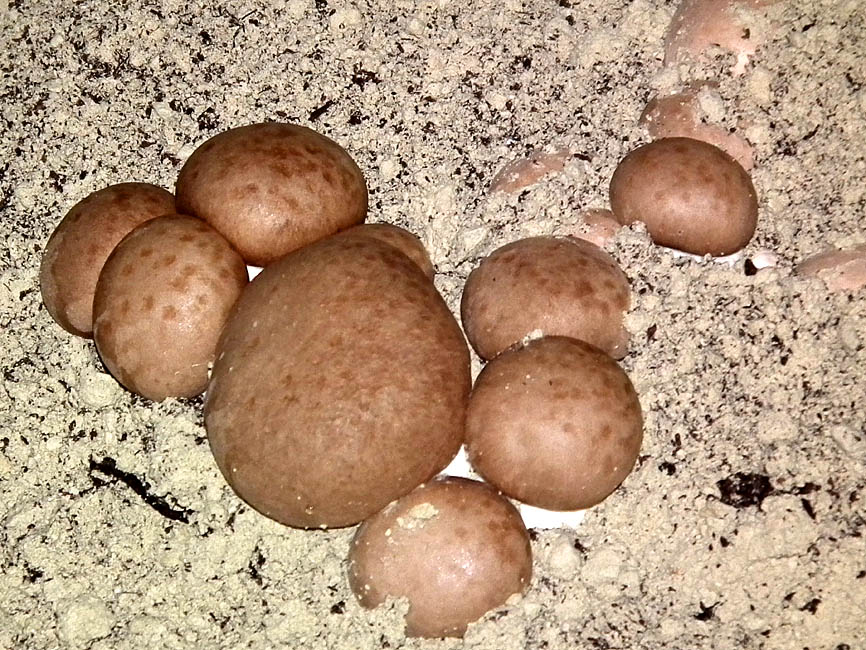
Cave grown chestnut mushrooms, Loir et Cher, France. Photo by Loire Valley Time Travel.
Chestnut mushrooms growing in La Cave des Roches.

Julien and his brother grew up in Bourré and their family have been mushroom farmers since 1893. Before that their ancestors were quarrymen, stone cutters and river boatmen.

Cave grown yellow oyster mushrooms, Loir et Cher, France. Photo by Loire Valley Time Travel.
Yellow oyster mushrooms growing in La Cave des Roches.

La Cave des Roches is what is left of the old Saint Roch co-operative of mushroom growers, one of the last growing button mushrooms underground on a large scale up to the beginning of the 20th century.
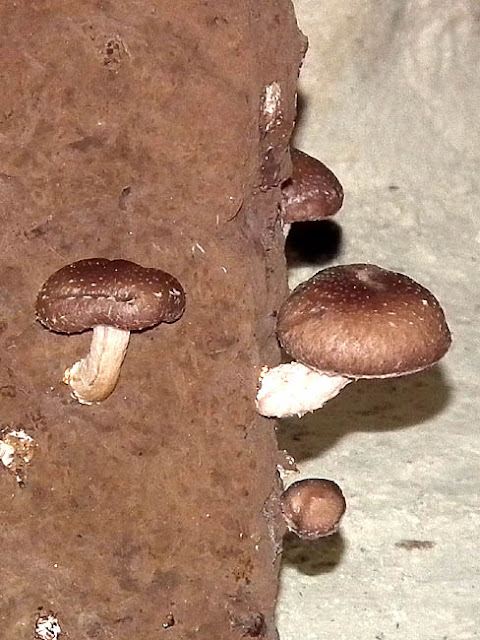
Cave grown shiitake mushrooms, Loir et Cher, France. Photo by Loire Valley Time Travel.
Shiitake mushrooms growing in La Cave des Roches.

According to Julien the family's underground galleries extend for several hundred kilometres, on seven levels (although some are now dangerous and no longer accessible). This maze of underground passages was where the fine white limestone that was used to build the most beautiful chateaux such as Chenonceau and Chambord was extracted.
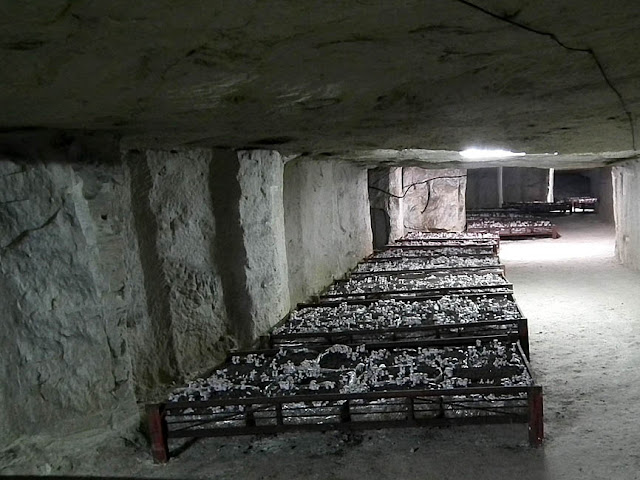
Underground mushroom cultivation gallery, Loir et Cher, France. Photo by Loire Valley Time Travel.
Underground mushroom cultivation in La Cave des Roches.

But today the site is no longer used to extract stone, and has become a major production site for mushrooms. Julien Delalande produces several varieties all year long, for example shiitakes, grey and yellow oyster mushrooms, button mushrooms and wood blewits. In fact, 40% of the world's wood blewit (Fr. pieds bleus) production (approximately 400 kg per week) comes from these troglodyte caves.
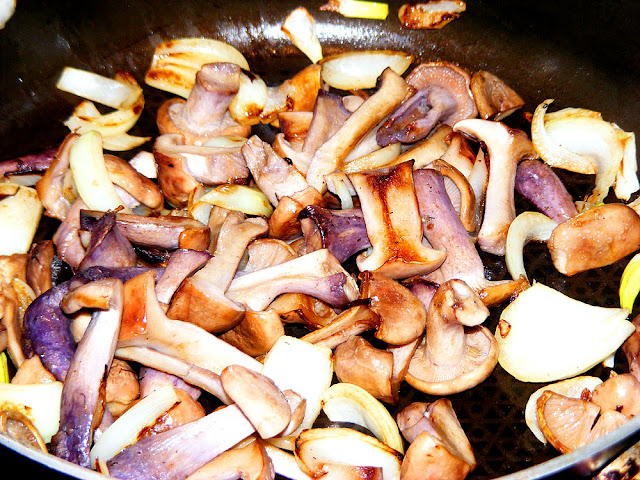
Cooking wood blewit mushrooms, France. Photo by Loire Valley Time Travel.
Cooking wood blewit mushrooms.

Thanks to the ventilation, the hygrometry, the constant temperature of 12C° these troglodyte caves allow cultivation for a longer season, and the mushrooms are of a higher quality, with a firmer texture and finer taste.

Cave grown wood blewit mushrooms, France. Photo by Loire Valley Time Travel.
Cave grown wood blewit mushrooms.

Julien advises that the best way to cook them is to pan fry them in neutral oil (not walnut or olive) for 7 to 12 minutes depending on the variety. You have to cook the varieties separately then in the middle of cooking add a little garlic, fresh chopped parsley then finish with a knob of butter.

Cultivated wood blewit mushrooms, Loir et Cher, France. Photo by Loire Valley Time Travel.
Cultivated wood blewits in La Cave des Roches.

He loves growing mushrooms, but also discovering new grafitti by the quarrymen on the walls of the tunnels.

Carving in troglodyte cave, Loir et Cher, France. Photo by Loire Valley Time Travel.
Carving in the underground village.

Julien's father, Maurice Delalande, had the idea of an underground village, which he and two friends, Slobodan Bugaric and Christian L'Hermitte started making in 1998. It is a fairytale space carved into the solid rock that can be visited from April to November and during the winter holidays. The guided tours are a good hour during which you will learn about the work of the mushroom grower and that of the quarryman.

Carving in troglodyte cave, Loir et Cher, France. Photo by Loire Valley Time Travel.
Carved representation of a blacksmith's workshop in the underground village.

La Cave des Roches [link].

Wednesday, 5 August 2020

Mystery Masons' Marks


On the third course down, tally mark III; the course below is marked with II.
Cut stones showing masons marks. Indre et Loire. France. Photo by Loire Valley Time Travel.

Simon and I were having lunch in the backyard the other day. There must have been something about the light that day because we both noticed how many masons' marks there are on the back of our barn. They are simple tally marks, but the majority of the stones have them. We don't recall noticing them before, but they must have always been there since we've owned the building. We don't know how old they are. They could be medieval, and the marks of the original stone cutters. They could be 20th century and something to do with the granary.

Masons marks on an old building. Indre et Loire. France. Photo by Loire Valley Time Travel.

There is a pattern to them. Stones in the same course have the same mark -- either I, II, III or IIII. I think there is a possibility that the marks relate to stones of different sizes, but if that is the case, at least two of the marks relate to stones which are very close in size. Perhaps they are just a way of indicating which course a block should go in.

Masons mark on an old building. Indre et Loire. France. Photo by Loire Valley Time Travel.

Generally mason's marks are a sort of signature, to indicate which blocks they should be paid for producing. These marks don't look quite like other masons' marks I've seen, which tend to be simple geometric shapes. They actually look more like carpenters' marks, which are to indicate which piece goes where. We have carpenters' marks on the wood in the attic of the house. 


************************************************

For details of our private guided tours of chateaux, gardens, wineries, markets and more please visit the Loire Valley Time Travel website. We would be delighted to design a tour for you.

We are also on Instagram, so check us out to see a regularly updated selection of our very best photos. 

Thursday, 14 November 2019

A Vented Step

We were in Loches last weekend, and I noticed this architectural detail at the entry to one of the award winning boulangeries. It's a very elegant solution to the problem of what you do when the only practical place to put a door is over the ventilation for the cellar.

Saturday, 2 September 2017

Scaffolding Goes Up


I ran into my friend Christine at the market on morning Thursday and she alerted me to the fact that Bernard was down at the chapel supervising the erection of the scaffolding. Yes, restoration work on the Chapelle de Tous les Saints has started! We've raised the money! 

When I got down there in the afternoon the masons were just packing up for the day, one level of scaffolding was up, the site taped off and the side road blocked. The masons, Jaillais, are a firm from Chinon. The young man I spoke to said he was a tailleur de pierre (stone cutter). I'm not quite sure what the difference between a maçon and a tailleur de pierre is, but I assume it's experience or qualifications.

For the back story to this restoration see our previous blog posts about the chapel.

Thursday, 11 May 2017

It's the Rozzers!


The former limestone quarry at Bourré which is now a mushroom growing facility is fascinating. Every year the guides show us a bit more of the site. We were there in mid-April and got to see a gallery with some fascinating wall paintings.


Apparently the paintings were created in the 18th century by locals who were hiding from the police. The characters painted high up on the quarry walls are crude, not very complimentary, representations of the police of the day. 


Also in this gallery is a map of the subterranean quarry, painted and carved on the roof. There are over 100 km on 7 levels, so maps and painted directional signs would have been very necessary. The caves are privately owned and today you are not allowed to go in without a guide.

Tuesday, 17 May 2016

Jack and Martine


There is a well known tradition of slipping sly portraits of local characters and the sculptor's mates into medieval capitals and other decorative carving.

Every now and then modern sculptors working on historic buildings will join in the fun. There is a great example in the courtyard of Blois chateau.


When the medieval tower which leads to the Louis XII wing of the chateau was restored in 1990 the master sculptors converted the bare bottomed character on the right hand socle of the first floor window into a very recognisable representation of Jack Lang, at that time Minister for Culture and the Mayor of Blois.

Jack Lang is one of France's most well known and popular politicians. (Australian readers are probably a bit confused by now, as Jack Lang is also the name of a well known and admired Australian politician from the 1920s.) Both are interesting egotistical Socialists who haven't always made decisions the people on their own side have been able to back. Nowadays the French one is the Director of the Institut du Monde Arabe and a member of the National Assembly.


Opposite Jack on the other side of the window is a caricature of Martine Tissier de Mallerais, who after studying art history at the Sorbonne became the Director of the chateau in 1967, at the age of 27. She took on a chateau that had limited resources, and had not had a curator for twelve months. She had hardly any staff and no inventory of the clearly important collection. The locals weren't interested in the place although the tourists came. Her first tasks were to make the chateau relevant to the locals and to create an inventory. She formed a team of volunteers to make up for her lack of staff and got on with things. They even managed to purchase significant objects for the collection, sometimes acquired via the most incredible sequence of events.

But in 1989 Jack Lang became mayor of Blois. He was determined to replace those in charge of the cultural life of Blois and when in 1990 a post became available that allowed her to leave with dignity Martine left to become Curator of the chateaux of Fougères, Chaumont and Talcy.


Martine and Jack apparently had incompatible ideas about how the chateau of Blois should be managed and presented to the public.

Many thanks to Rosemary from Loire Daily Photo for alerting me to this piece of modern history.

*************************************************************

Loire Valley Nature: A photo has been added to the Fly Orchid Ophrys insectifera (Fr. Ophrys mouche) entry. It shows a male digger wasp attempting to mate with an orchid flower. 

Friday, 24 July 2015

Nurturing Local Heritage Conservation Expertise

For the current major conservation work at the Chateau of Azay le Rideau, the Centre des Monuments Nationaux (CMN) has appointed local firms. They include Hory-Chauvelin (stone cutting, scaffolding, masonry, plastering and tiling) from Avoine, the Rolland-Réau group (stone treatment, sculpture) from Montlouis and the joinery Guérin Brothers from Pouzay. The first two have worked together on previous heritage conservation projects such as the Hôtel Gouin in Tours. Of the 9 contracts 6 have been won by local Tourangeaux firms.

Openings in the screen allow materials to be hoisted up and visitors to get a glimpse of the work behind.
Chrystelle Laurent, the senior curator, is at pains to point out that this is not parochialism, but because they are the best. The Touraine is a land of abundant limestone and therefore has a high concentration of masons and other expert artisans, so the choice is extensive. The CMN wants the work to be a showcase of the local skills with a level of excellence that is reknowned world wide.

The mirror pond that the chateau sits in creates logistical problems, solved by a raised platform created to gain access to the works from the rear of the building. 
Like Olivier Rolland, a sculpture conservator from Montlouis, many of the conservators and artisans have put their expertise to the test at the most prestigious heritage sites in France. Versailles, the Louvre and Chenonceau have all benefitted from the skills of these little known artisans who work in the background, unacknowledged except by fellow heritage professionals. They run businesses to be sure, but they also work for the prestige of gaining a contract such as at Azay. They are excited by the project and love the chateau.

I notice that they have planted bulrushes in the pond, presumably in acknowledgement of the restoration of Philippe Lesbahy's bedroom with its rush matting wallcoverings.
Olivier examines each stone carefully, checking if lichen is causing damage and needs to be removed or treated. His objective is to save as much original stone as possible and slow down further damage. Around him other teams of specialists are checking lead finials and treating wood. It's a huge restoration job.

Scaffolding across the front of the building, with a lifesize photo of the staircase printed on the protective screening.The screening also forms a weatherproof 'umbrella'.
Chrystelle notes that these artisans carry a particularly French know-how and present it to the world (she is, after all, a self-confessed 'child of Colbert'...) This work is also a means of ensuring these highly skilled individuals can earn a living.

Explanatory panel at the base of the chateau, talking about the slates and finials.
The work entails:
  • 25.5 m high scaffolding.
  • 4125 m² of stone repointed.
  • 5425 m² of facade.
  • 35 m³ of new oak carpentry.
  • 1838 m² of new roof.
  • 75 tonnes of slate.
I calculate that this means the roof alone (excluding carpentry) will cost at least €130 000.

The Biencourt's sitting room, as it was a few years ago.
Once the exterior is completed the next project is to improve the 19th century rooms on the ground floor. These rooms acknowledge the legacy of the Biencourt family, the last private owners of the chateau. In the next 2 years over a hundred objects from the CMN archive stores will be heading for Azay. Crockery and cookware owned by the Biencourt family will return to their old home and portraits from the 16th century hung to partially reinstate the family's collection. Textiles from the period will be conserved and rehung too, to return the feel of the rooms to how they were in the past. A highlight will be the velvet curtains set with gold lilies, with which these rooms were dressed at the time.
Article about the restoration in La Nouvelle République newspaper (in French).

Monday, 17 October 2011

The Underground Village

The mushroom caves at Bourré, owned by the Delalande family, have recognised that there is considerable tourist potential in their warren of underground galleries. When you visit you can not only see the mushroom growing facility, but you can also go to the underground village.


Apparently, this was created by the son of the current owner, who had a spell out of work in the late 80s and in order to keep himself occupied, began carving in one of the unused underground galleries. His father realised that it could be turned into a tourist attraction and paid him to create an entire underground village.

It took 12 years to complete and became something of a heritage project too. They could see that the old masonry and stone carving skills were being lost and that fine old carvings were being destroyed just through exposure to the weather. If they reproduced these skills, as well as illustrating in stone other traditional building techniques, the weather couldn't affect it. Sadly, after a decade of being open to the public, they are thinking they may have to close the village, because like in the prehistoric Lascaux caves, visitors breath is causing the stone to deteriorate.


Susan

This post was published some time ago then withdrawn in accordance with the Delalande family's wishes. It is now republished because they have decided to pay a portion of visitors' entry ticket price to the sculptor and mason who created the underground village. I assume this is a pragmatic move as many people ignored or did not understand the original restriction on publishing photos of the place.

Monday, 28 February 2011

A Sculptural Touch

While we were away in Paris earlier in the month StĂ©phane took the opportunity to finish some rather messy and time consuming work. In total, it hardly amounted to more than 1m², but it was several days of work involving dust and debris, then bucketloads of chaux, red sand and water.

The stone wall around the door of the attic bathroom has not been lined, but left exposed so that it could be finished in a more traditional manner and join the impressive carpentry in adding a bit of character to the otherwise modern dead flat plasterboard lined room.

To make the stone presentable it had to have all its crumbling old mortar and plaster scraped out. Then the moellons (rubble stones) had to be damped down for several days in preparation to being coated with a thick layer of chaux (lime) mixed with red sand to give it the traditional pale terracotta colour. The pierres taillées (cut stones) which form the doorway itself were to be left exposed. Walls like this are very common in the Touraine. The moellons were cheap to produce and easy to handle, and could easily be covered in render if a neater finish was required. Big, heavy, expensive cut stone was only used around openings and on facades.

I'm spraying the stones with water in
the morning just before leaving for Paris.
Stéphane applying the final touches to the day old render (below). He's using a stiff wire brush on partially dry render to simultaneously smooth and ensure an even texture.
The end result is wonderfully sculptural -
Stéphane has a real eye for line and contour.
Susan

Friday, 11 June 2010

Pierre Dure

When the masons were here (it was two months ago - where has the time gone?) one of the little tasks we had them do was replace the step from the salle Ă  manger (now our salon) to what will one day be the new cuisine. This had previously been done in the same quite nice vitreous tiles that covered the floor of the old kitchen. They were really well laid, and we considered keeping them, but in the end we decided we would lay tomettes directly on top of the existing tiles (most of this has yet to be done). This decision meant we had a problem where the kitchen and sitting room met, as we definitely wanted to keep the decorative cement tiles in the sitting room. Installing a stone threshold / step has solved the problem very neatly.

The new step is carved from pierre dure and we are pleased with it for a number of reasons: like the new threshold to our back door, it was made from stone that had come from of the outhouse we had demolished last year, and it is quietly restrained and elegant (if a simple block of stone can be said to be elegant, this is it).

Pierre dure (literally "hard stone") in our area is a calciferous stone (limestone), but a limestone that has started on the path to becoming marble. It is impervious to water, which is why on many limestone houses the first couple of courses of stone look slightly different to the rest - if it can be afforded the bottom of a wall is made from pierre dure. It is also very heavy, which is why it isn't used much past the first couple of courses - it weighs about three times as much as tuffeau. It is also difficult to work and usually has a chiselled finish, as opposed to the fine smooth finish found on a lot of tuffeau. (A note here - if a tuffeau wall is deeply chiselled it is because the wall was intended to be rendered, the chiselling giving the render somewhere to grip).

The new step is higher than the old tiles, as we will be laying tomettes (actually "Carrelage en terre cuite" because tomettes are hexagonal and our tiling will be square) over the old tiles once the kitchen is insulated. We like our new step. It is so in keeping with the rest of the house that we have already started not to notice it.

Simon

Sunday, 16 May 2010

A New Window Sill

The masons have been gone for 3 weeks now, but we still have the dust to remember them by. While we are doing so much work on the house it hardly seems worthwhile trying to clean away any dust - you know you will just be making more dust tomorrow.

One of the little jobs we had done while the masons were here was replacing the window sill to our bedroom. When we bought the house the sill was cracked and unstable, so while M. Douady was here building the chimney we had him remove the loose piece.

The remains of the sill, January this year

Removing the remains of the sill

Don't try this at home, kids.*

Finished!

Simon

* the roofers did a similar thing