Showing posts with label electricity. Show all posts

Friday, 2 February 2024

The View From the Orchard

This is the view I get from the orchard now, as the project to repurpose the old furniture factory site into a photovoltaic solar energy farm steady progresses, clearing the site and now adding access tracks and fences. For some reason, solar farm projects produce much less angst amongst the French populace than terrestrial wind farm projects.

Work building a photovoltaic solar energy farm, Indre et loire, France. Photo by loire Valley Time Travel.

The Total Quadran project will occupy 8.6 hectares (4.12 hectares of photovoltaic surface) on the Prés du Maine, on the south facing slope just the other side of the stream that runs along the front of our orchard. It is estimated that the panels will produce enough electricity (excluding heating) for 7786 households. So that's well more than the entire municipality covered. 

In other orchard news, Sylviane, who owns the neighbouring field and the Moulin du Chanvre across the road, has got halfway through the mowing. This is good news as it means that the part to repair her slasher has finally been delivered. She and I have an arrangement about the mowing and she does it in return for apples.

Wednesday, 29 November 2023

The Demolition of Dennery

The demolition of the Dennery factory on the edge of Preuilly is nearly at an end. It started in June and have caused quite a lot of nostalgia in town.

Many of the last cohort of workers are still alive, having worked in many cases their entire careers at Dennery, from the 1960s to the 1990s.

The Dennery workshops, in November 2019.

Former Dennery furniture factory, Indre et Loire, France. Photo by Loire Valley Time Travel.

The town was proud of this enterprise which was making high quality furniture that in its day was known worldwide.

In the 1960s the firm employed between 150 and 200 people (which in a town with a population of around a thousand, is significant). It finally closed for good in 2002, but in 1983 had won an award for exporters with fewer than 200 employees.

Former factory manager's house, November 2019.

Former Dennery furniture factory, Indre et Loire, France. Photo by Loire Valley Time Travel.

The clients were corporations like L'Oréal, Mercedes-Benz, Balmain, Renault, who would come to Preuilly and Dennery for their headquarters interiors and furniture. 

The factory worked in luxury woods like mahogany, ebony, rosewood, lemonwood, and birdseye maple. The furniture produced here was going just about everywhere in Europe, Africa and the Middle East. Former Dennery employees can remember the Saudi King visiting to personally choose elements of the pieces for his private apartment. 

The demolished workshops, November 2023.

Former Dennery furniture factory, Indre et Loire, France. Photo by Loire Valley Time Travel.


Then there was the interior fittings for the Louvre Pyramid, the Bastille Opera and the National Library of France. One prestigious contract after another. But there were also periods when the order books were empty and the workers were put on chomage partiel, an arrangement where the State will cover 80% of employees wages via a specific type of unemployment benefit (widely used by many firms during Covid lockdowns).

And in 1998 the business was bought by a Paris based enterprise. Employees found out via the furniture trade press rather than were informed directly. It was a shock.

The former factory manager's house, November 2023, the only structure on the site which will not be demolished.

Former Dennery furniture factory, Indre et Loire, France. Photo by Loire Valley Time Travel.

Former employees claim the new owners set unrealistic goals and were not overly scrupulous, so they set up a workers co-operative and took over the business. In the end though, the project failed through lack of support amongst the workers, and the real estate (buildings and land) is now owned by a medical supplies distributor.

Once the site is cleared TotalQuadran will start installing thousands of solar panels. Former Dennery employees are bitter that the Comcom (a level of local government above 'commune' and below 'département') could not create an 'atelier relais', a facility designed to take young people who want to train in a trade, but have been unable to gain a place at a specialist artisan college or an apprenticeship.

Thursday, 5 October 2023

Walking Around Abilly

On 20 September I joined Joel, Denise, Tilly, Helene and Jean-Jacques on a 8.5 km walk taking 2 hours. We walked up from the greenway, through the forest, past the medieval fortified farm of La Chatiere and back down to the greenway.

Sheep dogs guarding a barn full of sheep.

Sheep dogs guarding sheep in a barn, Indre et Loire, France. Photo by Loire Valley Time Travel.

A small abandoned vineyard. The variety looks like gamay to me.

Abandoned vineyard, Indre et Loire, France. Photo by Loire Valley Time Travel.

Common Heather Calluna vulgaris (Fr. Callune). I showed Jean-Jacques how to use the PlantNet app [link] to identify this plant.

Common Heather Calluna vulgaris, Indre et Loire, France. Photo by Loire Valley Time Travel.

Sweet Chestnut Castanea sativa (Fr. Chataignier) fallen leaves (Fr. les feuilles mortes) and chestnuts in their prickly husks (Fr. les bogues).

Sweet Chestnut Castanea sativa fallen leaves and chestnuts, Indre et Loire, France. Photo by Loire Valley Time Travel.

This view will change in the next few years. The 29 ha site will became a 40 000 unit solar farm, with sheep grazing beneath the photovoltaic panels.

Proposed site for solar farm, Indre et Loire, France. Photo by Loire Valley Time Travel.

Wild Privet Ligustrum vulgare (Fr. troène commun), growing in a hedge.

Wild Privet Ligustrum vulgare, Indre et Loire, France. Photo by Loire Valley Time Travel.

Tuesday, 30 May 2023

Three Beautiful Blue Spring Wild Flowers In the Touraine Loire Valley

These lovely and uncommon wild flowers were all photographed on the Eperon du Murat nature reserve near Ferriere-Larcon on 13 May 2023.

Upright Bugle Ajuga genevensis, Eperon du Murat, Indre et Loire, France. Photo by Loire Valley Time Travel.
Upright Bugle Ajuga genevensis (Fr. Bugle de Geneve).

Upright Bugle is probably often mistaken for Bugle A. reptans as it resembles it closely, they hybridise readily and A. reptans is much more abundant and well known. If you see a bugle in an open sunny grassy environment with a brighter lighter blue flower that is your clue that you might have Upright Bugle. Check the stems, which like all plants in the mint family, are square in section. If they are hairy on all four sides then you have Upright Bugle. The species likes dry sunny sites with poor calcareous or neutral soil. The flowers produce lots of nectar and are very attractive to Honey Bees Apis mellifera (Fr. Abeilles des ruches).

Veronica orsiniana, Eperon de Murat, Indre et Loire, France. Photo by Loire Valley Time Travel.
Veronica orsiniana (Fr. Véronique d'Orsini). Probably.

This speedwell is not considered threatened, but it is in decline, and uncommon enough in the Touraine that if it is present on a site it can be declared a Zone Naturel d'Interet Ecologique, Faunistique et Floristique (ZNIEFF). Native to southern Europe, it likes hot dry short grassland and woodland edges on poor calcareous soil.

Veronica orsiniana, Eperon de Murat, Indre et Loire, France. Photo by Loire Valley Time Travel.

Basil Thyme Clinopodium acinos, Eperon de Murat, Indre et Loire, France. Photo by Loire Valley Time Travel.
Basil Thyme Clinopodium acinos (Fr. Calament des champs).

This is an annual or biannual, in the mint family. The leaves are hairy and the flowers are usually pink or mauve but sometimes they are more violet like the ones in the photos, and they often have a white patch on the lower lip.

Basil Thyme Clinopodium acinos, Eperon de Murat, Indre et Loire, France. Photo by Loire Valley Time Travel.

The species likes uncultivated reasonably warm dry calcareous sites that are mowed annually. You can find it in short grassland, fields and fallow land.

Upright Bugle Ajuga genevensis, Eperon du Murat, Indre et Loire, France. Photo by Loire Valley Time Travel.


Friday, 10 March 2023

Repairing the Parquet at Cheverny

The parquet floors of the King's Bedroom and the Armour Room in the Chateau de Cheverny have been lifted in order to repair them. The rooms have been closed to the public and the admission tickets have been discounted for the period of the heritage conservation work. I was lucky enough to be there a day or two after the floors came up and I was able to get some photos.


Restoration of parquet floor, Chateau de Cheverny, Loir et Cher, France. Photo by Loire Valley Time Travel.
The Armour Room, looking from the landing doorway towards the King's Bedroom, with the fireplace at the end.*

The pattern is known as 'parquet Versailles'. It was created for the Palace of Versailles around 1684 then widely used in grand town houses and chateaux throughout the 18th century.

Many broken joists were discovered when the parquet was lifted, so they will all be repaired. The pieces of parquet were sent to a specialist workshop for restoration, then relaid on the repaired supports. Then they were waxed and polished.

Restoration of parquet floor, Chateau de Cheverny, Loir et Cher, France. Photo by Loire Valley Time Travel.
The joists exposed.

Because it was quiet I took the opportunity to talk to Reynaud, the House Manager, about the project. I asked him if all the utilities would be run under the floor to hide them, as would be the case in a National Trust house, for example. His reply surprised me a bit. He said that several decades ago they had a fire caused by a fault in an electrical wire hidden behind some panelling. As a result their policy now is to always have utilities exposed, even if it is a bit ugly, so they are easy to get to and faults are immediately apparent.

The work will be finished sometime between 15 March and 1 April. 

Armour Room, Chateau de Cheverny, Loir et Cher, France. Photo by Loire Valley Time Travel.
The floor pre-restoration, in the same corner as the photo above.

*At the end of the Armour Room the massive high relief carved and gilded fireplace depicts Mercury and Venus, accompanied by Love, framing a painting by Jean Mosnier of The Death of Adonis.

Friday, 16 December 2022

Meeting in the Dark

Meeting during a power cut, Indre et Loire, France. Photo by Loire Valley Time Travel.
Yolande and Valérie.
 

As I'm sure you've gathered, I'm on the committee of our local refugee support association, known as AARST. When I arrived for our last meeting, held in a syndicate room in the salle des fetes complex, the power was out and there were two elderly people stuck in the lift. They had been attending a jazz concert in the big main function room upstairs. Luckily someone arrived after about half an hour with a special key and they were released. But we held our meeting in the dark, lit by phone torches. Oh well, solidarity with Ukraine and all that...

Meeting during a power cut, Indre et Loire, France. Photo by Loire Valley Time Travel.
Our formidable vice-president Nina, and president Christiane.

The power cut remains random and mysterious and the mayor was attempting to get to the bottom of it last I heard.

Thursday, 18 March 2021

The Lime Kiln at Bellais

There are lime kilns everywhere in the Touraine [link] and the nearby areas of Poitou. Most of them are 19th century, and there is a whole collection of them on the Creuse and Vienne Rivers near Port de Piles and Les Ormes.

Bellais lime kiln, Indre et Loire, France. Photo by Loire Valley Time Travel.

The most notorious I suppose was the one at the Vieux Port on the Vienne. In the early 1880s there were several landslides at the site. One of them resulted in 30 deaths, including the manager's wife, two daughters and young son. The limestone cliffs at the back of the site had been heavily mined, leaving enormous unsupported underground galleries on multiple levels that you could turn a wagon around in. In addition, water was pumped from the river to aid the extraction of limestone rubble and the rock was saturated. One fateful lunchtime the cliff came roaring down, destroying buildings in its wake, including the cantine and the manager's house, and burying anyone in the vicinity. The manager and his two teenaged sons were out in the yard and they survived. One son was catapulted into the river, the other managed to reach his father and they sheltered in a lean-to. Two men were hideously burnt when the kiln fires caused the fracking liquid to boil.

Extraction of limestone from the site at Bellais began in 1881. It is only 3 kilometres to the railway station at Port de Piles, so the stone was transported by rail. The factory was constructed in 1903 by the businessman Desfontaines, on the left bank of the Creuse. It made cement, lime and Portland cement (a new product specifically for reinforced concrete, such as had been recently used on the Arms Factory [link] bridge in Chatellerault in 1899 [link]). Desfontaines was authorised to take water from the river, which is very close, for the 100 horsepower steam engine. The extraction galleries were slightly above the level of the river, which meant they were not in danger of being flooded (something that had happened to limestone quarries just downstream in Port de Piles).

Bellais lime kiln, Indre et Loire, France. Photo by Loire Valley Time Travel.

The square based kilns are quite visible today. They are built of refractory bricks and inside a constant low fire was maintained. Everything on the site was new and modern -- the steam engine, electric light, electric powered conveyor belt and rolling stock. Demountable rails allow wagons to transport the stone to the kilns, with an electric winch and a freight elevator. There was a reservoir for water and two entrances, one under the road which now runs along the front of the site. In 1910 there were about twenty employees. Lime and cement were sent to Paris, Bordeaux, Nantes and Brittany from the station at Port de Piles, changing at Chinon or Port Boulet, as well as going to Le Blanc and Argenton.

In 1911 Desfontaines' businesses failed and the lime kiln was put into administration. The kilns struggled on, producing less and less. When EDF built a weir downstream in 1920 the water in the river rose sufficiently to flood the extraction galleries. After winning a case against EDF for damages the factory was granted free electricity in perpetuity. The business finally ceased in 1936, and in the 1940s the buildings were used as a factory to manufacture wooden shoe soles.


************************************************

For details of our private guided tours of chateaux, gardens, wineries, markets and more please visit the Loire Valley Time Travel website. We would be delighted to design a tour for you.

We are also on Instagram, so check us out to see a regularly updated selection of our very best photos. 

Saturday, 12 September 2020

White Storks

The Brouage and Rochefort Esturine Marshes in Charente-Maritime are a paradise for herons, egrets, swans, storks and a hundred and fifty other species of birds.
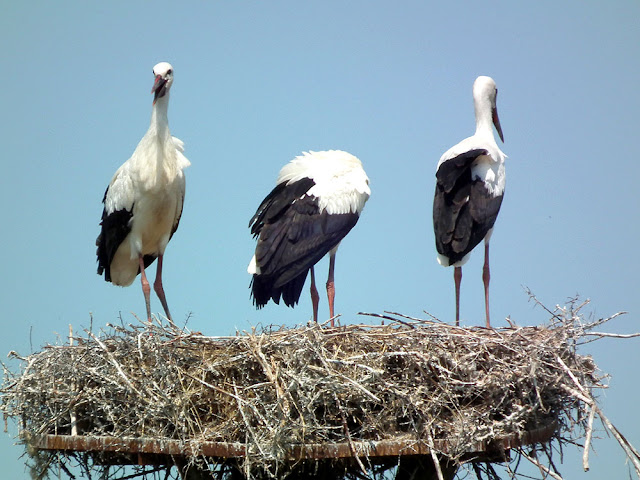
Young White Storks Ciconia ciconia on the nest, Brouage marshes, Charente-Maritime. France. Photo by Loire Valley Time Travel.
Young storks on a manmade nest platform.

The storks have been the subject of a conservation programme since 1978, with nesting platforms being erected and young birds being ringed.
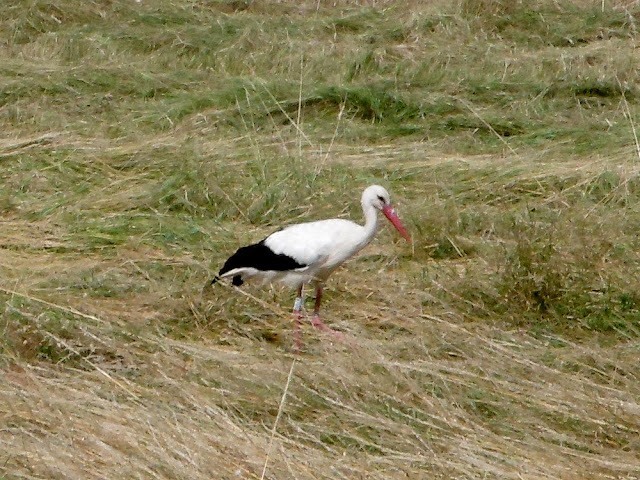
White Stork Ciconia ciconia, Brouage marshes, Charente-Maritime. France. Photo by Loire Valley Time Travel.
Ringed adult stork.

The marshes around Brouage and Rochefort offer a stopover and haven to waders, breeders and migratory birds of all sorts, with abundant invertebrates to feed them.
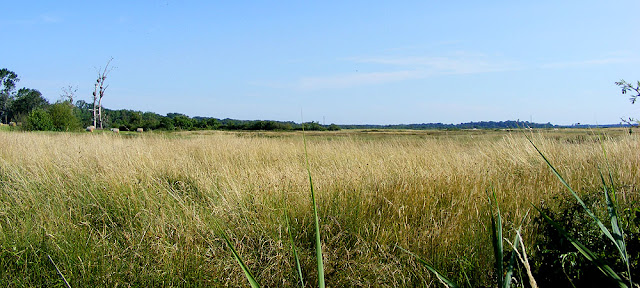
White Stork Ciconia ciconia nest tree, Brouage marshes, Charente-Maritime. France. Photo by Loire Valley Time Travel.
View of the marshes with the 'apartment block' on the left.

 Nowadays the storks in particular are a major attraction for the area.

White Stork Ciconia ciconia nest tree, Brouage marshes, Charente-Maritime. France. Photo by Loire Valley Time Travel.
A stork 'apartment tower' on the edge of the marsh, with lots of cormorants.

Today Charente-Maritime has the largest population of White Stork Ciconia ciconia (Fr. Cigogne blanche) in France, with just over 500 breeding pairs producing around 900 chicks every year in various large salt marshes and estuaries along the coast. This is from a low point in the 1970s when the species had more or less disappeared from France. Numbers of storks here are now higher than in the species other French stronghold, Haut-Rhin (Alsace).

Photographing White Stork Ciconia ciconia, Brouage marshes, Charente-Maritime. France. Photo by Loire Valley Time Travel.
Me photographing and watching storks from the ramparts of the Brouage star fort.

In the Brouage Marshes the storks are considered an umbrella species ie if they are protected, then the knock-on effect is protecting the whole ecosystem.

White Stork Ciconia ciconia, Brouage marshes, Charente-Maritime. France. Photo by Loire Valley Time Travel.
The Brouage marshes, with storks foraging.

Just twelve years ago there were only six nests on the marsh itself, but some of the storks no longer bothered to migrate. The climate on the Brouage Marshes was so agreable that they simply stayed put, sedentary at the end of summer. Now there are ten times the number of nests and they are the only predator of an invasive non-native crayfish. Today about 80 individuals are resident all year round. These birds tend to get the best nest sites, being able to lay claim to them before the migrants arrive back in February at the beginning of the breeding season.

White Stork Ciconia ciconia, Brouage marshes, Charente-Maritime. France. Photo by Loire Valley Time Travel.
The storks taking advantage of the hay mowing disturbing insects in the grass.

Food is abundant, especially the invasive alien crayfish Procambarus clarkii (Red Swamp Crayfish), and storks happily scoff all they can find, thus protecting amphibians and fish stocks by preventing their eggs from being eaten by the crayfish. Their crustacean diet has another benefit too, providing the storks with plenty of carotene for colouring their legs and beaks a good strong orangey red.

White Stork Ciconia ciconia, Brouage marshes, Charente-Maritime. France. Photo by Loire Valley Time Travel.
Adults foraging in newly cut hay on the marsh.

One of the problems of managing nesting storks in the marsh is that they have a liking for electricity pylons as nest sites. Nowadays there is a joint programme between the electricity supplier and the bird conservationists to physically move inappropriately sited nests to new purpose built platforms, sometimes attached to the pylon the birds originally chose. Apparently the birds tolerate this very well. The bird conservationists also often take the opportunity to install a kestrel nest box under the big metal mesh wheel on a tall pole erected for the storks. 

The storks will use the same platform for several years at least. Sometimes the nests will tumble off trees or even the purpose built poles in the winter. When this happens the conservationists make sure a new nest site is available nearby. A standard nest platform is made from a wooden pole inserted in a two metre deep hole and secured with wire cable stays. A metal ring with netting stretched over it is placed on top and several bundles of wood added for the storks to construct their nest from. 

Males arrive back before females and claim a nest (sometimes before the conservationists have finished working on it). The eggs are laid in March and chicks hatch in 35 days. The young birds take off for southern climes from July and August, some of them having been ringed in June. Their parents will depart for Spain or Africa in September and October.

White Stork Ciconia ciconia, Brouage marshes, Charente-Maritime. France. Photo by Loire Valley Time Travel.
An adult foraging.

 The marsh is a maze of actively managed canals, winding narrow roads and cattle grazing.
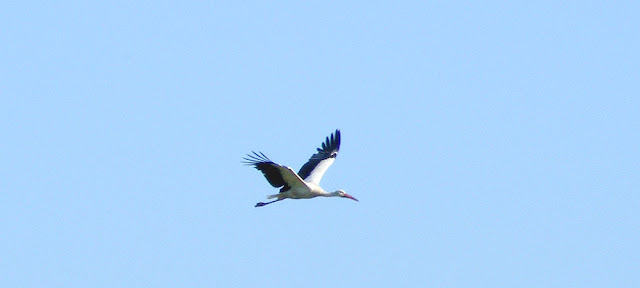
White Stork Ciconia ciconia, Brouage marshes, Charente-Maritime. France. Photo by Loire Valley Time Travel.
An adult flies, close to the nest.

Since the 1970s the storks have been ringed to help monitor them, and every year they are surveyed to count their numbers and distribution. In the last few years ringing has ceased, as the population is safe and stable. The conservationists are thus able to focus on other tasks with the time that has been freed up.

White Stork Ciconia ciconia, Brouage marshes, Charente-Maritime. France. Photo by Loire Valley Time Travel.
Adults, including a ringed one, foraging.

 The first scientific observation of migrating storks in Charente-Maritime was made in 1841. The oldest known stork from the area, according to her ring information, was a female of 26 years who died in 2018.


************************************************

For details of our private guided tours of chateaux, gardens, wineries, markets and more please visit the Loire Valley Time Travel website. We would be delighted to design a tour for you.

We are also on Instagram, so check us out to see a regularly updated selection of our very best photos. 

Tuesday, 4 August 2020

The Gathering


Juvenile swallows gathering on electricity wires prior to migrating. Indre et Loire. France. Photo by Loire Valley Time Travel.

Already the young swallows and martins are gathering together on the electricity wires in our street. More than I've ever seen before, and even as their parents are still raising their final brood in barns all over town. It's that time of year already. They are waiting for the big feast of flying ants that will happen any day now, then those that have bonded during the morning gatherings will start making their way south. If they make it they will end up as far away as South Africa.


************************************************

For details of our private guided tours of chateaux, gardens, wineries, markets and more please visit the Loire Valley Time Travel website. We would be delighted to design a tour for you.

We are also on Instagram, so check us out to see a regularly updated selection of our very best photos. 

Friday, 14 February 2020

Preuilly Municipal Council January 2020 Meeting Report


Documentary: Local film maker Sylvain Desclous is making a documentary about the upcoming municipal elections, and was present to film one of the last council meetings to be presided over by current mayor Gilles Bertucelli.

Sylvain Desclous and the actors answer questions at the preview of Vendeur, also filmed locally.
Director and actors take questions at preview of the film Vendeur.  Indre et Loire, France. Photographed by Susan Walter. Tour the Loire Valley with a classic car and a private guide.

Town Water: Responsibility for the town water supply and sanitation has transferred to the Communauté des Communes and Preuilly has handed over equipment relevant to managing the system. Several councillors brought up the complaint by various residents that the water has been very chloriney since the Comcom handed management of the system to Véolia in 2019. Prior to this Preuilly had been one of only three municipalities who managed their own water.

 The water tower in Preuilly is buried in the chateau ramparts.
Water tower buried in the chateau ramparts.  Indre et Loire, France. Photographed by Susan Walter. Tour the Loire Valley with a classic car and a private guide.

Place des Halles: The refurbishment of the market place has been suspended as Batiment de France, the State agency responsible for heritage buildings, wants changes to the plans that the council does not agree with, such as the removal of parking places, the existing trees and the proposed steps. They feel the project is jeopardised to the extent that they will leave it for the next elected team to take up.

 Place des Halles, decorated for Christmas.
Place des Halles, Preuilly sur Claise, decorated for Christmas.  Indre et Loire, France. Photographed by Susan Walter. Tour the Loire Valley with a classic car and a private guide.

New Doctor: The current local doctor, Patrick Mureau, is due to retire in the next four years. It was envisaged that the wife of the current dentist, who is a doctor, would replace him. However, she is Romanian, and has still not received authorisation to practice in France. The Romanian government is making it more and more difficult for their nationals to work in foreign countries as they want to retain doctors trained in Romania. The new council will maybe have to use an agency to find a new doctor.

Simon at the doctor's.
At the doctors.  Indre et Loire, France. Photographed by Susan Walter. Tour the Loire Valley with a classic car and a private guide.

Seasonal Jobs: Every year the municipality creates two seasonal jobs -- swimming pool lifeguard (maitre-nageur) and camping grounds manager. These posts are currently unfilled and the council is searching for candidates.

 The municipal pool in Preuilly, with a former maitre-nageur on the left.
A municipal swimming pool.  Indre et Loire, France. Photographed by Susan Walter. Tour the Loire Valley with a classic car and a private guide.

Solar Farm: The modification of use of the Dennery factory site has been approved and the public enquiry completed. It is not yet clear if the photovoltaic panels will be erected after the demolition of the existing buildings, or if they will be kept. The facility will produce 8.074 kW from 4.12 hectares of panels on 8.6 hectares of land. The annual production is estimated at being the equivalent of the consumption (except heating) of 7786 households.

 Site of the former Dennery factory.
Site of the former Dennery factory.  Indre et Loire, France. Photographed by Susan Walter. Tour the Loire Valley with a classic car and a private guide.

Grants: A grant of €50 per primary school pupil was agreed for a science discovery stay at Azay le Ferron. A grant of €2970 was agreed for the Sports Union, for the club itself and towards salaries and expenses of personnel.


************************************************

For details of our private guided tours of chateaux, gardens, wineries, markets and more please visit the Loire Valley Time Travel website. We would be delighted to design a tour for you.

We are also on Instagram, so check us out to see a regularly updated selection of our very best photos. 

Thursday, 21 March 2019

Fish Ladder


Recently we visited the fish ladder in the Creuse at Gatineau, near La Roche Posay.

Photographed by Susan from Loire Valley Time Travel. https://tourtheloire.com
The fish ladder, on the Indre et Loire side of the River Creuse.

It was constructed in the autumn of 2010. The Office Nationale de l'eau et des milieux aquatiques (ONEMA), having carried out a check on the weir, required the owner to install a fish ladder for migrating Atlantic salmon, lamprey, shad, sea trout and eel, and to allow the natural movement of sediment. From its source in the Massif Central, the Creuse runs nearly 300 km to its confluence with the Vienne. The lower section, up to the impassable hydro-electric complex at Eguzon, is potentially accessible to migratory fish. However, this 124 km stretch of river has 31 weirs or dams along its route - one every 4 km on average - that slow or block the flow of migrants.

Photographed by Susan from Loire Valley Time Travel. https://tourtheloire.com

The owner of the abandoned industrial complex on the other side of the river, who is also responsible for the weir, was advised in February 2010 that the work must be completed within 8 months. He still runs one of the hydro-electric turbines on the site under the business name Lumhydro. To force his hand, failure to comply with the obligation to construct the fish ladder would have resulted in the termination of his contract with EDF (Electricité de France) who buy the power the plant generates. He was also threatened with a 100 euros a day fine after the deadline until the work was finished, to help ensure the work was done and finished. The owner was obliged to comply with the ONEMA regulations by law, but was given a grant in order to achieve the work, as he was able to demonstrate his proposed improvements were suitable. The site is one of two top priorities on the Creuse to bring the river management up to modern environmental standards.

Photographed by Susan from Loire Valley Time Travel. https://tourtheloire.com
Fabrice, Edith, Marie-Hélène and a couple of people I don't know checking out the fish ladder.

In French fish ladders are called passes à poissons and this one was constructed by the specialist hydro-engineering company Verchéenne. Fish ladders vary in style depending on the target species and their capabilities (some fish are stronger swimmers or leapers than others and this has to be taken into account). 
************************************************

For details of our private guided tours of chateaux, gardens, wineries, markets and more please visit the Loire Valley Time Travel website. We would be delighted to design a tour for you.

Friday, 22 February 2019

February 2019 News From Preuilly


The local council has had their monthly meeting and here is an overview of the topics covered and decisions taken.

Finances
The municipal finances are looking healthy with nearly half a million euros invested. Money from this fund has been earmarked for a revision of the town plan, new street lighting, the covered stand at the sports ground, a communal water heater, a dojo (?? are we getting a martial arts hall??), the endless and bungled roadworks in rue de la Fontaine, and the conversion of the preschool to a kids activity centre. The crematorium at the cemetery is also full, so money has been allocated to build a new one.

Photographed by Susan from Loire Valley Time Travel. https://tourtheloire.com

Greenway Project
The communauté des communes Loches Sud Touraine is managing the conversion of the old railway line into a greenway. The investment will be about 1.8 million euros for the LST once grants have been taken into account. Communes like Preuilly, through which the track crosses, have been asked what development they propose to increase the attractiveness of the project. Preuilly is proposing to create 15 parking places near the former station, plus a picnic area, toilets and sinks in the area. This work is seen as linked to the proposed improvements to the market place in the centre of town. The mayor presented a new plan for the market place which includes angle parking down the western side. Residents of the square have been consulted and it was confirmed that there would be a public meeting to discuss the plans before any decision would be taken.
 
Photographed by Susan from Loire Valley Time Travel. https://tourtheloire.com

Pollution Complaints
Loches Sud Touraine has lodged a formal complaint against a grazier with 300 head of cattle within the boundries of the commune of Preuilly sur Claise. The allegation is that he has polluted the environment and the streams that flow into the Claise. The council are thinking of referring the complaint to the French Biodiversity Agency.

Student Grants
Eleven third and fourth graders from Preuilly go to school in Yzeures sur Creuse and these classes are off on a five day school trip to Courtenay. The trip will include activities, medieval workshops and a visit to the Chateau of Guédelon. The cost per pupil is €330 and Preuilly council will subsidise them to the tune of €50 per pupil.

Solar Farm
A modification of the urban plan has been made to allow the creation of a solar farm on the site of the former Dennery factory.

Here is the report of the meeting in the local paper (in French).


************************************************

For details of our private guided tours of chateaux, gardens, wineries, markets and more please visit the Loire Valley Time Travel website. We would be delighted to design a tour for you.

Friday, 19 October 2018

The Wind Turbine Project at Le Petit Pressigny


About six months ago I started hearing about a proposal to erect ten wind turbines along a ridge between Le Grand Pressigny and Charnizay. Everyone I spoke to at that point assumed I would be against the project, as they were. I was encouraged to go along to the town hall and look at the documentation for the project and to sign a petition against it.

Members of the Association de protection de l'environnement Pressignois at a local food and art fair.

I never got round to checking it out at the town hall, but slowly more and more information started to be widely disseminated. My natural inclination would be to be for wind turbines, unless they are sited inappropriately. That means breaking up important habitat. It does not mean spoiling my view or being located too close to my home. Nothing I read about the project raised particular alarm bells.

Over the last month or so the wind turbine project has been the super hot topic at social occasions. I know and like many of the people who belong to a new association dedicated to stopping the project. They are quite visible and vocal, to the extent that at a party a few weeks ago my friends Dominique (female) and Denise were delighted to find that I was for the project. Like me, they had been starting to think they were the only ones.

Flora Pastre (second left) answering questions from the public.

There have been a series of public meetings to allow the wind turbine company to inform and consult with the locals. I went along when the representative from the company was at Le Grand Pressigny, answering questions and presenting the project. Of the half dozen people present, four of them were friends and several were against the project. Later that day I accidentally gatecrashed the landowners meeting with the company in Le Petit Pressigny, which was a somewhat different affair. They were offered drinks and nibbles and were generally for the project.

I've now had a lot of contact with both sides and can summarise the situation thus:

Those for the project point out that
  • Indre et Loire currently has no wind turbines at all (the implication being that they are not doing their share -- after all, there are now hundreds of turbines in the neighbouring département of Vienne).
  • We need to start moving to renewables.
  • The land chosen is open farmland.
  • This is a poor rural area and it is an opportunity for small scale low income farmers to earn a bit of extra income. (Here is a link to a blog post that I wrote about one of the farmers in the area of the project.)
  • The venture is low risk as the regulations say that at the end of their 25 year lifespan every part of the turbines must be removed and recycled.
  • 18 months of ecological and biodiversity surveys began in April and will assess impact on the natural environment and inform the placement of the turbines.
  • Wind levels across the site have been monitored to ensure they will be sufficient to make the project worthwhile.
Those against the project say
  • This isn't Berry or the Beauce with huge flat expanses of open cereal culture. The scale of the turbines is too large for the system of small fields that exist on the proposed site.
  • Wind power is too unreliable to be useful.
  • The landowners are being offered 2% of profits, so if there are no profits the landowners will get nothing. 
  • Wind turbine companies have a reputation for gathering in lots of public funding and private investment, erecting the turbines, but then going bust.
  • If the company goes bust then the low income small scale farmers will be left with the responsibility to get rid of the turbines at the end of their working life. 
  • People visit this area because it is an unspoilt small scale mosaic of fields, woodland and villages and the turbines don't fit this bucolic scene. (Note: this is a French viewpoint, where 50% of wind turbine projects are opposed by the public. An Australian friend has pointed out that Australian visitors would much rather see wind turbines than the cooling towers of nuclear power plants.)
  • Wind turbines kill birds and bats. The biodiversity surveys are being done in a period when the population of raptors such as harriers has not yet recovered from a previous vole population crash. The surveyors will not find nesting raptors this year or next because they likely won't return until 2020, by which time it will be too late to take them into account.
  • The project appears to be borderline profitable, according to the wind turbine company's own information.
  • Wind turbines reduce real estate values.
  • Wind turbines cause noise pollution.
My own observations would be that
  • The project has split local opinion about 50/50. Feelings are running high, with the antis going to the effort and expense of setting up a formal association to fight the project, and the pros slashing the antis banners.
  • Some of the anti wind turbine feeling is, inevitably, nimbyism.
  • There is a strong tendency amongst those against the project to simply not believe anything the wind turbine company says and to not accept the project because it isn't perfect.There is no acknowledgement that projects and technologies necessarily develop over time. There is no acceptance that the wind turbine company is acting in good faith.
  • There is a strong belief amongst those against the project that it is a done deal and any consultation is lip service. There is no acceptance that their own arguments might not be relevant, strong enough or have been dealt with appropriately already.
  • The person who has impressed me the most over the course of my various discussions is Flora Pastre, the project manager in charge of prospection. She's young, she's sassy and she answered everyone's questions lucidly, at length and without hesitation. Occasionally she admitted she didn't know the answer, but mostly she had obviously encountered the questions before and had the answers at her finger tips. 
  • The two people on the side against the project whose opinions I find most credible are both retired from careers where they were involved with dealing with wind turbine companies. Neither are French (one's Dutch, one's Canadian). They are both deeply cynical about the wind turbine company's motives and the long term outcome of the project.
  • I've worked in the heritage and nature conservation sector for many years. I am well used to big lumbering consultative projects and the fact that they take ages to get to the action bit. It can be hard to accept that just because your ideas weren't included in the final project it does not mean you weren't listened to and your input considered seriously.
  • It has been a lesson in how important the French concept known as la vie associative is. Joining a club is not just to enhance your social life, it is to achieve change for the better. It is to engage in your community by working together collaboratively and is one of the pillars of French society. It's why when you apply for French citizenship you are quizzed about whether you belong to any associations. There is an expectation that you do and in all likelihood there is a political element at some level. The associations give their members a voice in public affairs. That's why those against the wind turbines formalised their group by creating a legal association. That's why the pro wind turbines mayor of Le Petit Pressigny is muttering about creating his own association to promote the project. 
  • The problems involving wildlife and habitat can all be solved by good consultative processes. The turbines can be sited in such a way as to avoid or minimise disturbance to wildlife once the ecological studies have been done.  This is rapidly developing science and wind turbine companies are well used to dealing with this issue now.
  • Wind turbines, given time, will become industrial icons of our age, just as 19th century railway viaducts did in the 20th century.
  • Studies looking at actual sales figures rather than real estate valuations show that nearby wind turbines have no statistically significant impact on prices overall, although they may impact on individual properties (both negatively and positively).
  • The latest regulations and recommendations regarding noise pollution from wind turbines in France is dealt with in this article (in English). Basically, sometimes there might be a problem, in which case the expectation is that it is monitored and ultimately dealt with.
Note: This post was edited on 27 October 2018 following feedback from several people. In particular, changes have been made to the points about vole/raptor boom/bust cycles and the biodiversity surveying, as well as the partisan nature of two of the people pictured. Other additional notes have been added.

Wednesday, 1 November 2017

Simon does a thing...


When our house first encountered its new electricity we had an enormous amount of stuff to install - hundreds of metres of cabling, and dozens of light switches and power points. Because of the sheer number of parts to be bought, we went for the least expensive option that still met European (and French) safety standards.

Thus we installed Norvika switches and power points from BricoDepot. They are a modular unit and the switches worked quite well for a number of years, before the buzzing and flickering started. Buzzing light switches is a bit alarming, and although I took the switches apart and made sure everything was tight before re-installing them, the buzzing soon returned. A combination of things meant that instead of replacing the switches we were just very careful about which switches we used and how long we left the light on for.


In September I decided that it was time to stop running away from issues, so I went out and bought some Legrand switches (the least expensive ones, naturally) because Legrand have just about cornered the market in branded electrical components and have a good reputation.


Once I had removed the old switches and played about with them for a bit I worked out what the issue was. Because the switches are modular, the clamp that holds the wires moves around ever so slightly - not enough for the wires to touch, but I assume enough that some arcing occurs.

A new switch installed

It is interesting to note that BricoDepot no longer sell Norvika switches. I wonder if this is the reason. The new switches are made in one piece, and once installed are buzz and flicker free, They also feel "softer" to turn on while still being positive, and they aren't the least elegant light switches in the world.

**********************************************

We have received our first t-shirt from the Loire Valley Time Travel store. So far so good - they are Fruit of the Loom t-shirts, and the printing looks good. The only change I had to make was moving the design up the shirt a bit - Susan will lose the bottom of her map if she tucks the shirt in. This is the ideal time to buy a unique gift, because everyone needs a unique gift. If enough people buy unique gifts we can have a get together where we are all unique together.