Showing posts sorted by relevance for query lyon. Sort by date Show all posts

Monday, 18 July 2022

Our Trip to Lyon -- an overview

We spent 10-13 July in Lyon with Simon's brother and sister in law and had a great time. It was everybody's first time in the city.

Visiting Lyon, Rhone, France. Photo by Loire Valley Time Travel.
Me, Rosy, Jon, Simon, on the foot bridge over the Saone. Photo courtesy of Rosy.
 

Lyon is France's second (or third, depending on how you measure it) city, situated in the south-east of the country on the confluence of the Saone and the Rhone Rivers. It is divided into several distinct districts -- Vieux Lyon (the old town), the Presqu'ile (the peninsula between the two rivers), the Croix Rousse (where many silk weavers lived), and La Part-Dieu (the new town).  

Looking up the Saone from the Basilica roof, Lyon, Rhone, France. Photo by Loire Valley Time Travel.
Looking up the Saone. Photo courtesy of Rosy, taken from the Basilica roof.
 

Traboules: These are alleyways which link the three streets in Vieux-Lyon. They are to maximise the use of space in an area that is constricted by cliffs on one side and the river on the other, allowing residences to be built over and around them and include small internal courtyards. They are quite hidden unless you know about them as they have entry doors which in most cases look like private entrances. I recommend hiring a guide to show you the best ones, as they are often architecturally rather brilliant (14C to 17C). Once you are inside you need to be very quiet as sound reverberates in them, and people live and work in the buildings they serve. There are also traboules in La Croix-rousse.

16C traboule designed by Philibert Delorme, Lyon, Rhone, France. Photo by Loire Valley Time Travel.
16th century traboule designed by Philibert Delorme, who also designed the gallery over the river at Chenonceau for Catherine de Medici.
 
Food: Lyon has a reputation for being the great foodie capital of France. It has a remarkable number of Michelin starred restaurants, none of which we tried, although I did chat briefly with one of the chefs. It also has restaurants known as 'bouchons', which were traditionally run by formidible women. There are plenty of good restaurants doing French classic dishes and quite a few places that the locals consider to be tourist traps, especially in Vieux-Lyon. Most of the best bouchons are on the Presqu'ile, not in Vieux-Lyon. The chef Paul Bocuse is (even now he's dead...) a big presence and influence in the city. Probably the most famous dish is quenelles (fish dumplings).

Rue de boeuf, Vieux-Lyon, Rhone, France. Photo by Loire Valley Time Travel.
Rue de boeuf in Vieux-Lyon is full of restaurants.

To be honest, based on what I had read, I expected Lyonnaise food to be stodgy. I was delighted to be proved wrong on that one, although it is generous and hearty. However, despite having a number of excellent meals, I didn't really get what it was about Lyonnaise cuisine that gives it a reputation as a cut above other regional French cuisine. We live in the Touraine, and the food is excellent here too, but somehow the Tourist Office hasn't managed to get the message out internationally in the way Lyon has.

Quenelle, Lyon, Rhone, France. Photo by Loire Valley Time Travel.
Quenelle.

The big difference that was very noticeable was that Lyonnaise restaurant staff are lively and happy to engage, in whatever language you can muster, with diners. Eating in a restaurant in Lyon is a joyous experience, quite loud and boisterous, with lots of smiling and healthy enjoyment of lots of food and drink. 

Aperitif, Lyon, Rhone, France. Photo by Loire Valley Time Travel.
Aperitif on the Fourviere. Photo courtesy of Rosy.
 

Where We Ate:
The Phamily, 7 rue du boeuf, Vieux-Lyon. Vietnamese. Dinner. https://www.thephamily.co/

Les Adrets, 30 rue du boeuf, Vieux-Lyon. French. Lunch. Recommended by our guide. http://les-adrets.com/

Les Adrets restaurant, Lyon, Rhone, France. Photo by Loire Valley Time Travel.
Les Adrets restaurant.
 

Café des Fédérations, 9 rue Major Martin, Presqu'ile. Bouchon. Dinner. Recommended by our guide as one of the authentic bouchons that was not a tourist trap. Nevertheless, by far the majority of diners were American. The restaurant occupies three premises (two adjoining and one across the street). First time diners, including us, struggle to work out how to get in, so don't hesitate to stand in the street and wave madly to attract the barman's attention. He will come and let you in. https://restaurant-cafedesfederations-lyon.fr/

La Salle a manger, 52 cour Charlemagne, Fourvievre (next to the Basilica). This is a restaurant run by a famous institution called the Apprentis d'Auteuil, which takes disadvantaged young people and trains them for various trades and professions. https://www.apprentis-auteuil.org/etablissements/fiche-etablissement/la-salle-a-manger-a-lyon-90944.html

Brasserie l'Espace Carnot, 4 place Carnot. https://espacecarnot.fr/

Note that many restaurants are closed on Mondays.

What We Ate:
Phamily - mixed starters of dumplings and spring rolls; pho, Saigon salad, chicken with satay sauce, coconut milk and chopped vegetables, sauteed beef, boiled rice.  

Les Adrets - Duo of mackerel; confit de canard (slow cooked duck) with polenta; a sort of deconstructed strawberry shortcake.

Café des Fédérations - oeufs meurette (poached egg in red wine, mushroom and shallot sauce); salad Lyonnaise, lentil salad, saucisson aux pistache brioché (pork sausages studded with pistachios and wrapped in brioche); quenelles (pike fish dumplings) with langoustine bisque sauce, civet de joue de porc (slow cooked pork cheeks in red wine sauce), tablier de sapeur (crumbed pork escalope with macaroni cheese); demi Saint Marcelin truffé (half a Saint Marcelin cheese with a layer of truffles and garlic), cervelle des canuts (cottage cheese with garlic); Crème glacée aux raisins, coulis de fruits rouge au marc de Bourgogne (house made vanilla ice cream with red fruit sauce and sultanas soaked in a local spirit).

Saucisson aux pistache brioché (pistachio studded pork sausage in brioche), Lyon, Rhone, France. Photo by Loire Valley Time Travel.
Saucisson aux pistache brioché (pistachio studded pork sausage in brioche).

La Salle a manger - cold carrot soup, lentils with a poached egg, rabbit terrine; pork sausages studded with pistachios; peach tart.

Espace Carnot - rougail (sausages in a spicy tomato sauce) with lentils and rice; pistachio sabayon with a shortbread biscuit.


All our restaurant experiences were good and we noticed that lentils and pistachios featured in nearly every meal.

Silk: We visited Brochier Soieries, 16 rue de boeuf, Vieux-Lyon for a history of the silk industry and the family run Brochier company in particular. They now concentrate on silk screen printing scarves for museum shops. I got to paint some silk and we were shown silk worms in various stages of growth. This was a real highlight. https://brochiersoieries.com/en/

Brochier Soieries, Lyon, Rhone, France. Photo by Loire Valley Time Travel.
Inside Brochier Soieries shop in Vieux-Lyon.
 

Churches: We visited the cathedral, in Vieux-Lyon, which has wonderfully detailed medieval carvings on the front, and a splendid 14th century clock (!!) inside, as well as stained glass from most centuries from the 12th to the 20th.

15C Lovers on the front of Lyon Cathedral, Rhone, France. Photo by Loire Valley Time Travel.
The 15th century lovers on the front of the Cathedral.
 

We also visited the Basilica, on the Fourviere hill, which, much to our surprise, turned out to be a tremendous highlight. The exterior and interior is a megafest of 19C high Catholic taste, but by chance we were invited onto a tour of the roof, which was great fun and very informative. Needless to say, there are the best views in Lyon from the roof of the basilica. The tour is only in French, but there were several non-French speakers doing it and they seemed to enjoy it.

Guide: We used New Generation Guide www.newgenerationguide.com who at under 300 euros for a private group of 4 for 3 hours of exploring Vieux-Lyon, including the silk workshop, cathedral and many traboules, was very good value. The guide was extremely knowledgeable and very well networked so we got to see things we would not otherwise have done.
Guided tour in Vieux-Lyon, Rhone, France. Photo by Loire Valley Time Travel.
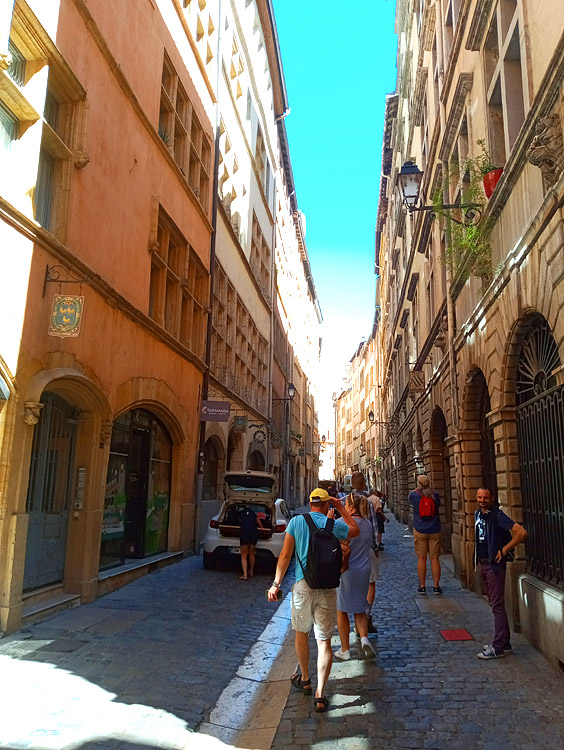
Our guide Alex, on the right, engaging in that time honoured guiding technique, herding cats.
 

Also recommended to us was www.foodie-lyon.com but we did not actually use them.

Museums: We visited the Musée de Beaux Arts and were impressed by the Egyptian collections, some of the medieval artefacts, and the 17th century paintings. https://www.mba-lyon.fr/fr

What we did not have time for but would have liked to do: The Museum of the Resistance and Deportation https://en.lyon-france.com/discover-lyon/culture-and-museums/museums/resistance-and-deportation-history-centre-chrd, the Institut Lumiere https://www.institut-lumiere.org/ and the Botanical Gardens https://www.lyon.fr/lieu/jardins/jardin-botanique. The Textile Museum https://en.lyon-france.com/discover-lyon/culture-and-museums/museums/textile-museum-closed, which has long been on my list, is closed for renovations. Note that many museums are closed on Mondays and/or Tuesdays.

Where we stayed: A 2 bedroom apartment in rue Johannes Drevet on the Presqu'ile. It was spacious, clean, well equipped except for a few minor niggles and perfectly located for getting to all the places we wanted to see.

What I did not like about Lyon: The noise! There was a lot of street noise, day and night.

How we got there: We caught the Intercity train from Saint Pierre des Corps to Lyon Perrache, a trip of about five and a half hours, and returned the same way. In Lyon we mostly walked, but on one day bought a 24 hour multi-trip public transport pass and used the funicular railway to get up to Fourviere and back.

Saturday, 3 September 2022

The Overground Underground

One thing I wanted to see while we were in Lyon in July was the funicular underground railway. The railways were built to carry goods and passengers up the incredibly steep cliffs that suround old Lyon and are very early - the first was built in 1862. They start at ground level and climb a very steep ramp to enter the tunnel. For the people of Lyon that may be normal, but for me...

There were once five funicular lines, but only two exist now, a line climbing the Fourvière hill linking Saint-Jean to Saint-Just with an intermediate station at Minimes, and a line from Saint-Jean to the Basilica. Both lines were modernised in 1986 and 1987. A new station at Saint-Jean was built in 1991 to serve a new line of the Metro and both funicular lines, and the whole complex named Vieux-Lyon. The Fourvière funicular was refurbished at the start of 2018, and the St Just funicular at the start of 2019.

We rode on the line up to the Basilica. It isn't very long, only 404 metres (1,325 ft), but it climbs 116 metres (381 ft). There's only 2 stops, one at each end, and two cars. They balance each other out, so it's actually quite an efficient mode of transport. Each car carries 70 passengers, and the journey takes 2 minutes.

That's the facts, now for the pictures:

The train is at the station

The funicular crosses a bridge to enter the tunnel


The same view from inside


The mechanism that hauls the carriage up the hill

One thing we weren't expecting (so we didn't get any photos) is Roman artifacts in niches in the tunnel.

Tuesday, 12 July 2022

Cathédrale Saint-Jean-Baptiste de Lyon

The Cathédrale Saint-Jean-Baptiste de Lyon is a late medieval church built on a very early medieval site. If you stand in the right place at the right time you can get photos like this.

It's hot in Lyon at the moment, and due to get hotter. Everyone in Lyon is wearing shorts and looking pink, us more than most. A full report will follow in due time, but needless to say we have walked miles and eaten too much.

Monday, 17 August 2015

By Train to Milan

We went almost all the way from Preuilly sur Claise to Milan by train - the only exception being that we drove from home to Saint Pierre des Corps, parked the car in our garage, and caught the slow train to Paris there.

We have caught the slow train to Paris Austerlitz before, and have always maintained that it's the slow train because it doesn't travel much faster than 100mph. Using my GPS I was able to discover that we have been wrong all along, and we will have to call it the "slightly less fast train" because it does actually hit 200km/h in places. No way is that slow...

    Slow Train - Fast Train 
From Paris Austerlitz we walked to Gare de Lyon, a short 10 minute wander across a bridge built for that purpose, and caught the 14.41 TGV direct to Milan. Because we booked early we had afforded ourselves the luxury of first class tickets (cheaper than second class on the earlier train...), settled down in the relative cool and silence, and spot on time the train left. We travelled via Lyon St Exupery, Chambéry-Challes-Eaux, St-Jean-de-Maurienne, Modane, Bardonecchia-Stazione, Oulx, Torino Porta Susa, Rho-Fiera Milano, and arrived at Milano-Porta-Garibaldi exactly on time. Being first class tickets we had trolley service for drinks and snacks, and a couple of hours before arriving in Milan orders for our evening meal were taken at our seats and delivered there as well.

A screenshot of the geolocation service for SNCF trains. We were on
train 9249 (and being served a hot meal) a week earlier than this shot was taken

The train is fast to Lyon St Exupéry, with a maximum speed of 300km/h, but once you get onto the windey rails up in the mountains everything slows down - sometimes as slow as 40km/h. At least it gives plenty of opportunity to look at Alps. Once past Modane you travel under the Alps into Italy and more windey stuff before the ground levels out and the train gets up to 160km/h. The trip takes 7 hours (more or less).

An Italian Alp from a moving train

We love train travel, so much so that when we received an email saying that our return train was a bus replacement service from Milan to Modane we went to the SNCF Boutique in Milan and rebooked for an earlier train that wasn't affected. This cost us slightly more, but even though we had non-exchangeable tickets the penalty was waived by SNCF which kept the cost down. This is the second time we have been impressed by SNCF customer service in the past few weeks: other companies around here could learn from them.

If I was a sub atomic particle I could have proved Heisenberg wrong...
(aka the joys of GPS)

Thursday, 14 July 2022

The Basilica at night

We arrived home from Lyon at about 22:30 last night. We're too hot and tired to write a blog, so here's a photo of the Basilica of Notre Dame, Lyon, at night.


Tuesday, 9 August 2022

Serendipity

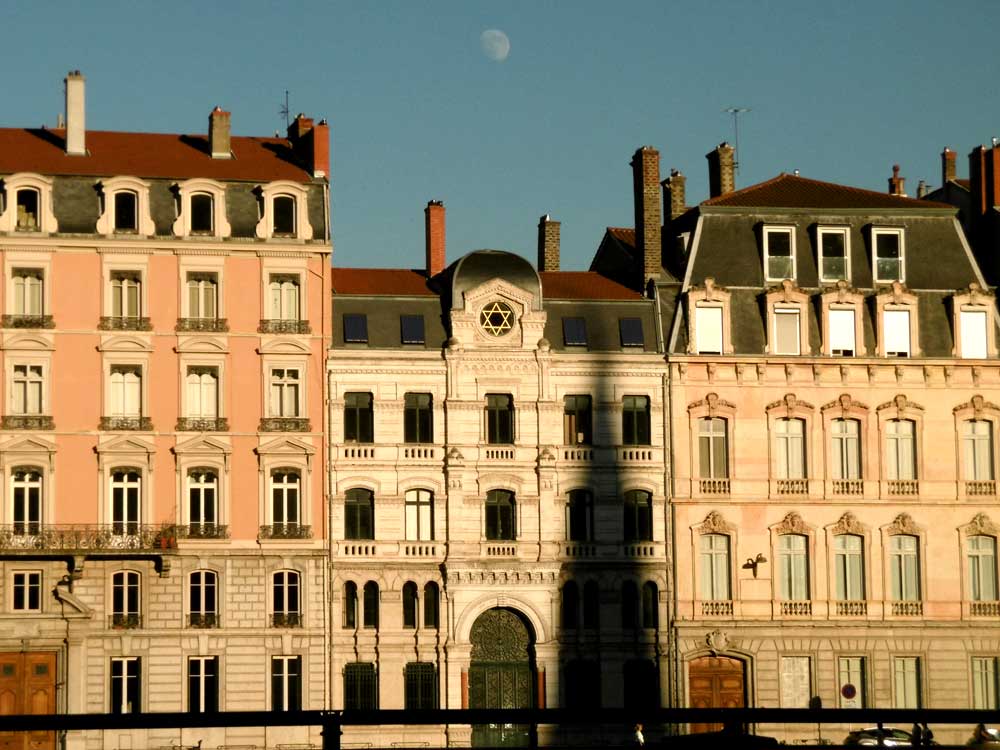
It's just that the moon happened to be in the right place. The photo was taken in Lyon, 4 weeks ago.


It's amazing... In some ways Lyon feels like it was longer ago than 4 weeks, but in others it feels so recent. I suppose it's because we have been so busy and done so much lately that time has felt really random.

Friday, 15 July 2022

Off the Tracks

No pictures of the Fete Nationale celebrations this year, we didn't go because we arrived back from Lyon at about 10:30pm and were hot and tired. The celebrations were curtailed this year, having no fireworks because of a request from the Prefecture to try stop wildfires.

So instead an artfully edited photo of the obsolete dockside railway tracks in Lyon.


Monday, 11 July 2022

On The Tracks

Susan and I are in Lyon for a couple of days, spending time with my brother who is over from Australia. He is the first family member we have seen since the pestilance hit.

We left tours at 07:33 and caught the InterCitie train to Lyon Perrache, arriving at about 13:30. The train was modern and air-conditioned and very smooth, if not the fastest. The tickets were inexpensive and the whole thing was less stressful than driving. It's territory we haven't really seen before, so it was a pleasant meander through central France

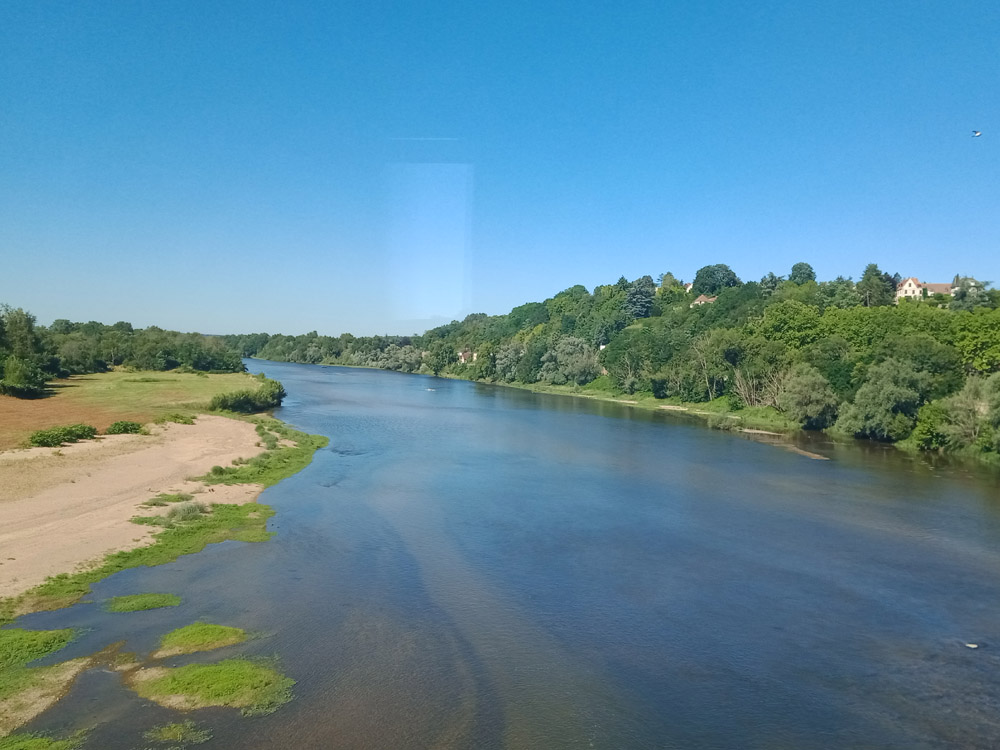
This is the Loire River at Nevers, taken through the train window.


Wednesday, 10 December 2014

The Virgin Gets a Makeover

Currently there is an exhibition of sculpture from the Touraine Loire Valley at the Logis Royal in Loches, curated by Guy Bertaud du Chazaud, Curator of Art and Antiquities for Indre et Loire. Numerous works have been brought together from all over the département. The exhibition runs until 15 March 2015.

Conservator Hélène Gruau touches up the base of the Virgin.
 
Some significant pieces proved too fragile to move to Loches though, including a terracotta Virgin with Serpent by Charles Jean Avissau from the Abbey in Preuilly. This notable 19th century sculptor is also known for his ceramic pieces exhibited in the Musée de Beaux Arts in Tours.

Conservator Laure Chavanne, who grew up in this area, catches up with one of the locals.
With transporting the fragile objects impossible it was decided to create a circuit for viewing them in situ. One of the circuits includes treasures in Boussay, Yzeures, Preuilly and Bossay. The sculptures concerned are currently being conserved with the help of the Conseil Général (the equivalent of county or supershire council). The Virgin with Serpent was carefully conserved by two graduates of the Ecole des Beaux Arts de Tours, Hélène Gruau and Laure Chavanne.

Hélène shares a joke with a local who's come to check out the work.
After a thorough cleaning, reassembling bits which have fallen off and filling cracks, they have given this forgotten work a new luminosity and she will hopefully attract more attention from the locals and visitors to the Abbey. 

I spoke to Hélène and Laure on Friday morning and they expected to finish the work that afternoon. Laure now lives in Lyon, but had come all this way for the opportunity to work with her friend and colleague on this project. Hélène said much of the work was actually redoing the work of an old restoration. When I visited the Abbey to see them in action she was working on evening out the colour on the repairs so they blended well with the rest of the sculpture. Apart from the overall clean, most of the repair work was done on the hands, the snake and the plinth. The statue has been moved to a different position in the church, perhaps to give it a bit more prominence. As yet there doesn't seem to be any plans to turn her into a theremin though.

Both women were relaxed and friendly with me and one or two other locals who dropped by to watch them working. They answered questions and engaged with us in a thoroughly professional and rewarding way. Visible conservation requires a delicate balance for the conservator, as they must concentrate on the work at hand and it can be really difficult for them to be interrupted by audience questions. On the other hand their audience really appreciates being able to see behind the scenes of what is involved in maintaining a work of art on display.
**********************************************************
A la cuisine hier: Endive and Leek Gratin, with gallons of cheese and bechamel sauce. Endives are not my go to vegetable of choice but they are local and seasonal and in the interests of ringing in the changes I'll cook them once or twice over the winter.

Eccles Cakes, made with the fruit mince that has been festering for a few days and home made rough puff pastry. These are my contribution to a shared lunch with friends today. I made 20, and some spiced cherry 'cream' (cheese) to serve with them. There is a jar of the fruit mince left over to make more cakes or pies with later.

Thursday, 27 March 2014

Roman Ruins near Thésée

Some years ago we read that there were Roman ruins near the small village of Thésée on the northern bank of the Cher. After studying the map and even GoogleEarth aerial photos we duly trotted off to visit them, approaching from the south and discovering the excavated foundations of a temple complex on the south bank of the river, by the small bridge with a memorial to a downed American airman. Thrilling we thought, and took lots of photos. We visited a second time and found that more excavations had been done. Super dooper and gosh what a lot of rather indeterminate rubble -- we weren't sure whether what we were looking at was Roman or 19th century.

The main building at Les Mazelles.
Eventually we mentioned the site to Niall and Antoinette and they in their turn trotted off to visit. When they got back their description of what they had seen didn't match ours at all. What was going on?

One day last year we found out. For once we entered Thésée from the west, and there on your left is a stonking great Roman ruin, with walls metres high, not just foundations requiring the maximum of imagination. Before, we had always entered Thésée from the south and turned right to go through the village, never realising that the ruins we had heard about were plain to see on the edge of the village in the opposite direction.

Looking north, from the road -- unmissable Roman ruins...
Earlier in March we returned yet again to take photos of this impressive site. It should properly be called the Gallo-Roman Site of les Mazelles. These imposing ruins have long intrigued the locals, specialists, antiquarians, archaeologists and historians alike. Theories (some serious, some crackpot) abound as to the purpose of the buildings and local legends have been created around them.

For the visitor today, the Mazelles ruins are the most visible remains of the ancient Tasciaca. In fact, far more still lies hidden underground, having been excavated and re-buried for protection. The site is situated 100m or so from the right (north) bank of the River Cher, right on the modern D176 as it comes into Thésée. In Roman times, this was the road from Tours to Bourges (and on to Nantes or Lyon ultimately). The proximity to both these highways (road and river) explain the location of Tasciaca.

The interior of the main building.
The sign says 'This listed site must be preserved. Have the kindness: not to climb on the walls; to avoid touching the stones.'
The complex consists of three buildings within a curtain wall forming a quadrangle of 7000m². The main building, to the north, is exceptionally well preserved with walls still 7.4m high and 52m in length. It comprises two rooms, one of which is 40m by 14.5m, flanked by two pavilions which were probably connected by an open sided gallery.

To the south we find two other buildings. The one on the south-west, 12m x 10m, is levelled off on top by three courses of quarry (rubble) stones. The other, to the south-east and measuring 35m x 18m, shows evidence for several rooms, but is in a rather delapidated condition and the original construction was more slapdash than the main building.

Evidence of what looks like a nicely done modern repair, made clearly visible so there is no confusion between museum service repair and original, as is best practice today.
The big main building to the north is the most interesting. Nothing else like it exists in the Gallo-Roman world, but its method of construction, with small visible stones and frequent brick courses is typically Roman. The walls have two faces, interior and exterior, made with small rectangular quarry stones or flat ones laid in a herringbone pattern, bonded by mortar. A mixture of mortar and stones was packed between these two faces. To bond the vertical layers together, two courses of big bricks which bridged the width of the wall were periodically laid.

The holes you can see in the walls are notches to hold wooden scaffolding used while constructing the building.

The cruder building to the south east, with the main building in the background.
Two thousand years later the walls are still standing, thanks to their method of construction. Although local tuffeau, like the stone used to make the chateau, these stones are of particularly high quality, with a low porosity and high density that has made them very durable. In addition, they are small in size and set in a very hard mortar, so they did not tempt the later local inhabitants to reuse them and treat the site like a quarry.

Les Mazelles was classified as an Historic Monument by Prosper Merimée in 1840. Old photos show the buildings abandoned, covered in ivy, brambles and scrub. In 1950 they were privately owned, with a vine growing in the shelter of the walls. From 1962 to 1965 a team of young archaeologists pulled the ivy from the walls, cleared the area and undertook a series of surveys and test digs. Maurice Druon, a member of the Academie Française, happened to pass the site one day in 1965. Falling in love with the place he purchased the ruins and the surrounding land, which he scoured and remodelled. In 1976 he gave Les Mazelles to the département of Loir et Cher for a symbolic 1 franc and the Conseil Général have landscaped the surroundings to what you see today.

A close up of a wall. 
Note the alternating bands of small flat stones laid in a herringbone pattern and small rectangular stones, as well as the notches for scaffolding.
Les Mazelles was probably constructed during first third of the second century, under the rule of the Emperor Hadrian, a period of peace and prosperity in the western part of the Roman empire.  The preliminary digs completed on the site have not allowed archaeologists to say with certainty what the site's role was. It is assumed that the buildings had multiple functions relating to their geographic position and in particular their proximity to the Roman road and the Cher. It is thought they were a sort of staging post, with government offices dealing with administration, taxes and justice, possibly also a market, shops, exchange and a temple. It does not seem to have been a military encampment.

The Friends of Tasciaca have an informative website here (in French), which is where I cribbed all the information above from.

Thursday, 7 May 2015

Roman Arch, Saintes

Recently we spent a couple of days at the coast with Simon's parents. On our way back we took a slight detour to visit Saintes, where we knew there were impressive Roman ruins. The most obvious of these is the Arch of Germanicus, once at the end of the bridge across the Charente on the main road from Lyon. The modern route has shifted downstream and the Roman bridge long gone, but the arch remains on the river bank.

This triumphal arch was built by a wealthy local in 18 or 19. That indefatigible champion of French built heritage, Prosper Mérimée, had the arch moved some metres to protect it from work on the quay and it was restored in the mid 19th century. The arch's inscription dedicates it to the Emperor Tiberius, his son Drusus and his charismatic nephew Germanicus, who died not long after the arch was erected. The original benefactor, Caius Julius Rufus, was of Celtic (Gallic) origin, but his family had been given Roman citizenship in his grandfather's time, possibly by Julius Caesar himself.


Tuesday, 6 October 2015

Archaeology at the Logis Royal, Loches

The annual archaeological dig at the Logis Royal in Loches was underway last week. They are working on the section between the destroyed private chapel and the 15th century addition at the rear of the Logis.
I asked what had been found so far and they shrugged ruefully and said it was complicated. There are just walls going every which way and they haven't had a chance to work out the sequence or stratification yet.
You can read about previous digs here (What's Under the Chapel at the Logis Royal?) and here (Digging a Medieval Chapel in Loches).
*********************************************************
Think on This: The 2015 Nobel Prize for Physiology or Medicine has just been announced. So the next time I want to complain about the use of Avermectin and Ivermectin on cattle, its effect on insects associated with dung and all the knock on effects to bats and other insectivores I must acknowledge that some good has come out of it. William C Campbell and Satoshi Omura, who developed the drugs from soil bacteria, have taken it even further and almost eradicated two horrible human diseases -- River Blindness and Elephantiasis. However, it doesn't mean that graziers should continue with routine calendar based prophylactic dosing of cattle when there are other ways of managing the problem.

Likewise the next time I want to diss Traditional Chinese Medicine (TCM) as science woo I must remember that occasionally it comes up with something really worthwhile. Youyou Tu has developed a drug for malaria from traditional plant sources (Sweet Wormwood Artemisia annua*). Importantly it works on patients who have chloroquine resistant malaria. However, it doesn't mean that TCM shouldn't distance itself emphatically and right now from the trade and belief in rhino horn as having medicinal properties. In fact, practioners of TCM should be actively campaigning to disabuse their clients and potential rhino horn buyers of the possibility of any link between the product and a cure for anything. Ditto lion and tiger bones.

*Sweet Wormwood, known as Armoise annuelle in French, is native to Asia, but has naturalised in the Rhone Basin around Lyon, where it is considered a noxious weed. It also occurs in other areas of France, but not, as far as I know, in the Touraine Loire Valley.

Tuesday, 23 August 2022

I had no idea

so I had to look it up


Apparently:

The Limousin ostensions are a religious and popular tradition dating back to the end of the 10th century. They take place in twenty communes including Limoges and other localities, fifteen of which are in the Haute-Vienne, but also in Charente, Creuse and Vienne. They are held every seven years, with the last edition in 2016.

The Limousin septennial ostensions are now on UNESCO's Representative List of the Intangible Cultural Heritage of Humanity, after this ritual practice was inscribed on the Inventory of Intangible Cultural Heritage in France.

The legend fixes the origin of this religious festival to the year 994, when Limousin, like a great part of Aquitaine, was in the grips of the "mal des ardents", or ergotism, an epidemic which starts at the end of the harvest. This intoxication is caused by the consumption of rye bread contaminated by a parasitic fungus, the ergot of rye. It causes a sensation of excruciating burning and hallucination (hence the name "ardent", from the Latin ardere, to burn), seizures and painful spasms, diarrhea, paresthesias, itching, headaches, nausea and vomiting. Patients also have hallucinations similar in every way to those triggered by LSD, and psychiatric disorders such as mania or psychosis.

In 994, this disease was seen as a punishment from God. In Limoges, the sick, who had come to implore divine protection, crowded into the churches. Faced with the extent of the tragedy, Bishop Hilduin and his brother Geoffroy, abbot of Saint-Martial, decided to organize a large gathering around the relics of several Limousin saints.

Ambassadors were sent throughout Aquitaine to invite the archbishops of Bordeaux and Bourges, the bishops of Clermont, Le Puy, Saintes, Périgueux, Angoulême and Poitiers, to meet in council in Limoges. On November 12, 994, after three days of prayer and fasting, the body of Saint Martial, the first of the bishops of Limoges and protector of the city, was lifted from his tomb, placed in a golden shrine, and carried in a procession from the Basilica of the Savior (today's Place de la République) to Mount Jovis (montis Gaudii), outside the walls. This hill bears this name which means Mount of Joy since that time. Today, it is located in the city of Limoges, in the Montjovis district.

The procession was led by all the prelates, the monks of the abbey of Saint-Martial, and William IV, Duke of Aquitaine, followed by many pilgrims. A huge crowd crowded along the route, gradually joined by groups of monks carrying relics from Figeac, Chambon, Salagnac, and many other parishes. Arrived on the hill dominating the city, the relics of the Limousin saints are offered to the veneration of the population in distress. This mass event was the very first ostension (a term that originates from the Latin verb ostendere, which means to show, or expose, and which was first used by Bernard Itier, monk librarian of Saint-Martial Abbey, in 1211). On December 4, when the body of Saint Martial was brought back to his tomb, the epidemic had stopped. The chronicles of the time mention more than seven thousand cures.

Nowadays, the Limousin Ostensions are events of patrimonial, social and tourist interest, which, as the interest that the Church continues to carry to it, keep a strong religious dimension. The organization of these events mobilizes the public actors, the associative world and many private individuals. The last septennial ostensions, the 72nd of the name, took place from February to October 2016. The next ones will take place in 2023.

The septennial Ostensions begin in Limoges, with the "ceremony of recognition of the chiefs ". The shrine of Saint Martial is opened jointly by the mayor of the city, the bishop, the parish priest of Saint-Michel-des-Lions and the first bayle of the great brotherhood of Saint Martial. In a second time, the heads of Saint Loup and Saint Aurélien are taken out of their shrine. A torchlight procession then stretches to the cathedral of Saint Stephen.

The following Sunday, the Primate of Gaules and Archbishop of Lyon celebrated an opening mass. The Limousin ostensions are framed by the raising and lowering of the amaranth and white flag at the top of the church of Saint-Michel-des-Lions.

Translates by DeepL from https://fr.wikipedia.org/wiki/Ostensions_limousines

Sunday, 21 July 2019

Vegemite Delivery


Earlier in the year Marie-France and Gérard (who grew up in our house) called me to say they were going on a world trip and were having trouble with the website for getting Australian visas. I went up and couldn't make it work either and eventually they resorted to using a third party commercial agent to get one, which of course meant they paid a bit extra. Also of course, once they got to Australia, it seemed like no one was interested in their visa! (I suspect it's all electronic these days.)

Marie-France was determined to come home with some Vegemite that she could give me. When in Australia they amused their guide by persisting in asking her if they could stop off at a supermarket to buy Vegemite. The guide (a French woman married to an Australian) didn't take them very seriously and it took several days to achieve the mission.

Photographed by Susan Walter.
Marie-France, Gérard and Simon with a jar of Vegemite.

Once back in France they tried to set up a date with me to deliver the goods. Twice we had a date, and twice it fell through for one reason or another. Then on Friday, they were coming down our way to pick up their daughter in La Roche Posay, so they let me know they would call in that morning. They arrived at 9.10 am, just as I was vaccuuming in preparation. That set Marie-France off into hoots of laughter about being such an important guest, and in fact, it was much nicer outside at that hour, so we sat on the terrace for a cool drink and an account of their trip.

First we discussed the state of the middle garage at the back of our place. It's now owned by Franck from Lyon. He inherited it last year from his uncle, and doesn't really know what to do with it. He's been here twice for a day to try to clean it up and do some emergency repairs. On his last visit we discussed renting it from him to cover the cost of his insurance and property tax. That's a potential win-win while we both work on the finances and a plan for repairing the building.

Anyway, it turns out that Gérard is a model train enthusiast and in his youth, the train set was up in the loft of this garage. I told Marie-France that Simon would love to have a model train and her advice was not to let him start. Once it starts, there is no cure, and no end to the ordering bits online and visiting model shops. We now have an invitation to see Gérard's set up at home. Marie-France says that she is willing to claim they won't be home on the day if I let her know I don't want to take the risk of Simon suffering irreversible train envy.

Finally we got back to their trip. It began very badly indeed, with a problem with Gérard's US visa meaning that he was not allowed on the plane in Paris that would take them to the US. Marie-France had already gone through all the checks. They managed to get Gérard an emergency visa and on the same plane the next day, but it meant that he was chasing the tour for a couple of days before catching them in Las Vegas. They never found out what the problem was and had to pay for extra hotel nights and so on. Their guide didn't seem to care, and blamed them for messing up the visa application in some unspecified way. They are now using their legal action insurance (standard with all home insurance here) to make a claim via the national consumer watchdog organisation.

Luckily after that things improved and went smoothly, but in a couple of places they didn't really find their guide very good. Marie-France commented that she was disappointed with how little Aboriginal culture they were exposed to. They did get told all about Lapérouse though, and how close Australia came to being French. She loved the Opera House, the Bridge and Taronga Park Zoo (although she had hoped to see the Komodo Dragon there, but ran out of time). She also observed that it seemed that Australian pensions weren't very generous and work hours long. I suspect that Rotorua, in New Zealand was the highlight of the tour, despite the fact it rained all the time they were there. She also contrasted how much the Maori culture features in New Zealand compared to the Aboriginals in Australia. Bangkok was very humid, Pape'ete and Tahiti didn't get much of a mention (not so challenging I guess, as they are French speaking).

For an account of another French-Australian interaction with Vegemite, read this post on Papilles et Pupilles

And you can see Simon's beautiful Vegemite sandwiches in this post.


************************************************

For details of our private guided tours of chateaux, gardens, wineries, markets and more please visit the Loire Valley Time Travel website. We would be delighted to design a tour for you.

We are also on Instagram, so check us out to see a regularly updated selection of our very best photos. 

Thursday, 20 June 2019

New Apothecary at Chenonceau


To celebrate the 500 year anniversary of the birth of Catherine de Medici, the Chateau of Chenonceau has recreated the apothecary that once existed in the stable block. The Queen was always surrounded by scientists such as her doctor, Augier Ferrier, and Nostrodamus, her herbalist. The latter was so reknowned that the Queen called him to court in 1555.

A local furniture maker has worked for three years to restore a monumental set of cabinets for the apothecary. It took Fabrice Hulak, who has lived and worked in nearby Azay sur Cher for fifteen years, nearly two years to restore the individual wooden elements before putting the whole thing together, another year's work. He's very aware of how lucky he has been to work on this once in a lifetime project.

Photographed by Susan Walter. Tour the Loire Valley with a classic car and a private guide.

Laure Menier, the curator of Chenonceau, has wanted to reinstate the apothecary for a long time. Then three years ago she had the opportunity to buy the apothecary from a Florentine palace. The nine wooden cabinets, 3.8 metres high and 1.8 metres wide, were delivered with four boxes of bits -- a real jigsaw puzzle.

Hulak, and his old apprentice master Patrice Goulon, from Bléré, took on the task in the autumn of 2016. There were no plans, drawings or instructions. There wasn't even a photograph of the apothecary in situ in Italy. As he worked on the cabinets he discovered that they showed the signs of being altered over the course of their life.

Photographed by Susan Walter. Tour the Loire Valley with a classic car and a private guide.

The apothecary has been reinstated in the stables, where the original one was. The Florentine cabinets have been adapted to fit the space and the beams in the ceiling. Mouldings have been remade, suitable pieces have been found to fit and later modifications reversed so the apothecary is a Renaissance piece of furniture.

Hulak worked at least three days a week on the project, and sometimes two weeks straight. All the while he was engaged in honouring other commissions too.

The longest task was to take the cupboards apart and remove all the old varnish, then replace or reglue the little carved motifs and the broken acanthus leaves. It was very precise and fastidious work. He had to reconstruct the cupboards, remake 400 metres of mouldings and the doors. It took nearly two years to remake all the elements before he could put it all back together.

Everything was done in the workshop, then reconstructed in the room in the stables. All the carcasses of the cupboards are oak, and the facades walnut. The glass for the doors, artisan blown like in the period, were ordered from Lyon.

Hulak has also done all the other items of furniture in the display, including an enormous Renaissance three metre high by three metre wide buffet in rosewood and walnut. That only took him three months!

************************************************

For details of our private guided tours of chateaux, gardens, wineries, markets and more please visit the Loire Valley Time Travel website. We would be delighted to design a tour for you.

We are also on Instagram, so check us out to see a regularly updated selection of our very best photos. 

Tuesday, 29 January 2019

A Rare Tours Tapestry


Photographed by Susan from Loire Valley Time Travel. https://tourtheloire.com

This very fine silk and wool tapestry is one of fewer than half a dozen survivors of the 16th century tapestry workshops of Tours. The reason such tapestries are so rare is that, although the silk producing and weaving industry was well established in Tours from the 15th century onwards, and peaked in the 17th century before being superceded by Lyon and dying in the 19th, there were only ever a few tapestry workshops in the city, perhaps just for a few decades from 1520. The quality is so high that the output would necessarily have been small and the majority of weavers in the city, hundreds of artisans, were not working on tapestries but on cloth for furnishings and clothing.

The tapestry is part of the collection of the Chateau of Langeais and is one of a set of four depicting the life of Saint Saturnin. Two are in the collection of the Chateau of Angers (home to the much more famous Apocalypse Tapestry) and the fourth was stolen in 1926 and has not been seen since. The style is Italian and the designer is assumed to be the Florentine painter Andrea Polastron, who lived in Tours in the 1520s, working first for Jacques de Beaune de Semblançay, then after his execution for possibly trumped up charges of embezzlement, for King François I. It was Jacques de Beaune de Semblançay who commissioned the set, and he bequeathed them to the Church of Saint Saturnin in 1527.

Only one other Tours tapestry remains extant, and it hangs in the Church of Saint Pierre in Saumur, the place for which it was commissioned and where it has always hung. It came from the Duval workshop, who were active in the second quarter of the 16th century and began work on it in 1538. It took four years to finish and the artists were Angevin (Robert Delisle and Jehan Delastre).

**************************************

For details of our private guided tours of chateaux, gardens, wineries, markets and more please visit the Loire Valley Time Travel website. We would be delighted to design a tour for you.

Thursday, 6 December 2012

The Plight of the Plane Trees

Plane trees were widely used in France in the early and mid-19th century, first planted along roadsides on the orders Napoleon to provide shade for troops and travellers moving through the country, and by country estate owners to create green cathedral-like grand allées through their landscaped parks. Most famously, they line the entire length of the Canal du Midi, providing shade for the boating community in the sunny south. These mature trees are a considerable size and the style of their planting produces an impressive effect. They are much loved for their aesthetic value and the heritage associated with them.


Ceratocystis platani, known as le chancre coloré in French ('coloured canker') is a fungal disease that for the last 20 years has constituted a serious threat to plane trees and sycamores (Platanus spp) in Europe. The deadly fungal disease was introduced accidentally in 1944 when American troops disembarked in Provence. The wooden munitions boxes made from American Sycamore P. occidentalis that landed with the troops were infected, and the local French plane trees were unable to resist this invader.

Roadside plane trees at Pont de Ruan.

For the first 15 years the parasite remained dormant, but now it is affecting trees in Italy, Switerland, southern Greece and the south of France. Its distribution reaches an ever advancing line from the area around Lyon to Toulouse and along the Canal du Midi. Even the cold does nothing to arrest its continuing expansion of territory.

Plane trees at the entrance to Chenonceau.

Just a few spores introduced into even the most trivial wound is sufficient to entirely infect the tree, which can resist the infection for no longer than 4 - 6 years, depending on where on the tree the contamination began. All chemical treatment trials have now been abandoned, due to the depth the fungus works its way into the trunk. The mechanism by which the fungus develops is remarkably effective. After contact with the parasite the tree defends itself by blocking and closing sap veins in the infected part, to contain the attack. The fungus follows the medullary rays of the wood as well as the sap veins though, and always propogates itself toward the healthy sections of the tree. At the same time it produces extremely damaging toxins which disseminate and poison the upper parts of the tree. The tree redeploys its defense mechanism, leading to its death, from dessication due to the complete blockage of its vascular system and the accumulation of toxins. And to top it all, the fungus is extremely contagious, transferring via the roots, water, infected prunings and contaminated machinery and equipment. In France, over 50 000 trees have already died.

The INRA (National Institute of Agronomy Research) has been working on a solution and have bred a resistant hybrid they have registered and called PLATANOR® Vallis clausa. By crossing American and Oriental plane trees they have achieved resistance not only to chancre coloré, but also other worrisome fungi, cankers and bugs (eg Sycamore Lace Bug Corythuca ciliata, known in French as le tigre de plantane). One of the parents of this new hybrid is the American Sycamore itself, and PLATANOR® retains all of this parent tree's ornamental features.

Plane trees at the entrance to Chenonceau.

Sadly, it's all too late for the plane trees lining the Canal du Midi. The disease has spread particularly rapidly here because the trees are planted very close together, so their root systems intermingle and transfer the fungus. It also leapfrogs, because people tie their boats to the trees (they are not supposed to, but they do). The wet rope can be contaminated and create a wound in the tree which transfers the fungus. A 20 year rolling programme has begun to cut the diseased 182 year old giants down. Happily, they can be replaced, at least in part, by the new resistant variety. However, the INRA continues to work on developing resistant strains and varieties, as the plan is to mix the new planting up genetically, so that there is no monoculture that a disease can take hold of and run wild through.

 Plane trees at the entrance to Chenonceau.

The combined cost of the research, removal, replanting and the potential loss in the interim of tourism income on the popular Canal du Midi will run into hundreds of millions of euros.

Source:  INRA press release.

**************************************

For details of our private guided tours of chateaux, wineries, markets and more please visit the Loire Valley Time Travel website. We would be delighted to design a tour for you.

Thursday, 19 November 2009

Le Jour le Plus Beaujolais

The third Thursday of November is the first day you can legally sell Beaujolais Nouveau, the first wine of the new season, produced in the Burgundy area of France north of Lyon. It is a light bodied red wine, made from the grape variety Gamay. In the 1980s and 90s there was a huge marketing campaign which skyrocketed to popularity a wine that was considered rather unsophisticated by many. The party is pretty much over now, as it is widely viewed as not especially good value for money.


It has to be said, though, that the prices seem completely reasonable, and some may find their way into our "drink now" cellar.

Susan

Wednesday, 13 July 2022

Fom Here to There

...and from there to here. The Lyon edition.

This is the view of Basilique Notre Dame from in front of our apartment. The basilica is the white building atop the hill


This is the view from the top of the basilica to our apartment (just behind the trees near the bridge, behind the tall steeple).


Yesterday we did a tour of the basilica which involved climbing as far as you can go - in this case the top of the right hand tower. The above photo was taken from about the position I have circled in red.


It was about 300 steps up (and down) but well worth the effort and the 14€ ticket.