Friday, 18 November 2016

Cold-pressed Canola Oil


I was interested to see this canola oil press in operation on the producer's stall at l'Art et Lard in Le Petit Pressigny in October. What interested me as much as anything was how small scale it was. I haven't tried the oil but perhaps I should. 

The producer wasn't anywhere in sight so I couldn't quiz him about it. I presume the husks get fed to chickens or something. Pellets made from canola waste are often used to feed animals, including dairy goats. You can see the waste coming out as a string that falls into the white bucket.


According to the farm's website they produce canola and sunflower oil, and wine vinegar. The canola (Fr. colza) and sunflower (Fr. tournesol) is grown on the farm, the wine for making the vinegar is purchased from local winemakers. The canola oil is clearly the main product and the website describes how it is made, and includes an infographic to explain the difference between cold pressed oil and industrially extracted oil.

The oil is virgin, that is to say, it is the product of the first pressing, unmixed with later pressings. Before the pressing the seeds are meticulously sorted to make sure any insect contamination is removed. The oil is extracted, using a technique that does not raise the temperature of it beyond 50°C. Contrary to normal practice the oil is not then filtered. Instead it is left to settle and slowly decanted. The finished product is clear and delicate, and has retained all its nutritional components and aromas.  Use it for flavouring and cooking but it is not suitable for frying.

*************************************************

Loire Valley Nature: A new entry has been added for the common but lovely fern Harts Tongue Asplenium scolopendrium.

A new entry has been added for Common Smoothcap Atrichum undulatum, an absolutely ubiquitous moss in the woodlands here.

****************************************************

A la cuisine hier: Pasta twists with a homemade sauce of tomatoes, peppers, aubergine, olives, green beans and chilli taken from the freezer. Topped with a dusting of parmesan cheese.

Compote of blackberries and apples. I have at least half a dozen plastic boxes of blackberries in the freezer and ten trays of apples that need to be used up.

Chicken breasts dry rubbed with a spice mixture, served with mixed mash (celeriac, parsnip and carrot).

Thursday, 17 November 2016

The Village Disco


Emergency exit above the door. 
The wall between the rustic carpentry lintel and ceiling beams is covered with brown carpet.

Friends of ours, Simon D and Lisa, have just bought a lovely house in a nearby small village. As a result they have also acquired the village disco -- or at least, the building that served as the village disco until sometime in the 1980s. It is a separate building, on the other side of the street to their house, and these days has reverted to its original purpose, as a barn.

 The bar (and some gardening tools). Note light brown carpet decor and enigmatic blowup globe.

On the outside it looks like a perfectly normal, charmingly rustic, Touraine barn built out of limestone and terracotta. But the traces of its life as a nightclub are still clearly visible. On the inside everything is covered in brown carpet! And there are mustard carpet covered booths on a raised platform around a dance floor!!

 Booths covered in mustard coloured carpet. I must say that the seats look jolly uncomfortable.

The story they were originally told is that the disco closed literally overnight when the body of a murdered man was discovered on the doorstep. Supposedly the investigating detective arrived, drew a chalk outline around the body, departed and nothing was ever heard about the incident again.

On the outside, a perfectly ordinary Touraine barn.

I'll let Simon D continue the story:

A visit from a neighbour on Thursday shed some more light on the murder mystery of the 'night club.'  Apparently it was quite the scene for disco and also French punk in the late 70s and early 80s, managed by artists from Poitiers. On the last fateful night it was in operation a former army guy showed up and got into a row with one of the regulars -- a fight spilled out into the area in front of the night club and the army guy stabbed his adversary to death. The club never reopened. No idea what kind of investigation or punishment followed. Bizarre all the same! More research needed.

He is hoping "maybe others who know more will come forward, or correct the version I heard!"

Wednesday, 16 November 2016

My Back Pages: Simon's T-Shirt Archive (7)

When I was but 5 years old, Thunderbirds was my absolute favorite TV show. I can remember watching it in black and white on TV, then being blown away when I went to the cinema to see the film (Thunderbirds are Go) which was in colour. Amazeballs (as we didn't say back then).


When I saw a thoroughly retro looking Thunderbirds t-shirt on one of my stage gear buying sprees I knew I had to have it. As with the past few weeks, no photo of the band with me wearing the shirt - but who needs that when you have this!


************************************************

Loire Valley Nature: Some photos have been added to the entry for Roe Deer Capreolus capreolus.

Two photos of frogspawn have been added to the entry for Agile Frog Rana dalmatina.

A new entry has been added for Wildlife Rescue.

A new entry has been added for Abandoned Underground Limestone Quarries (Troglodyte Caves). This entry is a stub, to remind me that I need to write more on the subject (hence the completely rubbish picture...).

A photo showing how to easily count flocks of flying birds has been added to the entry on Eurasian Crane Grus grus.

A section for Common Swift Apus apus has been added to the entry on Swifts, Swallows and Martins, with photos of nest boxes.

*******************************************

Firewood: We took delivery of 2 stères of oak, cut into 50 cm lengths and split to fit in our stove. It cost €50/stère (which is a cubic metre) plus a €10 delivery fee (due to our narrow access the wood man has to make multiple journeys with his station wagon rather than a single delivery with his ginormous tractor). The wood came from a fallen tree (un arbre qui s'est effondré) I'm told, but I was assured it was perfectly dry and would burn well. Our firewood guy is also a farmer so I asked him how the agricultural year had been. 'Catastrophe !' was his assessment of the situation, but he acknowledged that it had been a bad year no matter what your business. He had also seen un petit vol des grues (a small flight of cranes) fly over the evening before. He lives between us and the Brenne so I'm not surprised.
Susan

**********************************************************

French Expression: I was waiting my turn, standing by the vegetable stall in the market, talking to Françoise as she bought her vegetables. Brussels sprouts are in at the moment and Françoise wanted a few. She lives alone, so didn't want too many. The market gardener put a few in a bag and then a few more. Françoise intervened by saying 'Ça me suffit !' ('That's enough for me!'). It sounds like 'sam soofee' to anglo ears. 
Susan

**************************************************

A la cuisine hier: I took some smoked herring paste out of the freezer to have on baguette. Simon took a croissant from the freezer and had it warm with cheddar cheese in the middle.

I baked savoury biscotti, with some of last years walnuts, cheddar and rosemary. They were good. I reckon they would work well with seeds (sunflower especially). Just the thing for apéro (pre-dinner drinks) with a glass of rosé. Mason and general builder Thierry called round to look at something we want a quote for, stayed for apéro and he agreed that the biscotti were good.

Sweet and sour chicken out of a jar (thank you Colin and Elizabeth) with plain rice. Apple and rhubarb from the freezer, topped with crumble and served with homemade custard.
Susan

Tuesday, 15 November 2016

Fungi Outing in the Forest of Loches

I went on the fungi foray on 30 October organised by the Association de Botanique et de Mycologie de Sainte Maure de Touraine. We met at the carpark by the Pyramide de Saint Quentin. Here are some photos of the highlights of the afternoon:

Honey Fungus Armillaria melea (Fr. Armillaire couleur de miel).
 With age Honey Fungus develops a sort of hairy appearance.

Honey Fungus.
 Note the 'ring' on the stem.

Ringless Honey Fungus A. tabescens (Fr. Armillaire sans anneau).
Note the absence of the ring, which makes it easy to distinguish this species from the most common form of Honey Fungus.

Brick Tuft Hypholoma sublaterium (Fr. Hypholome couleur de brique).

Green Elfcup Chlorociboria sp (Fr. Pézize turquoise).

 Macrolepiota konradii (Fr. Lépiote de Konrad).

M. konradii.

 Grooved Bonnet Mycena polygramma (Fr. Mycène à pied strié).
You can just make out the vertical stripes on the stem that distinguish this species from other lookalike Bonnet mushrooms. This species is also a little bit bigger than a lot of Bonnets.

The caterpillar of the Pale Tussock moth Calliteara pudibunda (Fr. une chenille de la Pudibonde).
No, tawny port is not the caterpillar's food host, and no, I am not responsible for emptying the bottle.

Strict-branch Coral fungus Ramaria stricta (Fr. Ramaire droite).

 Two types of galls on oak leaves.
The little ones are called Spangle Galls, and are made by the tiny wasp Neuroterus quercusbaccarum. In French they are called les galles-lentilles, which I think is even better than spangles! They do look very like lentils. The big bobbly ones are called Cherry Galls and they are made by the equally inconspicuous wasp Cynips quercusfolii. In French they are les Galles-cerises du chêne.

Wood Cauliflower Sparassis crispa (Fr. Sparassis crépu).

Variable Oysterling Crepidotus variabilis (Fr. Crépidote variable).
This tiny mushroom is so cute, with its champagne pink gills and downy pure white caps. They never get any bigger than this, and were everywhere on twigs on the ground in the forests in late October and early November.

**********************************************

Global Coincidences: Jlm, a longtime reader based in the US but who was born in the Touraine, emailed me yesterday to give me a link to a young couple's Flickr album that he thought I might be interested in. The couple had paddled a canoe from the young man's grandparent's place, a mill on the Claise at Bossay, all the way to the Atlantic. Jlm mentioned that he thought the young couple lived in Australia now. What jlm had no way of knowing was that my sister ran into the young man in Kununurra in the isolated north-west of Australia a couple of years ago. They fell into conversation and my sister emailed me on the spot to see if I knew the family. I didn't, although I knew of them, as they are very involved in the mill owners association. Until jlm emailed me I had no idea the grandson had made his epic river journey. The connections the internet facilitates is amazing!

Update: John E-W has emailed me to say:

The Canadian style canoe used by the grandson to travel from Bossay to the mouth of the Loire is still in the grounds of the mill.  Many having had their attention drawn to it my well have thought ‘I would love to do that.’  Some, like me, may even have been introduced to the idea earlier by reading how C. S. Forrester’s hero Hornblower escaped from French captivity by the same down-river route.

****************************************************

How to Comment: We've had a few people mention lately that they would comment on the blog but can't figure out how to do it. I'm not sure if I can help much, but here are some links with instructions. Something in them may work for you if you are one of those struggling with Google or Blogger idiosyncracies.


Update: John has also emailed to say:

Despite the links you gave, I cannot seem to make anything work; but given your note and my inability to make anything work, I wonder just how many people have just given up.

So...if you can't make comments work, just email me. I can't help you with comments functionality, but I will be interested in what you have to say. My email address can be found if you click on my profile on the right side bar.

*****************************************************

Au jardin hier: I was washing some nearly past it tomatoes to cook them for dinner and Simon was fetching in some more firewood when he called me outside at about 5 pm yesterday. Two small flocks of Eurasian Cranes totalling 30 - 40 birds were flying down the valley, bugling to one another. They wheeled around and flew over the house, looking like they were heading for an overnight stop in the Brenne on their way to spend the winter in Spain.

******************************************

Loire Valley Nature:  A new entry for the introduced Ring-necked Pheasant Phasianus colchicus has been added.

A new entry for Prehistory has been added.

*******************************************

A la cuisine hier: Vegetable curry from the freezer, served with plain rice.

A gratin of home grown green beans from the freezer and the aforementioned tomatoes, to accompany chicken breasts dry rubbed with a special salt and spice mixture for chicken brought back from Ile d'Oléron for us by Niall and Antoinette. I added a slice of cornbread from the freezer on the side.

Monday, 14 November 2016

Blown Away


When Colin and Elizabeth were here briefly at the beginning of November we accompanied them, Tim and Gaynor, and Jim and Pauline on a walk through the Forest of Preuilly. One of the highlights of our walk was before we had even started.
 
Photo courtesy of Elizabeth.
On arrival at the carpark at the étang de Ribaloche our group were the only members of the public, but we weren't alone. Parked at the junction of the roads through the forest was a local council vehicle, and two council operatives were hard at work -- leaf blowing!

Leaf blowing -- in the middle of the forest! What a thankless task!
 
Photo courtesy of Elizabeth.

The men greeted us politely with bonjours, but they looked a bit sheepish. They could see we were amused.

To be fair though, there was a point to their task. Without the leaves being removed from the unpaved carpark, they would quickly form a layer of humus that grass, wildflowers and even tree seedlings would colonise. It has to be done in late October or early November, after the autumn winds have sent enough leaves whirling to the ground, but before the winter rain starts and they clump together. The council timed the job perfectly, as it has rained more or less every day since our walk on 2 November.

The leaf free carpark in the forest -- a modern miracle.

So, future fungi forayers can rest easy in the knowledge that the carpark is tout propre and the hard standing maintained in good condition.

Sunday, 13 November 2016

Painted Buttonquail


These adorable little Painted Buttonquail Turnix varius are fairly common, but their population is believed to be declining. Buttonquail look a lot like Old World Quail, but in fact are not related. The species was first formally described and given a scientific name in 1801 by the English physician and ornithologist John Latham. He is known as the 'grandfather of Australian ornithology' for his work describing many species at the end of the 18th century, working from specimens and drawings held in British museums.

Painted Buttonquail are about 20 cm long, scuttling about on the forest floors of eastern and southern Australia. Look at how well camouflaged the one in my photo is! They eat insects and seeds. It is the males that incubate the eggs and rear the young.

On Sundays our posts have an Australian theme. If you would like to read more, click here.

*****************************************************

Loire Valley Nature: A photo of a maternity roost has been added to the entry for Lesser Horseshoe Bat Rhinolophus hipposideros.

A new entry has been added for the delightful European Pine Marten Martes martes.

Photos have been added to the entry for Roe Deer Capreolus capreolus, our smaller and most abundant deer species.

A photo of frogspawn has been added to the entry on the Green Frog Group Pelophylax spp.

A photo of a House Martin nest has been added to the entry on Swifts, Swallows and Martins.

Photos of an injured bird have been added to the Barn Owl Tyto alba entry.

A new entry has been added for Asp Viper Vipera aspis, the only snake in our area that can deliver a venomous bite.

*******************************************************

Environmental News: Work starts tomorrow on building a wildlife bridge over the A10 at Coulombiers. It is part of the environmental mitigation required as part of the widening of the highway. It is hoped the bridge will be used by small and medium fauna such as beech marten, pine marten, red fox, polecat, and numerous amphibians. The bridge will link two significant woodlands. Ecological surveys have been conducted in the area and will continue for some years. In addition, camera traps will be set up to study how animals use the bridge. For more information see the report in the Nouvelle République.

***********************************************

A la cuisine hier: A couple of weeks ago Simon made a big batch of his sausage and bean casserole, so we had some of that from the freezer. Then he made a big dish of macaroni cheese from scratch with some of the cheddar that Niall and Antoinette brought back from Scotland for us.

I made Chocolate Gingerbread Cookies. These were almost identical to some fat free ginger biscuits I made the other day, except that they contained butter instead of apple puree and had added chocolate. I swapped half the butter for apple puree and they worked fine. I used proper Buderim candied ginger (brought over from Australia by my sister) in both lots of biscuits.

I quartered and peeled a tray of Reinette Blanche apples and stewed them.

Saturday, 12 November 2016

Donate to Restore the Chapelle de Tous les Saints, Preuilly sur Claise

This post is my translation of the Fondation du Patrimoine donation page for the restoration of the Chapelle de Tous les Saints, Preuilly sur Claise. If you have not already done so, please consider donating online.

The chapel, I think taken at the time of listing as a historic monument.

Description
The peaceful town of Preuilly is situated in the extreme south of Indre et Loire, perched on the south facing slopes of the Claise Valley.

The former premier barony of the Touraine is no stranger to rich architectural heritage, ranging from the vast 12th century romanesque abbey down by the river and the chateau on the hill. There are no less than ten buildings protected by listing as Historic Monuments, amongst which is a charming small chapel from the 15th century (registered as a Historic Monument on 13 May 1953). The Chapel of All Saints was built at the end of the Middle Ages at the far end of the most important parish cemetery and ever since its structure has remained the same, with the exception of a side door, opened up in 1684 to facilitate access to the cemetery.

A small rectangular building with a tile roof, constructed in limestone and lime mortar, its corners are supported by buttresses. The walls are pierced on the west by a door with a moulded pointed arch, the flat sanctuary end by an elegant Flamboyant Gothic window, and on the north and south sides by a more simple window to light the building. A carpentry belfry protected by slates points towards the sky. Its story is quite turbulent and its very existence threatened several times. The taking of Preuilly by the Huguenots in 1562 was the occasion for the sacking of the churches in the town, and the faces of the characters in the chapel's painted danse macabre were gouged out. A restoration of the interior of the santuary in the 19th century saw the paintings covered in render and painted with a pattern of false stone courses.  Prior to this the walls were keyed (hacked at with a pick) to take the render and this caused more damage to the paintings.

 The ceiling and western gable interior as it is today.

Finally, the relocation of the cemetery at the beginning of the 20th century left the chapel abandoned and steadily deteriorating, up until the removal of ivy carried away the facade of the building and the local council even considered its demolition in the 1950s. But this is a reliquary protecting a real treasure! Indeed, inside under a polychrome panelled wood ceiling, is a danse macabre, painted on the walls in shades of red, yellow and ochre. According to the canons codified at the end of the Middle Ages, the procession features secular and religious dignitaries as well as villagers and peasants, whose skeleton 'reflections' remind all of the equality of facing death in this time of  war and serious epidemcis. In the sanctuary, flanking the altar, a group of musicians accompanies them. The unusual feature of Preuilly is to have on one side a dance of women and on the other, that of men, a very rare configuration. Fewer than a dozen of these precious paintings exist in France. These are in serious danger due to the state of abandonment of the building, which is threatened with ruin and contribuiting to the degradation of the paintings since their updating in 1957.

In fact, Mr Lhériter de Chezelle, founder of the Friends of Loches and Area, had bought the building to save it from demolition. He updated the completely forgotten paintings and undertook some urgent work which was taken up by his children some years later. Nevertheless, for forty odd years, time has taken its toll. So it was that, with the encouragement of the local history society, the local council, who had become the owner, undertook to do a study in 2014 to determine how to approach the restoration.

The interior, I think in 1953 when the building was listed.

Nature of the Works
It is therefore essential to first of all make the building stable and watertight, and make sure the walls can retain their painted decoration. The works will therefore be divided into three stages.  
  • urgent - the complete renewal of the carpentry and roof, including the belfry; stabilisation of the structure; restoration of the painted ceiling vault and protection of the wall paintings.
  • restoration of the interior - renewal of the lime render; restoration of the wall paintings (including removal of old render which still hides some scenes); delicate dusting, restoration and re-adhering the paint to the walls.
  • the exterior - renewal of the ashlar cut stone masonry, render the walls and finish off the surroundings.
Detail of the danse macabre as it is today, showing part of the dance of the women.

Partners
The Fondation du Patrimoine (Heritage Foundation) is a partner in the operation alongside DRAC Centre-Val de Loire (the regional department of communication and culture), the Conseil Départemental d'Indre et Loire (the county council), and the Sauvegarde de l'Art Français (Saving French Art).  

***************************************************

Loire Valley Nature: A new entry has been added for Greater Horseshoe Bat Rhinolophus ferrumequinum, a not uncommon species here. 

A section for House Martin Delichon urbica has been added to the Swifts, Swallows and Martins entry.

****************************************************

Au jardin hier:  One of our dead cherry trees has snapped off at ground level in Monday or Tuesday's wind. This tree had been ringbarked by the previous owner for underperforming. I'll have to saw it up and turn it into firewood over the winter.

******************************************

A la cuisine hier: A batch of 6 jars of apple jelly, made from Reinette Blanche apples.

Friday, 11 November 2016

Life in the Trenches


Last year a French reader got in touch with us to tell us about his grandfathers, both of whom were from Abilly. Quite by chance we had blogged about his paternal grandfather, but because we are always interested in local history he told us about his maternal grandfather too.

A local war memorial.

His name was Louis Bernier, and at the age of 28 he went off with the 68th Infantry Regiment to the trenches in northern France. While there he kept a diary. It was clearly an utterly miserable existance.

The remains of a large World War I crater in northern France.

Here are some extracts from the battle of the Somme (translated by me):

There is no way to give the ears a rest [with the cannons of the] 75th [with the] 75 [mm canon] spitting. There is nothing but flash and rumble. Everything merges.

Bad news. The regiment having suffered losses, we need reinforcements. Despite the length of my service at the front I am not able to escape from here.

A local Armistice Day ceremony.

Advancing the front line and crossing a desolate countryside he writes: 
Apart from some debris of bricks, stones [...] which are lying about here and there, all the houses were rased by shells. And it is sad to see a village annihilated in this way, with big craters which have replaced dwellings.  

Finally arriving at a former German trench:
With lovely shelters which were shellproof.

The remains of a World War I trench in northern France.

But there was never any time to take a breather:
We went to the trenches that very evening. [...] What a miserable journey! Walking 3 hours without rest, with a load on the back, bad weather and from time to time the glow of bursting shells.

Then there was the fighting:
Around 11 am we leave the trench. Bad day, from crater into shell hole. Under machine gun fire we move forward a few metres. My corporal, who I only met that morning, is wounded. I do him his first bandage in the shell hole.

He found himself on his own but managed to rejoin some comrades that night. They were short of food:
As brothers, we shared the food and the blanket.

They settled down for the long wait for relief, desperately short of food and drink:
Several of my comrades had to drink water which had accumulated in the shell hole, after eating a biscuit as hard as stone.

Update: Chm has emailed me to point out that the '75' that Louis Bernier refers to is a 75 mm cannon, not a regiment as I had assumed. I've corrected the translation to reflect this. He sent me a link to the entry about this type of cannon in Wikipedia. Originally used to fire shrapnel shells, they became the principle method of delivering poison gas. Both the French and British used these guns and they were still in use in World War Two, for example at the Battle of Bir Hakeim in North Africa. I must have seen the one in Les Invalides, but I found the WWI galleries so distressing that I hurried through and took very few pictures. I don't think I took one of the famous canon de 75.

Postscript to the Update: Chm has emailed me again to say that when he read the Wikipedia article on the cannon he recognised the family name of one of the inventors. It sent him on a genealogical quest and it turns out that his second cousin was married to the nephew of the inventor. He's very pleased with this piece of serendipity that allowed him to fill in another section of his family tree. Hurrah for the internet!

Further Update: Jlm, who is Louis Menier's grandson, emailed me to say he thought my translation of his grandfather's diary "conveys the spirit of the original text with great realism".

************************************************

Loire Valley Nature: A new entry has been added for Great Crested Newt Triturus cristatus, a strictly protected species.

A photo of a Little Egret has been added to the Herons and Bitterns entry.

A new entry has been added for European Chub Squalius cephalus, the fish you are most likely to spot in the local rivers.

Two photos have been added to the entry for Eurasian Crane Grus grus, showing them flying elegantly over Preuilly.

Some photos have been added to the entry for Hedgehog Erinaceus europaeus, mostly of one snuffling about in our driveway.

*****************************************************

Inverts Rule!: Simon Leather, who is a blogging entomologist and ecologist that I read, has just had some success with a tweet about how you don't need the charismatic mega-fauna to go on safari. Check out his post on Don't Forget the Roundabouts.

***********************************************

A la cuisine hier: Some weeks ago I had quite a bit of veg to use up so made a batch of fridge soup. It turned out rather dull and unappetizing and I shoved it in the freezer. Yesterday morning we had an appointment at the bank so I pulled out the fridge soup as something quick for lunch and we dutifully but unenthusiastically ate it.

A few weeks ago I made crumbed chicken breast escalopes that Simon really liked, so yesterday I did turkey escalopes in the same crumb mixture (breadcrumbs seasoned with cumin, garlic powder, salt and pepper). The escalopes were served sprinkled with lemon juice and a salad on the side.

Recently we ran out of butter. We are currently on an economy drive, so instead of going out and buying more immediately we simply did without until the next supermarket grocery shopping day. As part of the economising we have also introduced a rule that dried fruit and nuts are not to be scoffed by the handful on their own as a snack. They are too expensive, and in order to extend them, they must be used as an ingredient in biscuits or something. Simon challenged me to make biscuits without butter and I've had a bit of a baking spree. One of the butter free nut containing biscuits that we really like is biscotti. At the moment we are munching our way through the batch of almond biscotti I made the other day.

Thursday, 10 November 2016

Destruction of a Vine Hut


In September last year we noticed that a very distinctive vine hut with a pyramidal roof that sat up on the hill to the left as you leave Loches on the D764, between the two roundabouts at Les Ees, going towards Amboise, had been damaged. It sat in the middle of a ploughed field and our guess was that the farmer had hit it with some farm machinery, causing it to partially collapse.

We waited with interest to see what would happen next, as we were under the impression that all vine huts were protected. Would the vine hut get repaired we wondered. We assumed that, given time, it would be.

How wrong we were. A couple of months ago all traces of the vine hut disappeared. We wondered if it had been dismantled to erect elsewhere, in a location that was more convenient for the farmer. Wrong again. We have just discovered what is really going on, thanks to a newspaper article detailing the fight between Pascal Dubrisay, former Loches councillor with responsibility for heritage, and the current mayor of Loches, Marc Agenault.

Dubrisay claims the council has done nothing to protect the vine hut, which was, as we suspected, destroyed by the farmer. The mayor says they did their best to acquire the stones (presumably with a view to reconstructing it elsewhere) but the hut was not a listed building and had no particular legal protection (this is news to us, but is presumably true...) so it was up to the farmer what he did with it. The mayor also says it does not help that Dubrisay refused to meet with his successor, the new councillor with responsibility for heritage, Stéphane Blond, for a handover of duties.

An unusual vine hut that has been rescued and relocated to the 'reserve' near Bléré.

Dubrisay now admits that the vine hut was not a protected building and therefore the farmer was within his rights to destroy it if he wished. What he still finds difficult to accept is that in a town that prides itself on its cultural and built heritage that every effort was not made to find financing to restore and relocate the building. He can't believe how easily the council gave up on a piece of Loches' winemaking past. He also disputes that he refused to handover to his successor. Rather, he says, he tried to set up a meeting but was rebuffed.

There are about 30 surviving vine huts in the Loches area, which once served to shelter vine workers and their horses. A few are lovingly maintained by their owners, most are in a delapidated state. They went out of use after the Second World War, as agriculture became more mechanised. The one at Les Ees seems to have been unique and special, with its pyramidal roof and its early date of construction. It is believed to have been an 18th century hut, whereas most of the huts date from the 19th century or even the 20th century.

We think it is a shame that such an interesting little building could not be saved. It would have been quite easy to reconstruct on another site -- perhaps one of the roundabouts close by or in the 'reserve' for relocated vine huts that has been established on the industrial estate ZAE Bois Gaulpied between the A85 motorway and Bléré. We await developments, if any, with interest.

To see photos of the vine hut as it was, and in ruins, see this article in the local paper.

One of several medieval statues of the Madonna and Child 
on display at the church of Saint Antoine in Loches.

The vine hut is not the only cultural icon Dubrisay is concerned the council is not protecting appropriately. Apparently there is a small statue of Our Lady which technically is owned by the local authority and should be housed in the Church of Saint Ours (formerly Notre-Dame) on the Royal Citadel. The priest of Saint Ours gave it to the church in Ligueil in 2011, but they say they no longer have it. It has recently come to light that it is currently in a private house in Loches. I have to say that I don't recall ever seeing this statue in Saint Ours, although I must have done so. I can't work out how old it is from the picture I have seen either.

The chancel of Saint Ours in 2006. No sign of the statue and 
I don't recall ever noticing it prior to its removal. I've no idea where it was in the church. 

**************************************

Loire Valley Nature: A new entry has been added for Common Tern Sterna hirundo, a delightful summer visitor to our rivers and lakes.

Wednesday, 9 November 2016

My Back Pages: Simon's T-Shirt Archive (6)

This t-shirt is a big part of the reason Susan and I embarked on our life of adventure in 1997.

In 1995 we spent 3 months on holiday in England, which included a month living in a studio apartment in Holland Park, London. We threw ourselves into being the kind of Londoners we all want to be in our fantasy life: out exploring every day, visiting museums and galleries, and the occasional night out at a club, theatre or concert: all without the encumberment of having to earn a living.

Every week we bought Time Out and checked what concerts were coming up, because although we were too late to book the arena events (Clapton at the Albert Hall sold out many months before), there was always the occasional club gig that looked interesting. One such was a fund raising concert for the benefit of Frankie Miller, a Glaswegian signer songwriter who you will remember as soon as you click on this link.

The concert was in order to raise funds for his treatment for a brain haemorrhage he had suffered in New York. The BBC later made a documentary about his recovery.


And the house band:
Ray Minhinnett (guitar)
Bob Young (harmonica)
Paul Cox (vocals)
Ed Deane (guitar/vox)
Tony O'Mally (vox/keyboards)
Neil Hubbard (guitar)
Steve Ferrara (guitar/vox)
Tex Comer (bass)
Annoucers:
Mary Costello
Bob Harrs (whisperin')
Philip Karhu

The Blues Basement was a small club style venue in Covent Gardens. There was no backstage, and the performers stood with the rest of us when not performing. I have many memories of this night: standing at the bar with Paul Rodgers and Bonnie Tyler singing "and then it waa-aa-aas, that lay-ay-ay-ter", then watching the two of them forget which number to call if you need good loving, Paul Carrack setting up a keyboard on what looked like an ironing board, and paying a kings ransom for a bourbon and dry. I thought that if that is what life in London was all about, one day I would have to properly throw myself into it.

Amazingly, there is a video taken at the concert. The sound isnt great, but it's what we got .

*you were wrong, weren't you...

*****************************************************

Loire Valley Nature: A photo of a room in a chateau used as a roost has been added to the entry for Lesser Horseshoe Bat Rhinolophus hipposideros.

A photo of the hounds at Cheverny has been added to the entry on Hunting.


Tuesday, 8 November 2016

Autumn Leaves its Mark


These shutters belong to a house that has not been lived in for the last year or so. Just recently the owner has been back to do some maintenance and the Boston Ivy has been ruthlessly pulled away from the building, leaving a delicate tracery of marks where sticky pads of calcium carbonate produced by the plant to attach itself to the wall have been.

Monday, 7 November 2016

Simon One, Technology Nil

I think I finally have my computer woes settled - for the moment, anyway.

The saga started when we bought a new combined printer/scanner (actually, it probably started when the old printer died, but anyway...). In celebration of freeing up some desk space I moved all the computer gear (there was quite a lot of it, including scanners, printer, external hard drives, etc etc etc) and cleared the desk, before putting it all back and plugging in. The PC took a while to start up, but after a few false starts it managed.

Until it didn't...

We took the tower to the Geek Garage, where Georges gave it the once over before declaring last rites on the motherboard. This meant a new computer, which I bought online the same evening from eBay - in this household the treasure trove of choice for technology.

A week later the computer arrived, well protected in a box full of bubblewrap. Unfortunately, at some point the box had been damaged, and with it the computer inside: so badly, in fact, that the whole chassis of the computer was bent, and the on/off switch was broken, along with the plastic surrounds on the case. I think we can guess who the culprits were....


This caused a certain amount of angst in the household, but then it occurred to me - I had a new PC in a broken case, and a good case with a broken motherboard. We returned to the Geek Garage and asked Georges to test all the new components, and then put all the best bits in the old case. Unfortunately the motherboard wouldn't go in the old case, but he managed to panelbeat the new chassis into shape, and build me a new computer.

Bent and broken

In the meantime the people I had bought the new computer from had refunded my money, but didn't want the computer back as it just wasn't economically viable to return a machine needing so much work.

Then the new challenge arose - fettling the new computer. For someone who worked in the technology field I don't cope well with change, so the first thing was to make the new computer (running Windows 7) look and feel like a Windows 98 Machine. The main reason for that is I don't like my computer spending all its processing power on looking "cool" (or what a 15 year old thought looked cool in 2004), but rather on doing what I want it to do. Then I had to reinstall various bits of software, photo indexes (all 76,814 photos are now tagged, labelled, and searchable), move all my files over from the old machine, reset all the network settings, and make the email program work.

For those interested, the really useful tools I have on the computer are:
  • AMP Font Viewer, which allows me to search through all installed fonts (478 of them) and find the appropriate one.
  • CCleaner, which is a really useful tool for keeping the computer running smoothly.
  • Classic Shell, which is essential for stopping your computer looking like a kiddies toy.
  • MP3 Tag, which allows me to tag all the music on the machine, organise it into albums and various other stuff.
  • Myphotoindex, which allows me to tag and search all my photos so I can find the one I am after.
  • Outlook Express. The reason I use this "outdated" software is so that I can receive all my emails from 7 accounts into one inbox and then sort them how I want, rather than in the way Microsoft think they should be organised. It also stores emails locally so in case of problems they are recoverable. Although not available for Windows 7, it has been made to work.
  • Stellarium, which lets me discover what star/planet I am looking at.
  • Windows Movie Maker 6.0, which is so much better than the "improved" versions.
In addition I have downloaded and installed the following security programs:
Both these I run in addition to the standard Microsoft Security Essentials.

There are still one or two issues: one of my external hard drives grinds to a start very slowly after a couple of false starts, and I think is on its last legs. All I have on it now is a backup copy of our photos, so it's not essential as I have the photos backed up on three drives, but it will need replacing. I can't make PhotoGadget Resizer work. The program, which allows you to resize photos with one click, won't open on the contextural menu, which is annoying but hardly dealbreaking.

So if you want to know what I have been doing lately....

Sunday, 6 November 2016

New Holland Honeyeater


The New Holland Honeyeater Phylidonyris novaehollandiae is common on the central New South Wales coastal heaths and found throughout southern Australia. It is black with a white eye, white flecks and yellow wing and tail margins. It was one of the very first Australian birds to be officially described and given a scientific name, in 1781. They are nectar feeders, and as such, important pollinators of Banksia, Hakea, Xanthorrhoea and Acacia.  They will also supplement their diet with insects.

New Holland is an old name for Australia. The continent was named New Holland by Dutch seafarer Abel Tasman in 1644 and the name remained in use until the mid-19th century. The British navigator Matthew Flinders proposed the name Australia in 1804 but it took a while to catch on.

On Sundays our posts have an Australian theme. If you would like to read more, click here.

Saturday, 5 November 2016

What does "PR" Mean?

Or more specifically, what does "PR" mean when you see it on a road sign?

I have wondered about this for ages, but never found an answer. Perhaps if I knew the slangy term in French for a milestone I could find out, but I have looked online without a result as well as asking everyone I can think of. They are definitely distances, as they signs are often 1km apart - but distances to what? The "PR" doesn't mean Preuilly - although ironically in this particular instance Preuilly is about 9 km away from this sign. Leaving Preuilly towards Tournan St Martin  the "PR" signs seem to indicate a distance to somewhere in le Blanc - but not the middle of town.


I think some of the signs give distances to road junctions, although what qualifies some junctions as worthy of being thus elevated I don't know. Some "PR" signs have an arrow, often pointing in what I think of as the reverse direction (PR 23 may have an arrow pointing in the direction of PR24).

So what's it all about? Can I use these PR signs for some purpose, or are they deliberately a riddle?

Friday, 4 November 2016

The Clockmakers on the Market Square

Yesterday I wrote about a clock that has come into the possession of our friends Jill and John. The clock is marked 'Fanon, Preuilly', indicating that it came from a clockmakers that was situated in the market square in the early 20th century. We thought it would be interesting to trace the development of the building in photographs, so Simon went digging on Delcampe for postcards.

They turned out to be few and far between. He only found four, and only one shows the building occupied by Fanon reasonably clearly (ie without a tree between it and the camera). With the eye of faith you can see that it says 'Horlogerie' across the front.


The premises to the right is the quincaillerie Doucet-Sibelleau (now the vet's surgery) and to the left, a travelling showman's (and today a dressmakers, run by Patricia Martin).


Above shows you what it looked like in 2008 -- an empty shop, although I think the house above might have been occupied. Below you see it as it is today, the home of general handyman Cyril Courteix and his family.


Thursday, 3 November 2016

A Fanon Clock


Recently friends of ours, Jill and John, acquired an old clock. They had seen it at a brocante (flea market) but initially decided not to buy it. Then they discovered that other friends had bought it. The new owners of the clock kindly offered it to our friends, knowing their interest in Preuilly memorabilia.


The clock has the name Fanon on the face. Fanon was a clockmaker situated on the market square in Preuilly in the early 20th century. The clock isn't of any great quality, but it is a nice thing to have.


In attempting to find out more about the clock one of the websites that came up for our friends in a Google search was Days on the Claise. We'd blogged about the clockmaker's back in 2008 using information from Roger Lezeau's article in the local history association's magazine. The clock was presumably made in the building shown in the photo in our original blog post.

I will let Jill tell the story of what she has been able to find out about the clock:

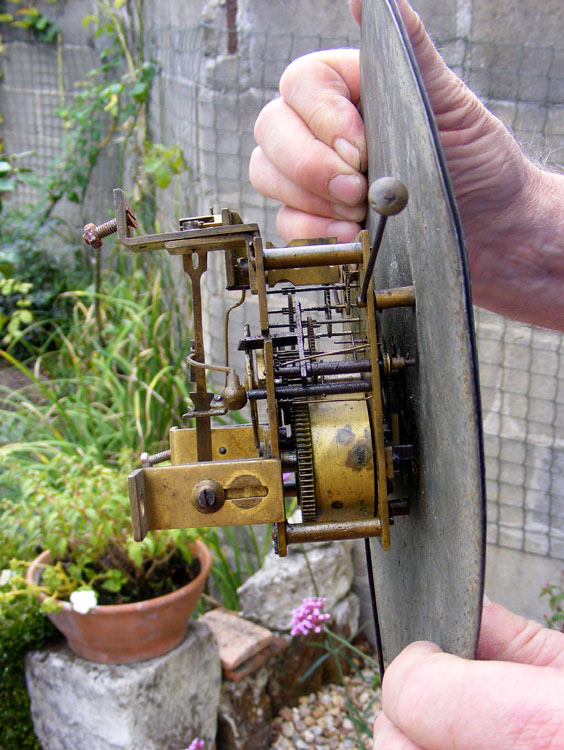
[I]t was possible to tell a little more about the movement of the clock from the maker’s mark on the back of the movement.  When I googled ‘clockmakers' marks’  I came up with this site, showing very clearly that the movement was made by Japy Frères Cie in Beaucourt, Franche Comté.  The firm still existed until the 70s, though by then they had diversified into typewriters. 
There is quite an interesting account of a visit to the Japy museum, in the old factory buildings on another site and also a reference with sound(!) here. 
It was quite common for clockmakers (really often clock assemblers) to buy in parts or complete movements which they would put into their own case and have their name on the clock face.  This also happened with sewing machines, which were often sold with no makers' marks, then labelled by the sellers.  I have 2 German made machines, sold in France and clearly badged as Désiré Bacle, Rue du Bac, Paris!
That’s about as much as I know.  I shall keep asking older Preuilly inhabitants if they remember M. Fanon’s shop, but other than that . . .
We saw the clock at a brocante and didn’t buy it instantly, regretted it, but it was gone later in the day.  It was bought by friends Jim and Pam, enthusiastic and very skilled brocanteurs, who gave it to us as a very generous and valued gift. 
Jill
*******************************************************

Quiz Answer: The answer to Monday's quiz has now been posted. It is in the church in Mezières-en-Brenne.

*************************************************

Clock Update: Quite by chance my friend Rosemary posted about clocks today too. Her post will teach you about clock terminology in French and sayings that reference clocks.