Friday, 5 November 2010

Wiring Progress

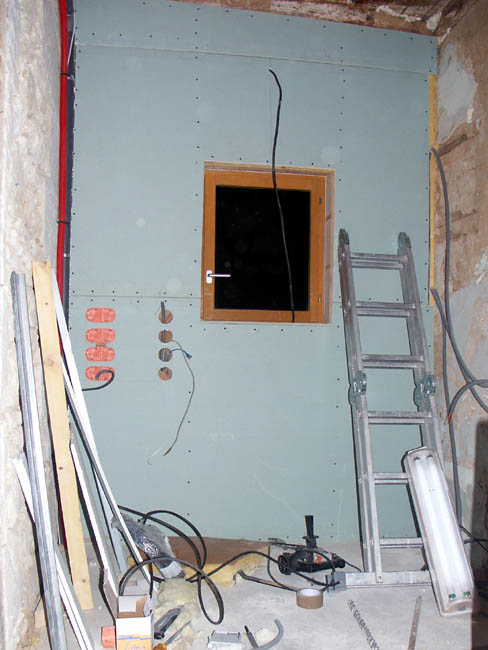
We are starting to get close with our wiring: We have power points and lights in the entry hall, pantry, guest bedroom, shower room, bathroom, laundry and toilet. In addition to that, we have the start of the cabling for the kitchen, main bedroon, and salon in place.

This has used a lot of cable: so far we have used over 500 metres of cable, and on Tuesday we bought another 200 metres. We hope this will do us.

We have dozens of these junction boxes. Where
we have room to make the cabling tidy, it's tidy.
The main reason we have used so much cable is because of the walls of the house, and where the doors have been installed. Having stone walls almost a metre thick means that the best way of getting power into a room is through bypassing the walls as much as possible.

This is why to get power for the powerpoints from the fuseboard to the main bedroom (which is only 1.5 metres as the mosquito flies) we had to go through 3 floors and 3 walls, for a total wire run of about 20 metres.

How to move electricity a very short distance.
From the fuseboard under the stairs to the bedroom.
Another consideration is just how many power points you need in a modern house. For a computer and it's associated gubbins you need 5 or 6 powerpoints: that is one complete circuit that needs to be run from the fuseboard.

One of the cables at the back of this photo
ends up in the bedroom.
Yesterday's little luxury was installing a light on the staircase that we can turn on and off from the top and bottom. As long as we give ourselves these treats occasionally, we feel we are making progress.

Simon

Thursday, 4 November 2010

The Colours of Autumn


This year the autumn colours have been spectacular. We suspect it is a combination of a long dry summer and a sudden cold snap.

Simon

Wednesday, 3 November 2010

Soufflés of Pattison Courgette and Carrots

Recently we met Cynthea Gregory, who lives near Sainte Maure de Touraine and has just written a cook book due to be published in March next year. It's in French and will be sold in various outlets, including the Post Office (one of a series that they sell).

She sent me one of her recipes to try out and has kindly allowed me to share it with you, so here it is, including her preamble and tips. Pattison (or pâtisson) is another name for a sort of large patty pan squash. It's often listed as one of France's légumes oubliés ('forgotten vegetables') but it is readily available in the autumn in the supermarkets and is often grown in private potagers. Cynthea was given one by her vegetable supplier and came up with this recipe to use it. Like me, I think she finds pattison needs to be used as a base for other more flavourful things, and was pleasantly surprised at how well this combination turned out.

Ingredients for soufflés of pattison courgette and carrots.
'Moelleux' of Pattison Courgette and Carrots

A 'moelleux' is a sweet or savoury soufflé with a soft and runny centre. (Moelleux au chocolat' has become a real favourite in many French restaurants.) These little soufflés can be served as a starter or an accompaniment to a main course - they are great with duck. I usually make my 'moelleux' in silicone mini-muffin moulds or non-stick tins, as they are so easy to unmold. If you wish to make larger ones use ramekin dishes. I like them as they can be re-heated after the initial cooking and also can be stored in the freezer and then reheated from frozen and they are still light and moist. You can obviously make your own carrot purée, but I buy one from Monoprix which I think is particularly good.

For about 16 little soufflés

Preparation time 20 mins
Cooking time 50 mins

♥Easy
♣Vegetarian
Cynthea's ingredients.
Ingredients
1 Pattison Courgette (100g only required)
100g carrot purée
2 eggs
75g goats' cheese (demi-sec or sec)
1 onion chopped
1 clove garlic chopped
150ml milk
1 tablespoon oil
40g flour
1 teasp. baking powder
1 dessert sp. corn flour
Pinch ground cumin
1 dessert sp. fresh coriander chopped
  • Do not cut up the courgette, leave it whole and in a large saucepan boil it for around 30mins. Lift it out of the saucepan with a large slotted spoon and leave it to cool a little before cutting off the top and scooping out the 100g you need for this recipe.
  • Preheat the oven at 210°C and put oiled ramekin dishes or a mini-muffin silicone mould on a baking sheet. Season the carrot purée to your taste with cumin.
  • Heat the oil in a pan and soften the onion and garlic 3-4 minutes. Add the milk and the crumbled cheese. Stirring the mixture continuously, heat it 2-3 minutes to allow the cheese to melt, and then remove from the heat.
  • Put the 100g of Pattison courgette into the bowl of a food processor and add the milk, cheese and onion mixture, then blend for a couple of minutes.
  • Break the eggs into a large bowl and then, with a wooden spoon, progressively beat in the flour, the corn flour and the baking powder to achieve a smooth batter.
  • Pour the mixture from the food processor into the egg/ flour mixture and mix well.
  • Put a small amount of the courgette soufflé mixture into each of the ramekins or moulds. Add a teaspoonful of the carrot purée and then cover this with more of the courgette soufflé mixture.
  • Put the baking sheet into the oven and cook for 18- 25 minutes (the cooking time depends on the size of the moulds used). Allow the soufflés to cool a little before serving.
  • If you wish to freeze some of your soufflés, they can be successfully reheated in a hot oven 18 minutes from frozen. The remaining courgette can be used in soups and vegetable gratins.
Cynthea's finished moelleux
I had cooked pattison only once before, using Ken's very nice stuffing recipe. Unfortunately, whilst the stuffing was tasty enough to use again, pattisons are probably the most tasteless vegetables I have ever come across (and I grew up where you periodically found chokoes on your plate!) Consequently, when it came time to make Cynthea's recipe, I avoided the pale off white pattison on the supermarket shelf and bought an orange one instead. It was much nicer - more or less pumpkin, really - but that left me with another problem. Simon was tramatised by a scoop of mashed pumpkin in his infancy and simply cannot face the stuff. Heyho, I made the soufflés anyway and served him different vege.

Because my pattison was orange I didn't think there was any point in keeping the carrot and the pattison purées separate, so I combined the two. Cynthea subsequently told me that she had put the carrot purée in the middle to give a good 'moelleux' texture, all squidgy in the centre. Coriander leaf is impossible to get in these parts unless you grow it yourself, and my small crop is finished, so I used a couple of finely shredded sage leaves and some chopped parsley. Due to the temporary nature of our kitchen, I wasn't equipped with 16 small soufflé dishes, or even a suitable silicone mould, so I made bigger ones in a rather motley collection of dishes.

My soufflés, just out of the oven.
I thought the end result looked and tasted good and I will enjoy eating them over the next few weeks. It's a great advantage that they freeze so well.Unfortunately, I mentioned to an elderly French lady I was visiting that I was making this recipe, and with a wicked gleam in her eye, she promptly gave me three of the white ones! Since I've recently been to the Paris Store (the excellent oriental grocer chain with shops in Tours Nord and Blois) I now have some lovely fresh coriander leaf. Does this mean I should make the recipe again, properly? Sigh...anyone want to take some pattison off my hands? I can give you a great recipe for pattison soufflés.

Susan

Tuesday, 2 November 2010

La Lutte contre les nuisibles

Reading the town noticeboard recently I came across the following arrêté (decree), headed Relatif à la lutte collective obligatoire contre le ragondin et le rat musque dans le département d'Indre-et-Loire au titre de la protection des vegetaux pour la periode du 1er juillet 2009 au 30 juin 2010.

In other words, Coypu Myocastor coypus (Ragondin in French) and Musk Rat Ondatra zibethicus (Rat musqué in French) are vermin and there is an organised campaign in Indre et Loire to eliminate them to protect plantlife. Although the document refers specifically to the current year, this is an established programme, reviewed on an annual basis. They are considered a risk to animal and public health, and cause damage to agriculture and roadside or train trackside drainage ditches and culverts. The Preuilly-sur-Claise town website has posted the main points of the decree and pointed out that residents must let either the trappers or the Mairie know if there are Coypu or Musk Rat present on their property.

A young Musk Rat swimming up a millstream.
Poisoning the animals is forbidden, but they may be dealt with in the following ways:
  • Digging them out at any time of year.
  • Shooting them with either a shotgun or a bow and arrow during the hunting season by trained and licenced hunters.
  • Trapping.
Individuals are allowed to trap, but the preferred option is for the organised teams of trappers set up by the département. The trapper network is trained by the departmental hunting association. The commune (local council) advises landowners when trapping will take place and landowners are obliged to provide access to their property.

Musk Rat enjoying a snack.
The following people are responsible for administering the programme:
  • the departmental director for agriculture and forestry.
  • the inter-services delegate for water and nature.
  • the sous-prefets (based in Chinon and Loches).
  • mayors.
  • the president of the departmental federation of vermin control teams.
  • the president of the departmental trappers association.
  • the president of the departmental hunters' federation.
  • the departmental head of the national office for hunting and wildlife.
  • the departmental chief of police.
  • the departmental head of the national office for water and aquatic environments.
  • the inter-departmental director of the national office for forestry.
A family of coypu at Chenonceau.
Curiously, the decree gives no indication of what the approved method of despatch is once the animals are caught. Presumably the training covers these sorts of questions (and I am guessing that they are clubbed and sent to authorised landfill). In the nearby Brenne wetland, where Coypu are seriously threatening the rare Large Copper butterfly by eating its caterpillar foodplant, you can buy pâté de ragondin, sold in the maison du pays and marketed as a local delicacy.

Both Coypu and Musk Rat cause considerable damage to river and ditch banks, by burrowing into them and creating entry/exit races. This causes bank subsidence and erosion, putting vegetation at risk and destabilising and changing the profile of the bank and the flow of the river. This would not be such an issue if these species were not so fecund, but like many introduced species, they breed rapidly. With no significant predators, they soon begin to tip the environmental balance.

A large Coypu in the Charentes.
They out compete the native Eurasian and Southern Water Voles Arvicola amphibius (rat taupier in French) and A. sapidus (rat d'eau in French) by their size. A large water vole and a small Musk Rat such as the one in the photos above can be quite difficult to tell apart, but the Musk Rat has a longer tail (keeled and nearly as long as its body, compared to the vole's tail, which is round and about half its body length), the ears are more visible on a Musk Rat and a water vole is a richer chestnut brown colour. A large Musk Rat and a small Coypu can be difficult to tell apart, but the Coypu has a distinctive white muzzle and whiskers and a round tail. Likewise, a large Coypu and a small beaver could be difficult to separate, but the beaver's big flat paddle of a tail is completely different and the whiskers are not pure white. For further details on how to tell the aquatic mammals of this area apart, please see my post on the subject.

They have been able to colonise the rivers once home to the European Beaver Castor fiber (Castor d'Erasie in French) because the beaver was hunted to extinction. The beaver, reintroduced in the 1970s, is clearly re-establishing itself. They now average a family every kilometre on the Loire, and are reported in the tributaries as far down as le Grand Pressigny. As a resultit is possible the Coypu will be pushed out to some extent. However, their lifestyles are different, and they don't compete for food, so the Coypu may not be greatly affected. Musk Rats and beaver appear to live on friendly terms, and in North America are known to share the beaver lodge on occasions, so it is unlikely they are threatened by increased beaver numbers.

Although Coypu and Musk Rat are theoretically nocturnal creatures, I have frequently seen them in the middle of the day, swimming or feeding. All of the pictures above were taken in the middle of the day, and they are often not particularly bothered by the presence of humans. Beavers, on the other hand, are much more difficult to spot. They spend a lot of time in the lodge, and the best time to catch a glimpse is at dusk during May and June. The rest of the time, you have to make do with signs like gnawed trees and footprints.

I don't think everyone will be pleased if the Coypu and Musk Rat are eradicated. Muskies are rather sweet and fun to watch, and because of their smaller size, their earthmoving activities cause a lot less damage. The group of Coypu which has ensconced itself in the ditches at Chenonceau are also now a tourist attraction. I noticed earlier this year that the gift shop has even gone so far as to stock a range of Coypu soft toys. I didn't know whether to be horrified or amused!

Susan

Monday, 1 November 2010

Events Around Preuilly in November

Today is Toussaint (All Saints' Day), so the cemetery will be buzzing with people, visiting their family dead and generally tidying up. Chrysanthemums and box are the plants most used as symbolising remembrance in France, so the past week the displays outside the florists' shops have been very colourful.

11 November is "Armistice 1918" day, so we will be meeting at the Mairie for our semi-annual parade to the war memorial.

Saturday 13 – Ensemble Vocal Cantigas are giving a concert of works by Pachelbel, Purcell, Bach, Schütz, Monteverdi and Vivaldi, accompanied by organ and cello in the church at Betz-le-Château starting at 20h30. Entry is 8€.

My friend Jeanne asked me to publicise this event, and I think we will attend. She is in the choir, along with several other people we know. I ran into her at the supermarket and she gave me some flyers. I noticed that she pronounced the 'z' in Betz-le-Château, so that it sounds something like "bez'lshato". Other local people pronounce the name of this village more like 'belshato', without the 'z'. No one pronounces the first 't'.

Saturday 20 and Sunday 21 November, open day (portes-ouvertes) at Huilerie Lepine, Availles en Châtellerault. We went last year.

The cemetery, yesterday
Saturday 27 - Portes ouvertes at Domaine de Rablais, the Simoneau family winery in Saint-Georges-sur-Cher. We went to this last year too.

Susan

Sunday, 31 October 2010

Works on the Grande Rue

For the past month or so (or it could be longer... it IS still August, isn't it?) travelling the Grande Rue by car has been a bit of an effort.

Not only has the top of the street been excavated (in the interests of renewing the water mains), but there have been two teams of masons at work on the facades of two ex-shops. Yesterday the masons, their trucks, and the scaffolding were gone, leaving behind two attractive additions to the streetscape.

ThisHas become thisAnd thisHas become this.
This now makes three buildings on the north side of the Grande Rue which have been turned back into houses, the other one having been transformed in January last year.

I knew that taking photos of every building on the main streets was a good idea when I first did it back in August 2006. I just had no idea why it would be a good idea.

Simon

Saturday, 30 October 2010

The Office and Wiring

Our office at the top of the stairs (which isn't at the top of the staircase, but on the 1st floor landing) is taking shape. The outside wall is insulated and plasterboarded, the wiring is in place, and next week we board the wall between the office and the guest bedroom. At the moment this wall is mud, straw, and stuff, and very old and crumbly. It would be nice to be able to somehow acknowledge this wall in our new improved house, but it is in too much of a state so (reluctantly) plasterboard it is.

The office, wired for computers and networks.
The wiring for the rest of the house is taking shape too. This took us at a bit of a surprise, but Stéphane and I suddenly realised that this was our last opportunity to put the wiring for the bedroom and lights for the staircase and have them invisible, as they are all routed via the office.

A tangle of wire. I am really glad
Stéphane knows what he is doing.
I just hyperventilate.
To get wires into the bedroom, they have to pass through a 60cm thick stone wall - no great difficulty, but it could be traumatic for someone not used to the frequency and casual way that walls get drilled through around here. In addition, the process of getting wire up a light switch for the staircase also involves chipping away at walls, this time the mortar between stones.

The wires for the light switch, snaking
between the stones of the wall
When the wall is finished the wiring will be invisible behing a layer of chaux, and just the faces of the stones will be showing. This process will probably also start next week.

Which will mean more dust....

Simon

Friday, 29 October 2010

A Double Mystery

We mentioned many years ago (January 2007) that we had bought a book of old photos of Preuilly sur Claise.

One of the photos has had me intruiged ever since we bought the book, but the other day it finally clicked: I knew where the old carriage works (carrossier) was.

It's this building on Rue du Faubourg St Nicolas:

The strange thing is that this building has already been part of another mystery: it's also the old Eglise St Nicolas I spent quite a long time trying to find a couple of years ago.

Simon

Thursday, 28 October 2010

Office Update

We have been working on the office. Last Thursday I mentioned about the stuff that fell out when we removed the ceiling, and a couple of days before that, the fact that the brick wall was an unattached curtain wall.

The office wall Frame
Well - no longer. The frame of the wall has been built, and the brick wall tied back to it. The frame itself screws to a large wooden beam that supports the roof, and the floor joists I inserted a couple of years ago. It is also bolted to 4 extremely large stones in the side wall (1 metre thick, and not going anywhere).

Playing pass the parcel.

The brick wall is tied back very simply - large screws and even larger washers, going through the wall and into the wooden frame. It's not pretty, but it will work - as we were tightening the screws the brick wall shifted back about 1cm (½ inch). Now it doesn't move when I lean on it, a source of great comfort, and the aesthetic issues will be resolved when we get around to rendering the outside walls.


We have also used a can of expansive mousse (foam) to seal some of the gaps that have opened up. The wall will, of course, be insulated, but every little helps.

Simon

Wednesday, 27 October 2010

More Traffic

We have posted a couple of pictures of traffic jams in town during the past year. Here are some more.

This was on Friday afternoon, after watching the races. I saw the school bus coming down the hill, and heard some machinery approaching. I had a suspicion it was going to be interesting.

Act 1


Act 2

Act 3
In the end the bus had to reverse up the hill so the truck didn't have to demolish the small wall. The "Serrez à Droite" sign only makes it more fun.

Simon

Tuesday, 26 October 2010

The Saffron Harvest Comes Round Again

This year's saffron harvest has been in full swing for almost week now. The weather is not so nice as last year, when we sat outside to pinch the valuable strands out of the centres of the flowers. It's colder and damper this year, and in the dull weather the flowers are not opening, making removing the stigmae even more fiddly. Monsieur Mériguet, the main local producer, is seated comfortably on his sofa with the fire going, and saffron crocus flowers spread everywhere, in piles, on newspaper, in various stages of processing.

Saffron should be planted in August if you have dry bulbs, or you can plant it 'in the green', immediately after flowering, in early November. They are easy to grow and multiply rapidly. Monsieur Mériguet pointed out to me on Sunday that any soil and aspect that is suitable for vines is suitable for saffron (and for truffle oaks). Getting them to flower successfully however means planting them deeply. 15cm is recommended - any shallower, and all you will get is leaves.

The saffron flowers from the weekend harvest, destined for the dyepot.
This year I have arranged with him to take the flowers after they have been processed. Normally they would just go on the compost heap, but I want to experiment with using them to dye some cloth. Apparently, like many purple flowers, they make an attractive blue-green dye. It always seems such a shame to waste the lovely flowers, so I am hoping that my experiments produce something worthwhile.

This will be my first foray into the textile art world in more than 10 years. Once upon a time, and for many years, working with textiles and thread to produce clothes and decorative objects was my main leisure activity. I haven't done much dyeing, but I think now is the time. I have the space to grow a lot of my own dyestuffs, and a nice outdoor area to work. My eyesight is no longer good enough for the sort of fine stitching, beadwork and textile manipulation that I used to do, but long ago I produced some natural indigo dyed samples and the magic of the process has stayed with me all these years. Of course, indigo is an entirely different kettle of dyestuffs to saffron flowers, but I am sure messing around with textiles again will be fun. I was very pleased to learn that, just when I need a refresher, there is an international conference on natural dyeing to be held at La Rochelle at Easter next year, so I am hoping to attend at least part of this. There are half a dozen Australians on the programme to speak, and a big marketplace which will be open to the general public.

Susan

Monday, 25 October 2010

Eco-chantier en Eco-habitat

Stéphane plastering over the chaux-chanvre wall he made.
This weekend just gone was open house for our friends Stéphane and Valérie. Not because their house is on the market - far from it - but because they are involved in the eco-chantier en eco-habitat programme. This means that they are doing up their house using many traditional techniques as well as modern methods which take into account sustainable practices. Valérie has just started a new job, and I know is very busy, but when I expressed sympathy at the thought of having to make the house presentable for le grand public, she said 'Oh no, I enjoy it!'

A close up of the chaux-chanvre surface.
Based in Chambray, the Alter'Energies association wants to promote new lifestyles, consumption and construction in order to reduce environmental footprints and encourage social equality. Eco-construction is one of three strands of activities that they concern themselves with (the other two are sustainable energy sources and sustainable agriculture).This weekend was the first open house event they have organised, and was designed to raise awareness of the organisation and the issues they are involved with. Fourteen homeowners across the département opened their doors to the public to show a variety of 'green' building techniques: straw bale construction, cotton waste insulation, chaux-chanvre (lime render with hemp for binding and insulation), pit toilets, reed or willow bed waste water treatment, mud bricks. The owners welcomed visitors and were on hand to explain their approach and share their experiences. The main objective is to create a constructive exchange about sustainable housing practices.

Stéphane applied the chaux-chanvre carefully around the
window to show off some big, well cut stones.

Susan

Sunday, 24 October 2010

We Learn a Little About a Mystery Place

Ever since we discovered it a few years ago we have been keen to find out about the history of the mysterious factory at la Gâtineau, situated on the Creuse River, between La Roche Posay and Lésigny. At last, and quite by accident, we have come across some information, both official, and from a local source.

The factory consists of a hydro-electric plant on a weir (barrage), which presumably powered whatever industrial activities took place in the extensive range of buildings and caves - that much is clear just by observation. There is a workshop (maybe a joiner), an office, stables, pulleys, an oven, and a good many random, industrial looking, objects. Unfortunately, one cannot enter the caves and explore because they are privately owned, dangerous, and in the winter, a roost for hibernating bats which must not be disturbed.

The factory in the cliff.
Our local source tells us that this was the first hydro-electric plant in France, built in the 1870s. One of the turbines no longer works, but the second still spins and produces electricity, although it is damaged and needs some repair. The factory produced precision parts for boats and aeroplanes, particularly screws for propelling boats and high specification engine parts. Our source thinks they may have even have made some parts for Concorde, but he is not sure. The site was chosen for this highly sensitive work because the humidity and temperature in the deep caves into the cliffs above the river is constant. The riverside location is also important because a reliable source of electricity was required for the power lathes used to shape the metal parts. We don't know when the factory closed, or whether it was purpose built for metal working, but it is possible, as smelting and forging have been traditional activities in this area for many centuries. It does not seem unlikely that some forward thinking manufacturer saw the opportunity to take metalworking a step further here in the late 19th century.

A couple of weeks ago we drove past and realised that work was being done on the weir. We took a photo for the record, but it was only luck that we happened upon the explanation. The Office Nationale de l'eau et des milieux aquatiques (ONEMA) has carried out a check on the weir and required the owner to install a fish ladder for migrating Atlantic salmon, lamprey, shad, sea trout and eel, and to allow the natural movement of sediment. From its source in the Massif Central, the Creuse runs nearly 300 km to its confluence with the Vienne. The lower section, up to the impassable hydro-electric complex at Eguzon, is potentially accessible to migratory fish. However, this 124km stretch of river has 31 weirs or dams along its route - one every 4 km on average - that slow or block the flow of migrants.

Work underway on the construction of the new fish ladder.
The owner was advised in February this year that the work must be completed within 8 months. To force his hand, failure to comply would result in the termination of his contract with EDF (Electricité de France) who buy the power the plant generates. If the work drags on, he will be fined 100 euros a day after the deadline until the work is finished. The owner must comply with the ONEMA regulations by law, but has been given a grant in order to achieve the work, as he has been able to demonstrate his proposed improvements are suitable. The site is one of two top priorities on the Creuse to bring the river management up to modern environmental standards.

This all seems good news, and it will be interesting to see if the migratory fish make it this far. Our local source was extremely skeptical, saying that anglers would catch and eat any salmon that poked its nose into the Creuse long before we ever saw it. Even if the fish don't return, it's still an atmospheric and beautiful place, and we hope it can continue to be maintained in an informed and sustainable way.

Susan

Saturday, 23 October 2010

Allez Preuilly !

Yesterday afternoon Preuilly's population doubled and the average age halved, as 700 teenagers from colleges in the area descended on the plan d'eau for an inter-communal sports day. Students from Preuilly-sur-Claise, Ligueil and le Grand Pressigny were divided into two age and gender groups (12-13 and 14-15 year olds, boys and girls) and competed to run a course starting at the plan d'eau, out past the swimming pool, around along the river, back through the campground and down to the start, then around again - probably about 400m just over 1.5 km (1 mile or so).

Whilst it seemed to be compulsory to participate, there was obviously no requirement to take it terribly seriously. Most of the kids were wearing 'warpaint', many of them with the initials of their school painted on their cheeks and hair dyed (probably a team colour). Some kids were more sportif than others and ran the course easily and eagerly. Others were less comfortable and were coaxed around by energetic teachers on bicycles or running themselves. After they had completed the course, each runner got a drink and a piece of cake and milled around with their mates.

We cheered on our neighbours' children, and anyone between races stood on the sideline shouting Allez Preuilly ! Allez Ligueil ! Allez GP ! according to their personal allegiances.

Susan

Friday, 22 October 2010

La Grève

So - what effect is the strike having in Preuilly sur Claise?

It's hard to tell, really - the town is always so quiet that it is difficult to notice when things get less noisy. Step out of our door any day, and the loudest thing you will hear is birdsong, the occasional sans permis or moto with engine screaming at 35kmh, and in autumn, a chainsaw or two.

We do know the fuel situation at the local garages isn't very good: on Thursday last week there was a queue at Intermarché where normally there is no queue and the garage at the top of the hill has no diesel, but we filled the car on Saturday with not too much difficulty so we should be right for at least a month. The supermarket fuel pumps were acknowledging a potential problem by posting notices saying pas des bidons (no jerrycans) and that the 24/24 facility had been switched off to prevent people stocking up in the middle of the night. We heard from a neighbour that someone took 2000 litres of diesel from the pumps in Preuilly in the middle of Saturday night - presumably a desperate farmer. He must have had to go around about 15 times.

In Yzeures this counts as a long line
Our post is still being delivered, and on Wednesday we had some light fittings delivered by UPS. We are also expecting another delivery today (this time a seche serviette for the attic bathroom). Susan paid our tax d'habitation and prélèvements sociaux at the Mairie without any problem, and the only time the local schools sent students home was when one of the teachers was off sick.

At the Market yesterday all the vendors were present and correct except for the fruit lady from Coussay le Bois, and the supermarket seemed to be suffering no shortages except for on the fish stall, half of which was taken up by bacon lardons so as not to look empty.

So, even though the strike looks serious when you see it on the news, so far it hasn't has a huge impact here. The longer it goes on for, the more obvious the signs will become, but as long as the boulangerie doesn't run out of bread and the laitière keeps milking the cows, we have the staples covered.

Simon

Thursday, 21 October 2010

Old School Insulation

Yesterday we removed the ceiling above what will become the office space. This is a 6 inch deep gap between the old bathroom ceiling and the floor of the attic. The ceiling was previously plaster on laths, and because it broke when we removed the old bathroom wall, we will be replacing it plasterboard - a lot quicker and easier.

The old ceiling
(or, at least, half of it)
The gap above the ceiling was full of shredded newspaper, walnut shells and the "evidence" of vermin.

The old ceiling, demolished: a pile
of "stuff" 12 inches deep
Needless to say, it was dusty, but this time also extremely smelly and unpleasant. About 20% of it (according to Stéphane, and he should know) was rat and mouse poo, all very dry and probably 50 years old.

Some of the 19 bags of detritus to go to the dechetterie
Tomorrow we got to the recycling centre. It will be interesting to see what they make (figuratively and literally) of our rubbish.

Simon

Wednesday, 20 October 2010

Making Apple Juice

Fruit presses like this can be seen all over the Touraine, and are mainly used for grapes or apples. This one was pressing apples. The apples were roughly cut up and tipped in. After each vat of apples a layer of straw went in as a filter. To really get things going when the press was full, someone stood on top of the pressing board to make it easier to screw down. A nice touch was the apple impaled on the screw at the top, presumably a low tech health and safety device to prevent serious injury if the man in the press fell.

Susan

Tuesday, 19 October 2010

A New Window on the World

On Friday the new lintel was installed above the office window. Yesterday we installed the new window, which annoyingly and typically, is about 1cm bigger all round than the old.

This was achieved with a lot of dust (when isn't there dust, I ask myself) by cutting back the bricks around the frame and removing another course of brick at the bottom of the opening.

Next thing to do was line the opening with some wood we just happened to have lying around the place, which was screwed into place.

Once that was done and squared to Stéphane's satisfaction the new window was slid into place, and the frame screwed to the wood lining the hole and the lintel.

All that was then left to do was make a new sill in concrete to bring the wall up to the bottom of the window.

The new window opens easier than the old window, closes a lot easier than the old window, and forms a barrier against wind and rain - something the old window had ceased to do aeons ago.

Simon

Monday, 18 October 2010

Glimpses 14

This is a Loire River Barge, taken from on high on the walls of the chateau of Chinon. The photo is slightly distorted because it has been taken through an old glass window.

These barges were built upstream, and then in spring they were filled with goods and sailed to Nantes or Saint-Nazaire. There not only were the contents sold, but the boat was sold as lumber. Then the owner would return home (presumably by foot or cart) and build another boat.

Simon

Sunday, 17 October 2010

The Glanvilles Settle in for Winter

For butterflies to survive the winter they have to hibernate, or at least seek protection. A few, like Red Admirals and Peacocks, hibernate as adults, clinging to walls inside barns and garden sheds and hoping not to freeze. Some hibernate as eggs, hidden deep within the larval food plant, and others as pupae, ready to hatch at the first hint of nice weather in the new year.

A Glanville Fritillary butterfly feeding on Wild Oregano
Origanum vulgare (or l'origan in French) in August.
A few don't actually hibernate, but spend the winter as caterpillars. When it's warm enough they munch their way through a leaf or two, but if it gets very cold they go dormant until the freeze is over. Of course, they don't go about in the open in the middle of winter. They huddle together in groups, protected by leaves and a web which they produce to keep the cold and predators out.

The inside of a Glanville Fritillary butterfly 'creche'
(rather a lot of caterpillar poo!)
The Glanville Fritillary Melitaea cinxia (la Mélitée du plantain in French) is one species that overwinters as a caterpillar. They are common in our orchard, and when I was mowing the other day I accidentally disturbed one of their 'nests'. It gave me the opportunity to photograph the inside, with caterpillars in several stages of development. I covered them back up again as best I could and hoped that they can repair the web.

Glanville Fritillary.
Glanville Fritillaries produce two generations a year and lay their eggs in clusters on the underside of Plantain leaves, where the caterpillars hatch out and live communally in their homespun silk nest. When the caterpillars are mature they are red headed, but young caterpillars are pale ochre with dark heads. You can see both in the photo above. The young ones greatly resemble the plantain flowers in the spring. The species seems to benefit from traditional agricultural practices, as the nests are often found in fallow land and along rural tracks where the roadside vegetation is full of plantain.

Adult males often sit with open wings on these dirt tracks, or on the tips of grass seed heads. They are assertive, agile and rapid flyers, and quite agressive to one another.

Susan