Monday, 12 April 2010

The Memorial at le Liege

When we went to have lunch at Le Detour we took the opportunity to stop at the memorial on the outskirts of le Liege. It commemorates a group of French Resistance fighters who were forced to dig their own grave, then buried alive in it.

They were part of the maquis FFI group commanded by Césario Bretegnier, who operated in the Loches area during the heavy fighting after the D-Day landings in the summer of 1944. The father of one of our readers was a member of this Resistance group, who survived the war and wrote an account of the action he saw. You can read Victor Maîtrejean's testimony in French here, or you can read my English translation here.

L'original en français est ici.

Susan

Sunday, 11 April 2010

The Apéro Terrasse

Alex has now finished his work on the apéro terrasse.

This is not to say that the terrace is finished, but now Susan and I will be taking over and putting down the surface, laying tiles, and planting plants,

The new walls of the garage (and the old brick wall) have been covered in chaux blanche, which will dry to a slightly sandy off white colour. The texture is rough, and is made with a taloche (a float, in this instance with a sponge face) after the chaux blanche (lime mortar and sand) has started to harden. We were going to go for a slightly peachy colour, which can be achieved with either coloured sand or powdered tint, but it is very easy to get different mixes of different colours, leaving a patchy wall, so we decided on ordinary masonry sand and no colour.

Putting the texture on the chaux blanche
The wall of the granary next to the terrace and what was the back wall of the toilets have been done in pierres vues. This is different from pierres apparentes (we have now learnt): with the pierres vues, chaux covers all the stones and is then scraped back over the most prominent of the stone, whereas with pierres apparentes less chaux is used, and all the stones stand about a centimetre proud of the pointing.

Pierres vues.Pierres apparentes.
The change in our back garden is amazing. We have done so much: removing a cobbled patch and the concrete "thing", levelling the ground, putting in a fence and gates, dalles gazon, demolishing and rebuilding walls, making sure the walls we had don't fall down, and now we have just about finished the hardscaping and building, and can get on to making it all pretty.

Four months ago the garden looked like this:
(although this photo is from Aug 2008)
Now we have this:
We are feeling pretty pleased with ourselves, because the realisation of this project has so far lived up to the plan, and our plan has lived to to our hopes!

Simon

Saturday, 10 April 2010

Lunch at Le Detour

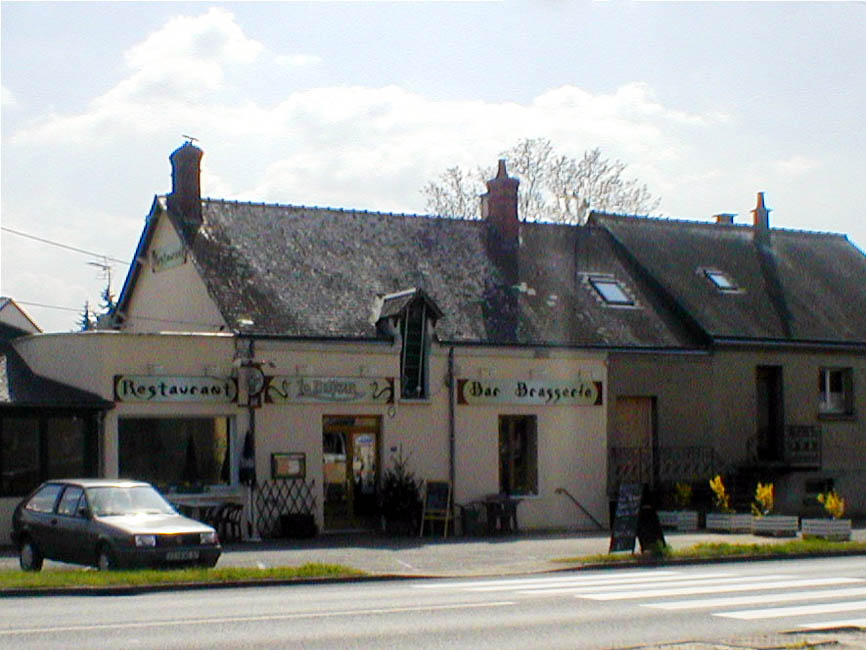
We had lunch yesterday with wine writer Jim Budd, his partner Carol and friend Anita at Le Detour, a brasserie in Civray-en-Touraine near Bléré.

Le Detour is run by Philippe and Laurence, with Laurence cooking. They've owned the place about 12 months and are starting to really make a name for the place with great food and relaxed friendly atmosphere. Jim has written about the restaurant a number of times.

We had the special of the day – Moules frites à volonté (mussels and chips, as much as you like), followed by a gâteau aux noix, pommes et miel (walnut, apple and honey cake). With coffee, for the two of us, this cost 27€. The wine was a 2005 Gamay*, produced by Claude Aupetitgendre a few kilometres down the road.

The mussels were robustly seasoned with herbes de Provence, and in a richer liquor than one normally gets. We liked them a lot, and the chips were perfect with smooth mayonnaise. Fingerbowls and mussel shell poubelle were provided as well as lots of banter. We enjoyed the meal and meeting Philippe and Laurence, and will definitely return there. It will be a great place to take clients if we are visiting Chenonceau or Montpoupon.

Although we have corresponded, and read one another's blogs, we hadn't met Jim until a couple of days ago. It was very pleasant to catch up with him again and to meet Carol and Anita too. Hopefully when we are living in more civilised style (i.e. with light switches and bathrooms and suchlike) we will see them down in Preuilly-sur-Claise.

Susan

*Actually a 2009 Gamay - see Jim's comment below

Friday, 9 April 2010

Mill Stones

This pair of mill stones sit at the entrance to Preuilly's Museum, housed in the Poterne of the château, and well worth a visit. There is an excellent collection of Tourangelle lace bonnets and the tools with which they were made. Other metiers are also well represented and there are many fascinating objects associated with skills which now have all but died out.

Susan

Thursday, 8 April 2010

A Day Out with Célestine

Célestine with Chenonceau in the background.
We went up to Tours in Célestine yesterday to meet Scott from New York and his mother Sally from Alaska for a day excursion while they are on holiday in France. They braved a train strike to get from Paris to Tours, and I hope they got back OK, as today is Sally's birthday (Happy Birthday to you, Sally). After the hustle and bustle of a few days in Paris they found it very pleasant to come to the peace and quiet of the Touraine for a day.

The gardens at Chenonceau are looking pretty.
The predicted rain held off and we visited Chenonceau, lunched at Le Bonheur est Dans le Pré in Bléré (pronounced the best lunch they've had so far in France by Scott), then on to Clos Lucé in Amboise, Leonardo da Vinci's last home (where they've made a little Leonardo go a loooooong way!).

After that we dropped in to the Château Gaudrelle caves on the Quai de la Loire in Rochecorbon (Vouvray), which Sally loved. We tasted a range of 8 wines, from a dry sparkling white (€6/bottle) through to a sweet dessert wine (€18/half bottle). It was a most interesting lesson in how terroir influences wines because we had the opportunity to taste two wines made the same year, from the same grape variety, same age vines, growing only metres apart. These two wines were completely different, and the only variable is that the soil changes in those few metres from argilo-siliceuse (sandy clay, somewhat acidic) to argilo-calcaire (clay and limestone, which is alkaline). The dessert wine is made with grapes that are allowed to dry on the vine until they are like dried currants. Hence the sugar is very concentrated (140g compared to 3g in the still dry white). It's more expensive because the same quantity of grapes produces far less wine. After being shown the wine production areas we all bought a selection of wine and who should we bump into there but Jim Budd, the wine writer, who has also written about his visit on his blog.

Jim Budd (left) with Alexandre Monmousseau,
the owner / winemaker of the Château Gaudrelle
winery, with Scott in the background buying wine
from Alexandre's partner Eric Pasquier.
To finish off the day we went round the as ever impressive gardens at Villandry, then it was back to Tours so Scott and Sally could catch their train back to Paris.

And today, Alex is back to recommence work on the apéro terrace.

Susan

Wednesday, 7 April 2010

More Spring

We think spring is here at last (again). Yesterday was lovely and warm , today and tomorrow are expeted to be wet, then it's the return of the good weather again (supposedly).

To celebrate, our annual cowslip photo. This year's was taken on the 28th of March, and is the fourth annual coucou we have posted. Does that qualify as a tradition yet?

A new addition for this year is a lamb photo, taken in a small paddock at the top of town. Isn't that just the loveliest colour? He is a pert little beasty too - when we arrived he was surveying his domain from the top of a pile of fruit tree prunings.

We are off to Tours today, visiting Chenonceau, Clos Lucé and Villandry. It will be a long day, but along the way we hope to see plenty of new things to tell you all about.

Simon

Tuesday, 6 April 2010

An Update on the Works

Yesterday Stéphane and I started doing the wiring. This involved cutting holes in floors, ceilings and walls to run wires, and marking out where exactly the powerpoints, switches and lights will go. We also made a big hole in the outside wall where the extractor fan will go.

Once that was done we threaded the gaines (conduit) with wires inside. We are now at the stage where we can start to install the insulation and mount the placo (plasterboard) on its frame.

Electric Spaghetti. You can also
see the hole for the extractor
After that all we need is the plumber, then we can finish the plasterboard, install the electrics, and we have a room!!

A room with power points and light switches.

To the left of the top of the ladder is
where the extractor fan will vent.
We won't know ourselves - and doubly so when the shower and toilet are installed.

This will be the view from the shower
I had to leave Stéphane to work alone for a while yesterday, as I had work of my own to do. This is a good thing, as it means we are starting to make an income - even if it is less than we are spending, it all helps.

Simon

Monday, 5 April 2010

Will there be an Invasion this Year?

A sunbathing Painted Lady.
Last summer will be remembered by European lepidopterists as the Year of the Painted Lady Vanessa cardui (or if they are French, I suppose it will be l'Année de la Belle-Dame). As many as a billion of these flitting black and tan butterflies made their way, in several generations, from their winter breeding grounds in the Atlas Mountains in Morocco, up through Spain and France, some stopping to breed again in southern France and send their progeny on into the Netherlands, the British Isles and up to Finland.

Battered and tattered, this one may have come
all the way from Morocco to Preuilly.
Here in the Touraine, this species cannot survive the winter and we rely on the annual migration to re-colonise the flowery grasslands. The Painted Lady is constantly on the move, migrating in order to be able to breed all year round, from North Africa in the winter, to northern Europe in the summer. The caterpillars eat an unsually wide variety of plants (at least 30, from 7 different families, including thistles, asters, mallow, echium, borage and plantain) and the adults follow the seasons and food supply for the caterpillars. The migration takes place over many weeks, but in late April 2009, 130 individuals per minute were recorded crossing a garden in southern France, all heading north-east.

Feeding on Red Valerian nectar.
These butterflies only have a wingspan of about 7cm, but some of them made trips of at least 1500 km. The long distance travellers, as opposed to the ones born locally, can be identified by their pale colour, indicating they developed in a hot climate, and by the time they've travelled that sort of distance, they can be fairly tattered too.

Numbers peaked in Preuilly in early June.
By the time the mass migration crossed into Germany and the Netherlands, in mid-May, there was an advancing front of butterflies about 1000 km wide. According to Butterfly magazine, 'typically, sightings were of butterfies flying fast and low, invariably northwards, in streams (with butterflies a minute or two apart) rather than swarms.' In some places, there were thousands of butterflies passing every hour.

Susan

Sunday, 4 April 2010

Spring Display


A group of particularly well maintained houses in Preuilly, whose owners clearly take pride in beautifying the street with an array of gorgeous spring flowers. The local council encourages homeowners to have plants in pots on the street and windowsills or to have front gardens open to public view, and offers an incentive in the form of €15 vouchers which can be used at the local florists and garden centre.

Susan

Plum trees in Chaumussay

Yesterday we went to BricoDepot, as planned, and bought a pile of stuff for wiring the house. We didn't buy everything we needed, just enough for two rooms, and the tableau. Once I am sure I have bought the right fittings, and the rooms we have rewired are working, I will buy the rest.

I need a lie down: just thinking about the trauma of all that making of decisions about things I am not sure I know much (or indeed anything) about has sent me all dizzy.

Simon

Saturday, 3 April 2010

The Week's Works

I have been working on our guest bedroom this week. With me has been Stéphane, returning a favour from a couple of weeks ago when I gave him a hand at his house.

We have been putting up framework for the insulation and plasterboard walls in the guest room and associated bathroom. This has been an interesting job, as it is the first time we have really looked hard at these rooms with a straight edge, spirit level and tape measure. Our first job after that was deciding what wall we would call as being straight.

We knew the walls weren't upright...
I drew the blue line to show the line of
the old wall. The framework is plumb and totally vertical
Likewise, the back wall isn't square
We have two different sets of framework - metal section against the back wall adjoining the barn, which will take 45mm of insulation, and wooden framework against the outside wall which will take 100mm of insulation.

It has taken us a couple of days to get the framework in, and the next job is to put in the electrical lines. Today we are going to BricoDepot to buy a "tableau" (fuseboard) and some "gaine" (conduite pipe for electric cables). We also have to buy the mounting points for prises (powerpoints) and interrupteurs (switches). We will not be buying the actual plugs, switches and lightfittings until we have decided what sort we want (we have a million styles to chose from). The most important part is getting the wiring in so we can put in the insulation and close up the walls of the bedroom.

This is my electrical plan (latest version)
After that we await the arrival of the plumber to put in the pipework for the bedroom.

I have learnt a lot of things this week - perhaps the most whimsical of which is the French name for noggins: le petit bonhomme.

Simon

Friday, 2 April 2010

Gifts

The hyacinths are bursting out all over, and the tulips behind them are budding up (photograph from late March). The nice trough with the acanthus leaf pattern on the left was a gift from readers Carolyn and Ernie, who came to visit last September. I am always touched by how kind and generous people are, and that they take enough of an interest to visit!

We are very lucky, and have received some fantastic gifts since we have been here. Martine and her friend C left tools, including what has become my favourite spade for the potager. Many people come for a meal and bring something delicious. Rosemary and Oetojo visited and brought an entire Indonesian feast with them one day not so long ago. The chicken curry was especially delicious. Leon and Sue brought Loire Valley Time Travel corporate gear with them because Leon works for a company in Australia that supplies corporate uniforms and he liked our logo so much he had polo shirts and baseball caps made for us. How smart are we going to look?!

While I was out at the supermarket yesterday a box arrived. It contained an olive tree, a gift from my office in London. My contract with them has now ended and they wanted to wish me all the best for the future. I was really touched that they had gone to the effort of getting me something I really wanted and organised delivery in France. After lunch, our neighbour Monsieur D. came by with some grains de pavot (poppy seeds) for me to sow and he admired the hyacinths, which make a lovely scent in the courtyard as you come through the front door.

Finally, Matt, Kay and Josh called in with a simply enormous jar of peanut butter. This was to thank us for giving them the name of the local vet so they could get the paperwork done for their spaniel puppy to travel back to England after their holiday.

Susan

Thursday, 1 April 2010

European Orchard Bees

One of the most charming natural history writers, in the original French, or translated into English, is Henri Fabre. He was particularly fascinated by the bee genus Osmia, known as Orchard Bees or Mason Bees. His observations and notes on this group in particular set the standard for modern natural history and ecological research. You can read him (translated into English) on Osmia at efabre.net, a wonderful resource. Without his careful and lengthy investigation of their lifecycle and behaviour we would know far less about these bees. As it is, he describes many species, how they build nests, what ratio of males to females emerge, and all manner of delightful nuggets of information.

European Orchard Bee Osmia cornuta male.
Note the white face and long antennae.
Osmia cornuta, the European Orchard Bee (l'Osmie cornue in French) is one of the most important species, as the adults emerge in early spring, just in time to pollinate the early flowering fruit trees. In our orchard the nectarines (brugnons) seem to be earliest, but the cherries, plums, almond and peaches are not far behind. Le Jardin de Lucie has recently written about this species and shown a wonderful series of photographs of a female making a nest under the table on her terrace.

The same male, showing the glossy black body.
Many species of Osmia are very visible because they are richly coloured and quite large - only a little smaller than a Honey Bee Apis mellifera worker, and much more striking in appearance. Male Osmia cornuta are deep black with long brick red hair on the abdomen and a pure white forelock. They are solitary bees, in that they do not work together in a colony, raising larvae communally and producing honeycomb like Apis mellifera, but they are quite sociable, and often nest in close proximity to one another.

Males cannot sting, and females, although they have a sting, it is smaller than a honey bee's and they rarely use it. They are closely related to the Leaf-cutter bees, and like them, carry their pollen load under their belly, not on their hind legs like honey bees and bumble bees. They will happily nest in man made nesting tubes, such as bundles of hollow canes or blocks of wood with holes drilled in them. The holes need to be about 8mm in diameter and 10 - 25 cm deep.

Note: The natural distribution of Osmia cornuta is across central and southern Europe. The species does not occur in Britain, so if you are seeing a black and red bee in early spring it will be the Red Mason Bee O. rufa or more likely, the Tawny Mining Bee Andrena fulva.

Susan

Wednesday, 31 March 2010

First Daff

This is our first daffodil for the year, actually from 29 March. They are a bit later than some because they don't get much sun in the back garden at this time of year, but isn't it handsome?

Yesterday Stéphane and Simon started work on the frame for the insulation and plasterboard. Simon will write more about it when he isn't quite so tired, but it is looking good so far.

Susan

Tuesday, 30 March 2010

Snails

What sort of blog about France would this be if we didn't include the occasional post about snails? The French do eat snails, and we periodically catch some old lady collecting her supper by torchlight under the château ramparts.

Sea snails are also popular, and frankly, tastier in their own right (as opposed to being something for your garlic butter to stick to). In France they are called bulots, in England they are whelks, and in Belgium, where they can be bought cooked in bouillon as street food, they are escargots de Bruxelles. In France they are most often served cold, and you can encounter them as one of the choices at lunchtime in restaurants that serve a buffet style entrée.

Bulots from the fishmonger in Preuilly market.
Like most seafood they must be cooked for a very short time or they turn into the most dreadful rubber. You also need to scrub them well before cooking to remove grit and growths that might fall off in the cooking. To eat them hook them out with a fork or toothpick, pop them in your mouth and bite off the hard 'foot'. At this time of year they seem to be producing roe at the other end, which is delicious - rather like liver in texture and flavour.

Susan

Monday, 29 March 2010

Little Red Visitors

These are different from little orange visitors.

Do you live in France? Do you have a wood burning fire or stove? If so, you've probably spent the winter disposing of little red visitors on a daily basis.

Pyrrhidium sanguineum female.
They are a beetle in the Cerambycidae family, known as longicorns in English and capricornes in French. If you live in France and you've had these beetles in your house you may be worried now that you know that they are capricornes. You get the impression that capricorne beetles can eat entire houses in a single night if you read some accounts.

Worry not. Very few capricornes are in the least interested in your charpenterie, and those that are only like wood that is a bit damp (so your problem is not really the beetles, it's your roof and guttering). Many species of capricorne are in fact endangered because what they require is dead wood in a still living tree. They come in a wide variety of colours and sizes (there are many species).

Pyrrhidium sanguineum female.
The red ones are most often Pyrrhidium sanguineum or Welsh Oak Longicorn Beetle. It doesn't seem to have a French name, which is curious, as it is quite common. They arrive in people's homes in the fire wood. Their natural emergence is scheduled for this time of year, but the warmth of their new homes causes the adults to emerge throughout the winter. Both because of their scarlet colour and their habit of heading for the net curtains (they are programmed to head for the light to escape) they are highly visible. Not only are they visible, but there is usually more than one, seemingly appearing from nowhere. The homeowner begins to worry about the state of their woodwork, but there is no need. Oak Longicorns don't like milled timber, only rough oak with its bark still on.

Looked at closely, for example through a 20x loop, they are extraordinarily beautiful. The red colouration is not created by the pigmentation in the wing cases, but is more like a red gold dusting of scales and hairs that can be rubbed off to reveal a glossy black beetle beneath. You can see a great close up photo taken by Dimitri Geystor on Le Monde des Insectes (the best French entomology online forum).

Susan

Sunday, 28 March 2010

Trout Fishing in the Touraine du Sud

The trout fishing season here opened at 6:35 (i.e. sunrise) just over two weeks ago. There are 15 000 card carrying anglers in the département of Indre et Loire, as well as holiday makers, day anglers and those who just buy a weekly licence.

Although the Touraine isn't particularly known for its trout streams, traditionally, the opening of the trout season opens the angling season, so it is a much anticipated moment. In fact, the area is crisscrossed by a good many small watercourses which shelter populations of wild trout, which both reproduce naturally, as well as being augmented by fishery stock. In order to take the pressure off the wild population the Fédération de Pêche d'Indre-et-Loire releases 1500 kg of trout into the category 2 rivers.

These two were bought from the fishmonger at the market,
so I imagine they are farmed, not wild.
Fishing licences (cartes de pêche) can be bought in tackle shops and post offices, and from this year, you can buy your licence online. You need to supply a photo for the licence, and they are valid for the département only. To fish further afield you need to get an additional stamp on your licence. Rivers and lakes are categorised into Category 1 (those fast flowing rivers where trout and salmon thrive) and Category 2 (slower, warmer waters where coarse fish dominate). Landowners do not necessarily own the fishing rights to lakes and rivers on their property. Many of the best trout fishing rights are owned by local angling clubs (e.g. along the Aigronne), so in addition to having a fishing licence, you must also join an angling club. Fortunately, almost all the clubs have reciprocal agreements with each other, so joining one club means you can fish almost anywhere (certainly in Indre-et-Loire, and up and down the Loire Valley as a whole). Your licence will come with a leaflet that explains where you can fish.

In category 1 rivers anglers are only allowed to fish on the weekend, Wednesdays and public holidays until 2 May. After that they are allowed to fish every day until 19 September. Category 2 rivers are open every day right from the beginning of the season. Anglers are allowed to take trout measuring at least 25cm long, and the catch is limited to 6 fish. Fishing after dark is not permitted.

Of the rivers near us where you might catch a trout, the Aigronne, which flows through le Grand Pressigny, is a category 1 river. The Brignon (Betz-le-Château, Neuilly-le-Brignon) and the Echandon (Tauxigny) are category 2 rivers. Anglers can also fish for trout, if they have a licence, on plans d'eau which are stocked in March and April.

Susan

Note that I am not an angler and have never purchased a fishing licence in France. I cribbed most of this information from the local newspaper.

Saturday, 27 March 2010

Drive Through Hardware

Yesterday we bought the wood for framing out the guest bedroom and bathroom. This was more exciting than it should have been, for a number of reasons.

Because we were buying so much materiaux, we took the trailer to BricoDepôt at Dissay. BricoDepôt is possibly the cheapest of the larger hardware shops, and is designed to be used by people who know what they are after - usually "spec-builders" (as we call them in Australia) - people who build homes speculatively to sell, i.e small scale professional builders.

BricoDepôt's shop at Dissay
One of the features of BricoDepôt (and one we haven't tried before) is the drive through section for buying what is called "bati" - proper building stuff like lumber, bags of cement, insulation, bricks, cement mixers, scaffolding, and 1001 other big butch things. The idea is that you drive through, loading your car/van/trailer, and then pay at the end once you are done.

The drive through section.
We needed 30 pieces of wood, 3 metres long, and 63mm x 75mm profile. This we found without problem (it would be embarrassing to have to "do a blockie") and started loading the trailer. All of a sudden it seemed like an awful lot more wood than I had bargained for.

Taken from this angle, it is obvious...
Once we had paid for the wood and a couple of bags of insulation at the drive through cashiers we left for home. Immediately a problem became obvious.

Because we had so much weight on the trailer, and because so much of that weight was behind the trailer's axle, at any speed greater than about 50kmh the trailer developed a "death wobble" which caused the car to fishtail. This is not a good thing at the best of times (am trying to figure out what those times could possibly be...) but on a rainy day on a road used by speeding semi-trailers it was positively scary.

I pulled off to the side of the road and moved the load forward slightly, which improved matters, but not enough for us to progress much further. We pulled over to the side of the road again and started ringing people for help. Jill walked down to Stéphane's house to see if he could come and collect us (he wasn't in) and Nicole and Alex were busy and not answering their phone. Added to this, Susan's phone ran out of credit half way through a call, and we were feeling pretty low. Then Nicole rang back and said she would bring their big trailer.

Just as Nicole said she would come and help, I noticed a tractor approaching at normal very slow agricultural machinery pace. I could tuck in behind him, then it wouldn't be me holding up the traffic - what a great wheeze! We rang Nicole and told her we were mobile at 45kmh.

He must have been wondering why we didn't
overtake when we had the opportunity.
We followed the tractor to the outskirts of Châtellerault, and of course, once in town we were almost capable of the speed limit. We kept on driving (at one stage tucking in behind a cyclist as another excuse for not driving fast) until our path crossed with Nicole's.

After trans-shipping a greater part of the load we proceeded home in convoy. Thanks to Nicole we had the wood undercover before a serious storm hit - if that had happened while we were sitting by the side of the road we would have been REALLY miserable.

So there you go - an exciting day, but not one I would care to repeat.

Simon

I have marked our epic drive here.

Friday, 26 March 2010

..if it wasn't for the houses in-between*

If you're over six feet tall and lean sufficiently far out of our guest bedroom window, this is the view.

Today we are off to Dissay to buy the wood to build frame for lining the guest bedroom walls. The frame will hold 100mm of laine de verre (glass wool, or fibreglass) insulation and the gaine (conduit tube for the electricity) in place, and eventually be covered by placo (plasterboard).

Simon

*a quote referring back to my east London roots

Thursday, 25 March 2010

Not a Brush Wood Fence

I made a discovery the other day: you really do have to finish cleaning up before winter comes.

Last year I was painting shutters, and I was very disciplined (or so I thought) about cleaning my brushes. Every day I would clean them in white spirit, then wash them in soapy water, dry them, then leave them to air. This meant that when I started painting the next day my brushes were in order.

Imagine my surprise, then, when even before I started painting this year I discovered a jar full of white spirit with 3 paint brushes in it. I had obviously been distracted in about October, because they had been sitting there in the back of the garage gently soaking away all winter. Being frozen in white spirit does strange things to paint brushes - the residual paint was harder than the rubber handles.

I have managed to clean them, and hanging them up in fresh air seems to have cured the sponginess of the rubber coating of the handle. They do still feel a bit odd, and I fear they will shed bristles hand over fist, but they are now clean.

It is a lesson I hope to learn though - clean up before it startes snowing!

Today Leon and Sue are paying us a visit (or maybe they are paying Célestine a visit and popping in to see us while they are in the area). We have met quite a few people through the blog, and shared some good meals and fun times. I don't know if that is what the interwebs were invented for or if it is the law of unintended consequences at work, but we rather enjoy it.

Simon

Wednesday, 24 March 2010

Spring is Sprung

At least, it is in the mind (?) of this collared dove.

Yesterday we planted the kiwi vine against the grapevine trellis. As we arrived at the gate of the potager the first frog of the season jumped into the brook. The first cherry blossom has appeared on our trees, and the black redstarts are in a frenzy.

As if any more proof is needed, yesterday afternoon the swallows arrived. This is two weeks earlier than last year, which is interesting but probably not a portent of anything.

So maybe the dove isn't so crazy after all.*

Simon

*this statement may be a little rash. A dove will never win Mastermind.