Wednesday, 21 February 2018

Meeting Our Member of Parliament

On Friday 16 February I met with Sophie Auconie, our local députée.  She is our representative in the Legislative Assembly and our consituency is the Lochois (3e circonscription Indre et Loire), in otherwords, the south Touraine, around the town of Loches.

I wanted to talk to her about Brexit and the impact it was having, and will continue to have for some time, on British residents of the area. She was holding a surgery in Preuilly and her assistant suggested that would be the simplest way of meeting her.

 Sophie Auconie (left) and me.

I wrote a briefing document outlining all the issues of citizens rights that we are worried about and my friend Alain translated it into French. He also came with me to the meeting. I am very lucky to have Alain available. His French is impeccable and he actually enjoys politics and getting involved.

Mme Auconie was pleasant and came across as sincere and open. She told me that she knows Michel Barnier, the EU chief negotiator, very well. She's worked closely with him in the past, when she was an MEP, and has considerable respect for him, saying he is extremely diplomatic. I must say I have been impressed with his performance and patience in public. From the start he has placed citizens rights up front, and Mme Auconie feels sure he will continue to do so.

She said I was the first British resident to contact her about this but she was well aware that there were quite a lot of Brits in her constituency. She has also been following Brexit a bit more closely than some as she has several good French friends living in England and they have been in touch with her to express their concerns for the future. She assured me that we have her full support.

One of the questions I asked her was what her feel for how the French would administer the change of status for British residents in France once the date comes. EU countries have a choice of requiring a simple declarative statement of circumstances, or they can go down the more complicated route of the notorious 85 page settled status form that Europeans in Britain were going to have to fill out, along with no doubt providing endless supporting documents to prove their details.

She felt that administratively the second option wasn't practical or necessary for people who are long established in France. Probably, she thought, France would opt for a form on which people stated their name, when they arrived in France, gave bank account details and indicated that they could support themselves.

At the end of the meeting she urged me to stay in touch and to pass on to her any new information, especially if it was something causing concern amongst local British residents.

Both Alain and I thought the meeting went well. On my way home I ran into a British resident and naturally updated him. He was supremely unimpressed and uninterested, taking the view that nothing will change.  He didn't have a very high opinion of Michel Barnier, who he refers to as Little Napoleon, because he's short and dictatorial, apparently...

Tuesday, 20 February 2018

We Go!

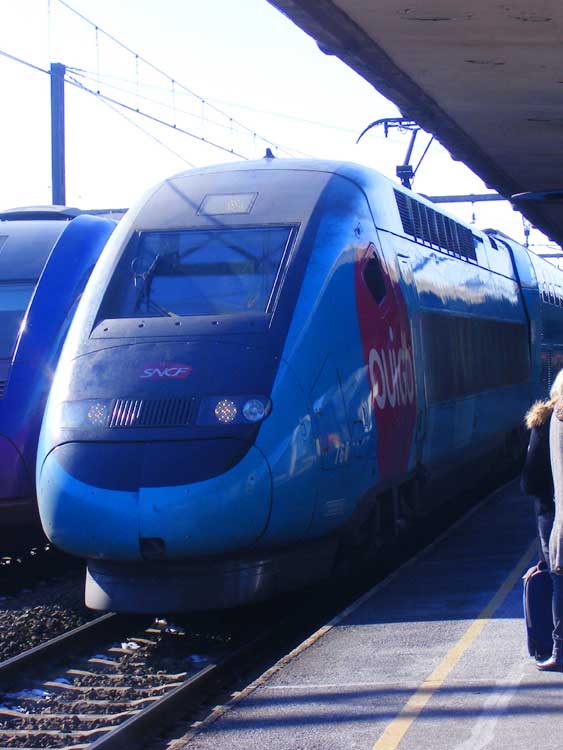
The other week went went up to Paris to visit Retromobile. As I mentioned about a month ago, I had bought Ouigo tickets for 10€ each, one way from Saint Pierre des Corps to Paris.

Catching a Ouigo train is more complicated than a normal TGV as you have to be at the station early to check in, and you have to book space on the luggage rack (for 5€ extra, this is the low cost airline of train travel) for each suitcase other than cabin luggage. Tickets can only be bought online, but at the moment they are all 10€ per person each way.

The other difference between standard SNCF trains and Ouigo is that in the big cities they don't use the "normal" stations. When they started the limited services from Paris started at Disneyland, but now they also use the un-touristy end of Montparnasse station - Hall 3, which is where suburban services and trains to places like Chartres tend to leave from


Having said that, the service is good. The trains are modern, latest but one generation of TGV, and clean (if a little too aqua and hot pink inside and out), and the announcements are plentiful and intelligible. This was especially important as the train was late arriving at Saint Pierre des Corps, and travelled slowly and then stopped a couple of times once it did arrive. This wan't Ouigo's fault - it was extremely cold, and there were problems with snow and ice so all trains were delayed (except the ones that were cancelled).

We arrived in Paris 90 minutes late, but by the time we arrived at our apartment we have already been sent an email saying we would get a partical refund of our tickets.

We will take them up on that - 10€ to Paris is a exceptionally good deal, and now we have used the service we feel we have de-mystified it, and next time should be all confusion free.

Monday, 19 February 2018

Monday is Queens Day: 19 Bertrada of Laon

Bertrada of Laon was born some time between 710 and 727, and as was common with French royalty managed to gain an unflattering epiphet:  Bertha Broadfoot ( Latin: Regina pede aucae - the queen with the goose-foot). Quite why is unknown, because contemporary sources don't mention any deformity, and the name only appears in the 13th century.

Bertrada's father was the Count of Laon, and in 741 she married Pepin the Short, son of the defacto ruler of France Charles Martel*. As was quite common with nobility in the medieval period Pepin and Bertrada were too closely related for the church's liking, so it took until after the birth of their first son (Charles, in 742) before the marriage was officially sanctioned. They went on to have seven (at least) children, of whom three survived to adulthood.


In 751 Pepin contrived with the pope to overthrow the Merovingian King Childeric III (a man placed in power by his father) and they became King and Queen of the Franks, something that their eldest son Charles was to exploit to the fullest. (He inherited half of his father's kingdon, and then when his brother Carloman died in mysterious circumstances gained the other half. He is now commonly known as Charlemagne).

After Pepin died (768) Bertrada lived at the court of Charlemagne, and her diplomatic skills are often credited for the sucess of Charlemagne's early rule. She retired from court when Charlemagne took full control of France, and died in 783. Charlemagne had her buried in the Basilica of St Denis near Pepin - her grave can still be seen there today.

The Jardin du Luxembourg has statues of 20 French Queens and Illustrious women. The subjects were chosen by Louis-Philippe I in 1843. This statue was created by Eugène Oudiné in 1848. To see Bertrada supporting her son (literally) you have to go here.

Eventually all 20 statues will be featured here.

*It's complicated. Charles Martel was a great warrior and defeated the Arab invaders at the battle of Tours in 732. He gradually increased his power and influence until he was in the postition to appoint his chosen puppet as King of the Franks.

Sunday, 18 February 2018

Manly Beach

Manly is a beachside suburb of Sydney, about 11km (by water) northeast of Sydney city. The best way to get there is by ferry (more on that another day) and although Bondi may be the beach everyone outside Australia asks about, Manly is far more popular amongst locals.

Manly beach from Queenscliff

Manly beach itself is about 1.6km (1 mile) long, and is divided into three sections: South Steyne, North Steyne and Queenscliff (south to north). South Steyne is the beach most visitors head to as it's closer to the ferry and the shops, takeaways and restaurants of Manly town centre. It also has a permanent year-round life-saving service, whereas the other beaches only have life-saving at weekends and holidays during the peak season. It forms the central part of the  "Manly-Freshwater World Surfing Reserve".

Colin was asking about the houses on Queenscliff head, Yup - they're that close.

At the northern end of Queenscliff beach is the Manly Rock Pool, a swimming pool built into the rocky headland (we have written about the tidal swimming pools of Sydney before).

Manly tidal swimming pool.


When we were there in November part of the beach was being used for a beach volleyball competition (thankfully ignorable, although the noise was fairly painful), but the rest of it was yellow sand, blue sky and white water. Which is apparently as it should be.


Of course, all this is wasted on someone who doesn't get beaches (an understatement), but even for me it's kind of pretty to look at for an hour or so.

Saturday, 17 February 2018

Mount Glorious

Ten days before we drove The Lions Road we were in Brisbane. My mate Matthew (whose brother it was recommended The Lions Road to us) asked if I knew Mount Glorious, and suggested it as a road worthy of the Idiot Wagon.

The view from the Western Window


He was right - the road up Mount Glorious (the Mount Glorious Road) and down the other side (Northbrook Parkway) is an amazing piece of road if you're in a car, although motorcycle riders will have to be careful of lumps, bumps, seams down the middle of a lane, and other traffic. Unfortunately, many people see the road as a racetrack, and as a consequence the road toll, mainly single vehicle accidents, is quite high. The police are usually out in force at the weekend and we saw evidence of this. There are also signs by the roadside warning drivers not to hoon (don't laugh).

Mount Glorious Road in Google Earth

Having said all that, the road really does live up to its name, and if you take time to stop along the route there are some amazing lookouts and views over proper sub-tropical (but only just) rainforest.  We didn't make many stops, as I was on the hunt for a half watermelon (long story...) and time was getting on.  We did stop at the Western Window and one or two other places, but photos just don't do it justice.

A wide variety of introduced trees (Jacaranda),
palms and other native rainforest species.

I have to admit that although I did stick to the speed limit on the very few straight parts of the road, I did do most of the corners faster than advised. In Australia yellow speed limit signs for corners are advisory, not compulsory, although one or two corners would be a challenge to do much faster than advised. Corners advised at 20km/h are usually quite tight.

Susan was hunkered down in sports car mode and I had my hands full of
steering wheel which is why there is a streetview pic here.


When we arrived back in Pittsworth, Susan's family were amazed that I lived in Queensland for almost 10 years yet had never heard of the Mount Glorious Road, but I had an explanation. As soon as I arrived in Queensland I joined a band that spent much of its time out west, so although I knew many of the dypsomanic publicans of South East Queensland, Brisbane was somewhere one went on a quick shopping trip, not sightseeing.

The music I am using for these videos are all Australia rock classic. Todays music is "Hard Road" by the late, great Stevie Wright (previously of the Easybeats), featuring the also no longer with us Malcolm Young, later of AC/DC. The second track is "Standing on the Outside" by Cold Chisel, a band which had amazing success in Australia, but virtually no profile in the wider world.

Friday, 16 February 2018

Swimming Without Sharks


The harbour at Manly has a shark net in the cove surrounding a section for swimmers who don't wish to contend with the rough and tumble (and sharks) of the ocean beach on the other side of the isthmus. The cove is wave free but the water was a little bit chillier than was comfortable on first plunge. It may be shark free, but it isn't for the squeamish swimmer. Several times I shared the shark netted space with small transparent jellyfish. They were disconcerting, but apparently harmless.


Thursday, 15 February 2018

Things are Grave Part XI -- Simone Veil


When Simone Veil died last year the whole of France mourned. She had been the first female President of the European Parliament and the French Health Minister, politically active in from the 1970s to the 1990s.


No sooner had she sat for her Bac (high school certificate) than she and her family were arrested and sent to Auschwitz-Birkenau. Veil always wondered if she had made a tragic error by sitting for her exam under her real name and that had been how the Nazi's found them. Her parents and brother died in the camps although she and her sisters survived.

After the war she trained as a lawyer and went to work in the Ministry of Justice. Right from the start her focus was women's rights, but she also worked to improve prison conditions and to protect children and the mentally ill. She is particularly well known for her successful fight to increase access to contraception and legalise abortion in France, which was won in 1975. Staunchly European she served as an MEP throughout the 1980s.

During her time as a high profile politician she had to deal with many misogynist and anti-semitic attacks. I remember reading about her describing how hurtful some of the remarks were and that she could be reduced to tears at times. After one such incident which made a reference to the concentration camp tattoo on her arm she always wore long sleeves.

The grave above is the Veil family tomb, but in fact Simone is buried in the Panthéon. Nevertheless, people are visiting this grave in Montparnasse cemetery and leaving tributes to her.
 

Wednesday, 14 February 2018

Recent Changes in Preuilly sur Claise


Roundabout: As part of the ongoing struggle to adequately cope with traffic in the Grande Rue, a roundabout is being trialed at the bottom of the street, near the Abbey. In addition, temporary chicanes have installed up the street and the plan is to widen the footpath to 1.40 metres.

Temporary roundabout at the bottom of the Grande Rue.

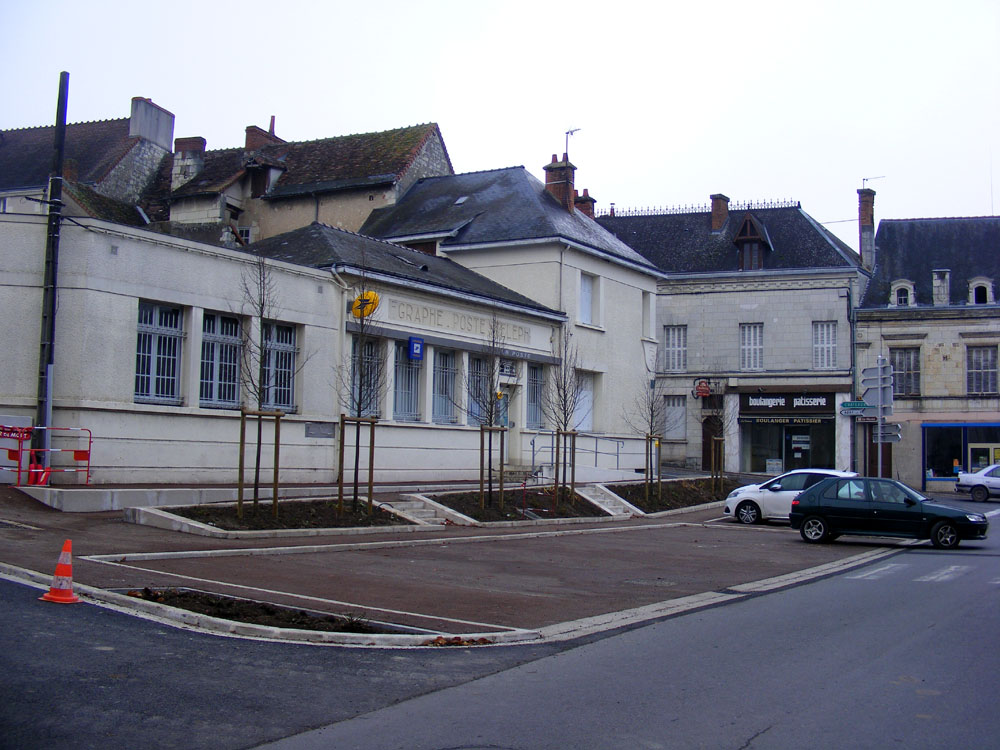
Post Office: From 1 September the Post Office in Preuilly will be reducing its open hours to 15 hours a week, mornings only. The commune owns the Post Office building and the Post Office is a rent paying tenant.

The Post Office in Preuilly.
Preschool Closure: The preschool (Maternelle) will be closing and the pupils transferring to the Primary School. Thanks to several new families moving into the area the Primary School now has 82 pupils (up from 75 last year).

Under New Management: The Episervice mini supermarket will change ownership on 1 March. The old owners are staying on to transition the new people. My sources tell me the new owners are of Moroccan background. The outgoing owners are from Brittany.

Change of Use: Cyril Courteix has taken over the old ambulance depot and installed his mechanics shop there (moving from rue des Douves).

New Shop: An outlet for a chocolatiere/baker/patissiere has opened on Place des Halles, next to the Restaurant de l'Image. The main shop is in Tournon and the 22 year old chocolatiere/baker/patissiere is called Laura. Her Mum runs the boutique in Preuilly.

New chocolatier-boulangerie-pâtisserie.

Milk Price Rise: Sandrine, who produces and home delivers dairy products around town tells me that milk has gone up. It is now 95c a litre.

Deaths: Our neighbour Edouard tells me that 3 elderly people from our street died while we were away. At least one of their properties is on the market now.

Chapel Nestboxes: Thanks to encouragement from me and SOS Martinets, a couple of nest boxes for Swifts will be installed as part of the restoration of the Chapelle de Tous les Saints. The chapel is currently swathed in scaffolding and tarpaulins. The masons and roofers have done some preparatory work.

 Swift nest boxes on our graineterie.

Greenway: The rails and sleepers have been removed from the old railway line and it is on its way to being a voie verte. Ultimately it will be 40 kilometres of walking track, from Descartes to Tournon. Much of the section near Preuilly runs along the Claise river.

The voie verte where it crosses the D725 in Preuilly.

Medical Personnel: The vet, Christian Martin, has retired and there is no new vet in town. The nearest vet is now Vanderquand-Lefebvre in Tournon Saint Martin or Vincent Monoyer in Descartes. The dentists, Drs Renaudie, have also retired. They have been replaced by Dr Claudius Zaharia Trofin, who has moved into a new surgery in the Post Office building. I'm told his wife is training to be a doctor and will ultimately be installed as a second GP for Preuilly.

Tuesday, 13 February 2018

Leaving the Bats in Peace


For the past couple of years I have gone out in January and June with a group of bat surveyors. But this year my friend Jean-Claude, who organises our bi-annual bat surveys, has emailed me to say there will be no surveying this year or next. Surveying bats, particularly if they are hibernating or raising young, inevitably disturbs them, and the local bat conservation experts feel that they need to be left in peace for a while. We have quite good data from the previous years surveys, so the bat experts can focus on number crunching and other projects.

Just in case you will miss the bats, here are some photos to be going on with:

Greater Horseshoe Bat.
Photo courtesy of my sister.
 A maternal roost of Lesser Horseshoe Bats.
Photo courtesy of my sister.
 A grounded Pipistrelle Bat.

 A Soprano Pipistrelle Bat on the wing.

Here are some links to previous posts about bat surveys:

Bat Surveying in the Touraine Loire Valley

Hanging From the Ceiling

Bats Spurn the Belfries

Monday, 12 February 2018

Monday is Queens Day: 18 Queen Mathilde

Where to start with this one...

Mathilde was born in about 1031 and was descended from most of the Royal Families of Europe - in the times when there were many Royal Families in Europe. This made her a worthwhile catch for any aspiring Duke or Baron, and the Duke most interested was William the Bastard, who as a bastard she felt was below her dignity. Stories of how William convinced her to marry him vary, but they all agree that he dragged her to the ground by her braids (quite how this helped....).

Of course, being nobility they were quite closely related: enough, in fact, that the Pope forbade them marrying - which they did anyway in, 1051. (The marriage was recognised by the following Pope 8 years later).


After William invaded England and became a Conqueror rather than a Bastard, Mathilde became Queen Consort of England in addition to Duchess of Normandy. Of course, the fact that one of the families she was descended from were the Kings of Wessex helped - she had a couple of extra clauses put into the coronation ceremony to acknowledge that it was God who put her there, and that she shared her husband's power.

She had at least 9 children, four sons, and 5 (or more) daughters. The history of the sons is well known: the eldest (Robert) becoming Duke of Normandy after his father died, and sons 3 and 4 (her second son died as a child) becoming Kings William Rufus and Henry  I of England.  Although she visited England to be crowned in 1068 she spent most of her life in Normandy, usually in Caen, which is where she was buried in 1083. The original grave marker is still in situ in the Abbaye aux Dames in Caen.

The Jardin du Luxembourg has statues of 20 French Queens and Illustrious women. The subjects were chosen by Louis-Philippe I in 1843. This statue was created by Jean-Jaques Elshoecht 1850. To see Mathilde (and her braids) you have to go here.

Eventually all 20 statues will be featured here.


Sunday, 11 February 2018

Queenscliff Head


At the lagoon end of Manly Beach, Queenscliff Head is a nice place for scrambling over the rocks. There is a tunnel under the heads called The Wormhole, which was carved (or maybe blasted) by locals in 1908 as a shortcut between Manly and a workers' camp in the next bay. The tunnel once led to Freshwater beach, but although you can still get through the tunnel the easy path ends there due to rock falls.


It also serves well as a place from which to photograph surfers - without getting wet.

Saturday, 10 February 2018

The Lions Road and The Risk

A couple of weeks ago Colin asked about The Risk.

The Risk is a community in northern New South Wales close to the Queensland border. It is on the Richmond River in the Border Ranges National Park, which is part of the World Heritage (UNESCO) listed Gondwana Rainforests of Australia. Local wisdom is that the first man to settle the area, one John Wilson, rode over the mountains and said he would take "The Risk", thus naming the area.

There isn't a town or village at The Risk, but the scattering of houses in the area do manage to support a 2 classroom school with 28 students, and a community hall. The main road through town (ok - the only road through the area) is Gradys Creek Road, also known as the Lions Road.


The Lions Road was recommended to us by Daz, the brother of my mate Matt. We were talking about roads to try in the Idiot Wagon on our way from Susan's parents to my parents, and I mentioned I was thinking about travelling through Woodenbong. He suggested that the Lions Road would be better, so I did some research. The route is in two parts, the Queensland part is called Running Creek Road, whilst the section in NSW is Grady's Creek Road - part of which is The Lions Road.

Google maps won't plan a route using The Lions Road
so I had to map it myself. The Lions Road is in red. Here it is

The residents of this part of New South Wales had been trying to have a road built connecting them to Queensland ever since the North Coast Railway went through the area in the early 1930s. Sucessive state governments had looked at the idea until 1967, when a commitment was made to build a road between Kyogle in NSW and the Queensland border, In 1969 the plan was shelved, at which point the local communities took over.


Impetus came from Kyogle Lions Club, which undertook the promotion of the road as a community project. With local help the best route was selected and it was decided to build a low standard 4 wheel drive track as a statement of intent. With assistance from businesses and the community a dirt road suitable for cars was eventually built and opened in December 1971.

Eleven kilometres of road was built over the McPherson Range, including 56 sets of pipes, 3 bridges and 12 cattle grids. When the Queensland Border was reached, the Beaudesert Lions Club joined the project and the Army helped by reconstructing 2km of road in Queensland. Over 100,000 vehicles per year use the road and there are donation boxes at the State border to collect contributions. The money collected enabled the Lions to approach government bodies with an offer to contribute to seal the surface, which was completed in 2002.

I made a movie using Google Earth to try give
an impression of what the road is like to drive.

The Lions Road is an amazing drive, although the upper reaches are probably not best suited to a European supercar. The road is one lane for most of its length, with very few passing places. Although it is a sealed surface, it is rough, with some serious drop off where a soft shoulder exists. At the moment the extremely rough wooden plank bridges are being replaced with concrete structures.

If you do ever drive the Lions Road make sure you stop at the Cougal Spiral lookout. This is where the North Coast railway line curls back on itself in a loop, entering a tunnel to pass back under itself.

You can see the railway line on the right.
Just after this it enters the tunnel in a loop

If you're ever in the area, do yourself a favour, and drive the Lions Road. It's worth it.

Friday, 9 February 2018

George and the Unicorn


'Mon seul desir', depicting the supreme courtly virtue of largesse, being generously distributed.

This year the extraordinary group of tapestries known as La Dame et La Licorne will be on loan to Australia and displayed in the Gallery of New South Wales from 10 February to 24 June, while their usual home in Paris is closed for renovations. We are lucky enough to have seen the tapestries a couple of times on visits to the Cluny Museum in Paris, but it wasn't until recently that I read the story of their discovery in the 19th century and how they came to be in the Cluny's collection.

The panels depicting hearing or joy, and sight or leisure. 
Joy is playing her portable organ, Leisure is enticing the unicorn in her mirror.

In the early days of the 19th century a little girl called Aurore Dupin would come down to the Berry countryside to stay with her grandmother in Nohant-Vic. Later, as a young woman with her own young family, she inherited the house at Nohant and came to live there to escape her husband and the political troubles in Paris. Although Aurore came from a wealthy family, because her husband controlled the purse strings she was forced to earn her own living. And thus, the novelist George Sand was born.

A genet, domesticated in medieval times in preference to cats to catch rodents around the house.

At Nohant Aurore/George was free to indulge love affairs with Chopin, Prosper Mérimée (Inspector General of Historic Monuments) and the artist Manceau, amongst others. Her children were raised in an atmosphere of creativity and independence. Everyone in the household wrote, made art or performed.

A rotund heron doing backstroke in 'Mon seul desir'.

In the 1830s and 40s many wealthy aristocratic and bourgeois people quit Paris as the political situation was not stable. One of George Sand's friends holed up in Boussac in the Creuse and set up a printing press there. She visited several times and on one of these visits came across an extraordinary set of tapestries hanging in the local chateau, at that time the offices of the local authority. She saw immediately that they were something special and invited Prosper Mérimée down to view them. As a result they were heritage listed in 1865 and in 1882 sold to the Cluny.

The lion, who appears in all the panels, carrying the crescent moon arms of Antoine le Viste.

The medieval Chateau of Boussac was one of George Sand's favourites and she used it as the setting in one of her novels, describing it as 'irregular, graceful and pretty in its simplicity'. Who commissioned the tapestries was long a mystery but recent studies suggest that it was Antoine le Viste in about 1500. The modern scholarly opinion is that they can be read in multiple ways and represent both allegories around the five senses and the six Courtly Virtues of Guillaume de Lorris's Roman de la Rose (frankness, beauty, joy, largesse, riches and leisure). In addition they contain a bestiary and a flora. Antoine le Viste was married to a member of the powerful Tourangelle family the Briçonnets (who built Chenonceau and Candé about a decade after the tapestries were probably woven). The mystery surrounding the set of tapestries is compounded and continues because George Sand wrote of eight panels -- and yet only six exist at the Cluny.

A terrier on a cushion, in 'Mon seul desir'.

Prosper Mérimée mentions in correspondence that he was told by the local mayor that there were other, even more beautiful tapestries at one time in the chateau, but a former owner had cut them up to make cart covers and carpets. Were these the missing panels, or is there some forgotten corner of the chateau hiding them behind a collection of battered furniture or rolled up in an old cart?

Thursday, 8 February 2018

Things are Grave Part X -- Serge Gainsbourg


Famous for his provocative song lyrics, performances and lifestyle, Gainsbourg is nevertheless buried in the family tomb in Montparnasse with his parents. The beady eyed will notice that the family name is actually Ginsburg. There are a number of variations on the name Ginsburg on tombs dotted about the cemetery, all descendents of Ukrainian Jews who fled to Paris in the early 20th century to escape pogroms and the Russian Revolution. During the Second World War Gainsbourg's family sought refuge in Limoges, using false identity papers.


The man is an absolute legend in both the French and English speaking worlds. His songs often contain morbid themes or sexual innuendo, and he loved puns. He worked in a remarkable range of styles and with a remarkable range of fellow writers and performers.

Wednesday, 7 February 2018

Death of a Culinary Legend


Friday 26 January was the funeral of French culinary legend Paul Bocuse in Lyon. Whatever your impressions of the media persona, there is no question that he was genuinely revered in French culinary circles. An obituary I read described him as 'a monument', 'a symbol of excellence', 'a guide', 'a figurehead', 'a star', 'an icon', 'a model', 'an example', 'a father'. 'Whether you had the luck to meet him, greet him, touch him, talk to him, be photographed with him, work beside him or simply see him on television, the love, respect and admiration in which he was held is immeasurable.'

My chef friend Jean-Michel, on the right, was a big fan.

The funeral took place in the cathedral and due to security issues and the large number of people attending, access was restricted. If you wanted to go to his funeral you had to telephone his restaurant and register, giving your name, phone number and work place. Chefs attending were asked to wear their uniforms.

For an interesting and amusing overview of his life, check out Taste of France's post on his demise, Butter, Cream and Wine. 

Tuesday, 6 February 2018

Making Coffee


Our drip filter coffee maker died the other day. History repeated itself, with the switch breaking.

So the next day we went to Loches to buy a new one. To our surprise, there was nothing we liked at a price we liked. So we bought a cafetiere for €6.50.

Our new French press and our Moka coffee maker, from our camping kit.

The object on the left is something I would call a cafetiere. That name reflects my time in the UK because that is what they are called there. In Australia they are called coffee plungers, and I notice that Americans call them French presses. In France they tend to be called cafetières italiennes, or sometimes a cafetière à piston.

The object on the right is what I would have called a Turkish coffee maker, but it turns out it isn't. It's a Moka coffee maker, also known as a cafetière italienne in France.

Both are Italian inventions but in my experience Italians actually use the stovetop Moka pot. Brits and Australians used French presses and northern Europeans used filter coffee machines. But nowadays everybody except us and the Italians uses capsules (and landfill be damned).

Monday, 5 February 2018

Monday is Queens Day: 17 Sainte Genevieve


There is almost no doubt that Sainte Genevieve, Patron Saint of Paris, was a real person. She was born in Nantes in the early 5th century (some time between 419 and 422) and died in Paris in the very early 6th century. Her main claims to fame are her abstinence (she seems to have abstained from everything) and the fact that she saved Paris from Attila the Hun and the Merovingian King Childeric I.

Genevieve first came to people's attention when she was but a youth. She attended a sermon by Germanus of Auxerre and declared she wanted to be a nun. To prove her commitment she decided to be purer than anyone else (hence the abstinence), something she eventually had to be talked out of.


When Attila the Hun looked like he was going to attack Paris in 451 it was decided by the Bishop of Paris that Genevieve should be the person to lead a prayer marathon. This was successful - in that Attila decided to attack Orleans (which was probably a richer target) instead. In 464 Childeric laid seige to Paris, and Genevieve managed to pass through the seige lines (probably quite easy for a religious person of note) to Troyes, where she arranged for a shipment of grain to Paris.

All this means that by the time she died (some time between 502 and 512) she was already considered a saintly person, something confirmed by Clothilde (remember her?) the second wife of Childeric's son Clovis. She was buried in the Benedictine Abbey later dedicated to her name, which was rebuilt by Louis XV as Saint-Étienne-du-Mont, where her tomb can be seen alongside the graves of Blaise Pascal and Jean Racine.

The Jardin du Luxembourg has statues of 20 French Queens and Illustrious women. The subjects were chosen by Louis-Philippe I in 1843. This statue was created by Michel-Louis Victor Mercier 1845. To see Genevieve looking abstemious you have to go here.

Eventually all 20 statues will be featured here.

Sunday, 4 February 2018

Drinking Stations


A basic drink station. When we were kids
these were known as bubblers

Manly Council has teamed up with Sydney Water to set up fresh water drinking stations around the beach front and the Corso, the main shopping street, which links the ferry terminal to the ocean beach.

The project is designed to reduce use of plastic bottles and provide an alternative to sweet fizzy drinks. The hope is that these modern drinking fountains can help change the culture of bottled drinks. There are a couple of different styles of drinking stations, the basic kind which will give you (and if someone has customised it, your dog) a drink, and an altogether more stylish unit (which we didn't take a photo of) which has a rest so you can fill your water bottle.