Friday, 19 May 2017

Some More Speaking of Tongues


Some more photos from the secret Tongue Orchid site:

On the left, a hybrid Green-winged x Loose-flowered Orchid (Anacamptis morio x A. laxiflora); on the right, a Loose-flowered Orchid.

 Loose-flowered Orchid Anacamptis laxiflora (Fr. Orchis à fleurs lâches).

 Two of five photographers all pointing at the same thing. They are not photographing the orchid, but a large bright green crab spider in the grass.

Black-veined White Aporia crataegi (Fr. Gazé) resting on Loose-flowered Orchid.

 Loose-flowered Orchids in the grass, with members of the botany club.

 A typical looking Tongue Orchid Serapias lingua (Fr. Sérapias à languette).

 A Tongue Orchid with a yellow labellum (the bottom petal or the 'tongue'). The lack of red pigment is a mutation.

Marc has asked me if I will return to the site in the late summer/early autumn to survey the Autumn Lady's Tresses Spiranthes spiralis, and I will be very pleased to do so.

Thursday, 18 May 2017

Officially Baffled

Some (unkind) people would say that baffled is my default state. And they may have a point...

Susan mentioned (about a 10 days ago) that our washing machine wasn't working. First it showed the child lock was on, then it showed the thermostat was faulty. After unplugging and plugging it in again both warnings disappeared, but the main control wheel didn't change anything when turned.

So I left it. 

Research on the internet told me how to sort out the thermostat, but it was fairly obvious that wasn't actually the problem. I was reluctant to drag the washing machine into the middle of the kitchen floor and  dismantle it, only to find I couldn't fix it.


So I left it.

Meanwhile, we took up the kind offers of various blog readers to do some washing whilst I pondered our next move. All the while the machine sat in the laundry, unplugged, until Tuesday afternoon, when I plugged it in, pressed the button  - and it worked.

So I can update my status to "baffled, but relieved".

I'm assuming the main thinky bit in the machine had got wet/temperamental/a bit fried in one of the electrical storms we've had, but has now sorted itself out. It will be interesting to see what happens next time I go to do some washing. (Update - it worked just like normal ovenight last night)

Wednesday, 17 May 2017

The Native Tongues


 Tongue Orchid habitat.

On Sunday 14 May Marc Fleury led a botany outing to see the last remaining colony of Tongue Orchid Serapias lingua (Fr. Sérapias à languette)  in Indre et Loire. The site is hidden away, well off the main road, and was once used as a source of kaolin for porcelin making. It is wet in the winter and dry in the summer, covered in rough grassy open areas and patches of scrub. Perfect for not just Tongue Orchids, but Loose-flowered Orchid Anacamptis laxiflora (Fr. Orchis à fleurs lâches) and Green-winged Orchid Anacamptis morio (Fr. Orchis bouffon). Apparently there are Autumn Lady's-tresses Spiranthes spiralis (Fr. Spiranthe d'automne) too, later in the season.

 Tongue Orchids don't stand out much, being pale in colour and no higher than the grass they are growing through.

It is an extensive colony of Tongue Orchids, with hundreds of plants over, I would guess, about a hectare. It's quite difficult to avoid standing on a few plants, and the tracks through the site were quite boggy.

 Green-winged Orchid, so named because the distinctive stripes on the lateral sepals are sometimes green.

Tongue Orchids are one of the few orchid species that produces more than one bulb each year, so you often get multiple flower spikes very close together. They have evolved to have a large 'tongue' or labellum as their bottom petal. This serves as a landing pad for insects. The flowers act as a cosy resting place and insects often spend the night tucked up in them. When they emerge, with any luck, they have an orchid pollenia stuck to their back and will transport it to the next plant for cross-fertilisation.

The flower colour can be quite variable, so here is a rather dark tongued specimen.

The former kaolin pit, now filled with water and very deep. It is L-shaped and bends away to the left beyond the edges of the photo.

Four-spotted Chaser Libellula quadrimaculata (Fr. Libellule à quartre taches), staking its claim to one end of the kaolin pit.

Ragged Robin Lychnis flos-cuculi (Fr. Silène fleur de coucou), another lover of wet grasslands.

Tuesday, 16 May 2017

Road Works


Ten days ago the road out of Preuilly in the direction of Le Grand Pressigny was resurfaced over a period of two days. The work blocked off the end of our street. At one point I went out to the supermarket and when I came back discovered that there was no way of 'legally' getting into our street. So I came down the street the wrong way.


The big orange machine shaved off the old surface and spat it into the truck. The driver bipped the horn whenever he needed the truck to move on, then bipped his horn again to say he'd moved up sufficiently. This went on all morning.


Monday, 15 May 2017

Walking from Buxeuil to Saint Remy sur Creuse


On Thursday 4 May our walking club did a circuit from Buxeuil to Saint-Rémy sur Creuse and back again. It took us along the river, through the village, past troglodyte caves in the limestone cliffs and a medieval church and tower, up through the forest and down through the fields, back to where we started.

The troglodyte village of Ethni'Cité.
Nestled in the cliffs overlooking Saint Rémy-sur-Creuse in the Vienne is a medieval troglodyte weavers village.

The Ganne Tower.
This ruined tower is the only vestige of a castle built by Richard the Lionheart, Duke of Aquitaine and future King of England. He acquired the land, which overlooks the Creuse Valley, from the abbey of Maillezais in the Vendée. The castle was destroyed in 1204 by neighbouring Tourangeaux forces, allies of the French King Philippe Auguste. Judging by the cadastral maps, the three other towers and the walls which formed the keep were still standing in 1831.

 Unusual carved stone window grill.
The window in the nearby 11-12th century church features a stone lattice in one of the windows. This is an unusual technique to see in France, being more common in Spain.

Pollen accumulating around the edge of a puddle on a farm track.


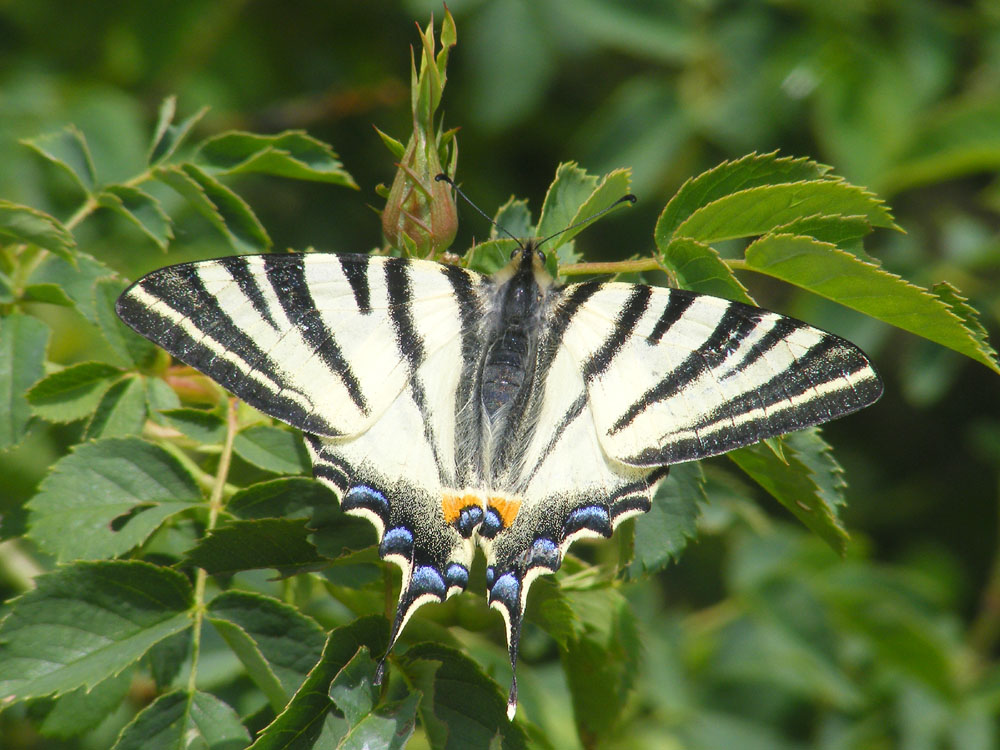
This beautiful fresh Scarce Swallowtail Iphiclides podilirius (Fr. Flambé) rests on a wild rose by the side of the track.

Overgrown gate.
I thought this overgrown gate we passed had a touch of the Miss Haversham's house about it.

Greater Butterfly Orchid Platanthera chlorantha (Fr. Platanthère verte) were just coming into flower. Four other orchid species were spotted -- Lady Orchid Orchis purpurea (Fr. Orchis pourpre), Early Purple Orchid Orchis mascula (Fr. Orchis mâle), Green-winged Orchid Anacamptis morio (Fr. Orchis bouffon) and Lizard Orchid Himantoglossum hircinum (Fr. Orchis bouc). Much hilarity when I explained exactly why the orchis mâle is called that. If you want to know, read the link.

Walking back down into Buxeuil.

For another perspective on the walk see Jim's blog post on Loire Valley Experiences.


Sunday, 14 May 2017

Something is Wrong


I took a dozen photos of this large hawk moth in my parents' garden and it was most co-operative and obliging. It took me quite some time to realise why. Can you see what has happened?


The eagle eyed and entomologically informed European reader will also have noticed that I am posting what looks like a European moth on Sunday, when our blog posts have an Australian theme (and I've already indicated that these photos were taken in my parents' garden). What's going on?

Well, the moth is a Convolvulus Hawk Moth Agrius convolvuli and the species has a distribution that includes more or less everywhere except the Americas, so it is at home in Europe, Africa, Asia and Australia. They are quite abundant, and we have had one in the garden in Preuilly in the past. 

The flower it is on is an Australian native called Murray Lily Crinum flaccidum, related to belladonna, hippeastrums, amaryllis, daffodils and snowdrops, a large tubular flower perfect for the exceptionally long tongued moth -- except when they hide a predator such as this one did.

Saturday, 13 May 2017

Friday, 12 May 2017

A Visit to the Chapelle de Tous les Saints With the Architect


As part of our bid to help save the Chapelle de Tous les Saints in Preuilly I organised a private visit with the architect for a group of interested anglophones. Several of them spoke good French, but I provided translation services for those who weren't so confident of their French and to clarify a couple of points. 

Jean-Philippe Barthel, the architect, talking to the group about the chapel project.

Jean-Philippe Barthel, the architect did a terrific job of explaining the project, both why it is important and how it will be done. (I've written about this here and here.)  I was really grateful to him for coming all the way from Blois to spend time with us. I invited him to lunch as a thank you, but unfortunately he had to get back to Blois. Bernard, who has done all the hard work in terms of obtaining funding and Dominique who made the excellent video about the chapel were also in attendance and able to add their knowledge of the project.

I was also really pleased that all those who attended were as intrigued and charmed by the chapel as we are. It is always a bit worrying showing a building in such a sorry state to others. Some people just see an unimpressive mess. But I needn't have worried. Everyone there understood how important the danse macabre is, and they were particularly taken by the painted ceiling. 

A foliate motif on the ceiling.


Jean-Philippe told us that Sabine de Freitas, the wall paintings conservator who will co-ordinate much of the work, has confirmed that the ceiling and the wall paintings are contemporary. She says that the pigments and the design motifs are carried from one to the other in a way which indicates they were done by the same artists at the same time.


DRAC, the main funding agency, has insisted that the ceiling be conserved in situ, which means that an umbrella style scaffolding (the most expensive sort) will need to be constructed to protect the entire building while work proceeds on the roof. After the roof has been repaired the wall paintings will be cleaned by painting them with a water based gum that is then peeled off. It will take all the dust and surface accretions with it, kind of like a face mask. Then the missing bits of the painting will be filled in using a hatching technique. This allows the eye to make sense of the images whilst still making it clear what is original and what is modern restoration. 

DRAC have also insisted that certain quirks of the building which have developed over time be retained, such as a bow in the wooden beam along the top of the northern wall. Sabine will be directing the work of the roofers and masons because everything revolves around and touches (both literally and figuratively) the wall paintings. She must ensure that the wall paintings and ceiling are protected while the roof is off and while the masons re-render the unpainted sections of wall. 

The same foliate motif used on the walls.

I invited everyone back to lunch afterwards, but unfortunately Jean-Philippe had to get back to Blois, Dominique was off to a meeting with Marisol Touraine, the Health Minister, and Bernard also had other commitments. Most of the rest repared to our place and enjoyed quiche (thanks Tim and Pauline), jerk chicken (made by me) and stewed loganberries (thank you Rose).

I thought it was a very successful outreach exercise and now we have a few more people who know and love the chapel. Jean-Philippe hopes to conduct more visits whilst the work is going on, perhaps in the autumn. We are still about €20 000 short of being able to finish, but the tenders have been put out and artisans chosen to do the initial masonry, carpentry and roofing work.

If you want to donate you can still do so via the Fondation de Patrimoine page. 

Thursday, 11 May 2017

It's the Rozzers!


The former limestone quarry at Bourré which is now a mushroom growing facility is fascinating. Every year the guides show us a bit more of the site. We were there in mid-April and got to see a gallery with some fascinating wall paintings.


Apparently the paintings were created in the 18th century by locals who were hiding from the police. The characters painted high up on the quarry walls are crude, not very complimentary, representations of the police of the day. 


Also in this gallery is a map of the subterranean quarry, painted and carved on the roof. There are over 100 km on 7 levels, so maps and painted directional signs would have been very necessary. The caves are privately owned and today you are not allowed to go in without a guide.

Wednesday, 10 May 2017

Medieval and Modern


The Hôtel Gouin with a Calder sculpture in the courtyard.

The Hôtel Goüin in Tours is not, and has never been, a hotel in the anglo sense. It was built as a grand private home in the 15th century, although what we see now is a 16th century remodelling. Later it served as the headquarters and archive storage for the Archaeological Society of the Touraine. In 1944 all but the facade was destroyed in a bombing raid and the building was partially rebuilt in the 1950s. Now it is a museum.

The sculpture currently in the courtyard is by Alexander Calder. He lived for much of his life in the Loire Valley, at Saché. This sculpture, one of his stabile-mobiles, is called 'Crinkly', from 1969 and made of steel, stainless steel and aluminium.

The American sculptor and painter Alexander Calder, 1898 - 1976, arrived in Paris in 1926. He created articulated toys, in wire. Jean Cocteau nicknamed him later 'the king of wire'. Calder was part of the avant-garde, with artists like Joan Miró, Fernand Léger, Man Ray, Le Corbusier, and especially, Pietr Mondrian, the pioneering abstract painter. Calder admired Mondrian's paintings and in 1930 declared 'I would like to make Mondrians which move'. From 1931, he was a member of the group 'Abstraction-Creation', which brought together Mondrian, Jean Arp and Robert Delaunay. In 1953, Calder set up his workshop in the Touraine, at Saché, on the banks of the Indre. 

The work of Calder is marked by the search for movement, which is expressed in particular with his mobiles. These are light iron structures, suspended and articulated, composed of several horizontal bars carrying small coloured leaves which move in the wind. 

A pioneer of kinetic sculptures, Calder combined mobiles and stabiles, creating standing sculptures topped with a mobile. His stabiles are monumental steel sculptures, destined for the centres of cities, to resonate with modern architecture. Calder first made models which were then tested in the breeze to check their robustness. These models were scaled up and erected by workers from a local boilermaking factory. The Biémont factory near Tours constructed most of these stabiles, painted in mat black, with details added at the request of Calder.

Tuesday, 9 May 2017

Will We Get Cherries?


Cherries forming on our Géant tree.

This year the yellow sweet cherries and one of the sweet red cherries have set a lot of fruit. But with the seesawing weather, first hard frosts then dry then a bit of rain and some hail, who knows what we will eventually harvest.

Monday, 8 May 2017

A Typical French War Memorial

Today is 8 May, the commemoration of the end of World War II and the beginning of the longest period of peace in Western European history.

This war memorial is in Mézières-en-Brenne. It would have been erected at the end of the First World War and depicts a poilu, an ordinary soldier. The nickname poilu means hairy. It's intended as a compliment, to indicate that these men were hairy chested ie courageous. Poilu is used in France in much the same way the nickname 'digger' is used in Australia.

The young soldier is wearing a uniform that looks to me like it dates from the latter part of the war and he's leaning on his rifle. I think it's probably a carbine which was a modification of the service rifle, adopted by the army in 1892. Carbines are short barrelled rifles, more suitable for cavalry and trench warfare, where long barrels would be unwieldy. Many thousands, if not millions of them, would have been made at the MAC (Manufacture d'Armes de Chatellerault). The gun in the sculpture is unloaded, but the soldier has two ammunition pouches on his belt, plus a grenade. He is standing beside what I assume is a wickerwork gabion, which would have been made of willow or hazel and filled with earth to reinforce the defences (just like in medieval times!).

There are 81 names on the monument of men who died in World War One. Later, the list of those who died fighting in World War Two were added. There are just 8 names from that time, but in both cases, the names are those of combatants only. Just across the street from this memorial is another memorial plaque, commemorating 13 men who died whilst working as conscripted labour in the Second World War.


Those names on the war memorial at the end of the First World War represent 4.2% of the population in 1911. Those on the two World War Two lists represent 1.5% of the population in 1936. These figures make the town exactly average for France at the end of the Great War. Of the Allies only Romania and Serbia lost a higher percentage of their population (and for comparison, Australian losses were 1.2% of the population). The World War Two figures make Mézières' losses very slightly higher than the average for France (and for comparison, Australian losses were 0.58% of population).

*********************************************

French Election Results: Emmanuel Macron has won, by a huge margin. We are not out of the woods yet, but he is pro-Europe. Although I knew intellectually, from reading the numbers, that Marine Le Pen could not win, I cannot tell you what a relief it is that she didn't get in. 

Sunday, 7 May 2017

Foiling Termites


A house on stumps in south-east Queensland.

Where I grew up in Australia there was a significant problem with termites (also known as white ants) eating your house. To guard against this wooden houses had to be built on stumps that raised the floor 45cm off the ground and the stumps wore a metal cap that looked like an upside down enamel dinner plate. When I bought my house, which may have been the oldest extant dwelling in the town, it was sitting on stumps which were too low. Because I needed to do major structural work to it, the local building authority decreed I must raise the house to modern standards. I was very worried it might alter the appearance of an historic building, and it meant building new steps for the front door. However, I solved the problem by covering the gap between the ground and the bottom of the house with lattice. The lattice was wooden and quite likely defeated the purpose of the higher stumps, however, since the house was made of cypress pine, a timber termites don't like, I wasn't too worried.

The idea of the capped stumps is that whilst the termites, which live underground, might take a fancy to the stumps themselves, they will be prevented from entering the building itself by the metal barrier of the overhanging cap. If they get in to your house they eat the wood from the inside out and can go undetected for quite a while.

Here in Indre et Loire, where there is a slight risk of termites in your house, a termite report must be obtained by the vendor and provided to the purchaser of a building. In Queensland, where a third of untreated houses are at risk, it is merely advised that a purchaser obtains a termite report and makes it a condition of the sale.

Saturday, 6 May 2017

Buckwheat Bread


Rejoice ye coeliacs. Rejoice all you lifestyle gluten freers (coeliacs can only do so if their packet of buckwheat flour is labelled gluten free).  Here is a recipe for buckwheat bread and it's very edible.


Buckwheat flour, known as farine de sarrasin or farine de blé noir in French is widely available as it is a traditional ingredient in the Breton style savoury pancakes called galettes.

Ingredients
500 g buckwheat flour
350 ml water at 40°C
2 tbsp canola oil
2 tsp dried yeast
2 tsp sugar
1 tsp salt
1 tsp cider vinegar
2 eggs
2 tbsp seeds (optional)

Method
  1. Mix all the ingredients using the paddle beater on a stand mixer. Mix for about 5 minutes, scraping down the sides of the bowl half way.
  2. Cover the mixing bowl with cling film and put it in a warm place for half an hour.
  3. Stir the dough, which will be quite wet.
  4. Tip the dough into an oiled 10 cm x 26 cm loaf tin. You can use a smaller tin, but don't go larger.
  5. Cover the tin and set in a warm place for 40 minutes.
  6. Turn the oven on to heat to 240°C while the dough proves.
  7. Bake for 40 minutes.
  8. Leave in the tin for 5 minutes before turning out onto a rack to cool.

Friday, 5 May 2017

Protecting the Potatoes


This local veggie gardener is protecting his newly emerged potatoes with a solar powered light that is triggered by a movement sensor. I assume the enemy is probably badgers, but given the rather isolated location of this potager it could be wild boar. Both badgers and boar are nocturnal and probably don't like being suddenly floodlit.

Thursday, 4 May 2017

Polluted or Pure?


Many of you may have heard that lichens are indicators of clean air because they don't grow where it is polluted. There has been quite a lot of research to show how sensitive lichen species can be used to monitor air quality. What is less well known is that other species are capable of bio-accumulating significant pollutants and living in situations that are eutrophic (overly rich in nutrients).

Some lichens are indeed very sensitive to pollution, but others positively suck it up. Species belonging to the shield lichen family Parmeliaceae are very happy to grow where there is excess nitrogen, and rural roads like the one pictured are quite good habitat for them. The shield lichens are the pale blotches. The yellow patches are some other type of lichen I haven't identified.

At least one of the common shield lichen species is an ingredient in Chinese Traditional Medicine concoctions to treat erectile disfunction. Unfortunately, they've recently been discovered to contain a cytotoxic ester, which means that they cause cells to die. They can also grow so thickly on road surfaces that they cause slippery unsafe conditions, especially for motorcyclists.

The nitrogen cycle globally is changing, due to human activity, mainly the increased use of fossil fuel powered vehicles. Nitrogen oxides (NOx) are some of the most important roadside air pollutants and one of the ingredients of smog. In rural areas a significant contributor to the NOx problem is excess fertilizer applied to arable land over the last 50+ years. The shield lichens absorb far more than they need when they are in eutrophic environments and this can be measured to quantify the levels of pollution.

Wednesday, 3 May 2017

Drought or Flood in May?


We've just come out of the third driest winter of the last 60 years, following on from the biggest floods in the summer for the same period. We've had about half as much rain as normal in the last 6 months. The last decent rainfall we had was on Sunday, but before that, 6 weeks ago, and whilst March was wet, the rest of the year has been dry so far.

Irrigating wheat in the Creuse Valley, late April.

Water tables have been classified as low and if there is not enough rain to replenish them farmers will not be able to use underground and river water to irrigate for much longer. The cereal farmers are not too worried at the moment though. But they will be if the first half of May turns out to be dry. By mid May the wheat will be setting ears of grain and if there is insufficient rain at this critical time the yield at harvest time will be low. Late May is normally rather wet so the farmers are remaining sanguine. At the back of their minds though will be the possibility that late May sees another deluge like last year, which will be equally bad for their bank balances because their crops will be drowned like they were last year.

Tuesday, 2 May 2017

Crossing Blois

Last Sunday was deemed to be a Journée Nationale des Véhicules d'Epoque ('National Classic Vehicle Day') by the FFVE (Fédération Française des Véhicules d'Epoque - 'French Federation for Classic Vehicles').

This meant that all major cities and towns, car museums, and car clubs were encouraged to hold events to celebrate old motor vehicles. We had a choice of events to attend, from racing days at Magny Cours to a gentle cruise around the Sologne, but we chose to attend the Bouchon de Blois, a traffic jam of the kind that have become a favorite in our household.

Looking good!
(Photo courtesy of Rosemary Kniepp Aussie in France.)

I assume that the organisers weren't allowed a permit for a bouchon (it means closing off the centre of town) and instead had a traverse - where people assemble in one or more places, and drive along a prescribed route to display their cars in action.

Rosemary and J-M look super authentic!

We went with Rosemary and J-M, dressed à l'epoque, and had a fun time even though at one stage I was having trouble seeing the front of the car, the rain was so heavy. We were going to picnic but instead ate at a restaurant, sharing a table for 10 with some other car owners also dressed for the occasion. We are constantly pleased by how immediately friendly people are at these events (we'd never met our dining companions before), and much hilarity ensued over 3 courses of interesting food.

Our lunch companions and their Mach1 Mustang

Here is a gallery of photos of some of the 400+ cars.

*********************************************

If anyone hears super loud sighing, muttering, and grumbling coming from the direction of Preuilly-sur-Claise it's me trying to make our website mobile friendly. At the moment our normal website redirects to our mobile website (if you're reading on a phone click here and you should be redirected), but apparently that isn't good enough for Google, who have moved us down their rankings.

This means a complete website rebuild is required. Or something.

Monday, 1 May 2017

A Walk in the Creuse Valley


We've joined the local ramblers association. We've been to see the doctor and get our health certificates and we've handed over a cheque for €54. That gets us membership of the Féderation Française Randonnée and the Comité Cycliste et Pedestre Pressignois. On Thursday 27 April the walk was in the Creuse Valley, near Yzeures-sur-Creuse.

Checking the route.
The walk began with Simon and David 'helping' walk leader Denise to refresh her memory of the route.

Walking close to the river, towards La Roche Posay (on the other side).

Rabbits in hutches in a farmyard we passed. These will be for the table, not pets.

Looking out over the Creuse Valley.
To the left, on the horizon are the wind turbines at Pleumartin, and on the other side of the river the spa town of La Roche Posay. Between us and La Roche Posay the fertile river flats are verdant with winter wheat, barley and canola.

Knife grinding wheel.
This old knife and tool sharpening wheel was sitting outside a barn in the hamlet of Cormier. We were intrigued by the oval, not round, profile. Perhaps there is some techical reason for it.

Cornflowers on the margins of a canola field.
Bright blue Cornflower Centaurea cyanus (Fr. Bleuet) and Bugloss Anchusa arvensis (Fr. Buglosse des champs) contrast strikingly with the acid yellow of the canola flowers. Cornflowers are an 'arable weed' that have greatly declined due to modern farming methods. This particular field must never receive too hefty a dose of modern herbicides, as it always has a nice selection of arable weeds growing on the margins. The Bugloss is common, but particularly favours sandy arable soils such as this field.