Thursday, 18 October 2012

Winemaking Worries

This has been the worst year for winemakers that many can remember. The weather has been all wrong all year. First very cold (February) then very warm and dry (March) followed by very wet with frost and hail (April-May) and not very sunny (June-July) then another bout of hot and dry (August-September) and now very wet (October). By the end of September everyone had resigned themselves to a much reduced harvest of about 50% of normal, but the grape quality seemed quite high -- perhaps a bit low in sugar, but no disease. Winegrowers in areas who were able to harvest in late September and did so are happy(ish) -- last year one of 'our' wineries in Saint-Georges-sur-Cher (Touraine) got no sauvignon blanc at all due to the dry. This year he has good sauvignon blanc -- not in his normal quantity, but enough to make a worthwhile vintage.


The chai (winery) manager's teenage son wrestles with the hoses at Chateau Gaudrelle.

Over in Vouvray it's a disaster. Many growers waited until around 10 October to start picking and the heavens have opened on them. Until a few of days ago it remained quite warm too, so the fungi were growing on the grapes while you looked at them. The original plan had been to leave the grapes as long as possible to try to achieve the best possible ripeness. They were also planning to make two passes through the vines, picking individual grapes by hand. This slows everything down, but was considered necessary, as the strange spring weather meant that individual bunches of grapes were a mixture of ripe and unripe berries. Flowering and pollination had been slow and intermittent earlier in the year, and the patchy development of the grapes is reflecting that now.

Grapes waiting to be pressed.

To top it all off, one of 'our' Vouvray wineries had some equipment failure and nearly lost a day's harvest -- you can't just leave grapes sitting in trailers, they deteriorate and develop bad flavours. Pressing and filtering eventually got underway, and a week or so ago we tried some really delicious fresh grape juice at Chateau Gaudrelle, with distinct Granny Smith apple flavours. This will go to making a very dry white wine that will ultimately undergo a second fermentation and become sparkling. Once the grapes have been pressed the winemaker is obliged by law to send the skins and pips off to a distillery, where they are used to make medical alcohol.

Grapes being transferred from the trailer to the press in the winery at Chateau Gaudrelle.

The worry will continue, as winemakers hope that their cellar stocks can compensate for this poor harvest. They need to be able to meet the needs of their regular customers or they will go elsewhere -- and not necessarily elsewhere in France, as all regions in France are reporting poor harvests.

Wednesday, 17 October 2012

Cyclamen Carpet

If you are lucky enough to stay at Domaine de la Tortiniere in September one of the many treats you are in for is the magnificent carpet of cyclamen in the park.

Tuesday, 16 October 2012

The Restoration of the Market Hall, Richelieu

The floor is up, the rotten bits of wood removed, and the whole thing supported by scaffolding.

La Halle, opposite the church in Richelieu has been undergoing an extensive restoration this year. We took the opportunity to photograph the work so far last week. Henri Proust, who lives in the town, has also posted a progress report, with photographs taken on site probably the day before us.

Wow! Copper guttering going on.

As he pointed out to me one day when I joined him for lunch, this building is a very rare survivor. Usually wooden buildings burn down before they reach 375 years old.

A filet laid on an old rafter that follows the natural line of the tree branch it is made from. The filet is to raise the level to that of the other rafters so the roof is charmingly undulating, but not totally ramshackle.

A pillar with new scarf-jointed bottom attached, but still waiting for the stone plinth to be replaced.

Monday, 15 October 2012

A Sorry Washout

 The lack of crowds is evident.

As predicted, the annual food and art festival in le Petit Pressigny, l'Art et Lard, was more or less a total washout. The weather ensured low visitor numbers, but there were fewer food stalls, and the art was noticeably less varied and attractive. I'm rarely very interested in works on canvas, and for some reason they seemed to dominate the festival. Worse, they seemed to me to be clones from the same art school, producing dark, ugly work (even when it wasn't dark and ugly in tone, there was a lot of deep blue and black in evidence). The one exception was Marie-Noelle Nisseron, who was displaying some quite charming portraits of families and friends interacting.

A sculpture by Putsch in the lavoir.

I'm much more interested in mixed media works, metal sculpture and ceramics. Luckily, there was a good blacksmith and a traditional zinc worker, as well as popular local potter Magali. She had some really beautiful pots in her trademark grey blue glazes, lovely shapes and there were at least half a dozen pieces I could happily have taken home. They aren't expensive either, but I didn't feel I could justify treating myself just at the moment.

Check out the distortion on the steeple of the church in le Petit Pressigny.

I bought a couple of pieces of flan for dinner, a jar of forest honey from the Brenne, some freshly pressed apple juice and a net bag of freshly harvested walnuts in their shells from Huilerie Lépine. Madame Lépine warned me that they are not quite dry yet and advised me to spread them out in a basket for a while before storing.

Pierre Gaillard of Girouettes Gaillard fashions a cock for a weather vane out of zinc.

There were very few people walking through town to look at the art, but of those who were there, a significant number were from the soi-disant expat community, and at least a dozen others were French locals that I knew, so I had quite a social time.

Sunday, 14 October 2012

More than Divine Protection

An old insurance plaque on the church at Cormery - well, someone has to deal with Acts of God...

Saturday, 13 October 2012

Miserable Weather

The view through Célestine's windscreen in the carpark at Chenonceau on 11 October.

On Thursday we experienced the worst weather we have ever had with clients. It rained, mostly heavily, for virtually the whole day. Naturally we were visiting Villandry for part of the day.


Mind you, I bet our clients were having more fun than the horse-trekking company's clients. We at least got to give our new wonder product, Captain Tolley's Creeping Crack Cure, a good workout, and are pleased to report that Célestine's windscreen no longer leaks.

We were also having more fun than the winemaker we visited with the clients. His grapes were on the verge of being ruined by the relatively warm, very wet weather, and to top it off, his pneumatic press had a software failure, leaving harvested grapes sitting in trailers for hours, deteriorating even further.

PS Tomorrow is L'Art et Lard, the food and art festival in le Petit Pressigny. See you there.

Friday, 12 October 2012

The Donjon

The Donjon (castle keep) on the Royal Citadel of Loches - built by the Count of Anjou, Foulques Nerra, along with Langeais, at the beginning of the 11th century. They were the first stone built castles in the world, and Loches is still the tallest castle keep, at 36 m high.

Thursday, 11 October 2012

A View of Loches

A view of Loches taken from the top of the Louis XI Tower. Saint Ours Church, with its strange multi-pyramidal roof, is mid-right.

Wednesday, 10 October 2012

Walnut Cream

During the Great Freeze of 2012, back in February when I was keeping warm in front of the wood stove, one of the tasks I took the opportunity to deal with was shelling our walnut harvest. The walnuts had been sitting in a box in the pantry since the autumn as I was still using walnuts shelled and frozen from the previous year (and originally given to me by our neighbour Edouard, in an enormous net sack!).

I decided to make granola to use up the last of the 2010 walnuts in the freezer and walnut cream to use up the nuts that were left over after packaging up the 2011 nuts in a neat 150 g box for the freezer. (The 2011 harvest netted me about 200 g of nuts - a meagre quantity, due to the drought, but those nuts were good quality, with few rejects. But if I thought that was bad, this year I have no walnuts at all, and neither do any of my neighbours. I had to buy walnuts at the supermarket yesterday! Unheard of!)

It may not look very cheffy, but the tangy cream combined with the buttery cake is heavenly.
Walnut cream is super easy, and in my opinion, much nicer than creme chantilly. First, tip a box of cream cheese into a bowl and stir it until it is smooth and creamy. Add a dash of walnut liqueur (I used my homemade liqueur de noix, which at 3 years old is now extremely drinkable). You could also add some chopped walnuts at this stage, although I didn't. Then, in a second bowl, whip two egg whites until stiff. Add 3 tablespoons of sugar to the egg whites and then carefully blend the two mixtures together.

Earlier I had made a Victoria sponge disc by making a regular quantity of sponge batter but cooking it in a 30 cm tin, so it ends up about 1 - 2 cm high and can be used as the base for cream and fruit desserts. Rather than spread the walnut cream all over and decorate then cut into wedges I decided it would be easier to store if I kept everything separate and built the dessert individually as we wanted to eat it. Walnut cream is best eaten the day you make it, but it will keep in the fridge for a few days. We weren't expecting guests, so this was 4 days worth of desserts sorted.

 A wedge of sponge went down on each plate, followed by a dollop of walnut cream, which was sprinkled with a mixture of toasted walnuts and almond flakes, with a few chocolate cornflakes. I stole the chocolate cornflake idea from Frédéric, who is the chef-owner of the Coté Cour in Azay-le-Rideau. The restaurant is just at the gates of the chateau and is easily the best rapport de qualité / prix in the town. We take clients there often, and Sandrine, Frédéric's wife, provides a warm front of house welcome. The chocolate cornflakes are ghastly as breakfast food, but make fun crunchy dessert decorations.


Yum

Susan

Monday, 8 October 2012

We're Back!

House Centipedes Scutigera coleoptrata are one of those creatures that send all the primitive synapses in our brains jangling on full red alert, but actually they are more or less harmless and earn their keep in the house by eating undesirables such as cockroaches and silverfish. They are very much more visible in the cooler months, when they tend to be active inside the house. In the summer they often move outside.

For some really professional pictures of house centipedes and a properly knowledgeable blog post on them, go to Piotr Naskrecki's Smaller Majority. You will be amazed and fascinated.

Sunday, 7 October 2012

Biggest Firewood Pile Yet

Another sign of approaching winter -- the firewood has been delivered. This year we ordered 7 steres (cubic metres) as an opening gambit. This should take us halfway through the winter or maybe more. The price has gone up a bit, to €48 per stere, but our firewood supplier, a father and son team, are terrific. Most people's firewood is delivered by dumping it in a big pile on the lawn and the firewood merchant then drives merrily away while the customer spends several hours stacking the wood neatly out of the weather. Because we only order relatively small quantities at a time, ours comes in several trailer or van loads and they help us stack it before they go off for more. Ours is also cut to the size our stove takes and this year we got a quantity of kindling material for free too.

Saturday, 6 October 2012

Circuses on the Move

The leaves are turning, the weather is changeable and the circuses are on the move -- all sure signs that autumn is here and winter is on its way. These circus vehicles are parked on the levee bank of the Loire at Onzain. The lead vehicle caught our attention -- the yellow canopied truck is towing three trailers, including the one carrying the white car. There were at least two more rigs of similar size to the one at the rear that finishes with some sort of gantry. One of them was the most impressive mobile home we've ever seen, but unfortunately didn't manage to get a shot of.

Friday, 5 October 2012

A Lone Walnut Tree

Mature walnut trees are often left in the middle of fields like this. It is good to see that the non-commercial walnut crop is valued as much as the profitable wheat, canola, sunflower or maize crop the land is annually sown with.

Thursday, 4 October 2012

Wednesday, 3 October 2012

Touring

Célestine parked outside the Hotel de Ville in Tours.

Tuesday, 2 October 2012

Preuilly From the Air

An aerial shot of Preuilly-sur-Claise from sometime prior to the construction of the Post Office extension. The image is an old postcard, out of copyright. I have posted this as the largest size image the new blogger interface offers, but the failings of the current blogger software means that the image is fuzzy. Click on the image to see it in actual size with good clear detail.

Monday, 1 October 2012

Sunday, 30 September 2012

Grapes Galore

 No problem with grapes in our orchard - our black Hamburg table grape has produced lots of small and medium sized bunches of good sized sweet, musky grapes.

It's in quite a protected spot, so seems to have survived the vicissitudes of the weather this year rather well.

The local winemakers on the other hand, are reporting a crop about 50% down on average. Luckily the quality seems to be generally good, but some are worried the quantity will be so low they may not be able to meet their commitments to customers.

Susan

Saturday, 29 September 2012

Overlooked

These houses in Loches are overlooked by the Louis XI Tower on the citadel. The owners should be proud of how attractively they have maintained the properties. You can see how dry it's been from the state of their lawns. The photo was taken on 23 September, just before this current round of stormy weather. I like what they've done with the huge glass opening in the big house. Very stylish and must improve the interior of the house considerably. Mind you, they (or their architect) must have an extremely good relationship with Batiment de France to have been allowed to create such a non-traditional feature - even if it can only be seen when you are on top of the tower.

Susan

Friday, 28 September 2012

Homemade Crumpets

Because Antoinette gave me a Herman sourdough starter recently I've been casting around for things to use the ever growing monster on. The Herman website features cake, cake, cake and cake. I wanted to make bread, so I have started modifying the starter to be a bit less sweet. Once it is a mature starter with plenty of yeasty beasties you can reduce the amount of sugar and just rely on adding flour periodically to feed them (and liquid in the form of milk or water to keep it at batter consistency). It may smell nasty, but it works a treat. You can also keep it in the fridge to send it to sleep for a few days if you are away, or fed up with weekly baking to keep it in manageable quantities (or have run out of friends to pass it on to). The more mature your sourdough the better the flavour it gives to your baked goods and the better it modifies the gluten without any effort on your part (ie it's great for no-knead breads).

Crumpet forming the characteristic bubbles
 Crumpets are one of those things, like golden syrup and powdered mustard, that you cannot buy in France. Fortunately they are not an essential anglophone staple, but they are nice to have from time to time. So I consulted my bread baking bible, Bread Matters by Andrew Whitley, and checked out how you make crumpets.

One cooking and one ready to eat.
 He says crumpets are a ciabatta dough with extra water added to turn the mixture into a batter. The preparations must be done over several days, but I have discovered that the batter keeps well in the fridge, so you can make a couple of crumpets fresh for breakfast several days in a row. This is better than cooking the whole batch at once if you are not going to eat them immediately. Homemade crumpets do not keep well. You can toast day old crumpets to refresh them, but it is very definitely a compromise.

Ingredients:
A sachet of yeast
350 ml water
350 g flour
200 g sourdough starter
2 tsp olive oil
1/2 tsp salt

Method:
  1. Dissolve the yeast in 150 ml water.
  2. Add 150 g flour and mix well.
  3. Leave to rise for a day or two (it will bubble madly and expand hugely, then collapse - this is fine and what it is supposed to do).
  4. Combine the sponge dough you have created with the sourdough starter and all the rest of the ingredients in a mixer using the cake beater. The water can be cold (if the batter is destined for the fridge to rise) or warm (about 34C if for consumption later the same day).
  5. Mix on the slowest speed for 15 minutes.
  6. If the mixture is clearly not pourable add some more water. It should be thicker than pancake batter, and only just pourable.
  7. Leave it to develop bubbles for a couple of hours (or overnight in the fridge).
  8. Heat a griddle on a medium flame and brush it and a 10 cm metal ring with oil.
  9. Place the ring on the griddle and pour in about 1/2 a cup of batter.
  10. Reduce the heat to low. Cook until the top has dried right across and has no liquid batter centre - this will take a good 20 minutes. It should have formed the characteristic bubbles which leave holes in the top.
  11. Remove the ring and flip the crumpet for 3 minutes on its top. Try to hold your nerve, but if you think it is burning on the bottom, if necessary, turn the crumpet early.
  12. Smear with butter and honey and enjoy for breakfast.

Yum

Susan

Thursday, 27 September 2012

The Duchess and the Portmanteau

I was born and spent my early childhood in the Australian state of Victoria. This means I pronounce castle as 'cassel', plant as 'plant' (not 'plarnt') and so on. In 1971, when I had just turned 12, my family moved to Queensland, and I encountered a whole new dialect.

Ports strapped to the top of a Renault 4CV Sport.

In Queensland castles are 'carsells', which is not too difficult to acustom yourself to, but I found that I no longer took a case to school. Suddenly, I was lumbered with a port. Not only that, but in Victoria I would have started the new school year in First Form at High School. In Queensland, I still had a year of Primary School to go and was in the 7th Grade. Plus they wrote funny and I was always getting into trouble for the way I formed my 'r's, 's's and 'f's.

More ports strapped to another Renault 4CV Sport.

I eventually discovered that 'port' was short for 'portmanteau'*. I also discovered that I no longer had a dressing table in my bedroom, but a duchess, and I was expected to drink and enjoy a disgusting substance known as 'sars' (pronounced 'sarse'). This was apparently short for 'sarsparilla' and was the most popular flavour of soft drink in the area we moved to.

Ports on the back seat of a Citroen Traction Avant.

The 70s were interesting times in Australia, especially if you lived in Queensland. The State Premier, from 1968 to 1987, was Joh Bjelke-Petersen, an ultra-right wing, Christian fundamentalist. (State Premiers are the equivalent of State Governors in the US, but not to be confused with the actual State Governor, who is appointed, not elected, as the Queen's representative.) By the time I had finished High School he had established a police state wherein there was no right of assembly on the street to publicly demonstrate and various of my friends and acquaintances had been arrested for daring to protest about the Springboks touring or just for being in a group of pinko University of Queensland students on the street. As Peter Beattie, then one of the student protestors, but who would go on become State Premier himself, said, '...they had a dossier on everybody'. The police were given free rein to harrass and intimidate as they saw fit, especially journalists and activists.

Ports strapped to the roofrack on a Citroen Traction Avant.

Joh even meddled in Federal politics, playing a key role in the downfall of the Federal Government, led by the charismatic Labour Prime Minister Gough Whitlam. When Joh arranged for 'his' Senator to be elected to the Federal Senate, it allowed the Opposition Leader Malcolm Fraser to block supply. The Government ran out of money, public servants' wages were not paid, and I can remember people discussing, in the privacy of their homes, whether the Armed Forces would stage a coup d'etat.

 A port strapped to the back of a vintage sports car in the carpark at Chenonceau - Célestine in the background.

Eventually suspicions about Joh's sharp business practices grew too great to contain. He famously despised journalists, arresting any he really disliked or refusing them police passes and releasing information at the last minute so that there was no chance to do any research. Finally, the Australian Broadcasting Commission (ABC, the Australian public radio and television network) aired The Moonlight State, alleging massive corruption amongst government ministers and the police to the highest level. The FitzGerald Inquiry corroborated all the accusations made by the investigative journalists and several of Joh's ministers and the Police Commissioner went down, while he himself retired from politics. Joh Bjelke-Petersen was only ever charged with perjuring himself at the Inquiry, but the case collapsed due to issues with the jury.

Susan

*Despite appearances, 'portmanteau' is not a French word. The French word for suitcase is valise. The French word for 'coatstand' is portemanteau.

Wednesday, 26 September 2012

Tuesday, 25 September 2012

Saturday, 22 September 2012

Easing Off a Bit

We are finding the new blogger setup a bit tedious to get to grips with, so we are using it as an excuse / trigger to ease off the blogging a bit. Like many longterm bloggers seem to be doing, we will no longer reliably post every day.

Chateau de Candé

Over the winter I hope to concentrate on Loire Valley Nature, my somewhat ad hoc field guide to the local area's wildlife. Winter time is always fairly hard going on a daily blog about central France, so your pickings on Days on the Claise may be a bit lean for a while. Likewise, in the spring, summer and autumn, we hope to be busy with clients, garden and other projects (some of this busy-ness relies on self-discipline and organisation, so we may blog as a displacement activity - or as I like to call it - creative procrastination).

Susan

Friday, 21 September 2012

Les Fouaces fourrées

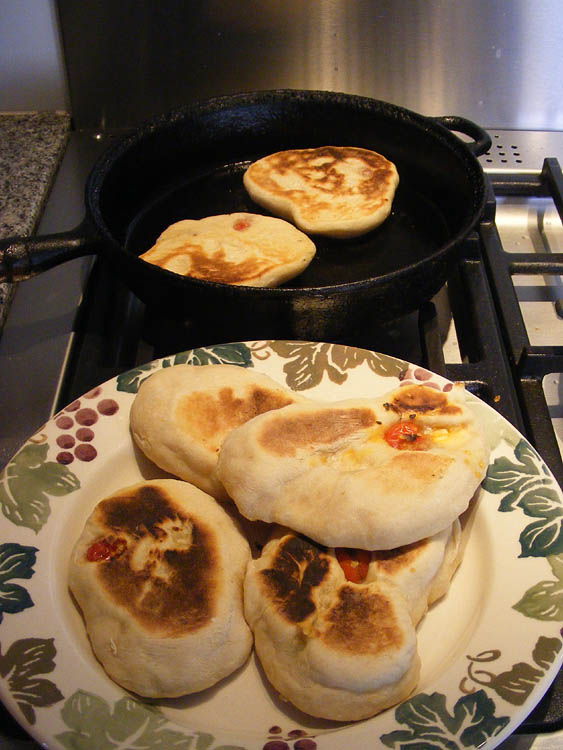
Fouaces, or fouasses, often called fouées (to the west) or fougasses (to the south), are the local Touraine version of pita bread or foccaccia, that is to say, they are a small soft stuffed flat bread. Medieval in origin, they were originally made at either the beginning or the end of a baking session, when the big brick wood fired boulangerie ovens were either heating up or cooling down. If baked at the beginning of a session, they allowed the baker to judge the temperature of the oven. Generally they are cut open and stuffed with rillettes, to be eaten while still warm.

The reknowned gourmande Rabelais (a local boy) describes them as being made from water, egg yolks, saffron and spices (which I guess is why they are available as takeaways at the Foire au Safran in Preuilly). I decided to try my hand at making them, but none of the recipes I found looked terribly authentic, or they were for a sweet version more like brioche. Therefore, I decided to create my own not terribly authentic recipe, as that seemed to be the tradition, with every family having their own variation.

Homemade fouaces fourrées.
Ingredients:
For the Dough
500g flour (I used organic stoneground Type 65 farine de blé from la Ferme des Hauts Bourdiers, Nouans-les-Fontaines)
1 tsp salt
200g refreshed sourdough starter*
30g butter
250ml water

For Stuffing Option 1
6 slow roasted tomato halves
3 slices from a goat cheese log, cut into semi-circles (I used Sainte-Maure-de-Touraine, purchased from my mobile laitiere)
(or you can use Délice de tomates from a jar you bought in the supermarket and some cheese)

For Stuffing Option 2
1/2 an aubergine, cut lengthways.
1/2 tsp ras al hanout
(or you can use baba ganoush if you've got some lurking in the fridge you want to use up)

Method:
  1. Put the flour and salt in a mixing bowl and combine.
  2. Cut the butter into cubes and combine with the flour, using the cake beater attachment of your mixer.
  3. Add the sourdough starter and beat some more.
  4. Gradually add the water and beat for 10 minutes on the slowest speed (this is to begin developing the gluten, like kneading does).
  5. Cover the bowl and leave in the fridge overnight to rise slowly.
  6. Meanwhile, prepare the aubergine by scoring it in a diaper pattern all over, down to the skin.
  7. Paint it lightly with oil and roast it in the oven at 200C for 25 minutes.
  8. When it is soft and cool enough to handle, scrape out the flesh and mix in the spice.
  9. Tip the dough out onto a floured bench and knead it a bit by hand to knock the air out.
  10. Divide the dough into 12 lumps and roll them into balls.
  11. Take each ball and roll it out into an oval 15-20 cm across.
  12. Put either a piece of tomato and a semi-circle of cheese, or a teaspoon of aubergine puree onto one half of each oval.
  13. Fold the dough over and press to seal and flatten.
  14. Heat a heavy frying pan to moderately hot and brush with oil.
  15. Place a couple of the fouaces in at a time. Cook them for 3-4 minutes each side, until they are just beginning to blacken.
  16. Serve warm.
Susan

*for instructions on how to make a sourdough starter see here. Alternatively, if you have been given a Herman starter, this works perfectly well, and is in fact what I used.

For a recipe that looks a lot like the street food ones I have had stuffed with rillettes, see here (in French). I only found this after making my own rather different, but still practical and tasty, version.

Thursday, 20 September 2012

Gordon Bennett!!

Indeed.

Look at this monster. It's a Richard-Brasier 96hp racing car. It may only have 4 cylinders, but that makes for an 11.3-litre (11.3 litre!!) engine, and it was the winner of the 1905 Gordon Bennett cup. Here is a photo of it in action.

Gordon Bennett was an interesting character. Heir to a fortune - and the New York Herald - he was the man who sent Stanley to look for Dr Livingstone (I assume there was a story in that) but is more noted for being profligate. Not only did he sponsor what eventually became Grand Prix racing, he also established prizes for yachting and ballooning and once set a wad of bank notes on fire because they were uncomfortable in his pocket. He spent much of his life in France, being educated here and founding the Paris Herald (which eventually became the International Herald Tribune). You can read all about him, and the expression Gordon Bennett! here.

This photo was taken at Autos Enjouées in Joué-les-Tours.

Simon

Wednesday, 19 September 2012

A Flashback

We have been in Paris the past few days, and as is usual we have stayed at the Hotel le Laumiere in the 19th. One thing we always do when we stay there is take a turn around the Parc des Buttes Chaumont, which is a 3 or 4 minute walk away.

These photos weren't taken on this trip, however, they were taken when we were in Paris in February, visiting Retromobile. At the time, Paris was suffering the Grand Froid (the opposite of a canicule).


As we walk around the parc this morning I hope the temperature is somewhere between the two, so that the waterfall is water rather than ice, but we aren't sweating buckets. The way the weather has been this year, it's a bit of a crap shoot...

Simon

Tuesday, 18 September 2012

Bathing Luxury

Bathroom mosaic, Candé.
The bathrooms at the Chateau de Candé, on the outskirts of Tours, are fine exemplars of Between the Wars bathing luxury and elegance. When Charles Bedaux acquired the place in 1927 he was the 5th richest person in the United States. He subjected the building to a complete overhaul and extensive modernisation. The house was the first private residence in France to have a telephone and 60 tons of pipes were shoehorned into the walls for that very modern indulgence, hot and cold water on tap.

Fern Bedaux's bathroom.
Although Charles was French, he had made his money in America and was a big fan of American style plumbing. The baths at Candé could be filled and emptied in under a minute decades before the surrounding village houses got piped town water.

Charles Bedaux's bath.
Susan

If you are local and visit chateaux regularly, the Conseil Général d'Indre et Loire offers a very good value season ticket to all the sites they own and manage - Chinon, Candé, Prieuré de St Cosmes, the Logis Royal and Donjon in Loches, the Balzac museum at Saché, Hotel de Gouin, the Rabelais museum at Hotel de la Deviniere, the Museum of Prehistory in Grand Pressigny and the Parc de Richelieu. The annual ticket costs €14 and gives you and your guests a discount or free entry at each of the sites. The tickets are called Cartes Ambassadeurs and can be purchased at any of the sites included in the scheme.

Monday, 17 September 2012

The Language of Lingerie

Lingerie (pronounced lë-zhree in French, with 'ë' representing a nasalised i) is a word that has been absorbed into English and the pronunciation modified (lon-zher-ay). Go to Forvo to hear native French speakers saying it. Lingerie in both languages means the same thing.

However, brassiere is a false friend. A brassière is what I would call a singlet, and I think only used in reference to baby clothes here. French bras are called soutiens-gorge ('throat supports'!). They don't have cups, but bonnets ('bonnets'). French sizing, however, is a perfectly sensible system - centimetres around the body just under the breast, ie your band measurement, not some randomly assigned number, and cup sizes are indicated by letters of the alphabet, A being the smallest volume.

A gauche, un soutien-gorge corbeille* (push-up bra) et un shorty (boyleg briefs);
à droite, un soutien-gorge à armatures (underwire bra) et un slip.
Women's underpants are usually les slips (bikini briefs), les boxers or les shortys (boyleg briefs) and les culottes (full briefs). Interestingly, I notice that UK and Australian underwear retailers no longer bother to mention cotton lined crotch gussets - it is presumably now a given. Yet French retailers often feel it desirable to list fond doublé coton ('doubled cotton bottom') in the description of a pair of underpants. French sizes for underpants are a randomly assigned number, that do not bear any sensible relationship to your actual measurement.

Susan

*Push-up bras are often referred to as les balconnets in France (for the technicalities see this post from The Stage Door, in French). They give you a noticeable décolleté (cleavage). My understanding is that the English decolletage, meaning cleavage, is a false friend. The French word décolletage isn't used much and when it is, only refers to a deep or wide neckline of a garment, and not directly to the view it affords of the body beneath. Ken may be able to clarify.

Sunday, 16 September 2012

Hunt Signage Explained

Hunting land is categorised in a number of ways which may restrict who is allowed to hunt. The category a parcel of land falls into can be identified by the signs prominently displayed on the boundaries.

Chasse gardée
means that hunting is the main activity undertaken on the land, and it is managed to maintain a good population of game. Non-hunters are not welcome on this land as they will disturb the game. Hunters need the permission of the landowner to enter.

Chasse réservée means that unless you have permission from the owner you can't hunt there. In practice it usually means the land is reserved for the local communal hunt.

Chasse privée signs mean an estate of more than 20ha which you cannot hunt on unless you have the owner's permission. These are usually the private hunting estates, which operate more or less according to the wishes of the owner and cater for paying clients.

Chasse interdite means that the land has been officially registered as withdrawn completely from any hunting activity. It means that even the landowner cannot hunt on the land, and you very rarely see this sign here.

No sign at all on a parcel of land means that theoretically anyone with a hunting licence can hunt there. Strictly speaking they are required to notify the landowner in advance in writing that they wish to cross the land but my impression is that most hunts obtain a verbal agreement only, and do not deliberately antagonise landowners by entering properties where they are not welcome. Since theoretically you cannot discharge a gun within 150m of any building (including garden sheds and caravans) in practice the hunt is not very likely to cross your backyard even if the quarry does. (I have it on good authority that the 150m rule is routinely broken, but even so, the hunt is not generally conducted on land where it is not welcome.)

Temporary signs on the roadside saying Attention! Chasse en cours mean that the hunt is currently operating in that area. You need to be careful of dogs or game dashing across the road. Occasionally you may encounter a mounted huntsman, in which case you should give the horse a wide berth at a slow even speed. Usually the huntsmen are on foot though and wearing hi-viz vests. If they are carrying a gun it must be uncocked or broken. If the hunt is only just starting beware of panelvans slowing down and turning off.

The hunting season opens in Indre et Loire today. For the rules about what can be hunted, how and when throughout France, go to the Féderation Nationale des Chasseurs website.

Susan