Wednesday, 17 April 2013

Célestine is 60

On this day 60 years ago, Célestine rolled off the assembly line at the Citroën factory in Paris.
Happy Birthday Célestine!

Tuesday, 16 April 2013

Cycling Heaven

This photo was taken one evening in late March, near the Vienne in the area known as the Véron. Many of the rural lanes here are marked as cycle trails. The river flood plains are flat and the tracks not much used by motorised vehicles.
************************************************
Foire de Saint Georges: The annual Saint Georges Day Fair is on in Preuilly on Saturday 20 April.

Monday, 15 April 2013

Merci, Commune de Boussay !

A while ago I posted about having to park at the bottom of the laneway to our orchard because it has all been churned up and I couldn't get the car up the slippery slope.

Shortly afterwards, one of our orchard neighbours, Madame G, who works in Saumur and keeps up with Preuilly news partly by reading the blog occasionally, came up to me in the market place. She asked me what the story with the laneway was, and I said that all I knew was that sometime in the late autumn the ditch opposite the Moulin de Chanvre had been cleaned out, with the spoil dumped on the adjacent field, and the heavy machinery having made a mess of our laneway. Then in late winter, the commune of Preuilly churned it up even more when they were pruning the laurel hedge at the nearby sewerage works.

She suggested that we visit the mairie at Boussay and ask them to repair the lane. Our orchards, and the laneway, are just across the communal border, so Boussay, not Preuilly has responsibility. So, the following Wednesday she picked me up and off we went.

We were in luck, because when we got there Madame Ligaud, the mayor, was in reception. She is an attractive and dynamic woman in her 50s (or perhaps slightly older) and was very happy to listen to our case and said she would do what she could. She established exactly where we were talking about and told us that the ditch cleaning had been an emergency operation. Apparently the culvert under our lane got blocked and the road flooded, making it impassable. The border between the two communes is the ruisseau which runs along side the lane, in front of our orchards. The commune of Preuilly didn't feel to take responsibility for the blockage ('they don't like to put their hand in their pocket!' -- not the first time I have heard this remark...) so the commune of Boussay came and sorted the ditch out, but inadvertently left us with a pile of mud.

On Friday I nipped down to the orchard in one of the sunny half hours to find that sometime in the last few days, the commune of Boussay has been and levelled out the lane and rolled a load of blue metal on top. It looks good and I hope will prove to last. The lane doesn't get much traffic -- just me, Monsieur Ch and the Madames G or their mower man. A busy day is when more than one of us is down there at the same time. As we happened to pass Madame G's house on our after dinner walk that evening I popped in to tell her the good news. If she hadn't suggested visiting the mairie, I doubt if anything would have been done, so thank you commune de Boussay and thank you Madame G!
***********************************************
Communal Finances: Preuilly has a population of just over 1000, and a budgetary turnover of just over 1 million euros. Around half the budget is spent on personnel. Just for comparison, Boussay has a population of 250 and a budgetary turnover of just under a quarter of a million euros. Slightly more than a third of their expenditure is on personnel. Both communes balance their budget and indeed have a surplus, which in Preuilly's case is around 100 000 euros, and in Boussay's about 70 000, invested.

Sunday, 14 April 2013

Flowers in the Cemetery

 Finger Flower Cheiranthera cyanea.

The old cemeteries in the little country towns around Canberra are well known as havens for native wildflowers. Cemeteries are often good places for wildflowers as they are spaces that are treated with a light touch out of respect for the dead.

Finger Flower Cheiranthera cyanea. It grows in open forest and woodland.

Dalton Cemetery is one of the best, and I took these photos in November last year in the semi-natural open wooded grassland that surrounds the central compound of graves.

 Finger Flower Cheiranthera cyanea. Endemic to a band running from central Victoria to south-east Queensland.

 Common Wedge Pea Gompolobium huegelii.

Forest Goodenia Goodenia hederacea.

Saturday, 13 April 2013

Anzac Parade

The view down Anzac Parade across Lake Burley Griffin to Old Parliament House and beyond that, New Parliament House, in Canberra.
*****************************************
Nature News: Heavy rain showers for the fourth day in a row, with thunder yesterday. The Claise is properly overflowing now, and even our well drained sloping orchard feels like walking on a spaghnum bog. The river is flowing faster than I have ever seen it. Everything is saturated, with the rain falling on already waterlogged earth. It's been fairly windy, but the temperatures are mild enough to let the fire go out in the house now, and I saw my first bat of the year yesterday evening -- probably a Brown Long Eared Plecotus auritus, as it flew into the attic across the street. More and more martins and swallows are arriving, but they are not yet ubiquitous and there must still be more to come.

By the banks of the Claise in the middle of Preuilly, between the plan d'eau and the campsite, yesterday.

Friday, 12 April 2013

Official Butterfly Report for 2012

Just as I am gearing up to start surveying my local butterflies for 2013, waiting and watching for the weather to improve sufficiently to make it worthwhile, the official STERF report on last year's national survey has landed in my email inbox...with a covering message from Luc Manil, who co-ordinates us STERFistes, saying 'Don't even think about going out and doing your first survey until the last 10 days of April. The weather forecast is awful and there will be nothing flying but those few species that hibernate as adults...'

Meadow Brown.
The French national butterfly survey has been going since 2005. From an initial 14 survey sites it is now 215 sites. 44% are allocated randomly and can be anywhere within 10km of the surveyor's home base, 56% are chosen by the surveyors (and are usually nature reserves). Last year both my survey sites were randomly allocated. You can read my report for 2012 here.

Gatekeeper (male).
The Paris area (Ile de France) and the mountains are the best covered by surveyors. The high number of survey sites near Paris reflects the distribution of surveyors rather than butterflies -- a typical skewing of the statistics that all biodiversity surveyors are ruefully aware of and take into consideration.

Over the lifetime of the survey 199 species of butterflies have been recorded in France. The most abundant species recorded last year were, as usual, Meadow Brown Maniola jurtina, Small White Pieris rapae and Gatekeeper Pyronia tithonus. The most frequently observed species were Small White, Meadow Brown and Small Heath Coenonympha pamphilus. This second category are the species that are present everywhere, often the same species which are abundant and occur in great numbers, but not necessarily. The most gregarious species (those seen in the largest numbers per transect) were Chalkhill Blue Polyommatus coridon, Marbled White Melanargia galathea, Gatekeeper and Meadow Brown.The national average number of species recorded per transect visit was 3.4. My average was 6. The highest number of species recorded in a single transect visit was 28. My highest was 12.

The richest habitat nationally for butterflies is pelouse (calcareous grassland) and pine woods. The poorest habitat is urban, suburban, arable and other cultivated land which does not include pasture or native grasses.

Orange Tip (male).
The records for last year show that the summer species were on the wing 15 days later than average. On the other hand, one early spring species, Orange Tip Anthocharis cardamines had an exceptional year, benefitting from the outstanding weather in March. With a spell of good weather later in the year, some of the calcareous grassland species like Adonis Blue Polyommatus bellargus also had a boost after an intially very poor year. Last year was a bad one for forest species (but the year before that had been a very good year for them, so we need a few more years of recording before we can tell what the overall trend is for this habitat).

 Adonis Blue (female).
Nationally there has been a 10% drop in numbers of species observed over the lifetime of the survey and a tendency for generalist species to be on the increase in frequency. This reflects the results coming out of other European countries who survey butterflies. The implication of these statistics is that habitat is being degraded or homogenised, causing specialist species to disappear and generalists who are less choosy about habitat to colonise areas that now support a lower level of biodiversity.
*****************************************************
Loire Valley Nature Updates: a new entry for Eyebrights Euphrasia agg has been added.
A new entry for Field Scabious Knautia arvensis has been added.
**************************************************
Weather Update: The weather continues to be dismal. It rained all day yesterday, but was not very cold, just wet. At the market the bus driver joked with me that it was just like English weather (all the English people in the district must have heard this on a weekly basis for the last six months I reckon). Apart from being anglais, the weather was variously described to me as déprime (depressing), triste (miserable) and mouillé (soaking wet).

Thursday, 11 April 2013

News from the Garage

One of Claudette's brake drums, badly repaired in the past by welding a piece of steel onto the cast iron.
On Wednesday we went over to Chateauroux to check on progress with Claudette. Jean-Louis was hoping to have her brakes fixed and enough done to get her through her CT (roadworthy/MOT) but as usual, things turned out to be more time consuming than expected. We took Célestine along because Simon was worried about a noise in her engine, and we gave Jean-Louis a cheque for the parts he has purchased so far on our behalf through the car club for Claudette.

Tuning Célestine.
Claudette's brake problems are a combination of grease on the front left brake shoe, worn brake drums, and lack of lubrication on the handbrake cable and rear cylinders, plus a few other minor things. So everything is going to be new, just to be sure.

Claudette in Jean-Louis' workshop.
A lot of her wiring and tubing is run along non-standard routes, and Jean-Louis pointed out places where wiring or tubing was too short and other places where it was too long. It is routed too close to hot parts of the engine, or over something when it should go neatly under it, or the rubber sheathing is old and snaps, or ...oh la la, pleine de petite choses. He's not sure the dynamo is working, so will replace the regulator. If that doesn't work, we will need to figure out how to squeeze an alternator under the non-standard oil filter. The starter switch and the choke are wired back to front. That's just confusing, so he'll get to that too.

You can hit this brake cylinder with a hammer and it still doesn't move.
Célestine got a health check too. Jean-Louis tuned her and adjusted the brakes. The noise remains a mystery, but is perhaps a combination of a bearing in the alternator and another in the water pump. We will just have to leave it and see what develops.

Jean-Louis showing Simon just how much wear there is on Claudette's brake drums (the diameter is over 2mm more than the allowable variation from the spec).
We picked up two old tyres to take to our newly rented garage in Saint Pierre des Corps. The garage is so Claudette and Célestine don't have to make the journey from Tours to Preuilly quite so often, but it is quite a tight fit. Simon doesn't want to run into the end wall, so we will use the old tyres as buffers.

Claudette and Célestine meet for the first time.

Wednesday, 10 April 2013

What Big Hairy Feet You Have!

One of my favourite beetles is the Lesser Bloody Nosed Timarcha goettingensis. They do everything ponderously and can be seen in almost any month, unless it is really cold. Look for them on bedstraw Galium spp. They are a type of leaf beetle Chrysomelidae, so spend their time munching their way through their favourite plant.

A male Lesser Bloody Nosed Beetle making his ponderous way across our driveway.
 Males and females are easy to tell apart. Males are smaller, and have noticeably large spread feet with a thick velvety underside. In the last decade or so, scientists have been getting very interested in this sort of feet. Many of you will probably have heard of work being done to find out how geckoes can climb plate glass and what the applications for humans might be. The interest in these hairy beetle feet is similar.

Terribly undignified, I know, but I tipped him over so you could see the pads on the feet.
The male beetle has to be able to stay 'on board' when mating, but the female beetle is very smooth and shiny. The special pads on the male's feet mean that he can 'glue' himself at a molecular level to the female. His feet have three different sorts of hairs, with different shaped tips. This allows him to stick if he moves his feet in one way, and peel himself off if he moves them in another. Scientists have recently created an adhesive tape based on the same principle. It doesn't involve any actual glue, but creates an bond, using an electrostatic intermolecular attraction known as van der Waals attachment forces. For more information see Science Daily. Such adhesive tapes will work in wet or dry conditions, and cause no damage when pulled off, so you can see there is enormous potential for difficult situations such as under water or bandaging wet wounds.

Le Jardin de Lucie has some great pictures of the closely related Bloody Nosed Beetle T. tenebricosa, including photos of them mating, so you can see the feet in action, doing what they evolved to do.
***************************************
Botany Outing: There is a botany club outing to look at mosses on the walls and trees of Sainte Maure de Touraine on Sunday 14 April. Meet at 2.30 pm in front of the Mairie in Sainte Maure. Bring envelopes if you want to collect samples.
***********************************************
Weather Update: Yesterday's weather was atrocious, with very strong gusty south-east winds roaring and whistling through the village, accompanied by horizontal rain most of the day. A few brief interludes of brilliant sunshine, until finally it cleared in the evening, although it remained fairly breezy. At least it isn't particularly cold.

Tuesday, 9 April 2013

Local Green Asparagus!

The asparagus season has begun. Several local producers have it on their stalls at the markets.

The local asparagus is white, that is to say, it is grown by mounding up the earth around the spears to blanch them. The spears are thick and so delicately flavoured that their attraction is a bit of a mystery to me. They are more work for the producer and more work for the cook, as they have to be peeled to remove an outer layer which is fibrous and bitter.

Locally grown green asparagus.
Why is green asparagus not grown here? It's grown in the south of France I believe. Obviously, asparagus is one of those things the Tourangeaux are northern about. It is probably also an indication that Paris is the biggest market and Parisians like it white.

However there is good news for those of you who, like me, live in the Touraine du sud now, but who grew up in a country where green asparagus is favoured. The asparagus and strawberry lady (who sells nothing but her own locally grown asparagus and strawberries, and a few other red berries) at Loches market is growing some green! I was so excited I paid €8 for a kilo! (€5/kg is my normal upper limit for asparagus.)

Monday, 8 April 2013

Spring Wildflowers

I've been busy, so I've not had a chance to post any photos of the lovely spring wildflowers I've been seeing in the last few weeks. Despite the fact that the Arctic Oscellation Index is still, after more than a month, just about as negative as it has ever been and we have all been all perishing here, many of the spring flowers obviously respond to day length not temperature, and flower regardless.

Snakeshead Fritillary Fritillaria meleagris. 
These were photographed in the Aigronne Valley between Le Petit Pressigny and Le Grand Pressigny (thanks for the tip off Tim), but we have been lucky enough to see them at three different locations this year.

Purple Toothwort Lathraea clandestina.
Also in the Aigronne Valley, at le Moulin Neuf, between LPP and LGP.

Cowslip Primula veris.
Common on roadsides throughout this area.

Wild Grape Hyacinth Muscari neglectum.
In our orchard, but there's a long way to go before there's a carpet.

Lesser Celandine Ranunculus ficaria.
Common along ditches and in damp grassy patches.

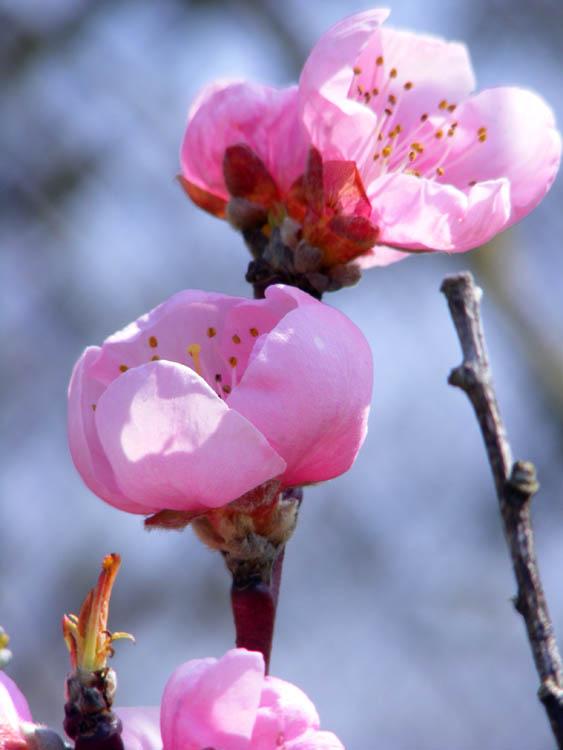
Not wild, but still pretty -- the nectarines in the orchard are covered in pink blossom.
***********************************************
Fleas and Scuties:  Yesterday our neighbour Pierre-Yves came over with an arthropod in a jar that he wanted identifed. The beast, which was dead, was a scutie (House Centipede). He'd found it in a pot plant and was worried it had been eating his plants. Typical of Pierre-Yves, who is an artist, he was also intrigued by how beautiful the creature was, remarking on its stripey legs and patterned back. I reassured him that they were carnivorous. He explained that it must have died because he has been battling against a plague of fleas in the house. Until recently he has been living over his garage in a studio apartment and the house has been tenanted. The tenants had half a dozen cats, and the cats clearly had fleas. Pierre-Yves can't believe how many eggs a single flea can lay and how many places they can get! He's sprayed anything he's seen with a flea on it or signs of fleas, including the insides of his jeans! The scutie must have come into contact with something that has been sprayed, which is a pity, as they probably eat fleas and flea eggs. He's getting a bit wary of continuing to use chemical sprays, so has just spent the last two not very warm days with the heating off in the house in the hopes they will either push off somewhere warmer or die of cold. He's not very hopeful, but I told him to wrap small objects in plastic bags and freeze them for a few days (ideally up to a week), like museum pest control programmes do, and he was quite taken with that idea. He also has a battery of herbal oils that he hopes fleas find insupportable. Then we got a bit silly, and I suggested he borrow a cat back for a day, put it in a cage and wait until all the fleas had got on board. My idea was to then whip the cage outside, with its cargo of cat and fleas. Pierre-Yves was still quite keen to try out the freezer idea though...

Sunday, 7 April 2013

Australian Beer

Australian beer when we left the country for England in 1997 was dreadful stuff -- over carbonated mass produced lager that was served ice cold so you didn't notice it didn't taste of anything. People have been telling me ever since that the beer has improved, with a proliferation of micro or artisan breweries making styles other than lager. However, it wasn't until our trip last year that I finally got to drink something that made me think the Australian palate might be developing. I still didn't get anything outstanding, but at least I got something that was better.

At my sister's birthday drinks, held at Edgar's Inn I asked the barman what he would recommend. He suggested the draught James Squire 150 Lashes Pale Ale. It turned out to be an improvement on the XXXX of my youth, but that wouldn't be hard. It was disappointingly nothingy. No hoppiness, very little malt, and as usual, served utterly frigid (which turned out not to matter, as it warmed up quite quickly in the beer garden atmosphere and wasn't improved). It was completely innoccuous, drinkable, but not something you would make any effort to return to.

The bar at Edgar's. I'd never seen ice cooled taps like this before. Note too the jar for donations to the Movember appeal -- half the male population of Australia was going round looking like they were on an 80s retro kick.

Luckily I discussed my dilemma with some bloke at the party. He recommended I try something from the Little Creatures brewery if I saw it, and when we were in Manly having lunch at a restaurant that had it on their drinks list I leapt at the chance. We tried the Little Creatures Pale Ale and the White Rabbit Dark Ale (the two breweries seem to be connected).

In the old days, Simon, having access to the more sophisticated choices available in New South Wales, could quaff Tooheys Old -- a drink that I never encountered in parochial Queensland. Of all the muck produced by the big brewers in Australia this is the most drinkable, being an acceptable but not inspiring dark ale. We expected the White Rabbit offering to better it, and it did, but not by that much, and in fact, the Little Creatures Pale Ale completely outshone it. It helped both drinks that the restaurant went a bit easier on the chilling too.

Little Creatures Pale Ale (left) and White Rabbit Dark Ale (right) at the Manly Grill.

Normally you would expect a dark ale to be packed with flavour and completely overpower any pale ale. Not so in this case. The White Rabbit was nice enough, but lacking in oomph. The Little Creatures Pale Ale had much more going on and was a nice drop -- still not really outstanding, but quite good.

Here are some quotes from the Beer Advocate that echo my experiences and could have been written by me:

Tooheys Old
The character it has sets it above most Australian macros but still a very average beer.
Mediocre brew in the land of lousy brews.
White Rabbit Dark Ale
...decent flavor although it could have been a bit more nuanced.
An interesting beer, but not groundbreaking.
 James Squire 150 Lashes Pale Ale
It's inoffensive, but there is really nothing here to entice real beer lovers.
Not unpleasant, just too subtle and weak.
Little Creatures Pale Ale
Good and drinkable with lots of tasty hops notes.
Of the beers I've had from Australia, this ranks in the top 3, and it is widely available.
So thank you anonymous bloke from Kathy's party. None of these beers would compete in my affections for most British bitters or ales or any Belgian beer, but it is nice to know that the situation is improving.

Saturday, 6 April 2013

Reach for the Sky

 Lovely Green Cape Lighthouse, from my 2009 trip to Australia.

 
Telecoms tower on Melba Hill, Canberra.


 An absolutely humungeous agave, preparing to flower in a Canberra garden, November last year -- and the photo I took immediately after the telecoms tower above. Do you think there was a theme developing in the neighbourhood?

Friday, 5 April 2013

Vincent Bellivier, Chinon Winemaker

In March we had clients based in Chinon, so naturally we wanted to introduce them to a local winemaker in this well known wine appellation. I emailed someone who had been recommended to us, but he was going to be away at a wine fair and schmoozing his biggest customer, so was unavailable on the date I wanted. I hunted around for an alternative, and happened across Richard Kelley's review of Vincent Bellivier. He sounded ideal, so I got in contact. His son Matthieu responded positively, and we set up a rendez-vous.

Barrels of Chinon wine in the cave at Vincent Bellivier's winery.
The family is based in Huismes, a village to the north of Chinon. They have 6 hectares (15 acres) of grapes, almost all Cabernet Franc, as you would expect in Chinon. They are a small producer, even by local standards, but they have a well appointed tasting room and Matthieu was happy to show us the chai (where the wine is made) and cellar.

Coins stuck to the accumulated yeasty goo on the ceiling of the cave. The US quarter was put there by our clients, and Simon put one of the euro currency coins there.
We arrived and were greeted by a spaniel and two wire-haired dachshunds, brimming with personality. Matthieu emerged from the house and invited us in to the tasting room, where we tried the 2011, 2010 and 2009 vintages, all 100% Cabernet Franc (as required by the Chinon appellation rules). All were excellent, but the 2011 needs a bit more time to mature (in a year's time it will be much more integrated, and it will easily keep for 4 or 5 years). The 2011 and 2010 had been matured in stainless steel tanks, and the 2009 in oak barrels from Bordeaux between 3 and 7 years old, so it has just a hint of wood. Matthieu was particularly pleased with the 2009, and we bought some of that and the 2010 (€7.25 and €5.70 per bottle respectively).

A fungus covered corkscrew hanging on the wall of the cave.
Matthieu, who told us he was 27 years old, is following his father's 30 years of experience in winemaking. It turns out he is also a classic car enthusiast, with a Traction Avant 11BL and a Peugeot 203 parked in the hangar next to the cellar door. He speaks a little English, although is rather diffident about doing so. At one stage he told the dogs to 'shut up' in English and claimed that was just about the only thing he could remember from English classes at school.

You can just see me talking to Matthieu in the entrance to the next section of the cave in this photo.
The cave is dark and dank, lined with barrels down each side. We noticed that there were coins and other small objects stuck to the gunge on the walls and ceiling and Matthieu said it was a tradition, in this cellar at least, to stick a coin to the wall for luck. They produce about 12 000 to 15 000 bottles per vintage, depending on the year. Almost all their wine is sold locally, and more and more in 5 litre bags in boxes rather than bottles. It's the same wine, but cheaper to buy in the boxes, and the local customers prefer it that way.

Thursday, 4 April 2013

A Surprise Visit from Strangers

Just as I was packing the car to go down to the orchard on Monday last (and had just discovered that my key had gone AWOL) a car pulled up beside me in the courtyard. I'd noticed the same car go up the street extremely slowly only a few minutes before, so I assumed they were lost.

Curiously, when she wound the window down, the woman passenger's first words to me were 'Parlez-vous un peu de français ?' I'd never seen her before, so it didn't dawn on me that she had already guessed who I was.

Gérard and Marie-France in our kitchen.
It turned out that her husband, driving the car, had grown up in our house. The reason she knew who I was because they read the blog! Their names are Gérard and Marie-France and they live in Sainte Maure de Touraine.

Gérard is the son and grandson of the last owners who ran the property as a grain merchants. His family lived in our house and his grandmother lived both in our house and next door in Ghislaine's (although I'm not sure what the sequence was, or even if it was two different grandmothers). He told us that there used to be a big horse trough in the back yard, which in those days was walled, and that he had scribbled all over the walls of the office (our pantry). The business dealt not just in grain but also in walnuts. He has confirmed that we do not have a cellar, but commented that Patrice, at the end of the next driveway, has an enormous souterrain under his workshop.

The raised section of Ghislaine's yard was where his grandmother's orchard was planted. He described the layout of our house in his parent's time, with two stoves, one oil, one wood, where we have our stove and opposite. There was a sort of kitchenette where we have our dining area. What was his bedroom is now our spare bedroom ensuite bathroom. Our spare room was once his grandmother's bedroom, and he remembers what a cold room it was (still is, even with the new insulation, it's always the coldest room in the house). Their bathroom was where our office is, but it was a pretty basic affair -- really just a wash basin. It did not include the large cast iron bath that we had to deal with when we started renovating.

I mentioned that I will be in Sainte Maure several times over the next few months, so I have a standing invitation to come and visit them. They, and more particularly, Gérard's sister, have photos of our place from the first half of the 20th century, and I am quite keen to see them. They left Preuilly in the mid-sixties. And what a coincidence! Gérard's sister is called Claudette!!

Wednesday, 3 April 2013

A Collapsed Cave

When we took our first clients of the season to Loches in mid March we discovered that the vaulted cellars across the road from the Logis Royal have partially collapsed. The view from above when you are standing on the citadel is quite dramatic.

We've never been able to work out quite what this building is. Obviously there are cellars, but was there once a building on top? The roof of the vaults is covered in a layer of soil, as though someone once had a garden there, but there is no sign of that now. It is surely too high to be the original soil level. Yet another historical mystery, and more information may come to light in due course, in which case we will pass it on.

In the mean time, the masonry firm Menet has been called in to do the repair, so the situation has been given the highest level of consideration. The Menet team do most of the important historic masonry restoration in the area, and have already worked on several significant buildings in the nearby streets.

Tuesday, 2 April 2013

Le Manoir de la Giraudière, near Chinon

Just recently we spent the night in Beaumont en Véron at the Manoir de la Giraudière. This place is a real hidden gem. It's tucked away in the Véron, west of Chinon, where the Loire and the Vienne meet. (And yes, I know there's a nuclear power station right in the middle of it all, but it's such beautiful countryside that you can easily ignore that.) Down close to the river are small grazing fields known as bocages. The higher ground of limestone ridges are known as puys, and in between are the expansive Chinon vineyards.

Our room at le Manoir de la Giraudière.
Our room at the Manoir was spacious and well appointed (comfortable chairs, and room to sit on them!) We paid €46 for a double room with bathroom and €8.50 a head for breakfast. A real bargain.

 Célestine parked in the courtyard in front of the wing we stayed in.
The staff are friendly, helpful and most of them speak English. The hotel buildings are full of charm, with some very nice 19th century Gothick revival furniture in reception and the sitting room, clearly made for the hotel, as they matched the lovely ornate front door. Parking is tucked away in the English park style gardens. We would happily stay there again. The hotel is a member of the Logis de France network, which is an association of small, family run, good value hotels which we have always found reliable and comfortable.

Reception.
The hotel has a restaurant, which does evening meals, but we didn't try it. Instead we met our friends Chris and Annie and went to a nearby crêperie, Dans un Jardin, and had some wonderful organic galettes and crêpes for dinner. Mine was topped with buttery carrots, leeks and scallops, followed by an 'aumonier' ('purse') filled with apple, vanilla icecream and homemade salted butter caramel sauce. Scrumptious, and all washed down with a Leffe Ruby. It came to €22 a head.

We had Célestine for transport, but both establishments would make an ideal base for anyone who wanted to cycle around the area. There is a network of flat, quiet, pretty country lanes all around, many of which are designated cycle routes. Botanists especially will appreciate this area, as both the bocages and the puys are full of rarities. If you are visiting between 20 March and 10 April, this is the area to come to if you want to see Snakeshead Fritillary Fritillaria meleagris in the wild, and up on the puys a week or so later you will get Pasqueflower Pulsatilla vulgaris. Wine lovers will also enjoy visiting the many family run wineries. Not to mention the picturesque villages and farms with slate roofed houses made of the local limestone and often set into the hillside to be semi-troglodytic. And of course, you have historic Chinon just 5 minutes by car down the road.
*********************************************
Botany Club Outing: there is an outing to Sainte Maure de Touraine on Saturday 6 April to look at urban wildflowers on walls and footpaths, as part of Sustainable Development Week (la semaine du développement durable). Meet at 2.30 pm at the Mairie in Sainte Maure.
 *******************************************
Orchard Update: the nectarines are in full pink blossomed glory, and the little Wild Grape Hyachinths Muscari neglectum are out. I once saw a picture of an orchard in New Zealand, where the ground under the trees was carpeted with Grape Hyacinth in a great swath of blue as good as any bluebell wood in Britain. It would be lovely if my GHs did the same, but since they are currently a tiny little colony under one of the apple trees, it will take them many decades to achieve glory. 

The temperature in our courtyard was 21°C and down at the orchard, 17°C. That was probably about right, but since there was a gusty north-easterly wind (our coldest direction, a little gift from Siberia), it wasn't exactly tropical. Still, the soil has dried out a bit more, and the weeds stuck slightly less persistently to my gloves. There were quite good numbers of Honey Bees Apis mellifera out, but not much else, and the Honey Bees weren't working the fruit trees -- they were sticking to dandelions, down nice and low and out of the wind. I did see an Andrena cineraria female which surprised me, as I thought they emerged later. No butterflies, and only one bumble bee, a White-tailed Bombus lucorum. It can't have been very warm, as even though it was sunny, the Field Crickets Gryllus campestris weren't sitting at their burrow entrances and keeping me company.

Monday, 1 April 2013

Wildlife Watching in the Touraine du Sud in April

If the weather is good you will hear the first cacophonous carryings on of the local Green Frog population, day or night, in every ditch, étang and plan d'eau. In the evenings, listen out for the delicate plinking bell sounds of the Midwife Toad.
Green Frog.
The average maximum temperature here in April is 15°C and we can expect less than 200 hours of sunshine. So long as I get a couple of days where the temperature goes above 16°C for a few hours and it's not too windy, I'll be able to start my annual butterfly survey (unlike last year, when I wasn't able to properly survey until June!)

A Brimstone butterfly, one of the most common species flying in April.
The ecology in the Loire Valley system relies to a large extent on spring rain. Orchids in particular respond to good spring rain in terms of how many flowers per stem they have and how many rhizomes produce flowers at all. According to the Association de Botanique et Mycologie de Sainte Maure de Touraine, spring here has tended to be dry for over a decade. As a result, year on year, they note that orchid colonies in the Touraine are getting smaller and smaller, with fewer and fewer flowering plants as each year passes. I am noticing the opposite in our orchard, but that is because a complete change of management regime has meant the orchids are allowed to achieve their full cycle, rather than being ruthlessly mowed off in their prime as happened under the previous owner's care.

And according to a botanist contact of mine who lives near Candes Saint Martin, on the confluence of the Vienne and the Loire, you've still got about 10 days to see the Snakeshead Fritillaries Fritillaria meleagris in all their glory in Véron, west of Chinon.
****************************************
Paques Pain-demonium: It seems the entire world has descended on Preuilly for Easter. Families are coming together and the town is full of drivers who don't know how to politely negotiate the rather tricky main street. Even I could lip read the frustrated woman trying to go up, getting half way and being forced to reverse with a succession of drivers determinedly coming down on the wrong side -- 'J'ai le droit !', with an exasperated flick of the hand, but short of simply blocking the road to the downcomers, there wasn't much she could do but move aside and hope none of them scraped her going by. There were 40 people lined up to buy bread at our now solo bakers and it took me over 20 minutes to be served. It was just before lunch time, and many people were buying sack loads of pain or baguettes as well as cakes or pastries.
*************************************
Loire Valley Nature Updates:  a new habitat entry for bocage has been added.
****************************************************
Easter Beetles: In this household it seems that it is beetles that arrive on Easter Sunday, not bunnies, bilbies or bells.

Some were chocolate, and appeared to be species of chafer and ladybird...

Another was the handsome and rugged male Lesser Capricorn Cerambyx scopoli, newly emerged from the wood pile.
 **********************************************************
Loire Valley Time Travel News: Our website has been completely revamped, so take a look and tell us what you think. Simon put hours and hours of work into the photos and coding, I just did copy editing. We are rather pleased with it, but we are grown up enough to take any feedback you may have, positive or negative.

Sunday, 31 March 2013

Ring a Bell?

 At first glance, European readers will probably assume this is a bellflower. Well, it is and it isn't. It is Campanulaceae, just like the European bellflowers Campanula spp, but it is the closely related southern hemisphere member of the family, Wahlenbergia. This pretty and common wildflower is called the Australian Bluebell W. stricta.


The Quaking Grass Briza maxima with which it is growing is an attractive, but invasive alien plant which out competes the native vegetation and reduces the biodiversity of any area where it is established.