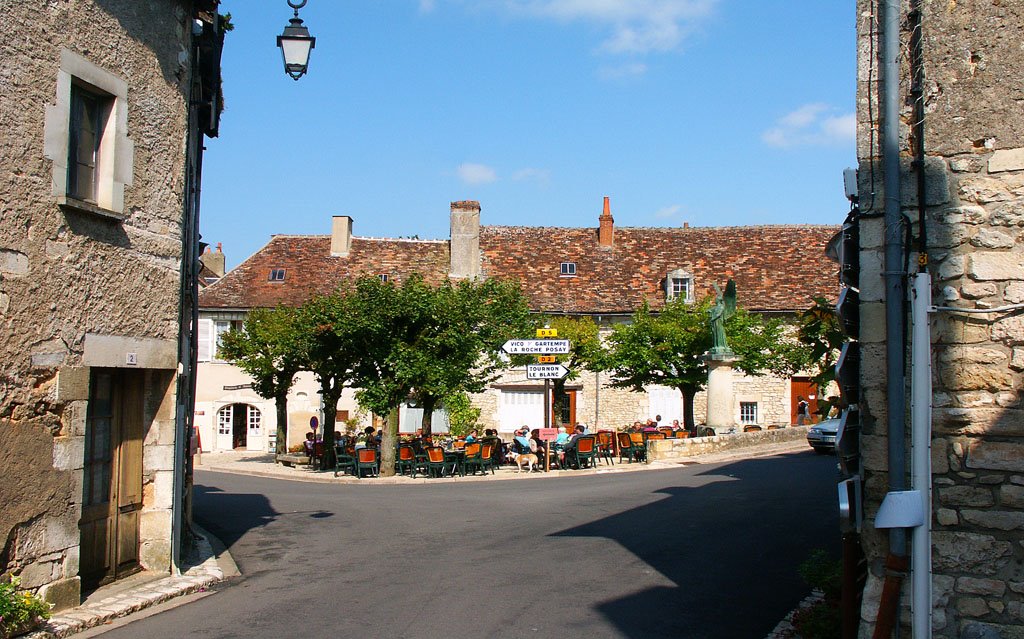
We know very little about this building and its history, except that it now serves as the Mairie for le Pont Chretien, a very pretty town on the banks of La Bouzanne river.
So - castle or town hall?

Simon


 In May 1940 France was invaded by the Germans (for the 3rd time in 70 years*) and for the French, things weren't going well. The French Government fled Paris, and took the gold reserve of the Bank of France with them to prevent it falling into enemy hands. It was moved by convoy - first to Tours, and then after the German army crossed the Loire, to Poitiers and then Bordeaux. All this was done with the Germans in hot pursuit.
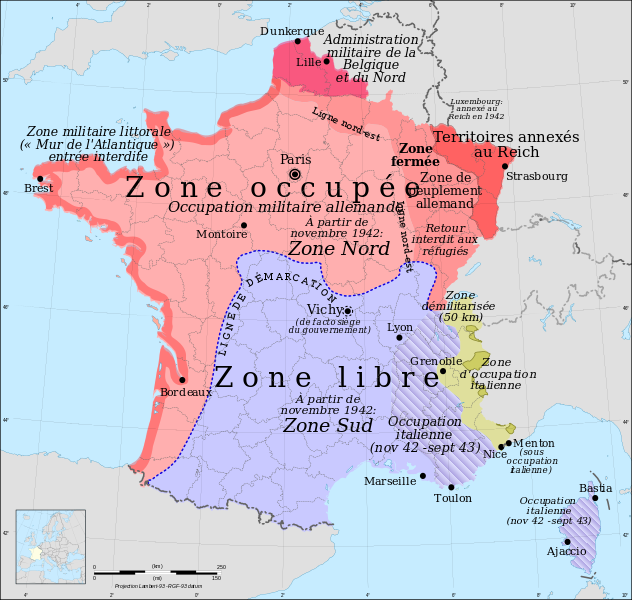
 Coincidentally (or maybe not coincidentally) part of the border between what became known as Vichy France and the Occupied Region was the Creuse river, with La Guerche in the nominally French zone, and Poitiers and Bordeaux in the Occupied zone (map here). Even though the bridge was no longer there, la Guerche became an important point for smuggling people and goods across the border.


 which I quite like, but grey just isn't my colour. So I won't post it for anyone except Walt. Everyone else look away!


 As you get towards the bottom of the garden the trees become more of a forest - then suddenly it opens up to a large (now unfortunately empty and not in the best of condition) round pond with fountains. There are a number of decent vistas from here, including some "borrowed views" over the adjacent farmland. The best view, however, is back towards the house.
 These gardens are well worth an hour or two of anybody's time, and the chateau - although I have not yet been inside it - also looks pretty good.

 Roger Lezeau says:
Roger Lezeau's anecdote translated by me from his article in Les Cahiers de la Poterne, No34. Monsieur Lezeau was born in 1912 and is a great source of knowledge about the history of Preuilly.
Huguet's shop, run by 'Father Mathieu' occupies two lots. Auvergnat by birth, he fell into the category of middle class shopkeeper, a group that was not lacking in Preuilly.
He went to mass and found himself thus classed amongst the 'white arses' (culs blancs*) while the 'red arses' (culs rouges*) claimed a fashionable anti-clericalism. A travelling singer, to satisfy his bistro customers, had incorporated into a song: l'père Mathieu, d'un air pieux, s'en allait prier l'bon Dieu... ('...Father Mathieu, with a pious air, would pray to the good God...')
His business was still prosperous in 1920, the habit of dressing in the latest Paris fashions having not yet reached our region. Outfits in corduroy, beige or greenish, would be unpacked and laid out during fairs.
Inside, he sold fabric by the metre, using a wooden ruler which descended from the ceiling above the vast counters. The bulky rolls were kept on shelves taking up three sides of the store.
His principal salesman, Henri Jambier, during the week, went out to the local farms, enthusiastically selling everything you could imagine for a coming wedding to everyone from the bride to the grandmother.
For this work he had acquired the first post-war car, a yellow Citroën trèfle with three seats, one in the boot (trunk) at the rear.
Monsieur Jambier, unlike his boss, was a dyed-in-the-wool Republican.
Monsieur Huguet, with the help of his wife, had five girls, but they were desperate to have a boy. In time his business was taken over by his son-in-law Lévrier.
 There are all sorts of alleyways that make short cuts if you're walking - roads shown as "ruelle" and "chemin" are quite often formerly roads that are no longer wide enough for cars. As you look down this one in September you get an unexpected flash of virginia creeper climbing up the back of a house.
 There are also little laneways like this one that leads only to what once may have been a door - now a boarded up window in what looks like a deserted grange.
 These things are new to us; I think the secret is to not stop looking around as we lead our daily lives - and to always carry a camera!
 When we looked closer though we realised that it was flowering! It was absolutely covered in male flowers. Apparently they only do this every couple of years. I hope it is a good sign, a fulfilling of a natural cycle, and not a final fling for the tree. It's interesting to see just how many cones there are retained on the Deodar too.
 It's easy to be blown away by a chateau on a cliff and take dozens of photos without looking around. Chateaux are such eye-catchers that sometimes it is difficult to do anything else but try and capture it - I take at least a couple photos of this chateau every time we visit. However, like a lot of French villages, there is a lot more to see if you take your time.
 Angles is another on my list of places I must take more photos of.
 The Éolienne Bollée is an interesting creature. [alert: "windmill nerd!"]

 Reading what appears to be the definitive webpage on the Éolienne Bollée, I have discovered that when you bought one of M. Bollée's wondrous machines it was delivered in a kit of parts by rail to the nearest station, where the new owner had to collect it and take it to the site where it was to be erected. Then the factory would send someone out to actually piece the whole thing together. The Éolienne Bollée was modular, so to make it taller you just needed to order more of the column/spiral staircase pieces.
"John Walter, who runs the Friends of the Eoliennes Bollée website with Régis Girard, tells me that our éolienne is one they thought had been dismantled, so I was pleased to be able to give him updated information."Since then, however, I have noticed a photo in the book of old photos that there is a pic of the mill at Yzeures, showing an Éolienne Bollée by the Creuse River in Yzeures. This means either the éolienne at Confluent is a newly discovered, previously unknown one, or the éolienne at Yzeures was dismantled and moved to Confluent. It is certainly no longer in Yzeures - the factory/mill it was at burnt down in the 1960s.


 Taken near Argenton sur Creuse. That camouflage really doesn't work, does it?