Sunday, 14 December 2008

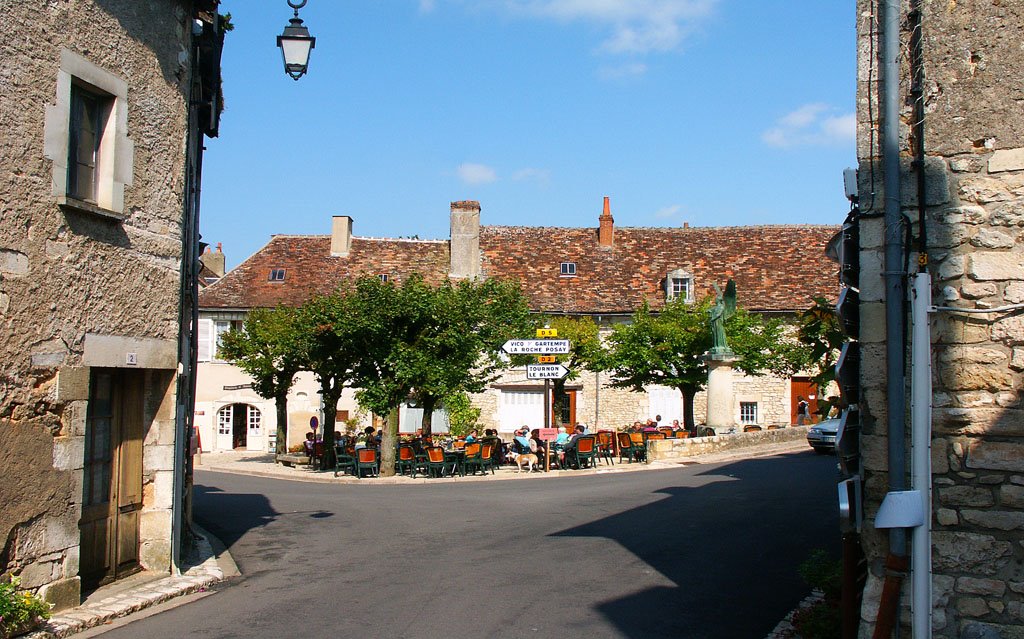
Chateau du Broutet

This chateau, which we saw one day when travelling from Argenton sur Creuse to the Brenne with Susan's parents, presents us with a problem - how to categorise the photo...

We know very little about this building and its history, except that it now serves as the Mairie for le Pont Chretien, a very pretty town on the banks of La Bouzanne river.

So - castle or town hall?


Simon

Saturday, 13 December 2008

A Different View of le Grand Pressigny


If you go down to the river in le Grand Pressigny, where the Aigronne meets the Claise and instead of gazing dreamily into the slowly moving water, turn around and look back at the town, you get this view. Two substantial bourgeois houses of some age (at least a hundred years) and a more modern looking workshop – but what is the story behind the remnant brick chimney next to the workshop? What was manufactured here – so close to these quite fine houses? Was the chimney once taller?

Susan

Friday, 12 December 2008

The Bridge at la Guerche

Not the current bridge over the Creuse built in the 1970's (from which most photos of the Chateau are taken), but the previous bridge at la Guerche.

There is a piece of stone in the car park of the Mairie in la Guerche with an interesting story...

In May 1940 France was invaded by the Germans (for the 3rd time in 70 years*) and for the French, things weren't going well. The French Government fled Paris, and took the gold reserve of the Bank of France with them to prevent it falling into enemy hands. It was moved by convoy - first to Tours, and then after the German army crossed the Loire, to Poitiers and then Bordeaux. All this was done with the Germans in hot pursuit.

To delay their pursuers the French destroyed the bridges of Descartes, Leugny, la Guerche and Lésigny. I had assumed from what I have been told that the convoy actually travelled through la Guerche, but now I am not so sure. What we do know for sure is that the bridge was destroyed at 7.15 on the 22nd June 1940. Eleven hours later (in the same railway carriage in which the 1918 Armistice was signed) an armistice was signed between representatives of the Third Reich and the French government of Maréchal Pétain.

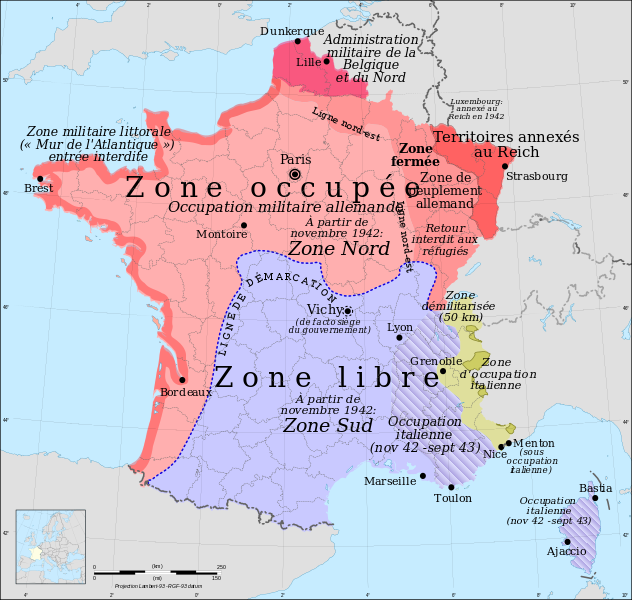
Coincidentally (or maybe not coincidentally) part of the border between what became known as Vichy France and the Occupied Region was the Creuse river, with La Guerche in the nominally French zone, and Poitiers and Bordeaux in the Occupied zone (map here). Even though the bridge was no longer there, la Guerche became an important point for smuggling people and goods across the border.

In the 30 odd years between the destruction of this bridge and the current bridge being built, crossing the Creuse at la Guerche meant either fording the river (it is only about 60cm, or 2' deep during summer) or using a boat. I imagine that neither method was truly comfortable during winter, and the populations of the pretty little villages that lie at each end of the bridge were mighty pleased when the new bridge was finished.

Simon

*It is interesting to note that it is almost 70 years since Germany last invaded France. The Common Market appears to be fulfilling its primary aim.

p.s. Tomorrow (Saturday) my house in Queensland is being auctioned. Fingers crossed everybody!

Thursday, 11 December 2008

What Do You Cook With?


There is no Photoshopping involved here...oh no no no no no...absolutely not...that would be juvenile...

Susan

(it weren't me guv, 'onest it weren't. Simon)

When I was in France with a certain daughter who was 14 and will remain nameless (hello Katherine) we had great fun with this company's name, until one day she looked at me very ernestly and said "you know - it isn't really called that". It has, however remained as butgaz in my mind. Who says girls mature faster than boys?

Our computer is working again. Hip hip and all that

Simon

Wednesday, 10 December 2008

Rue Torticienne

I like this photo.

For once, having a sign which shows which numbers go where is useful. One might almost say essential, especially for people looking for bread in la Guerche.


I looked on Google to see if there was something interesting to say about "Torticienne". It would appear from the word itself that it refers to a lady from Torti (or some form of that name), but no luck there. I did find that Tortic is a central European surname.

The only slightly interesting thing I have discovered from Google about rue Torticienne is that this seems to be the only street of that name in the world. And that la Guerche has a boulangerie (and, what's more, a boulangerie biologique) we didn't know about - at No.4 rue Torticienne.

Simon

PS Our computer at home is having problems, so if we don't respond to any comments/queries we're not being rude.

Tuesday, 9 December 2008

Spanish Fly

This is the notorious aphrodisiac Spanish Fly, actually a beautiful metallic emerald blister beetle and not a fly at all. Spanish Fly belong to the Oil Beetle family, Meloidae, and are related to the Violet Oil Beetle that I wrote about a few months ago in Big Black Beautiful Beetles. The scientific name is Lytta vesicatoria and in French it is la mouche d'espagne.


Like all oil and blister beetles, it contains a highly irritant poison called cantharidin, which can be extracted from the beetles by simply grinding them up. The ingestion of minute quantities of cantharidin causes priapism, hence its reputation as an aphrodisiac. Unfortunately, ever so slightly more than minute quantities cause permanent kidney damage or death. Today, products marketed as 'Spanish Fly' are either banned, or contain another irritant such as the relatively harmless cayenne pepper, which does not induce the immediate and pronounced blisters that contact with cantharidin would. (If you come across a beetle like this, don't touch it! This one was photographed by my mother in the grounds of the Château de la Celle Guenand in June.)

The Moroccan spice mix ras el hanout, which is very popular in France, once sometimes contained Spanish Fly along with the somewhat tastier cardamom, cloves, cinnamon, chilli, paprika, coriander, cumin, mace, nutmeg, pepper and turmeric. I make up my own ras el hanout, and I don't think it is any the worse for the lack of Spanish Fly. The spice mix has a great affinity with cauliflower, making it so delicious that even cauliphobes will eat with gusto.

Here is my recipe:

Mix together the following spices and store in a sealed jar
  • 2 tablespoons ground cumin
  • 2 tablespoons ground coriander
  • 1 tablespoon turmeric
  • 1 teaspoon hot chilli powder
  • 1 teaspoon smoked sweet paprika
  • 1 teaspoon lapsang souchong tea, ground to a fine powder
Susan

Monday, 8 December 2008

Winter Photos

Walt commented a while ago that I am posting a lot of summer photos - and he is right!

I could post autumn and winter photos like this one taken September 2007:
which I quite like, but grey just isn't my colour. So I won't post it for anyone except Walt. Everyone else look away!

So instead, another summer photo. This was taken in June this year from Roux, looking towards Preuilly sur Claise. I took over 5000 photos this summer, and winter seems the ideal time to work through them.


Simon

Sunday, 7 December 2008

More Hay

I wrote in August about the haystacks (or more accurately, stacks of hay bales) found around our area.

Here are some free range hay bales. During late July and August they roam majestically across the countryside of France, sometimes in huge groups. It isn't as majestic as the wilderbeest migration in the Masai Mara, but then I doubt anything is.


Simon

Saturday, 6 December 2008

Ahhhh is for Arboretum

Usually, I let Susan write about gardens - she is into plants (and stuff), whilst I am more a views and vistas person. As I have been to this garden twice, and Susan hasn't*, it is time for me to be brave. Luckily, this is a "big picture" garden.


The Chateau at Azay le Ferron has extensive gardens, laid out in 1856 in the "English Style". This picks up from the 18th century English fad for parkland gardens in the style of Capability Brown and Humphry Repton, but for some reason it never seems terribly convincing when done in France. To my eyes the open spaces are too wide and open and bordered by the trees, rather than an idealised naturalistic landscape with little copses scattered to draw the eye around.

I think the French are at their best in a garden when you give them a mountain of small box bushes and leave them alone for a while. Luckily, at the back of the chateau is a garden where they have done just that. There is a parterre (knot garden) and a collection of slightly weird topiary immediately behind the chateau (Any takers for the theory that great parterre gardens like those at Villandry might be a sign of borderline autism?)

I like the "bush as futuristic TV" topiary,
the "Madonna bra" is amusing but less effective.

The main attraction (and the way they market themselves) is as an arboretum. The way it is slightly oddly laid out in no way detracts from how good an arboretum the garden is, with a great collection of trees from Europe/Asia and North America, including various sequoias and cedars - big trees all.

Giant Sequoia

There is a leaflet that gives you a list of the trees so you can get your eye in, and a couple of suggested walks. I have only ever done the route marked in red on the leaflet - but the second time I walked this route I did it in reverse.

I am a rebel, me...

As you get towards the bottom of the garden the trees become more of a forest - then suddenly it opens up to a large (now unfortunately empty and not in the best of condition) round pond with fountains. There are a number of decent vistas from here, including some "borrowed views" over the adjacent farmland. The best view, however, is back towards the house.

These gardens are well worth an hour or two of anybody's time, and the chateau - although I have not yet been inside it - also looks pretty good.

Simon

*This is not quite true - Susan and I went to the garden in February, but didn't get in because we discovered at the cashier that we didnt have any money with us. Not even 3 euro each to see the garden.


Friday, 5 December 2008

Le Château de Châtelier


We came upon this little known, privately owned mediaeval château when making a visit to the prehistoric site, la Pierre Chaude, which is about a kilometre down the road from Châtelier.


The château at Châtelier itself is a great bonus view as you come winding gently down into the Val du Brignon, but the best bit is around the back. The people who live here get to access their vegetable garden by lowering the drawbridge and crossing the moat to the potager. How cool is that!

Susan

Thursday, 4 December 2008

Buildings on the Market Place – Nos 3 & 5 rue des Halles

Roger Lezeau says:

Huguet's shop, run by 'Father Mathieu' occupies two lots. Auvergnat by birth, he fell into the category of middle class shopkeeper, a group that was not lacking in Preuilly.

He went to mass and found himself thus classed amongst the 'white arses' (culs blancs*) while the 'red arses' (culs rouges*) claimed a fashionable anti-clericalism. A travelling singer, to satisfy his bistro customers, had incorporated into a song: l'père Mathieu, d'un air pieux, s'en allait prier l'bon Dieu... ('...Father Mathieu, with a pious air, would pray to the good God...')

His business was still prosperous in 1920, the habit of dressing in the latest Paris fashions having not yet reached our region. Outfits in corduroy, beige or greenish, would be unpacked and laid out during fairs.

Inside, he sold fabric by the metre, using a wooden ruler which descended from the ceiling above the vast counters. The bulky rolls were kept on shelves taking up three sides of the store.

His principal salesman, Henri Jambier, during the week, went out to the local farms, enthusiastically selling everything you could imagine for a coming wedding to everyone from the bride to the grandmother.

For this work he had acquired the first post-war car, a yellow Citroën trèfle with three seats, one in the boot (trunk) at the rear.

Monsieur Jambier, unlike his boss, was a dyed-in-the-wool Republican.

Monsieur Huguet, with the help of his wife, had five girls, but they were desperate to have a boy. In time his business was taken over by his son-in-law Lévrier.

Roger Lezeau's anecdote translated by me from his article in Les Cahiers de la Poterne, No34. Monsieur Lezeau was born in 1912 and is a great source of knowledge about the history of Preuilly.

The big glass shop window still exists, and apparently one can glimpse some tiles depicting the patron saints painted by Marie-Françoise Lévrier, but we have never seen these. The shutters on the front are very rarely open - the exception being a couple of times during summer this year. The building is now a private home, so I expect the shutters stay closed to stop sticky-beaking foreigners like me peering in, or more probably, to keep the noise and dust down in the house, as it is opposite the bus stop (3 buses a day) and rue des Halles is one of the main thoroughfares in town, so in Preuilly terms, quite busy.

Susan

*Line infantrymen (ie ordinary soldiers) in Napoleon's army wore red trousers, as opposed to the soldiers of the old army, who wore white trousers. Thus good Republicans were culs rouges, those who continued to adhere to the old ways were culs blancs.

Wednesday, 3 December 2008

Glimpses

As we spend more time in Preuilly we have time to observe some of the sights a small French town has to offer. These are the sort of thing that amuse (or maybe bemuse), whilst not being "important" enough to justify a trip just to see them.

If you keep your eyes open as you walk around town you may see delights such as this timber framed house. It isnt a cruck frame (I'm afraid I don't know the French term for cruck frame - anyone?) , but I think it is one of the close relations. This is a very old building method, common in medieval domestic building in England, but appears to have been used well in to the 19th century in our area.

There are all sorts of alleyways that make short cuts if you're walking - roads shown as "ruelle" and "chemin" are quite often formerly roads that are no longer wide enough for cars. As you look down this one in September you get an unexpected flash of virginia creeper climbing up the back of a house.

There are also little laneways like this one that leads only to what once may have been a door - now a boarded up window in what looks like a deserted grange.

These things are new to us; I think the secret is to not stop looking around as we lead our daily lives - and to always carry a camera!

Simon

PS For anyone interested in what has been happening in Thailand recently, the blog Thaidings, written by FrogBlogger, gives an on the spot, and I think, very insightful view from Chang Mai. FrogBlogger used to live not so far from Preuilly, in Châtellerault, and occasionally comments on our blog. Susan.

Tuesday, 2 December 2008

Flowering Cedars


One day in late September we noticed that the Cedar of Lebanon in the little arboretum in Preuilly had turned brown. Uh oh! we thought – it's in trouble. The weird weather, the proximity of its cousin the Deodar, have finally taken their toll.

When we looked closer though we realised that it was flowering! It was absolutely covered in male flowers. Apparently they only do this every couple of years. I hope it is a good sign, a fulfilling of a natural cycle, and not a final fling for the tree. It's interesting to see just how many cones there are retained on the Deodar too.

Susan

Monday, 1 December 2008

Angles sur l'Anglin

We have been to Angles sur l'Anglin a number of times. It is one of "Les Plus Beaux Villages de France", and as it is only 20km from Preuilly it is an easy and attractive place to take guests. I suspect that most of the photos taken there are of the chateau (and here, too) or the town square (more of a triangle, as these things often are), although the new museum (les Roc-aux-Sorciers) is well worth a snap or two.

It's easy to be blown away by a chateau on a cliff and take dozens of photos without looking around. Chateaux are such eye-catchers that sometimes it is difficult to do anything else but try and capture it - I take at least a couple photos of this chateau every time we visit. However, like a lot of French villages, there is a lot more to see if you take your time.

Angles is another on my list of places I must take more photos of.

Simon

Sunday, 30 November 2008

The Street of Little Sunshine

This is the Rue du Petit Soleil in Preuilly sur Claise.


As you can see, during summer at least, the name isn't totally accurate for part of the street. However, the street does a dogleg in front of the blue gates and runs east-west towards the chateau. I imagine during winter that end of the street gets no sun at all, because not only is it in the shadow of the hill and chateau, but it's also in the shadow of eglise Notre Dame des Echelles.

Simon

Saturday, 29 November 2008

Dolus le Sec

Yesterday I mentioned we visited the Éolienne Bollée at Dolus le Sec. It is conveniently located about 150 metres down rue de l'Éolienne, which should have been a clue the half dozen times we have driven through the village without seeing the main feature...

The éolienne in Dolus has been restored, and has been in working condition since 2002. In the photo below, not only can you see the éolienne, but also the lavoir (laundry - the low wooden building on the left) that it fed.

The Éolienne Bollée is an interesting creature. [alert: "windmill nerd!"]

Unlike most windmills, this is a true wind turbine - that is, not only does it have a turbine (the turny roundy bit that does the work) it has a stator - a set of stationary blades combined with a ring that directs the wind onto the rotating blades. This compresses the air and makes the turbine more efficient. On later models the ring around the blades was enlarged to make a slight funnel to increase the amount of wind collected.

The Éolienne from downwind.
You can see the funnel to the right of this picture

In addition, the whole ensemble has a little rotor (on the front) and counterweight (on the rear) arrangement that turns the turbine to face into the wind. The rotor is also connected to a latch that releases once the wind reaches a certain speed, turning the turbine edge-on into the wind. This stops the turbine spinning out of control in high winds and damaging itself.

The rotor arrangement on the front

There is a drive shaft inside the column that supports the turbine, and through a series of gears this drives the water pump. This is housed in a small stone building near the base of the column.

Reading what appears to be the definitive webpage on the Éolienne Bollée, I have discovered that when you bought one of M. Bollée's wondrous machines it was delivered in a kit of parts by rail to the nearest station, where the new owner had to collect it and take it to the site where it was to be erected. Then the factory would send someone out to actually piece the whole thing together. The Éolienne Bollée was modular, so to make it taller you just needed to order more of the column/spiral staircase pieces.

The maker's plate on the base of the column.

This is the second Éolienne Bollée we have seen, the first being at Confluent, near Yzeures sur Creuse. In the comments to the blog we wrote about it, Susan said:
"John Walter, who runs the Friends of the Eoliennes Bollée website with Régis Girard, tells me that our éolienne is one they thought had been dismantled, so I was pleased to be able to give him updated information."
Since then, however, I have noticed a photo in the book of old photos that there is a pic of the mill at Yzeures, showing an Éolienne Bollée by the Creuse River in Yzeures. This means either the éolienne at Confluent is a newly discovered, previously unknown one, or the éolienne at Yzeures was dismantled and moved to Confluent. It is certainly no longer in Yzeures - the factory/mill it was at burnt down in the 1960s.


Simon

Friday, 28 November 2008

Windmills

As you drive south from Loudon (usually we do this after visiting Fontevraud) there are a couple of windmills near the road.


The first is near the "Maison de Pays Loudanals" on the D347 near Puits d'Ardanne. There is a noticeboard in the carpark by the maison du pays which explains all, thus saving me some typing.


The second windmill is a couple of kilometres further south along the D347 and looks to be a lot older.


These are wind mills - used for milling grain, as opposed to wind pumps like the Éolienne Bollée.

Talking of which: when Susan's parents were with us, we visited the restored Éolienne Bollée at Dolus le Sec. It isn't nearly as obvious in the landscape as we thought it would be - as evidenced by the fact we had driven through Dolus le Sec a number of times before that visit.

Simon

Thursday, 27 November 2008

The River Claise from the Footbridge


You might recognise this photo as being where our blog title picture comes from. It was taken on the evening of 15 February 2007.


This second photo was taken mid afternoon on the 22 April 2008 from exactly the same place. I wrote at the time how much it had rained.


The footbridge in the post title is the one near the swimming pool - here on Google maps*.

Simon

*This link may, or may not work. Google have recently changed the way that Maps is navigated. As usual with software, they have apparently changed the way you operate something without changing what it does. In future, I would like every car manufaturer to shuffle the pedals every time a programmer buys a car - and maybe hide the steering wheel while they are at it. If an Austin 7 from 1922 and a Bugatti Veyron from 2006 can have all the basic controls in the same place, why should the controls in version 3.1 be so different to version 3.0 when it comes to software?

Wednesday, 26 November 2008

The Church in Fontevraud

This is not the abbey, but the parish church in the town of Fontevraud l'Abbaye.


The church of Saint Michel was built in about 1170 at the request of the abbess Audeburge of Fontevraud Abbey and built (or ar least paid for in part) by Henry II and his wife, Eleanor of Aquitaine. There are two heads carved into the vault of the choir near a rib which could be their likenesses. We haven't noticed these, even though I have taken a photo of them, so next time (and there is sure to be a next time) we are there we will report back.

This photo has a couple of interesting features: the heads which are supposedly those of Henry and Eleanor; and the blocked windows over the altar, which have subsequently plastered over and the whole wall painted to look like cut stone.


The church was expanded in the fifteenth and seventeenth centuries, but the Romanesque core of the building is still evident - the blocked up rounded windows in the above photo, for instance, and the generally half rounded rather than pointed arches. I don't know if the low porch all around the building as shown in the top photo is unique (or even particularly romanesque), but I do really like it.

The gilded wooden altar and surrounds come from the abbey,
where they were erected in 1621.

I don't know where the altar in the side chapel comes from,
but I suspect it was also from the abbey.

Simon

Tuesday, 25 November 2008

Psssst.... wanna buy a truck?

Taken near Argenton sur Creuse. That camouflage really doesn't work, does it?