Thursday, 21 April 2016

Early Spider Orchids


Showing the backs of the flowers. You can see they are shaped more like an apron than a pocket.

The Early Spider Orchids (Fr. Ophrys araingées) are flowering in the orchard, so here is some pictures.

These are a particularly rich burgundy colour on the labellum (the lower petal), with no yellow border.

This one shows the shiny lilac 'landing strip' to give the bee pollinators somewhere to aim for.

Wednesday, 20 April 2016

A Prickly Customer


On Monday Célestine was due to go back to the mechanic to investigate various noises and clunks. When we came out of the house to head off I noticed a small Hedgehog (Fr. hérisson) skulking in the driveway. It tried to pretend it wasn't there and I took some photos of it.


Then I put on some gloves and moved it to behind the barn so it was at no risk of being run over. It was a bit frightened of us but didn't seem to be injured so I left it to sort itself out. It poked about under the steps of the barn then in the vegetation. By the time we returned from dropping Célestine off at the mechanic's the hedgehog had disappeared.


Tuesday, 19 April 2016

La Chapelle de Notre-Dame de Lorette


Notre-Dame de Lorette is a troglodyte chapel in the valley of the Courtineau river near Saint Épain. It is privately owned.

The chapel.

The chapel is carved into the rock and under the patronage of Our Lady of Loreto. This 15th century oratory has its origins shrouded in mystery, as evidenced by the crescent carved into the door lintel. Inside there are apparently interesting sculptures in the rock too, but the door was locked and I couldn't see anything through the windows. I missed a central arch which is decorated with a carved cross on its entire length and two arched arcades that adorn the wall. There is also a representation of the Holy Trinity, with God as a bearded old man, his Son symbolised as a tomb, and the Holy Spirit shown as a bird with outstretched wings, all overlooked by two kneeling angels. Then there is a short stone frieze and a carved coat of arms. Unfortunately I didn't get to see any of it. According to tradition, Joan of Arc sheltered from the rain here as she traveled from Sainte-Catherine-de-Fierbois to Chinon on 6 March 1429. Each year, this is a place of pilgrimage on the first Sunday in October.

The little house attached.

The chapel is adjoined by a dwelling created at the same time, cut into the rock and lit by a mullioned window and a door with a decorated lintel. It comprises two rooms, one of which was heated by a fireplace cut into the rock. The crescent arms are found carved into the mantelpiece here too. Not far from the chapel is a fountain dedicated to Saint Mark which was once a destination for many pilgrims.

The door to the chapel, with its mysterious crescent coat of arms.

It is listed as a Historic Monument. Many people believe this place was sacred long before the chapel was constructed or the area Christianised.

A substantial seam of flint runs through the stone the chapel is carved from.

It is very easy to find, just north of Sainte Maure de Touraine, and turn west off the D910, signposted Vallée de la Courtineau. It is a kilometre or two down a quiet country road that meanders along in the valley of the river and there is a carpark in front of the chapel. It makes a good base for a walk.


Monday, 18 April 2016

The Museo Storico Alfa Romeo

It's Simon's turn to do Mondays in Milan / Les lundis en Lombardie

I hinted at this after we returned from Milan, but it never quite made it to the blog. When we were in Milan my mate Alex and I ventured past the city limits to Arese, a journey not to be undertaken lighty if you don't have a car. (It takes an hour, even using a taxi for the last 15km).

The Museo Storico Alfa Romeo is a combination museum, reference collection and shrine to all things Alfa, from aero engines to Formula 1 via family cars and road racers. It is on the site of the factory Alfa Romeo opened in the 1960s, and although cars are no longer made there it is still the site of the head office.

Take note of the spelling, you'll need to know it when
 buying my birthday present. That's G.i.u.l.i.e.t.t.a...

There are many many cars there, from the obscure to the bizarre, and some that I even remember from seeing on the roads. Of course, visiting a place like this with a self admitted rev-head whose father had a string of Alfas when they were living in Italy in the 60's and early 70's really added to the day: stories of long summer voyages from Milan to Rome in pre-autostrada times were really evocative.

Did I say bizarre? This 1913 car has the engine inside the cabin.
And portholes

The museum is spread over 5 floors, with the cars arranged by theme - pre world war 2, post war family cars, exotica, road racers of all periods, experimental cars, and modern racing cars. Most of 'em rather quite nice, even if, as we have already seen, not always practical.

And then there is this... the Alfa Romeo 8C 2900B Lungo
with Carrozzeria Touring Superleggera body. Mmmmm nice

Alex's dad had one of these - a 1962 Giulia Super

We spent a very interesting couple of hours at the museum, and I have to say it is beautifully presented. If there was only a way to get there by public transport when the temperature is nudging 40C.

Did you see what I did there? A whole post about Alfa Romeo and not a red car in sight! Next time, maybe.

Sunday, 17 April 2016

Fogg Dam Fungus


This striking banded fungus was found trackside on one of the Fogg Dam walks. I've no idea what species it is.

Our post on Sundays has an Australian theme. You can see our other Australian posts here.

Saturday, 16 April 2016

How the Heck is the Postman Supposed to Reach That?


Earlier in the year Carolyn Knowlman contacted me and asked me if I would like a couple of nest boxes for European Swift Apus apus. She is spearheading a campaign in Amboise to put up nest boxes on as many buildings as possible. I was absolutely delighted and said 'yes please!'

 One of the nest boxes, showing the interior with its glued in ring to create a base for the nest.

The next challenge was to find someone with a long enough ladder who could fix them to the back of our barn, just under the eaves. This is north facing and just to the left of the downpipe was deemed ideal for swifts by Carolyn. I emailed everyone I could think of who might have a ladder suitable for working at about 8 - 10 metres off the ground. Several French friends suggested I contact the fire brigade or a local roofer, but luckily Dennis got in touch to say he had a suitable ladder and could do it. On Tuesday he and wife Angela came over and the job was done. Longtime readers may remember Den and Ang as the lovely people who delurked as blog readers several years ago in order to offer to bring our bargain priced range hood over from England.

 Dennis arrives with his longest ladder. Turned out his second longest ladder would have done.

Carolyn has convinced the Amboise town hall to install nest boxes on various buildings, and her friends and acquaintances are all encouraged to do so too. Her best result so far has been some friends in Amboise who put up some boxes last year. They were occupied by swifts within three weeks of going up. Now the house has 28 nest boxes under the eaves, ready for this year's arrivals.

 Dennis finurkling.

I picked the boxes up from Carolyn on the day I went up to Vouvray to look at the wild tulips. I showed them to Charles at Chateau Gaudrelle as he is busy renovating an old farmhouse in Esvres and has already instructed his roofers to be careful not to disturb the House Martin nests. He queried whether the nest boxes should be painted, worried that the paint might off-gas which would be bad for the birds, or they might just not like it. Carolyn reassured us that modern paint is much less noxious than in the past and the swift conservation groups now take the view that it is better to prolong the life of the nest boxes by painting them on the outside. They are not painted inside.

 My two nest boxes installed on the back of the barn. They look rather like improbably high letter boxes.

She also advised that someone like Charles, who is still renovating, should ideally go for swift nest bricks which are built into the wall or leaving gaps under the eaves so they can access the roof space. Swift bricks look like a concrete block with an entry hole and are just incorporated into the wall like an ordinary brick or block. If it is too late for a nest brick, the nest boxes like I have installed are a good alternative. They need to be placed as high as possible, with a clear flight path for approach, not on a south facing wall. Ideally a recording of swifts calling should be played as loudly and as often as possible from mid-May onwards to attract the swifts to your nest boxes. A hour long CD can be purchased for very little from Swift Conservation.

 They fit very discreetly between the rafters under the eaves.

Nest boxes themselves are quite easy to make and there are lots of instructions available on the internet. This version is the one Carolyn recommends. The idea is that they are fixed to the wall through the back, but Dennis suggests that the back be extended beyond the sides so that they can be fixed without having to fiddle about in the limited space inside the box under the eaves. The opening faces downwards so that the less aerially adept sparrows are discouraged from taking possession of the boxes before the swifts even arrive.

The nest boxes are becoming essential for the swifts. Their breeding success is starting to be affected by the loss of nesting spaces in buildings as people renovate and block holes up.


***************************************************

Questions? I will be interviewing Laurence, one of our local bakers, on Tuesday, for a future blog post. If there is anything you would like me to ask her, let me know, either in the comments section below or by emailing me via my profile on the right hand side bar.

Friday, 15 April 2016

Disgruntlement All Round on the Tours - Loches Line


For years there have been lots of complaints about how inexplicably inadequate the train service between Tours and Loches is. Henry James made some rather exasperated comments about it a hundred and forty three years ago. There are especially complaints about the 6.20 am train, which is the one many commuters use. The journey of 47 km from Loches to Tours takes 61 minutes at an average speed of 46 kilometres per hour. The commuters from Loches complain that the train is often late. They describe contacting their local, departmental, regional and national authorities to complain as being about as effective as throwing a message in a bottle into the sea. No one ever responds.

Tours station.

The commuters get alerts by text message to their mobile phones when the train is going to be late. The reasons given range from 'equipment unavailable' to 'late leaving the depot'. It might be 5 minutes, it might be half an hour. Often the train is delayed because of a freight train sitting in Reignac sur Indre station. When that happens commuters sometimes resort to calling taxis, but often by the time they arrive the train has moved off again. They could choose to wait for the next scheduled service, which in fact is a rail replacement bus. But it is always full. The commuters joke that in Loches it isn't the early bird who catches the worm. (The French expression is l'avenir n'appartient pas à ceux qui se lèvent tôt, which translates as 'the future belongs to those who rise early'.)  Luckily most people's employers understand.

The interior of Tours station.

The commuters have considered car sharing as an alternative but decided against it. The train fare is part subsidised by their employers so that it costs each commuter €40 a month (or a euro per trajectory). To travel any other way would be more expensive.

Loches station, with train replacement buses parked outside.

The commuters want to have a meeting in Loches one evening, with the regional authority. Despite the announcement to modernise the line, regular passengers doubt there is any political will to invest in it long term. The modernisation is enshrined in the Regional Plan for 2015 - 2020 and is set to cost 40 million euros. That's 19 million from the national government, 19 million from the Region and 2 million from SNCF (the French National Railway Company). Every month there are 59 000 passenger journeys on this line, which is a single track, non-electrified route built in 1878.

And it's not just the passengers who are disgruntled. The railway union CGT wrote to the Regional Vice President for Transport in March this year. "For several years, the Tours / Loches line has suffered from numerous shortcomings causing the growing dissatisfaction of the users but also frustration within the railway, who are not given the means to ensure a quality public service." They say the upgrades scheduled for 2018 do not compensate in any way for the current problems. They also want a meeting, with the local railway bosses and Tours-Loches line Development Committee. The last meeting between these groups was in 2013.


To read our other posts about Loches (which are mostly glowing paeans of praise about this lovely historic town) click here.

After the recent newspaper articles about the inadequacies of this railway line the Nouvelle République ran an article claiming that a local retired mechanic has come forward and on Friday demonstrated his 'mini-bus-on-rails' solution. According to the article he has been working on it in his shed for a while, intending it for the long closed Loches-Chateauroux line, but it occurred to him that his idea could also work for Loches-Tours. The date of publication is significant.

Thursday, 14 April 2016

The Real Life Tintin


At the Chatellerault classic car swap meet on the weekend the Chatellerault Motor Museum was displaying a 1926 Gillet-Herstal motorbike that had circumnavigated the globe.

 Gillet-Herstal motorbike, Belgian, 1926.

Its vital statistics were as follows:
  • Origin -- Belgian.
  • Motor -- single cylinder two stroke 350cc.
  • Carburetor -- AMAC.
  • Lubrication -- mixed and manual pump.
  • Transmission -- chain.
  • Gearbox -- two speed.
  • Brakes - drum front and rear.
  • Supplementary petrol tank with around 40 litres capacity.
Ridden by Robert Sexé, French motorcyclist, reporter and photographer, this particular motorbike achieved the first circumnavigation of the world by motorbike between June and December 1926, travelling more than 25 000 kilometres to cross Europe, Asia and North America. After this exploit Robert Sexé continued to ride the bike, up until the end of the 1960s, by which time it had several hundreds of thousands of kilometres on the clock.

 A cardboard cutout photo of Robert Sexé looking dashing on his motorbike.

According to legend, the famous cartoonist Hergé would be inspired by Robert Sexé to create the character of Tintin. The character of Milou (Snowy in the English language version) is named after another motorcyclist of the period, René Milhoux, who always wore white overalls. The chateau of Cheverny is the inspiration for Captain Haddock's residence Moulinsart (Marlinspike Hall in the English versions).

Wednesday, 13 April 2016

Loches Market


With 34 stalls per 1000 inhabitants, Loches market, in the heart of the town, is the second most important market in the Département d'Indre et Loire. For comparison, there are only 7 stalls per 1000 population in Tours. According to a recently published study reported in the paper recently, the market is growing year on year, unlike most of the markets in the Touraine.


Between the stalls, people meet one another. They discuss current events, the weather and pass on their news. Obviously, they do their shopping as well. Every Wednesday and Saturday the market in Loches attracts customers from the north of Indre to Cormery. Its success continues to grow, as evidenced by the annual survey of markets of Indre et Loire, which is published by the Observatory of the Economy and Territory of Touraine.


The report shows that the two weekly markets in Loches have the strongest growth in terms of numbers of vendors. Between 2005 and 2015 the total number of stalls per week has increased from 135 to 220. This positive growth means that the sud Lochois is the only area in the département where market sales figures are inceasing. Everywhere else in the département markets are shrinking at about the same rate and the report notes this with disquiet. But Loches is one of the few towns that is bucking the trend (Chinon is another example). In comparison, over the same 10 years, the markets in Tours have lost 400 vendors. Over that period the report estimates that vendors at Loches have increased by 63%.  The market manager, who was appointed in 2001, says he would say the increase is 'only' 50%.


At the moment Loches is the seventh largest market in Indre et Loire in terms of vendors. It is second, just behind Bourgueil, in terms of number of stalls per population. That's a sign of what an attractive proposition the market is for stallholders.


The south Touraine has seen growth overall of its markets of 11.5%, whereas the conurbation of Tours has seen a drop of 22.2% in the number of vendors. In Pays Indre et Cher (Monts, Esvres, Veigné, etc) the loss is 28.7%. The biggest market is that of Amboise, far in front of the main market in Tours.


We've written about Loches market a number of times before. In 'The Offal Butcher' and 'The Tarte Tatin Man' I wrote about specific stalls. In 'Local Green Asparagus!' I wrote about how pleased I was that a local asparagus producer now sells green asparagus at Loches market, when previously it had been more or less unobtainable (the local taste is for white asparagus). In 'Blessed are the Cheesemakers' I included a section on the various cheese stalls in Loches market. In 'The Last Market Day Before Christmas' I describe going to Loches market just before Christmas. In 'On the Road Again' Simon wrote about house hunting and the part Loches market played in our choice to live where we do.

Tuesday, 12 April 2016

Vendeur Premieres in Preuilly


Last year French film writer and director Sylvain Desclou brought a film crew (Fr. équipe du film) to Preuilly for the filming (Fr. tournage) of Vendeur ('Salesman') on location. We drove past them when they were filming in the cemetery. The decision to film in the area came about because the director's family comes from here and he spent childhood holidays here with his grandparents.

On Saturday night the finished film was premiered in the salle des fêtes (the town function rooms, which double as the cinema once a month).  We went with Niall and Antoinette and the room was packed by the time we arrived. Luckily we spotted a group of four seats in a row on the left hand side of the room and grabbed them quick.

Pantechnicons and coaches parked outside the mediatheque last February for filming in Preuilly.

The film is about a salesman, Serge (Gilbert Melki), who is very good at his job, but has sacrificed his family and his health in the pursuit of his career. He works in a kitchen showroom, for Daniel (Pascal Elso) and describes himself as an itinerant (Fr. un bourlingueur). His son Gérald (Pio Marmai) is a chef who has just lost his restaurant. He comes to his father to ask for a job selling kitchens. At first he is hopeless at it, but with coaching from Dad, finally gets the hang of it -- rather too well. Serge realises his son is making the same mistakes he did and tries to warn him. He is also distinctly miffed that Gérald is starting to beat him in the monthly sales figures. Ultimately, after a health scare Serge deliberately sabotages Gérald, causing the break up of his son's marriage (Clémentine Poidatz plays his wife Karole) and the loss of his own job with Daniel. At the end of the film we see that Gérald has re-established himself as a chef, but Serge is unable to give up the buzz of selling and has moved to the south of France to sell swimming pools.

Quite early in the movie we started recognising places, such as the roundabouts at Chambray les Tours. A real frisson went through the audience only when the scenes became really local though. Serge drives along the road to Chaumussay in his classic black 1980s BMW and the murmur rippled through the assembled population -- 'Look, it's La Forge...' Later views over Preuilly were very recognisable and we identified the house used as Serge's father's. Our neighbour Gilles says he caught a glimpse of his own house and another neighbour's.

The  Q&A session: (left to right) Gilles Bertucelli, mayor of Preuilly; Sylvain Desclou, writer and director (with microphone); Clémentine Poidatz (Karole); Pascal Elso (Daniel).
Photo courtesy of Antoinette, who took this with her phone as none of us had thought to bring a camera.

After the film finished there was a question and answer session. The writer and director (Sylvain Desclou), two of the actors (Clémentine Poidatz and Pascal Elso), the casting director and a couple of the finance people sat on the edge of the stage and took questions from the floor.

Q: How long did filming take?
A: Eight days in a real kitchen showroom, three weeks around Tours and in the south Touraine, 38 days in all. The nightclub scenes were filmed in a real nightclub (Fr. boîte de nuit) in Saint Pierre des Corps. The main filming started in January of 2015 and was finished by the end of April. Then from May to November of that year a team of 50 people worked on the film making it ready for release.

Q: What was the budget?
A: 3 million euros. (There was a buzz at this information along the lines of 'goodness what a lot of money', but the director went on to explain that this is a tiny budget and has to cover a team of dozens of people for about a year, quite apart from all the actual filming.)

Q: How long will it take to break even?
A: No idea. That's a question for the distributors, and will depend on how long it stays in cinemas, how good the audience figures are and when it's released for television. It will premiere on Canal+ in two years time.

Q: There was a lot of drinking in the film. Are the drinks real?
A: No, they are syrups or teas. The cigarettes are real, but the lightest possible. The cocaine was real (joke).

Q: What research did you do about the life of a salesman?
A: The director talked to salesmen in a number of fields, not particularly kitchen showrooms. He wanted to focus on the sort of character whose skill is selling (it doesn't matter what) and will move from franchise to franchise to practise his trade, making money for himself and his boss. A whiteboard with the sales figures on it features prominantly in the film, and the director talked to a franchise manager so he could understand the figures. Gilbert Melki had worked as a saleman before he became an actor.

Q: At the end Gérald is shown as the proprietor of the Moulin Fleuri. Is that the real restaurant? (It's at Veigné and was where Edward and Mrs Simpson had their wedding breakfast.)
A: Yes.

Q: How do you cry on demand?
A: Pascal Elso admitted that he always had to cheat with fake tears, but that Clémentine Poidatz felt things quite intensely and cried very easily.

Q: What training did you do to become an actor, director, casting director...?
A: Pascal Elso responded that he had done a lot of theatre and had rather a fragmented training. Clémentine Poidatz said her background was fairly classic, beginning with chosing the right high school, then the Comédie Française. She said she didn't like doing theatre and preferred filming. The casting director had started as a stylist, and the director said he had done all sorts of things, most not related to film and had originally studied political science and economics.

Q: How was the music chosen? Why did the songs all have English lyrics? Why were there no songs with French lyrics, in particular, no chansons? Wasn't an opportunity to convey an extra nuance missed by having songs in a language the audience didn't understand?
A: Although it was fairly clear that the director had chosen the music, it was the actress Clémentine Poidatz who waded in and answered the question most fully. She countered that the songs were there to add atmosphere, a feeling and that the lyrics were not as important as the music (for a French person that is a difficult one to swallow...) The songs had clearly been carefully chosen, by someone with taste and a flair for matching song and action. They were all driving songs, a mixture of British and American and with an urgency of beat that no chanson would have been able to provide. Assuming that you understood English, the lyrics were remarkably appropriate too. (Simon was impressed to note that a song from incomparable John Martyn had made it onto the soundtrack).

Q: What will your next film be about?
A: It will be set in the world of politics (at which point the woman behind us went 'well that won't be set in Preuilly then...') and about a young woman from a humble background who becomes a lawyer and joins the team of a government minister.

During the Q&A session a man stood up and said he didn't have a question but rather a 'proclamation'. He referenced a joke from the film about fathers and it turned out he was the director's father. He wanted everyone to know how proud he was of his son. It was really touching and Clémentine Poidatz promptly shed a few tears.

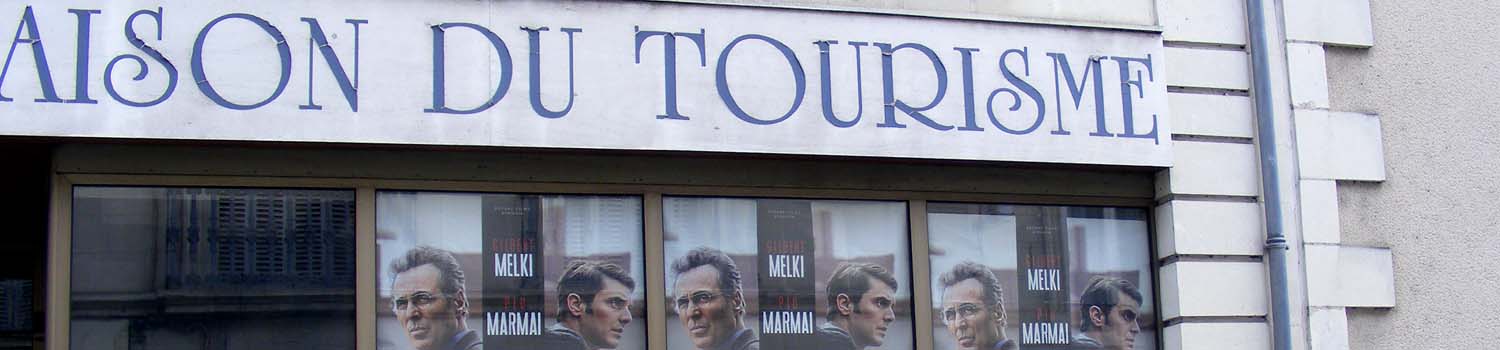
The poster for the film, displayed in Preuilly's main street.

Once the questions had dried up everyone was invited to go downstairs for a drink. We didn't stay, but friends who did report that at the end of the night they were rewarded by seeing the producer drive off in the classic black 1980s BMW that Serge drives in the film.

We thoroughly enjoyed the evening and thought the film was well cast, well acted with some nice comedic touches (Serge ineptly stuffing a pillow into a pillowcase when he comes to stay with his father for example), good directing, shooting and cutting and a believable and interesting storyline. The film is released to the big wide world tomorrow. Here is the media kit (in French).


Monday, 11 April 2016

Sixteenth Century Saints 'n' Stuff


Mondays in Milan / Les lundis en Lombardie


This 16th century painting hangs in the Castello Sforzesco. I can tell it is the right hand section of a triptych, the central panel of which I believe is a Madonna and Child. I can also tell it is Saint Roch standing on the left and Saint Sebastian on the right. Saint Roch is wearing his trademark sun hat and carrying his staff (looking quite different from this amusingly graphic 20th century version I wrote about in January). Likewise, Saint Sebastian isn't looking too tortured. Unusually, he isn't depicted here as a human pincushion. Instead, he is shown delicately holding an arrow in his right hand. The three kneeling characters are probably members of the family which commissioned the triptych and donated it to some church. The two younger women are wearing plain but generously cut dresses. They are dressed fashionably but not very ornately, suggesting that their status is comfortable but not in the wealthiest or aristocratic circles. The older woman on the right is presumably an attendant, with her narrower set in sleeves, plain turban and apron.

I can tell all that just by looking at the painting. Unfortunately I can't tell you who the artist is or anything else about it. The museum label is blurry in the photo, and I can't remember anything else about it.

But it's a nice 16th century painting all the same.

UPDATE: With help from Simon I have now identified the painting as Saints Sebastian and Roch with Donors by Pseudo-Boltraffio. The delightfully named Pseudo-Boltraffio is a catchall covering painters from the Lombard School between 1500 and 1530, most of whom were students of Leonardo da Vinci. Their styles are so similar that in many cases the individual artist can no longer be identified.

Sunday, 10 April 2016

The First Time I Saw..

... Loches.

After our first foray into real estate buying in France, Susan had to take a rest by trekking across half of Australia with her family. This left me with an ambition to buy a house, but no way known was I doing it by myself.

Online, I had found two small houses for sale in Loché sur Indrois. They looked good on paper (as it were), and were within budget. I really wanted to see them: I had reached that stage where I was ready to leave London and start the next adventure, but that adventure didn't extend to talking to real estate agents on my own. I rang our friend Bryan and asked, if he wasn't doing anything, if he would like a trip to France. He was doing something, then suddenly he wasn't (meeting rescheduled), and suddenly we had a three day window in the middle of the week where we could go.

 The first photo we ever took of Loches.

Bryan was living in the Lake District at the time, so I booked a ticket on BMI Baby from Durham Tees Valley Airport for him, and myself a ticket from Heathrow, both timed to arrive at Paris Charles de Gaulle within 30 minutes of each other. I also booked a car. Driving around Paris in rush hour is not much fun, but we were amused by following a circus trailer carrying a crocodile.

We reached Amboise before deciding to call it a night. Seeing the chateau of Amboise for the first time, all lit up and glowing in the dark, was magic. Having breakfast in a cafe at the base of the chateau walls was no less magic.

After breakfast we drove to Loches, to stay in the (let's be kind here...) idiosyncratic Hotel George Sand. And that's the first time I saw Loches: 10 April 2006.

(For more details, the original trip report is here)

Saturday, 9 April 2016

Sometimes I Forget


Well - not forget exactly, but maybe fail to remember.

For some reason, there is nothing in my brain which causes me to remember that we own two Citroën Traction Avants, and that this isn't exactly typical for blokes from Australia. It only really strikes home when I see the cars together.

On Thursday we had a group of clients that required the two cars, and I have to say I think we looked epic on the road to Loches.


It's rare that both cars are in the same place: usually one is in the secret garage location in Saint Pierre des Corps, and one is at home. At the moment it is Célestine at home and Claudette awaiting the next client.

**************************************************

Chenonceau Tickets: We've ended up with an adult and a child ticket  for Chenonceau that we can't use. They are valid until 14 April. If you would like them, please get in touch (email addresses on our profiles on the right hand side bar). We will happily give them to you for free.

Friday, 8 April 2016

A Greenway to Replace the Railway?


A feasibility study to establish a greenway has been commissioned in the south Touraine. The Communauté des Communes (a group of local authorities) have obtained a provision for a 10 year renewable lease of a section of the old railway line between Port de Piles and Le Blanc, unused since 2005. They envisage creating a greenway and a company to design the project has been engaged.

The line at Le Grand Pressigny.

To begin the diagnostic phase local councillors met those doing the study at Chaumussay station. Councillors from Tournon-Saint-Pierre, Bossay, Preuilly, Boussay, Chaumussay, Grand-Pressigny, Abilly, and Descartes attended and saw the initial ideas for the project.

The line between Humeau and Chaumussay, running alongside the Claise River.

Positive elements, such as the proximity of picnic areas in Chaumussay and Bossay, were looked at, as well as problems to be solved, such as how to cross major roads. The greenway is going to ban the use of motorised vehicles of any sort. It remains for certain choices to be made once the diagnostic is done -- pedestrians or cyclists, and if applicable, what type of bicycles. Once the diagnostic study has been signed off a feasibility  study will examine the technical issues in the light of legislation, environmental constraints and landownership. A financial evaluation of the project will be done, which will look at both costs but equally, the positive economic benefits that could result.

The line at Humeau. They'll have to be quick if they want to preserve the railway signage in situ. 
The rusting metal kilometre sign in this photo has already disappeared.

During the visit several ideas were aired by the Councillors, such as the preservation of most of the existing infrastructure (bridges and tunnels) and railway signs. Setting up information panels with photos and history of the line were advocated. If this study deems the project feasible a tourism development phase will implement a series of measures to promote and operate the project. This could include creating a label for nearby accommodation, shops next to the greenway, signage and events relating to the various districts that the track passes through. The feasibility study group cited examples of similar projects that have succeeded and have expanded to double the length of their walking and cycling tracks in a linked network.

Chaumussay station.

I think it's a terrific idea. I've walked the line between Chaumussay and Preuilly and it is peaceful, attractive and once it's a walking track not a railway with sleepers, rails and bridges in dodgy condition, will be suitable for all levels of fitness. There are obviously possibilities for linking to the section through Le Blanc, with its impressive viaduct. I predict dog walkers and bird watchers will love it.

Back in 2012 Simon wrote about plans at that stage for the line in 'The End of the Line?'. The Nouvelle République reports on the current plans here.

Thursday, 7 April 2016

Pavement Pansy


I was amused to find this pansy having seeded itself in a crack in the gutter along the side of our house. It hasn't bothered growing more than a couple of leaves before sending up this large and pretty flower. It's currently on it's second flower, and there is another to come.