Monday, 18 November 2019

Toxic Mushrooms Kill Every Year in France


A wild foraged Bay-brown Bolete prepared and ready to cook.
A wild foraged Bay-brown Bolete Xerocomus badius prepared and ready to cook.  Indre et Loire, France. Photographed by Susan Walter. Tour the Loire Valley with a classic car and a private guide.

Every year a quite remarkable number of people manage to ingest toxic mushrooms in France. Over a thousand people every year are treated for mushroom poisoning, and 30 to 40 people will die.

There is always a sharp spike in incidents at the beginning of the mushrooming season in October. I find these figures astonishing.

In a country where mushroom picking is a popular pastime and where there are innumerable really knowledgeable people out there to learn from, just how do people manage to misidentify mushrooms so frequently? What is really difficult to believe is that these people are eating mushrooms they have themselves picked, and they cannot apparently tell a gilled mushroom from a mushroom with pores and tubes.

I am just astounded by how unobservant these people must be.

Death Cap Amanita phalloides (Fr. Amanite phalloïde) -- extremely toxic.
Note the sickly yellowy beigey greeny cap and the volva (a sort of sack at the base of the stem). 
Death Cap Amanita phalloides.  Indre et Loire, France. Photographed by Susan Walter. Tour the Loire Valley with a classic car and a private guide.

More often than not people are eating the lethal Death Cap, thinking they are eating nice safe, delicious Ceps!! The most recent episode was in Deux Sevres, where a woman died and her husband and sister in law were hospitalised, seriously ill. In the same fortnight, at the end of October, there were nearly 500 other cases of mushroom poisoning in France, as the weather changed and the mushrooms appeared.

Dark Cep Boletus aereus (the approved vernacular name in French is the Cèpe bronzé, but in rural areas it is still usually referred to as the Tête de nègre).
Dark Cep Boletus aereus.  Indre et Loire, France. Photographed by Susan Walter. Tour the Loire Valley with a classic car and a private guide.

Mushrooms in the Boletaceae (Ceps and boletes) family are easy to recognise (I would have thought!!) because they do not have gills, but a sort of sponge made up of pores called hymenophores under their caps. Ceps (Fr. cèpes) and boletes, also often known in English by their Italian name porcini, are the most widely sought after wild foraged mushrooms.

They have the advantage of being easy to recognise and having few species that will poison you. There are only a couple of poisonous species possible in this area. None are deadly, and foragers will be put off them by their appearance or taste long before ingesting enough to cause digestive upset.

Many boletes stain very unappetising colours such as blue or black when broken, and some taste very bitter. Breaking a small piece off the cap and watching for staining, plus tasting the piece then spitting is an essential part of checking the identity of these mushrooms.

Staining or bitterness is not an indication that the mushroom is poisonous per se -- numerous boletes that stain or taste nasty are non-toxic -- but it does mean that you are unlikely to make the mistake of eating the poisonous ones because they will be amongst those that you reject as they don't look or taste nice. Boletes with red pores and flesh that stains blue should always be avoided.

Left, Bay-brown Bolete Xerocomus badius (Fr. Bolet bai) and 
right, Edible Cep Boletus edulis (Fr. Cèpe de Bordeaux).
Left, Bay-brown Bolete Xerocomus badius; right, Edible Cep Boletus edulis.  Indre et Loire, France. Photographed by Susan Walter. Tour the Loire Valley with a classic car and a private guide.

Death Caps are responsible for 90% of deaths related to mushroom consumption in Europe. They contain a toxin which damages kidneys and livers, which is not destroyed by cooking, drying or freezing.

The initial symptoms are digestive discomfort, with diarrhea, nausea, vomiting and abdominal pains within 5 -12 hours of consumption and lasting for a couple of days. This can lead to dehydration, hypertension, tachycardia and hypoglycemia.

Then typically the symptoms fade for several days, only to return once it is too late and irreparable damage has been done to the kidneys and liver. Delerium, fits, coma and death after 6 - 16 days result if treatment is not sought.

Early treatment usually involves activated carbon or stomach pumping plus rehydration, later treatment a liver transplant, and is not guaranteed to succeed (10 - 15% of patients still die, especially children). There is no recognised antidote to the toxin.  

The lethal dose can be as little as half a cap. Many mycologists will advise never eating any Amanita spp, but especially the white gilled ones, as a precaution. Others will go so far as to say do not even touch Death Caps and do not eat any mushroom which has any possibility of being contaminated by proximity to a Death Cap (eg in the same picking basket).

Curiously, some mammals, such as rabbits and squirrels, appear to be able to eat Death Caps and suffer no ill effects. Slugs can also eat them, but this is less surprising as their digestive systems are very different to ours.

Orange Oak Bolete Leccinum aurantiacum (Fr. Bolet orangé)
 -- edible but not the most prized species.
Orange Oak Bolete Leccinum aurantiacum.  Indre et Loire, France. Photographed by Susan Walter. Tour the Loire Valley with a classic car and a private guide.

Edible Cep Boletus edulis (Fr. Cèpe de Bordeaux). 
Note the fine pale border to the 'nubuck' cap, and thick, 'vase shaped' stem.
Edible Cep Boletus edulis.  Indre et Loire, France. Photographed by Susan Walter. Tour the Loire Valley with a classic car and a private guide.

Scarletina Bolete Neoboletus praestigiator (Fr. Bolet à pied rouge). 
An edible species, although most people do not risk it, 
because of its resemblance to a toxic species and its generally unappetising appearance.
Scarletina Bolete Neoboletus praestigiator.  Indre et Loire, France. Photographed by Susan Walter. Tour the Loire Valley with a classic car and a private guide.

A mixture of toxic Panther Cap Amanita pantherina (Fr. Amanite panthère) 
and edible Blusher Amanita rubescens (Fr. Amanite rougissante).
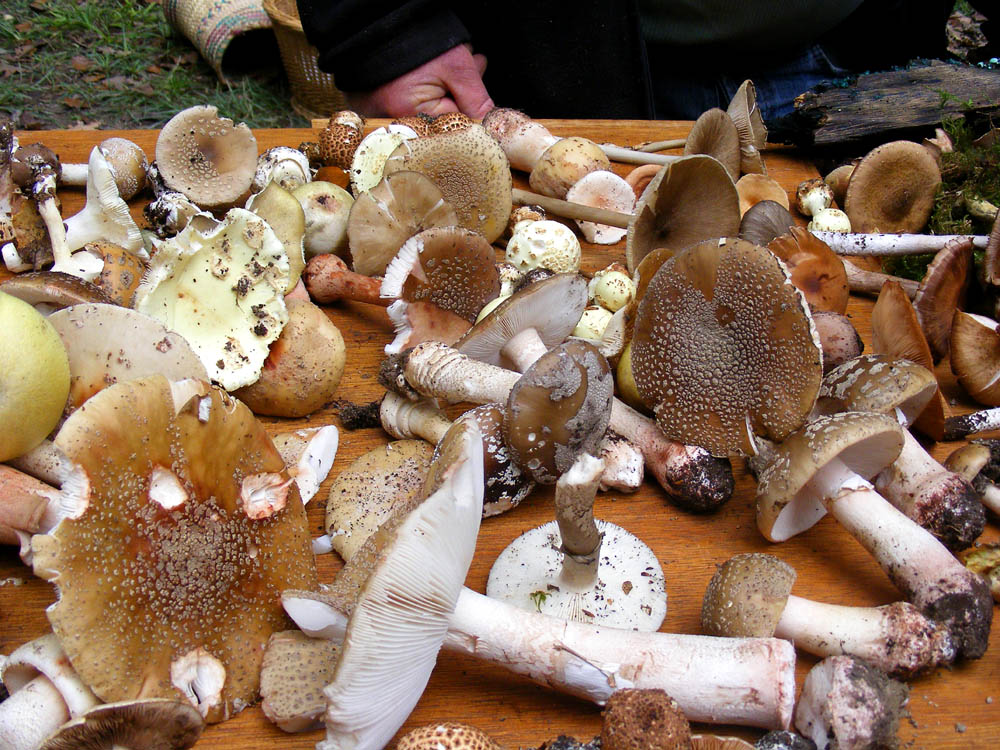
A mixture of Panther Cap Amanita pantherina and Blusher Amanita rubescens. Indre et Loire, France. Photographed by Susan Walter. Tour the Loire Valley with a classic car and a private guide.
The mushrooms in the photo above are closely related to the Death Cap, and possess the same white gills. Gills (Fr. lames) are the delicate structures that radiate out from the stem under the cap of many mushrooms.

The gills of the button mushrooms Agaricus bisporus (Fr. champignons de Paris) that you buy in the supermarket start off pink and go brown with age. The gills of Amanita spp, many of which are toxic, are white.

That is why it is sage advice to avoid all white gilled mushrooms unless you are a very experienced forager.

Dominique Tessier, an experienced mushroom surveyor, 
explaining the key characters to look for in the Death Cap he is holding.
Lesson on how to identify Death Cap Amanita phalloides.  Indre et Loire, France. Photographed by Susan Walter. Tour the Loire Valley with a classic car and a private guide.

Didier Raas, an expert mycologist and pharmacist from Loches, holding an Edible Cep during a public outreach and fungi education session (other boletes on the left hand end of the table).
An expert pharmacist/mycologist conducting a public outreach fungi education session.  Indre et Loire, France. Photographed by Susan Walter. Tour the Loire Valley with a classic car and a private guide.
Didier leads mushroom foraging outings in the Forest of Loches several times each autumn. Any one is welcome to turn up and learn from him. Details are usually advertised in the Tourist Office and the local paper (plus you can ask me as I generally have a list of upcoming outings).

Bay-brown Bolete, showing the identifying spongelike pores and tubes under the cap.
Bay-brown bolete Xerocomus badius, showing the spongelike pores and tubes under the cap.  Indre et Loire, France. Photographed by Susan Walter. Tour the Loire Valley with a classic car and a private guide.
If your mushroom has cream or yellow coloured pores and tubes like this under the cap it is safe to eat. The unappetising looking blue staining in this species only affects the pores, and as for all boletes, it is best to remove the 'sponge' before cooking. It is full of water and not very nice texturally.

If your mushroom just has pores, but no tubes, it is not a bolete. If your mushroom has gills it is not a bolete. If it is not a bolete it may be best not to eat the mushroom.

Boletes and Death Caps are abundant in the forests of the Loire Valley and many people regularly go mushroom foraging. If you see a car parked on the side of the road in the forest in the autumn the unseen occupants are more likely to be mushroom foraging than dog walking.

For full descriptions of boletes and Death Caps, go to my nature website, Loire Valley Nature.
Click here for Boletes
Click here for Death Cap

The French Department of Health has produced a nice infographic on how to consume wild mushrooms as safely as possible and advises: "Do not buy mushrooms from street vendors. This practice is forbidden and dangerous. Individuals can neither sell nor give away mushrooms picked in the forest. They can only be for personal use."

************************************************

For details of our private guided tours of chateaux, gardens, wineries, markets and more please visit the Loire Valley Time Travel website. We would be delighted to design a tour for you.

We are also on Instagram, so check us out to see a regularly updated selection of our very best photos. 

Sunday, 17 November 2019

Recent History


In 1967 there was a referendum in Australia to do with who had the power to legislate for Aborigines. Up till that time each State had separate laws regarding the indigenous population, and many of those laws were discrimatory and racist in nature. Activists and the Federal Government wanted to rectify this situation and indeed the referendum passed by an enormous majority (90%). But what the referendum was actually about and what it changed is not quite how it is remembered now.

 Plaque in the floor of the foyer of the National Museum of Australia.
Plaque commemorating the 1967 referendum on who legislated for Aborigines in the foyer of the National Museum of Australia, Canberra, Australia.  Photographed by Susan Walter. Tour the Loire Valley with a classic car and a private guide.

Many people think that this was the moment that Aborigines were finally allowed to vote, and stopped being classified as 'flora and fauna'. Neither of these things are quite true. One of the things it did allow for though was that Aborigines would be included in the official population census figures, which meant that health policy could be more sensibly managed and allowed such issues as infant mortality and life expectancy to be monitored. Federal legislation was also introduced to cover land rights, discrimatory practices, financial assistance and preservation of cultural heritage.

Certain States were notorious for discrimatory practices towards Aborigines. For example, in Queensland they were treated as slaves and forbidden to engage in traditional practices. In Western Australia Aborigines could apply for citizenship, but had to renounce all traditional practices, and their status could be removed at any time. Aborigines were allowed to vote if they had served in the defence forces in some States, but otherwise it was not until 1983 that Aborigines were required to register for the electoral roll and vote, putting them on the same standing as other Australian citizens.

Plaque in the floor of the foyer of the National Museum of Australia.
Plaque commemorating the Mabo Decision, in the floor of the foyer of the National Museum of Australia, Canberra, Australia. Photographed by Susan Walter. Tour the Loire Valley with a classic car and a private guide.

The Mabo Decision in 1992 was a significant turning point in the fight for recognition of Indigenous Land Rights in Australia. The High Court decision overturned the idea that Australia was terra nullius when Europeans arrived. The Torres Strait Islander who led the fight for Land Rights, Eddie Mabo, is today a household name in Australia. Very sadly he died just months before the High Court decision was made. Today, 15% of Australian territorial land and water is subject to the Native Titles Act and there are over 600 registered Indigenous Land Use Agreements between Aboriginal tribal groups and other land users, establishing exactly how certain places are managed.


************************************************

For details of our private guided tours of chateaux, gardens, wineries, markets and more please visit the Loire Valley Time Travel website. We would be delighted to design a tour for you.

We are also on Instagram, so check us out to see a regularly updated selection of our very best photos. 

Saturday, 16 November 2019

Petit Train de la Rhune

Back in April 2016 I wrote about the panel in Tours station depicting St Jean de Luz, and how we wanted to visit and ride the Petit Train de la Rhune. Although we have written about visiting la Rhune and seeing Vultures and a Northern Wheatear, I have somehow managed to miss out writing about the reason we went in the first place.

The Train de la Rhune is a metre gauge rack railway that runs for 4.2 km from near Sare to the top of La Rhune in the Pyrénées-Atlantiques. It starts at 169 metres above sea level and climbs to the summit of la Rhune (905 metres). The railway was opened in 1924, and is still run using the original train locomotive and carriages. It's ace.

Saint Jean de Luz from the train.

It really is that steep.

Here comes the next train.

The village in the distance is Sare.

This is the drive mechanism for the cogwheel.

We first tried to ride the train on the first day after school started. There were cars parked along the side of the road for a kilometre either side of the station, and both car parks were overflowing. We decided that we would have to give it a miss and went off for a picnic.

A couple of days later we had some spare time (and the weather was cold and foggy) so we tried again, to find no crowd, plenty of parking, and an opportunity to catch the next train. We did that, and managed to spend 35 minutes at the summit of la Rhune in bright sunshine with views for miles.

You can read more about the Petit Train de la Rhune on their website

Friday, 15 November 2019

A New Cheese (for us)

A couple of weeks ago Susan was doing the shopping at Intermarché. Whilst there she bought a cheese we hadn't seen before.

Of course, being a Touraine cheese it's chevre (goats' cheese) - there is no cow cheese made here, all the cows milk goes to either milk, butter or yoghurt. This cheese is really very good - it was the perfect age - softly chalky in the middle, but there was a layer of tangy creaminess just below the salt and ash exterior. Perfect.

Doesn't everybody colour code their cheese to match the kitchen worktops?

I am not sure how often we will see this cheese, but it needs buying again.

Thursday, 14 November 2019

A Vented Step

We were in Loches last weekend, and I noticed this architectural detail at the entry to one of the award winning boulangeries. It's a very elegant solution to the problem of what you do when the only practical place to put a door is over the ventilation for the cellar.

Wednesday, 13 November 2019

Armistice Day 2019

Armistice Day was on Monday. In France it's a public holiday, and every town has a ceremony. This year in Preuilly it rained appallingly, and everybody got soaking wet. We went, but I left early, because I didn't fancy standing around in the rain whilst still trying to recover from bronchitis.


The parade is starting to form


This year the ceremony was shorter: normally we would leave the War Memorial and parade to the opposite end of town for a ceremony at the Cemetery. This year (and probably in future) that part of the ceremony was cancelled because the volunteers of the Preuilly branch of the organisation Souvenir Française, which cares for the war graves and conducts the ceremony in the cemetery have disbanded. The municipal council has taken over the care of the military section of the cemetery.

Tuesday, 12 November 2019

Fungi Foray in the Forest of Loches November 2019


The 5 November fungi foray to the Forest of Loches was led by Didier Raas, a pharmacist from Loches. He leads outings a couple of times a year to teach anyone who chooses to turn up about how to identify mushrooms, and best practice when foraging. Outings are often in partnership with the Association de botany and de mycology de Sainte Maure de Touraine. They are advertised in the local press and at the Tourist Office in Loches. He's leading another one today in the Forest of Preuilly, from 9.30 am.

Fungi foragers gather in the car park of the Pyramide de Saint Quentin.
Fungi foragers gather before an outing.  Indre et Loire, France. Photographed by Susan Walter. Tour the Loire Valley with a classic car and a private guide.

A dry rot Serpulaceae (Fr. mérule) growing on a stump. Not the species that can damage your house.
A dry rot Serpulaceae growing on a stump in the forest.  Indre et Loire, France. Photographed by Susan Walter. Tour the Loire Valley with a classic car and a private guide.

Cream coloured 'milk' forming on the gills of Oak Milkcap Lactaria quietus (Fr. Lactaire tranquille) after they are touched. This species smells strongly of bedbugs or wet laundry.
'Milk' forming on the gills of Oak Milkcap Lactaria quietus.  Indre et Loire, France. Photographed by Susan Walter. Tour the Loire Valley with a classic car and a private guide.

A slime mould Myxomycetes (Fr. Myxomycète).
A slime mould Myxomycetes.  Indre et Loire, France. Photographed by Susan Walter. Tour the Loire Valley with a classic car and a private guide.

A curtain crust Stereum sp (Fr. une stérée).
A curtain crust Stereum sp.  Indre et Loire, France. Photographed by Susan Walter. Tour the Loire Valley with a classic car and a private guide.

Dominique explaining how to identify Death Cap Amanita phalloides (Fr. Amanite phalloïdes),
 the most toxic mushroom in the forest.
An experienced fungi forager explains how to identify Death Cap Amanita phalloides.  Indre et Loire, France. Photographed by Susan Walter. Tour the Loire Valley with a classic car and a private guide.

Bicoloured Deceiver Laccaria bicolor (Fr. Laccaire bicolore).
These can be found everywhere, in the forest and in damp grass in light woodland such as orchards.
They are abundant and a mushroom you most likely see every day.
Bicoloured Deceiver Laccaria bicolor.  Indre et Loire, France. Photographed by Susan Walter. Tour the Loire Valley with a classic car and a private guide.

Mostly bracket fungi. Includes Strict-branched Coral Ramaria stricta (Fr. Clavaire dressée),Variable Oysterling Crepidotus variabilis (Fr. Crépidote variable), Turkey Tail Trametes versicolor (Fr. polypore versicolore) and Lingzhi Mushroom Ganoderma lucidum (Fr. Reishi). The latter is made into a syrup used in Traditional Chinese Medicine for the usual plethora of ailments.
Mostly bracket fungi.  Indre et Loire, France. Photographed by Susan Walter. Tour the Loire Valley with a classic car and a private guide.

The mushrooms are laid out in their family groups at the end of the outing to be identified. 
Amanita spp left foreground, Russula spp right foreground.
Mushrooms being sorted into family groups at the end of a fungi foray.  Indre et Loire, France. Photographed by Susan Walter. Tour the Loire Valley with a classic car and a private guide.

Didier showing the two groups of mushrooms that have pores (not gills, like 'supermarket' mushrooms). Bracket fungus on the left, Bolete on the right.
An expert mycologist teaching fungi foragers about species with pores.  Indre et Loire, France. Photographed by Susan Walter. Tour the Loire Valley with a classic car and a private guide.

Didier holding an Edible Cep Boletus edulis (Fr. Cèpe de Bordeaux) and explaining how to recognise this prized edible species. Other edible boletes on the left hand end of the table.
An expert mycologist holding an Edible Cep Boletus edulis at a training session for fungi foragers.  Indre et Loire, France. Photographed by Susan Walter. Tour the Loire Valley with a classic car and a private guide.


************************************************

For details of our private guided tours of chateaux, gardens, wineries, markets and more please visit the Loire Valley Time Travel website. We would be delighted to design a tour for you.

We are also on Instagram, so check us out to see a regularly updated selection of our very best photos. 

Monday, 11 November 2019

11 November

If you're driving through Preuilly sur Claise this morning, please be careful - and patient.

At 10.30 there will be a group of people gathered in front of the Mairie to comemmorate the end of the First World War, 101 years ago. From there we will be walking behind representatives of the Veterans Associations to the War Memorial, then on to the cemetery at the other end of town. This means that there could be a considerable number of people on the main road up until about midday.

Please don't try force your way through in your car, as some have done in the past. The march is always led by the pompiers (firemen), and there is also usually a ceremonial police presence.


*******************************************************

If you're not doing anything today and you live in France, the transit of Mercury across the face of the sun will be visible from about 12:30. If you go to this website you can set the cursor to your location and get the exact times. This is your last chance until November 13, 2032.

PS - don't look directly - here is more information. Assuming you can see the sun...

Sunday, 10 November 2019

Giant Moths


Situated between the Australian Institute for Aboriginal and Torres Strait Islander Studies and the National Museum of Australia in Canberra are a number of large sculptures of moths. This seems like an odd choice of subject matter unless you know about Bogong Moths.

Two bogong moth sculptures by Matthew Harding in collaboration with Jim Williams. Canberra, Australia. Photographed by Susan Walter. Tour the Loire Valley with a classic car and a private guide.

The sculptures were designed by Aboriginal artist Jim Williams and made in collaboration with Matthew Harding. They were commissioned in 2001 to celebrate the ongoing culture and history of the Ngunnawal people, who are the traditional owners of the area. The Ngunnawal and others gathered here to collect and feast on the moths.

Bogong Moths migrate annually and were an important source of food for the Ngunnawal. Millions of the creatures emerge in the spring along the Queensland - New South Wales border west of the Great Dividing Range and start heading for the Southern Alps where they will spend the summer hiding in caves and crevices to avoid the heat. Flying at night, they are attracted by the lights as they overfly Canberra, briefly invading the city. Supposedly each moth contains three times the fat of a Big Mac. Traditionally they are roasted to remove the wings and legs. They can be eaten immediately, or made into a paste that can be transported by nomadic people.

************************************************

For details of our private guided tours of chateaux, gardens, wineries, markets and more please visit the Loire Valley Time Travel website. We would be delighted to design a tour for you.

We are also on Instagram, so check us out to see a regularly updated selection of our very best photos. 

Saturday, 9 November 2019

Basque Four-headed Cross


Basque four-headed cross, the lauburu.  Pyrenees-Atlantiques, France. Photographed by Susan Walter. Tour the Loire Valley with a classic car and a private guide.

Everywhere in Basque country you will see a four-headed cross symbol called the lauburu. Its origins and meaning are shrouded in mystery but it has been used as a decorative element in the area since the 16th century, and today it has become a symbol of Basque unity.

************************************************

For details of our private guided tours of chateaux, gardens, wineries, markets and more please visit the Loire Valley Time Travel website. We would be delighted to design a tour for you.

We are also on Instagram, so check us out to see a regularly updated selection of our very best photos. 

Friday, 8 November 2019

Returning to a Childhood Home


Gary, Gabrielle, Sally and Fran at l'Esperance.
Gary Hoover, Gabrielle Hoover, Sally Weinbach and Fran Hoover at the Hotel de l'Esperance 2019. Indre et Loire, France. Photographed by Susan Walter. Tour the Loire Valley with a classic car and a private guide.

Some months ago I was contacted by Sally, an American who was planning to come to France in October to visit her childhood haunts. Her father had been in the US military, based at the huge American facility at Déol, on the outskirts of Chateauroux. The family, Harry and Elizabeth the parents, and their five children Diane, Sally, Gary, Dawn and Les, lived in France between 1952 and 1956. Because of the shortage of accommodation at the time American families were often lodged a considerable distance from the base.

Walking down the road to the mill. Mme Fauvet lived in this building, and Sally and her siblings once caught some burglars coming out of the ground floor windows.
The Hoover family visiting the Moulin de Humeau. Indre et Loire, France. Photographed by Susan Walter. Tour the Loire Valley with a classic car and a private guide.

Sally wanted help identifying the chateau she had lived in. She knew it was just outside Preuilly sur Claise but couldn't remember its name and couldn't find it on any maps or satellite images. A major clue was that she remembered it had a mill house and a swimming pool, something that would not have been at all common in the 50s in the Touraine, even at a chateau.

Gary and Sally get their first glimpse of where they used to live.
The Hoover family visiting the Moulin de Humeau. Indre et Loire, France. Photographed by Susan Walter. Tour the Loire Valley with a classic car and a private guide.

I sent messages to anyone I thought might be able to help. As the replies came back it was clear we all agreed on two possible locations: the chateau de Ris, which is actually just outside Bossay sur Claise; and the Moulin de Humeau, between Preuilly and Chaumussay (not a chateau, but quite a grand complex of buildings).  Humeau looked like the best contender, and satellite photos show it certainly has a swimming pool now, but it seemed clearly more modern than we needed. But we had some discussions about whether it was really Preuilly sur Claise. Maybe Preuilly sur Cher or Preuilly le Ville should be looked at too.

As more information came from Sally we really started to get somewhere. She knew the owner of the property at the time was a Madame 'Fuvay', and she lived there with her mother, her daughter and son-in-law, whose names, Sally recalled, were 'Christian' and 'Bob' 'Shebwasone'.

A Canadian kite hanging on the end of the mill.
A Canadian kite hanging on a French house. Indre et Loire, France. Photographed by Susan Walter. Tour the Loire Valley with a classic car and a private guide.

I knew immediately that the younger couple must be Christiane and 'Bob' Chaboisson. I didn't yet know how they fitted in to the larger Chaboisson clan, but I knew how to find out. I just had to wait until I saw Martin, who is a member of this well known local family.

The apartment at the Moulin de Humeau that Sally's family lived in.
 It has gained dormer windows and a back door since the 1950s.
Apartment at the Moulin de Humeau. Indre et Loire, France. Photographed by Susan Walter. Tour the Loire Valley with a classic car and a private guide.

Bruno suggested that Madame 'Fuvay' might have been Madame Fauvet, and he did some digging to find out that the first of the big name domestic pool companies in France was started in 1958. Then Jean told me he was sure that the Moulin de Humeau had a pool in 1952. Yvonne told me she thought that the Chateau de Ris would have had a pool at the time too, but I was dubious about it being the American's home because I think it was owned by Hispano-Suiza as a village des vacances for employees at the time.

Sally's little sister and brother fishing in the swimming pool at Humeau in the 1950s.
Dawn and Les Hoover fishing in the swimming pool at the Moulin de Humeau in the 1950s. Indre et Loire, France.
Photo courtesy of Sally Weinbach.

Gérard told me that the Fauvet family had owned the mill at Humeau. It was looking more and more likely as the place we were seeking.

Finally I ran into Martin, at the municipal swimming pool. As I suspected he is closely related to 'Bob', who was his uncle ie Bob was his father's brother. Bob's real name was Albert, but he worked for NATO and all the Americans called him Bob (his family called him Bébert). When de Gaulle left NATO and chucked the Americans out of France, Bob moved to Luxembourg in order to stay in his job. Martin also told me the name of the current owner of the Moulin de Humeau and suggested we get in touch. My friend Yvonne, whose husband had also worked for NATO, and who was taking a lively interest in all of this subsequently gave me the phone number of the owner.

The water wheel on the end of the old flour mill at Humeau.
Water wheel, Moulin de Humeau. Indre et Loire, France. Photographed by Susan Walter. Tour the Loire Valley with a classic car and a private guide.

And Martin gave me some background on the Fauvets.  Monsieur Fauvet died very suddenly and unexpectedly. At the time, a freight car intended for him was at Preuilly station, and Martin's grandmother was subsequently asked to pay for this shipment.

The impression I got from several people who recalled him was that he was a big wheeler dealer with a champagne lifestyle -- apartment in Paris, the property at Humeau and another one somewhere else. Always luxury and high living. I guess the luxury lifestyle explains why there was a swimming pool there at such an early date.

The Moulin de Humeau.
Moulin de Humeau. Indre et Loire, France. Photographed by Susan Walter. Tour the Loire Valley with a classic car and a private guide.

By the time Sally and her family knew Madame Fauvet she was a widow. Sally says "She had our family over for meals quite often and usually we did not go beyond the large country kitchen, however once in a while she would let us see the formal dining room and the parlor where there were beautiful and countless antiques to look at. She also rented a couple of rooms upstairs to a young couple with a toddler, also American. This and rent from my family may have been her income."

Gabrielle, Gary, Simon, Sally and Fran walking towards the bridge at Humeau.
The Hoover family at Humeau. Indre et Loire, France. Photographed by Susan Walter. Tour the Loire Valley with a classic car and a private guide.

Then I ran into my friend Jean and his wife Ninon in the street. Ninon's parents had been the teachers at the school in Chaumussay and she and Christiane had been in the same class. They reminded me that there were three Chaboisson brothers -- Albert/Bob, Paul (who was the charcutière in Preuilly), and Jacques (the veterinary). Paul's widow is the only one of this generation still living. Jean reckoned the pool was installed some time in the 1940s. Ninon told me that Monsieur Fauvet had been a manufacturer of glass preserving jars. The Fauvet family came down to Chaumussay to live during the War, as refugees from Paris. Initially they lived in a grand house on the other side of the river, then at Humeau, which they bought in 1947.

Gary, Jean, Sally and Ninon outside Jean and Ninon's house.
Gary Hoover, Jean Pelle, Sally Weinbach and Ninon Pelle. Indre et Loire, France. Photographed by Susan Walter. Tour the Loire Valley with a classic car and a private guide.

Sally's family lived at Humeau for about a year. Her little brother Les had his first haircut at the barber's in Preuilly. The older children would walk or cycle in to town for the cinema. But Preuilly is a long way from Chateauroux and their parents were always trying to move closer. At one point Sally's father fell asleep at the wheel of his car and had an accident coming home from work. After living in the former home of the doctor in Saint Hilaire en Lignière accommodation was finally built at the base and they moved into an apartment there. Sally has photographs of  Madame Fauvet, Bob and Christiane visiting them on the base, with everyone sitting around the table playing cards.

Mme Fauvet, Christiane Fauvet Chaboisson, Bob Chaboisson and Elizabeth Hoover (Sally's Mom) sitting around the table in the apartment on the base at Chateauroux in the 1950s.
Mme Fauvet, Christiane Fauvet Chaboisson, Albert 'Bob' Chaboisson and Elizabeth Hoover on the American armed forces base at Deols in the 1950s. Indre, France.
Photo courtesy of Sally Weinbach.

Finally, after weeks of correspondence, and some lovely meetings with local people who were young in the 50s, or had connections to the American armed forces, the day arrived and we met Sally, her brother Gary, his wife Fran and their daughter Gabrielle at the Hôtel de l'Esperance in Preuilly for a coffee and croissants. After walking around Preuilly they treated us to lunch at the Relais de la Mothe in Yzeures sur Creuse. Then it was time for the big event! -- visiting the Moulin de Humeau.

Sally and her niece Gabrielle.
Sally Weinbach and her niece Gabrielle Hoover. Indre et Loire, France. Photographed by Susan Walter. Tour the Loire Valley with a classic car and a private guide.

Gabrielle, who speaks French, had phoned the owner to ask his permission for the family to have a look around. He was most gracious and told her to just turn up whenever. He would not be there as he was in Canada, where his son lives, but he would let the American friend who was staying at Humeau know that people would be visiting. Gabrielle also lives in Canada, as it happens, and to everyone's astonishment, in the same city as Humeau's owner! What are the chances!!

Sally and Gary were visibly moved by the experience of looking around Humeau. They remembered everything so clearly and the visit was obviously important to both of them. Sally shed a few tears and Gabrielle confided that she had never seen her father so happy.

The famous swimming pool, as it is today.
Private swimming pool. Indre et Loire, France. Photographed by Susan Walter. Tour the Loire Valley with a classic car and a private guide.

To round off the day we went over to Jean and Ninon's place for a chat. They were their usual wonderful friendly and hospitable selves and told lots of great stories about life in Chaumussay in the 1940s and 50s. Ninon talked about the tremendous social divide between the wealthy Parisian Fauvets and all the ordinary people of Chaumussay; Jean related the scandal he caused by wearing fashionable brief swimming trunks to go swimming in the river one day. 

This is the laundry copper in which Sally's Mom did the family's washing.
Old laundry copper. Indre et Loire, France. Photographed by Susan Walter. Tour the Loire Valley with a classic car and a private guide.

It was lovely to be able to help them achieve their dream and for it to have turned out so positively. Sally found us because of the blog. It's not the first time someone has done so, and it is always an absolute delight to meet people that have an intriguing connection to Preuilly. I know all my friends loved helping to solve the mystery of where the family lived, and passing on their memories. I would like to particularly thank Martin, Jean and Ninon, Yvonne and Gérard for the information they provided and the interest they took. Also of course, JLC, the owner of the Moulin de Humeau and his friend in residence Mrs Fry. 

************************************************

For details of our private guided tours of chateaux, gardens, wineries, markets and more please visit the Loire Valley Time Travel website. We would be delighted to design a tour for you.

We are also on Instagram, so check us out to see a regularly updated selection of our very best photos. 

Thursday, 7 November 2019

An Accident in the Forest


The headline local news since Saturday has been about a shocking car accident in the Forest of Loches, where a car hit a stag in broad daylight. The young woman who was a passenger in the car remains in hospital in a medically induced coma. There is ongoing controversy over whether the driver of the car was to blame because of excess speed or whether the local hunt was to blame because the hounds chased the deer on to the road. It had been raining and the road was slippery.

According to the family of the victims there was no roadside signage to indicate a hunt was in progress. The crash was very dramatic, with a couple of eye witnesses, and has shocked everyone who spends time in the forest -- drivers, hunters and nature lovers alike. The vehicle ended up on its roof, in the ditch. The stag was thrown 50 metres. Forestry officers were called to retrieve the body of the animal. The medivac helicopter couldn't land near the scene due to the proximity of the trees, so the injured were taken by road ambulance to the hospital in Loches. The helicopter was waiting there to take the young woman, who had suffered a cardiac arrest, to intensive care in Tours.

A typical road through the Forest of Loches (not the stretch of road where the accident occurred).
A road through the forest.  Indre et Loire, France. Photographed by Susan Walter. Tour the Loire Valley with a classic car and a private guide.

A car carrying a man driving, his wife as passenger and their two year old child in the back hit a stag on the D764 between Loches and Genillé. According to the police there was a white van on the road with its hazard lights on to warn that a hunt was taking place in the forest. According to an eye witness the stag was not being pursued, but crossed the road calmly when the vehicle, travelling at considerable speed, collided violently with the beast. This witness had been standing at the edge of the forest and spotted the stag. They stepped forward to take a photo and the car appeared out of nowhere and slammed into it.

The brother of the driver has a different version of events though. According to him, his brother was driving at 80-90 kilometres per hour. He saw the vehicle stopped on the road in the distance, but no warning lights. He wondered what it was doing there. He passed it but did not see the stag coming, and says it was being chased. He saw the hunters and hounds arrive five minutes after the collision. He did not see signs placed along the roadside warning of the hunt.

A Red Deer stag Cervus elaphus (Fr. cerf) (not in the Forest of Loches).
Red Deer stag Cervus elaphus in the grounds of the Chateau of Chambord.  Loir et Cher, France. Photographed by Susan Walter. Tour the Loire Valley with a classic car and a private guide.

The president of the local hunt federation says there are two sorts of responsibilities when there is a collision with big game animals. If the stag is being pursued by the hounds, then the hunt is responsible. In the hunt the prey becomes the property of the hunt organisation when it is being pursued. To prove the hunt is responsible you need to know if the hounds had caught up with the stag.

The driver's family talks about a delay of five minutes after the impact. An eye witness says it was a quarter of an hour.  If the game animal was not being chased and crossed freely it means the animal is not the property of anyone in particular, but is common property.

The hunt president also mentioned that the law is vague about the circumstances when a hunt must be indicated with signage. Under current regulations there is no obligation to put out signs, other than that hunters must wear high viz (usually choosing orange). He also observed that hunters are not the only people in the forest disturbing the wild animals. Mushroom hunters are also in the areas where the big game lives.

Local opinion is split on the subject. Some people are demanding the cessation of hunting. Others criticise the speed of driving and point out that hunting is useful for regulating the deer population. Drivers who use the road frequently say that the hunt would not have been indicated to road users. Others say that the presence of large game is a natural risk and requires everyone to be extra vigilant.


************************************************

For details of our private guided tours of chateaux, gardens, wineries, markets and more please visit the Loire Valley Time Travel website. We would be delighted to design a tour for you.

We are also on Instagram, so check us out to see a regularly updated selection of our very best photos. 

Wednesday, 6 November 2019

Assistance for Workers Transport


Electric assisted city bikes for hire in Amboise.
Electric assisted city bikes for hire, Amboise.  Indre et Loire, France. Photographed by Susan Walter. Tour the Loire Valley with a classic car and a private guide.

French employers are obliged to subsidise their workers transport fees if those workers are using public transport of any sort (buses, trams, trains, city bikes). These days this arrangement is explicitly to encourage people to use more climate friendly means of getting to work than individually driving themselves from home. The payments involved are tax and social contributions free for both parties. As well as subsidising train tickets employers can also choose to hire a fleet of bicycles (regular or electric assisted) that their employees can use.

Tram in the city of Tours.
Tram in the city of Tours.  Indre et Loire, France. Photographed by Susan Walter. Tour the Loire Valley with a classic car and a private guide.

To benefit from this system employees must hold a season ticket or subscription that is regularly topped up for their chosen public transport service. If an employee chooses to use their own car, scooter or bike there is no obligation for their employer to contribute to the costs. However, in practice, if workers have no access to public transport or work shifts that mean public transport is not running when they need it, then good employers will stump up, and both parties are allowed to take advantage of the tax benefits.

Fast trains at Tours Centre station mean you can live in Tours and work in Paris.
Fast trains in Tours Centre station.  Indre et Loire, France. Photographed by Susan Walter. Tour the Loire Valley with a classic car and a private guide.

Employers must contribute 50% of the second class fare for the shortest journey between the worker's home and place of employment. Part time employees are included in the 50% contribution rules if they work 18 hours or more a week. Fewer hours than that means you get the subsidy on a prorata basis.

************************************************

For details of our private guided tours of chateaux, gardens, wineries, markets and more please visit the Loire Valley Time Travel website. We would be delighted to design a tour for you.

We are also on Instagram, so check us out to see a regularly updated selection of our very best photos. 

Tuesday, 5 November 2019

Regional Roof Tiles


I've been talking about roofs and tiles to various people recently, so I thought I would refresh and repost something Simon wrote in October 2008.

*****************************************************

Flat terracotta tiles in La Guerche.
Photographed by Susan Walter. Tour the Loire Valley with a classic car and a private guide.
Preuilly sur Claise is on or close to a number of borders. At the time our barn was built it was on the border between England and France. During the Second World War it was close to the border between Vichy and Occupied France. Now it is very close to the border between the départements (counties) of Indre, Indre et Loire, and Vienne.

It is also close to another less formal border - that of roof tiles.

In Preuilly we have flat tiles, known as tuiles plates. These tiles are traditionally made in terracotta (in French terre cuite) and are found in all places north and east of us. The tiles are hung by a little tag on horizontal battens, which you can see quite clearly in this photo of our roof under repair.

 Our barn roof being renewed with flat terracotta tiles.
Photographed by Susan Walter. Tour the Loire Valley with a classic car and a private guide.

However - travel only 25 kilometres toward Poitiers and you will see roofs of canal or mission tiles (tuiles canal). These are also made from terracotta, but are slung in vertical battens, with one tile on its "back", with another tile upturned over the top. This makes everything look very Roman, or mediterranean. These tiles are in St Germain de Confolens, in the Charente.

Photographed by Susan Walter. Tour the Loire Valley with a classic car and a private guide.
Of course, if you had a lot of money when you built your house, or subsequently came into money and wanted everyone to know about it, you have a slate roof. Like a lot of buildings in Preuilly, our barn has a slate roof facing the street, but a tiled roof where it doesn't show.


************************************************

For details of our private guided tours of chateaux, gardens, wineries, markets and more please visit the Loire Valley Time Travel website. We would be delighted to design a tour for you.

We are also on Instagram, so check us out to see a regularly updated selection of our very best photos.