Saturday, 17 February 2018

Mount Glorious

Ten days before we drove The Lions Road we were in Brisbane. My mate Matthew (whose brother it was recommended The Lions Road to us) asked if I knew Mount Glorious, and suggested it as a road worthy of the Idiot Wagon.

The view from the Western Window


He was right - the road up Mount Glorious (the Mount Glorious Road) and down the other side (Northbrook Parkway) is an amazing piece of road if you're in a car, although motorcycle riders will have to be careful of lumps, bumps, seams down the middle of a lane, and other traffic. Unfortunately, many people see the road as a racetrack, and as a consequence the road toll, mainly single vehicle accidents, is quite high. The police are usually out in force at the weekend and we saw evidence of this. There are also signs by the roadside warning drivers not to hoon (don't laugh).

Mount Glorious Road in Google Earth

Having said all that, the road really does live up to its name, and if you take time to stop along the route there are some amazing lookouts and views over proper sub-tropical (but only just) rainforest.  We didn't make many stops, as I was on the hunt for a half watermelon (long story...) and time was getting on.  We did stop at the Western Window and one or two other places, but photos just don't do it justice.

A wide variety of introduced trees (Jacaranda),
palms and other native rainforest species.

I have to admit that although I did stick to the speed limit on the very few straight parts of the road, I did do most of the corners faster than advised. In Australia yellow speed limit signs for corners are advisory, not compulsory, although one or two corners would be a challenge to do much faster than advised. Corners advised at 20km/h are usually quite tight.

Susan was hunkered down in sports car mode and I had my hands full of
steering wheel which is why there is a streetview pic here.


When we arrived back in Pittsworth, Susan's family were amazed that I lived in Queensland for almost 10 years yet had never heard of the Mount Glorious Road, but I had an explanation. As soon as I arrived in Queensland I joined a band that spent much of its time out west, so although I knew many of the dypsomanic publicans of South East Queensland, Brisbane was somewhere one went on a quick shopping trip, not sightseeing.

The music I am using for these videos are all Australia rock classic. Todays music is "Hard Road" by the late, great Stevie Wright (previously of the Easybeats), featuring the also no longer with us Malcolm Young, later of AC/DC. The second track is "Standing on the Outside" by Cold Chisel, a band which had amazing success in Australia, but virtually no profile in the wider world.

Friday, 16 February 2018

Swimming Without Sharks


The harbour at Manly has a shark net in the cove surrounding a section for swimmers who don't wish to contend with the rough and tumble (and sharks) of the ocean beach on the other side of the isthmus. The cove is wave free but the water was a little bit chillier than was comfortable on first plunge. It may be shark free, but it isn't for the squeamish swimmer. Several times I shared the shark netted space with small transparent jellyfish. They were disconcerting, but apparently harmless.


Thursday, 15 February 2018

Things are Grave Part XI -- Simone Veil


When Simone Veil died last year the whole of France mourned. She had been the first female President of the European Parliament and the French Health Minister, politically active in from the 1970s to the 1990s.


No sooner had she sat for her Bac (high school certificate) than she and her family were arrested and sent to Auschwitz-Birkenau. Veil always wondered if she had made a tragic error by sitting for her exam under her real name and that had been how the Nazi's found them. Her parents and brother died in the camps although she and her sisters survived.

After the war she trained as a lawyer and went to work in the Ministry of Justice. Right from the start her focus was women's rights, but she also worked to improve prison conditions and to protect children and the mentally ill. She is particularly well known for her successful fight to increase access to contraception and legalise abortion in France, which was won in 1975. Staunchly European she served as an MEP throughout the 1980s.

During her time as a high profile politician she had to deal with many misogynist and anti-semitic attacks. I remember reading about her describing how hurtful some of the remarks were and that she could be reduced to tears at times. After one such incident which made a reference to the concentration camp tattoo on her arm she always wore long sleeves.

The grave above is the Veil family tomb, but in fact Simone is buried in the Panthéon. Nevertheless, people are visiting this grave in Montparnasse cemetery and leaving tributes to her.
 

Wednesday, 14 February 2018

Recent Changes in Preuilly sur Claise


Roundabout: As part of the ongoing struggle to adequately cope with traffic in the Grande Rue, a roundabout is being trialed at the bottom of the street, near the Abbey. In addition, temporary chicanes have installed up the street and the plan is to widen the footpath to 1.40 metres.

Temporary roundabout at the bottom of the Grande Rue.

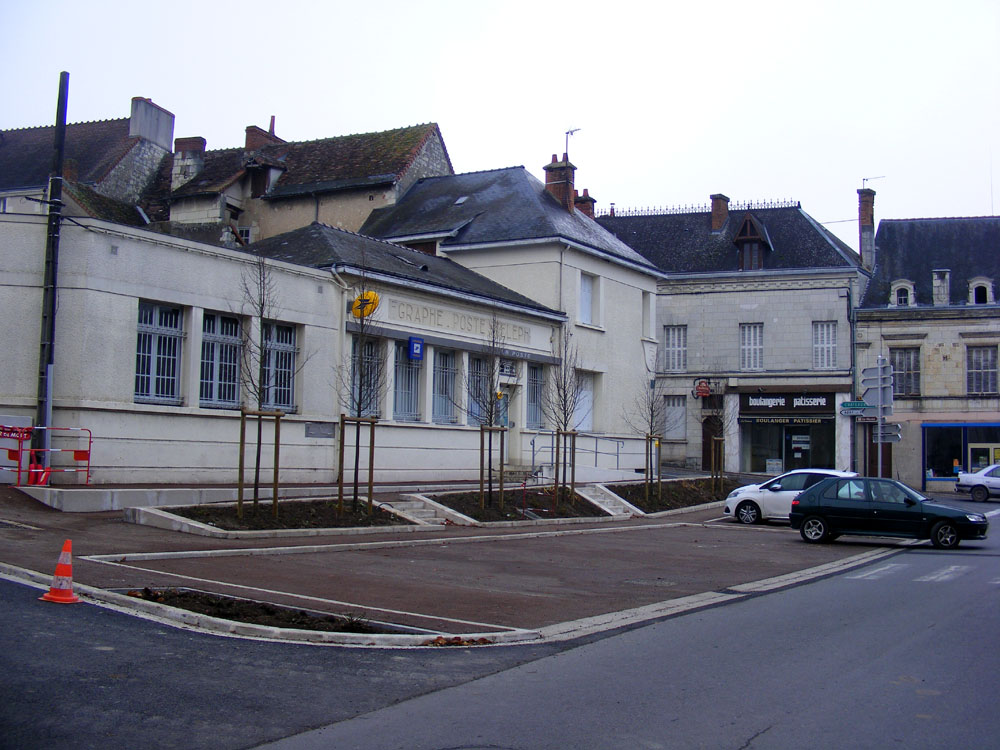
Post Office: From 1 September the Post Office in Preuilly will be reducing its open hours to 15 hours a week, mornings only. The commune owns the Post Office building and the Post Office is a rent paying tenant.

The Post Office in Preuilly.
Preschool Closure: The preschool (Maternelle) will be closing and the pupils transferring to the Primary School. Thanks to several new families moving into the area the Primary School now has 82 pupils (up from 75 last year).

Under New Management: The Episervice mini supermarket will change ownership on 1 March. The old owners are staying on to transition the new people. My sources tell me the new owners are of Moroccan background. The outgoing owners are from Brittany.

Change of Use: Cyril Courteix has taken over the old ambulance depot and installed his mechanics shop there (moving from rue des Douves).

New Shop: An outlet for a chocolatiere/baker/patissiere has opened on Place des Halles, next to the Restaurant de l'Image. The main shop is in Tournon and the 22 year old chocolatiere/baker/patissiere is called Laura. Her Mum runs the boutique in Preuilly.

New chocolatier-boulangerie-pâtisserie.

Milk Price Rise: Sandrine, who produces and home delivers dairy products around town tells me that milk has gone up. It is now 95c a litre.

Deaths: Our neighbour Edouard tells me that 3 elderly people from our street died while we were away. At least one of their properties is on the market now.

Chapel Nestboxes: Thanks to encouragement from me and SOS Martinets, a couple of nest boxes for Swifts will be installed as part of the restoration of the Chapelle de Tous les Saints. The chapel is currently swathed in scaffolding and tarpaulins. The masons and roofers have done some preparatory work.

 Swift nest boxes on our graineterie.

Greenway: The rails and sleepers have been removed from the old railway line and it is on its way to being a voie verte. Ultimately it will be 40 kilometres of walking track, from Descartes to Tournon. Much of the section near Preuilly runs along the Claise river.

The voie verte where it crosses the D725 in Preuilly.

Medical Personnel: The vet, Christian Martin, has retired and there is no new vet in town. The nearest vet is now Vanderquand-Lefebvre in Tournon Saint Martin or Vincent Monoyer in Descartes. The dentists, Drs Renaudie, have also retired. They have been replaced by Dr Claudius Zaharia Trofin, who has moved into a new surgery in the Post Office building. I'm told his wife is training to be a doctor and will ultimately be installed as a second GP for Preuilly.

Tuesday, 13 February 2018

Leaving the Bats in Peace


For the past couple of years I have gone out in January and June with a group of bat surveyors. But this year my friend Jean-Claude, who organises our bi-annual bat surveys, has emailed me to say there will be no surveying this year or next. Surveying bats, particularly if they are hibernating or raising young, inevitably disturbs them, and the local bat conservation experts feel that they need to be left in peace for a while. We have quite good data from the previous years surveys, so the bat experts can focus on number crunching and other projects.

Just in case you will miss the bats, here are some photos to be going on with:

Greater Horseshoe Bat.
Photo courtesy of my sister.
 A maternal roost of Lesser Horseshoe Bats.
Photo courtesy of my sister.
 A grounded Pipistrelle Bat.

 A Soprano Pipistrelle Bat on the wing.

Here are some links to previous posts about bat surveys:

Bat Surveying in the Touraine Loire Valley

Hanging From the Ceiling

Bats Spurn the Belfries

Monday, 12 February 2018

Monday is Queens Day: 18 Queen Mathilde

Where to start with this one...

Mathilde was born in about 1031 and was descended from most of the Royal Families of Europe - in the times when there were many Royal Families in Europe. This made her a worthwhile catch for any aspiring Duke or Baron, and the Duke most interested was William the Bastard, who as a bastard she felt was below her dignity. Stories of how William convinced her to marry him vary, but they all agree that he dragged her to the ground by her braids (quite how this helped....).

Of course, being nobility they were quite closely related: enough, in fact, that the Pope forbade them marrying - which they did anyway in, 1051. (The marriage was recognised by the following Pope 8 years later).


After William invaded England and became a Conqueror rather than a Bastard, Mathilde became Queen Consort of England in addition to Duchess of Normandy. Of course, the fact that one of the families she was descended from were the Kings of Wessex helped - she had a couple of extra clauses put into the coronation ceremony to acknowledge that it was God who put her there, and that she shared her husband's power.

She had at least 9 children, four sons, and 5 (or more) daughters. The history of the sons is well known: the eldest (Robert) becoming Duke of Normandy after his father died, and sons 3 and 4 (her second son died as a child) becoming Kings William Rufus and Henry  I of England.  Although she visited England to be crowned in 1068 she spent most of her life in Normandy, usually in Caen, which is where she was buried in 1083. The original grave marker is still in situ in the Abbaye aux Dames in Caen.

The Jardin du Luxembourg has statues of 20 French Queens and Illustrious women. The subjects were chosen by Louis-Philippe I in 1843. This statue was created by Jean-Jaques Elshoecht 1850. To see Mathilde (and her braids) you have to go here.

Eventually all 20 statues will be featured here.


Sunday, 11 February 2018

Queenscliff Head


At the lagoon end of Manly Beach, Queenscliff Head is a nice place for scrambling over the rocks. There is a tunnel under the heads called The Wormhole, which was carved (or maybe blasted) by locals in 1908 as a shortcut between Manly and a workers' camp in the next bay. The tunnel once led to Freshwater beach, but although you can still get through the tunnel the easy path ends there due to rock falls.


It also serves well as a place from which to photograph surfers - without getting wet.

Saturday, 10 February 2018

The Lions Road and The Risk

A couple of weeks ago Colin asked about The Risk.

The Risk is a community in northern New South Wales close to the Queensland border. It is on the Richmond River in the Border Ranges National Park, which is part of the World Heritage (UNESCO) listed Gondwana Rainforests of Australia. Local wisdom is that the first man to settle the area, one John Wilson, rode over the mountains and said he would take "The Risk", thus naming the area.

There isn't a town or village at The Risk, but the scattering of houses in the area do manage to support a 2 classroom school with 28 students, and a community hall. The main road through town (ok - the only road through the area) is Gradys Creek Road, also known as the Lions Road.


The Lions Road was recommended to us by Daz, the brother of my mate Matt. We were talking about roads to try in the Idiot Wagon on our way from Susan's parents to my parents, and I mentioned I was thinking about travelling through Woodenbong. He suggested that the Lions Road would be better, so I did some research. The route is in two parts, the Queensland part is called Running Creek Road, whilst the section in NSW is Grady's Creek Road - part of which is The Lions Road.

Google maps won't plan a route using The Lions Road
so I had to map it myself. The Lions Road is in red. Here it is

The residents of this part of New South Wales had been trying to have a road built connecting them to Queensland ever since the North Coast Railway went through the area in the early 1930s. Sucessive state governments had looked at the idea until 1967, when a commitment was made to build a road between Kyogle in NSW and the Queensland border, In 1969 the plan was shelved, at which point the local communities took over.


Impetus came from Kyogle Lions Club, which undertook the promotion of the road as a community project. With local help the best route was selected and it was decided to build a low standard 4 wheel drive track as a statement of intent. With assistance from businesses and the community a dirt road suitable for cars was eventually built and opened in December 1971.

Eleven kilometres of road was built over the McPherson Range, including 56 sets of pipes, 3 bridges and 12 cattle grids. When the Queensland Border was reached, the Beaudesert Lions Club joined the project and the Army helped by reconstructing 2km of road in Queensland. Over 100,000 vehicles per year use the road and there are donation boxes at the State border to collect contributions. The money collected enabled the Lions to approach government bodies with an offer to contribute to seal the surface, which was completed in 2002.

I made a movie using Google Earth to try give
an impression of what the road is like to drive.

The Lions Road is an amazing drive, although the upper reaches are probably not best suited to a European supercar. The road is one lane for most of its length, with very few passing places. Although it is a sealed surface, it is rough, with some serious drop off where a soft shoulder exists. At the moment the extremely rough wooden plank bridges are being replaced with concrete structures.

If you do ever drive the Lions Road make sure you stop at the Cougal Spiral lookout. This is where the North Coast railway line curls back on itself in a loop, entering a tunnel to pass back under itself.

You can see the railway line on the right.
Just after this it enters the tunnel in a loop

If you're ever in the area, do yourself a favour, and drive the Lions Road. It's worth it.

Friday, 9 February 2018

George and the Unicorn


'Mon seul desir', depicting the supreme courtly virtue of largesse, being generously distributed.

This year the extraordinary group of tapestries known as La Dame et La Licorne will be on loan to Australia and displayed in the Gallery of New South Wales from 10 February to 24 June, while their usual home in Paris is closed for renovations. We are lucky enough to have seen the tapestries a couple of times on visits to the Cluny Museum in Paris, but it wasn't until recently that I read the story of their discovery in the 19th century and how they came to be in the Cluny's collection.

The panels depicting hearing or joy, and sight or leisure. 
Joy is playing her portable organ, Leisure is enticing the unicorn in her mirror.

In the early days of the 19th century a little girl called Aurore Dupin would come down to the Berry countryside to stay with her grandmother in Nohant-Vic. Later, as a young woman with her own young family, she inherited the house at Nohant and came to live there to escape her husband and the political troubles in Paris. Although Aurore came from a wealthy family, because her husband controlled the purse strings she was forced to earn her own living. And thus, the novelist George Sand was born.

A genet, domesticated in medieval times in preference to cats to catch rodents around the house.

At Nohant Aurore/George was free to indulge love affairs with Chopin, Prosper Mérimée (Inspector General of Historic Monuments) and the artist Manceau, amongst others. Her children were raised in an atmosphere of creativity and independence. Everyone in the household wrote, made art or performed.

A rotund heron doing backstroke in 'Mon seul desir'.

In the 1830s and 40s many wealthy aristocratic and bourgeois people quit Paris as the political situation was not stable. One of George Sand's friends holed up in Boussac in the Creuse and set up a printing press there. She visited several times and on one of these visits came across an extraordinary set of tapestries hanging in the local chateau, at that time the offices of the local authority. She saw immediately that they were something special and invited Prosper Mérimée down to view them. As a result they were heritage listed in 1865 and in 1882 sold to the Cluny.

The lion, who appears in all the panels, carrying the crescent moon arms of Antoine le Viste.

The medieval Chateau of Boussac was one of George Sand's favourites and she used it as the setting in one of her novels, describing it as 'irregular, graceful and pretty in its simplicity'. Who commissioned the tapestries was long a mystery but recent studies suggest that it was Antoine le Viste in about 1500. The modern scholarly opinion is that they can be read in multiple ways and represent both allegories around the five senses and the six Courtly Virtues of Guillaume de Lorris's Roman de la Rose (frankness, beauty, joy, largesse, riches and leisure). In addition they contain a bestiary and a flora. Antoine le Viste was married to a member of the powerful Tourangelle family the Briçonnets (who built Chenonceau and Candé about a decade after the tapestries were probably woven). The mystery surrounding the set of tapestries is compounded and continues because George Sand wrote of eight panels -- and yet only six exist at the Cluny.

A terrier on a cushion, in 'Mon seul desir'.

Prosper Mérimée mentions in correspondence that he was told by the local mayor that there were other, even more beautiful tapestries at one time in the chateau, but a former owner had cut them up to make cart covers and carpets. Were these the missing panels, or is there some forgotten corner of the chateau hiding them behind a collection of battered furniture or rolled up in an old cart?

Thursday, 8 February 2018

Things are Grave Part X -- Serge Gainsbourg


Famous for his provocative song lyrics, performances and lifestyle, Gainsbourg is nevertheless buried in the family tomb in Montparnasse with his parents. The beady eyed will notice that the family name is actually Ginsburg. There are a number of variations on the name Ginsburg on tombs dotted about the cemetery, all descendents of Ukrainian Jews who fled to Paris in the early 20th century to escape pogroms and the Russian Revolution. During the Second World War Gainsbourg's family sought refuge in Limoges, using false identity papers.


The man is an absolute legend in both the French and English speaking worlds. His songs often contain morbid themes or sexual innuendo, and he loved puns. He worked in a remarkable range of styles and with a remarkable range of fellow writers and performers.

Wednesday, 7 February 2018

Death of a Culinary Legend


Friday 26 January was the funeral of French culinary legend Paul Bocuse in Lyon. Whatever your impressions of the media persona, there is no question that he was genuinely revered in French culinary circles. An obituary I read described him as 'a monument', 'a symbol of excellence', 'a guide', 'a figurehead', 'a star', 'an icon', 'a model', 'an example', 'a father'. 'Whether you had the luck to meet him, greet him, touch him, talk to him, be photographed with him, work beside him or simply see him on television, the love, respect and admiration in which he was held is immeasurable.'

My chef friend Jean-Michel, on the right, was a big fan.

The funeral took place in the cathedral and due to security issues and the large number of people attending, access was restricted. If you wanted to go to his funeral you had to telephone his restaurant and register, giving your name, phone number and work place. Chefs attending were asked to wear their uniforms.

For an interesting and amusing overview of his life, check out Taste of France's post on his demise, Butter, Cream and Wine. 

Tuesday, 6 February 2018

Making Coffee


Our drip filter coffee maker died the other day. History repeated itself, with the switch breaking.

So the next day we went to Loches to buy a new one. To our surprise, there was nothing we liked at a price we liked. So we bought a cafetiere for €6.50.

Our new French press and our Moka coffee maker, from our camping kit.

The object on the left is something I would call a cafetiere. That name reflects my time in the UK because that is what they are called there. In Australia they are called coffee plungers, and I notice that Americans call them French presses. In France they tend to be called cafetières italiennes, or sometimes a cafetière à piston.

The object on the right is what I would have called a Turkish coffee maker, but it turns out it isn't. It's a Moka coffee maker, also known as a cafetière italienne in France.

Both are Italian inventions but in my experience Italians actually use the stovetop Moka pot. Brits and Australians used French presses and northern Europeans used filter coffee machines. But nowadays everybody except us and the Italians uses capsules (and landfill be damned).

Monday, 5 February 2018

Monday is Queens Day: 17 Sainte Genevieve


There is almost no doubt that Sainte Genevieve, Patron Saint of Paris, was a real person. She was born in Nantes in the early 5th century (some time between 419 and 422) and died in Paris in the very early 6th century. Her main claims to fame are her abstinence (she seems to have abstained from everything) and the fact that she saved Paris from Attila the Hun and the Merovingian King Childeric I.

Genevieve first came to people's attention when she was but a youth. She attended a sermon by Germanus of Auxerre and declared she wanted to be a nun. To prove her commitment she decided to be purer than anyone else (hence the abstinence), something she eventually had to be talked out of.


When Attila the Hun looked like he was going to attack Paris in 451 it was decided by the Bishop of Paris that Genevieve should be the person to lead a prayer marathon. This was successful - in that Attila decided to attack Orleans (which was probably a richer target) instead. In 464 Childeric laid seige to Paris, and Genevieve managed to pass through the seige lines (probably quite easy for a religious person of note) to Troyes, where she arranged for a shipment of grain to Paris.

All this means that by the time she died (some time between 502 and 512) she was already considered a saintly person, something confirmed by Clothilde (remember her?) the second wife of Childeric's son Clovis. She was buried in the Benedictine Abbey later dedicated to her name, which was rebuilt by Louis XV as Saint-Étienne-du-Mont, where her tomb can be seen alongside the graves of Blaise Pascal and Jean Racine.

The Jardin du Luxembourg has statues of 20 French Queens and Illustrious women. The subjects were chosen by Louis-Philippe I in 1843. This statue was created by Michel-Louis Victor Mercier 1845. To see Genevieve looking abstemious you have to go here.

Eventually all 20 statues will be featured here.

Sunday, 4 February 2018

Drinking Stations


A basic drink station. When we were kids
these were known as bubblers

Manly Council has teamed up with Sydney Water to set up fresh water drinking stations around the beach front and the Corso, the main shopping street, which links the ferry terminal to the ocean beach.

The project is designed to reduce use of plastic bottles and provide an alternative to sweet fizzy drinks. The hope is that these modern drinking fountains can help change the culture of bottled drinks. There are a couple of different styles of drinking stations, the basic kind which will give you (and if someone has customised it, your dog) a drink, and an altogether more stylish unit (which we didn't take a photo of) which has a rest so you can fill your water bottle.

Saturday, 3 February 2018

Ducking the Duck

When we were in Beijing last year we were on a more or less standard organised tour. The main difference is that instead of the "Special Peking Roasted Duck Dinner" that most tours include, we opted for a visit to a street food market.

Where we ate in Beijing

Peter (our guide) explained on the day that the most famous of Beijing street food markets was definitely for tourists only, being weird "look what strange people the Chinese are - who eats scorpions and bugs?" type food (that needless to say, Chinese people only ate during the most fraught period of the Cultural Revolution) or another, less touristic street that had recently been closed due to hygiene issues. We walked down those streets anyway, before Peter led us into a department store and down two flights of stairs.

The debit card and recipts

We had our dinner in what can only be descibed as a food court, but one that we would never have found if left to our own devices, and furthermore one that we would never have figured out of our own accord as the payment was by debit card system. The card was purchased from a central booth for 100¥ (100 Yuan Renminbi, 12€75), of which 8 ¥ was for the card, leaving us 92¥ to spend.

Cooking dumplings

There were about 20 small kitchens, all producing food to order.  We spend 20¥ each on a bowl of dumplings, one fried and one as dumpling soup - and there was about 12 dumplings in each meal. Peter ordered a mixed combination for 30¥, and then I ordered squid on a stick for another 10¥. This means all up for more food than 3 people could jump over we paid 80¥, or 10euros.

Fried Dumplings

A combination meal

After the meal we returned the card to the booth for our refund - but of course, most people keep their card and top it up as required, as they would eat a meal there on every working day.

Squid on a stick (whilst being
photobombed by a local)*

The result is that we returned to the airport overflowing with authentic Chinese food, having spend not much money at all, and having had a proper Beijing experience.


*also my best Spike Milligan impersonation.

Friday, 2 February 2018

Dripping Wet


Dripping Wet is the surf shop on Manly Beach. You can buy your surfing supplies here, as well as hire boards if you are visiting the area and fancy trying a bit of surfing. 

Thursday, 1 February 2018

Things are Grave Part IX -- Maryse Bastie


Maryse Bastié overcame multiple tragic events in her personal life to become a pilot and business woman in the early 20th century.


Born in Limoges, her father died when she was a child. She worked in a shoe factory and married young. The marriage ended in divorce and her only child died. She remarried, to a World War I pilot and caught the flying bug. When her second husband was killed in a crash in 1926 she earned her living by performing aerial acrobatics and was soon able to buy her own plane.

For several years she concentrated on setting aviation distance and duration records, then in 1935, reputation firmly established, she opened her own flying school at Orly Airport. She also served in the French Air Force, achieving the rank of Captain.

She was killed in a plane crash in 1952 and is buried in Montparnasse cemetery in Paris.