Friday, 18 December 2015

Silenes

The thirty one painted oak wooden boxes from the beginning of the 17th century, the legacy of Master Maré, apothecary to the Hospice Saint Roch in Issoudun in 1646, are amongst the oldest of their kind in France. They feature a rich ornamental decoration of flowers, animals or human figures. A Latin inscription in the upper cartouche identifies the remedy contained within. The use of wooden boxes, in chestnut or oak, sometimes cylinder shaped, was advocated from the Middle Ages to keep hydrophilic drugs, dried plants, roots and barks, gums, resins, horns, nails, bones and ivories. 

Pyrethrum was used in poultices for headaches. 
I have no idea why it is represented by a boar-cum-fish.
Rabelais described them from 1534 in the prologue of Gargantua: [My translation] Silènes* were small boxes which you used to see in apothecary shops, painted on the outside with joyous and frivolous figures, like harpies, satyrs, bridled goslings, horned hares, basted ducks, flying bucks, lemon tree antlered stags, and other such painted enjoyable counterfeits to make everyone laugh...but inside them they store fine drugs like balm, ambergris, cardamom, musk, civet, jewels and other precious things.'

Labdanum is a resin from rockroses Cistus spp, gathered in medieval times
 by combing it from the hair of the goats that grazed on the shrubs. 
There is no connection to unicorns so far as I know.
The painted representations of strange animals, associated with products from Asia or the Americas are borrowed directly from scientific works of the 16th century, such as 'Monsters and Prodigies' by Ambroise Paré, published in 1585 or the 'Universal Cosmography' by André Thevet, from 1575.

Opium has been used as a painkiller since Neolithic times. I'm interested
that the image on the box is not of bog standard single lilac coloured flowers, but of a fancy (quite common) mutation which produces flowers like a pompom.
*There doesn't seem to be an English language term for these boxes.

Thursday, 17 December 2015

Guitars in the Windows

The organisation that trains master craftsmen in France is called les Compagnons du Tour de France. This is a trades guild that has existed since medieval times, but was perhaps most active in the 18th and 19th centuries. There is a wonderful museum in Tours dedicated to the organisation. The companions, or master craftsmen, have left their mark in all sorts of surprising places if you know what to look for. For example, several times we have enjoyed meals at the restaurant run by the guild in Paris, Aux Arts et Sciences Réunis, where they have many carpenters' masterpieces on display.

A relatively simple guitarde with pincer ties in Chaumussay.
In Chaumussay, a tiny village just down river from Preuilly, there are two dormer windows (Fr. lucarnes). They are to be found on adjoining houses in the main street. They are of a type that is rare, being unusual and complex in form. They are made from curved and deliberately warped pieces of timber, making their assembly difficult and requiring specialist skills. They are clearly the work of a compagnon du devoir (master craftsman) and are in a form known as guitardes (guitar-like), a reference I assume to refer to their curved roofline. Similar complex decorative arrangements supporting a square balcony or dormer are known as capucines (I assume because they were thought to bear some resemblance to the hood on a cloak).

According to the director of the Musée du compagnonnage in Tours there are only three guitardes which incorporate this star motif in the Touraine [Source: Au temps du Chaumussay by Michel Brouard]. The star is possibly a 'secret' guild sign representing the Seal of Solomon. 

Starred guitarde in Chaumussay.
The second guitarde on the neighbouring house is different in design, simpler, but nonetheless interesting. The two houses were owned by the same person at the end of the 18th century.

For an example of a guitarde and two capucines side by side, check out a house on your left as you come through Perusson on the way to Loches. It's the balconies you want to look at, not the dormers, in this case.

According to Le Compagnonnage, chemin de l'excellence (ATP Editions Musées Nationaux):

[My translation] A guitarde is a wall dormer, circular or ellipsoidal in plan. It takes its name from the assemblage of pieces of curved wood called 'guitar ties'. Dormers on a square or rectangular plan are known as capucines but the term guitarde is equally used when the carpentry uses 'pincer ties', whether on a circular or square plan. The complexity of the assemblages, but also the aesthetic, drew out genuine master pieces from elder companions and even independent artisans in the 19th century and up to about 1950. A survey by Christian Chenault in the 6 départements of Région Centre has identified over 300 guitardes and capucines. [Click to see photos of some]
The guitardes were used by elder companions to signal to younger journeymen companions who were making their tour around France gaining experience that here under the guitarde was the workshop or home of a potential mentor.
*******************************************
A la cuisine hier: Cream of Jerusalem Artichoke and Leek Soup, using a small pot of fresh goats cheese (Fr. faisselle de chèvre) instead of cream.

Picadillo, a Cuban savoury mince dish that I had never heard of, which turned out to be fairly ordinary. I had some difficulty getting brown rice to serve with it and in the end had to settle for the quick cook variety from the supermarket. It was OK, but not as rustic as the real thing.

Wednesday, 16 December 2015

Neige aux pommes pour les grands

Hah! I bet you thought the apple recipes had finished and the billion trillion apples dealt with. Not quite yet, but we are getting there. The apples are down to one big tray and one small tray, and this recipe uses a whole kilo of apples. Hurrah!

Apples, peeled, cored and diced, ready to be stewed.
Apple Snow, which I figure is neige aux pommes in French, is the sort of dessert that in its simplest form you may well have seen quite often on the table in your childhood, made by your mum. Usually it is just stewed apples and uncooked meringue, sometimes with the addition of lemon and/or whipped cream. Although quite common and well known (but old fashioned) in [some parts of] the Anglo world, it appears to be almost unknown in France. 

Stewed apple, with just the right proportion of purée to dice.

Meringue.
Since I was making the dessert as my contribution to the shared lunch at our foie gras workshop I thought I would make a slightly more sophisticated version (pour les grands means 'for grownups'). Apple Snow is essentially a syllabub (ie cream or milk thickened by whipping sweet wine or similar into it and often folded through tart fruit, sometimes with meringue). The English have been eating it since Elizabethan times.

Whipped cream and calvados.

Ingredients:
1 kilo apples (use several varieties, some which will turn to pulp and some which will hold their shape)
½ cup water
Juice and grated zest of 2 limes (or lemons or oranges)
120 g sugar (for the apples) + 50 g sugar (for the meringue)
4 egg whites
¼ cup calvados (or cider or pommeau)
Powdered cinnamon or ginger (optional)

Method:
  1. Peel and core the apples then chop into 1 cm dice.
  2. Put the apple, water, lime juice and sugar in a saucepan, cover and cook on medium heat for about 10 minutes.
  3. Leave to cool completely.
  4. Whisk the egg whites until stiff, add the sugar and whisk again to incorporate.
  5. Put the cream in a bowl and if it is very thick loosen by adding the calvados.
  6. Whip until soft folds form. 
  7. Stir the calvados into the apple if it isn't already in the cream.
  8. Fold the cream into the apple.
  9. Fold the meringue into the apple mixture.
  10. Put into 8 serving bowls, and refrigerate for at least 30 minutes before serving. (Sprinkle with spice if using.)
  11. Serve with a biscuit, such as shortbread, sablé, gingernut, macaroon or biscotti.
 I nearly forgot to take a photo of the finished dessert...
It occurred to me that a pineapple and coconut version might be nice too, using crushed pineapple and coconut whipped cream (but would you use green ginger wine or Malibu...?). 


Tuesday, 15 December 2015

Border Post

Looking towards Preuilly and into 'Free' France.
On this day 75 years ago the border between German occupied France and supposedly 'Free' France was tweaked. Between 30 June 1940 and 15 December of the same year the border ran through Chambon, then just to the west of Chaumussay, le Petit Pressigny, la Celle Guenand and Ferrière Larçon. Preuilly was in 'Free' France, le Grand Pressigny was in Occupied France. The border was drawn up partially to reflect where German troops had got to when the Armistice of 22 June was signed between France and Germany. Preuilly's capital was now Vichy, le Grand Pressigny's was Berlin (and locally administered by Chateauroux). On 16 December 1940 the border was pushed further west, to Descartes, where it remained until February 1943, when the Germans occupied the whole of France. Le Grand Pressigny and Abilly were French again.

The official reason for the change in the border was that it was compensation for certain sectors which had been 'improperly' occupied. In reality it was because the new border was easier to police. Life around the border and especially if you needed to cross it was oppressive and rigid.

The memorial to the Demarcation Line on the site of the border post just north of Chaumussay at Les Reuilles.
Here is a description of the situation by several locals, translated by me from Michel Brouard's recent history of Chaumussay:
The Demarcation Line crossed the D42 at Les Reuilles, guarded by the Germans. They had a weatherboard hut. They lodged at Petit Carroir [a nearby farm I think]. The French were at La Croix de la Villate [towards le Petit Pressigny]. We had frontier passes for the Line. Sometimes they would warn us of the arrival of less 'obliging' guards. Numerous personal messages were passed under the noses of the Germans. They left us with our radio, on condition that they could come and listen to it. They took the oats from the grain stores for their horses. They demanded that we prepare food for them -- chickens, ducks...They paid for the food. A. Multon.

The German post was on the Carroir track. The Germans had erected a quite substantial barracks. The Germans lodged at the Carroir.  The French post was at the Bergeon Cross. I was going to school. We would cross the line without too much problem. The Germans would give us money to bring back cigarettes from town. In 1940 there were Germans everywhere. They would wash themselves at the well, and had even broken the head of the well. We had to make them omelettes. When they were recalled back to Lésigny, the bridge was destroyed, they left in a hurry, all along the road we found plates and forks scattered. Raymonde Aubeau.

The Line passed la Croix Jourdain, the Breuil Woods, Les Reuilles. The post at la Croix Jourdain allowed the surveillance of the Millet track. The Germans stopped the postman and a female day labourer and drove them to the Grand Pressigny post. They were released that evening. The day labourer returning by the D42 was hassled again by the post at Les Reuilles...she was finally able to get home. The German patrols on horseback or on foot kept the Line under surveillance. The locals learnt the routines in order to facilitate the passage of escaping prisonners. Serge Villan.

We would hide messages rolled up inside bicycle pumps and also in the tube of the frame under the saddle. In order to fool the checks I would put fashion magazines on the baggage rack. The Germans would leaf through them, roaring with laughter, and let me go without checking properly. I was apprenticed to Madame Delaporte, the dressmaker. The German officers would come to have their gloves repaired. At the least noise, they would get up and be on the alert. Yvonne Massé.

Monday, 14 December 2015

Bernabo Visconti

It's difficult to imagine a more unpleasant bunch than the Visconti family who ruled Milan in the 14th century. Bernabo was by no means the worst of the bunch, but he doesn't come across as anyone you would want to spend time with. He was notorious enough to be mentioned by Chaucer, who describes him as the 'scourge of Lombardy' in one of his tales.

Bernabo spent most of his adult life excommunicated by a series of Popes, fighting everyone in sight, and fathering children. Married to Beatrice Regina della Scala of Verona, they had 17 (seventeen!!) children who lived to adulthood. He is also known to have fathered at least 13 other children by at least four mistresses, all of whom he acknowledged, as was considered proper in those times. One of his daughters married the Duke of Bavaria and was the mother of Isabeau of Bavaria, queen to Charles VI of France (known as Charles the Mad because of his psychiatric condition, which had him believing he was made of glass). Another married her cousin, Bernabo's nephew Gian Galeazzo Visconti. A third married the famous English condottiero (mercenary) John Hawkwood.

 Bernabo Visconti looms over the gallery.
Eventually his nephew and son-in-law Gian Galeazzo deposed, imprisoned and poisoned him and took the duchy of Milan for himself.

Bernabo's funerary monument had been made a few years before his death, as was customary. Best to be prepared in those troubled times. It features a life size equestrian statue, which reveals that Bernabo must have been quite short, even if you take into account the large war stallion. The pair of women standing by the horse's girth are not, as I expected them to be, Bernabo's wife and a daughter. They are apparently allegories for something entirely inconsistent with his actual lifestyle (Truth and Justice or something -- I forget exactly what).  

The funerary monument is one of the first objects you see when you enter the fine arts section of the Castello Sforzesco. At first sight it seems large and lumpen, but close up reveals tremendous detail (every hair on the horse, for example).

Sunday, 13 December 2015

Tropical Downpour

It can really rain in the tropical north of Australia. This downpour was at the tail end of the wet season and didn't last long. But while it did, it really bucketed down.

Saturday, 12 December 2015

Foie Gras Fun

Thursday was our second annual foie gras workshop, held at Rosemary and Jean-Michel's place in Blois. I picked up the fresh duck livers from Maison Perrin on Monday and kept them in our 2ºC fridge. They were wrapped in cling film and I put them all together in a big plastic box. To transport them up to Blois they went in the eskie on a couple of freezer blocks. 

 Preparing foie gras involves quite a lot of peering and poking...
Mme Charcellay at the foie gras farm had told me to make sure the livers had been out of the fridge for at least four hours before we worked with them, so they weren't too hard. We also talked about the outbreak of bird flu to the south of us and she said she wasn't expecting it to arrive in our area. She had taken the opportunity to speak to the Health Minister, Marisol Touraine, who was in Preuilly last weekend for the Christmas market, and there is no indication that anything other than vigilance is required at the moment. Last time there was an outbreak all the birds had to be kept inside, to make sure they didn't have contact with the wild population which is responsible for spreading the disease.

 ...prodding and pressing...
We also discussed the new animal welfare laws that will be coming in by 2017 and how they will affect her work. She has already purchased and is using gavage cages that comply with the coming legislation but she is not convinced they add to the birds' welfare. She is at least the third generation of her family producing foie gras and she says the new legislation will make the salle de gavage look better to the uninformed visitor, but from a practical point of view may actually reduce the welfare of the ducks. The problem is that the cages are larger, which means the ducks have more wriggle room when they are being fed. With the new cages the handler has to hold the duck much more firmly and there is a risk they can be injured if they move.

The day of the workshop dawned with thick fog blanketing the Claise and Indre valleys. Fortunately as we travelled north the fog got thinner, but driving through the forest of Loches, with deer crossing in front of us twice, was not without stress.

 ...pushing...
We made a quick stop en route at Jean-Luc Bilien's goats cheese dairy, Fromagerie Moreau in Pontlevoy, and purchased a 60 day old Selle sur Cher for lunch (and one for us to take home). Jean-Luc was in good form and we wished each other seasons greetings before moving on.

  ...and patting.
At Rosemary and Jean-Michel's everything was prepared for the workshop and we went around the back of the house to admire JM's handiwork. He's recently installed a large new window over the sink, which makes an enormous difference to their kitchen. As usual he's done a terrific job. They bought the stone second hand, through the French equivalent of Ebay, leboncoin. We had quite a discussion about the stone as it is pierre de Beauce, a limestone that is harder than tuffeau but softer than marble. It looks great.

Françoise and Paul arrived for lunch, which began with an apéritif of sparkling Vouvray, some crudités and French onion dip (which of course as the name will tell you is a dish unknown to French people). Paul had made a delicious salmon quiche for entrée, followed by Jean-Michel's duck à l'orange, served with quinoa. I made apple snow and sablés (shortbread biscuits) for dessert, which turned out to be quite a hit.

Deveined foie gras.
Janet arrived just in time for dessert and coffee, then we all got to work with the foies. This went very easily as everyone except Janet had done it before. The next day I pressed the cured liver into two terrines and they are now developing flavour in the fridge.

For my previous post on making foie gras see here, and for Rosemary's post on this year's workshop, see here.

Friday, 11 December 2015

External Staircase

This rather nice external staircase is typical on vernacular buildings in the Loire Valley, south-west France and probably many other regions in the country. The one in the photo can be easily seen from the path up to the Source Saint-Marc in Chaumussay.

Staircases like this first appear in the 15th century, providing access to the interior of the house, which sits on two floors, plus attic, above its semi-underground cellars. Staircases themselves don't get to be integrated into the body of the house until the 16th century, and even then they were open to the elements very often. Since they acted as chimneys drawing warmth upwards they were problematic in an age when heating was difficult. If you wanted to access a different floor of the house it was normal to step outside onto the staircase, go up or down, then back in. The staircase itself was sealed off from the interior of the house to retain warmth inside and to ensure the staircase took advantage of natural light. In higher status buildings staircases were often enclosed in their own tower, attached as an annex to the main building. But even the grandest houses such as the chateau of Azay le Rideau had staircases which were originally open front and back, and it was not until the 17th century that fully enclosed internal staircases became the norm for grand houses. The open external staircase persisted for rural vernacular buildings well into the 19th century in many cases though.

Thursday, 10 December 2015

Mary and Saint John

These two charming little painted and gilded limestone statues from the mid-15th century are part of the goods saved from the former Hospice of Saint Roch in Issoudun. The hospice is now a museum.

They represent Mary and John, and were certainly part of a larger calvary style composition accompanying Christ. Saint John is shown as a young man with long curly hair, holding his red cloak in pleats with his left hand as though he is holding a book. The impression of the shape of a book represents his gospel, invisible because it is not yet written. He rests his head delicately in the palm of his right hand in a sign of his suffering. The Virgin joins her hands in front of her body, fingers entwined, as she lowers her head slightly forward.

Mary (left) and Saint John (right).
The composition is ordered by the position of the arms rather than the thick and heavy pleats of the draperies. The left arm of Saint John describes a semi-circle from the right foot to the hair, accentuated by the elegant inclination of his head. With regard to Mary, her joined hands are pulled hard into her chest at the level of her heart, accentuating the strength of her internal feelings.

The general attitude of compassion of these two saints, their lowered eyes and inclined heads, enhanced by a delicate polychrome colour scheme radiates an impression of calm and gentleness.

Wednesday, 9 December 2015

Metal Dragonfly

This sculpture is fixed to the side of a house in Chaumussay, on the corner of Avenue de la gare and rue du bourg. We've posted about it before, but I thought it was worth showing again, with a bit more information.

It is the work of sculptor Alain Brouard, originally from La Guerche, a nearby village, but now living in Brittany. The dragonfly is a Blue Emperor Anax imperator, the largest insect in Europe. The species can be seen on the banks of the Claise River which flows through the village just one street away. The sculpture also references fossil dragonflies from the Carboniferous, 350 million years old, with an 80 centimetre wingspan, gigantic compared to modern dragonflies, but half the size of the sculpture.

Source: Au temps de Chaumussay by Michel Brouard, a local history of the village, available in local newsagents and the mairie at Chaumussay.

Tuesday, 8 December 2015

Charlemagne and Louis IX

In the chapel of the Hospice Saint Roch in Issoudun is a late 15th century stained glass window depicting Charlemagne and Saint Louis.

The stained glass windows of the oratory of the chapel were created at the same time as the other transformations at the end of the 15th century. Charlemagne and Louis IX are included here as part of the iconographic theme of King-Saints. Both were canonised. 

According to the 13th century legends Charlemagne was considered the first pilgrim of Saint James (Saint Jacques). Having seen the saint in a vision, he had built the first edifice dedicated to Saint James. Louis IX is reputed to have feed the poor, visited the sick and washed the feet of the leprous. In particular, he had the Hospice des Quinze-vingt constructed in Paris. The two kings symbolise Christian hospitality and remind of the duty to welcome and help the poor. Finally, they are related to the evocation of the Passion of Christ.

Charlemagne assembled relics such as bits of the crown of thorns, pieces of the true cross and shroud of Jesus in Aix-la-Chapelle. Saint Louis constructed the church of la Sainte-Chapelle in Paris to house the nails from the Crucifixion. Their importance is emphasised by their image carved into the arms decorating the keystone of the sanctuary vault.

Below the portraits of the two kings in the window there are two angels carrying the coat of arms of Guillaume de Cambrai, Archbishop of Bourges, who was the donor of the windows. They were almost certainly executed by a stained glass workshop in Bourges.

Monday, 7 December 2015

The Bridge of the Cast Iron Sisters

In the middle of Parco Sempione (Simplon Park) in Milan, crossing a narrow section of the lake, stands a 19th century cast iron bridge. Its official name is il Ponte delle Sirenette (the Mermaid or Siren Bridge), but its nickname is il Ponte delle Sorelle Ghislini (the Bridge of the Cast Iron Sisters).

It was the first metal bridge in Italy and was originally installed over the Naviglio della Martesana, one of the canals in the Navigli district in 1842. In 1930 when the canal was filled in, the bridge was moved a couple of kilometres to its present location in the park.

The bridge is a lowered arch, with cast iron mermaids holding paddles decorating each of the four parapets. The mermaids were cast at the Rubini, Scalini, Falk and Company ironworks on Lake Como. The bridge was designed by Francesco Tettamanzi.

Sunday, 6 December 2015

Stingless Bees

If you look carefully you can see some of the little black Australian native stingless bees flying around this Grevillea sp. They are probably Trigona sp. There are three in this photo that I can see. How many can you spot? They have a very characteristic jizz, with dangling hind legs which are modified for carrying pollen. The dozen or so species of Australian stingless bees are all tropical but some come down the east coast to south of Sydney.

In recent years it has become rather trendy in suitable areas of Australia for hobby apiarists to keep native bees. They live communally and produce a small quantity of honey, known as 'sugarbag', which can be harvested.

Saturday, 5 December 2015

Flowers and Baubles

Every year the chateau of Chenonceau staff decorate the interior for Christmas and New Year. The floral workshop and the gardeners are in charge of achieving this Herculean task, working for several weeks to produce gorgeous and creative arrangements in every room. Between 800 and 900 fresh flowers are used, replaced at least once a week by the in house florist, who makes the round trip to the famous wholesale flower market of Rungis in Paris to source the blooms at this time of year.

 All this plant material and glitter is somewhat worrying on antique furniture. It simply wouldn't be allowed if the table had any provenance for Catherine de Medici or Diane de Poitiers, but the truth is it doesn't, and it is seen as replaceable.
 Red roses on everything, displayed on a pietra dura table. There is always a flower arrangement on this table, so it probably doesn't matter if it gets scratched.
The colour theme for Christmas is usually some variation on white, silver, gold and red combinations and includes lots foliage and decorative non-floral elements. The grandest arrangement is a Christmas tree, nearly 5 m high, positively dripping with 1800 decorations. Another tree, half the size, is set up in another room and decorated to appeal particularly to children. Last year there was a third stupendous tree, in Louise of Lorraine's bedroom. In the gloom of this atmospheric room it blazed with light.

 Forced hyacinths and very cute pine cone hedgehogs.
The kitchens, set in the great pilons that supported the medieval waterwheel before the chateau even existed, always have a luxuriant and food oriented display.

 Owls and poinsettia.

 The tree in Louise of Lorraine's room last year.
This special Christmas display is only on for a month, from early December to just after New Year. The chateau is open every day (yes, really, every day!). Surprisingly few people visit and it is extraordinarily generous of the chateau's owners and management to continue this gorgeous spectacle. For more pictures of last year's display see our post here.

 White roses in Catherine de Medici's study.
If you've ever been to Chenonceau you will know that their fabulous flower arrangements are one of the highlights, but they always surpass themselves with the Christmas display. Don't miss it if you are in the area.
***********************************************

Friday, 4 December 2015

Saint Catherine of Alexandria

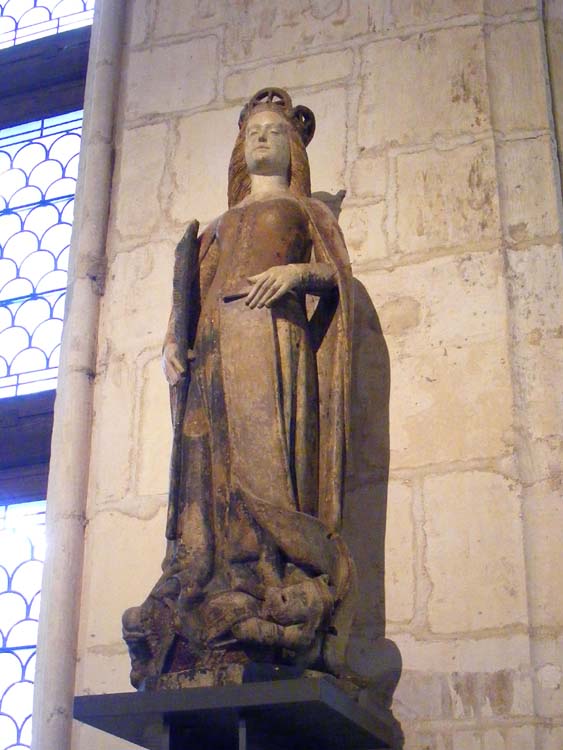
The polychrome limestone statue of Saint Catherine of Alexandria in the chapel of the Hospice Saint Roch in Issoudun dates from the end of the 15th century.

The construction of a new hospital in 1875 resulted in the abandonment of the former hospice. The administration in their wisdom at the time therefore set about selling several statues which formed part of the important sculptural decor of the chapel. Saint Roch himself, Saints Cosmas and Damian, Saint Peter of Verona and Saint Catherine of Alexandria were dispersed in 1906 into private American collections. Going first to the collections of the Wildenstein family and then to J. Pierpoint Morgan, Saint Catherine of Alexandria is today owned by the Metropolitain Museum of New York. The work has been on loan from the Met since 1995.

Saint Catherine, of royal descent, is richly clothed in a purple cloak. She holds a palm frond in her right hand, the symbol of her martyrdom. She unrolls from her left hand a phylactery (speech scroll) which carries the inscription 'Ora pro nobis' ('Pray for us'). The saint is wearing an unusual crown, formed from four wheel sections, which were to have been the instruments of her martyrdom, but which miraculously broke. She crushes her executioner, the Emperor Maxentius, victoriously under her feet.

Placed at the entry to the oratoire, as a pendant to the Virgin and Child, facing the open doorway to the sickroom or hospital ward, for the poor bedridden inmates she represents a hope of cure and a return to good health.

***********************************************
Blog Post Milestone: This is the 3,000th time we have committed wisdoms to the internet. Of course, it tallies to more than 3,000 wisdoms because we often do more than one wisdom per day. That's a lot of wisdom - and Susan has given more than her fair share.
Simon

Thursday, 3 December 2015

Red Helleborine Research Report

Back in June I collaborated with David Armstrong, Lead Ranger from the National Trust Cotswold reserves, and his team when they came to France to research the rare Red Helleborine orchid Cephalanthera rubra. David is based at the Ebworth Centre.

Red Helleborine near Chaumussay.
The orchid is critically endangered in England and the National Trust, Natural England and the Royal Botanic Gardens at Kew are trying to establish what the species requires to reproduce. Without this information they can't begin to propagate it from the few precious seeds the English plants produce.

Red Helleborine in the Claise Valley.
Last week he sent me the report of the team's visit to the Touraine and has given me permission to quote it on the blog. So here are his General Observations:

  • All the sites were within or adjacent to woodland on limestone, dominated by downy oak.
  • All of the sites were on slopes.
  • The woodlands appear to be “natural”, with no real indication that they have been planted, and probably ancient in nature.
  • The woodlands showed signs that their management is low intensity, generally coppice for firewood. There was no sign of any very recent management. There were very few very large standards, but some old coppice stools.
  • The sites are privately owned and none of the sites are managed for their conservation interest.
  • Most plants were within a few meters of downy oak trees, but plants were not seen very close to trunks.
  • Plants were seen in open ground up to 10m from the more mature trees, but close to saplings.
  • None of the sites were dark or heavily shaded. Although we did not spend time searching deeper within the woodlands. (Susan Walter concurs with this).
  • Dappled shade, wood edge, tracks appeared to be favoured.
  • Plants can exist in very open conditions.
  • The flowers were often open very wide, more so than we have observed at Workmans’ Wood.
  • Clumps of many flower stems were seen in places.
  • Few if any non-flowering plants were seen, but these could have been missed. Susan’s impression is that if they come up they flower reliably here.
  • All of the sites included many different species of orchid.
  • All three species of Cephalanthera were present at most of the sites. “Where you get one Cephalanthera you tend to get all three”.
  • Juniper was common on all but one site.
  • Only one beech tree was seen!
  • There were many plants across the site and the collection of seed pods or root material would have little or no impact on the populations.
  • It is possible to enjoy a civilised lunch break sampling the local plat de jour within easy reach of all of these sites.
You can read my blog posts on the National Trust teams visit here and here. 

Red Helleborine in the Claise Valley.
Now the project is on the move again, with Jon Kendon, from the Royal Botanic Gardens, having applied for permission to take protocorms (tiny bulbs) from the wild in the Claise Valley. Jon's job title is Lab Technician, Analytical Methods (In Vitro Biology), Comparative Plant and Fungal Biology Department. He's based at the world famous gardens at Kew, on the western edge of London. We are not very hopeful of getting permission in this case, but it might set the scene for us getting permission to collect seed in the late summer. The Red Helleborine, although rare and localised here too, probably sets thousands more viable seeds than it needs or will ever grow here, so seed collecting will probably be viewed by the authorities as a safe request. Collecting protocorms is more unusual and although I am sure they will be sympathetic to the project's desire to identify the mycorrhizal partners of the orchid in the soil, they may feel it is not appropriate to grant the request given their remit to protect the plant in France. If we do get permission to go after the protocorms, the work will be done in mid-February, so it is likely to be cold out there on the limestone slopes where the orchids grow.

Red Helleborine by the side of a track on a limestone ridge near Panzoult.
So far Kew has had very little success in propagating the species. Partly this is because the English plants don't flower well and don't produce viable seeds. But it is also because they don't know what fungal partners the orchid requires in the soil. The English plants are so few in number that they dare not take material from them. Hence the request to take samples in France, where there are several localised but thriving colonies.

Corinne takes a photo of a Red Helleborine on a botanical outing to Panzoult.

 ***********************************************
Car for Sale: Is anyone looking for a car? Our 1999 Renault Megane Scenic 1.9td is surplus to requirements: we were going to keep it as a potager wagon, but it is the fourth car in the garage and has been used exactly once in the past two month. It goes, but has issues - it'll need two tyres before it passes a CT, and it tends to leak electricity. If you're looking for a gardenwagon and have 100€, drop us a line before mid afternoon Friday and you can have it as is. It's been a good car for us, done many kms, and we will be sad to see it go - but it would be nice to think it'd have a life after us.

Before we take it to the wreckers we thought we would ask here if anyone wants it.

If you're thinking of buying an electric car (we were, but they're not quite ready for us) it could be worth a lot more than 100 euros: trade it in the right way and it could be worth up to 7,000€!
Simon