Twenty or so botanists gathered in the carpark by the
fire station on the edge of Chinon and then we set out in convoy up into the low hills to the north-west. The Puys are a series of hard limestone ridges with sloping sandy sides, criss-crossed by a confusing grid of dirt tracks. You have to know where you are going to navigate through the vineyards and gypsy encampments to get to the nature reserve.
Vineyards come right to the edge of the reserve.
Once there, the botanising started immediately, in the carpark, with some charming little pink Sand Catchfly Silene conica (Fr. Silene conique). It is only found on sandy ground. The next plant of interest was the fine grey green leaves of Seseli montanum (Fr. Séseli des montagnes). It will flower in July so at the moment it is just foliage a bit like carrots, to which it is related (one of its English names is Moon Carrot). A little later we come across another rare and protected umbellifer, Honewort Trinia glauca (Fr. Trinie glauque). It is flowering, looking a bit like tiny florist's baby's breath.
Already a pattern is emerging. This site is full of plants that 'shouldn't' be here. They 'should' be at the beach or in the mountains or much further south in the heat and dry. That's what makes the site so interesting -- all these species that are unexpectedly present and thriving, and a significant number of rarities too.
White Rockrose in the grass.
There are also plants which provide food for insects with very particular tastes. The ground is covered in places with Horseshoe Vetch Hippocrepis comosa (Fr. Hippocrépide à toupet). This is the larval foodplant for the beautiful Adonis Blue Polyommatus belargus (Fr. le Bel-Argus) butterfly, and the small irridescent blue males are flitting about everywhere. The presence of these two species tells you that the substrate is dry and calcareous. If it wasn't they wouldn't be here.
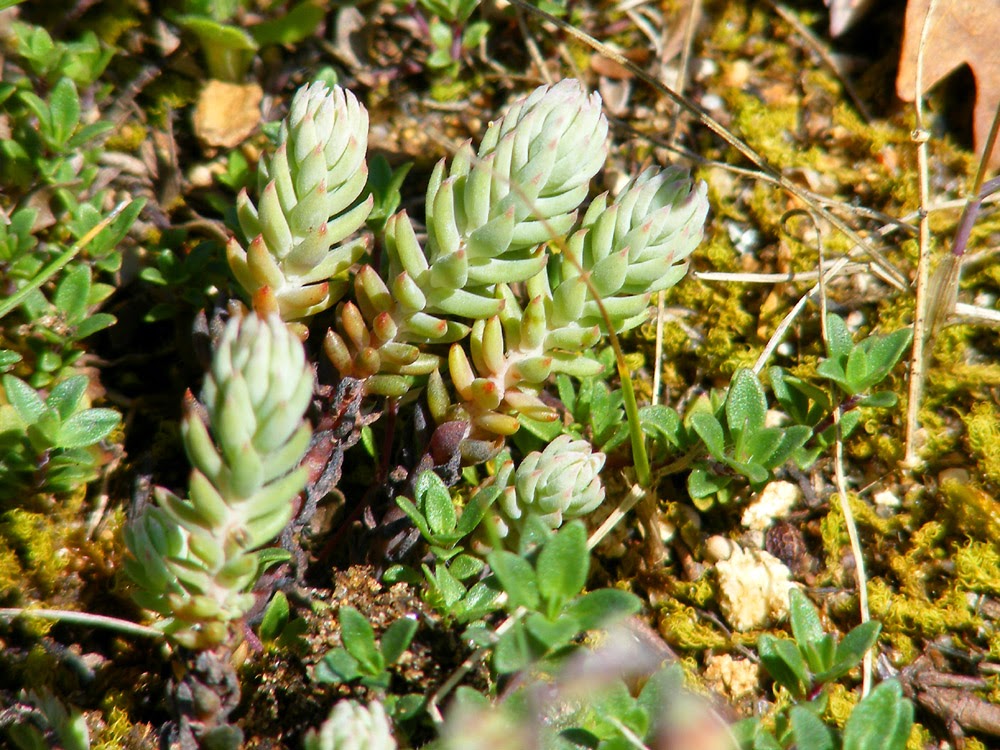
We encounter several species of Sedum, some ubiquitious, some rare, and Rockroses of several species. The White Rockrose Helianthemum apenninum (Fr. Hélianthème des Apennins) is everywhere in the grass, the yellow flowered Hoary Rockrose H. oelandicium (Fr. Hélianthème des chiens) is much smaller and restricted to exposed rocks in the ground where it clings on with apparently no soil.
Arenaria grandiflora.
Arenaria grandiflora (Fr. Sabline à grandes fleurs) is a pretty white flower with greyish leaves that would grace any alpine garden. It is found in isolated pockets from the Mediterannean to Fontainebleu. A national study and survey to determine the genetic variation of the species discovered that the Tourangelle plants and those at Fontainebleu are the same. Given how isolated each population is, this was a bit of a surprise.
As we progressed through the site, François Botté, who was leading the outing, pounced on plant after plant. For each he had a tip to aid identification or a story about some interesting research. The genus
Globularia has been reclassified into the Plantain family and our local species is no longer
G. vulgaris (now restricted to plants in Siberia) but
G. bisnagarica (Fr.
Globulaire allongée). The protected species
Violet Limodore Limodorum abortivum (Fr.
Limodore à feuille avortée) is a parasitic orchid which instead of photosynthesising takes its nutrition from the mycellium ('roots') of Brittle Gill
Russula spp fungus, which in turn are in a symbiotic relationship with surrounding trees (taking carbohydrates in exchange for certain micro-nutrients).
Broomrapes
Orobanche spp, on the other hand, wrap their root ball around their host and subsume their roots. To accurately identify an
Orobanche it is necessary to dig the plant up and see what it is actually connected to (François deployed the tip of his umbrella for this task). None of the available identification keys are reliable in all cases and identifying an
Orobanche by guessing that its host plant is what is growing next to it or by matching it to a picture or photo is also not reliable.
A colony of Violet Limodore.
We also got tidbits like old wheat fields (presumably with specimen oak trees present) were once the best sites in the Touraine to find truffles, but now these fields have had 50 years of fungicide there is no chance of finding good truffles in the wild. We found a
Scarce Swallowtail Iphiclides podilirius (Fr.
le Flambé) and François told us they and their cousins the
Swallowtail Papilio machaon (Fr.
le Machaon) are both declining because of habitual disturbance (ie gardening or farming) to their larval host plants such as carrots and plum trees, and because the adults are commonly hit by cars.
Field Pepperwort Lepidium campestre (Fr. Bourse-de-Judas) has seeds that look like old fashioned tractor seats according to François. He didn't make anyone taste it, but he did offer me and some others some Clematis flammula (Fr. Clématite brulante). Boy was it peppery! Apparently in the south of France it was eaten in the old days. Later we came across a patch of wild Gooseberry Ribes uva-crispa (Fr. Groseillier à maquereau) and Red Currant R. rubrum (Fr. Groseille à grappe). Sadly the berries were well green, so no opportunity to sooth our zinged out tongues!
Photographing a very co-operative Scarce Swallowtail resting on François' finger.
We saw 8 species of orchid in flower on the site and caught the last of a special patch of
Pasqueflower Pulsatilla vulgaris (Fr.
Anémone pulsatille) still out. The pompom seedheads were testiment to how many had flowered earlier in the season.
Pasqueflower seedheads.
All in all a thoroughly top notch nature reserve, tucked in
between a medieval fort and a nuclear power station and surrounded by vines.