Wednesday, 21 August 2013

Welcome Home Claudette!

Claudette has arrived home after her 4 months with Jean-Louis J-L the Traction Doctor and his mate Michel the panel beater. We met Michel 5 weeks ago when we drove over in convoy with J-L's Traction and spent a morning deciding on the work to be done, and the methods to be used: door fit was discussed for quite some time because the back passenger side door only fitted where it touched - although it would lock, there was daylight still visible around the edges. We also discovered that her rust problem had been made worse because someone had tried to disguise it by covering it with fibreglass and respraying.

Mince!


Claudette in Michel's workshop.

 New sill and door bottom being made.

There are still several small things to do, such as add wing mirrors and remove some stains from the upholstery, but we are really happy with the results so far. Jean-Louis' work we already knew from past experience can't be beaten for getting your Traction in tip-top condition. We were super impressed by Michel's rust removal and re-hanging of the doors, which involved remaking the passenger side sill and the bottom of the front door, plus fixing some other smaller rust holes and paintwork to blend in with the existing black (There are apparently 5 shades of black that Citroën used over the years. Who knew?!). It's a magnificent job, once again by someone who knows Tractions well.

 Claudette in La Guerche, yesterday.

Yesterday morning Simon washed her and gave her a first coat of wax and I've vacuumed her carpets. To celebrate her arrival we took her out on a photoshoot, stopping off in Le Petit Pressigny to pick up our friends Tim and Gaynor. We timed it really well, as they had spent the morning nettle bashing and were exhausted. A nice relaxing run in the country in a classic car was just what they needed.

Claudette in Le Grand Pressigny.
Our final challenge is to solve the brake drum problem. At the moment she is sporting a pair of brake drums that belong to J-L, because the new ones we bought are not properly round. So far the manufacturer and the supplier are not responding to customer complaints and we are not the only Traction owners in this position. My guess is that as there is only one manufacturer of Traction brake drums we will keep the ones we purchased and pay extra for someone we trust to re-machine them.

Tuesday, 20 August 2013

Stinky Cheese

France is famous for its cheese, and quite a few French cheeses are distinctly aromatic. One of the stinkiest comes from the area between Deauville and Lisieux in Lower Normandy. Simon loves to tell people the story of us spending Christmas in the area and taking a block of the local Pont l'Eveque cheese home on Eurostar.

The other day he announced that the fridge smelled, as if there was stinky cheese in there, but he couldn't see the source of the aroma and was mystified. Eventually I remembered that I had bought a Petit Pont l'Eveque some days earlier. It was unopened, and hidden under something else, but after a few days in the fridge had completely stunk it out. We happily unwrapped it and ate it and the fridge problem disappeared. A clear win-win.

There is a very fine line between good stinky and bad stinky with cheese. Once the lactic aromas go over a certain level or develop in a certain way the cheese turns from being a delicious treat to something disgusting that turns the stomach. But the cut-off point between delicious and disgusting is different depending on where you were raised and what foods you have been exposed to.

The French anthropologist Claude Lévi-Strauss had quite a lot to say about this particular aspect of our approach to food and how our attitudes are culturally acquired. He points out that these distinctions are entirely learnt, and not instinctive or innate as one might think. He illustrates his point at one stage by relating how, in the days after D-Day, American troops would occasionally encounter fairly whiffy dairies in the Norman countryside. To the unsophisticated Americans, who had never been exposed to anything more challenging than processed cheddar, they assumed the dairies were full of dead bodies, and burnt them to the ground. They were revolted and wanted to eliminate the smell.

Monday, 19 August 2013

L'Epopée Médiévale

L'Epopée Médiévale (The Medieval Epic) is a sort of free flowing outdoor performance by co-ordinated troops of semi-professional re-enactors, supported by local people and the staff of the various historic monuments in the town where they are performing. For the last couple of years it has been staged in Loches over the Assumption weekend. Assomption was on a Thursday this year, and although the Friday isn't a holiday, many people took the day off, faire le pont in traditional French style, thus making it a long weekend.

These mummers may be powerbocking but they hark back to a pre-Christian tradition, and some of them are genuinely scary.
We had never been to this event before, but this year we had visitors and decided to spend the day in Loches on Thursday. To be honest, we'd forgotten about the Epopée, and just wanted to show Jon and Rosy a charming small town with good medieval and renaissance buildings and go to a good restaurant for lunch.

Serious bagpipe alert! 
(The percussionist is 'doing a plastic' instrumentally, and the bagpiper on the right has the nattiest facial hair, which unfortunately you can't really see in this photo.)
The Epopée was free unless you wished to enter the grounds of the Logis Royal or the Donjon. Most of the stalls selling medieval wares were in the free zone up on the citadel near the church or in front of the Donjon. If you wanted to buy a medieval costume or accessories, there was plenty of choice, all taking a very professional attitude to authenticity. The tented encampment with trebuchet demonstrations and 'learn how to wear armour' sessions were in the grounds of the Donjon. On a normal day you don't need a ticket to get into the park around the Donjon. I am aware that the lack of free access to this area is resented by some visitors who don't think it is value for money at €9 a head (a combined ticket that gets you full access to the Donjon and the Logis Royal). The ticket booths are set up at the gates of both buildings and you get a stamp which you then just wave at the person on the gate at the other location.

Luckily for us, the guys at the entrance recognised me and the four of us got in for €5 a head, which I thought was perfectly good value. Once in we decided to opt for the medieval fare for lunch and had tranchoirs (basically open sandwiches with cured meat, slabs of cheese, gherkins, sultanas and nuts). We passed on hypocras or the various fairy or hobbit elixirs, and just went for beer though. Later we went for cocktails at Le Caravage, which were, as usual, superb and extremely good value whether alcoholic or non-alcoholic.

Guards at the Porte Royale, the only entrance to the citadel of Loches. These guys come from the re-enactment group Medio evo.
Being an erstwhile member of the Costume Society, I am fairly beady when it comes to spotting the anachronisms and anyone 'doing a plastic' (as the English re-enactors call it). I was most impressed by the quality of the costumes here and the way they were worn. Where manmade textiles had been used, they had been chosen carefully so they had the right weight and fall. There were a few modern touches, but of the sort that can be forgiven if they are done discreetly (modern prescription spectacles, kids in modern shoes, spring-loaded stilts). Most of the costumes had been at least partially machine stitched, but when it really mattered they were hand stitched, and everyone accessorised carefully, with some excellent belts, purses, weapons, head gear and foot wear. All the costumed characters were only too pleased to chat about their roles and be photographed. They were also fantastic at involving kids in the crowd in the performance and generally entertaining whilst staying in character.

We had a great time (except for periodically having to dodge the bagpipes...)
***********************************************************
A la cuisine hier: Stuffed Mushrooms and roasted vegetables. Shirley Conran is a woman of great common sense, but she is wrong about mushrooms.

Gooseberry Crumble. I keep a jar of crumble mix in the fridge so I can whip up a fruit dessert in no time. Jean's gooseberries were a real treat. I had forgotten what a distinctive flavour they have. Served with proper homemade custard of course. I'll be able to make fool with the rest today, but I have to wait until the laitière delivers some cream at lunchtime.

Sunday, 18 August 2013

Carpark Shade

Carparks are difficult to make attractive whilst continuing to maintain functionality. The small shopping centre in the town where my parents live has gone to some trouble to improve the situation. I guess they could have planted some trees, but the shade sails are not a bad solution -- they certainly look smart and practical.
***************************************************************
Ile de Ré Reflections: A pool in the salt marshes, part of the Réserve naturelle.
*****************************************************************
Annual Hay Bale Migration: The annual hay bale migration is upon us, with the great beasts present in many fields. I've recorded at least five species and noticed that they've started aggregating at strategic points. Once this starts happening the local farmers need to keep their wits about them. I've noticed an increasing number of farm vehicles that have clearly been hijacked by groups of hay bales wanting to move more quickly from their summer grazing to their winter farmyard stacks. Once they start lining up in a regular fashion across the field I reckon the farmer needs to be particularly careful, as this change in behaviour heralds their intention to move.
******************************************************************
Goosegogs: The lovely Jean from Baking in Franglais called over yesterday afternoon delivering English gooseberries and her homemade strawberry and redcurrant jam. We love gooseberries, but they don't grow here (the plants succumb to mildew very quickly). I feel a fool coming on.
****************************************************************
Guests: Our guests Jon (Simon's brother) and his wife Rosy have gone home. We sent them on their way after 3 days of eating and drinking and a bit of medieval culture.
**********************************************************************
A la cuisine hier: Vietnamese Summer Rolls. I'd never made these before and now having done so, I would highly recommend you give them a go. They aren't nearly as difficult as you might think, and they are light and delicious. Maybe not to the standard Chez Kim, but good and tasty, sort of crunchy summer comfort food. I will have to make them again, partly because I need to practice rolling them up tight, and partly because I have a packet of 40 galettes de riz (rice papers) from the Paris Store to use up.

Saturday, 17 August 2013

The Brigalow Belt

The Brigalow Belt is one of Australia's biodiversity hotspots. It forms a band of wooded grassland stretching from tropical Townsville in the north, inland and beyond the New South Wales border to join the semi-arid temperate woodland of the Pilliga. Brigalow is a type of wattle (mimosa) Acacia heterophylla and the bioregion takes its name from this dominant species. Other important species are Belah Casuarina cristata, Poplar Box Eucalyptus populnea, Narrow-leaved Ironbark Eucalyptus crebra and Wilga Geijera parvifolia.

Driving through a beautiful silver leaved patch of Brigalow, south of Gilgandra in north western New South Wales, in December last year.

Up until the Second World War, government policy either opposed wholesale clearing of this vast woodland, or, in the interwar period, were hampered by having to deal with the invasion of prickly pear Opuntia spp, which had a distribution that more or less coincided with that of the Brigalow Belt. After the War though, conservation issues were sidelined and the land was considered ripe for exploitation. Pastoral leases were granted which depended on clearing the land within a certain time limit in order to fulfill the conditions of occupation. Large areas were opened up for broadacre farming and cattle grazing.

Seemingly dense natural bush on the roadside...

Things really escalated when Joh Bjelke-Petersen became Premier of Queensland. He developed a technique of clearfelling using a heavy chain pulled between two bulldozers -- a crude and brutal method typical of the man. Much of his personal fortune was based on this 'property development' activity. Others followed suit and applications to clear the land were never turned down. Finally, legislation was introduced to bring the destruction to a halt, but there was such a long lead time until the legislation was enacted that the rate of clearing increased by 50% every year for the couple of years before we left, as landowners panicked before the rules tightened up. As a consequence, most of the Brigalow Belt has been cleared in my lifetime, and living as I did on its eastern fringe, I watched it happen. In the 70s and 80s the conservation focus was on the more glamorous wet old growth eucalypt forests and temperate rainforests of Tasmania and the New South Wales hinterland. Backward, conservative, corrupt Queensland was considered a lost cause and virtually no one rallied to defend the Brigalow.

...but then there's a break in the trees and you see how open the country has become.

When you drive through it you don't get a sense of how much has gone. The roadsides have mostly been left intact, to form more or less useless ribbons of original vegetation. It is only when you look at the satellite images that you see that the dense stands of brigalow that line the roads are a facade, hiding truly vast paddocks of 'improved' pasture or cereal crops. And now it's the heart of the coal seam gas mining activity in the country. Does the irresponsible short termist exploitation of this special area never end?
**********************************************************
Ile de Ré Reflections: Proof we saw an avocet.

Friday, 16 August 2013

A Clock in a Tower

This is one of the clock faces in the Tour de l'horloge over the Porte Picois in Loches. The Porte Picois is one of the Renaissance entries to the town of Loches, forming a gateway in the third (outer) defensive wall. It was built at the order of Francois I between 1535 and 1543, and is now the Hôtel de Ville (Town Hall).

 This is what the clock tower looks like photographed from the terrace by the Logis royal.

Thursday, 15 August 2013

Nice But Dim

This handsome devil is the 27 year old Charles VIII of France. This bust sits on a mantelpiece in the Logis royal in Loches. It appears to be one of a number of versions that exist, and I have no idea where the original is (maybe Langeais chateau). Charles came to the throne as a young teenager, 13 years old. Because he was so young, and considered a perfectly pleasant, but not terribly bright young chap, his formidable sister Anne of France was initially appointed regent. (She was once described by their father Louis XI as 'the least foolish woman in France'.)

He might not have been as dim as everyone suggested however, as once he reached his majority he pulled off an audacious and advantageous marriage. At first he allied himself to the Holy Roman Emperor Maximilian I of Austria, by becoming betrothed to one of his daughters. But when Maximilian was married by proxy to the child duchess Anne of Brittany, Charles and his advisors knew they needed to act decisively if France was not going to end up as the ham in a sandwich formed by an independent Duchy of Brittany to the west and Austria to the east.

Charles laid siege to Rennes, and when Maximilian did not come to Anne's aid, Charles knew he had gained the upper hand. Escorted by troops to 'ensure her safety' Anne was 'persuaded' to come to Langeais castle, where she and Charles were married. The 14 year old Anne was not a happy bunny and famously brought two beds with her to Langeais for the wedding. Poor little Margaret of Austria can't have been a very happy bunny either, as she was left hanging around the French court for years before she was finally returned to her family.

The young king died the year the bust was made, after hitting his head on a door lintel in Amboise castle, apparently rushing to watch a game of tennis. The story goes that after the game he lapsed into a coma and died some hours later, presumably of a head injury. He and Anne had 4 children, but none lived beyond infancy. (The poor little mites are buried in Tours cathedral.) Anne's marriage contract obliged her to marry the next king if there were no surviving male children to take the throne, but since the next in line, Charles' cousin Louis of Orléans was already married she took the opportunity to scarper back to Brittany. (In the end she had to marry Louis, but that is perhaps a story for another day...)
********************************************************************
A la cuisine hier: Elephant turd cake (well, that's what Simon told 7 year old Anneloes anyway) but to the grown ups it was billed as chocolate cake with chocolate buttercream. Simon made it for Huub, Ingrid and Anneloes' last day at the pool. They made a savoury tart and there was melon, peanuts and crisps along with wine and fruit juice. We had lunch at the pool, joined by Carole, Tristan and Ludovic, Bruno, the omas, and of course, Laurent and Véro. It was kind of like a lock-in, but outdoors...

Later in the day Simon's brother and sister-in-law arrived and he made a fougasse and barbecued a chicken marinated in his chillicherry sauce.

Wednesday, 14 August 2013

Sylvie's Rose

A couple of years ago our seriously green thumbed friend and neighbour Sylvie did a rose propagation workshop at the Chateau of Azay-le-Ferron. I was the lucky recipient of one of the cuttings she had taken from the chateau's rose garden. Ever since it has lived in a smallish plastic pot and moved around the garden and courtyard, developing roots and growing a bit. My attention to it has be shamefully intermittent, but it has survived several cold winters and some hot dry weather. It's clearly indestructible.

It's also beautiful. This year I potted it up into a really big pot and it has put on a lot of growth and flowered for the first time. The flowers are the palest palest pink (or white with a pink blush in rose speak). It has the most glorious scent. I am delighted with it, and impressed by its tenacity as well as its outstanding all-round rosiness.

Sylvie told me when she gave it to me that she couldn't remember what it was called. I've consulted some books and I think it might be a centifolia of some sort, but rose taxonomy is a black art, and I am by no means sure. Anyone who has any idea what the name of my lovely rose is please speak up!

Tuesday, 13 August 2013

Life at the Pool

We are getting quite a lot of swimming in at the moment, with nearly daily sessions at the public pool in Preuilly. Recently we learnt that it will be Laurent's last season as the maître-nageur here, as he is going to take a year or two off work 'to make a new life for himself'. We wish him well on his new adventure, but we will miss him. He's here until 1 September, then the pool closes until next year.

Laurent on the left and Huub on the right, below. Huub is wearing his special go faster swimming trunks, designed by him and his associates. They specialise in triathlon suits known as Huub Tubes (as seen in this video worn by Jenson Button and his mates).
 Simon, below left, encouraging Anneloes to behave badly. And what is the best thing about spending the summer in France according to a 7 year old? Swimming with Simon! Yay!
 Swimming lecturer Ingrid and swim scientist Huub show everyone how to do it.

Monday, 12 August 2013

A Fish Pedicure

One day in early August, on our way home from le Blanc we decided to stop off at the river in Fontgombault. It was so hot we took off our shoes and dangled our feet. The water was cool and refreshing, and we were in the shade of a tree.

The bridge over the Creuse at Fontgombault.
 Looking across the river to Fontgombault.
 Blue Featherleg Platycnemis pennipes damselflies ovipositing in the river. The males 'stand guard' over the females, who they have grasped by the scruff of the neck with the claspers at the tip of their abdomen. They look like circus acrobats.
 Simon receives a fish pedicure from some bold little fish in the shallows.
 I very inelegantly hitched up my smart pencil skirt in order to dangle my feet.
 The view over the Creuse.

Sunday, 11 August 2013

Prickly Pear

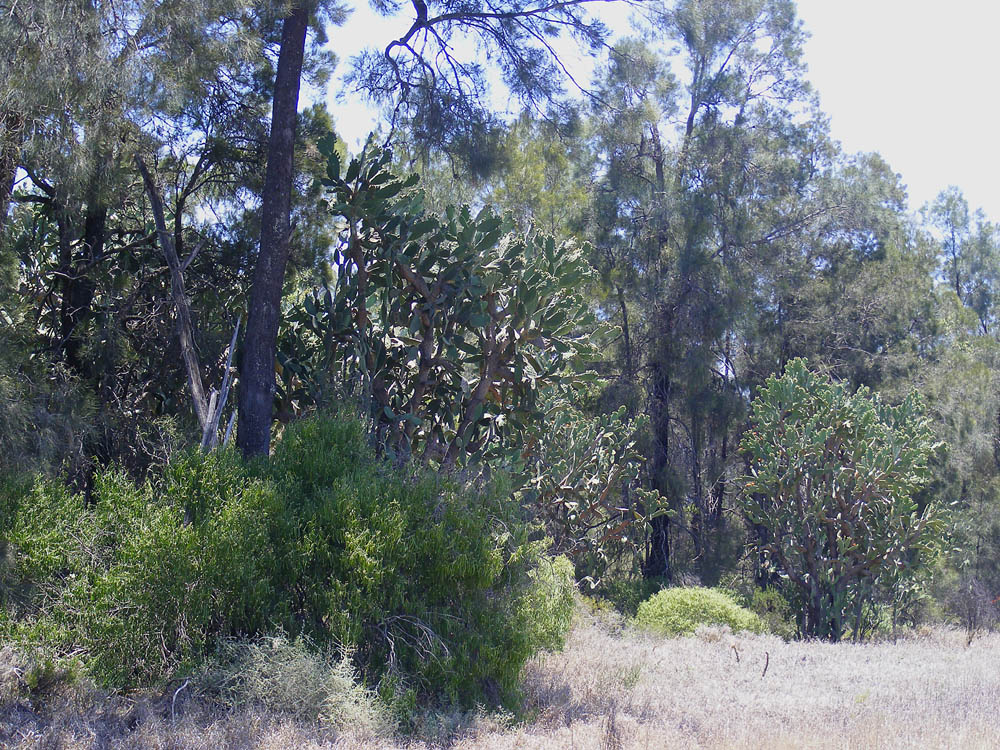
Australia has had its fair share of disasterous plant introductions and its fair share of disasterous attempts at control. One disaster that has had a happy ending after all though is the prickly pear story.

Prickly pears Opuntia spp were introduced at the time of the very first white settlement. The idea was to break the Spanish South American monopoly on cochineal. This red dye is produced from a scale insect that feeds on the prickly pear and was required for making British military uniforms. Initially the plants remained well behaved at the coast, but then someone planted them at a homestead garden in the bush. At some stage several different species were introduced and other people planted them as stock proof hedges or emergency stock fodder. Once they got inland, before anyone could draw breath, the prickly pear had multiplied in the wild and rendered useless a huge swathe of southern Queensland. There are old photos from the early and mid 20th century showing the extent of the problem. Where once cattle grazed, now there was an impenetrable forest of cacti, covering over 24 million hectares and spreading at a rate of a million hectares a year.

Remnant Tree Pear Opuntia sp specimens in the Belah Casuarina cristata (the tall dark trees) and Wilga Geijera parvifolia (the bright green shrubs) scrub between Goondiwindi and Millmerran.

The government of the day was desperate. They organised programmes of control, trying burning, poisoning and physical damage or removal. Nothing worked, and frankly, when you read the litany of poisons used, it is amazing the whole area isn't completely toxic to this day! Reminiscent of the phylloxera outbreak in France at much the same time, a reward was offered to anyone who could eradicate the cactus. Like the phylloxera reward, it has never been granted, as the pest has never been completely eradicated.

Finally, however, in 1912, the Prickly Pear Travelling Commission was formed. Their objective was to identify possible biological controls by visiting countries where the cactus was indigenous and obtaining species that would be safe to introduce into Australia (ie be prickly pear specific and not move on to other plants). Enter the Cactoblastis moth and its caterpillars, as well as a dozen other natural predators of Opuntia spp. After researching the effectiveness of the predators, it became clear that the Cactoblastis moths were the star prickly pear destroyers. After the First World War the government set up a Cactoblastis moth breeding centre and eggs were distributed to landholders with instructions for their use. Within a decade the problem was under control!

These photos of the roadside vegetation were taken while we were queuing for roadworks. Note the wizened plant in the left foreground -- the Cactoblastis have been at work.

I am very familiar with the prickly pear and its amazing story, as we lived on a farm within the affected zone. There is a memorial to the Cactoblastis moth in a town not far (in Australian terms -- it's 170km away) from where my parents live. So now you know why I am so horrified when people tell me they have smuggled cacti or other plants intercontinentally.
****************************************************
Concert: There will be a concert in the Abbey in Preuilly starting at 5 pm on Thursday 15 August. A trio of cellist, flautist and pianist will play works by Mozart, Handel, Haydn, Debussy, Fauré and many others. Reservations advised.
*******************************************************************
Ile de Ré Reflections: the island's snails seemed to find our tent irresistable. This one thought it would be safe in Simon's cap, another made it to the very centre of the tent roof outside, where we couldn't reach it. Yet another managed to emigrate, coming home with us in our swimming gear bag to be discovered when I unpacked.
*********************************************************************
A la cuisine hier: The liqueur de noix has developed a scum. At first I thought it was growing some undesirable fungus, then I realised it was a slick of walnut oil. The vin de noix smells divine -- really rich and walnutty.
*******************************************************************
Orchard News: I mowed 2 more small sections of orchard yesterday. My aim is to get it all done (except for a strip for Wasp Spider Argiope bruennichi) before early autumn when Alex will come to do the annual end of season mow to set it up for winter. You should have seen his face when I told him it hasn't been mowed since the last time he did it! 

I was joined by a very yellow female Great Green Bush-cricket Tettigonia viridissima, who looked just like a yellowing leaf, and rushed towards me when I knelt down to photograph it. It zipped up my knee and over my shoulder, sat there for a while, then flew back down to the grass. I'm not quite sure what the attraction was -- probably I was a good hunting stand. Also hunting in the potager was a female White-tailed Skimmer Orthetrum albistylum dragonfly and an extremely muscular looking robber fly, Pogonosoma maroccanum, hunting bees. The robber fly is a bee mimic, black with golden 'fur' and weightlifter's thighs. It had better eyesight than me, and refused to co-operate for photos. No matter how much I sneaked up on it, it always saw me first and moved. They seem to specialise in bees as prey. Fortunately, given the poor quality of my photos, it is a striking and unmistakable species and I identified it easily. A nice new record for the orchard.

On the way down to the orchard I passed our firewood merchant, energetically weeding his potager (he does most things energetically). He tells me all his tomatoes (cent pieds! that's '100 plants'!) have blossom end rot. According to him all the treatments that worked on this fungal disease are now banned, and anyway, he didn't want to be treating tomatoes intended for his personal consumption. We took the opportunity to discuss the coming winter's firewood supply and I have ordered 10 stères to start with, but we will probably need about 14 by the end. He said he'd used an unusually high quantity of firewood last winter, not because it was particularly cold, but because it dragged on for so long. He asked me if we had storage space for 10 stères all at once and I said I thought we did. We've used all of last year's firewood...because winter dragged on for so long...
***********************************************************
 

Saturday, 10 August 2013

A Bush Town

Goondiwindi is a typical bush town. It's in southern Queensland, on the border with New South Wales. The name is pronounced 'gundawindy', and the place is frequently referred to as Gundy.

The main street. 
You can tell this is Queensland and not New South Wales because it doesn't have stupid reverse angle parking. The street is this wide because in the old days you had to be able to turn a bullock team around in it (the central island with its palm trees is a relatively modern addition).

The old and the new. 
On the left, a traditional weatherboard house on stumps (to protect against termites originally, and in this case raised up on metal stilts to provide usable semi-openair space underneath), an architectural style known as a Queenslander. On the right, a modern lowset brick home with an enormous footprint taking up the whole plot.

A nice old home, hunkered down under its verandah, which performs the same function as shutters do in France, providing shade and protection against weather good and bad.
****************************************************************
Ile de Ré Reflections: I've no doubt that plonger is strictly interdit, but I was quite pleased to capture this young rebel in mid leap from the sea wall.
********************************************************
Orchard News: I picked our entire white nectarine crop yesterday. This amounted to two fruit. Delicious, but sadly meagre. The yellow nectarines and the pears seem to have stalled. They are all very small and rock hard.

In the potager I dug some potatoes, also with a disappointing result in terms of yield. I didn't weigh them but I reckon 5 plants have given about 10 serves of potato. I dug a few leeks as well, small but going to seed. The first tomatoes have been picked, mostly cherry types, but one largish variety which is very firm and dark red (it's lost its label, so I don't know what it's called).

The orchard is a sea of flowering Wild Carrot Daucus carotta (aka Queen Anne's Lace) at the moment. Normally the flowers that make up each umbel are white, with a few red ones making a little spot in the centre. I was interested to see that one of my Wild Carrots has almost entirely dark purply red flowers, with a few white ones in patches in the umbels. I've never seen one like it before -- perhaps I'd better patent it and make my fortune.
***************************************************************
Black Traffic Day: Yesterday Bison Futé, the traffic info site, was predicting a particularly black day on the roads, with holiday makers travelling in both directions (home and away) in great numbers. By 8am France Info radio was already talking about tens of kilometres of traffic jams throughout France. Last Saturday had close to record traffic, and today is expected to be similar.

Friday, 9 August 2013

The Garbos

The garbage is collected in Preuilly around 7 am on Thursday mornings. Until about 12 months ago it was a 4 am collection, so I'd never met the garbos. A 7 am collection means that I am up and about and it's light enough to take photos in the summer, so I did. They were highly amused and asked me if it was because they were so irresistably attractive. I assured them that was the reason I rushed out to photograph them, and told them they'd soon be world famous because I would put the photo on the blog (although, just between you and me, I think they may find they have serious competition in the form of Laurent the maître-nageur, but he's only here for the summer, so I guess they have the advantage there...).

They work for the rather Bondesque sounding Smictom, whose company motto is 'Au pays de Descartes, je pense, donc je trie' ('In the land of Descartes, I think, therefore I sort') which has always made me giggle.

One of the differences between life in Europe and life in Australia that amazed me when we first moved was that people put their garbage out for collection on the street in plastic bags, with no other protection. Nowadays people often have wheelie bins, but 16 years ago when we first arrived in London, the dustmen, as they are quaintly known there, just wanted to be able to grab the bags and sling them in the back of the lorry (as they would no doubt call it). As you can see in the photo, the Preuilly garbage truck has the facility to tip a wheelie bin, but of the three households who put their waste on that corner, only one uses a bin. It is very rare that a bag gets ripped open in the night by wandering wildlife or dogs.

The 50 litre yellow bags are for recycling (most plastics, metal, tetrapaks) and the 25 litre black bags for anything unrecyclable and I pick up our allocation from the council once a year in March. Newspapers and magazines and glass must be taken by the householder to the recycling bins located in several places around the town. We compost our food and garden waste and some paper (and burn woody garden waste in the winter). The rest goes to the local tip, sorted into various categories for recycling and run by the superbly organised and neat and tidy Didier.

The usual French word for household rubbish is poubelle, after Eugène Poubelle who introduced the idea of rubbish bins in France in the 19th century, but more formally it is ordures ménagère. Sometimes you also see déchets ménager. The tip is the déchetterie and the bottle and paper bank is a station de récyclage.
*****************************************************
Picnic in Chaumussay: We had a shared picnic in Chaumussay yesterday to celebrate our friend Pauline's birthday. We supplied a fougasse and some limoncello and blueberry cake along with sparkling and liqueur Vouvrays (note for future reference: Chateau Gaudrelle Brut Tendre is a perfect match for fougasse topped with salt, onion, olives and cheese). Tim made potato salad, cucumber salad and chickpea and spätzle salad, Pauline made an eggah and an apricot clafoutis and they brought a sparkling rosé. Niall and Antoinette brought ham and a Spanish omelette (tortilla). It was lovely, and we recommend the picnic ground in Chaumussay, which has good picnic tables, a large shelter, a barbecue, recycling and rubbish bins and a secluded setting on the River Claise.

Cucumbers were handed out. Cucumbers are the new lettuces.
***********************************************************
Answers to Yesterday's Quiz: Have been posted at the bottom of yesterday's post. No one earned all 6 points, but Tim was awarded 2 points for getting quite close.

Thursday, 8 August 2013

A Few Words About La Sologne

France is a country of many parts, each having little resemblance to the others. The terrain is different, the people are different and the conditions of life are different. Most of these districts, which carry a general name but have no visible boundaries, are well known to tourists, notably the ever popular Riviera. Nothing could be more unlike than the Ile de France, with its plains rolling away to the horizon, and the towering Pyrenees.

But unless the voyager has some specific reason for going there, or happens to find himself on the great highway known as Route Nationale 20, it is unlikely that he will hear of La Sologne. Even in that event he will little suspect what lies on either side of the road, for hundreds of square miles of forest, swamp and jungle, are not what he would expect to find in the heart of a country wherein agriculture is a basic industry.

To paint a pen portrait of this strange land of nearly a million and a half acres will not be easy, but we must try, for the reader should know something of it from the outset. Apart from being a land of moods, La Sologne takes care that you do not see all her face at one time. At every turn the scene is different, yet there is no particular view to remember. Indeed, from La Ferté St Aubin in the north (on the map you will find it about twenty-five miles south of Orleans) to Vierzon in the south, a matter of roughly forty miles, the traveller by road may think the countryside monotonous. Actually, it is one of the wildest, and for that reason for some people one of the most fascinating, stretches of country in Western Europe.

For the most part La Sologne is true forest, with stands of oak, chestnut, birch, fir and pine. The ground underfoot may be arid, supporting a tangle of heather, sometimes waist high, or it may be a reedy swamp extending for miles. There are jungles of scrub and undergrowth that are literally impenetrable. Everywhere trailing brambles drag on the feet. Scattered over the whole area are lakes, large and small, more than a thousand of them, dark, solitary, tranquil, fed by furtive-looking streams that glide mysterious courses through the labyrinth. Over all hangs a brooding silence that seems to fall from the sky, and at sunset creates a haunting, often sinister, atmosphere.

This is not to say that so vast a tract of land is uninhabited. On the main road that cuts through it like a knife from north to south there are one or two small towns and villages, and on either side of it you will find an occasional farmer scratching a living in a clearing; for the soil is poor, and in recent years a great many of these homesteads have been abandoned. Apart from the diehards fighting their losing battle with nature, the only man you might meet, except in the shooting season, would be a forester or a gamekeeper. The visitor might walk all day long, as has the writer, without seeing a living soul or hearing sound of one. A man seeking solitude will certainly find it here.

For the bird-watcher it is a paradise, but let him beware of snakes, one species of which is venomous. The lizards are harmless, as are most of the wild creatures that have here found a safe retreat; and that includes the great deer as well as the smaller roe. An exception can be the sanglier, the wild boar, an ugly beast that can weigh up to hundreds of pounds and has tusks that would rip a man to pieces should he fall foul of one in a nasty mood. But even the sanglier, left alone, is not to be feared. By day he retires to the thickest jungle, and there, unless disturbed, he is content to remain until nightfall, when he emerges to foray for food. Upset or wounded, like all his species, he can be a devil incarnate.

In the autumn hunting seasons La Sologne is the Mecca of sportsmen, for game abounds—pheasant, partridge, woodcock, snipe, wild duck, and the like. There are fish, too, in the lakes—enough to satisfy the most ambitious angler. Areas of ground are rented by those who can afford them, and this, in the 19th century (when men had money to spend) produced what at first seems a startling paradox in the form of hunting lodges of a size and splendour seldom found elsewhere—mansions of forty, fifty, or even eighty bedrooms. Some are still occupied; others are empty and have fallen into disrepair, with roses, long untended, fighting a hopeless battle with the weeds.

How did this wild place come into existence? Standing within the forest with the smell of rotting leaves in the nostrils, a buzzard circling overhead and a fox slinking across a glade, one has a feeling that this was how much of Europe must have looked ten thousand years ago. It is said that during the wars of the Middle Ages, and after, when the land was a prey for marauding gangs of disbanded soldiery, the people who dwelt here—those who had not been murdered—fled, leaving the ground to go back to swamp and forest; and since that time the huge sum of money that would be necessary to drain it and restore it to cultivation has not been available. So it remains as the visitor will find it today, a land which Nature has won back from men in spite of their machines.

The men who lived in the region during the Dark Ages have left their marks, although these are fast disappearing. One comes upon crumbling, overgrown ruins; fortified, moated sites that once were castles, and even churches. Old foresters whisper darkly of underground passages, too. But the hand of death and decay has fallen heavily on these relics of a forgotten past, and sympathetic nature is fast burying them in a shroud of moss and ivy. Even the rabbits have gone, wiped out by the deadly myxomatosis; and how many there must have been may be judged from the fact that at one time the district exported three million a year. Now the burrows, like so many of the homes, are empty.

La Sologne has had more recent troubles, and if one other thing was needed to complete the atmosphere of tragedy and chill the heart of the visitor it is there. Graves. Graves, sometimes solitary, sometimes in long rows. Little white crosses, everywhere. Usually there is just a name, or names, and below, those significant words that speak for themselves: Mort pour la Patrie: Morts pour la Liberté de leur Pays: or, Morts pour la Résistance. The visitor will come upon this melancholy harvest of war everywhere, in the woods, the fields, or by the roadside. Under each cross lies a Maquisard, one of the boys or girls (many were students) who refused to be conscripted into Hitler’s forces. As one enters La Ferté St Aubin in the north, by the roadside lie forty-five.

La Sologne, by reason of its nature, became a hiding- place, during the occupation of France by Germany, for the Maquis, as they were called, or the Résistance. When they were caught they were shot out of hand. The German method employed to find them was to infiltrate a collaborator into the forest. He would pretend to be a Maquisard, or an escaped prisoner, and having been received by the boys and girls in hiding would later slink away and betray them. To such base treachery can human beings sink. Did I say human? Inhuman would be a better word. So their victims were shot, peasant, priest and pupil, men, women and children whose only crime was patriotism. Many died shouting defiance at their murderers, and today, should you pass that way, you may see where they lie. There are British names among them. But times are changing, and perhaps these things are best forgotten.

One need not be too depressed by this, for as an old Maquisard told the author simply, but for this sacrifice how would we know of their courage? Courage of the highest order was needed by these Davids to defy the invading Goliath.
So who wrote this?
  • 2 points to anyone who can name the author. 
  • 2 points to anyone who can name the book this is from. 
  • 2 points to anyone who can give me the year of publication.
**************************************************************************
A la cuisine hier: A gigantic chicken tajine which should give us about 8 generous servings with couscous.

Chicken and mushroom soup, made with the scraps of meat from a carcass, frozen homemade chicken stock and whatever likely looking vegetables I had in the fridge (it's mostly mushrooms...).

A fresh coconut processed using these excellent instructions. I have frozen the flesh in shreds, and will use it from time to time on my morning muesli.

Gherkins (from the market, not homegrown, but produced locally) sliced and salted, put into a pickling liquor made from my friend Sweetpea's homemade vinegar plus some sugar and spices.
******************************************************************
El Dorado: The couple who took over in February this year at La Claise restaurant as was, renaming it El Dorado, seem to have packed up and pushed off. The restaurant has been empty for a few weeks now. We hadn't even got round to trying them -- maybe that was the problem -- not enough people got round to trying them...
********************************************************
Answers to Quiz Above: The author is Capt WE Johns, the book Biggles Takes Charge and the year of publication 1956.

Tim got quite close and picked up a lot of useful clues without quite getting the answer, so he gets 2 bonus points for sound reasoning. 

Wednesday, 7 August 2013

Wild Swimming and Weirs

Recently we went to a barbecue at the family home of someone whose property extends right down to the river Claise in Preuilly (well, technically Boussay, as not all of Preuilly's houses fall within the communal boundary). It gave us an opportunity to get up close and personal with the weir that serves the Moulin de Chanvre. The Claise is an unclassified river, so the landowners either side own to the middle of the river. This gives them fishing rights, but also the responsibility of maintaining the weirs, sluices, side channels and river banks on their patch.

Fancy a swim? You can go from here right into the centre of Preuilly.
Martin, our host, told us that he learnt to swim in the pool below the weir, and that both sides of the barrage are safe (there's not much flow, and it's not very deep, so no worries about undertow). One side of the property includes part of the old Roman route between Preuilly and La Roche-Posay. Technically, Martin's family own the remains of the Roman / Medieval bridge, which form an island in the middle of the river.

Martin and me, sangrias in hand, standing on the weir and discussing the finer points of river management.
I was tempted by the idea of wild swimming, but I expect the water is fairly cold. Last time I went wild swimming, in the Northern Territory nearly 10 years ago, I was horrified by how feeble I was against even the most gentle current too. There's lots of water lilies to get entangled with in some places, not to mention submerged fallen branches. Plus, Martin tells me that the river now has silure, huge catfish sometimes a couple of metres long, which eat everything in the river. He says he no longer gets moorhens, as the silure have eaten them, and I don't fancy sharing the water with them. (Mind you, they will take coypu too, so there is some benefit to having them...) He also told me he has often encountered snakes in the water, which didn't surprise me -- couleuvres (grass snakes) often swim, and will hunt frogs. They are no threat to swimmers though.

The weir was completely restored a few years ago by the owner of the Moulin de Chanvre. They didn't receive a grant to do so, but the job has been done to the highest quality and will no doubt last for many years to come. This plaque is charmingly discreet and modest. Note the photographer's temporarily abandoned sangria glass...
When he was young he used to catch eels and crayfish by setting out bait overnight and retrieving the catch before school. The crayfish have all gone now too. His father was the local vet, and the property has always been run in a way that respects nature. Martin has allowed the small stream that runs down the slope through the property to join the river to become full of vegetation so as to be a haven for wildlife. He's rightly proud of the fact that he can live with 'untidy' fringes to the garden and scythes rather than motor mows the grass.

We felt really privileged to be allowed to share this special place and learn about it from someone who has known and loved it all his life.
***********************************************************
Swim Safely: I wrote this post before hearing the news that 15 people were drowned in France over the weekend. Mostly they were swimming in the sea, outside the flags of supervised beaches, and were pulled out to sea by currents or caught by undertows. There have been 91 drownings in France so far this year, and the authorities are so concerned that they are thinking of introducing penalties for those who refuse to come out of the water when asked to do so by the lifeguards.
********************************************************
Outraged!: Outraged I am...The weather cooled down to the extent yesterday that by mid-afternoon I had to change into a long-sleeved t-shirt, jeans and shoes, from my short-sleeved shirt, linen trousers and sandals. It's early August! The weather should definitely be short sleeves and sandals temperatures. But the rain was very welcome...
*****************************************************************
A la cuisine hier: Cherry sponge pudding, made with some of our homegrown frozen sweet dark cherries. Delish.
********************************************************

Tuesday, 6 August 2013

Bakery Tools at the Museum

One of the categories that the Poterne museum in Preuilly has a very good range of is tools from all the local trades. These two examples below are specific to the bakery business.

Mortar and pestle for making almond paste.
Once upon a time pastry chefs and confectioners pounded their own almonds to make paste for their goods. Almond paste had been a stock in trade of the patissier since Renaissance times.

Wooden grain shovel.
The grain shovel is made from a single piece of fruit wood. Tradition forbade the use of a metal shovel - presumably because of the risk of sparks, which could cause an explosion in an atmosphere full of flour dust.

The museum is manned by volunteers and only open in the summer holidays, Tuesday - Sunday afternoons.
***********************************************************
Guided Walk: There will be a guided tour of the Abbey of Saint Pierre in Preuilly followed by a walk around the town to learn about its history and architecture. Meet in front of the Abbey at 3 pm on Saturday 10 August. Afterwards there will be refreshments offered. The commentary will be in French, but if you are interested in architecture the walk is still worth doing.

Monday, 5 August 2013

Peak Insects

Late July is peak insect period. Many species of butterflies, dragonflies and flies especially are at their most abundant in July. When I do my butterfly transects for STERF I always return along the transect photographing everything else that I couldn't afford to pay attention to when I was counting butterflies in a strict time frame.

So here are some of the photos I took on my late July survey.

This little beauty is a male Small Spreadwing Lestes virens, warily keeping an eye on me. Spreadwings are often called emerald damselflies, for obvious reasons, as they all have gorgeous metallic green bodies. There were several species in the long grass and rushes Juncus spp along a damp ride in the Besom Heath Erica scoparia scrub. They are completely camouflaged in the rushes, and the Small Spreadwings particularly like this type of heathland habitat.
A male Ruddy Darter Sympetrum sanguineum (below) posing on a twig. Many dragonflies, especially males are easy to photograph because they return again and again to the same perches.
A wool carder bee Anthidium sp collecting pollen on Field Scabious Knautia arvensis. They are fierce little creatures, defending their patch of flowers against all rival pollen collectors, including the much bigger Violet Carpenter Bees Xylacopa violacea. They are not aggressive to people though, and generally just ignore photographers. Anthidiums collect pollen and carry it in the hairs on their belly (you can see the white pollen load this bee is carrying). I always think it makes them look rather like they are wearing a nappy. These are one of the bees that if you are lucky will use a bee hotel if you make one for them, and you may see them collecting fluff from plants such as stachys (lamb's ears) or the undersides of vine leaves to construct their nests.
One of my favourites, the Broad-bordered Bee Hawk Moth Hemaris fuciformis nectaring at Verbena bonariensis in a friend's garden (not one of my butterfly transects, but taken the same day as my July survey...). The next day, in another friend's garden I saw a female ovipositing on Snowberry Symphoricarpos sp, a garden plant native to America. It is in the same family as honeysuckle, one of the BBBHM's caterpillar food plants, so I'm guessing the caterpillars will be able to survive on it.
A male parasitic fly Ectophasia crassipennis  (below) nectaring on Wild Carrot Daucus carota. These flies prey on shield bugs, especially in the family Pentatomidae.
A female robber fly (below) from the Tolmerus atricapillus group. This group of species is very difficult to separate from one another just by photos. The English name for T. atricapillus is Kite-tailed Robber Fly and they hunt other flies, much like miniature dragonflies. This one was particularly confiding and used my recording sheet as a lookout point, taking very little notice of me. It was a bit tricky getting a photo of it only using one hand to operate the camera while the other held the clipboard and all the while trying not to disturb the fly.