Wednesday, 19 December 2012

Staking the Orchids

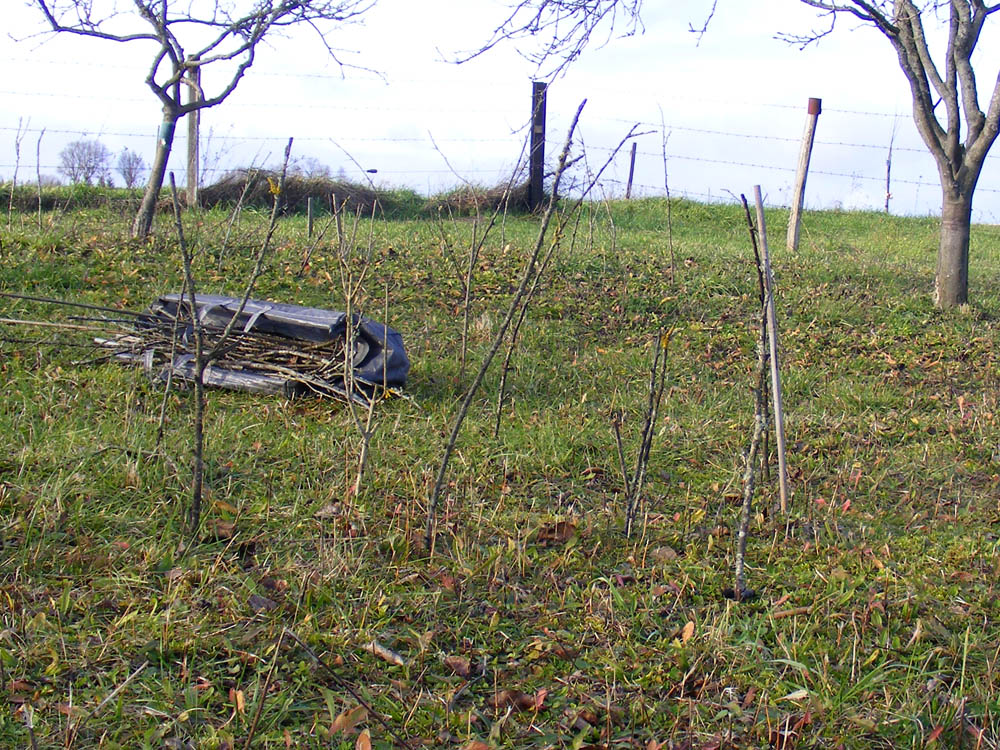
Orchid markers under the apples.

Yesterday was my birthday, and as a little treat to myself I spent the afternoon in the orchard. I wanted to get the rapidly emerging orchid rosettes marked with sticks. This protects them from being accidentally trodden on (or run over if they are closer to the gate). Later, in the spring it will protect them from being mown off before they have a chance to flower. After they have flowered I leave the markers in until early September, so the orchids are not mown over before the seeds mature and disperse. The species that send their leaves up in the late autumn and winter are not frost tender, so they will survive just about anything the weather sends. If it doesn't rain sufficiently in the spring about a third of them could go dormant again without flowering, but mostly, if they send up leaves they flower.

This is what I was searching for to mark.

It took me 2 hours to methodically work over the orchard grass, searching for rosettes of leaves and sticking a marker in just to the west of each cluster of leaves. In all, 124 orchid plants or clusters of plants of 4 species have sent up leaves so far. This year, the early emergers are those under the apples and to the north of the site, unlike previous years, when the southern side and under the cherries seemed to be the first. I expect the laggards, including the 5th species, will come in due course.

 And this is the reward in April for protecting the orchids so they get to flower.

Tuesday, 18 December 2012

Hunting Lodge or Palace?

This is the view you get of Chambord as you walk from the carpark. I can't decide if this truly massive building is a hunting lodge masquerading as a palace or a palace masquerading as a hunting lodge. Probably the latter. It was never really intended to be lived in for any longer than a short duration hunting trip though, and as a consequence, those who got lumbered with the responsibility of caring for it, long after its Renaissance construction, probably loathed the place for its huge echoing rooms and inadequate heating arrangements.

Monday, 17 December 2012

Protecting Rural Tracks

 Simon, Anne-Loes and Ingrid admire the view over the Creuse valley in October, coming back from a walk along a chemin rural near Yzeures.

This is an extremely rural area and there are many public roads that are actually just grassy tracks. Local authorities are allowed to restrict access to these chemins ruraux, as they are known, if they feel the route would be damaged by motorised vehicles. One of the reasons for this is because these tracks often form a network that allow otherwise isolated places to be reached. They also link in to forest and fire trails and so it is important they remain in good condition just in case an emergency vehicle needs to use them.

Last year's official notification of the dates motorised vehicles were banned from using the track.

The usual arrangement is to ban vehicles from vulnerable chemins ruraux from the beginning of October to the end of April, but if the commune deems it necessary, they can restrict access at any time of year. Over the winter is when the tracks are most likely to be soft due to rain, and could easily be ruined by vehicles churning up the ground. Some are routinely restricted in the winter as a precautionary measure. Sometimes a compromise solution is to simply ban agricultural machinery, which is heavy and have big tyres that leave dangerous ruts.

Sunday, 16 December 2012

Malaysian in Beijing

We had an excellent breakfast (lunch? who knows when you are flying longhaul...) in the Malaysian restaurant in Beijing airport.

Our brunch order appeared in these hatches and was brought over by a waitress.

Pak choy in fish sauce, a fruit smoothie and a banana milkshake. It cost the equivalent of €11.

The view across the restaurant.

 My view out the windows. I'd like to give Beijing the benefit of the doubt and say this was fog. It was very cold and there was snow on the ground, but I suspect the visibility issue may have included some smog.

Saturday, 15 December 2012

Keep in Step

This extraordinary file of identically dressed workers marched past us in Beijing airport. I've no idea where they were off to or what their role was.

Friday, 14 December 2012

We're Back!

And I bet you didn't even know we were gone (unless you are a blog reader we also see regularly in person).

We got back on Wednesday from a month in Australia, with a stopover in China. Niall and Antoinette very kindly picked us up from Chatellerault station after our epic return journey (Sydney - Shanghai - Beijing - Great Wall - Beijing - Paris). They also very kindly supplied us with delicious home made leek and potato soup and a loaf of bread for our supper so I didn't have to prepare anything in my travel addled state.

The Great Wall of China.

Our trip was to visit friends and family of course, and we spent time in Canberra, staying with Simon's brother Jon, his wife Rosie and assorted teens and twenty-somethings (an ever shifting configuration of neices, nephews and their boyfriends and girlfriends). Jon and Rosie generously lent us a vehicle -- a great gas guzzling Mercedes 4WD that we had something of a love/hate relationship with. It was much more convenient than hiring a car, and when we went out west we fitted right in (we got lots of friendly waves, as though people knew us -- all those big silver 4WD obviously look the same to more than just me...)

The visit to Canberra was primarily to attend Simon's father's 80th birthday celebrations and my sister's 50th. The weather was a bit variable, but included the hottest November day for a decade (naturally, the day we went out in the bush hunting for orchids...)

Sydney Harbour Bridge.

From Canberra we went to the coast both north and south of Sydney. North to check out where Simon's sister Elizabeth and husband Vic have bought a house and where his parents are planning to move to. South to visit friends Rick and Helen in their new house. They live in an area we've been to several times before (just across the bay from where my parents celebrated their 50th wedding anniversary in 2009). It's somewhere that is fairly high up on our not very long list of places we think we might like to retire to.

Then we went up to south-east Queensland to stay with my parents. This coincided with a heat wave and temperatures in the mid-30s. I caught up with old quilting friends Trish L, Trish O, Margie C, Margie P, Diana and Hilary. Simon went off to Brisbane and hung out with his former band members, Matt and Greg and their mate Andrew (who also lived in London at the same time as us). Heading back to Canberra to return the car we went via Lightning Ridge, an outback opal mining community, dodging emus, kangaroos, sheep, cattle and feral pigs all the way.

A gecko on my parents' kitchen window.

We spent our last weekend in Australia in Sydney, catching up with one of Simon's oldest friends, Alex, and his partner Stefania, as well as our very dear friend Liselle. My sister recommended a block of serviced apartments in central Sydney, and from this ideally situated base we had a great time walking along the beach tracks from Bondi to Coogee, and the next day catching the ferry across the harbour to Manly. Saturday walking along the coast was sweltering, so we all dressed for extreme heat on Sunday, only to freeze as it clouded over and rained. Oh well, the company made up for it, and we survived.

As we had a long wait of 20 hours between flights in Beijing on the way home, Simon booked a hotel (courtesy of Air China) and a guide and driver to take us to the Great Wall. Apart from being slightly wrong-footed by Air China landing us in Shanghai and organising the transit permits there rather than Beijing as we had been expecting, this all worked extremely well. Day time temperatures here were about -3C on the Wall, which is about 1000 metres above sea level, and +3C in Beijing (which is still about 600 masl).

Emus on the roadside, west of Thallon.

And now we are home and very happy indeed to be sleeping in our own bed again -- even if the weather is dismal.

Thursday, 13 December 2012

Grape Camouflage

This Great Green Bush-cricket Tettigonia viridissima is perfectly camouflaged in amongst the burgeoning grapes in August. It's not threat to the grapes -- probably the reverse, as it is carnivorous and will catch and eat almost any other insect it can grab in its hook lined legs.

Wednesday, 12 December 2012

Not a Bee

The creature in the photos is not a bee, but a Drone Fly Eristalis sp, a superb honey bee mimic.


In my experience of newspaper articles about honey bees, about 50% of the time the stock photo used to illustrate the article will be of a fly, not a bee. Usually the not a bee in question is a Drone Fly.


If you want to check out the difference between the two, go to my earlier post about feral honey bees.

Tuesday, 11 December 2012

Uppers and Unders

 Side view.

This female Wasp Spider Argiope bruennichi set up home in the long grass and Bristly Oxtongue Picris echioides amongst the apple trees in the orchard in August.

  Underneath.

Like most sit-and-wait predators, she positions herself head down. This is the most energy efficient pose she can adopt, as explained in Piotr Naskrecki's The Smaller Majority.

 Above.

Monday, 10 December 2012

You can't do that on the Loire

At least, not on the central Loire where we live. There are many lovely riverside properties on the Loire and its tributaries, but no one owns boats like this -- none of the rivers are navigable to any great extent.


The Charente, on the other hand, where this photo was taken, is navigable from Rochefort on the Atlantic coast where it exits into the sea, right up to Angouleme, 120 km away.

Sunday, 9 December 2012

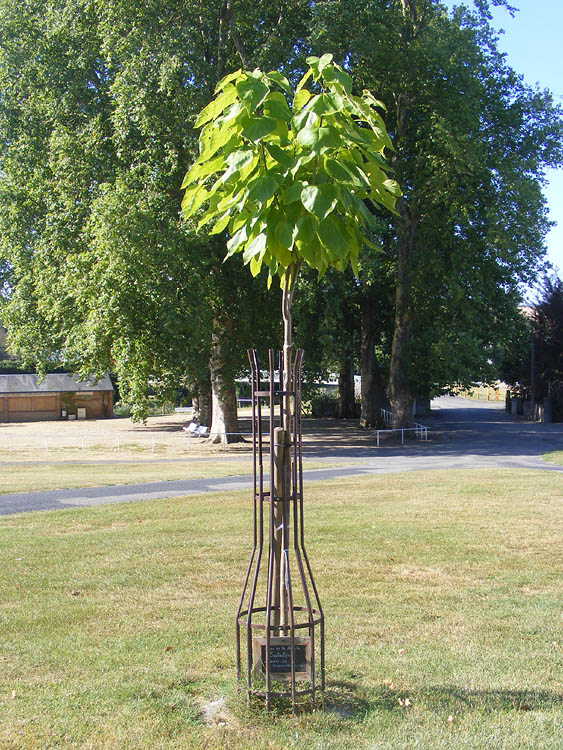
L'Arbre de la laïcité

To shamelessly quote Wikipedia (in translation): 'The Tree of Secularism is a tree planted to commemorate the Law of 9 December 1905 separating the Churches and the State in France and for promoting the notion of secularism. It is inspired by the Tree of Liberty.'

Slate tree label.
Secularism is sometimes described as the 4th pillar of the French Republic (along with Liberty, Equality and Fraternity). Last year many communes, encouraged by a national human rights organisation dedicated to the idea of a secular society, planted a symbolic tree. Many, like Preuilly, chose to position the tree close to the State Primary School.

The tree is planted in the middle of the Champ de foire.
This secular republicanism is part of France's determination that each person should be free to exercise their own conscience in public affairs, and not be obliged to follow a dogmatic religious line. La laïcité does not preclude people from holding a religious belief in private, but it insists that religion has no place in public life. It promotes education as a means of achieving the more well known tenets of the Republic - Liberty, Equality and Fraternity. Without education and a secular environment democracy is worthless. The aim of la laïcité is to support the functioning of democracy for the general interest (at the expense of the individual interest if necessary).

Susan

Saturday, 8 December 2012

Fungal Fecundity


We encountered this large fungus on a tree stump in a picnic area on the River Charente near Saint Simieux in August. Not only was it producing cushions of white flesh, but it had ejected a dense powdering of brown spores which covered the immediate surrounds.

I've no idea what it is called.

The drinks can isn't litter, by the way. We put it there to try to give some idea of scale.
********************************************
Identification: I finally got round to sending these pictures to Paul Leroy to ask for an identification. He came back the same day (11 April 2013) saying (I've translated) -- "Here is the answer for the big hard brown mushroom: Ganoderma lipsiense, formerly called: G. applanatum.
This mushroom is a formidable parasite. It settles on weakened trees, often Poplars, to kill them slowly. In the photo, the surrounding herbacious plants have been coloured brown -- these are the spores, it is a characteristic feature of these mushrooms.
The white mushroom, a little funnel shaped, is: Lentinus tigrinus. This species is common on damp wood, as well as often found near water and especially on Willows."

Many thanks Paul! The tree stump the fungus was growing on was almost certainly poplar. The English name for Ganoderma lipsiense is Artists Bracket Fungus, and Wikipedia has some interesting information about it.

Friday, 7 December 2012

A Lavoir in the Charente

This lavoir (public laundry) is in La Voute, a hamlet near Mosnac in the Charente, to our south-west. It reminded me of some Roman archaeological sites, but that may just be because the whole of the Charente always strikes me as very Roman, with its blocky pink rendered buildings and canal profile terracotta tiles on shallow pitched roofs.

Thursday, 6 December 2012

The Plight of the Plane Trees

Plane trees were widely used in France in the early and mid-19th century, first planted along roadsides on the orders Napoleon to provide shade for troops and travellers moving through the country, and by country estate owners to create green cathedral-like grand allées through their landscaped parks. Most famously, they line the entire length of the Canal du Midi, providing shade for the boating community in the sunny south. These mature trees are a considerable size and the style of their planting produces an impressive effect. They are much loved for their aesthetic value and the heritage associated with them.


Ceratocystis platani, known as le chancre coloré in French ('coloured canker') is a fungal disease that for the last 20 years has constituted a serious threat to plane trees and sycamores (Platanus spp) in Europe. The deadly fungal disease was introduced accidentally in 1944 when American troops disembarked in Provence. The wooden munitions boxes made from American Sycamore P. occidentalis that landed with the troops were infected, and the local French plane trees were unable to resist this invader.

Roadside plane trees at Pont de Ruan.

For the first 15 years the parasite remained dormant, but now it is affecting trees in Italy, Switerland, southern Greece and the south of France. Its distribution reaches an ever advancing line from the area around Lyon to Toulouse and along the Canal du Midi. Even the cold does nothing to arrest its continuing expansion of territory.

Plane trees at the entrance to Chenonceau.

Just a few spores introduced into even the most trivial wound is sufficient to entirely infect the tree, which can resist the infection for no longer than 4 - 6 years, depending on where on the tree the contamination began. All chemical treatment trials have now been abandoned, due to the depth the fungus works its way into the trunk. The mechanism by which the fungus develops is remarkably effective. After contact with the parasite the tree defends itself by blocking and closing sap veins in the infected part, to contain the attack. The fungus follows the medullary rays of the wood as well as the sap veins though, and always propogates itself toward the healthy sections of the tree. At the same time it produces extremely damaging toxins which disseminate and poison the upper parts of the tree. The tree redeploys its defense mechanism, leading to its death, from dessication due to the complete blockage of its vascular system and the accumulation of toxins. And to top it all, the fungus is extremely contagious, transferring via the roots, water, infected prunings and contaminated machinery and equipment. In France, over 50 000 trees have already died.

The INRA (National Institute of Agronomy Research) has been working on a solution and have bred a resistant hybrid they have registered and called PLATANOR® Vallis clausa. By crossing American and Oriental plane trees they have achieved resistance not only to chancre coloré, but also other worrisome fungi, cankers and bugs (eg Sycamore Lace Bug Corythuca ciliata, known in French as le tigre de plantane). One of the parents of this new hybrid is the American Sycamore itself, and PLATANOR® retains all of this parent tree's ornamental features.

Plane trees at the entrance to Chenonceau.

Sadly, it's all too late for the plane trees lining the Canal du Midi. The disease has spread particularly rapidly here because the trees are planted very close together, so their root systems intermingle and transfer the fungus. It also leapfrogs, because people tie their boats to the trees (they are not supposed to, but they do). The wet rope can be contaminated and create a wound in the tree which transfers the fungus. A 20 year rolling programme has begun to cut the diseased 182 year old giants down. Happily, they can be replaced, at least in part, by the new resistant variety. However, the INRA continues to work on developing resistant strains and varieties, as the plan is to mix the new planting up genetically, so that there is no monoculture that a disease can take hold of and run wild through.

 Plane trees at the entrance to Chenonceau.

The combined cost of the research, removal, replanting and the potential loss in the interim of tourism income on the popular Canal du Midi will run into hundreds of millions of euros.

Source:  INRA press release.

**************************************

For details of our private guided tours of chateaux, wineries, markets and more please visit the Loire Valley Time Travel website. We would be delighted to design a tour for you.

Wednesday, 5 December 2012

Modern Transport Solutions

These days, due to the speed and efficiency of the TGV (Train Grande Vitesse = 'High Speed Train') service it is perfectly possible to commute the 250 km from Tours to Paris for work. You can buy an awful lot of train tickets with the million euros you've saved by buying an apartment in Tours instead of Paris. Cycling to the station makes sense too, as you can dodge the central Tours traffic jams more easily. Plus you get to feel righteous.

*******************************

The Ferriere-Larcon Christmas Market is on Sunday 9 December, in the church, from 10.00 to 17.00. 

Tuesday, 4 December 2012

Classic Chaumont

The Chateau of Chaumont, photographed from the viewing tower on the other side of the river Loire.

Monday, 3 December 2012

God Loves Boules Players

 These gigantic plane trees can be seen from almost anywhere in Preuilly.

God loves boules players because plane tree leaves are perfect for keeping the sun off. I read a quote to this effect earlier in the year on Patti Lecron's blog A French Education.


It made me smile because, sure enough, the boules courts in Preuilly are situated under the most enormous plane trees.

In August it's shady under the plane trees, true enough, but it's still cooler to play at night.

Sunday, 2 December 2012

Worst Place Name

Is this the worst place name you've ever seen? You would have thought that the local planners could have come up with something a little more elegant than Marray-sur-D943. What's wrong with Marray-sur-Indre -- all the other villages along this route are named something-sur-Indre, as the road runs parallel with the river. Nearby villages are called lovely lilting names like Preuilly-sur-Claise, Azay-le-Ferron, Chanceaux-pres-Loches or Joué-les-Tours. How come poor little Marray got lumbered with this terrible, unimaginative and unattractive name?

Saturday, 1 December 2012

A Blue Moon

But not in June, in early September. I (she announces self-righteously) was putting in my 50 laps of the pool, while Simon was lounging around poolside taking photos of the sky.

Friday, 30 November 2012

The Michelin Factory

The Michelin factory in Joué-les-Tours employs hundreds of people and stretches as far as the eye can see in this photo. Sadly it is struggling financially. Several times this year there have been compulsory temporary lay-offs of a couple of hundred staff for a day or two. This arrangement is called chomage technique in French and is a means for the company to stand staff down and have the state benefits system pay them temporarily. After the lay-off ends the staff go back to work as normal. It is not just used in times of financial trouble, but can be used for any temporary difficulty the company finds itself in (for example, an accident such as a chemical leak which forces the closure of a plant because it is temporarily too dangerous to work).

**************************************

For details of our private guided tours of chateaux, wineries, markets and more please visit the Loire Valley Time Travel website. We would be delighted to design a tour for you.

Thursday, 29 November 2012

Can you see what it is yet?

One of the many difficulties of presenting a historic building to the public is how to deal with the accessories and installations of modern heating, lighting, safety and security devices. These are invariably white and made from some clearly modern material -- not the easiest objects to blend in sympathetically with even a 19th century interior, much less a Renaissance one.

Central heating radiator painted to blend into oak panelling in the Chateau des Bretonnieres, Joué-les-Tours.

The usual curatorial device is to camouflage light switches, power points, smoke detectors and radiators with a trompe l'oeil paint job. It's fairly tacky if you look closely, but, especially for really anachronous things like smoke detectors, high up on the ceiling and painted to blend in with the surrounding decor, it works well enough. Of course, the bigger the object and the closer it is to eye level, the less pleasing the result.

Wednesday, 28 November 2012

Water not Wine

This tap disguised as a locally themed sculpture sits in the square at Mesland. I would guess that it is the work of sculptor Patrick Meriguet, who works in stainless steel and lives in nearby Onzain. I would further guess that its purpose is to provide tap water on market days for hand washing and filling buckets for washing down stands and suchlike. Maybe people fill up water bottles from it and thirsty dogs lap from bowls placed under it.

Tuesday, 27 November 2012

Mesland Mystery

 Perhaps the insignia of a master butcher?

In September we stayed overnight in the rosé producing village of Mesland, above the Loire opposite Chaumont. It is a very attractive little place, with many interesting and picturesque buildings.

The master winemaker's sign?

These two dormer windows on a building in the centre of town feature some mystery carvings. Possibly they are symbols pertaining to the Compagnons du Tour de France, the lodges or guilds that date back to medieval times and whose purpose is to train and support master craftsmen. However, our voluble history geek of a host (link removed), who alerted us to their presence, was unable to tell us anything with certainty.

Monday, 26 November 2012

Bike Racks at Cheverny

Cycling in the Loire Valley is greatly encouraged. If you haven't brought your own, you can hire bikes in several of the main tourist towns and there is an extensive network of bike paths, many of them dedicated and separate to the roads. A lot of people bring a bike with them on the plane or on the back of the car. Cycling is safe here and it's flat, travelling along the bucolic river valleys. Where the cycle path and the road share space, there are regular signs to remind roadusers that voitures, vélos, partageons la route.

 In the village of Cour-Cheverny, as in most places, they have installed some robust and practical looking bike racks and we nearly always see cyclists on the routes between the major chateaux.

The Loire à Vélo website should give you much of the information you need to plan a cycling holiday here.

Sunday, 25 November 2012

Be Still

Driving through Manthelan.

We followed this mobile still on our way home after dropping clients off on one of the Journées du Patrimoine in September. I don't know if it been somewhere demonstrating the heritage of small scale distilling in France, or whether it was a licenced mobile distiller heading home after a session in someone's orchard -- I'm inclined to think the former.

La Chapelle-Blanche-Saint-Martin.

Bertrand, over on Wine Terroirs has written a long post about a day spent at the mobile distillery if you are interested in knowing more about this tradition.


Between La Chapelle-Blanche and Ligueil.
Up until 1959 mobile stills were passed down family lines, but with the change in the law that meant that you could not inherit the right to distill, the tradition of the private mobile distillery is dying out. These small scale family distillers were allowed to produce 20 litres of eau de vie per year, tax free. From next year, the few that are left will not even be allowed to do that, and all mobile distilleries must be licenced professionals and anyone using them pays a duty of  €7.50/litre.

The roundabout for the Ligueil bypass.

Saturday, 24 November 2012

The Eiffel Tower

The Eiffel Tower is a profoundly disappointing structure if you see it close up and in daylight (unless you are an engineering history geek or similar). It looks nothing like all those nickel coated tourist souvenirs you've seen just bigger and better ie it is not an intricate and lovely bronze sculpture.

It's painted a particularly uninspiring matt brown, and it is set in a sand pit.

The Eiffel Tower from the Trocadero Gardens at about 8pm in September.


Doing its Cartier impression.

My advice is to view it in the evening from the square above the Trocadero Gardens. You look out across the Seine, over the Trocadero's fountains and it is there directly in front of you. As night falls the crowd gathers and once the required level of darkness is upon the city, the lights on the Tower spring into life. There is a bit of fancy flashing with coloured lights and pretty patterns, then it settles down to glitter like a piece of jewellry set with white diamonds.

Afterwards you can go off to dinner at Le Wilson -- touristy, cheap and friendly.