Tuesday, 9 February 2016

Petit Pompier

This littlest fire engine of all is at Montparnasse station in Paris.

I hope it has a bloody great big "GET OUT OF MY WAY!!" siren

************************************************
Loire Valley Nature: A photo has been added to the entry for Knapweed Fritillary butterfly Melitaea phoebe, showing an adult resting on the the caterpillar host plant.
A new entry has been added for Large Chequered Skipper butterfly Heteropterus morpheus, a super zippy little creature with personality, rarely settling to be photographed and identified.

Monday, 8 February 2016

A Medieval Stabproof Vest

Mondays in Milan / Les lundis en Lombardie


This object in the Castello Sforzesco in Milan is a very cleverly displayed gambeson. Essentially it is a medieval stabproof vest. You can see the outer surface of the front of the garment at the top, and the inner surface of the back of the garment below. It is designed to be worn as a protective garment on its own, or under plate armour and provides added comfort and protection for the wearer. It is made of canvas and mail. This one has additional metal studding and all the layers are stitched through like a quilt. Indeed I would expect it to have some padding and quilting, and it may also have arming points, for securing sections of plate armour.

Plate armour had known vulnerable points, where a properly trained swordsman with the right weapon could slip his sword in under the armour of his opponent. The gambeson made up for the weaknesses in the plate armour design, as well as acting as a shock absorber for blows from blunt instruments. Milanese plate armour, along with south German armour, was considered the very best at the time this gambeson was made.
*************************************************
Loire Valley Nature: A photo has been added to the entry for Ilex Hairstreak butterfly Satyrium ilicis. This is one of my favourite butterflies, partly because it has such a short season.

Sunday, 7 February 2016

Termite Mounds


These two giant mud structures were made by termites in the savanna woodlands of the Northern Territory of Australia. These ones, with their buttresses, are known as 'cathedral mounds' and are made by Spinifex Termites Nasutitermes triodiae.  Other termite species in the area build tall narrow mounds aligned north - south, and others live underground or in trees. The termites that live in mounds like this are not the sort that will invade and eat your wooden house, although these species occur in Australia too.

Termites and ants are the most abundant insects in the savanna. The savanna would not look as it does without the termites. They are herbivores and consume vast quantities of grass and wood. The savanna supports a far greater weight of termites per square kilometre than it does cattle, despite this being considered good cattle grazing country. Termites live in colonies, with a queen served by workers and soldiers. The workers are adapted for either foraging or mound building, the soldiers have different weapons at their disposal (some use chemical substances, others have pincer like mandibles). The secret to their success is that they can digest cellulose and lignin from the plants they harvest. These tough parts of the plant which give it rigidity are indigestible by most herbivores.

Termite colonies last for the lifetime of their queen. The soldiers and workers only have a lifespan of a couple of years, but some evidence suggests that a queen could live 100 years. While the queen lives the mound is maintained. Unfortunately because of the continual running repairs and internal remodelling it is impossible to date termite mounds using a cross-section, as there are no 'growth rings' like there would be in a tree for example. A mature mound is about 5 metres high and may contain millions of individuals.

The insulated termite mounds serve to control the insects' environment in hot dry conditions, allowing them to live in a humid microclimate. It is believed the large buttressed or fluted structures of the cathedral mounds allows better ventilation for the storage of the termites grass forage.

Periodically the termites produce a generation with wings and they swarm and mate, simultaneously providing a feast for ants, small mammals, birds, spiders, frogs and lizards in the area. The mound itself is full of nutrients which get cycled back into the soil, and the termite activity is extremely important in dry environments which don't suit bacteria and fungi in terms of breaking down dead plant material. In Australia termites are probably particularly important because there are no great herds of migrating grazers such as there are in Africa.

My Dad by one of the termite mounds.

******************************************
Back from Babylon: We returned yesterday from a week in Paris. We have seen the Beast of Turin and many other wonders beside. Blog posts to follow, naturally.

Saturday, 6 February 2016

Eglise Saint Denis, Amboise


Saint Denis in Amboise is a Romanesque church dating from the very early 12th century. It was enlarged in the 16th century and extensively renovated in the 19th century.


Saint Denis is apparently 70.10 metres above sea level (Fr. 70.10 au dessus du niveau de la mer) according to this plaque by the door.


The view from the church to the chateau.

Below: Looking towards the apse, which is filled with an enormous 17th century altarpiece. In the centre of the choir hangs a crystal chandelier, a gift from the Algerian leader Emir Abd-el-Kadr in 1853. He had been held under house arrest in the chateau from 1848 to 1852.


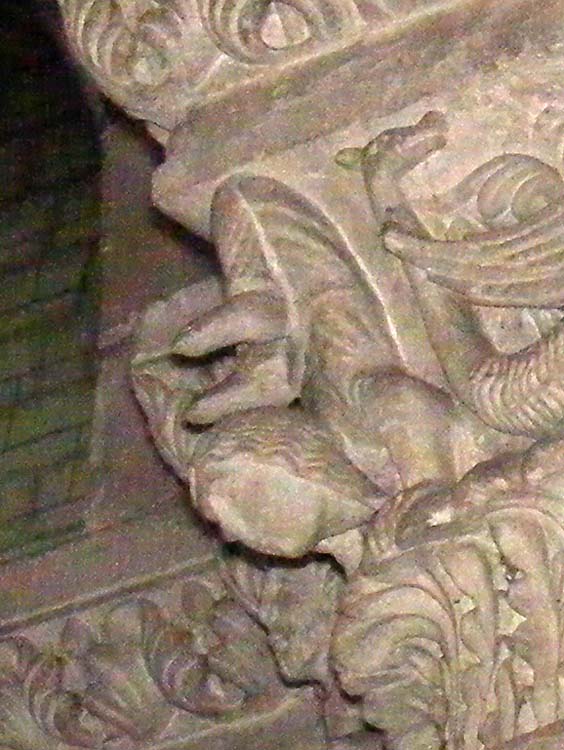
The capitals date from the 12th century. They are particularly fine and depict foliage, monsters and fantastical animals, legends and historical events.


On the left of the capital two devils seize a pot-bellied sinner to drag him off to Hell.

A girl doing a handstand on one of the column capitals.

The organ was restored in the 1960s.

The side chapel dedicated to the Virgin Mary features two 19th century wall paintings. The one below is of Jeanne de Valois, the unfortunate youngest daughter of Louis XI and first wife of Louis XII. When Louis XII became king he wanted to discard Jeanne in favour of Anne de Bretagne. In order to ensure an annulment was granted to the thus far childless marriage he publically claimed that Jeanne was so ugly, deformed and mentally handicapped that he found it impossible to fulfill his duty as a husband and there would therefore never be an heir to the throne, a disaster for the monarchy. Jeanne fought back in spirited fashion, reminding the court of the time Louis had boasted of 'performing' three or four times in one night, but it was to no avail and she was put aside.


A 19th century stained glass window dedicated to Saint Vincent,
probably by the well known workshop of Lobin in Tours.


Saint Denis also houses some exceptional 16th century funerary monuments. I blogged about the Babou family tomb monument here, the 'drowned woman' here and Mary Magdalene here.

Friday, 5 February 2016

Trapped Triton

On Saturday 23 January I participated in the local annual survey of hibernating bats. This involves getting slightly speleological and going down various holes in the ground, mostly abandoned underground limestone quarries and the cellars of chateaux, both known in French as caves.

In one chateau cellar we found two forlorn creatures huddling together in a patch of damp where water was seeping down the wall. They had obviously fallen in to the cellar either down a light well or a ventilation duct.

Agile Frog.

One was a Great Crested Newt Triturus cristatus (Fr. Triton crĂȘtĂ©) and its companion an Agile Frog Rana dalmatina (Fr. la Grenouille agile). The newt particularly was dehydrated.

Great Crested Newt. We don't know which sex it was as it is impossible to tell at this time of year.

Once they are in somewhere like a cellar or the bottom of a well they don't have the strength to haul themselves up several metres of vertical stone wall. Well owners are advised to drop a length of landscaping textile down from the top or provide a permanent ramp made from a plank covered in small chicken wire. There just isn't enough food available down at the bottom for these creatures to survive.

Great Crested Newt, turned over to display its belly, with the Agile Frog just sitting there, probably an indication of its weakened state.

Fellow blogger Amelia wrote about her experience with this problem last year and you can read her posts here.

We picked the unfortunate beasts up and took them outside to recover in some wet grass near a pond.

Thursday, 4 February 2016

The Drowned Woman, Amboise


The marble tomb effigy (Fr. gisant) above currently resides in the Church of St Denis in Amboise. It is known as la Femme Noyée ('the Drowned Woman') and there is a persistent story that the life sized figure is that of an unnamed female member of the Babou family who drowned in the Loire.

It dates from the 16th century and came originally from the crypt of the chapel at the Chateau of BondĂ©sir in Montlouis sur Loire. The crypt was the mausoleum of the Babou family of the Chateau of La BourdaisiĂšre but when the priory at BondĂ©sir was closed in 1770, the chapel was also closed and the funerary monuments moved to Amboise. She seems to have already been in a worrying state of deterioration when she came to Amboise, due to the dampness of the underground crypt at BondĂ©sir. Once in Amboise she was moved from place to place a number of times, at one time possibly in the collegiate church of the chateau, then in Notre Dame en GrĂȘve (now dedicated to Saint Florentin) in 1828. Around 1864 the Inspector General of Fine Arts for the region saw her and was so worried by her condition that he had her moved to the chateau. It is not known when the damage to her face, hands and forearms and feet occurred, but the main ongoing problem seems to have been damp and the surface proliferation of mineral salts. In 1896 she was moved to Saint Denis, to a position more reminiscent of her original situation in the crypt of BondĂ©sir.
 
I am extremely dubious of the effigy's provenance as a drowned woman. The sculpture appears to be remarkably similar to one of Catherine de Medici in the royal necropolis in the Basilica of Saint Denis in Paris. The pose is more or less identical and the state of the corpse much the same. Both are representations of old women it seems to me, not decaying corpses with their innards removed as is often the case with medieval and renaissance tombs. Their purpose is nevertheless to indicate humility, a submission to God's will at the end of life, and the hope for salvation. I would say it is quite likely that the 'drowned woman' is Marie Gaudin (1490 or 1495 - 1571 or 1580), the wife of Philibert Babou, Treasurer to François I, and that one sculpture may well have influenced the other. The 1897 account in the archives of the Archaeological Society of the Touraine of the 'drowned woman's peregrinations notes a resemblance to the effigy of Claude of France in the royal mausoleum of Saint Denis, Paris too (despite which they still seem remarkably attached to the drowned woman theory). Unfortunately Claude's full effigy is very difficult to see and I only have a photo of the base of her bare feet. You can see a better photo, showing her upper body, on this website.

I think the notion of the drowned woman owes much more to 19th - early 20th century obsessions with objects like the supposed death mask of a young woman known as l'Innconnue de la Seine. The death mask has mysterious and obscure origins, but that didn't stop a back story for her building up which proved irresistable to artists and romantics of the time. According to the story the young woman committed suicide by throwing herself in the Seine some time in the 1880s. 

These 16th century effigies may not show beautiful young women, but they are very striking images of serene old age. They are certainly less gruesome than many from this period and earlier. In the second half of the 16th century it seems to have been a personal choice how graphically one portrayed the inevitable corruption of ones flesh after death.

Funerary monument of Catherine de Medici as a corpse in Saint Denis, Paris. This is the second version of the effigy, dating from the 1570s, as Catherine rejected the earlier one as too emaciated and macabre.

My thanks to Rosemary K, who was the only one of us to take a photo of the 'drowned woman' when a group of us visited Saint Denis specifically to look at the funerary monuments. Rosemary has kindly allowed me to use her photo for this post.

I've written about other remarkable funerary monuments in Saint Denis here and here.

Wednesday, 3 February 2016

A Winter Morning in the Grounds of a Chateau

One misty morning in late January I happened to be at a privately owned chateau in the Brenne.

The pillar base below is the remains of a pair to the column above.

A simple stile in the fence round the horse paddock.

In the moat.

***************************************************************
Foreign Fare: Those of you interested in botany, vegetables, etymology and / or history might like to listen to that nice Mr Attenborough talking for 10 minutes about various vegetables, their wild origins and how their English names arose.

Tuesday, 2 February 2016

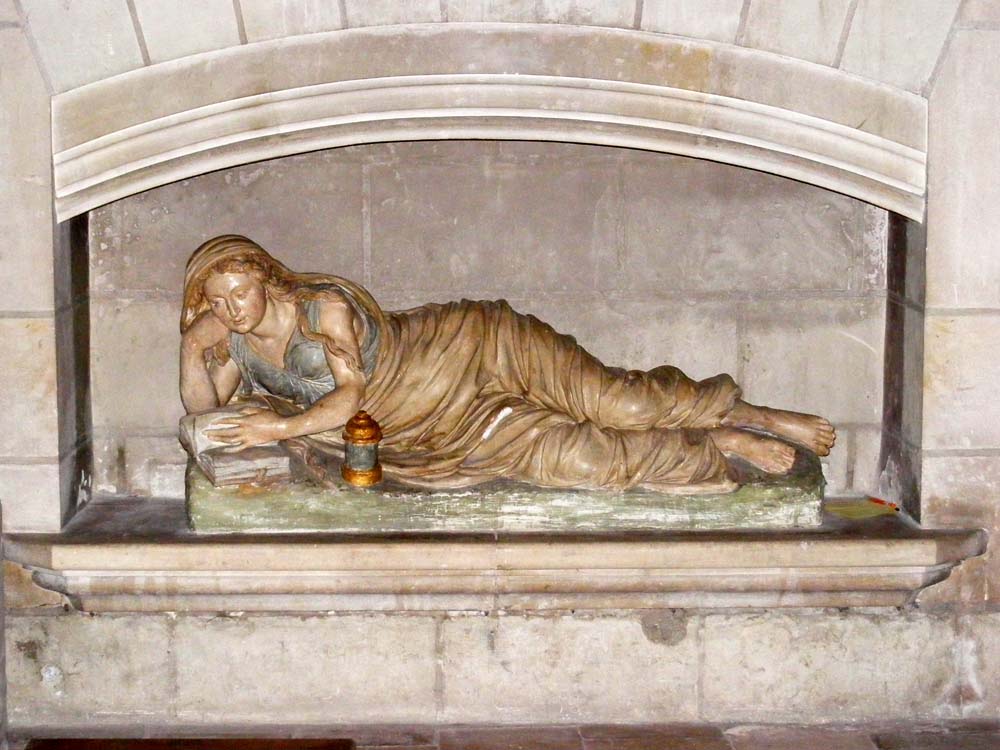
Mary Magdalene, Reclining and Reading in Amboise


There are quite a few images of women reading that date from the 16th century, and this one is a charming example. Middle and upper class women could almost all read by this time, and reading for pleasure and the gaining of knowledge was encouraged. Mothers were expected to ensure their daughters were taught to read because the Virgin Mary was taught to read by her mother Sainte Anne.

The sculpture is in painted limestone and represents Ste Mary Magdalene, with her flask of aromatic oil that she will use on Christ's body after it is taken down from the cross. Mary Magdalene is depicted life size, as a pretty young woman with loose hair tumbling over her shoulder and diaphanous drapery revealing every curve. She looks absorbed and contented.

In the New Testament she is mentioned more than any other female follower of Jesus, and there is no indication that she was a prostitute. Quite the contrary in fact, and she is important primarily for being the first person to encounter Jesus after his resurrection, referred to as the 'Apostle to the Apostles'. She is the second most depicted female Biblical character after the Virgin Mary. However, from the early days of the Catholic Church, she has been conflated with several other characters named Mary and is a composite character representing temptation and reformed sinners. The representation here is of the type known as the Penitent Magdalen, where she is wearing nothing more than an undergarment and flimsy drapery.

One of the stories associated with her is that she washed Jesus's feet and dried them with her hair. In the 16th century only prostitutes or aristocratic women wore their hair loose and uncovered. In the Medieval tradition she is a reformed wealthy hedonist rather than a prostitute. She is viewed essentially as a female disciple, and perhaps as more beloved by Jesus than his twelve male companions. The Penitent Magdalen became a very popular cult in 16th century France, especially after the Council of Trent 1545 - 1563, as she was an enticing example of repentance and a reformed character who piously disavowed the vanities of the secular world.

The book she is reading may not be the Bible, but is undoubtedly of a religious nature. It is a symbol of her committment to her reformed lifestyle and devotion to good works, and she is frequently depicted absorbed in a book, or in a moment of reflection whilst reading. The book also represents Christ himself, as the Word. It is also an opportunity for the sculptor to display his skill, in the delicacy of his rendering of the fingers.

Originally the scuplture graced a church dedicated to Mary Magdalene in Amboise but now it resides in a niche refurbished for her in 1975 when she was conserved. The Church of Saint Mary Magdalene no longer exists and she was brought to the church of St Denis in Amboise, her current location,  in 1896. She lies next to the Babou family tomb in the church of St Denis in Amboise, and is more or less contemporary with this sculptural group. She is also represented in the group of figures on the Babou tomb, but in a different incarnation, richly dressed.

Mary Magdalene as she appears on the Babou family tomb,
 complete with gilded diadem.

Rosemary has blogged about the visit we made to Eglise St Denis with friends here.

To see my post about the third significant tomb monument in the church, known as 'the drowned woman', click here.

Monday, 1 February 2016

The Three Dukes Cassone

Mondays in Milan / Les lundis en Lombardie

A cassone is a chest used for storing clothes or tableware in medieval and renaissance Lombard households. They are typically long and narrow, easy to transport from residence to residence and sturdy enough to double as a seat in the sparsely furnished rooms of the time. These chests are probably the single most common item of furniture in medieval houses.

This particular cassone is special because its painted front shows three Dukes of Milan: from left to right we have Ludovico il Moro, Giangaleazzo Sforza and Galeazzo Maria Sforza. They are dressed as knights and attended by their pages. The chest is wooden, made in a Lombardy workshop and dates from 1479 - 1494.


************************************************

A la cuisine hier: Lunch was a sort of shawarma made from leftover lamb, leftover hummus, the last of a lettuce and the remains of some condiments that have been in the fridge for a while (pita sauce, bbq sauce) all wrapped up in a warmed Turkish flatbread. It was delicious, not to mention making me feel righteous for all that good use of leftovers and dregs.

I bought the last two slices of bavette d'aloyau steak at the butchers. He is normally open on Sunday mornings, but since he is on holiday from today he was running stocks down. I asked if he was going anywhere nice. He said, no, he was staying home and insulating the loft. I seasoned the steaks with a secret homemade spice mix and grilled them on thermonuclear in the cast iron pan. Served with potato wedges, steamed carrots and green beans and a creamy oyster mushroom and garlic sauce.

***********************************************

Loire Valley Nature: A new entry has been added for the Yellow Stainer mushroom Agaricus xanthodermus. If you pick and eat Field or Horse Mushrooms you need to know how to identify this poisonous lookalike mushroom.
A photo has been added to the entry on Adonis Blue butterfly Polyommatus belargus, one of our prettiest grassland species.
A photo has been added to the entry on Brown Argus butterfly Aricia agestis. A species often very difficult to distinguish from a female Common Blue.
A new entry has been added for Essex Skipper butterfly Thymelicus lineolus. A tricky business, distinguishing it from the Small Skipper. 
 A photo of two Gatekeeper butterflies Pyronis tithonus making more has been added to the entry for this species.

***********************************************

Au jardin hier: The daffodils are up and budding. Yellow crocuses are flowering, as are eastern cyclamen and the hellebores.

***********************************************

Nature News: It rained steadily all day Saturday and the Aigronne has flooded its meadows.

Sunday, 31 January 2016

Spear Grass

Australia Day is 26 January so we are having a week of Australian themed posts, not just restricting them to Sundays.

Spear Grass Sorghum ingrans is a very common grass in the woodland savanna of northern Australia. It isn't very palatable for cattle once it matures, but they will eat it when young and its presence apparently indicates good grazing land. It grows up to 3 metres high and dominates in areas of medium and high rainfall.


*********************************************
Check for Ticks! In the middle of winter! I ran into Éric M at the market yesterday morning. He had a tick in a jar that he had pulled off his foot earlier in the day.

*********************************************
A la cuisine hier: I dyed my fingers purple by shredding a 2kg red cabbage and 1kg of onions. Combined with brown sugar, red wine vinegar and a secret seasoning blend it all went into my most humungeous casserole, dotted with a little butter and put on to braise for two hours.

I whipped up some hummus for lunch since I had half a can of chickpeas that needed using up. We had hummus with lettuce and cucumber in Turkish flatbread wraps.

And for those of you anxious to learn what I did with the brined lamb -- I slow roasted it with onions and potatoes, Ă  la boulangĂšre. It was delicious, tender and savoury. I served it with the braised red cabbage, carrots and green beans.

Saturday, 30 January 2016

Top End Bamboo

Australia Day is 26 January so we are having a week of Australian themed posts, not just restricting them to Sundays.

This is Bambusa arnhemica, otherwise known as Top End Bamboo. It's native to the northern, tropical third of the Northern Territory of Australia (an area often referred to by the locals as the Top End), it's big (8 metres tall), long lived and it grows so fast you can just about see it happening. I remember getting the feeling the locals were a bit scared of it. It's usually found on sloping forested river banks prone to flooding but with deep well drained alluvial soil. Because its requirements are rather particular, its distribution is patchy. It doesn't do well on poorly drained soil or where fires are frequent. Where it does grow, it dominates the area.

*****************************************************
A la cuisine hier: I made a big tub of brine, some of which I used to marinade a shoulder of lamb in overnight. I'll slow cook the lamb today. The question is -- should I make a pot roast or madras curry? Which do you think we chose? Or maybe it will be slow roasted a la boulangere...

Friday, 29 January 2016

The Wet

Australia Day is 26 January so we are having a week of Australian themed posts, not just restricting them to Sundays.

 Driving through the monsoon towards Darwin on 1 May 2006.

The monsoon season is known as The Wet in Australia and affects the tropical northern quarter of the country, usually lasting from December to March.

Thursday, 28 January 2016

Grass Seedheads

Australia Day is 26 January so we are having a week of Australian themed posts, not just restricting them to Sundays.

This pretty grass is a mixed blessing in Australia. It is Buffel-grass Cenchrus ciliaris, an important pasture grass for beef cattle in the north, but it is an introduced species. It has naturalised and in places is invasive, extirpating the native species by taking their water. It also burns easily and ferociously, something Australia could mostly do without.

********************************************

A la cuisine hier: Beef, Tomato and Pasta soup, which is kind of like liquid bolognaise sauce.

Boudin blanc (white sausage) with mashed potato, carrots and green beans, followed by apple crumble. No custard because we've run out of eggs.

Wednesday, 27 January 2016

Screw Palms

Australia Day is 26 January so we are having a week of Australian themed posts, not just restricting them to Sundays.

Screw Palm Pandanus spiralis is native to the coastal regions of northern Australia. They grow to about 10 metres high, with spiny leaves mounting in a spiral up the tree. Aboriginal people use the leaves to make fibre for weaving dilly bags, string, mats and fish traps.


**********************************************
ChĂąteau Ă  vendre: As we drove past the other day I remarked to Simon what a lovely chateau the one at Verneuil sur Indre is. It has been vacant and for sale since the horticultural college for disadvantaged youngsters moved out. Here is the real estate listing on Terres et Demeures de France if you are interested.
**********************************************
A la cuisine hier: Fried rice for lunch. 

The very last apple from our 2015 crop has been eaten. The billion trillion apples are no more (well, except for the remaining stewed stock in the freezer).

Dinner was from the freezer -- beef stew, mashed potato and peas, followed by stewed apple which I made into crumble by topping from a big batch of crumble mix I had made earlier and kept in a jar in the fridge. Finally, I made half a pint of custard from scratch.

Tuesday, 26 January 2016

Celestine Takes a Selfie

Australia Day is 26 January so we are having a week of Australian themed posts, not just restricting them to Sundays.
Célestine reflected high up in the press box windows overlooking the Bugatti circuit at Le Mans. Photo taken in August 2014.

Monday, 25 January 2016

Here Lies Gaston de Foix

Mondays in Milan / Les lundis en Lombardie
Gaston de Foix, Duc de Nemours, was only 22 when he was killed at the Battle of Ravenna. His military career was short but by all accounts brilliant. By early 1512 he controlled northern Italy, on behalf of his uncle Louis XII, who had fallen out with the Pope Julius II and the Holy Roman Emperor Maximilian I and was engaged in staking his claim to Milan and the surrounding area on the basis of his Visconti grandmother.

The exquisite detail achieved by Bambaia and his sensitive modelling of the handsome young man was universally admired.
The death of de Foix was a great blow to French ambitions in the area. He was young, energetic, hot-headed and brave and had been shot and killed leading a cavalry charge against the Spanish infantry. Both his contemporaries and modern historians hint that the final outcome of the Italian Wars could have been very different had he lived. 

Gaining the nickname le la Foudre d'Italie ('the Thunderbolt of Italy') Gaston showed a talent for manoeuvering and strategy that many compare with Napoleon. He specialised in rapid cross country marches and audacious offensive actions. 

Check out the trendy goatee...
His body was placed in the Duomo in Milan, surrounded by captured weapons and pennants, but after the French left the city his remains were moved to another church, now demolished. In 1515 when François I retook Milan he ordered a funerary monument fit for such a warrior, but once the city reverted to the Sforza's the work was abandoned. Today most of the completed elements are displayed in the Castello Sforzesco. The sculptor is Agostino Busti, known as Bambaia and the work is considered to be his masterpiece.

Two of the panels showing de Foix's military engagements intended for the base of the tomb, carved in a mixture of high and low relief typical of late medieval Milanese work.

Sunday, 24 January 2016

Strangler Fig

Strangler figs start life as seeds dropped by birds in the crooks of branches of other trees in the rainforest. The fig seed germinates and sends its roots downward to the soil. In the process, over time, its roots envelope the support tree like a cage. Often the fig will outlive the support tree and end up as a living self-supporting scaffolding frame. This one was photographed in the Northern Territory, Australia.

Saturday, 23 January 2016

Les Veilleurs by Brigitte Terziev

Brigitte Terziev was born in 1943, into an artistic and creative family. Her father was a sculptor who emigrated from Romania to France, her mother a television producer and her brother a comedian. Her series of imposing 'Elders' are constructed of ceramics and metal.

The thirteen forms keeping silent vigil in the temporary exhibition space of the Musée de l'Hospice Saint-Roch in Issoudun are the result of years of experimentation with wood carving, welding metal and modelling clay. They are eerily human, several metres tall and displayed so that the visitor can walk around and amongst them. You get glimpses of an ancestral past -- shapes that recall classical Greek sculpture, and yet others which have a sci-fi futuristic look. They give the impression of being engaged in some mysterious, silent ceremony, oblivious to the viewer, yet able to radiate a power that induces an uneasy respect, not just for their size and the technical ability of the artist, but for the ambiance the objects themselves create as a group.


************************************************
A la cuisine hier: French Apple Pie, a dish that, as you will no doubt have guessed, is unknown to French people. Until now at any rate. I will be introducing a group of French bat surveyors to this pie at lunch today, as my contribution to the meal after our annual winter bat survey.

Dinner was leftover roast rear end of turkey with gravy, potatoes, carrots and chard from our local organic market garden and orchard. I made some sablés with the leftover pastry from the pie and took a small baked custard with plum syrup out of the freezer.