
Prickly pears Opuntia spp were introduced at the time of the very first white settlement. The idea was to break the Spanish South American monopoly on cochineal. This red dye is produced from a scale insect that feeds on the prickly pear and was required for making British military uniforms. Initially the plants remained well behaved at the coast, but then someone planted them at a homestead garden in the bush. At some stage several different species were introduced and other people planted them as stock proof hedges or emergency stock fodder. Once they got inland, before anyone could draw breath, the prickly pear had multiplied in the wild and rendered useless a huge swathe of southern Queensland. There are old photos from the early and mid 20th century showing the extent of the problem. Where once cattle grazed, now there was an impenetrable forest of cacti, covering over 24 million hectares and spreading at a rate of a million hectares a year.
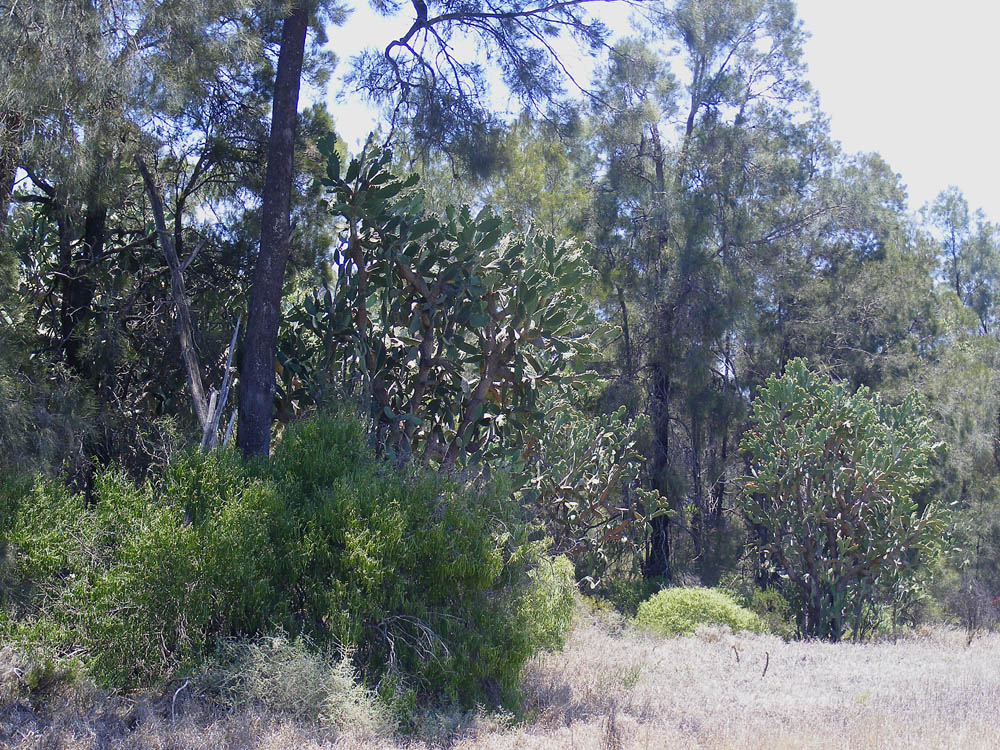
Remnant Tree Pear Opuntia sp specimens in the Belah Casuarina cristata (the tall dark trees) and Wilga Geijera parvifolia (the bright green shrubs) scrub between Goondiwindi and Millmerran.
Finally, however, in 1912, the Prickly Pear Travelling Commission was formed. Their objective was to identify possible biological controls by visiting countries where the cactus was indigenous and obtaining species that would be safe to introduce into Australia (ie be prickly pear specific and not move on to other plants). Enter the Cactoblastis moth and its caterpillars, as well as a dozen other natural predators of Opuntia spp. After researching the effectiveness of the predators, it became clear that the Cactoblastis moths were the star prickly pear destroyers. After the First World War the government set up a Cactoblastis moth breeding centre and eggs were distributed to landholders with instructions for their use. Within a decade the problem was under control!

These photos of the roadside vegetation were taken while we were queuing for roadworks. Note the wizened plant in the left foreground -- the Cactoblastis have been at work.
I am very familiar with the prickly pear and its amazing story, as we lived on a farm within the affected zone. There is a memorial to the Cactoblastis moth in a town not far (in Australian terms -- it's 170km away) from where my parents live. So now you know why I am so horrified when people tell me they have smuggled cacti or other plants intercontinentally.
****************************************************
Concert: There will be a concert in the Abbey in Preuilly starting at 5 pm on Thursday 15 August. A trio of cellist, flautist and pianist will play works by Mozart, Handel, Haydn, Debussy, Fauré and many others. Reservations advised.

*******************************************************************
Ile de Ré Reflections: the island's snails seemed to find our tent irresistable. This one thought it would be safe in Simon's cap, another made it to the very centre of the tent roof outside, where we couldn't reach it. Yet another managed to emigrate, coming home with us in our swimming gear bag to be discovered when I unpacked.

*********************************************************************
A la cuisine hier: The liqueur de noix has developed a scum. At first I thought it was growing some undesirable fungus, then I realised it was a slick of walnut oil. The vin de noix smells divine -- really rich and walnutty.
*******************************************************************
Orchard News: I mowed 2 more small sections of orchard yesterday. My aim is to get it all done (except for a strip for Wasp Spider Argiope bruennichi) before early autumn when Alex will come to do the annual end of season mow to set it up for winter. You should have seen his face when I told him it hasn't been mowed since the last time he did it!
I was joined by a very yellow female Great Green Bush-cricket Tettigonia viridissima, who looked just like a yellowing leaf, and rushed towards me when I knelt down to photograph it. It zipped up my knee and over my shoulder, sat there for a while, then flew back down to the grass. I'm not quite sure what the attraction was -- probably I was a good hunting stand. Also hunting in the potager was a female White-tailed Skimmer Orthetrum albistylum dragonfly and an extremely muscular looking robber fly, Pogonosoma maroccanum, hunting bees. The robber fly is a bee mimic, black with golden 'fur' and weightlifter's thighs. It had better eyesight than me, and refused to co-operate for photos. No matter how much I sneaked up on it, it always saw me first and moved. They seem to specialise in bees as prey. Fortunately, given the poor quality of my photos, it is a striking and unmistakable species and I identified it easily. A nice new record for the orchard.
On the way down to the orchard I passed our firewood merchant, energetically weeding his potager (he does most things energetically). He tells me all his tomatoes (cent pieds! that's '100 plants'!) have blossom end rot. According to him all the treatments that worked on this fungal disease are now banned, and anyway, he didn't want to be treating tomatoes intended for his personal consumption. We took the opportunity to discuss the coming winter's firewood supply and I have ordered 10 stères to start with, but we will probably need about 14 by the end. He said he'd used an unusually high quantity of firewood last winter, not because it was particularly cold, but because it dragged on for so long. He asked me if we had storage space for 10 stères all at once and I said I thought we did. We've used all of last year's firewood...because winter dragged on for so long...
On the way down to the orchard I passed our firewood merchant, energetically weeding his potager (he does most things energetically). He tells me all his tomatoes (cent pieds! that's '100 plants'!) have blossom end rot. According to him all the treatments that worked on this fungal disease are now banned, and anyway, he didn't want to be treating tomatoes intended for his personal consumption. We took the opportunity to discuss the coming winter's firewood supply and I have ordered 10 stères to start with, but we will probably need about 14 by the end. He said he'd used an unusually high quantity of firewood last winter, not because it was particularly cold, but because it dragged on for so long. He asked me if we had storage space for 10 stères all at once and I said I thought we did. We've used all of last year's firewood...because winter dragged on for so long...
***********************************************************


 ******************************************************************


