Monday, 11 October 2010

L'Art et Lard at le Petit Pressigny

Yesterday was the Fête d'Automne in the nearby village of le Petit Pressigny, home to our stone mason and our nearest Michelin starred restaurant. The festival has a well deserved reputation as being a cut above the average. Stalls selling artisanal foodstuffs in the market place are combined with artists displaying their work in gardens and barns all over the village. Le Petit Pressigny is tiny, so you can easily visit all the artists on foot, then come back to the market for a bite to eat. We opted, as we did last year, for pizza made by the people at the house on the hill, cooked in their 19th century wood fired bread oven. Then we had freshly pressed apple juice and some pâtisserie.

The view from behind le Petit Pressigny, looking out over
the valley it nestles in.
I discovered this elephant in a garage. It's not one of the
exhibits and it's not in a room.
Jacky Dallais' Michelin starred restaurant La Promenade, below. A 'two course' menu (which is actually entrée, main, dessert and amuses bouches) is €40 and the wines start at €19. It's extraordinarily good value.

We ran into quite a few people at the event, so it was pleasantly social.

First was Keir and her husband and their Bearnaise Mountain Dog, Grace. Keir is a blog reader who lives in the next département and recognised us from the blog although we have never met before. She had read Jim Budd's reminder that the event was on and remembered our report from last year and thought this might be a nice way to spend the day, especially as Grace doesn't like gunshots and Sunday is hunt day in Loir et Cher.

Then Sweetpea from the Village de Vaux blog, who was there on her own as husband Captain Sensible is away organising new windows for their current renovation project. Bloggers Tim and Pauline were next on the scene and we discussed the identity of a swarm of black and yellow flies they've been having. After that, Nicole and Alex, who run a gite complex and gardening business. Alex did our apéro terrace and back garden, as well as repairing our front courtyard with reclaimed cobbles.

There was Angélique, who runs a mobile organic grocery service, Madame and Monsieur C (he's on the council and they are both lovely people), our stone mason Monsieur Douady, Parisian acquaintances Anne-Marie and Bertrand (she observed that there was a lot of English being spoken in the street and she felt a bit like she did when they were in America, as she doesn't speak any English at all) and just as we were leaving, our neighbours Christine and Guy.

Susan

RIP Solomon Burke

Sunday, 10 October 2010

Wine Making for Dummies.

At I understand it, wine making is really easy:

First you grow grapes, then pick them when they are ripe. Once they are picked you squash all the juice out of them. Traditionally this is done with the feet, but most people use a machine of some sort now.

Squeezing the juice from the grapes
It's not ready yet
After that you store the juice at a mildly warm temperature until it goes alcoholic.

The musts (grape skins and pressed flesh)
are used to fertilize the vines
Then you stick it into barrels or metal tubs until it develops some flavour. This is apparently the bit you need to be an expert to do.

Wine available to be bought "en vrac" (in bulk)
Take your own plastic container
At any time from this point you can drink it.

Perhaps you understand now why Susan doesn't let me make wine and we instead buy it from experts. These photos were taken at the Simoneau winery, Domaine de la Rablais at St Georges sur Cher, where Carine and her family are the experts and make really tasty and interesting wine. She took time out of a hectic day of picking and pressing to show us how they make their wines, which was extraordinarily generous of her.

Simon

Saturday, 9 October 2010

The Tomb of Agnes Sorel

Susan wrote a while ago about Agnes Sorel, and a couple of years ago we mentioned she is buried in the church of St-Ours, in that part of Loches which is within the medieval walls.

Until Tuesday I have never managed to take a photo I was happy with of the effigy on the tomb of Agnes Sorel. Now I am happy.


Simon

Friday, 8 October 2010

Autumn Colours

Back in November 2008 Susan wrote about autumn leaves.

Well - it's that time of year again: here is the view from the Logis Royal in Loches, taken on Tuesday.

And while you're here, some music. To rock fans of a certain age, this will be very scary.


Simon

Thursday, 7 October 2010

Montrichard

Montrichard is a really pretty little town on the north bank of the Cher River. We have driven through a number of times, but never remembered about stopping until we had missed the opportunity to get a good view. I think the problem is that you dont get the real impact of the view until you are on the quite narrow but very long (and busy) bridge - and by then it's too late!

On Monday we were working in the area: in the morning we had visited Chaumont in the pouring down rain, and in the afternoon we were at Cheverny and the weather was improving. By the time we reached Montrichard on our way back to Chenonceaux the weather had brightened considerably. As we were heading in the opposite direction to which we normally travel, I was able to cross the bridge, then park looking back at the town.

Montrichard from across the river.
The chateau in Montrichard is another originally built by Foulkes Nerra (discussed here and here) and dismantled in 1589 by Henri IV. It looks properly imposing and medieval, which is always a good thing.

The Chateau

The Bridge across the Cher
We have never stopped in the town itself and explored, which is a pity. The chateau looks well worth visiting, the streets narrow and old (and some are pedestrian only) and there are some large but interesting restaurants lining the quay, which for some reason always reminds me of a seaside resort. One day we really must make the effort and explore properly.

Simon

Wednesday, 6 October 2010

The Wildlife Photographer at Work

Simon photographing a female Adonis Blue butterfly.
Can you see her in the middle foreground?
The grass around the prehistoric monument known as the Chillou du Feuillet is cut short and is full of wild thyme. This is ideal habitat for a number of species of blue butterfly, and the day we visited there were quite a few Adonis Blues Lysandra bellargus (in French le Bel-Argus) present. The males were busy pushing and shoving each other out of the way, and the females were busy laying eggs. They were so occupied it was easy to get up close for photographs.

Here she is, abdomen bent down to deposit an egg on the grass.
Susan

Tuesday, 5 October 2010

Gathering the Nuts

A homegrown almond, still in its shell, with the leathery outer
pulled off behind.
Of course, the nursery rhyme is gibberish, with its talk of gathering nuts in May. Various dodgy theories exist to explain the words, but whatever those children were being encouraged to gather, it was unlikely to be nuts in May (and 'here we go gathering nuts in late September, early October' doesn't scan).

The rest of the almond crop, laughing at me from the top of the tree.
The black dots at the tips of twigs (and there's more of
them than you'd think) are the almonds.
I am working on gathering our small but interesting enough to bother with almond crop. Commercial harvesters use tree shakers, but they must be considerably more vigorous than I can manage, because after shaking the tree as hard as I could, not a single almond fell. They are clearly ready to pick, as the fleshy outer has leatherised and split. I did succeed in knocking down 3 directly with a long stick, but the rest are too high. I'm going to have to lug the ladder down there and have at them again with the stick.

Fallen hazelnuts.
No such problems with the nice, well behaved and productive hazelnuts, although I was beginning to think they were never going to ripen. The trees and husks show very little sign of yellow autumn colour, but they have all just fallen off the tree and on to the ground overnight, leaving me merely to rake them up. Simon and I will spend the winter cracking boxes of nuts in front of the fire. It doesn't seem to be a problem to share them with the squirrel, and we don't get too many weevils.

The trees are still green, but the nuts are ready to harvest.
We have a sack full of walnuts to shell too. They are not from our trees, but from our neighbour Edouard. They are last year's, but I assume will still be perfectly fine in baking and suchlike. Our own trees, hit by the late frost at the crucial moment, have about two nuts between the 7 of them.

Our two walnuts for this year are in this picture somewhere.

Susan

Monday, 4 October 2010

Les Chemins Blancs

Throughout the Touraine there is a network of tracks, giving public access to forests, agricultural land and riverbanks. These tracks are unpaved, and often hundreds of years old.

In Australia they would be called dirt tracks, but here they are les chemins blancs, because the calcareous rock and soil they are made from is white. Much of the famous pilgrimage route to Santiago de Compostela, which runs through Tours, is via chemins blancs. Occasionally you see them referred to as les pistes blanches.

The sign says 'A white track. It's also rural heritage.
Respect it! Motorists - drive slowly!'
The term seems to be a quite specific and descriptive one. There are also chemins herbeux (grass tracks) and chemins forestier (forest tracks). In some places, where the soil is different, the chemins are rouges, not blancs.

They are very popular with mountain bikers (les vététistes in French, from vélo tous terrains or VTT) and in September every year there is a 30km night bike ride known as la Piste des lucioles (the firefly trail) from Mont-près-Chambord, so called because the riders career through the forest lit only by head torches.

Susan

Sunday, 3 October 2010

Last Minute Feasting

Many places are reporting huge numbers of swallows and martins moving through, coming from the north and heading south for their winter homes in Africa.

Swallows and martins feeding over our sour cherry trees.
A couple of days ago I was surprised to see a large mixed flock of Swallows and House Martins concentrated over our orchard. They were, in the parlance of my childhood, 'going mental', hurtling from one side to the other, flittering at tree top level and sometimes even landing in the cherry trees - I'd never seen that before!

There are at least 5 swallows actually in the tree,
and the cloud of flying ants is clearly visible.
As I got closer, approaching by way of the haymeadow in front of the orchard, I realised there were huge swarms of flying ants. I could see columnar clouds of insects that hung in the air about a metre above the ground at the bottom, and snaking up above tree top height. I'm guessing they are either mating swarms or swarms of males, but I don't know enough about this group to identify them. I've asked an expert contact, but may have to wait a few days for an answer.

This is the quarry.
Clearly the swallows and martins were stuffing their faces as fast as they could. These sorts of swarms don't last very long (a few hours maybe) and those little birds need all the food and energy they can snap their beaks around if they are to survive the trip to Africa.

Susan

Saturday, 2 October 2010

Poster Campaign

Simon has designed some lovely posters for Loire Valley Time Travel and we will be sending them out to friends and family all over the English speaking world to promote the joy of coming to France and seeing the Loire Valley with Célestine.

Poster 1
We hoped that our readers, even if we don't know them personally, might be happy to put up one or two posters as well. We are thinking of workplace noticeboards or at the college where you take your French lessons, or anywhere else people who are planning a trip to France might see them and be encouraged to book a day trip with us.

Simon has done 3 designs - one based on our logo (which Simon also designed) and two based on illustrations from an original Traction Avant owners' manual. Our favorite at the moment is poster 2, so that's the one we have made available for download so that it can be printed using an ordinary home printer. There are 4 versions of the design, each with different phone numbers so that people can contact us and not worry about the cost of a phone call to France. We have Canberra, Connecticut and London numbers in addition to our French number, or people can go to the website and email us.

Poster 2
You can download the posters from the following links:

Australia poster

Europe poster

North America poster

United Kingdom poster

Once the poster has opened in a new window right click on the image, "save image as" and download to your computer. You can then print the image using your computer's print program.

Poster 3
Let us know if you have managed to place a poster (especially if you've found somewhere really inspired) and Célestine will be pleased to show you a few of the sights around Preuilly the next time you are in the area. Let us know also which of the designs you like the best - if you want one of the other posters email us and we will send you a link to it. If you have any problems with this please let us know.

Susan

Friday, 1 October 2010

Things to Look Out for in and Around Preuilly in October

Crane migration: the cranes will be making their long trek back from Scandinavia down through France to winter in Spain. You can follow their progress on this website.

Ceps - the damp but still relatively warm autumn is the peak time for edible mushrooms. Look for ceps in pine forests, where they live in a symbiotic relationship with the conifers.

Looking out towards Bossay from Preuilly on an autumn day.
Saffron - the crocus which produces the expensive spice should flower and be harvested this month.

The dominant roadside flower will be the pale Yellow Toadflax Linaria vulgaris (la linaire commune).

Saffron flowers.
Birds of prey will be very visible - merlins, hobbies hunting linnets, sparrowhawks, buzzards and harriers chasing young away.

Anniversaries: one year ago we got our fireplace. Now we have insulation, the fire should heat the whole house.

Making apple juice at l'Art et Lard.
Fête d'automne - Le Petit-Pressigny's L'Art et Lard food and art festival on 10 October from 10:00 to 18:00. Come and wander round the village, into private gardens to see a wide variety of art work. There's a gourmet market, kids' workshops, trout fishing, an apple tart competition, and several options for lunch.

Susan

Thursday, 30 September 2010

Monet's Waterlilies

When we were in Paris in late December, returning home from Australia, we took the opportunity to visit the Orangerie, a domed building off Place de la Concorde. It is home to many of Monet's famous paintings of waterlilies and it is one of those places that tends to get forgotten in the myriad of huge and great museums and galleries that Paris has to offer.

A few deft brushstrokes, and you have waterlilies bobbing
on the pond surface.
Even so, you need to get there at opening time to ensure you walk straight in. Because of the way the panoramic canvases are presented, visitor numbers at any one time are restricted, and once the building reaches capacity, someone has to come out for the next person in the queue to get in.

Probably the image most people have in their minds
of Monet's waterlilies.
In the galleries that display the Monets you can stand up close and study the brush strokes or you can stand in the middle and take in the whole view. Monet painted the waterlily pond many times, in different light conditions and seasons. He clearly worked quickly over much of the painting, covering large areas of background with broad rough strokes, turning two or three little pink and white twitches of the bristles into flowers. You can see that the panorama has been created by painting a series of more manageable sized canvases which are then joined together. Occasionally you can see where he didn't quite match a canvas to its adjoining section, or didn't bother completely covering a corner.

Was this panel painted in the autumn, when the bankside
vegetation was yellowing? How much of it is reflection?
For me, being able to get really close to them was fascinating, and to see how different they are. I had seen the one in the National Gallery of Australia, which is a pretty 2m square concoction of blue-greens and pink - clearly painted on a lovely sunny day. It seemed to me that many of the ones in the Orangerie were painted in greyer light conditions, at dusk, or in the autumn. There is a theory that Monet's sight was deteriorating and this accounts for the increasingly murky paintings, but having seen them in the flesh, and having visited the garden itself on a dull summers day, I really feel he was painting what he saw. Often he is choosing to paint the juxtaposition of reflection and reality, so that you cannot tell which is which, lush bank vegetation projecting into tangled water lily or gently wind ruffled pond surface. The width of the works enables him to cross back and forth between solid objects and their watery projections, drawing you in to a representation of somewhere essentially nebulous and ephemeral.

I think this is my favourite panel. If you visit the garden,
you can stand in this spot and see this view today.
Looking at these paintings I could see how he was drawn into fascination with the changing light and colours and why he painted the lily pond over and over. Particularly if one has seen the actual garden, these works are very accessible to the viewer and I guess this is why they are loved the world over.

If you are visiting Paris, try to visit this gallery if you possibly can, and as an added bonus, there is an exhibition of Monet's work at the Grand Palais until 24 January 2011.

Susan

Wednesday, 29 September 2010

Just Peachy

Peaches are the last of our fruit crops to come in this year, since we don't have any grapes to speak of, and this year the white ones have been the star crop. The cherries were very good, but the white peaches, although small, were juicy and sweet and gave me lots of produce to store in the freezer at a time when the vegetable garden was barely able to produce a meal for us through lack of water.

I loved the delicious peachy scent that wafted from the trees when the fruit was warm from the sun. I could put it in a bucket and bring it home too.

I didn't do anything fancy to most of the peaches, not even bothering to peel them. I like the extra texture and the hint of bitterness you get from the skins. Mostly I just cut them in half, cut out any bad places, took out the stones and stewed them with a little water and sugar. They will be delicious with yoghurt for breakfast over the next twelve months.

One recipe I did make several times because we enjoyed it very much was Cobbler aux pêches épicées, found on La Vie Cevenole. Peaches won't be around for very much longer, so make it now!

Susan

PS For those of you interested in wildlife, I have added a butterfly species list to Loire Valley Nature. Dragonflies will be next, but don't hold your breath.

Tuesday, 28 September 2010

Slated in Azay le Rideau

We returned to Azay le Rideau a couple of weeks ago, and I was struck by how much slate there is in town.

As in Preuilly sur Claise, in Azay slate tends to be used on the roofs of older building that have been "upgraded" some time in the past or on relatively recent buildings. However, unlike Preuilly, in Azay it is also used on huge swathes of walls.

I can think of only one building in Preuilly sur Claise that has a slate wall, and ironically that is a building with a really abimé tile roof.

Simon

Monday, 27 September 2010

The Sorry Tale of the Potager With No Water

On 22 September the weather report predicted cooler damp conditions for the next week, so I stripped all our tomato plants and brought the fruit up to the house to sit in boxes and hopefully ripen. I can count on one hand the number of ripe full sized tomatoes the plants produced during the season, and the cherry tomatoes were not much better. A combination of a cold start to the summer and cold nights at the end, along with lack of rain seems to be the cause. Whilst our vegetable garden is not in a frost pocket, it is always a couple of degrees cooler than up at the house, and, according to our neighbours, the temperature difference between the lower part of the orchard, where the potager is, and the upper part, where the cherries, peaches and apples are, is quite marked. Now that the stream that runs along the front of these 'allotments' dries up in the summer, our neighbour has given up growing vegetables here, but has planted some young peach trees amongst his beloved walnuts on the upper slope.

Our overwintering onions and garlic did extremely well. Early summer vege, like lettuce, peas, broadbeans and mangetout did quite well, but the late summer crop such as tomatoes, zucchinis, green beans, sweet corn, aubergines and peppers was in some cases non-existant, and in others, no better than poor.

This is about three-quarters of this year's pathetic crop.
The garden is mulched heavily with straw and we have installed two water butts which would hold a total of 600 litres of water when full. Since their installation the most they have ever collected in one go is 150 litres. I calculate we need about 200 litres a week to keep the vegetables going. There is also the amount of physical effort required and the time to be considered. However, I have no plans to scale down the vegetable garden. I'm sure if I do that the weather system will revert to raining every couple of weeks throughout the summer and I would bemoan the missed opportunity. Mind you, if it rains regularly, I bet that diseases such as tomato blight are rife, so you can't guarantee a crop even in a more temperate season.

Our cunning plan for next year is to grow some late summer vege in pots up at the house, where we can water it easily. We were successful this way with tomatoes and peppers in 2009, and it does not involve any real extra work.

For now in the vegetable garden, we need to mow the paths and get ready to plant next year's onions and the garlic bulbils I've saved. They won't produce a crop until 2012, but we've got the space, and plenty of garlic from this year to last us until they mature. After the hazelnut crop is collected then we need to mow the orchard one last time for the year, before the orchids start to emerge in October-November. I disturbed a tiny Grass Snake Natrix natrix (Couleuvre à collier in French) the other day - slimmer than a pencil and not much longer. It was heading for the big pile of fruit tree prunings, which we have left in one corner to provide shelter for creatures such as this. Grass clippings get piled up nearby, and last year a large Western Whip Snake Hierophis viridiflavus (Couleuvre verte et jaune in French) seems to have hibernated and nested in the pile of straw in the shade of the paulownia. I'm guessing it will do so again, since some rather tasty looking young shrews have taken up residence in the pile, and a large family of Common Wall Lizards Podarcis muralis (Lézard des murailles in French), their favourite food, live in the adjacent logs.

Susan

Sunday, 26 September 2010

TW3

We haven't been writing much about the works on the house over the past couple of weeks. This is because insulating is not intrinsically exciting (or even for the most part even marginally interesting).

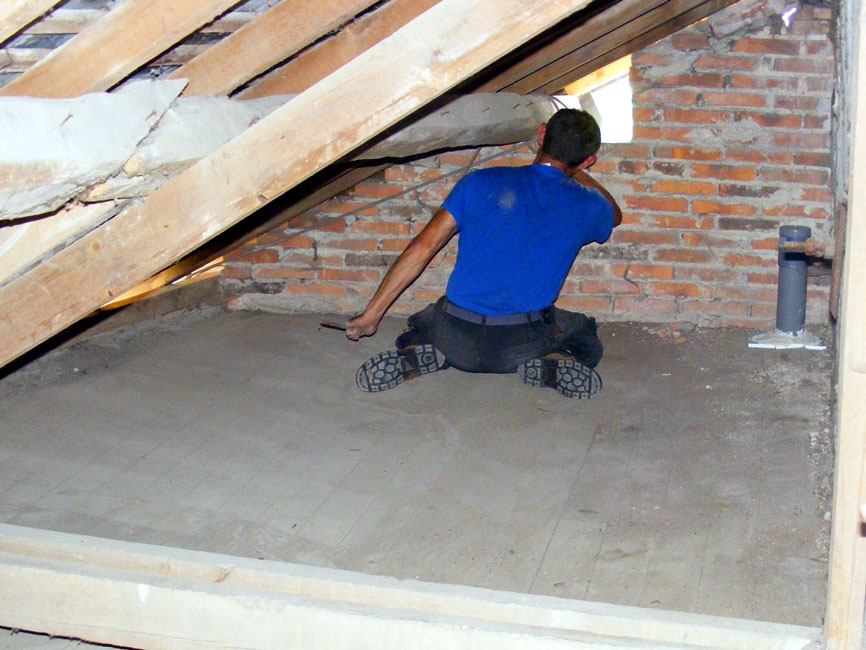
However, we have almost finished the attic, which now has 95% of its insulation in place and just awaits the wall for the big sliding doors, and we have insulated above the guest bedroom and en-suite bathroom. This entailed first closing off the eaves, which we did with a vertical soffit (or, if you like, a fascia that fits under the eaves) and replacing some of the less than secure brickwork at the end of the attic. The staircase tower is mostly insulated, and we hope to be totally closing the insulation in the roof by the middle of next week.

The roofspace before we started. Now
there is no daylight at all up there.
The space is insulated, in what Susan
describes as looking like a "big fluffy duvet"

The top of the stairs
The only other thing of note we have done recently is going to Paulmy to see Shanna Waterstown sing, and Susan did lots (and lots) of fruit works: stewed fruit, jellies and sauces. She also made the occasional pudding.


Simon

*Older readers from the UK may recognise this

Saturday, 25 September 2010

Ca c'est un bouchon !

Even though Thursday was supposed to be a day of strike action across France, the trésor public (Finance Department) was not so on strike that it couldn't accept my money. Tant pis...

On emerging from the hôtel de ville (Town Hall) €240 poorer, having just paid our taxes foncières (rates / Council tax) I encountered this meeting of monsters. At this time of year the stream of logging trucks is fairly steady. Across the road in the boulangerie it is like night descending when one of these goes by. No wonder their vitrine (plate glass shop window) cracked under the daily pressure of these huge vehicles rumbling past.

Susan

Friday, 24 September 2010

Apples - les Pommes

I picked the last of this year's apple crop a couple of days ago. We have 7 varieties of apples in the orchard, but not all of them cropped this year*.

From left to right they are Reinette du Canada, Reine des Reinette, Golden Delicious, Granny Smith, Melrose.

Reinette du Canada appears to be some sort of russet, judging by the rough skin. The fruit is wider than it is high, and remains tart. They are the last of our apples to fully ripen, perhaps because they produce the largest fruit. Last year this one didn't crop at all, so it will be interesting to see what it does next year. An old variety, apparently it keeps extremely well.

Reine des Reinette is indeed the queen of French cooking apples, favoured by many big name chefs. It's a soft sweet apple eaten fresh, an old variety, yellow, streaked with red on more exposure to the sun. Not a great keeper, but long enough lasting that it isn't a mad panic to use them all up.

Golden Delicious, known simply as Goldens in France, are ubiquitious, by far the most popular apple here. Three of the 10 apple trees we have inherited in the orchard are Goldens. Outside of France they are greeted with scorn and derision because of their palid unappetising appearance and their tendancy to go disgustingly floury with age and cold storage. Fortunately, I knew from buying them from an organic grower when we lived in London, that a fresh Golden Delicious is a completely different creature to one purchased in the supermarket, and so I look upon our Goldens reasonably kindly.

Young Granny Smiths on the tree back in June.
Granny Smith is an Australian variety, so it is rather nice to find it in the orchard. This is the apple of my childhood. Red apples were not for me - never crisp or sour enough. The archetypal apple green coloured Granny Smith keeps well and cooks well too. According to this excellent website, the red blush on our ripe Granny Smiths in the top photo is typical of those grown in central France, where the rather cool nights cause the apple to gain a reddish tinge.

Melrose keeps very well and is a great favourite with the birds. I pick them over a period of about 6 weeks, hoping, but not succeeding, to keep ahead of the wildlife. They start off somewhat unripe, but by the last couple of weeks are just about the perfect apple, sweet and crisp. I'd never heard of this variety before we inherited this tree in the orchard, but on looking it up I see it is an American variety.

The locally popular organic apple juice from the Durand's
orchard, for sale in Vival, one of Preuilly's mini-supermarkets.
Apples do very well around Preuilly and there are several commercial orchards. You can pick your own at one on the road to le Grand Pressigny, and the people who own one on the road to Loches make the most delicious organic apple juice, which is for sale in our local supermarket. Guy Durand, the orchardist, tells me that he wants to retire, and he has put the farm up for sale. The business is expanding and I would guess is a very good opportunity for anyone who wants to take it on.

Susan

*The two trees that didn't produce a crop this year, although they cropped well last year, are Jonagored and Ballerina.

Thursday, 23 September 2010

Pick me! Pick me!

Yesterday, on the sun drenched wall of a ruined house under the château terraces we encountered a fascinating scene of butterfly mating ritual.

These are the aptly named Wall Brown butterflies Lasiommata megera. The one with the downswept wings in both photos is the female. She shimmied and fluttered to encourage her admirer. He positioned himself right in front of her and did press ups, then star jumps, then reached forward to gently caress her with one front foot.

The male and female look very similar, but are not identical. The male has a prominent dark mark running through the middle of his upper wing. This is known as a sex mark, and the scales that form the dark patch emit scented aphrodisiac hormones. Sex marks are not uncommon in butterflies, but the Wall Brown's is probably the most striking. You can see it clearly here in a photo we took a couple of years ago.

In French, male Wall Browns are called les Satyres and the females are les Mégères (which, I am told by a local nature reserve warden, should be translated as something like 'Devils' and 'Witches', although it is literally 'Satyrs' and 'Shrews'.)

Wall Browns are widespread and abundant in France. They have an exceptionally long flight period, and can be seen in any month of the year in the southern half of the country. The caterpillars eat various sorts of grass. The adults like open sunny places, especially dry, rocky spots such as walls, banks and scree.

Susan

Wednesday, 22 September 2010

A Matter of Timing

Last week Célestine travelled a long way, in all about 500km. I know that doesn't sound a lot by modern standards, but as some parts on the car need attention and lubrication every 500km we regard it as a fair distance.

Towards the end of the week she was doing something a bit "individual". When we were cruising she would shudder. This got increasingly worse, until I became convinced it was the clutch slipping. A call to M.Musseau and we were booked in to be looked at yesterday afternoon.

He took her for a drive (enjoying himself immensely, it has to be said) and said the clutch was fine, but it was a probleme de carburation.

We returned to the garage, where he hooked her up to the machine to check the timing. It was about 15° out, so out came the screwdrivers. Thirty minutes later we were on our way. The timing still isn't perfect, but we are within 2°, something he is quite content with.

M. Musseau likes playing with Célestine, it gives him a chance to use his mechanic's skills and his brain, whereas with modern cars most of it is computer driven.

A man in his element.
If you don't understand these things, you can read about it here. It will be less confusing than me explaining it!