Tuesday, 10 October 2017

Guess the Chateau


.... is what I was going to call this blog post. But then I realised that I am a bit poor at responding to comments so I will give you a hint.

Monday, 9 October 2017

Monday is Queens Day: 3 - Anne de Bretagne


Anne of Brittany, born in 1477, was Duchess of Brittany in her own right and Queen Consort of France twice. During the Italian Wars she was also Queen Consort of Naples and Duchess Consort of Milan. Her father died when she was 12, leaving her the sole heir to the strategically valuable duchy of Brittany. A year later, to protect herself from the French she married Maximillian I of Austria, by proxy. The French royal family, led by the redoubtable Anne of Beaujeu, determined to put a stop to her independence and invaded Brittany. Anne was essentially kidnapped and brought to Langeais castle, where she was forced to marry the young Charles VIII.

When Charles managed to kill himself by hitting his head on a door lintel whilst running to catch a tennis match in the chateau of Amboise, Anne hightailed it back to Brittany. Sadly for her, the next king, Louis XII, was prepared to ruthlessly put aside his wife and forced Anne to return to court and marry him. Anne lived a life overwhelmed by the politics of her time and the need for the French kings to produce an heir and a spare. In the end, she never managed to produce a son who lived to adulthood.


Anne died in 1514 and was buried in Nantes (her heart) and St Denis (the rest). At no stage during her life was she a nun, as she pre-deceased her last husband, worn out by constant pregnancies and infant mortalities.

The Jardin du Luxembourg has statues of 20 French Queens and Illustrious women. The subjects were chosen by  Louis-Philippe I  in 1843. This statue was created by Jean-Baptiste Joseph Debay in 1846. To see Anne de Bretagne being statuesque you have to go here.

Eventually all 20 statues will be featured here.

Sunday, 8 October 2017

Big Fig


This lovely mature native fig tree is a remnant of the rainforest on the Great Dividing Range. It provides shade and elegance to the lookout and picnic area in Ravensbourne National Park, near Toowoomba in south-east Queensland. It is also no doubt home to various creatures and its fruit may be small, but they are an important food source for several bird species, especially Topknot Pigeons. The tree is known locally as the Big Fig.

Saturday, 7 October 2017

Amboise Allotments


Allotments in Amboise. The plot growing maize belongs to someone from Martinique.

I've wanted to visit the Jardins Ouvriers in Amboise for ages, and recently I got the chance to. I emailed Dominique Berdon, the president of the allotment association and asked if he would be interested in meeting a group of American gardeners I was guiding. He very kindly said yes and we arranged to meet at the allotments (or what my American group called the community gardens).

 Hot air balloons over the allotments.

There are 89 plots in all, on two sites. The one we visited is the one at Malvau, right on the banks of the Loire River, on the western edge of Amboise. At present all the plots are 'occupied' and there is a short waiting list. The area is made up of individual plots and common areas. One of the allotment association's projects for next year is to create a common picnic and barbecue area. Many of the allotmenteers live in appartments and the allotment is their garden. The association would like to provide some of the other advantages and opportunities for being outdoors enjoying nature that a garden can provide. Dominique hopes people will start spending Sundays with their families down at the allotment and it will become a regular fun social gathering.

 The American gardeners and Dominique Berdon (third from right).

The town of Amboise owns the allotments, which cover an area of 3 hectares. The size of plots ranges from 170 square metres to 500 square metres and the cost to the allotmenteer is between €40 and €60 per annum (calculated as the price of a cubic metre of water times the area in square metres of the plot). In addition allotmenteers pay €15 per year to be members of the Association. There is a total annual budget of €10 000 and the allotments consume around 3200 cubic metres of water.

 The view from the allotments.

At the moment the Association is working on improving the garden sheds and installing water tanks to collect rain water. Also in the plans are improving the fencing and installing more taps. The allotmenteers have to be encouraged to stick to the rules and respect their neighbours. For example, herbicides are banned from the site, but old habits die hard, and the best one can expect from some of the allotmenteers is that they do not spray around their boundaries and allow drift into the next. The allotment holders are a microcosm of the wider society. They range in age, social condition and cultural background. These differences are no barrier to the gardening, and especially in June and July, everybody is out in the allotments, enjoying the sunny weather.

 Chatting and photographing.

The Association provides support and advice to its members, both formally and informally, with experienced members advising novice members. The gardens are principally for growing vegetables for the families of the allotment holders, but flower growing is encouraged. It's seen as enhancing the beauty of the gardens and attracting beneficial insects.

 Dominique's plot. He says it's been a bumper year.

There are currently no plans to expand the allotments. There isn't enough money to acquire more land (and that adjoining the Malvau site is contaminated with waste from Citroën apparently). Dominique feels it is better to improve facilities on the land they have already.

 This allotmenteer was using a broadfork and his adorable little girl was helping.

It was good of Dominique to spend some time with us as it was a chance for the Americans to see some ordinary gardens that are not intended to be show gardens and are not run by a team of professionals. He was also pleased to see us during the Journées du Patrimoine (Heritage Open Weekend) as although the gardens are not grand heritage like the chateaux, they are local heritage nonetheless. Like most Jardins Ouvriers (Workers Gardens) they were set up originally in the 19th century by the local priest, who wanted some way of helping poor families to augment their diet and stay fit and healthy inexpensively. There is now pressure to change the name of the association to the Jardins Familiaux (Families Gardens), but Dominique is resisting, as he feels the name is an important part of the heritage.

Friday, 6 October 2017

The Elephant MkII

This weekend is le Petit Pressigny's L'Art et Lard festival, as being advertised by the elephant on the road from le Grand Pressigny.
 

I assumed it was the elephant that had been languishing at the back of someone's garage for many years and was going to call this blog post "The Elephant Revived", but no - it's a completely different beast. This must make le Petit Pressigny one of the smallest villages in France to have two elephants.


So get yourself to le Petit Pressigny this weekend for art and food (not as I first assumed, a festival of sculpture in pig fat).

Thursday, 5 October 2017

Resting in Peace


I wrote on Monday about Marguerite de Provence, and mentioned that she died at the ripe old age of 74 in Paris.

She was buried in the Basilica St Denis north of Paris, but not with her husband. Her tomb was "under the altar steps" and unmarked, so when the Basilica was ransacked and all traces of kings destroyed during the revolution she remained undisturbed. There appears to never have been an effigy.

And supposedly there she remains, one of the few memeber of the French Royal Family not to have suffered the indignity of being disinterred.  There is a memorial to all the kings and queens in the crypt on which her name appears.


Wednesday, 4 October 2017

Making Fine Wine


We had a last minute day of work on Monday - the phone rang at 8.40am, and it was an American man who had booked a tour from Paris which had failed to materialise. He and his wife were on their way to Paris Montparnasse station, were determined to see the Loire Valley, and wondered if we were available.

It takes us about the same time to get to Saint Pierre des Corps station from Preuilly-sur-Claise as it takes an American to get from halfway across Paris to the same place, so we said yes, got showered and dressed (I had decided it was a dressing gown day) and beetled off to town.

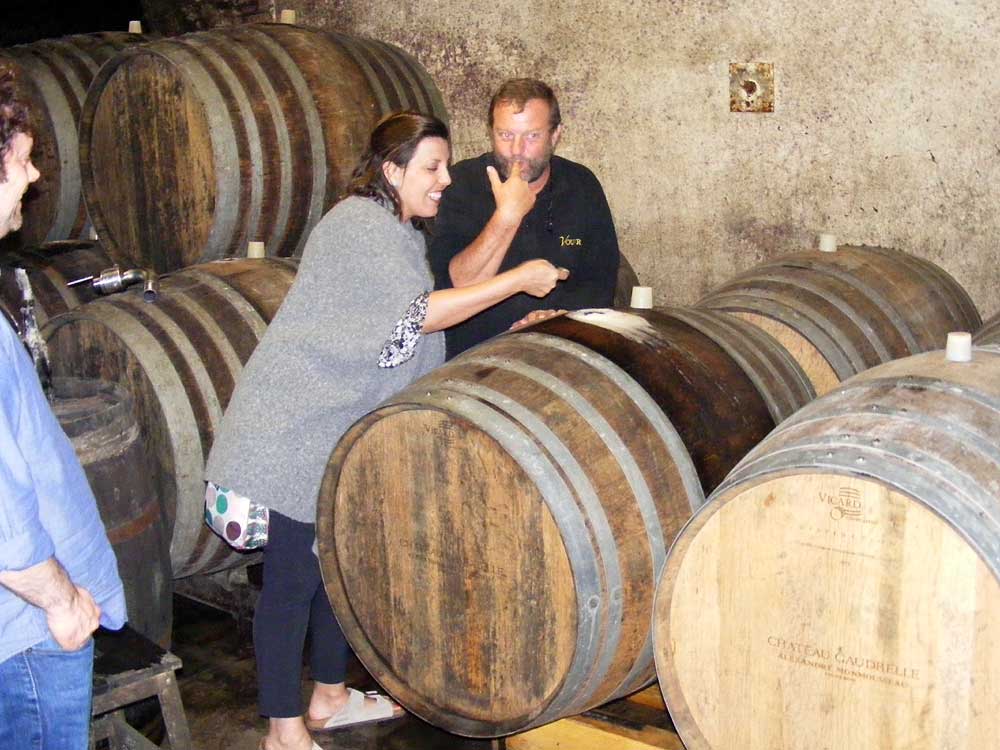
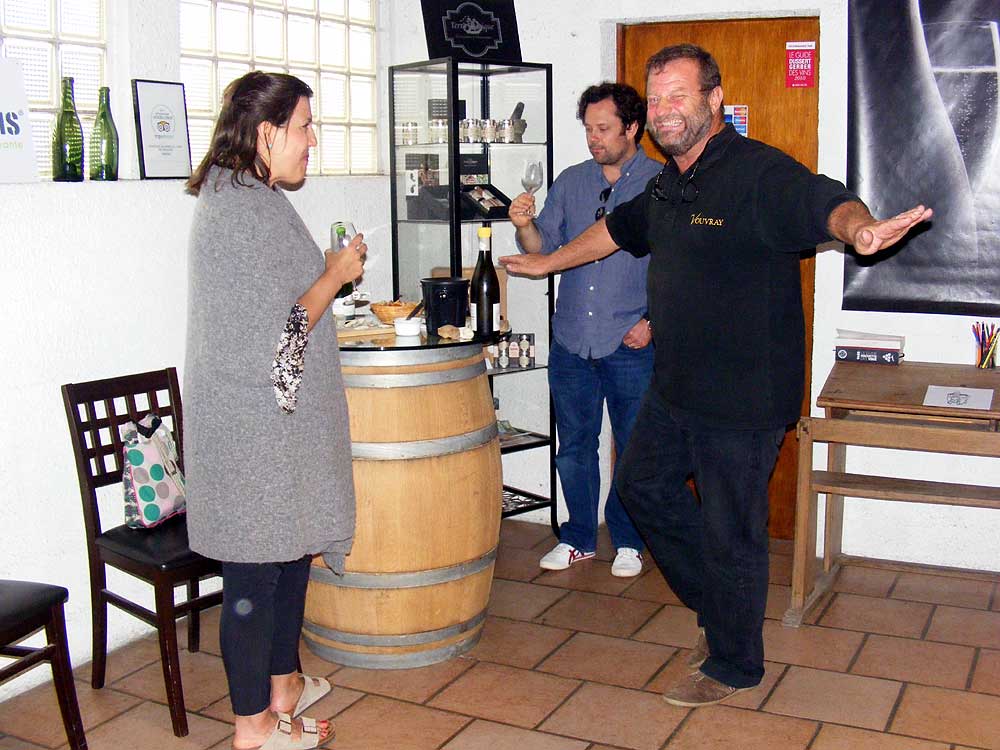
They were lovely people (our travellers invariably are), and we ended the day at Chateau Gaudrelle (another almost invariable). There the tour of the cave and tasting was led by the man with his name on the label, the effervescent Alexandre Monmousseau. He was in particularly fine form as the harvest is finished, the wine is now fermenting, and the quality of the grapes was high.

We have shown wine fermenting before, but until Monday we have never sampled it. Alexandre reckons that tasting the foam and then sticking your finger into the fermenting juice is a great early test of the likely quality of the wine.


He is the expert, so we all tried it. Not sure I could make any personal recommendations about the 2017 vintage yet, but the boss man seems happy so far.

Alexandre, demonstrating how wine should "fly"

Tuesday, 3 October 2017

Walking From Preuilly to Villejesus


On a walking club hike about a month ago we started from just outside of Preuilly, walked up to the plateau, around in a big arc to the hamlet of Villejésus and back to our starting point.

Goldenrod Solidago virgaurea (Fr. Solidage verge d'or) growing on the edge of the forest near Boussay.

 Looking back at the Chateau du Lion in Preuilly sur Claise.

 Walking along the edge of the forest. This just happens to be one of my butterfly transects.

Millepertuis farm.

A view from the plateau, looking up the Claise Valley towards the Brenne.

An interesting garden feature in a complex of buildings we passed through.

The road from Preuilly sur Claise to Yzeures sur Creuse.

Monday, 2 October 2017

Monday is Queens Day: 2 - Marguerite de Provence


Marguerite de Provence (1221 – 20 December 1295) was the wife of King Louis IX (Saint Louis). Marguerite accompanied her husband on the Seventh Crusade, which became a disaster after the king was captured in Egypt. She raised and paid the ransom herself.

She didn't get on well with her Mother in Law (more on that later) but all reports give the impression that Louis was devoted to her. She was as devout as her husband, and a sponsor of the arts and the church, including building Sainte Chapelle.


Louis went on crusade again in 1267, this time leaving Margeurite at home. He died of dysentry in Carthage in 1270. Marguerite died in Paris at the age of seventy-four, after spending the last years of her life doing the nun thing.

The Jardin du Luxembourg has statues of 20 French Queens and Illustrious women. The subjects were chosen by Louis-Philippe I in 1843. This statue was created by Honoré Husson in 1847. To see  Marguerite de Provence in all her stony faced glory you have to go here.

Eventually all 20 statues will be featured here.

Sunday, 1 October 2017

Lace Monitor


Lace Monitor Varunus varius is a type of goanna. This one joined my family at a picnic in Ravensbourne National Park. It was a bit over a metre long, so not an especially large specimen. It was a totally wild native animal, but unfortunately it had become habituated to people and knew that picnics mean food. Goannas prowl around in a thoroughly menacing way, so we all kept a wary eye on it.


Lace Monitors are the second largest lizards in Australia and can reach a length of 2.1 metres and weigh 20 kilos, although most are much smaller. They can be found all over eastern Australia, wherever there are forests. They roam around on the ground, as much as 3 kilometres a day and are strong tree climbers. In the wild they eat birds eggs, especially those of the nest mound making Scrub Turkeys, as well as insects, other lizards, small mammals, and baby birds. They will certainly not pass up the opportunity of carrion either. Unfortunately they have also learned to raid chook sheds and garbage bins.


In their turn they are eaten by dingoes and birds of prey. They are considered top tucker by Aboriginals, who also use their fat medicinally.


Lace Monitors have formidable claws, leathery skin and forked tongues like a snake. Although they mostly amble they are capable of moving with startling speed, both across the ground and up trees. If they come across a large carcass, for example roadkill, and can gorge themselves they will do so and then not eat for many days.


Females lay a clutch of eggs in a termite in a tree, then when they are ready to hatch, return to dig out their little goanna babies.

Here is another post I wrote about Lace Monitors.

Saturday, 30 September 2017

Cake Club


Last Wednesday was the last Loire Valley Cake Club for 2017. It was a very pleasant gathering at Gaynor and TimB's, with 11 in attendance. The weather behaved so were able to sit outside in the sun, have a glass or two of rehydration, and then get stuck in into the food.


This month was a "Lucky Dip" event, so anything cooked in the oven qualified. Thus we had sausage rolls, quiche, madeleines, muffins, flapjacks, sticky ginger cake, eclairs and meringues, a nice mixture and not a diabetes inducing bloatfest that a bigger gathering can become.
All in all, an excellent way to spend an afternoon, and we hope they continue for as long as we have an appetite for cake.

********************************************************

Oops - almopst forgot. There wasn't a raffle this month, but Jean had bought along a cake stand to be taken away. Thus we wrote our names on a piece of paper, popped it into the proverbial hat (a tin) and drew out Simon's name. Yay!

Friday, 29 September 2017

The History of the Franks


In Monday I wrote about Ste Clotilde, and mentioned that there were many lurid tales about her in the 10 part "History of the Franks" by Gregory of Tours.

When we were in Paris in February this year we visited the Cluny Museum, which had a special exhibition of Merovingian items, including an 8th century copy of one of the books of "The History of the Franks". My Latin isn't good enough to be able to tell you what page this was open at, but it is amazing that such a thing still exists.


Even more amazingly, there was a 7th century copy of the book (3rd or 4th quarter), which means that it was produced less than 100 years after Gregory's death.


Of course, just because it was produced so close to Gregory's death doesn't mean that it is any more accurate in its history, but it does mean that it is closer to the story that Gregory wrote. It has to be remembered that he had to be very careful about displeasing his temporal master, who happened to be the Frankish king. Tours was on the border of the two parts of modern France - the Frankish north, and the more Roman south, so he heard plenty of stories which he appears to have used to illustrate the benefits of Roman Catholic clean living, rather than being totally empirical.

It is through Gregory that we "know" so many things about the Merovingians, but the quality of the art and literature the Merovingians left behind would tend to make a lie of the impression Gregory gives that they were an unruleable rabble.  It may be that the stories of the Merovingians are there to contrast the virtues of being a good, Roman Catholic king, as opposed to the Pagan, Jewish or even (gasp) Arianist Christian subjects.

Thursday, 28 September 2017

Cooking With Stephane

Stéphane doing something cheffy with a tomato.

As part of my week spent guiding a group of American gardeners around the Loire Valley I got the opportunity to attend a cooking class with the chef at the Hotel Clos d'Amboise, Stéphane Bureau. Deb Flanders, from Goodspeed and Bach, who organised the tour, has traditionally included a cooking class in the tours with Charlie Nardozzi, and this was no exception.

 The only photo I have with Cédric in it! He's the dark haired guy reaching across the table.

Finding somewhere that would take a group of more than 10 people for a cooking class was really difficult. Deb and I exchanged ideas and emails for months before Stéphane said he would do it. Luckily for us, he has been wanting to start doing classes for the public since the beginning of the year and now had got permission from the management.

 A proud julienner shows of her handiwork.

He very sensibly designed a menu that would give everyone something to do, from those who were experienced and wanted a challenge, to those who needed the basics. He also very sensibly invited his sous-chef Cédric to join us. Stéphane's English is hesitant and his vocabulary limited. Cédric has worked in Ireland, Australia and New Zealand, so his English is excellent, and he and I provided translation services.

 Chef and student concentrating on giving and receiving instructions for the pudding.

Over the course of two hours we made Salmon Mousse, Hazelnut Crusted Chicken with Sainte Maure and Vegetable Gratin, followed by Squidgy Chocolate Pudding. Then we got to eat it for lunch. At the half way point we took a break for oysters and white wine from Chateau de la Presle, who are neighbours of Stéphane.

 Oysters from the market, prepared by the apprentice chef.

The teaching kitchen was jam packed with equipment temporarily set up and 25 people. In that very French way it seemed like utter chaos to begin with, as Stéphane gradually made his way around the room, explaining to everyone their particular tasks. The group was broken up into four smaller teams, each of whom got to work on a dish. I sort of hovered mostly between veggies and pudding. After a short while everybody was concentrating and it all came together. We produced a tasty meal with very little fuss and bother.

 Getting ready to plate up the starter.

Despite us being his first class, Stéphane was a model of calm and relaxed instruction -- or so we thought. The receptionist later let slip that he was in fact very nervous. It didn't help that we were such a large group. He had another, smaller, group scheduled for a few days later, and was relieved when our group went so well. The next group will benefit from some tweaks to solve minor issues that were revealed by our class.

 Stéphane demonstrates piping the salmon mousse.

All in all a fun and convivial way to spend a morning in Amboise.

 Dressing the salmon mousse with julienned vegetables.

Nothing left to do except wait for the caramel to boil.

Wednesday, 27 September 2017

Missing the Train

A week and a half ago were the journées européennes du patrimoine. I took part in the heritage traffic jam on the Sunday, and didn't do much more. However, we expected the steam train R.840, one of only a few in France, to make an appearance in Loches soon after the traffic jam finished so we hied our way from Ste Maure to Loches in anticipation.

The rain had stopped, the sun was out, but the train was nowhere to be seen. Unfortunately, due to a misunderstanding we were 22 hours late, so here's a photo of where I expected a train to be:


And a link to a video of the train in Loches on Saturday

Tuesday, 26 September 2017

Brain Surgery


OK, brain surgery is a bit of an exaggeration, but I did have surgery on my scalp the other day. 


For many years I have had two cysts on my scalp. One of them was a nuisance for years because it was right where I kept sticking it with pins if I did my hair in a certain way. Then the other one got large enough that it became visible as a sort of roll in my hair and began to ache when I lay on it in bed, and it made wearing a hat or putting my sunglasses on my head uncomfortable. Time to get them removed.


The dermatologist took one look at them and said they definitely needed to be dealt with, but that it would be day surgery and she wouldn't need to shave my head. She told me that they were hereditary, and it turns out that my father has similar lumps on his scalp.


Simon drove me to Le Blanc, which is where our dermatologist is based. He asked if I wanted him to come in with me. He didn't really want to because he was a bit squeamish, but I asked him if he would. Just as well, because although I was looking forward to getting rid of the things, I must have been a bit stressed. The doctor asked me three times if I had washed my hair that morning or the day before. The words, in French, just didn't compute. I was fine with 'have you ever had cysts like this removed before' and various other preliminary questions, but for some reason 'did you wash your hair today' was just noises. Luckily Simon understood and translated. Having had various medical treatments in France now, I would say it is always a good idea to have someone else along, as brain freeze seems to be quite common. Simon suffered from it a couple of times when he was being treated for his detached retina.


The doctor injected a local anaesthetic and used sticky tape to hold my hair out of the way. This caused a good deal of oh la la-ing and 'it's like the pelt of an animal!' I have long thick hair and I think she might have regretted saying she wouldn't shave patches. Then she cut the cyst open, squeezed like mad, poked, scraped and prodded for quite a while, cauterised some veins (burning some hair in the process), cleaned it up, sprayed on an antiseptic and finally put in some stitches. The process was repeated for the second cyst. Simon said he was surprised how much blood there was.


I got a finger wagging about leaving it too long to have them dealt with. Next time, she said, don't let them get beyond hazelnut size (they were about 3cm long and 2cm wide). They are much easier to remove if they are small. I got a prescription for some swabs and some antiseptic spray and told to apply the spray twice a day, then once a day until going to the nurse to have the stitches out a week later. I wasn't allowed to wash my hair for two days either.


The local anaesthetic wore off fairly quickly, and the wound on the side of my head really throbbed. I took some painkillers when I got home and that improved it, but I was uncomfortable and a bit miserable for the rest of the day. I was too scared to put my hair up again and just gently tied a scarf around my head. The doctor did a good job though. No one seeing me in the street would have been able to tell where the dermatologist had been at work.


The operation cost €111, which she tells me will all be reimbursed.

Monday, 25 September 2017

Monday is Queens Day: 1 - Ste Clotilde


The Jardin du Luxembourg has statues of 20 French Queens and Illustrious Women. The subjects were chosen by  Louis-Philippe I  in 1843.

Ste Clotilde (475?–545) was the second wife of Clovis 1, first king of all the Franks, and  was responsible for him converting to Christianity (particularly to Catholic Christianity rather than Arianism, which would have been the most likely course). She is the subject of a number lurid tales, including from Gregory of Tours (538?-594) in his epic 10 book Historia Francorum (History of the Franks).


After Clovis died (511) she did the nun thing, and went to the Abbey of St. Martin at Tours. You can read more about her here, and to be in her statue like presence you have to go here. This statue was created by Jean-Baptiste-Jules Klagmann in 1847.

Eventually all 20 statues will be featured here.