Wednesday, 17 August 2016

Kew Comes to the Vallee de la Claise Tourangelle


The Kew team's vehicle, parked at Les Limornières, where they stayed.
Photo courtesy of Nicole Crawford, Les Limornières.

For the past year I have been involved in a project to study the Red Helleborine Cephalanthera rubra. This orchid is critically endangered in Britain and the project's primary goal is to save the species in the British Isles. It is a joint effort by the National Trust, who own and manage the remaining Red Helleborine sites, the Royal Botanic Gardens, Kew, who are attempting to propagate the species, and Natural England, who are providing the funding.

The target species, Red Helleborine Cephalanthera rubra.

The reason I am involved is because project members wanted to check out Red Helleborines in France, where there are several areas where the species thrives here. Because I have written about the orchids here one of the National Trust wardens got in touch and arranged a study trip last year with two colleagues. After their very successful visit Jon Kendon from Kew got in touch to ask if I could help with a proposed visit of his team in 2016.

Downy Oak Quercus pubescens woodland and prime Red Helleborine habitat.

The Kew research team is led by Dr Viswambharan Sarasan. Jonathan Kendon, who co-ordinated the trip with me, is the lab technician, and the third member of the team is Dr Kaz Yokoyo, who is research assistant. The aim of their work is to isolate the fungi present in the roots of the French Red Helleborines and establish if they can be used to aid the germination and growth of English Red Helleborine seed. This is the sort of work they focus on in their lab at Kew, working with plants from all over the world. For a good overview of a typical project that they've contributed to, see Kaz's blog post about the conservation of orchids in Madagascar.

The Kew visit was a lot more complicated to organise than the National Trust visit because it involved taking samples of a protected species. We had to approach the appropriate authorities and Jon had to submit an official written submission asking for permission to take plant material. My job was to find out who exactly we needed to contact at the Préfecture and liaise with property owners and local French botanists. This turned out to be more time consuming that we had anticipated, and the Kew team had to reschedule their visit because of funding issues as well.

The Kew team begin their investigation by just looking.

One of the first things I did was contact my friend Marc Fleury, a local orchid expert. He had helped with the previous visit of National Trust wardens, suggesting sites and getting landowner permission. He and I scoped out the sites prior to the English visits in both cases. This time round Marc also helped where I had to approach landowners formally, by correcting my French and designing a consent form that we sent to the landowners. I did the legwork of getting names and addresses for the landowners by visiting the relevant town halls and asking to check the cadastral records. I also got in touch with everyone I could think of who might have an interest in the project to let them know what was planned (that included the botany section of the university at Tours, the Conservatoire d'espaces naturel Centre Val de Loire, the local representative of the Société Française d'Orchidophilie, a local journalist and my local botany club).

Jonathan Kendon (left) records the details as Dr Viswambharan Sarasan (right) takes a sample.

The Prefectural permission to take plant material took weeks to be granted but eventually it was and we set the date for fieldwork as 7 June. Marc, Jean Bouton and I went out the week before to check the sites. That was a day or two before the floods peaked. We got absolutely saturated and had to go 10 kilometres out of our way to find bridges we could cross to access the site we thought would be best for the fieldwork to be undertaken. We were disappointed by what we saw too. There weren't many Red Helleborines in flower and we were worried the Kew team wouldn't find enough material. To top it off, we ran into the mayor of Chaumussay out inspecting the flood and she had a bit of a rant. Fortunately not directed at us, but at the Prefecture, who had not bothered to ask her opinion before granting Kew permission to take samples from a protected plant growing on her patch. Luckily I had kept her informed about progress and had forwarded the Prefectural documentation to her, so I was in her good books. Marc was in her good books because he was organising an orchid walk for a group from Amboise and raising the profile of Chaumussay and its reputation as an orchid hotspot.

Jon measures root depth while Dr Kaz Yokoya takes a photographic record with his phone.

This group from Amboise turned out to indirectly cause us a slight problem. Four days before the Kew team arrived I realised there had been some confusion regarding permission from the landowner of the site we wanted to use. I was working so I asked Marc to call on the landowner and clarify who was visiting the site, when and what it was that they were doing. He went round to her home but there was no one around. He couldn't follow it up because he was going on holiday. Finally, the day before the Kew team arrived I managed to catch her at home, sort out the problem and reassure her that there would be no damage to the site, and we would do our best not to disturb the game.

Kaz checking a fragment of root to identify what species it belongs to.

On the morning of 7 June I got up early and was down at the baker's in the Grande Rue by 7.30 am, collecting ham and cheese baguettes for lunch and croissants for breakfast. Having picked up the day's provisions I headed over to Les Limornières where the Kew team were staying. After breakfast together we drove over to Chaumussay, where we were to meet Jean Bouton, who had volunteered to represent French botanists. Jean Pelle, another orchid associate was with him and he admitted that Marc had called him and asked him to be there in case there was further negotiating to do with the landowner. Marc clearly was nervous that my French wouldn't cut it with the landowner.

Sarasan cutting a sample of a suitable Red Helleborine root.

Off we went to the site, via a farm track that had been badly scoured out by the rain. The best patch of Red Helleborine is very conveniently situated by a very distinctive tree. The Jeans told us it was probably about 400 years old and a hybrid of Downy Oak Quercus pubescens and Pyrenean Oak Q. pyrenaica.

Sarasan gently sorting out roots in the soil. The abundant ivy roots were a problem.

The Kew team spent ages just looking at the patch of orchids and discussing what their approach should be. They didn't want to dive right in to the middle of the patch, but to choose small plants that were isolated or on the edge of the main group. There was two reasons for this. First, it would minimise the disturbance to the main patch. Second, taking some samples which were further away from the main patch would mean they were more likely to be seedlings, not clones, which might make a difference to the range of fungi living in symbiosis with the orchids.

Sarasan and Jon measure the root depth of a specimen.

Taking a sample from the path.

The team worked slowly and carefully in a number of places across the site near Chaumussay and took about ten samples. They were aiming to get protocormes of the orchids and roots which they could slice up in the lab to see what mycorrhizae would grow. The mycorrhizae are embedded in the cells of the orchid roots in bundles known as pelotons and the plant depends on them to transfer minerals and nitrogen from the soil (in return for which the fungi receives carbohydrates). They also took soil samples and a seedling Downy Oak and a tiny Juniper Juniperus communis, to examine if all the plants are using the same mycorrhizae. From what they said, it seems likely that Red Helleborine likes to position itself underground on the horizon between the humus rich layer and the underlying limestone. There was a considerable difference between the length of samples taken about a third of the way up the slope, growing in deep leaf litter and those taken at the top of the ridge, in the thin sandstone layer or the flinty soil. A plant from lower down the slope had roots 15 cm under the surface, a plant from up at the top only had its roots 5 cm down.

Taking a sample from the top of the limestone ridge, which has a remnant sandy cap.

At one point in the morning the husband of the site owner turned up, almost certainly to check exactly what we were up to. Jean Pelle stepped forward to greet him and introduce him and I realised there was a very specific reason why Marc had arranged for him to be there. Turns out that Jean was our visitor's college teacher (thirty or forty years ago) and has known him all his life. 

I must say that I would never have been able to negotiate the sometimes delicate relationships with the various French parties involved without the help of Marc and the Jeans. I'm very grateful to them and I know the Kew team are too. The project would never have got this far without Marc and Jean Pelle's local knowledge, and Jean Bouton's willingness to represent French botanists on the day of the field work.

Sarasan tells me that this research has implications for other terrestrial plants that are facing extinction. They hope to be able to isolate fungal material and use it to improve seed germination and growth. They should be able to tell if they've got something after 48 hours in the lab, but it could take months to identify the specific mycorrhizae and a year write up their results. The hope is that the results will enable the Red Helleborine conservation project to move to the next stage and start propagating a new generation of the orchid with English material. The team were very happy with what they collected and delighted with the site. Marc and I needn't have worried that there wouldn't be enough for them to make the trip worthwhile.

I had a most interesting day out in the field with them and loved watching the careful way they worked and how well they worked as a team. From them the Jeans and I learnt that orchid roots have a particular smell, a bit starchy and lightly sulphurous, somewhat like a potato. Kaz could identify tiny pieces of orchid root by touch, sight and smell -- that was impressive. Jon pointed out that the target species always seems to have a red stem, whereas other similar orchids nearby did not, something I had never noticed. This year most of the plants were not in flower but were little seedlings or clones with just a few leaves. Marc thinks this lack of flowering was due to the dry spring last year. (Remember that last year in the first week of June when the National Trust team were here we had temperatures in the 30s!) Given how much rain we've had this spring I am expecting a bumper crop of flowers next year!! The Kew team had hoped to do some hand pollination while here, as a sort of payback for taking a few plants away, but the flowers proved too fragile and Jon couldn't do it. A shame, but the population seems robust enough here anyway.

Once again, the lesson for me was a reminder not to take the abundance of orchids in the Claise Valley for granted. Jon had never seen a Lady Orchid Orchis purpurea in the wild before, and here we had a couple of splendid ones still looking good. The landowner was bemused that we were so interested in what to her is a fairly ordinary plot of land. She loves it and is proud to be the guardian of the orchids and other wildlife, but I think she doesn't really realise how special her former sheep fold and limestone ridge overlooking the Muanne is.

Further reading: A Perfect Day in Panzoult.

Saving the Red Helleborine.

Red Helleborine Research Report.

Tuesday, 16 August 2016

European Pine Marten


As well as the deer I posted last week my sister Kathy also photographed a European Pine Marten Martes martes (Fr. Martre des pins) in the Forest de Preuilly in June. I cannot tell you how extremely green with envy I was! This is an animal one only gets a fleeting glimpse of, and not very often, even though it is common here. Mostly you see them as roadkill, and my best ever view of one was as it dashed across the road in front of me when I was driving between Châtillon sur Indre and Azay le Ferron last year (making it to the other side fine -- I did not squash it, thank goodness).


In medieval times Pine Marten pelts were widely used to line garments for warmth and if you see a portrait of some medieval dude wearing dark fur it is quite likely to be Pine Marten. The fur was valuable right into the 19th century and according to an 18th century account '[has] no strong disagreeable scent, like the polecat, weasel, and other stinking animals of a similar nature...I caught several one winter...and sold their skins...for the sake of the fur, which is exceedingly good.' The fur is also used to make artists brushes even today.

Pine Martens are mustelids, related to otters, weasels, stoats, sables, mink and ferrets. They are about the size of a cat and extremely agile, wary and alert. They greatly resemble the Beech Marten Martes foina (Fr. Fouine), but once you know what to look for, are reasonably easy to distinguish. Pine Martens are a rich dark brown with a creamy yellow bib that does not divide and extend down their front legs. Beech Martens are a duller brown, with a white bib that divides.


Pine Martens live in mixed or coniferous woodland, bounding across the ground and climbing and leaping with ease. Despite the fact that they are less likely to be near human habitation they are more frequently seen than Beech Martens. They are nocturnal but can be spotted at dusk or even during the day. The species occurs throughout France and females require about 30 hectares of territory. Males roam more widely.

These carnivorous predators eat small mammals, birds and insects, but they are also quite partial to wild fruits such as rosehips, strawberries and raspberries. Small rodents form about 80% of their total diet, mainly voles, field mice and shrews. They love eggs, but because they are forest creatures and wary of man, they do not raid chook sheds like their cousin the Beech Marten. In season fruit can form up to 70% of their diet. They will not turn down a carcass such as a deer killed by a bigger predator if they come across one either.

Sadly the population of these charming animals is in decline. The causes are multiple, with the long centuries of hunting not helping. They are officially classed as vermin in much of  France and in Indre et Loire it is permitted to trap and kill them all year (they can also be shot in the early spring if you have a licence to do so). The fragmentation of woodland, loss of wooded corridors, deforestation and intensive forestry management techniques will disrupt populations and cause a decline in numbers. Finally, roadkill is not an insignificant contributor to the losses.

Further reading: The French Wikipedia entry for Pine Marten, which has a very interesting section on a technique for monitoring their population. It involves plumbers pipe, chicken wings and a reliance on Pine Martens being more agile than any of the other carnivores around.

Monday, 15 August 2016

Diane de Poitiers


Diane de Poitiers was born in late 1499 or early 1500, the daughter of Jean de Poitiers and his wife Jeanne de Batarnay. Her mother was the daughter and only surviving child of Imbert de Batarnay, the remarkable negotiator and diplomat who served four French kings. She was born in the Dauphiné in the south-east of France, where her father held territory. For more than twenty years she was the mistress of Henri II, King of France. Clever and well educated, with a head for business and politics, she strongly influenced the king. She was clearly his soulmate, despite the twenty year gap in their ages.

 The tomb of Imbert de Batarnay. He is the effigy in the foreground.


Her family operated in the most intimate royal circles. Her paternal grandfather had married the illegitimate daughter of Louis XI. In medieval times illegitimate children of noblemen were acknowledged openly and shared all the privileges of their legitimate half siblings.

 Diane de Poitiers, portrayed as Diana the Huntress by Francesco Primaticcio. She is also discreetly exposing one breast, telling you she is the King's mistress, and her hair is bleached blond.

Diane's mother died  when she was six years old and she went to live in the household of the formidable Anne de Beaujeu, daughter of Louis XI and regent of France in the early years of her brother Charles VIII's reign. At the age of fifteen she was married to Louis de Brézé, the grandson of Charles VII and Agnès Sorel. He was nearly forty years her senior, and she gave him two daughters. It seems to have been a successful union, despite the age difference.

In 1524 Diane's father and Anne de Beaujeu's brother-in-law were accused of treason, and Jean de Poitiers became the principal scapegoat of the affair. He was only saved from the scaffold by her intervention and reminding the king of her husband's loyal service. Louis de Brézé had in fact been the person who alerted the king to the plot. I think it is likely that Diane inherited her maternal grandfather's diplomatic skills and political savvy. Nevertheless, the affair was serious enough that her father spent the rest of his life imprisoned, in the chateau-fort of Loches (in some comfort, it has to be said...).

 Jean de Poitiers was imprisoned in the tower on the right.

Diane served as lady in waiting to François' queen, Claude, then when she died, the king's mother Louise of Savoie, then finally to his second wife, the Hapsburg Eleanore of Austria. It is during this time that some biographers claim that she became the mistress of François I, but there is no real evidence of this and I am inclined to think she managed to keep herself free of the lecherous king's clutches.

Louis de Brézé died in 1531 and Diane adopted the garb of a widow from that time on. I suspect that the combination of black and white with gold stripes suited her and gave her a defined style and elegance that people remarked upon. Later, Henri II was to adopt the same colour scheme for his household livery. She also took the opportunity to gain control of Louis' lands and titles in her own right, and to manage them on behalf of their daughters. François I was clearly benignly disposed to her as he granted her the letters patent to achieve her goals and giving her the right to the income from her daughters' inheritance.

The battle of Pavia in 1525 had been a humiliating defeat for François, and he had to send his two young sons as hostages to Charles V, King of Spain and Holy Roman Emperor. Prince Henri was seven at the time, and they were accompanied to the border with Spain by their grandmother Louise of Savoie. In the absence of their dead mother, Diane, one of Louise's ladies in waiting, kissed the young prince farewell. The boys were prisonners for four long years, held in isolation and uncertain of what the future would bring. Henri immersed himself in chivalric stories and in his fantasy world Diane was cast as la dame par excellence. When he was finally returned to the French court, his father put Diane in charge of his education, and during the celebratory games when François married Eleanore of Austria, Henri saluted not his new stepmother from the jousting lists, but Diane.

Henri, Duke of Orléans, as he was then, married Catherine de Medici in 1533. Diane approved of the match and had promoted the idea, despite Catherine being considered 'trade' by many at the French court. Catherine's mother was French and she and Diane were in fact cousins. The young royal couple did not produce the expected string of heirs and Diane was on hand to advise. Despite ensuring that Henri spent sufficient nights in his wife's bed, it seems likely that Diane and Henri became lovers around 1538.

When in 1547 Henri became king, Diane was showered with gifts, including the crown jewels and the chateau of Chenonceau. He took as his personal symbol the crescent, the symbol of Diana the Huntress, and he used it everywhere. It's difficult to tell if their relationship was sexual or not, but certainly she was his friend and confidante, and was his 'lady' in the chivalric sense.

The queen Catherine resented Diane deeply, but while Henri was alive had to keep her feelings in check. Diane was one of her ladies in waiting, and served her during the birth of all of her children. It was Diane who occupied herself with the matters of the royal children's education, nourishment and living quarters. She also made sure Henri slept with his wife often enough that she produced ten children in twelve years. During his reign there was a lot of comment on the fact that his monogram of two interlaced Cs back to back over an H looked more like two Ds and an H. Catherine reclaimed and reworked it after his death, making sure the ends of the Cs went beyond the uprights of the H so it was more clearly two Cs.

Ambassadors visiting the French court report that every evening after an ambassadorial meal the king would repair to Diane's chamber to talk over the day's events with her. It is always assumed that she advised the king, probably wisely, during these sessions, and therefore had considerable influence at court. However, there is no record whatsoever of the conversations that took place between them and no real proof of her affecting the king's decisions or the course of events (except that certain members of her family rose to high office). For modern romantics it can be very easy to over estimate the influence of Diane and under estimate the influence of the Constable of France, Anne de Montmorency.

However, the rise of the hardline Catholic Guise family was assisted by Diane's position and her daughter's marriage into the family. Montmorency did his best to mitigate Diane's influence, ensuring for example that the king was encouraged to spend time with another woman during a period when Diane was absent from court while a broken leg caused by a fall from a horse healed. But as the Guise family became more and more powerful Diane and Montmorency put their rivalry for the king's attention aside in order to make sure the Guises did not gain too much control.

Diane was a significant patron of the arts and commissioned many works from painters, sculptors and architects. She also supported the Italian goldsmith Cellini and the poet Ronsard

 The Chateau of Chenonceau. 
Diane added the bridge from the back of the chateau to the southern bank of the Cher.

When king Henri II was mortally wounded in 1559 she refrained from exposing herself to the possible humiliation of being barred from his sickroom, by simply not visiting. She was barred from attending the funeral. When he died she returned the crown jewels to the new king, as was customary.  By the end of the year Catherine de Medici had forced her to accept the chateau of Chaumont in exchange for Chenonceau, but surprisingly, Diane was left with the majority of her assets intact. She very sensibly retired to her chateau of Anet in the north and lived in obscurity until her death in 1566.

A currently unknown* woman as Diane chasseresse.

In 2008 her remains were forensically examined and it was discovered that she had an unusually high concentration of gold in her bones. It is believed that this was caused by her drinking colloidal gold as an elixir of youth and to maintain her extremely pale skin.

In my opinion one of her most important legacies was as the creator of a new ideal of womanhood. In medieval times women were expected to aspire to be like the Madonna. They were encouraged to cultivate traits such as obedience and piety and concentrate on their maternal and domestic duties. But by the late 15th century young aristocratic and middle class girls were being educated as well as their brothers. Clever, capable women like Diane wanted more, and she adopted an alter-ego of Diana the Huntress. This allowed her to demonstrate much more challenging traits such as independence, intelligence, sportiness and most interesting of all, the power to choose who she slept with and when. This last quality is associated with the legend of Acteon and Diana, where the goddess transforms a peeping Tom into a stag and hunts him down. Young women were attracted in droves to this new ideal of womanhood, and many copied Diane's habit of having herself portrayed as Diane chasseresse.


*When I first saw this painting the woman was identified as Gabrielle d'Estrées, the mistress of Henri IV. Then the identification was changed to Laure Victoire Mancini, the second Duchess of Vendôme. Now she's unidentified. I wouldn't mind betting that it is Diane herself. I always doubted the identification as Laure Mancini, as I think the slight dip in the neckline is an extra subtle way of telling us she is somebody's mistress. Laure Mancini died very young in childbirth and as far as I know was sincerely attached to her husband (or at least, continually pregnant from the age of 18 to 21).

Sunday, 14 August 2016

The Assistant Lighthouse Keeper's Cottage


The Assistant Lighthouse Keeper's cottage at Green Cape on the New South Wales coast, where I stayed with my family in 2009. This arrangement of veranda around two or more sides of a single storey house with a corrugated iron roof and sash windows is a very typical style for Australian houses, especially those built in the 19th and early 20th century. I should imagine that the solid looking picket fence is designed to keep the larger local wildlife out.

Our posts on Sunday have an Australian theme. If you want to read more, click here.

Saturday, 13 August 2016

Bridge Across the Gartempe


The (probably*) 13th century bridge across the Gartempe which allows you to cross between the communities of Saint Savin and Saint Germain. It is 100 metres long, slightly humpbacked, with a central width of 3 metres. Each of the piles forms a refuge alongside the narrow track. There are 6 arches, one of which is designed for boats to go under. In the Middle Ages this was a major route, between Poitiers and Bourges. You can still drive over it but nowadays the main route into town is across the 19th century bridge, from where I took this photo.

*It might be 11th or 12th century, but it resembles 13th century bridges in Limoges, so 13th is the generally accepted opinion.

Friday, 12 August 2016

Painted Sheep


Ewes painted in the Tour de France jersey colours.

Consumption of lamb is going down and the price of lamb meat is going down, dropping nearly a euro per kilo this year according to the national ovine federation. Lamb producers are worried, so some of them took the opportunity to raise the profile of the sector at the Tour de France this year in Saint Savin. We visited a pen full of somewhat disgruntled ewes who had been painted in the colours of the cyclists jerseys (and rather curiously, crutched in a heart-shaped pattern...)

The sheep pen in the landscape at Saint Savin.

Visiting the pen also gained us a couple of reusable shopping bags proclaiming us to be supporters of geographically protected Poitou-Charentes lamb. Sadly there was no barbecued lamb on offer.

'At our place, our ewes make the countryside that you love.'

Pasture, or prairie, as it is generally referred to in lowland France, is one of the fastest disappearing habitats in the country. Sheep farmers point out that in the mountains sheep grazing can help prevent avalanches and wild fires.  In the lowlands of the south-west, they point out that pasture helps control and mitigate flooding. Sheep pasture uses few fertilizers and pesticides, and the system of fields and hedges traditionally used to raise lamb here prevents erosion and filters out excess nitrates, phosphates and herbicides. The sheep farmers are of course too polite to say 'as opposed to arable farming methods', but that is what they mean. I of course am too polite to mention sheep dip.

(We realise we haven't yet blogged about out day at the Tour de France this year. It may still happen...)

Thursday, 11 August 2016

A Family Reunion


On Monday we had the pleasure of an overnight visit from Simon's cousin Linda and her two sons, Matthew and James. We had dinner with them at l'Image and she and Simon reminisced about the few times they can remember meeting before. It has been 39 years since they saw one another!

We really enjoyed their visit. They are the nicest people and arrived burdened with an embarrassment of goodies from Sussex, where they live (beer, cheese, a homemade tea cake, marmalade and relish, plus some teabags). The next morning, after a quick circuit around the neighbourhood in Célestine, they headed off for Cahors where they were visiting other family. We hope they will be back sometime, and not leave it another 39 years!

Wednesday, 10 August 2016

More Chenonceau Views


More Chenonceau views from July. You just can't have enough photos of Chenonceau in the sun in my opinion. It is glorious.


Tuesday, 9 August 2016

Roe Buck


When my sister was here in June she made the effort to get up early and go to the Forest of Preuilly. Birdwatchers do that sort of thing. I don't know that she saw all that many birds, but she captured these nice views of a Roe Buck Capreolus capreolus (Fr. brocard).


Monday, 8 August 2016

The Dead Centre of Preuilly

Looking at the 1813 cadastral map the other day (as you do) I was drawn to the area around the Chapelle de Tous les Saints.

The chapel is in the top left corner of the the old cemetery, the area outlined in yellow.
The area outlined in red is part of the new cemetery

We know that the area to the east and south of the chapel was the burial ground, which was moved to its current location at the start of the 20th century. The exact date seems to be lost in the mists of time, although there must be a record somewhere.


What interests us is that on the 1813 cadastre an old cemetery is shown: the cemetery which predates our current "old cemetery". It's marked on the map as the Ancien Cimetiere (bottom left corner of the above map), in a location now occupied by houses and farm buildings.

Sunday, 7 August 2016

Spear Grasstree


The Spear Grasstree Xanthorrhoea resinosa is one of a genus with about 30 species, all endemic to Australia. This one doesn't look particularly tree-like as it is one of the shorter species that doesn't form a trunk of any height. Both its genus and species name refer to the fact that the plant is a source of a yellow resin, which was used as a glue by the Aborigines when making spears, and patching water containers and didgeridoos. Later it was used by European settlers as incense and in varnish.

Grasstrees are very slow growing and although they germinate easily from seed are very often taken from the wild (removed under contract from areas being developed, where the plants would otherwise be destroyed). Garden centres will charge a considerable amount for a mature grasstree but their survival rate is poor in gardens if taken from the wild.

The leaves are grass-like and form a mop shaped crown. A flower spike emerges from the centre and the woody spike persists long after the flowers are gone. The cream coloured flowers are full of nectar and very attractive to insects. Many species are triggered to flower by the smoke from bushfires.

Our posts on Sunday are all about Australia. To read more of them, click here.

Saturday, 6 August 2016

Decorative Duckweed


I was vastly amused and full of admiration for the ever brilliant florists at Chenonceau when I noticed that they have taken to using duckweed to float orchids in. In the spirit of as far as possible sourcing everything used in the floral displays from the chateau estate, I imagine that they have gone out and scooped up a supply of duckweed from one of the canals which run through the park. The first display I saw was done in clear shallow flat bowls at different heights and placed on the desk in the library with purple Phalaenopsis orchids floating in a layer of duckweed. A couple of weeks ago it was this arrangement above, in a steel wok like dish, set on a tree stump in Louise of Lorraine's bedroom.

Further reading: The Royal Horticultural Society's page about Duckweed.

**********************************************

And while we are on the subject of Chenonceau....... Simon was here

Friday, 5 August 2016

Parked Outside the Patisserie


Claudette waiting patiently for us to return with the clients. She's parked right outside the boulangerie pâtisserie in Montrésor. We thought the combination of classic French car and traditional French bakers shop in a picturesque French village made an inviting image, fitting the nostalgic dreams of many romantic travellers.

Thursday, 4 August 2016

A Summer Day at Chenonceau


The Chateau of Chenonceau, sitting in the River Cher.

Because Thomas Bohier built his renaissance chateau on the foundations of a medieval watermill, it allowed him to site it literally in the river in this dramatic way. Later, when Diane de Poitiers added the bridge (and Catherine de Medici the gallery over the bridge) the effect was enhanced.

A bedroom in the chateau.

Many of the rooms in the chateau are dedicated to the major characters who lived here. This appears to me to primarily be a device to take the visitor through a series of important characters associated with the chateau, rather than based on much evidence that they actually slept in these rooms. This one is associated with Catherine de Medici. In this case it may well it have been her bedroom, but although the objects in the room are the right period and right quality, none of them have any known link to her. The fireplace and terracotta tiles on the floor are original.

Flower arrangement in the entrance hall.

The floral arrangements at Chenonceau are endlessly creative and magnificent. I suspect this one is intended to reference fireworks.

Mourning panelling in Louise of Lorraine's bedroom.

Louise of Lorraine inherited the chateau of Chenonceau from her mother-in-law Catherine de Medici. She was here when her husband Henri III was stabbed whilst sitting on the toilet at Saint-Cloud. He sent her a message saying he hoped to recover and for her to stay where she was. When he died of the wound after all she honoured his wish for her to stay at Chenonceau. The space she created to express her feelings of loss and mourning has been recreated in the chateau, using some of the original panelling. Her private apartments were demolished by 19th century owner Marguerite Wilson Pelouze, but the black and white panelling, which had been in storage since an earlier renovation, was reinstated in a highly atmospheric room in the roofspace.

Matt and Nina on the balcony.

Old friend Matt and his new wife Nina visited us in early July. Chenonceau was on his bucket list, so naturally we obliged.

The impressive 19th century cast iron range.

Cast iron ranges changed everything about cooking. The fuel was coal, not wood and the heat indirect, not direct. Cooks knew how to roast, boil on an open fire and bake in a bread oven. To use the new-fangled range they had to learn to bake and boil in a different way. True roasting was no longer possible, except in households that retained their spit and open fire. Firewood isn't the cleanest fuel in terms of the housekeeping required to keep ash dust from covering everything, but coal is much messier and nasty smelling, leaving everything covered in tar. On the plus side, this type of range allowed much more control and precision than the open fire once you got the hang of it and so haute cuisine was born.

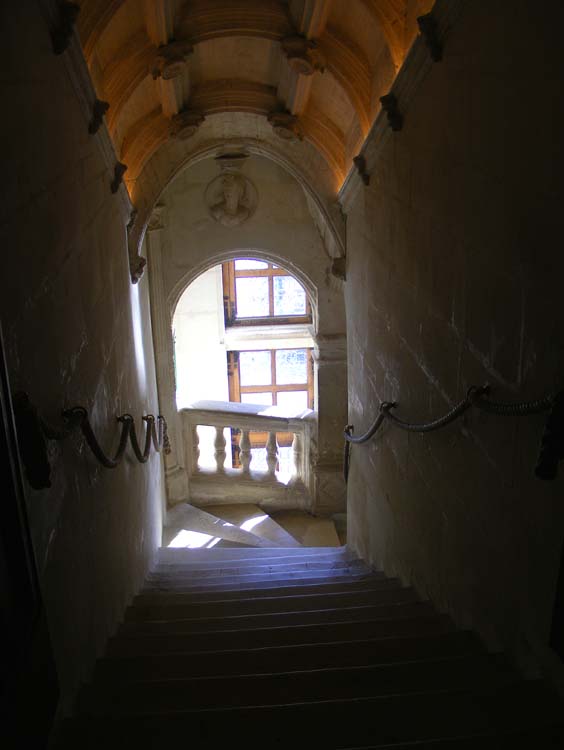
The staircase.

One of Chenonceau's many claims to fame is that it is one of the earliest buildings in France to have a straight ramp on ramp staircase in the middle of the building (as opposed to spiral staircases in corner towers).


Further reading: French Wikipedia entry on the Chateau of Chenonceau (which changes all the time, but contains considerably fuller detail than the English version and I find less prone to errors).

***************************************

Those wondering about yesterday's challenge might find a bit of a clue in today's blog post. Or if that's still too difficult, you can just go here. I am surprised no-one guessed - it's where we seem to spend half our lives in summer. (And no-one has found Simon yet!)

Wednesday, 3 August 2016

Guess Where We've Been...

We were working out and about a couple of months ago and I saw the Google StreetView car. So guess where Claudette was, and for an extra bonus point... where's Simon!?


Answer please on the back of a £5 note.

(The trick here is to work out which car park this is, find Claudette on Streetview, and then find Simon. He was wearing his hat.)

Tuesday, 2 August 2016

Gargoyles on Blois Cathedral


Approaching Blois Cathedral.

Blois Cathedral has recently undergone a major restoration of the exterior. Now it has been unveiled again I thought it would be nice to show some shots of the best bits. The cathedral is essentially a 17th century building.

A chimpanzee like gargoyle on the cathedral.

Gargoyles leering over the north-western corner.

These gargoyles appear to be flying felines.

To see my post about the interior of this cathedral, click here.

Monday, 1 August 2016

Wildlife Watching in August in the Touraine Loire Valley


Look out for the rare Autumn Squill Prospero autumnale hiding in the grass. This one was photographed on the side of a rural track in Vienne, near Vicq sur Gartempe. They are related to Bluebells and Star of Bethlehem.

There are lots of big impressive flies buzzing around in August. This one is the Giant Tachinid Fly Tachina grossa, nectaring on Hemp-agrimony Eupatorium cannabinum growing in a ditch, but you could see horse flies with their dazzling stripey eyes, or hover flies mimicking hornets or even robber flies, the fiercesome hunters that rival dragonflies in their near perfect kill rate.

Sunday, 31 July 2016

Mum Makes a Big Move


Mum in her ground floor room with garden access.

For about the last twelve months our family has been seriously discussing at what point my parents should give up the family home and move into the local Aged Care Facility. Even before that it was on the agenda and the last time I was in Australia I visited the complex with my sister and her husband and we met with the general manager, the director of nursing and several other people there. I was already somewhat familiar with the place as I had visited people there on occasion when I still lived in Australia.

Being visited by the dog, Bunjee.

My mother has dementia. In general I can have a fairly normal conversation with her on the phone, but her attention span is not that great and she can no longer follow a rapid or complicated discussion. She's fine on the weather and what she's been doing recently (although she sometimes mixes days and events up) but she doesn't follow current affairs any more. She gets muddled and stressed if her routine is upset too much. Her eyesight is also failing, and the combination of that and her dementia means that she gets disorientated very easily outside the home, even in the supermarket and the main shopping street in the small town where she lives and has been going to for decades. She has glaucoma and wet macular degeneration, so she needs big print and good light. Nevertheless, she is a devotee of colouring in for grownups (currently very trendy) and loves the new gel pens one can get these days as they make very clear bright colours.

On the wall a photo of my mother in her early twenties, 
as a newly qualified triple certificate nursing sister.

In the last couple of years my mother's condition has meant that my father has had to learn to cook and grocery shop. Mum has got to the stage where she can't follow a recipe any more and forgets ingredients or steps even in dishes she knows well. She was also prone to forgetting she had taken something out of the freezer for dinner, and taking something else out. Nevertheless they were managing to stay in their own home with the help of a care package which included someone who cleaned and did the ironing, and a gardener.

However, my father has Parkinsons and was finding that making sure Mum was alright and dealing with her memory loss and frustration with herself was increasingly hard on him. When Mum is frightened or frustrated she has a tendency to lash out at Dad, which he finds deeply upsetting. In many ways my sister and I were always more worried about him than Mum. 

Anyway, to cut a long story short, a place came up at the local Aged Care Facility and was offered to Mum. After consulting with my sister and me, my parents have decided that it was the best solution for them now. It's a huge change for them, but Dad visits every day (Mum is only a few blocks away from the family home) and their dog is welcome to visit too. They still go out as a couple to social events at least twice a week. Dad has hung lots of pictures from their home in her room and installed some of her own furniture, such as the desk made for her by her father's foreman when she was a teenager. He also has negotiated a new home care package for himself which includes more services, such as someone who brings firewood up to the house and will clean the gutters when necessary.

My mother has known many of the residents and staff at the centre for a long time. She often can't remember their names, but she knows she's friends with them. The centre is well designed and the food is good. The residents are looked after by caring professionals. My father hung a photo of my mother as a young nurse in her room because he thought it was a nice likeness of her, and because he wanted to remind people that my mother was not always a little old lady. In fact, she was a nurse specialising in aged care and home nursing, just like the people who care for her now. I thought it was a particularly nice touch.

Photos courtesy of my father.