Showing posts with label St Savin. Show all posts

Wednesday, 7 February 2024

A Longtime Reader Is No More

Regular and longtime readers of the blog will no doubt be familiar with comments from someone calling themselves 'chm'. This is our old friend Charles Henry Michel, resident in the US since the seventies, but French born and raised. I learnt yesterday that he died on Friday. He was 99 years old, and had been bedridden, living in an aged care home (and complaining about the food) for several years.


A gathering of 10 different nationalities of bloggers at our place in June 2012. Charles Henry is fourth from the left, standing in the back row, next to Simon and behind me.

International party in France. Photo by loire Valley Time Travel.

He had been reading the blog, and adding his thoughts, insights, anecdotes and opinions on a frequent basis since 2007, so almost from the start. He found us through his friend Ken's blog Living the Life in Saint-Aignan. Saint-Aignan sur Cher is not that far from us, and it was Ken who introduced us in person when Charles Henry came to visit.

He was a tall, charming, elegant and handsome man, even in his 80s when we first knew him, always dressed in white, with a good head of white hair and a beard. He had grown up in a family of artists and doctors from what I understood from his stories, and every year until his health prevented it he would spend the summer in France.


Charles Henry, centre, with Ken on the left and me with my back to the camera, in Saint Savin in June 2009.

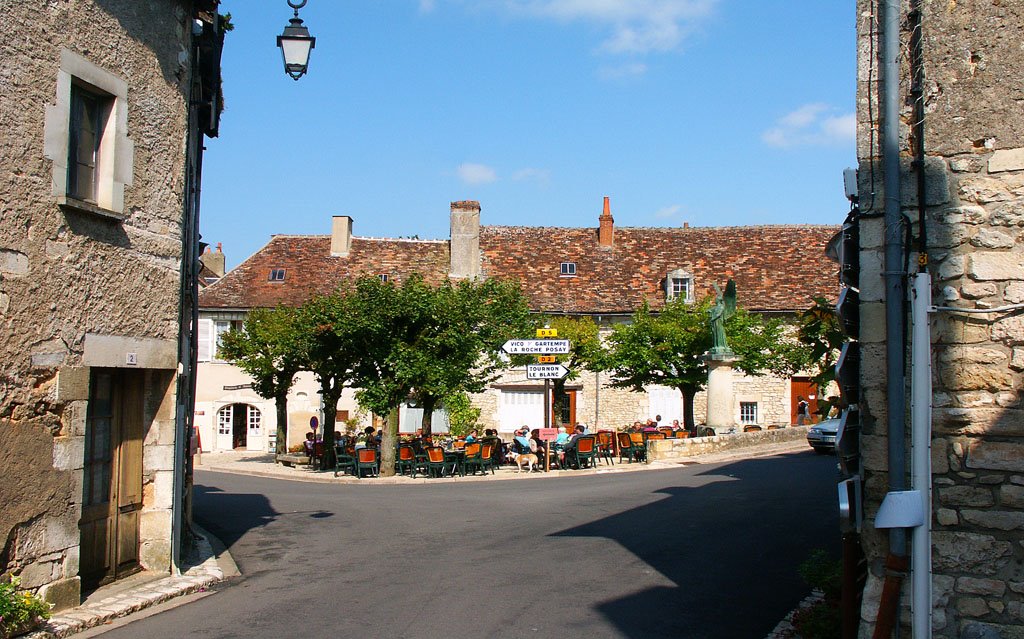
Cafe in Saint Savin, Vienne, France. Photo by loire Valley Time Travel.

I knew I could count on him if I had a question about mid-20th century French life, or the proper way to prepare some delicacy, or for a steer towards extra information about some historical object or place. There wasn't much about French culture he didn't know about or wasn't interested in, and he was always willing to share his knowledge and experience.

Curious and generous minds like his are always a loss, and the blog and our lives are richer for having him involved, and will be poorer having lost him.

Saturday, 1 July 2017

Getting the Best View


Despite the fact that these people on the stepladder completely ruined my view of the 2016 Tour de France riders as they whizzed through Saint Savin, I was amused by their ingenuity and self-confidence. 

The Tour de France starts today and if it is passing somewhere near you we really recommend you get out there and watch it. It's a great day out even if you are at risk of being stampeded by nine year olds competing for trinkets flung from the caravane, or have your well chosen vantage point on a retaining wall outclassed by three people who set up a stepladder just ten minutes before the riders arrive.


Saturday, 10 September 2016

The Painted Church of Antigny


The church at Antigny in the Gartempe valley in the Vienne, to our south-west, is so amazing, with so many details worth looking at, that I fear I will not do it justice in a brief blog post. It is one of a string of painted churches along this section of the Gartempe, the most famous of which is Saint Savin. Don't get me wrong, Antigny is no Sistine Chapel (although it does share some characteristics with Leonardo's Last Supper). The thing about the church at Antigny is that many of the most extraordinary paintings are at eye level or just above, not up so high you really need binoculars to appreciate the detail. The paintings are in a limited palette of colours and vernacular in style. They are not frescoes (ie painted on damp plaster) but wall paintings (ie painted on dry plaster). Perhaps the most significant thing about them is that although I think they have been wholly or partly covered in render at some point, they have not been damaged by being hacked at with a pick to create a key for the later render, unlike many rediscovered wall paintings. The restoration in 2005 revealed at least six layers of wall paintings and successive renders.

The lanterne des morts, opposite the church in the former cemetery. 
Lanternes like this are somewhat of a peculiarity of the Poitou area.

The visible paintings date from two different periods, with late 12th century works on the north wall of the nave and the rest from the 14th century. But the paintings are not the only things worth looking at in this church. Yes, there's more! The architecture of the church itself is a bit unusual, with a large porch to the southern side, called a caquetoire ('cacklehouse'), also known in the Poitevin dialect as a balé, and by the front door a slab of stone resting on four short carved pillars which was for resting a coffin or body on before it went into the church for a funeral, called an édicule. The coffin rest has two grooves at one end and a circular depression at the other, probably for draining away fluid seeping from shrouded bodies on the slab, in the days before coffins were commonplace. The church is solid looking, with a square tower ornamented with fleurons.
 The church at Antigny, with its rather squat square tower. The porch is on the right.

The church was built in the 11th century on the site of a Merovingian cemetery, and was subsequently remodelled in the 15th and 18th centuries.  The nave is covered by a timber vault in oak. The wall paintings have been recently restored and many new details have been revealed. The chapel, dedicated to Saint Catherine, was built in 1421 by Renaud de Mauléon, Lord of Bois-Morand. The interior decor was commissioned by Jean de Moussy (1433 - 1510) also Lord of Bois-Morand (son-in-law?). In the 18th century the porch was constructed to extend the chapel.

 Detail of wall paintings in the side chapel: above, the story of the three living and the three dead; below, Christ carrying the cross.

The chapel attached to the church at Antigny, the oratory at the chateau of Bois-Morand (privately owned and not open to the public) and the Chapel of Saint Catherine at Jouhet were all decorated at the end of the 15th century on the orders of Jean de Moussy. They depict the life of Jesus, the Last Judgement, the story of the three living and the three dead and Christ in Majesty.

An archer, a detail of a partly destroyed depiction of the martyrdom of Saint Sebastian.

The Day of Judgement, with the dead rising from their coffins below, being assessed for entry into Heaven on the left by Abraham, assisted by the Archangel Michael weighing souls. There is some intriguing but not uncommon imagery in the centre. Mary is expressing milk and Christ bare chested, with a sword pointing at his head. John the Baptist is kneeling on the right.

Some scenes from the life of Christ: top left, the shepherds receive the news of Christ's birth; top centre, the three magi visit the infant Christ; top right, the massacre of the innocents; bottom left, Judas betrays Christ to the soldiers with a kiss; bottom centre left, the seated figure is Christ and I think the figure behind him is Mary, but I'm not sure what story is being illustrated in this panel; bottom centre right, Christ on the cross; bottom right, Christ being held while Pontius Pilate washes his hands.

Christ in the tomb. I notice he has no genitalia, but the sword wound in his side is clearly shown.

The last supper. The lamb on the central platter caused us some amusement.


**************************************

For details of our private guided tours of chateaux, wineries, markets and more please visit the Loire Valley Time Travel website. We would be delighted to design a tour for you.

Saturday, 13 August 2016

Bridge Across the Gartempe


The (probably*) 13th century bridge across the Gartempe which allows you to cross between the communities of Saint Savin and Saint Germain. It is 100 metres long, slightly humpbacked, with a central width of 3 metres. Each of the piles forms a refuge alongside the narrow track. There are 6 arches, one of which is designed for boats to go under. In the Middle Ages this was a major route, between Poitiers and Bourges. You can still drive over it but nowadays the main route into town is across the 19th century bridge, from where I took this photo.

*It might be 11th or 12th century, but it resembles 13th century bridges in Limoges, so 13th is the generally accepted opinion.

Friday, 12 August 2016

Painted Sheep


Ewes painted in the Tour de France jersey colours.

Consumption of lamb is going down and the price of lamb meat is going down, dropping nearly a euro per kilo this year according to the national ovine federation. Lamb producers are worried, so some of them took the opportunity to raise the profile of the sector at the Tour de France this year in Saint Savin. We visited a pen full of somewhat disgruntled ewes who had been painted in the colours of the cyclists jerseys (and rather curiously, crutched in a heart-shaped pattern...)

The sheep pen in the landscape at Saint Savin.

Visiting the pen also gained us a couple of reusable shopping bags proclaiming us to be supporters of geographically protected Poitou-Charentes lamb. Sadly there was no barbecued lamb on offer.

'At our place, our ewes make the countryside that you love.'

Pasture, or prairie, as it is generally referred to in lowland France, is one of the fastest disappearing habitats in the country. Sheep farmers point out that in the mountains sheep grazing can help prevent avalanches and wild fires.  In the lowlands of the south-west, they point out that pasture helps control and mitigate flooding. Sheep pasture uses few fertilizers and pesticides, and the system of fields and hedges traditionally used to raise lamb here prevents erosion and filters out excess nitrates, phosphates and herbicides. The sheep farmers are of course too polite to say 'as opposed to arable farming methods', but that is what they mean. I of course am too polite to mention sheep dip.

(We realise we haven't yet blogged about out day at the Tour de France this year. It may still happen...)

Saturday, 9 July 2016

The Works at Saint Savin

A couple of days ago CHM asked about the chateau at St Savin.

It is good to announce that restoration work is happening - maybe not as fast as some might like - but it's definitely happening. The building still has scaffolding, but most of the windows appear to have been either replaced or fixed (or even added!), and parts of the building have a fresh coat of render. Searching back through our archives I found a photo from September 2006 for comparison:


We were there mainly for the Tour de France, but we did visit the church. With any luck there will be Tour de France photos at some stage....

(photos by Nina, because we forgot)

Wednesday, 15 May 2013

Wonderful Wall Paintings!

 The final scene in the sequence of Christ being tempted by the Devil. I love the slightly sheepish aspect of the Devil and the somewhat peeved expression on Christ's face -- both are thinking 'oh no, not again...'
One morning in late March we were sitting around in the lobby of the Hotel Diderot in Chinon, waiting for our clients to finish breakfast. I noticed that there were some leaflets on the side table for a church with wall paintings that I had never heard of, so I picked one up and was immediately intrigued by what I read. By good luck the church was exactly on the route we planned to take with the clients, so we asked them if they would be interested in stopping there. We told them we had never seen this church, but it looked fascinating. They readily agreed, and so we made the wonderful discovery together.

A wider view of the various temptation episodes.
The church of Saint Martin in Lignières en Touraine is situated between Azay le Rideau and Langeais. It dates from the 12th century and inside is like a mini Saint Savin. The wall paintings are contemporary with the oldest parts of the church, but have been retouched several times, in the 13th and 14th centuries. They were professionally restored and conserved in 2008-09. The church is open every day and entry is free. If you want to illuminate the painted ceiling you put a €2 coin in a slot. That gives you about 10 minutes and we put in €4 in total.

Abel is blessed by a disembodied arm.
The paintings are utterly captivating. You don't need to be overly familiar with your Bible stories to identify what the paintings are illustrating, and anyway, there is a brief, but excellent guide (in French and English) available for visitors to read and fill in any details they are unsure of.

Panels from the parable of the rich man and Lazarus. The rich man has died (centre left) and the monsterous dog like Devil lies in wait to take him to Hell.
Decorating the arch as you enter the apse is a series of boxes representing the months of the year. Lengthwise down the barrel vaulted ceiling are a series of 'cartoon' style stories -- Christ being tempted by the Devil, the story of Adam and Eve and the expulsion from the Garden of Eden, and the parable of the rich man (Dives) and the poor man (Lazarus). Over the altar is Christ in Majesty. On one of the window surrounds is Cain and Abel. The stained glass is 19th century, and the theme of the window now bears no relationship to the theme of the painting surrounding it, resulting in a disembodied hand blessing Abel. Antoinette explains in her post on Chez Charnizay that this was a convention to avoid having to portray God.

The angels gently and lovingly receive the soul of Lazarus, the poor man.
Naturally I immediately alerted Antoinette to the existence of this church, in the hope that she and Niall would go to visit soon and write one of their erudite posts about it. I am pleased to see that they have obliged.

Looking straight up, showing the story of Adam and Eve above and the rich man and Lazurus below.
****************************************************
Next week is the annual national Fête de la Nature. This year's theme is 'small creatures'. Please support your local nature enthusiasts by attending an event near you.

Tuesday, 20 July 2010

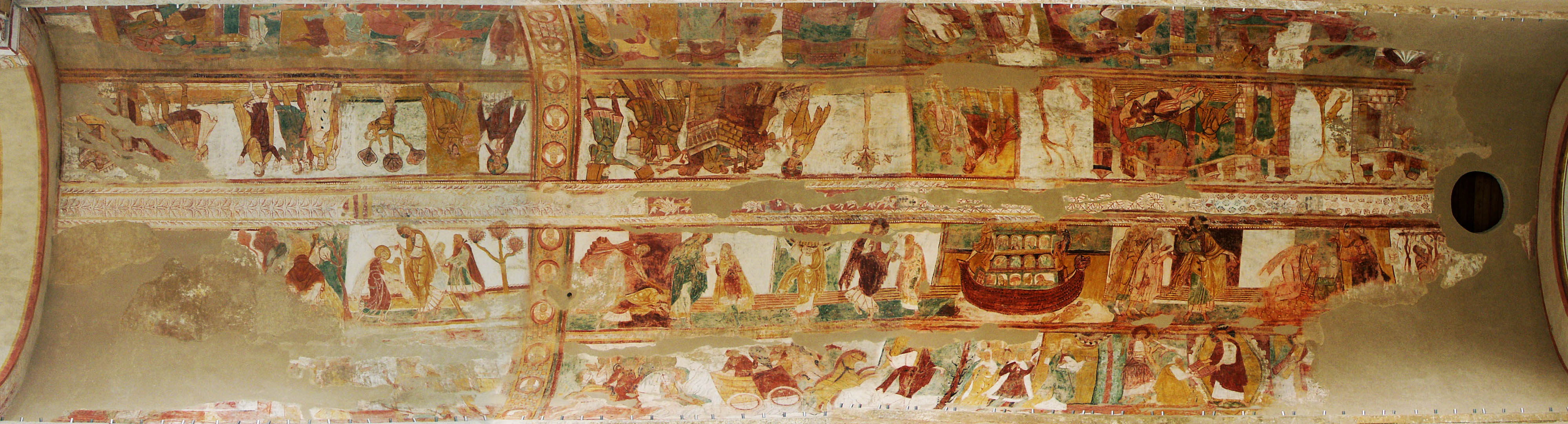
The Ceiling of St Savin

The first time we visited St Savin the ceiling was scaffolded and the painting was being restored. On subsequent visits the scaffolding was up, but in different places, until last year, where the painting was revealed in all its glory.

Last Saturday we visited and I took a couple of photos which I have stitched together, so here it is, fully resstored. Warning though - it's a biggie! (click on the picture below, then click on the picture when it opens in a new window, and it will appear bigger than fullscreen)


Simon

Sunday, 14 June 2009

An Afternoon in St Savin

We have been to St Savin a number of times, but not since the restoration work on the 12th century paintings has been completed. So when Ken and CHM visited us on their way to there we took the opportunity to tag along (as it were - I drove).

The restored church is a lot more open and airy than I expected, the previous times we visited it was filled with scaffolding and temporary walls and you got no real idea of the scale of the thing. We were impressed by the "candy cane" columns, which have been painted much in the manner they would originally have been painted, but in muted, faded colours rather than the poke your eye out variety favoured by previous generations of restorers.

This is not to say the church is perfect - there was a quite appalling "installation" artwork with sub John Williams atmospheric movie score soundtrack. This has not gone down well with visitors, as evidenced by all but one of the comments in the visitors book.
I rather like this photo of the lime trees
outside, taken through a clear glass window
CHM knew St Savin well and while we sat in the garden behind the church told us something of the family who lived in the "Chateau" which is attached. He spent some time there as a child, including when he was evacuated from Paris during the 1939-45 unpleasantness. In a comment on a previous blog entry CHM said "This part of the abbey was known as the "château" and was the property of M. Édoux, of "Ets. Édoux-Samain," a Parisian lift or elevator builder of the late 19th and 20th century who was a friend of my father's. M. Édoux built this faux medieval tower to encase a hydraulic elevator, what else!"

The church gardens. The building on the left
was for many years the gendarmerie
After sitting in the garden and watching the swifts whirling and swooping we adjourned for refreshments (lunch, having been taken at least 3 hours earlier, had worn off).
Time for a beer and a history lesson

The view from the cafe.
We had a really pleasant, relaxing, but very informative afternoon with good company in pretty surroundings. What more could you ask for on a perfect late spring day?

Simon

PS. The morning was spent making cherry jam. We have to do our chores... This morning Susan will be making sauce from the last of the cherries we have picked. Unfortunately, it's raining, so we can't go and pick more cherries today.

Tuesday, 11 December 2007

Another view of St Savin

Why an abbey needs a crenellated tower quite a butch as this is beyond my comprehension, but maybe it's a later addition - or not even really part of the abbey.


When you get behind the abbey things are not nearly so neat and ordered. This part looks like it needs some loving care and attention.


Simon

Wednesday, 14 November 2007

A column in St Savin

A carved capital fro the church of St Savin. It's more famous for the paintings, but it's always worth looking at the carving in old churches.


I have no idea what it is, or what it means. I will have to buy a book on iconography - once I find one that I understand.

Simon

Wednesday, 10 October 2007

St Savin

The Abbey church at Saint-Savin-sur-Gartempe is world renowned for the quality and quantity of it's frescoes. The building was World Heritage Listed in 1983 because of the paintings. Because of this the church has a huge car park (well - it's really the market square) and a visitors centre.

Something I suspect that isn't seen so often is this view of the oldest part of the church, taken from the river. The original building is the cruciform piece under the tower in the centre of the picture, which was started in the 11th Century. The little chapels you can see were added slightly later.

The huge tower that is usually the feature shown on postcards wasn't built until the 14th century, after the addition (in a couple of instalments) of the long nave.

A full description of the frescoes (in French) are here

Simon

Wednesday, 11 October 2006

Sunday Sunday...................

Sunday 17 September

Part 3 of our trip with Pat and Geoff - part 2 here

Sunday morning, and the church bells called the faithful to breakfast. Things were looking slightly brighter weather wise, so during breakfast we made plans as to what we were going to do. Sunday had been set aside as a day to do some sightseeing, and we wanted to visit a chateau or two.
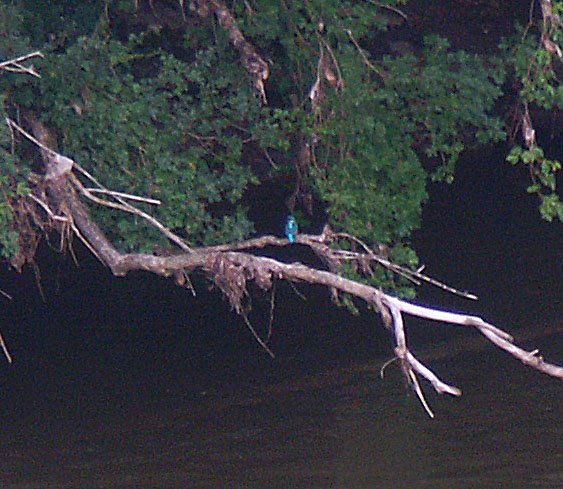
We hadn't reached a decision by the time we got to the car, but on the way out of Grand Pressigny we decided to go to la Guerche (mainly because we saw a sign pointing there). After a short drive through the countryside (and passing a hunter complete with shotgun and horn) we parked in la Guerche and had a walk through town. While we were standing on the bridge Susan pointed and said “look!” and we saw the unmistakable flash of blue that can only be a kingfisher. It settled on a branch on the other side of the river, far enough away that we couldn't take a proper photo, but near enough so that the spot of blue you can see in the photo is obviously a kingfisher.

When we returned to the car we noticed that the Chateau gates were open, and it dawned upon us it was the Europe wide “Open Weekend”. After a pleasant wander through the grounds of the chateau we reached the stable block to find they were giving guided tours of the chateau in French and broken English – the perfect combination for improving our language skills. More about the chateau in another post.
The rooftops of la Guerche
After leaving la Guerche we took a drive through the countryside alongside the Gartempe,driving through la Roche Posay and Vicq to Angles sur l'Anglin. There we had lunch sitting in the village square, before wandering off to the castle above the river. I think Angles sur l'Anglin may be a place that we visit many times.

Town Square, Angles sur l'Anglin
As we were near we thought we would visit the Church of Saint-Savin sur Gartempe to see it's much vaunted wall and ceiling paintings. They are truly spectacular, even though at the moment you can only see about 30% of them because of building works, The murals were painted in the 11th and 12th century and almost totally cover the walls and ceilings. Another place we will be visiting again.

The ceiling of St Savin
We arrived at Poitiers airport in plenty of time, checked in, got through passport control, and sat in the single lounge, with everyone vying for position so that when the gates open they could sprint for the plane.
When the gates opened, Geoff and I took of like the rabbit at a greyhound race. We were going to get two pairs of seats over the wings and stretch out. When I reached my chosen seat I realised Geoff was no longer with me. He was standing discussing something with the hostess at the rear of the plane. I was torn – should leave my hard gained seats to go and help, or should I wait? Luckily Susan wasn't far behind, so she was left to guard the two seats while I went to the back of the plane (against the tide of people all fighting for places) to see what was up.

Geoff didn't have his boarding pass, but rather he had the pass from his flight the previous Friday. Even though you need a pass to get through passport control that wasn't good enough for Ryanair, and Geoff (who had now been joined by Pat) was being made to wait. This was causing a blockage, which was making people being delayed irate. Add to this the fact that even though the flight was fully booked people were not being allowed to use the last 10 rows of seats, and the temperature was rising.

Pat and Geoff were really worried by this stage, Geoff being convinced he was going to be left behind. People from Ryanair were rushing up and down the steps, having to force their way past the now stalled line of passengers waiting to board, checking their clipboards and then disappearing. I looked down...and there on the floor were Pat and Geoff's boarding passes...............

After that the simple matter of spending ten minutes looking for the car in the Stansted carpark was nothing!

Simon