Saturday, 19 October 2013

Radio Active

It was slightly disconcerting to find ourselves parked behind a vehicle proclaiming itself to be radioactive. I assume this is a geologist working on the local coal seam gas mining operation. Macquarie Geotech has strong links to the coal industry. I guess he is carrying samples that may contain radioactive elements such as radium. Or maybe he's just fed up with having his equipment nicked...

This is on the Castlereagh Highway between St George and Hebel in Queensland. The roadworks were part of a massive programme, still in ongoing in December 2012, to repair the road after major flooding caused widespread damage in January 2010.
****************************************************************
Ile de Ré Reflections: Oysters for lunch -- from La Flotte, bought at the market in Ars-en-Ré.
*********************************************************
A la cuisine hier: Apple crumble.

Friday, 18 October 2013

La Tour Saint Antoine, Loches

La Tour Saint-Antoine in Loches.
Former church belltower whose bells also served to sound the town alarm. It is 52 m high. Constructed between 1529 and 1575 it is the only Renaissance free standing belfry in the Touraine. Access to the exterior is free. You can visit the interior on the Journées de Patrimoine.

I love the oily sheen of the slate roofs in this picture.
***************************************************************
Orchard News: A goodly haul of walnuts collected and the last of the grapes picked. The first of the Ophrys sp orchid leaf rosettes has reappeared, preparing for next year after their brief autumn dormancy.
*****************************************************
A la cuisine hier: Dolmades, using up the last of the vine leaves I pickled in brine in the early summer.
***************************************************
How Field Naturalists Die: Alex Wild has posted an informative graph on his blog Myrmecos. The top two reasons are vehicular and trauma, but you'll be pleased to hear that no one has been poisoned in over 20 years. Murder and execution is the third highest cause of death though – higher than animal attack, exposure, heart attack and infectious disease.
*************************************************
Bee News: My friend Jill sent me a link to a well written, well informed article (for once!) in the Guardian about the plants bees visit most in the garden. It won't come as any news to gardeners that lavender tops the list, but it is nice to have it quantified and verified scientifically. Plant more lavender and oregano if you want your bee population to thrive! Wallflowers are the best for butterflies and pelagoniums are good for nothing.

Thursday, 17 October 2013

A View of Loches

A view of Loches taken in mid-August.
I can tell you it didn't look like that yesterday when I went shopping in the market. It was overcast and drizzly.

Wednesday, 16 October 2013

Map Butterfly

 A Map butterfly Araschnia levana, demonstrating the reason for its vernacular name. The underside resemblance to a street map is so striking that is also called la Carte géographique in French. This one was photographed in early September, along one of the rural tracks behind Preuilly. It is quite a small butterfly, and this year was abundant in the late summer. To see what the upperside looks like go to this earlier post.
****************************************************************
A la cuisine hier: Simon made a white milk loaf which turned out wonderfully well. I made a batch of apple pectin, to be frozen until next year's jam making commences.

Tuesday, 15 October 2013

Fougères-sur-Bièvre

 The mystery chateau revealed...
 Recognise it now?
This wonderful late medieval chateau sits in the midst of the village of Fougères-sur-Bievre and gets very few visitors, probably because it makes a great drive-by so people content themselves with that. Also it is not one of the big name chateaux with their luxurious interiors and splendid gardens, and people with limited time will concentrate on those.
 Its survival in such an intact condition is partly due to the fact that it is a defensive chateau built at a time when the family no longer needed to defend their home, due to the outbreak of peace and prosperity ushered in by the end of the Hundred Years War. Consequently it has never been damaged by seige engines or pounded by cannon and has remained a beautiful example of  late 15th century architecture, never subsequently modernised (except for the roof and some minor details) because in the 19th century it was an industrial building and by the 20th century had become state property, listed as an historic monument in 1930.
For more details on its origins see Niall and Antoinette's post on Chez Charnizay, 'Twilight of the Middle Ages'.
*****************************************************************
Fungi Exhibition: The Association de Botanique et de Mycologie de Sainte-Maure-de-Touraine will be holding an exhibition of fungi in the Halles de Sainte-Maure on the afternoon of Saturday 19 October and all day Sunday 20 October.

There is also a lecture on the 'Restoration and Historical and Botanical Interest of the Heritage Herbarium of Ernest-Henry Tourlet (1843-1907)' on Saturday 19 October at 2.45 pm. It will be held at the Salle de Rohan, rue du 11 Novembre in Sainte-Maure. The speaker is Emeritus Professor Marc Rideau from the University of Tours. In French.
***********************************************************
A la cuisine hier: 5 small jars of quince jelly. It is darker in colour and more brownish than the delicate pink of the apple jelly.

Carrot Soup. I used some big homegrown carrots that we were given by friends, our own homegrown leeks, some milk that the laitière warned me was leftover from Saturday. Instead of the usual coriander seeds I used yellow mustard seeds.

One box of the hazel nuts I gathered has been dehusked, and boy, was it tedious. Taking them out of their leafy calyxes is only the first step, and we've only done a third of the total quantity. They still have to be shelled and their inner skin removed. Never complain about how expensive nuts are in the shops -- it's because they are so time consuming to prepare. The big advantage of doing your own is freshness, and you know exactly how long they have been sitting on the shelf. Once they are shelled I will freeze them.
******************************************************
Firewood News: Still no sign of our firewood delivery, but we have cleaned out the wood storage area in the garage. We've got maybe two days wood left.
**********************************************************
Weather News: Yesterday afternoon we stood at our back door and watched the rain approaching us across the valley. The sight was impressive enough, but what really struck us was the sound. It was quite strange to be able to watch and hear the downpour about 100 m away for a minute or two before it hit us.
********************************************************
Quiz Results: Martine takes the points for yesterday's quiz. She guessed correctly that it was the Chateau of Fougères-sur-Bièvre, near Blois.

Monday, 14 October 2013

Mystery Chateau

 4 points to anyone who can name this chateau from these photos.
I have given you a huge clue, if you know where to look for it.
*******************************************************************
Weather News: The temperature suddenly plunged to 0°C overnight Saturday, resulting in a frost Sunday morning. We had to scrape the ice of the car windscreen in the morning and roofs were covered in frost. The television news the night before showed footage of it snowing in the Auvergne, up in the mountains.

Sunday, 13 October 2013

Heat Haze

Heat haze on the southwestern wheat plains of Queensland just after harvest in early December.
********************************************************
Ile de Ré Reflections: There were lots of these tear drop shaped bladder things in the rock pools above the oyster farms at Pointe de Grouin. I don't know what they are (the remains of jellyfish maybe?). I didn't touch one, so I don't know what they consisted of really.

Saturday, 12 October 2013

The Bali Bombing Memorial, Coogee

This sculpture is the memorial erected on Dolphin Point, Coogee, Sydney, to those who lost their lives in the Bali nightclub bombing of 2002. 88 of the 202 dead were Australian, 20 of them lived in Coogee and neighbouring suburbs, and six of those were members of the Coogee Dolphins, the local rugby league club.  
*****************************************************
Ile de Ré Reflections: These tiny snails had congregated on all the carpark posts.
***************************************************************
Fungi Foray: The Association de Botanique et de Mycologie de Sainte-Maure-de-Touraine will be holding a fungi foray in the Forest of Chinon on Sunday 13 October. Meet at 2.30 pm in the Saint-Benoit-la-Foret church carpark. The mushrooms gathered will be identified by experts at the end of the outing. The emphasis is on learning to identify all types of fungi, but there is nothing to stop you gathering edible species for eating at home later.
**************************************************************
Car News: We replaced the back tyres on the Scenic yesterday, following a rather exciting episode which resulted in me ending up backwards and in the middle of the roundabout in front of IKEA in Tours some days ago.

Friday, 11 October 2013

Vines with Esca

On a recent visit to a parcel of vines in Rochecorbon (Vouvray appellation) we had a discussion about the fungal disease esca. It's causing real headaches for the wine industry and we were able to take photos of affected vines and learn about how it is managed.

The characteristic pattern that develops on the leaves of affected vines.
I was impressed at how open the winemakers are about whether they have the disease and how much of it they have. It's the sort of thing that many industries would be very secretive about, just in case it damaged consumer perceptions. However, diseased vines sometimes limp along producing quite useable grapes for years before succumbing, so I guess the winemakers feel there is nothing to hide, and much to be gained by educating the public about what a serious threat it is. Plus, virtually every vineyard is affected.

In the parcels of Chenin Blanc we looked at I would say there is currently one or two vines in every row with the disease. I was surprised to learn that they are just left there until 90 - 95% of vines are affected. They can't be treated as there is no known cure (apart from sodium arsenite which is banned because it is so toxic to everything, not just fungal diseases...). Once the whole parcel is diseased the vines are grubbed out, burned, and fresh certified disease free stock planted. The vines here are being subjected to an outlandish sounding alternative treatment involving sound patterns and the affected plants are counted on an annual basis to see at what rate the disease is spreading.

A diseased vine.
It is not cost effective to replace vines one by one as they become infected, and I suspect it becomes difficult to manage a parcel with grapes of many different ages. It is much easier to harvest grapes from a parcel that is all the same age. I was particularly surprised that infected vines are not grubbed out immediately in an attempt to prevent the spread of the disease though. I was also surprised that the soil is not usually left fallow for a significant period after the diseased vines are pulled out. In most cases the new vines are planted within weeks of the old ones being removed. Possibly these measures are not seen as necessary because no one knows how the disease transfers from one plant to another, so it may be a pointless use of time.

For my previous post about esca, which goes into detail about the effect the disease has on the vines, see here.

Thursday, 10 October 2013

Chestnuts

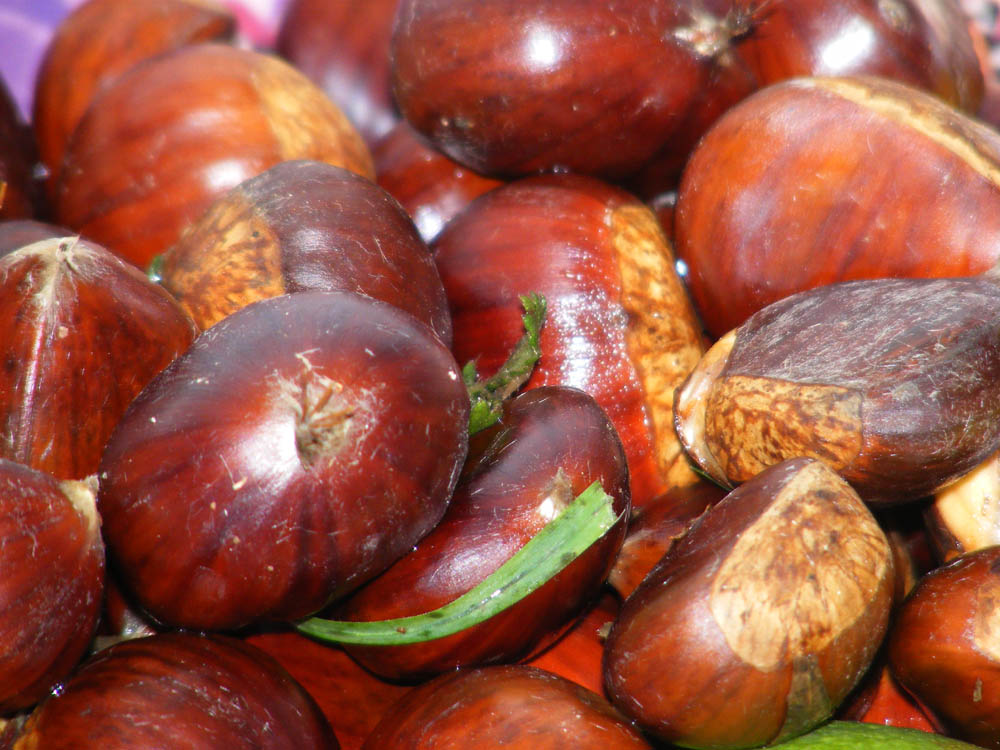
Commercial crops of chestnuts are harvested in October by laying sheets out under the trees to collect the fallen fruits. The farmers get about €2.50/kg.  Prices for canned chestnuts range from €6.95 to €10.96 a kilo. A 240g can of the most popular brand costs €2.63 at SuperU. Fresh chestnuts (marrons or chataignes in French) are €3 to €3.50/kg in Preuilly market.

 Marrons from our orchard neighbour.

Every year you can sign up for forest randonées to go chestnut gathering in late October. If you do gather your own, make sure you process them within a few days or you will find a pile of frass and your chestnuts full of exit holes made by insect larvae that have been merrily feeding inside.
A group of ripe chestnuts. They fall from the tree still in their prickly casing.

Chestnuts are very time consuming and tedious to prepare, with tough rich glossy brown outer skins that come off to reveal not a smooth cream coloured nut, but a wrinkled and creviced object covered in brown wallpaper. It is this inner skin that takes the time and it is very difficult to winkle it out of all the nooks and crannies. You need to accept that a lot of your chestnuts will break in the process.
Chestnuts scattered on the ground under the tree.

The method I favour is to slit the outer skin once or twice, then microwave them in batches of 10 - 20 for 2 minutes*. Thoroughly peel them while they are still warm (as hot as your finger tips can stand). They can be eaten at this stage (sweet and floury) or you can candy them by following the instructions here. Once candied they are very sweet, but retain that distinctive grainy floury mouthfeel.
Unripe chestnuts on the tree.

If you can't be bothered with all that, buy ready peeled frozen ones.
 A chestnut tree in the forest (in this case a private hunting estate near Yzeures).

*This top tip comes from a friend who overheard it in the marketplace in Preuilly.

Wednesday, 9 October 2013

Identifying Chenin Blanc Grape Vines

Charles Morand from Chateau Gaudrelle gave me a quick lesson on how to identify Chenin Blanc grape vines recently, so here are the main things to look for:

The vines are trained and pruned into a goblet shape.
The top of the petiole (leaf stem), where it joins the leaf, is pink. Often the whole petiole and the leaf veins are pink. The young leaves have shallow lobes although very mature leaves can be deeply divided into lobes with lyre shaped cut aways.
 The bunches of grapes are long narrow cone shapes with small tightly packed berries. They are late maturing.
Of course, in Vouvray, where these photos were taken, identifying the grapes is easy because they are all Chenin Blanc, the only variety allowed by the appellation rules.

Many thanks to Charles for the lesson, and apologies to him if I have got anything wrong or misunderstood.

For my previous post on identifying grape vines see here.
**********************************************************
L'Art et Lard: The annual art and food festival held in le Petit Pressigny is on Sunday 13 October. For an idea of what you might see, here is our post about it from 2009.

Tuesday, 8 October 2013

Chateau de Montgouverne

The Chateau de Montgouverne sits on the hill of Rochecorbon, tucked in amongst the grape vines all around it. According to the thoroughly useful blog, Tourainissime, the chateau building is 18th century. You can just see its towers peeking through the trees on the right. It is privately owned.
The building in the photo above is a 17th century enclosed dwelling on the chateau estate. Everyone who sees it, including the vineyard workers, would like to be the owner who lives there. Its setting and appearance is just so perfect.
*******************************************************
Orchard News: The Lizard Orchids are sending up big robust leaf rosettes ready for next year. I know this because I accidently mowed over several yesterday afternoon. No real harm done, as I always have the mower on the highest possible setting, so they have just lost the tips of their leaves.

Friday's deluge obviously caused the ruisseau that runs along the front of the orchard to become a raging torrent. All the vegetation in the ditch is flattened and the culvert clearly didn't cope. There is debris all over the place and the water must have cut the road for a time.

Monday, 7 October 2013

Céleri Rémoulade

The general appearance of celeriac doesn't inspire much confidence in it being tasty, and even less so if you consider eating it raw. Nevertheless, the most popular dish using celeriac (céleri-rave in French) does indeed use raw, grated celeriac.

Don't be fooled into thinking that this is diet food though. This is a dish to which cream is added in order to make it lighter (!!) and easier to digest (!!!) It is tremendously popular in France, but I don't think many people bother to make it themselves. Most people buy it from their trusted local charcutière traiteur (delicatessen). If you do make it at home, it's not just a matter of grating some celeriac and coating it with mayonnaise. There's a trick to getting the deli style céleri rémoulade, as Ken explains in his blog. David Lebovitz has a recipe and discusses the tricks to making it on his blog too.

 I make it like this:

Make a mayonnaise by putting a whole egg and an egg yolk in a jug. Add a dollop of prepared mustard and some salt. Using a hand held blender, whiz the egg and mustard together, then start blending in a thin drizzle of olive oil until you have about two thirds of a cup of mayo. Then switch oils and add some sunflower oil in the same manner, until you have about a cup and a half of mayo. Next tip in a pot of thick cream (I use the 40% fat raw cultured cream I buy from my laitière) and whiz that around until it is all blended in.

Now peel the celeriac. I find the easiest approach is to slice off the outer layer with a chefs' knife, like I would for pumpkin. Cut the peeled root into big chunks and grate it to medium shreds. If you are grating by hand, as I do, since I don't own a food processor, it is a good idea to do it in stages and coat the celeriac with the mayonnaise as you finish grating each chunk. That way it doesn't discolour. Once you've grated all the celeriac, add more mayonnaise if you think it needs it. For an average sized celery root, about the size of a small melon, you will need to use about half the mayo you've made (use the rest on warm potato salad...).

Céleri rémoulade (at the back) as part of a mixed plate of salads.
The vegetable may be ugly, but it is aromatic (smelling of celery) and in a salad adds a crisp texture and a distinctly nutty flavour note. And homemade céleri rémoulade is quick, cheap and easy.

Yum

********************************************************
A la cuisine hier: Wine Glazed Baby Pears, poached and coated in a red wine syrup flavoured with a few slices of ginger root, a cinnamon stick, lemon wedges and a vanilla pod, served with homemade custard.

Sunday, 6 October 2013

Canola Windrows

Both Australia and France grow canola (known in France as colza) but the method of harvest is different in the two countries.

In France, the crop is left standing until as ripe as possible, then direct combined -- that is, taken off using a harvester with a rotating header, just like wheat or barley is.

A windrowed canola crop, photographed near Cowra in late November last year.

In Australia, most canola is windrowed -- that is, cut and raked into neat linear piles to dry for a few days. Then a combine havester with a special header is run over the windrows to pick up the seed.

One of the reasons Australia has opted to windrow is the canola crop is ripe at the same time as the barley. Windrowing is done just before the maximum ripeness of the canola, so the farmers can work first on the canola and then on to the barley and finally, back to the canola. Another reason it is windrowed is that the crop is vulnerable to wind damage, which causes ripe seedpods to clash against one another and shatter, loosing their seeds. Cutting the plants down early reduces this risk greatly.

French farmers take the view that time is money and if you only have to pass over the crop once, you are saving money as well as time. They have less area to cover and therefore can manage both harvests simultaneously (or at least in quick enough succession).

The payoff seems to be higher quality but lower yield if you windrow, higher yield but lower quality if you direct combine. Neither country seems to use a defoliant to make the harvest easier as far as I can tell (this seems to be quite common practice in North America).

 Two thirds of the French canola crop goes to make biofuels. Fifty percent of the canola exported from Australia is destined for European biofuel manufacturers. France produces 8 times as much canola as Australia (and less than half the quantity of Canada). The varieties grown in France are not GM as they are not allowed. In Australia, some states allow GM canola crops, others do not.

Part of the reason for the lower quantities grown in Australia is that, although canola is fairly tough, it is really a cool climate plant. It is the major oilseed grown in Australia, but it is impossible to find out exactly how much is grown there, as the figures are always combined with cotton seed. The canola industry in Australia is curiously secretive.

Even in France canola production varies wildly from one year to the next depending on weather conditions, and even in France, even with the current focus on biofuels, only 1.5 million hectares are planted with canola (compare this to the 9 million hectares planted of the much higher yielding wheat). Farmers here will get anything from 3 to 5 tonnes a hectare of canola. Australia manages 1.3 - 4 tonnes per hectare and probably plants about a million hectares annually.
**************************************************************
Ile de Ré Reflections: Working in the salt pans.
*******************************************************************
A la cuisine hier: 750 ml of quince juice is macerating with an equal quantity of sugar in preparation for making jelly. The cooked remains of the quinces have been frozen so I can mill them and make dulce de membrillo at some later date.

Slow roasted vegetables -- wedges of tomato, baby aubergine, round zucchini (courgette ronde), baby butternut pumpkin, beetroot, barbecued peppers (capsicum), coated with a little olive oil, sprinkled with salt, a pinch of sugar and 5 pepper spice mix, sprigs of thyme tucked in before cooking in the oven spread out on a big tray for 3 hours at 150°C.

The liqueur de noix and the vin de noix have been filtered and decanted into their bottles. The green walnuts, vanilla, lemon peel and spices have done their job and the flavour is now in the liquid. To my surprise both are perfectly drinkable now. My last lot of liqueur took 3 years to mature into genuinely good drinking, although it was useable as an ice cream topping and such like long before. It may have the unfortunate appearance of slurry, but this vodka based infusion is far better than the wine and vermouth based mixture called vin de noix. It is complex, aromatic and richly luscious with a slightly thick mouth feel. The vin de noix, which I made for the first time this year, is a beautiful mahogany colour, but it is a bit thin tasting and slightly too sweet. As is the way of these things, I was only able to make 500 ml of the liqueur but I have 1.5 litres of the vin.

Saturday, 5 October 2013

Something in the Distance

Sitting at a roadworks red light out in the middle of nowhere on the Castlereagh Highway last December, we noticed a strange object a way over in the paddock.

It wasn't until we checked the photo taken out of the car window with Simon's telephoto magnification that we could tell what it was. Remarkably, there didn't seem to be any sign that the fire that destroyed the header had caused a grass fire. In the hot dry conditions of the Australian bush, a piece of farm machinery catching fire can lead to widespread disaster if a fire reaches the trees.
****************************************************************
Ile de Ré Reflections: Harvesting oysters.
**************************************************************
Chapelle de Tous-les-Saints News: According to the latest Preuilly council minutes posted on the town noticeboard the Société d'Archaeologique de Preuilly has submitted a request that the commune create a dossier for the chapel with a view to undertaking the necessary repairs. The situation was discussed at the council meeting and it was agreed to spend €10 000. The SAP has been asked to approach organisations who may provide grants. I'm not sure if the council has agreed to spend its own money, or has simply agreed to allow the work to a certain value to go ahead if it is funded by someone else. The total emergency repair work needed has been estimated at €30 000, so I hope the council is aiming to fund match or better, rather than limit the spend. Eleven members of the council voted for the repairs and two abstained. It may be that the two abstentions are tradesmen who might be approached to do the work and therefore have a conflict of interest. If not, I'd be interested to know on what grounds they abstained.
*****************************************************
Weather and Car News: We spent yesterday afternoon in Chateauroux as Célestine was having one of her door handles fixed and some new clunks investigated. All afternoon the radio weather reports were warning of storms and flash flooding. We drove home through a deluge. The emergency services were out and visibility was dismal. Not the most fun conditions to drive an old car in.

Friday, 4 October 2013

Visiting the Vines in Vouvray

Charles Morand from Chateau Gaudrelle rang me recently to tell me that they had been approached by a journalist who wanted to interview them and some visiting American tourists at the winery. He thought we might be interested in 'supplying' the American tourists. We were happy to suggest some suitable dates for the meeting and asked our clients if they would be willing to be involved. Charles and I finalised our arrangements and then we waited for the journalist to confirm. In the end the journalist didn't turn up, but we went ahead with the visit as planned without them.

Charles talking about the vines to me and one of our clients.
It included not just visiting their winery caves on the Quai de la Loire as we usually do but also going up on to the top of Rochecorbon and seeing the vines too. Charles took us to an area called Montgouverne, where Chateau Gaudrelle owns about 2.5 ha of vines. They purchased these two parcels about 2 years ago and are converting them to a near organic form of management known as agriculture raisonnée ('intelligent agriculture'). The former owner practiced a full-on 'nuke all the pests, diseases and weeds before they even make an appearance' approach, so the vineyard isn't yet in the condition they would like it to be (for example, very little grass grows between the rows yet). They've decided not to go completely certified organic because they feel that it could result in them losing the crop if the weather was particularly poor. They manage the parcels in ways that reduce the risk of fungal diseases and pests, and are aiming to increase the biodiversity, especially insects and wildflowers. However, they want to retain the option of being able to use fungicides to save the grapes if absolutely necessary, but they do not use pesticides routinely.

 Youngish vines on flint clay soil.
Charles showed us the two different types of soil in the parcels, how to tell the age of the vines and what variety they were. We also discussed the problem of the fungal disease esca and how the grapes were picked.

Rochecorbon is in the Vouvray wine appellation, so only chenin blanc grapes are grown. They have to be planted in rows 120 cm apart and the number of plants must not exceed the density per hectare specified by the authorities. They are also not allowed to produce more juice than the appellation rules specify.

 Claudette on her second proper job, lurking about in the vineyard.
The vines are 15 years old in one parcel and 35 years old in the other. That makes them fairly young and middle aged respectively. Chenin blanc grapes don't produce a useable harvest until they are 5 years old and the grapes produced by very young vines are just left on the plants to be consumed by birds. Deer are apparently not a problem. We saw their tracks but Charles says although they might nibble a few grape berries it's nothing that warrants the vineyard being protected from them.

Most of the grapes are picked by machine. It goes along the rows, gently shaking the bushes. It is calibrated to shake with just enough force to make only ripe grapes of a certain weight fall off into collecting baskets. These grapes will go to making the dry and semi-dry wines (including the base wine for the sparkling Vouvray). At the end of the harvest, if weather conditions have been favourable, hand pickers will go through and selectively pick grapes from certain parcels for making sweet wine. This is a practice known as passerillage where the grapes are allowed to dry to currants on the vines before being picked. The last time Chateau Gaudrelle was able to make sweet wines was 2010, so everyone is hoping for fine weather and a continental (east) wind in mid-October to replenish the stocks.

Middle aged vines on limestone clay soil, full of fossils of marine creatures from 90 million years ago and only a few metres away from the flinty soil in the photo above.
We sampled the grapes, but they were still not quite ripe on 25 September. The harvest is scheduled for between 10 and 20 October -- the latest ever due to winter hanging on until June this year. Although Chateau Gaudrelle lost 60% of their crop on 17 June due to a hail storm, September was looking very promising for maturing the grapes, with very warm and mostly dry weather. The day we visited the vines were starting to brown at the tips, indicating they needed a bit of water. Worryingly, they got more than a bit only a couple of days later, with the weather deteriorating from warm and a bit humid to a day of heavy rain followed by several warm drizzly days. This is just the sort of weather the winemakers don't want at this time as it promotes fungal diseases and rot.

Update: Simon, who took these photos, tells me I had the soil types back to front so the photo captions have been corrected now.
******************************************************************
Orchard News:  I picked the last of the Reine de Canada apples and gathered some more hazel nuts. Actually, the hazels appear to be filberts according to information provided by Pauline. I've got enough now, so the rest can go to nourishing various foraging small mammals (squirrels, voles and the like). I'll continue picking a punnet of grapes every day or so for the next couple of weeks. 

One of the apples weighed 350g (average apple weight is half that). Its friend next to it on the tree attempted to break my nose by leaping off and landing smack in the middle of my face from a great height.

The harvest mites (aoûtats in French) are driving me mad. I never see these microscopic creatures, but they bite, leaving me with itchy red welts around the line of my bra and underpants and in the crook of my elbows. Thank goodness for Onctose cream, with its antihistamine and local anaesthetic.
**************************************************************
A la cuisine hier: A veritable tomato led frenzy, with Simon making 12 jars of pasta sauce and me whizzing up a dozen little pots of Ken's salsa for the freezer. I also cooked up some quinces which are currently suspended in the jelly bag.

Thursday, 3 October 2013

Digging a Medieval Chapel in Loches

The past few weeks has seen a small but important archaeological dig taking place in the grounds of the Logis Royal in Loches. A team from the departmental archaeology service has uncovered the entrance to the private chapel. They had known it must exist, but didn't know where exactly.

You can just make out the checkered pavement and the small dark mark above that on the far side of the doorway is the hinge (opposite the archaeologist's insulated mug resting on the base of the near door column).
The archaeologists were hard at work one day when I visited with clients, but popped up like prairie dogs out of their hole when I 'bonjour'd' them. One of them was happy to spend a few minutes explaining the site and the purpose of the dig to us.The next time I visited, the senior archaeologist was there with a journalist and a photographer from the local newspaper, so I left them alone.
 The archaeologist in charge and the press visiting the site.
Their dig has been successful beyond their hopes for it. The building once joined the original 14th century section of the Logis (the front half) at right angles and is contemporary with this building. They are thrilled to find the iron hinge for the door still in place and a checkerboard tile floor.

I must apologise for the quality of the photos. I took them on Simon's camera but did not notice that it had been left on the setting he had used for a much more shaded situation. The most frustrating thing is that the hinge and the pavement was clearly visible, but has been burnt out by the over exposure in the photos. Equally frustrating is that I may have slightly better photos taken on my phone a few days earlier, but I have discovered that I can't download them. Simon has worked on the photos above in Photoshop to improve them as much as he can.
***********************************************************
Orchard News: I picked the last of the Reine de Reinette apples and most of the Reine de Canada yesterday, along with walnuts and hazelnuts. The Reine de Canada are large, ugly, malformed apples with typical russet skins of yellowy green with light brown scales all over. They keep and cook well, and are even nice for eating raw, so long as you peel them, so I don't care. The Reine de Reinettes are yellow skinned with lots of red streaks. They are many French people's favourite cooking apple. They are also quite good eating when first picked, but they go soft and wrinkly quite quickly so are mostly cooked.
*******************************************************************
A la cuisine hier: Stewed apples -- a great cauldron of them, for the freezer.

Simon barbecued a load of peppers and some of his brined pork loin.

Wednesday, 2 October 2013

It's Cyclamen Season Again

This year, for the second year in a row, our annual cyclamen photos come from the grounds of the chateau-hotel la Domaine de la Tortinière at Veigné just outside of Tours. Their park has the best display of anywhere we know of in the area. It must be a real treat for guests who are lucky enough to stay at this time of year.
**************************************************************
Orchard News: I picked Reine de Reinette and Melrose apples, Black Hamburg grapes and hazelnuts. The grapes are absolutely perfectly ripe and you can smell them when you approach the vine. The bunches are small but the grape berries are the largest we have ever had. I dug some baby leeks, picked a few herbs and a few straggler tomatoes and strawberries.
*******************************************************************
A la cuisine hier: Pickled Pears, a mixture of our own Doyenne de Comice and Louise Bonne d'Avranches from the potager gardens at the Chateau of Villandry. The quartered unpeeled pears are cooked in a pickling liquor of red wine, red wine vinegar, sugar, mustard seed, bay leaves, pimento and orange peel, bottled and sealed when hot. They can be served with game, charcuterie or strong cheese.

Fruit Cobbler, made with a luscious mixture of apples, pears, strawberries and blueberries and topped with a sort of sloppy scone dough. All the fruit is homegrown except the blueberries, which came from my excursion to pick blueberries in the Sologne a couple of months ago.

Tuesday, 1 October 2013

Taking the Tram in Tours

A tram pulling into a station.
After 3 years of distruption the new tramway in Tours is finished and running. The trams themselves are modern and sleek. The track winds its way for 15 km from the northern outskirts of the conurbation near the airport to Joué-lès-Tours in the south, crossing the Loire and the Cher rivers and even the motorway.

 This photo was taken from inside the tram, more or less in the same place as this photo, taken when the works were in progress.
We had a day off on Saturday, and even though it was the most miserable rainy weather, we took ourselves off to the Paris Store for some Asian cooking supplies. As a treat afterwards we caught the tram at a nearby stop and rode it all the way to Joué and back.

Much of the track is laid in turf, which will be sprinkled with low growing wildflowers in the spring and summer. It adds greatly to the attractiveness of the tramway, especially in residential areas.
We weren't the only ones on the tram just taking the ride to see what it was like. Each stop is clearly signalled by a little tune then the name of the station. Slightly disconcertingly, if the stop is an interchange this is signalled by the tram breaking into somewhat operatic song.

Our tram meeting another coming the other way.
I highly recommend hopping on the tram if you are a visitor to the city. It will give you an excellent overview of what Tours is like.