Monday, 14 August 2017

Cooking With Kids


Preuilly is full of grandchildren in August. They are sent down from Paris and from other big cities during the school holidays to stay with their grandparents in the country. All over France small towns and villages experience an influx of young people in August.

Ludmilla weighs butter, while Hamud, Yasmine and Aboud look on.
My friend Christiane is one of these grandparents, and she currently has four of her teenaged grandchildren in the house. She thought it would be a good idea if they kept up their English studies and spent some time with me too. So I had to dream up some activities that we could do together whilst speaking English. Baking cakes proved to be by far the most successful.

Yasmine and Ludmilla grease a rum baba mould for the boys' chocolate cake.
I asked the kids what type of cake they wanted to make. Hamud said 'chocolate!' and Ludmilla said 'lemon?' I gave them a selection of recipes in English and the boys chose Chocolate Sponge Cake and the girls chose Lemon Drizzle Cake.

Yasmine adds sugar.
Christiane checked out the recipes and made sure she had all the ingredients in the pantry. The boys did their cake first and while it was baking the girls mixed theirs. Then while the girls' was baking the boys did their icing. 

Ludmilla mixing.
We decided to use a rum baba mould for the boys' cake because Christiane didn't have two sponge tins the same size. Like the beautiful old kitchen scales Ludmilla is using in the first photo, the rum baba mould had been Christiane's mother's, so the kids great-grandmother's. It was a bit battered, but the girls greased it thoroughly and the cake released with no problems.

Hamud icing.
I enjoyed spending time with the kids. Like so many young people I meet, they are smart, funny and good company. They worked really well together, sharing the tasks fairly and not bickering or niggling one another. They are a credit to their parents.

Proud bakers Hamud and Aboud show off their Chocolate Sponge Cake.
 Proud granny Christiane sends a picture to the kids' parents.
 Equally proud bakers Ludmilla and Yasmine with their Lemon Drizzle Cake.
 Hamud concentrating on getting perfect slices.
 Enjoying the fruits of their labour.
Somewhat to the boys' chagrin, everyone except them liked the Lemon Drizzle Cake best. The Chocolate Sponge Cake was extremely sweet.

Sunday, 13 August 2017

Sydney Blue Gum


The upper trunk, with bark hanging in shreds.
More or less impossible to photograph, this venerable Sydney Blue Gum Eucalyptus saligna stands at the entrance to Ravensbourne National Park in south-east Queensland. It is still here because when loggers arrived in the area in the 19th century, this tree was already old. It was hollow inside, and no use to the loggers. It acts as a multi-storey apartment building for forest animals, their supermarket, as well as being an air purifier and water pump.

 The lower trunk.
High up in the sky bats and bees feed on nectar from its flowers. Down in the trunk termites munch on heart wood. Underground fungi grows on the roots and lives in a symbiotic relationship with insects. Signs of occupancy include claw marks in the trunk, faint trails across the bark and droppings on the ground.

Saturday, 12 August 2017

Caterpillar Catastrophe


European Box Buxus sempervirens is probably native (or at least naturalised for more than a thousand years) in this area. Up until 2009 it had no significant insect pests, although it could be attacked by the fungal diseases known as box blights, which arrived in France in 2006. Sadly, now there is a moth which arrived in our garden last year, and this year has caused significant devastation in gardens and in the forest locally.

 Caterpillars have got the low hedge and are half way up the Box ball.
The brown and white Box Tree Moth Cydalima perspectalis is native to east Asia and seems to have been accidentally introduced first to Germany in Europe. The caterpillars eat the soft green parts of the leaves and not the harder central rib and outer margin, so the plants take on a particular lacey appearance. Ironically, one of their predators is also here in Europe, and Yellow-legged Asian Hornet Vespa velutina, currently causing a lot of concern amongst apiarists, has been observed taking caterpillars in France. Supposedly birds do not like the caterpillars, as they have ingested a lot of toxins from the Box leaves, but Simon has witnessed sparrows taking the caterpillars in a friend's garden.

Various synthetic insecticides, including pyrethrin sprays, will kill the caterpillars, as will Bacillus thuringensis and the appropriate nematode. They need to be applied regularly (about once every 10 days) to keep plants free of the caterpillars. Some control can be achieved by using pheromone traps from March to October to catch the males and prevent the females laying so many fertilized eggs.

 The caterpillars and their typical sticky web and pattern of eating just the soft parts of the leaf.
The plants don't die, but since Box is often topiarised, cutting it back to allow encourage vigorous shoots from the base to re-establish a nice green plant is not always an option. I notice that a lot of the online garden advice websites are claiming that hand picking off the caterpillars is a worthwhile method of control, but it's obvious to me that there are too many caterpillars for this to work once you have an infestation.

The adult moth, courtesy of Aigronne Valley Wildlife.

Friday, 11 August 2017

Mudlarking at Mont Saint Michel


Recently I had the opportunity to join a group walking across the bay from the Ecomusée de la Baie de Mont Saint Michel to Mont Saint Michel in Normandy. I was working with Walking Adventures International as their local guide in the Loire Valley and after hearing what a wonderful experience it was to approach the Mont from across the sands at low tide, I requested to join the group early. Our local guide was François Lamotte d'Argy, who focused as much on the ecology of the area as the history as we walked.

The saltmarshes with Mont Saint Michel in the background.
We started by walking across the saltmarshes, home to grazing sheep and cattle. Once we got beyond the electric fences keeping the cattle beyond the limits of the tides François pointed out edible plants such as the samphire and we all had a taste.

Silt.
The saltmarshes are succeeded by fine squidgy muddy silt. It is covered by a film of algae that is the first stage of the land being reclaimed from the sea.

Walking across the sand.
The mud gives way to sand, which is inundated daily by the tide. The mud and sand are full of little creatures, including tiny shrimp in any little puddle. The bay is an important food resevoir for wading birds, many of which are migratory and need stopovers like Mont Saint Michel in order to fatten up for their journeys north in the spring and south in the autumn.

François leading the group out of one of the rivers.
The Mont Saint Michel estuary is where three rivers, the Sée, the Sélune and the Couesnon empty into the sea. The river channels twist and curve, changing their paths over time, which is one of the reasons you need a guide to lead the crossing.

François listening to the sand.
The sandbanks between the rivers are full of tiny organisms, and if you stand still and listen you can hear them sucking and blowing. If you pick up a handful of sand it's full of tiny holes made by these little creatures.

Strung out across the sands.
The walk we did took about three hours, during which time the Mont never seemed to get any closer. At this point we are all strung out, walking in contemplative silence to recreate the experience of being a medieval pilgrim. The only sound was the wind, the distinctive call of the Redshank Tringa totanus...and the squishing of François' booties.

Slipper Limpet.
We found whelk, cockle and winkle shells, bits of coral, spider crab carapaces and some Slipper Limpets Crepidula fornicator. These last are notable for the stacks of up to a dozen animals that they form, with the lower ones being older females and the upper ones younger males. 

The Mont and its reflection.
 At last the Mont gets a bit closer.

François draws a map of the new water management system.
François' map shows the canalised river Couesnon at the bottom, with the barrier and the flow divider on the right. The water can be directed around between the Mont and the mainland to scour it out and keep it an island. The scheme is generally hailed as a great success but François is starting to have concerns about how much the sand is moving around, how much further upstream the rivers are converging and how all of this might be affecting the wading birds and their food sources.

Washing our feet at the base of the Mont.

Thursday, 10 August 2017

Comice Agricole 2017 - Day 2

The second day (Saturday) of the Comice was (in many ways) the busiest.

The day started before many of the dancers from the previous evening were out of bed - I went to the brocante at 10.30 and it was still fairly quiet. There was a good range of stuff available, none of which floated my boat. I was joined by Lisa and Simon and lunched on sausages and chips and half a baguette (6€) and a cup of cidre (1€) courtesy of the Comité des Fetes. There was a local marching band on hand to provide entertainment, and it was all very convivial.


Also on Saturday was the agricultural display, with sheep, cattle, chickens, pigeons, and rabbits, and a large range of tractors of all ages. The pompiers from Loches (I think) were there with some impressive machinery, as well as a display of cars available to buy from the local garages.


I missed seeing the Montgolfiers (hot air balloons) - if they happened - because I had to pick Susan up at 6.30pm in Chinon, and in the evening there was the official ball (also missed by us) but which was deemed by no less a personage than the Maire as being "magnifique, impeccable !"

That'll learn us to be dance dodgers.

Wednesday, 9 August 2017

The Traction Twins

Last week Susan and I organised lunch with Leon and Sue (from Australia) and our friend Olivier (from near Amboise). Olivier writes automotive books (mainly about Citroens), and Leon has penned the odd book or two about cars himself. After lunch Olivier invited us all back to his house for coffee, and to show Leon his pre-war Traction Avant (think Célestine's older sister).

Talk about separated at birth! It was an afternoon made even more remarkable by the fact that a couple of years ago Leon had met Olivier's son in Australia, and had sold his previous Traction Avant to Olivier's son's best friend in Melbourne.

Small world, full of great people.

The restaurant we ate at was Le Bistrot du Terminus in Nazelles Négron. It does a great menu at 14€50, including buffet entrée, a choice of mains, and buffet dessert. If you haven't been - do!

Tuesday, 8 August 2017

Comice Agricole 2017 - Day 1

This is the second time since we have lived the Preuilly sur Claise that the Comice Agricole has been held here. (For Australians, think of the Ekka and the Royal Easter Show rolled into one).

Friday kicked off about midday with the concours de labours, or ploughing competition. For afficionados of ploughing this must have been riveting, but I am not au fait with the nuances, so for me it was the tractors that took my attention. There were all ages and sizes of tractors, but no horse ploughing. As with most of the western world, grey Fergies were the most evident, but it was a little tracked machine that particularly caught my eye.

  
The tractor that started the modern world

Then in the evening we had  the selection of the Queen of the Fair, followed by special comice fireworks, and dancing. I am a huge fan of dancing (the concept of bringing communtities together, not your actual me dancing thing) and as ever it was great to see all ages together on the dance floor. As in previous years the Madison was the most popular. My photos capture the movement...


The street lights were left on all night to help the partyers get home - normally they turn off at 11pm on a Friday.

Monday, 7 August 2017

Monday is Washing Day

Is everybody happy?

In many rural communities in France, town water that came out of a tap in your house didn't arrive until the 1960s. Prior to that, laundry was done in big copper boilers that you filled from the well and at the communal lavoir (laundry shelter) on the river. 

Lavoir at Marcilly, fed by a spring.
Lavoirs could be as simple as a shelter with washing slopes on the river bank, or they could be a much more complicated arrangement, with wood fired coppers, hand operated water pumps and stone troughs under one roof. By the 20th century large items such as sheets were boiled with grated savon de Marseille (pure soap) in a wood fired copper if you had access to such a thing. Alternatively, if you had a trough, you could soak items in a lye solution, which in the 19th century and before, could have had ash and urine added. Real soap was expensive, so you generally only used it on stains. Also soap tended to be more common in areas where wood (for ash and lye) was not the usual fuel stuff. Here in the rural heart of France, soap would have been a bit of a luxury until the 19th century. Lye along with sunshine acted to bleach and whiten white cloth.

A laundry barrow.
After soaking or soaping the wet laundry was fished out with a pole and dumped onto a specially made wheelbarrow for trundling to the next stage where they were beaten with a bat and rinsed in the river. The lavoirs usually had washboxes in which you knelt to keep your skirt dry and washing slopes for scrubbing on. The laundry might be started at home (especially if you needed to deal with stains) and just rinsed in the river, or dirty washing brought to the lavoir and the entire process done there. If you had access to a copper you might add laundry bluing (which often contained starch) to your final rinse, to brighten and starch your items. Starch requires boiling to dissolve and items could be blued and starched simultaneously or consecutively.

Lavoir at Chédigny, on a small stream.
Once your laundry was soap free at the lavoir you asked a friend to help wring them out then they were plonked back on the wheelbarrow and taken home where they were run through the mangle and hung on the line to dry. By the 19th and 20th centuries, washing was a weekly event for most households. Prior to that it was much less frequent as it involved so much work.

Sunday, 6 August 2017

The Reality of Summer

Summer can be beautiful, whether in the Loire Valley or Australia. It can also be too hot, or too cold, and occasionally it can be too windy and rainy.

This photo is for anyone who thinks a bit of global warming would be good for Europe. It's Sydney Harbour (Australia) on a cold wet and windy midsummers day. Kind of like a couple of midsummer's days in the Loire Valley last week.


We used to go to Sydney in summer every year for a couple of weeks holiday, staying in our family tent on Sydney's northern beaches. Sitting on the terrace of a café in Avranches (Normandy) on Wednesday morning, not only did the weather (cool, windy) take me back to those times, the sound of rain on canvas was also very evocative.

Saturday, 5 August 2017

Pragmatism

I think that's what you'd call it....

I assume that at some stage, part of this church in Ducey (Normandy) fell down.
The repair shows practicality, if not style. 

I took this photo on Wednesday on my way back from dropping Susan off to play in the mud. Normally, once I am on the road I don't turn the car around - this, however, needed looking at. The church is this big because it was on the pilgrims route to Mont St Michel.

Friday, 4 August 2017

Today's Events in Preuilly

The year the comice agricole for the Loches arrondissement is in Preuilly. The streets are all decorated (by the local schools) and street cleaning machine passed us by at exactly 8.00am this morning. We are ready!

Timings for the event are rather sketchy, but at some time today there will be a grand defilement of tractors before the plowing competition, followed by the plowing competition itself. That will be held in a field about half way between Preuilly and Bossay sur Claise at a locale called Vaucoulon.

 What the plowing competition will look like if the cloud clears.


This evening on the plan d'eau there is the crowing of the king and queen of the comice followed by fireworks and a bal populaire.

Tomorrow is the brocante, with pony rides and sheepdog demonstrations at the plan d'eau, livestock exhibitions on the champ de foire and at the school, a marché gourmande in the marketplace, and a travelling fair near the abbey. Then in the afternoon we have hot air balloons on the football field, and in the evening a cabaret evening in the commune's gymnasium with a "bal prologera" for which booking (I assume) must already have been made.

Last comice's agricultural display. This year there may be 1 month
old Holstein triplets calves (local celebrities) on show

Sunday there are various walks, followed by the grand parade in the afternoon. At Boussay there is a Mass with hunting horns.

You will notice no times are given for these events - as usual you are expected to know when (and where) this stuff happens, because thats when and where it always happens. Non-locals will be made to feel extremely welcome, but greeted with a some surprise because visitors rarely come to these things.

I wonder why...

(note - on page 2 of google search I found a timetable on the Loches page:

Today
14h plowing
21h dancing, election for king and queen, fireworks

Tomorrow
21h is the cabaret

Sunday
8.15 walk from Chambon
11h open air mass St Hubert at the chateau of Boussay
15h Grand Parade)

Thursday, 3 August 2017

I like this Photo as well

It isn't one of our photos, it's a postcard I snaffled from the internet. Looking at the cars I assume it is from the early to mid 60s.


I think the thing that interests me most is the haphazard parking arrangements. These day's its very structured, and you can no longer park underneath the church butresses or blocking the church's main door. I also like the fact that if you took the same the picture today you would see the same number of cars - and people!

Wednesday, 2 August 2017

I like this Photo

I took it a couple of weeks ago in St Georges sur Cher. The vines are those of our friends Christophe and Veronique, and as you can see from this page they make some exceedingly good wines.


If you haven't been to Domaine de la Chaise you have really missed out; we have taken quite a few people there, and they have all emerged entranced, clutching a couple of bottles - or boxes - of wine.

Tuesday, 1 August 2017

A Busy Day

Today we are quite the social gadabouts...

We are lunching with Leon and Sue near Amboise (at one of our new favourite restaurants) and introducing them to our friend Olivier, before heading off in a northern direction so Susan can play in the mud with a group of Americans.

Susan will be walking from there (on the horizon) to here

She will be walking from Avranches to Mont St Michel in an almost direct line with a qualified mud walking guide, and a group of 15 American walkers she will later be guiding for 4 days in the Loire Valley. I am rather jealous, but only if it turms out the weather is good...

Monday, 31 July 2017

New Developments at Saint Pierre des Corps

We are occasionally at Saint Pierre des Corps (4km de Tours) Station, which has recently been refurbished to go with the opening of the new high speed train line to Bordeaux. There are many changes, some which have been finished (the new WCs, the waiting room on platform 2), some which are still in progress (the ticket office is one). It is also likely that the station name will be changed, possibly to Tours-Saint Pierre des Corps.

My favorite changes so far are the bright pink columns on platform 1 which include some services:


So now you can polish your shoes, re-charge your phone, and use the free wi-fi all whilst waiting for a brand new, 320kmh double decker train.

Ace!


Sunday, 30 July 2017

This is what summer looks like there

But only if you're the roughty toughty outdoors type, of course...


This is in contrast to last Tuesday's post.

Saturday, 29 July 2017

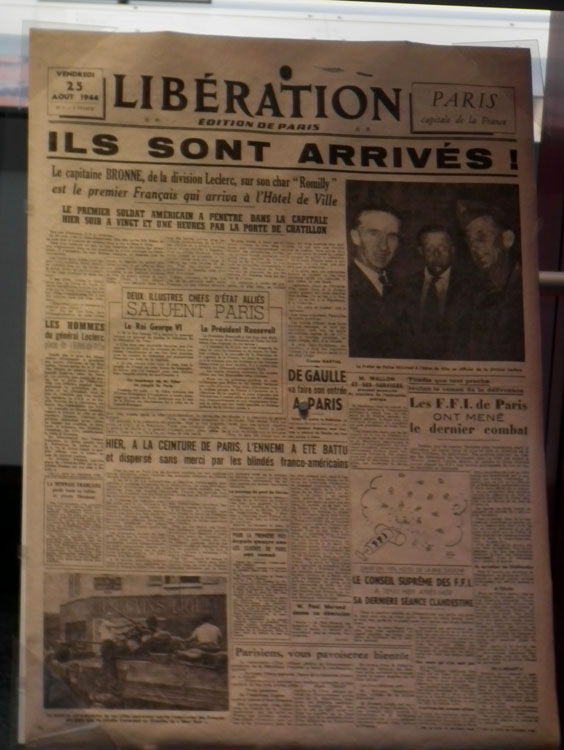
Philippe de Hautecloque


Bust of General Leclerc on the bridge at Amboise.

Philippe de Hautecloque was the fourth son of an old aristocratic French family. He trained as a cavalry and tank officer at the military school in Saumur, politically was extremely right wing, a devout Catholic and fluent in German. He fought in the Second World War, escaping twice from German captivity and joining de Gaulle in exile in England. Present during the liberation of Paris and the surrender of the Japanese, his military career took him to Indochina and later to Algeria, where he was killed at the age of 45 in a plane crash.

 The Leclerc Museum in Paris.

He is better known both to French people and to the rest of the world as General Leclerc, but this name is a nom de guerre that he used from June 1940, after the surrender of France. It allowed him to operate at a high level, leading Free French Forces in Africa, without endangering his family, who remained trapped in France.

'Captain Bronne of the Leclerc Division, in his tank Romilly
 is the first Frenchman to arrive at the Town Hall.'

Friday, 28 July 2017

Drinking in the Rain


On Sunday we held one of our monthly networking gatherings, which doubled as a birthday party for Simon. People very generously brought not just contributions to the shared table, but little presents for Simon too. We got Belgian chocolate, French, English and Belgian beer, homemade mayonnaise, Dutch caramel wafer biscuits and syrup, wild picked blackberries and a couple of very well chosen books. 

We don't have much parking near our house, and a couple of people attending commented on how there were people carrying trays of food converging from all directions on our house when they walked down from the market place or up from the park. I identified one lost soul in the street as 'one of ours' by the fact she was carrying a tray of food. We'd never met before, she had been invited by a friend.
Although the weather forecast wasn't promising, because we expected around 40 people, we decided to take the risk of holding it outdoors because that many people inside is a bit squished. In the end we welcomed around 50 people, and they all stood around nonchalantly in the rain once it started. Some had come prepared with waterproof coats and umbrellas. I handed out more umbrellas, and some people retreated to the garage, but some just ignored the drizzle and mingled determinedly.

These events just about run themselves. I send out invitations and instructions, then people just turn up and talk and drink and eat. They speak a mixture of English, French and Dutch and include English, Scottish, Irish, French, Australians, South Africans, Dutch and Americans. A lot of them read the blog, not all of them live in France full time. Some live in Belgium, the Netherlands, England or South Africa for much of the year. Long may our Eurocentric lives continue.

Thursday, 27 July 2017

Christ on the Cross


The most remarkable object in the parish church at Fontevraud is this polychrome wooden sculpture of Christ on the cross. It was carved in the 15th century but discovered in the attic of the presbytery in 1952. The body is tortured, but the face peaceful. His fingers are extended in a gesture of benefaction.

I think this crucifixion is an arresting and moving work of art (although it fails to stir any strictly religious feelings in me). Compare it to this much cruder crucifix from Ligeuil, with its agonised and despairing Christ who is nonetheless in the same tradition, and was also found tucked away out of sight in an attic.

Wednesday, 26 July 2017

Halloween Comes Early


Simon is modelling his new black bathrobe, a gift from our friend Penelope. She bought it for herself because it was €5 at Noz, but it is much too big for her. Simon was the biggest person she could think of to give it to. It fits him perfectly.

Tuesday, 25 July 2017

This is What Summer Looks Like Here


In the background wheat is being harvested, in the foreground, sunflowers at their most glorious. (This photo is from last year.)

Monday, 24 July 2017

Translating Tintamarre


Emile serving Tintamarre to Joy and Jheanne.

Our friends at Chateau Gaudrelle very kindly invited us to the launch of their new wine, a natural sparkling chenin blanc that they have dubbed Tintamarre. We asked our South African friends Joy and Jheanne if they wanted to go and they were delighted, since they hadn't had a chance to visit a winery so far while they've been here. The wine is gently bubbly, fresh and fruity. We liked it a lot (I bought a case for our apéro yesterday).

Rillettes (pork paste) and Sainte Maure de Touraine goats cheese to go with the wine.

We asked Laetitia what 'tintamarre' translated as and she thought a bit and said 'hurly-burly', but acknowledged that she'd need to double check that. It is what you get when you put the word into Google, but having consulted widely (well, Christophe at l'Image and Jill, who looked in her big serious dictionary...) I don't think it's the best translation. We think it's more like 'hullabaloo', as it doesn't seem to refer to movement, but to noise, particularly a din or racket with percussive or chinking glass sounds.

Chateau Gaudrelle Tintamarre.

Sadly, Joy and Jheanne returned to South Africa today. The town of Preuilly had adopted them for the duration of their stay, and they received considerable encouragement to buy a house here and move here permanently. I reckon they'd easily win a vote of 'most popular new resident' if such a thing was held. We will truly miss Joy and Jheanne a lot. Thank goodness we've got a ready supply of Tintamarre available, to raise a glass to them on a regular basis.

Sunday, 23 July 2017

King for a Day


Today is Simon's birthday. 
This is how he celebrated last year.

Saturday, 22 July 2017

Don't Panic!

Yesterday was the first day in ages (probably 6 or 7 years) where we didn't have a blog post. This was because we went out for a pre-lunch apero at 11.00am on Thursday, and didn't get home until 8.30pm, and then had to do office stuff before going to bed early in order to leave home at 6.45am yesterday to work.

Then I was going to do an "on the road" blog post from Chenonceaux using our "smart" (it isn't) phone, but I couldn't remember my password,

But here's a photo of Claudette in Amboise from yesterday afternoon instead...


****************************************

Tomorrow is our monthly apero evening. If you're in the area (Preuilly sur Claise) and haven't received an invitation drop us a line using the links on the right (click on Susan's name)