Friday, 11 July 2014

The Roman Amphitheatre in Tours

The garden of the Musée de Beaux Arts in Tours. 
The wall behind the terrace is the remains of the Roman amphitheatre.

The amphitheater, the only [Roman] monument preserved, is unfortunately filled with houses or covered with earth. It was one of the largest in the Empire (143 x 124 m on the axes). The outer height may be calculated as ca. 20 m. The seats, which are cut in the natural rock to the N, rested on vaulted passageways. The walls are faced with limestone rubble with white mortar joints, often trowel-marked, and double courses of brick. Four passageways have been found, placed on the axes of the ellipse; at the entrance they are reinforced with enormous buttresses shaped like semicircular towers about 6 m in diameter. The size of the building and the moderate use of brick indicate that it dates from about the time of Hadrian (117-138). The remains can be reached through the cellars of certain houses.
The 3d c. surrounding wall, an irregular rectangle (ca. 340 x 240 m) enclosed half of the amphitheater on its S side, and formed an enormous bastion that dominated the plain (perimeter 1155 m, area 9.23 ha). The foundations were built of reused material (blocks, columns, capitals); the wall itself was 4.3-4.8 m thick, made of rubble dressed with small blocks of stone and with red mortar and double bands of brick every 7-10 courses. It was flanked with round towers filled with rubble up to the first floor, where small tegular windows were set. Remains can be seen at rue des Ursulines no. 12, the Musée des Beaux-Arts, and the N and S sides of the Cathedral. Source: The Princeton Encyclopedia of Classical Sites.

From GoogleEarth.
********************************************
Preuilly News: The new police station (caserne in French), which includes accommodation for the gendarmes, has been officially opened. It is named after Denis Bonnaudet, a local policeman during the Second World War who became a member of the Resistance, captured by the Nazis in July 1944 and died in a deportation camp in April 1945. His two daughters were present at the inauguration ceremony.
*******************************************
Au jardin hier: I weeded the potato bed -- took me 2 hours. I also dug the remaining white onions. They've formed bulbs the size of large marbles to golf ball size, so not huge, but good quality and no sign of onion fly. The yellow onions are ready to pull too, but they will hold a bit. The tomatoes are thriving, but I am slightly concerned about pollination levels. There was plenty of honey bee action, in the flowers that have come from a sowing of Vilmorin's 'biodiversity seed mix', and in the Virginia creeper, but honey bees can't pollinate tomatoes (or peppers, aubergines, chillies, zukes or cukes). My impression is that although the year began well for bumbles and solitaries, they are now much less visible and active. However, something has been pollinating the zucchini and the gherkin, so perhaps the slow development of fruit is more down to the recent lack of sun.

Thursday, 10 July 2014

House Martins at Chenonceau

Every year these little birds fly in from Africa to nest on the Chateau of Chenonceau and other buildings in the Touraine Loire Valley. In French they are called les hirondelles de fênetre (='window swallows'), in English they are House Martins. Their scientific name is Delichon urbicum. 
In general, just as at Chenonceau, property owners leave them to get on with nesting, and they return year after year to the same mud nest, repairing it as necessary for the next year's brood (or broods, as they may have more than one if they are quick off the mark). Where one nests, others will join to form a colony.
They can be distinguished from other similar species by their white rump. 'Aerial plankton', tiny flies and aphids caught on the wing form the bulk of their diet. 


*********************************************
French Expression: Parti en fumée = gone up in smoke. I heard this twice in one evening recently from different interviewees on different subjects on current affairs programmes. An expression of their frustration with how life and politics in France is heading.
*************************************************
Quiz Results: The mystery chateau has not been openly identified by anyone, but I know Liselle knows it, as she was standing next to me when I took the photos. To find out where it is, go to the post.

Wednesday, 9 July 2014

The Streets of Bourges

Recently we went to Bourges and enjoyed this small city very much. Bourges is situated about 2 hours east of us. Here are some pictures of the centre ville.

A street in the really old quarter of town.
 I forget what this building is (the old Palais de justice maybe?) It's medieval anyway.
 I liked the juxtaposition of old and new here.
 A typical shopping street.
 A 15th century church.

Tuesday, 8 July 2014

Mystery Chateau


 5 points to anyone who can correctly identify this chateau.
*****************************************
French Expression: Tout simplement = quite simply. Magazine programme and current affairs interviewees use this phrase a lot on the telly.  If they are talking about politics, French or Australian, at the moment, C'est tout simplement une honte! (= 'It's quite simply a disgrace!').
****************************************
A la cuisine hier: Cottage pie, with mushrooms in with the meat and carrots in with the mash, served with steamed green beans grown by our local organic market gardeners. Followed by home made raspberry sorbet, using fruit grown by our aged orchard neighbour.
*************************************************
Quiz Results: This is the Chateau of Saint Florent sur Cher. The first photo shows the 19th century front, the second photo the late medieval gatehouse. It's not a Touraine Loire Valley chateau, but located in the old province of Berry (the modern départements of Cher, Indre and part of Vienne) right bang slap in the centre of France, between Chateauroux and Bourges. The chateau now serves as the town hall.

Liselle knows where it is because she was with us when we visited. As a result I don't think I can fairly award points. Jean wanted to know if she could visit and the answer is you can visit the grounds which have lovely views of the chateau and the river, but the interior of the chateau is office space (which you could get to see if you had business with the town hall).

Monday, 7 July 2014

Not Made for Walking

I really don't think these boots were made for walking...
Made by a master shoe and boot maker in the mid-19th century.

This one is tiny stones glued to cardboard.
Made in Bordeaux in 1865 the design shows Garibaldi mounted on horseback, triumphant after defeating the Austrians.
The second was created at Saint Etienne in 1839. It is 'seamless', ornamented with figures sewn on leather from women's hair, glorifying the Emperor Napoleon I.
These boots are part of the collection on show at the Musée de Compagnonnage in Tours.
****************************************************
French Expression: Eventuel, éventuelle = possible. As you can see, this is a 'false friend' as it does not mean 'eventual'. Perhaps most commonly encountered on food labelling, in the form of 'traces éventuelles de gluten' and the like. This is the equivalent of the English labelling 'possible traces of gluten', 'produced in a factory that handles nuts', or 'may contain traces of soy'.

Sunday, 6 July 2014

At the Base of Kata Tjuta

*******************************************
French Expression: Je regarde = I'm (just) looking / browsing. A very useful little phrase this one. It's polite and effective at heading off salespeople in shops when they approach.

Saturday, 5 July 2014

Kata Tjuta Panorama

Kata Tjuta is a rock formation in the Northern Territory of Australia.
****************************************
French Expression: La permanence n'est pas assurée = the office is not manned; no one is on duty. Etre en permanence is 'to be on call'. The opening phrase is one I see more often than not on our town hall (mairie) noticeboard in relation to the absence of our town's weekly service visit by someone from the tax office based in Descartes. It is clear they don't really want to provide the service any more.

Friday, 4 July 2014

The Musée de Compagnonnage, Tours

The Musée de Compagnonnage (Trade Guilds Museum) in Tours houses a remarkable collection of master works by journeymen and master craftsmen in all sorts of fields -- carpentry, ropemaking, baking, silk weaving, harness making, boot and shoe making, wheelwrighting, blacksmithing, locksmithing, masonry and more. Some of the objects are quite fantastical, others are just beautiful examples of their craft. In addition to the master works themselves there is a myriad of documents and auxiliary artefacts which tell the story of the various guilds and how they developed and operated.

 Architectural models from the carpenters' guild.
************************************************
French Expression: Jaunâtre = yellowish; blanchâtre = whitish; verdâtre = greenish; noirâtre = blackish; rougeâtre = reddish; bleuâtre = bluish. You get these types of adjectives a lot in French field guides.

Thursday, 3 July 2014

Villandry in the Sun


All photos taken mid-June 2014.

Villandry's visitor numbers are up by 8% this year, with 10 000 more visitors already than this time last year. They envision these figures holding for the year and next year will start a major (3 million euro) project to alter and improve the entrance to the site and the parking area. Over the past 30 years roughly 15 million euros have been invested in restoring the chateau and grounds (roofs, retaining walls, etc).

Last year Villandry had 350 000 visitors, compared to the most popular of the Touraine Loire Valley chateaux, Chenonceau, which got 850 000. Chambord got 750 000 and Azay le Rideau 320 000.
**************************************************
French Expression: Une dizaine = ten or so. Une dizaine d'années is a decade. Des centaines = hundreds. Une bonne centaine is 'at least a hundred'. Une quinzaine = fifteen or so, eg il y avait une quinzaine de personnes (= there were about 15 people). Une quinzaine can also be a fortnight.

Wednesday, 2 July 2014

A Glowing Report

In mid-June Simon found a female glow-worm Lampyris noctiluca doing her thing on the deck of the mobile home we had rented for the week at Ville aux Dames. We have them in the orchard and I quite often encounter the larvae, but neither of us had ever seen an adult before.

Photographed with flash.
 Without flash.
A larvae, photographed in April last year.
**********************************************
French Expressions: Tout sous la main = everything to hand. I wrote this down as a useful phrase I heard while watching television. I'm fairly sure it was a cookery show.
***************************************
A la cuisine hier: Walnut and Kidney Bean Spread, from Susan Voisin on FatFree Vegan Kitchen. I love bean dips and spreads and this one is a bit different and quite good. I served it on slices of baguette, along with tapenade on baguette, followed by a tomatoey couscous dish.
***********************************************
Au jardin hier: I harvested the garlic yesterday. It has divided properly and formed quite sizable bulbs, despite the mild winter. I pulled some more white onions and picked the few berries that were ready (a tayberry and a few loganberries). The tomatoes, potatoes and chard are thriving. I picked a bag full of chard. We have a real mixture of varieties, thanks to seedlings from Potager Queen Pauline. Two of the plants are like wild seabeet, which is a real favourite with me. I pulled up the broad beans, which have finished. The coriander has gone to seed. The peppers and one of the aubergines are flowering. A gherkin had escaped my notice and has turned into a miniature watermelon lookalike. The zucchini has started to bear.

The sour cherries have been left too long and are now spoiled. I just didn't have the energy to deal with them earlier. The Black Hamburg grape has gone triffid and has huge leaves and quite sizeable grapes already.
******************************************
Bee Hotel: Ed Phillips, who writes an excellent blog about the wildlife he photographs in Warwickshire has provided an update on the progress of his extremely stylish and successful bee hotel which I thought some of our readers might be interested in.

Tuesday, 1 July 2014

The Nature of July in the Touraine Loire Valley

Longhorns to Look Out For:

Wasp Beetle Clytra arietas.
Here hiding amongst the nashis in our orchard, but usually more visible on bramble flowers and fence posts or other bare untreated timber.
Stictoleptura cordigera, a common and distinctive visitor to flowers at this time of year.
July is one of the warmest and sunniest months of the year here.
***********************************************
French Expressions: Actuel, actuelle = current; actuellement = currently. This is one of the most commonly encountered 'false friends' in my experience. English speakers speaking French use actuellement when they mean en fait or vraiment (me included if I'm not careful). French speakers speaking English use 'actual' when they mean 'current'. For instance, I might inadvertently say 'Actuellement, je ne le connais pas' when talking about someone I don't know, but this would translate as 'At present I don't know him'. I guess this just about makes sense, but isn't what I thought I said. What I should have said is 'En fait, je ne le connais pas'. Likewise, Clément, one of the interns at Chateau Gaudrelle, might say 'The actual owner is Alexandre Monmousseau'. Again, it just about makes sense, but what he meant was 'The current owner is Alexandre Monmousseau'. In Clément's defense though I should point out that English is his third language and his Spanish is way better than mine.

Monday, 30 June 2014

Pigs in Pens

Pork appears to be easily the most popular meat in France, and France is the third biggest pork producer in the EU, but you never see pigs in the fields. You rarely notice the local piggeries at all. They are off the beaten track and the pigs are all indoors.
In the wild, pigs live outdoors of course, foraging in the forest and roaming quite widely (several kilometres a day). They live in small groups of related females with young. Boars have solitary lifestyles. Wild pigs have small litters of about half a dozen piglets. They have a reputation for ferocity, so don't seem a likely contender for domestication. However, their big advantage for subsistence and peasant farmers was that they would eat anything. The farmer didn't have to set aside special pasture or sideline any of his cereals. The pigs thrived on household scraps and what they rooted out of the leaf litter. Thus, it came about that pigs were simultaneously but independently domesticated both in Europe and China several thousand years ago.

In China, where there were fewer animals to provide much needed manure for the fields, pigs were coralled in sties from quite early on, but in Europe they stayed running free in the forests until the Industrial Revolution caused a shift in lifestyles of both city and country folk. There was a difference in the selection of breeding stock between east and west too. China selected for big litters, Europe for big pigs. European pigs even developed several extra vertebrae as they got longer and longer in the body. At some point around 1700 a Chinese pig was brought to Europe. The resulting hybrid produced a big hardy pig that ate anything, fattened quickly and produced big litters (a modern sow will have an average of 30 piglets a year). More recently, white bristled pigs became favoured over black bristled, as the consumer doesn't like to see black bristles in their pork products.
Modern pigs are raised in related groups, similar to the groups they would form in the wild. Modern lighting and air conditioning mean that pigs can be raised indoors so farmers need less land. Despite the best efforts of many farmers, there is no question that indoor pigs develop a few behavioural issues that the farmer needs to stay on top of. Although farrowing crates are still used, to prevent sows inadvertently crushing newborn or suckling piglets, gestation crates or stalls, in which pregnant sows are unable to turn around or make physical contact with one another, have been banned in Europe since 2013, and pregnant sows live together in indoor pens. French pig farmers could apply for a grant of up to €17 000 to make the conversion.

In the confined space and close contact, sows can fight to establish a hierachy and access to food. The pigs' tails are docked because tail biting is one of the ways the pigs express their aggression. Smart pig farmers are dealing with the problems of penned groups of pigs by selectively breeding for a less aggressive temperament.

French pig farms are usually fairly small scale 'farrow to finish' establishments, averaging 220 sows on 60 ha of land. Manure is dealt with by spreading on the land and few farms have treatment units. The amount of manure that can be spread is strictly controlled, which in effect controls the number of pigs a farm can hold.

The photos above are all of local piggeries.
******************************************************
A la cuisine hier: Eggy nests, from that irrepressible pair at Veggischmooze. Basically it's mashed potato made into a 'nest' which holds an egg and all is smothered in cheese and baked. I used Etorki, a Basque ewes' milk cheese. We had the potato skins on the side, along with green beans, as suggested in the recipe.

Sunday, 29 June 2014

Not Uluru

Kata Tjuga may not be a single monolith, but this rock formation in the same national park as Uluru provides an equally dramatic skyline.
***********************************************
La Chatonniere: As of this season the gardens at la Chatonniere are no longer open to the public for individual visits. Visits must be by prior arrangement and in groups of 10 people or more.

Saturday, 28 June 2014

Weevil in the Desert

These large black weevils were common in Uluru Kata Tjuta National Park. I saw many live ones and many sunbleached remains.
*******************************************************
Car News: The good news is that we have our keys back. Simon picked them up from the Auberge in Cour Cheverny on Thursday while I took clients around the chateau. Other good news is that Célestine's gearbox is fixed. The bad news is that the gearbox repair alerted the mechanic to the fact that she needed a new clutch and the new clutch is not working well with the new gearbox. Plus the alternator has decided not to work for some mysterious reason none of us understand. Meanwhile, Claudette soldiers on, but she needs a bit of attention and is starting to huff and puff in hot weather when in slow moving traffic. We don't have clients for a few days now so it gives us a chance to get Claudette to the mechanic too.
****************************************
Veggie Vending Machine: Due to reader interest I have updated the Vegetable Vending Machine in Villandry post to show a photo of the labels with details of the French distributor and the German manufacturer.

Friday, 27 June 2014

Thursday, 26 June 2014

Botany Outing to Les Pelouses de Bertignolles

 A view of les Pelouses de Bertignolles from near the entrance.
On Saturday 21 June Dominique Tessier led a group of botanists from the Association de Botanique et Mycologie de Sainte Maure de Touraine on an outing to the Pelouses de Bertignolles.

Botanists looking at a sedge Carex sp on the edge of one of the shallow pools.
The site is situated on the left bank of the Loire, in that triangle of land known as the Véron, formed by the confluence of the Vienne and the Loire. We met in the car park at Candes Saint Martin, then crossed the bridge over the Vienne and turned left into the site down a dirt track.

 Sand Broomrape Phelipanche arenaria, rare and specialised in terms of habitat and host (it is parasitic), one of the prettiest of its family.
The flora here is of considerable interest because the substrate is alluvial sand. That meant it was very dry, and Dominique warned everyone that they would get covered in really annoying grass seeds that would get stuck in their socks and boots. I had arrived in shorts and sandals (looking sportive, according to my friend Paul) which Dominique was a bit dubious about, but actually, that turned out to be better than if I had been fully kitted out in hiking boots and socks, as the grass seeds just slid off me. The area is really a low lying sand dune, much of it covered in Grey Hair Grass Corynephorus canescens and Cladonia lichen, which crunches underfoot. In English this type of habitat is called Grey Dunes (Fr. les dunes gris) because of the colour of the vegetation. I've never visited this type of habitat before, and I was fascinated by how different the plant species were and the abundance of interesting insect life.

 The gorgeous male chafer beetle Hoplia caerulea, abundant on this site.
Dotted about this dry sandscape were shallow pools with aquatic plants and rabbit warrens which turn out to be very important in the ecological cycle of the site (especially while they wait for a flock of sheep to manage the vegetation).

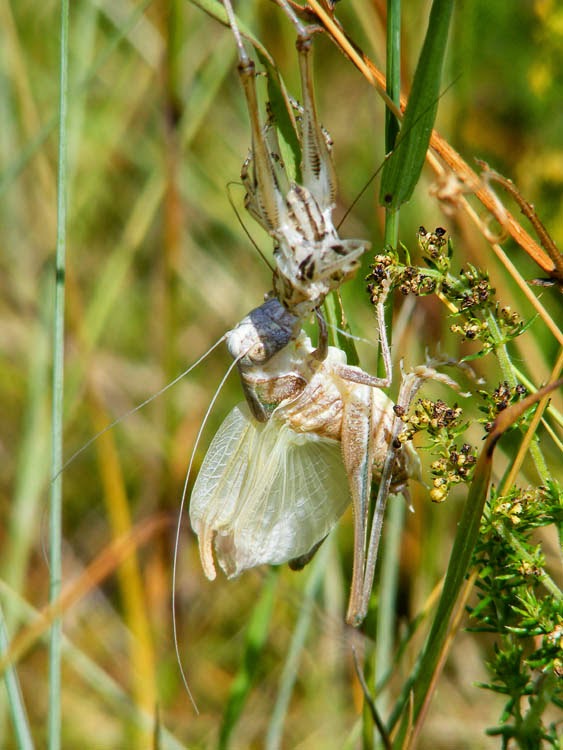
 A grasshopper moulting.
 My personal highlights for the day included:
  • several species of Robberfly Asilidae
  • Hoplia caerulea, an irridescent blue chafer beetle which I have never seen live before.
  • The chafer beetle Anisoplia cyathigera.
  • a Bembix sp sand wasp shoving a grasshopper down its nest hole in the sand.
  • an Ammophila sp sand wasp rushing about moving clumps of sand and small bits of wood chip to close its nest hole in the sand.
  • Common Forester moth Adscita statices.
  • a grasshopper, maybe Euchorthippus declivus, moulting out of an exoskeleton that has become too small as it has grown to adulthood.
  • Oak saplings which had signs of animals digging for summer truffles around them.
  • a tiny baby Tree Frog (Fr. Rainette).
  • Sheep's Bit Jasione montana 
  • Tasteless Stonecrop Sedum sexangulare
  • Reflexed Stonecrop Sedum rupestre (syn. S. reflexum)
  • Hoary Allysum Berteroa incana -- this is not native to here, but a common plant, interesting because it was introduced in the 19th century in hay brought by Prussian troops during the Franco-Prussian War.
  • Crow Garlic Allium vineale -- this is also a common plant, but I hadn't realised that its French name is Ail des vignes.
  • Field Wormwood Artemisia campestris (Fr. Armoise de champêtre)
  • Hare's-foot Clover Trifolium arvense
  • Yarrow/Sand/Wormwood Broomrape Orobanche purpurea, syn. O. arenaria  (Fr. Orobanche de l'armoise), which was parasitising the Field Wormwood.
  • Birthwort Aristolochia clematitis (Fr. Aristoloche clematite). For me, Aristolochia is a coastal rainforest plant that is the food plant of birdwing butterflies in Australia, so I was amazed to find a species in this situation.
  • Narrow-leafed Lupin Lupinus angustifolius, very rare and protected nationally. One of the flagship species of the site.
  • Bastard Lucerne Medicago varia.
 An Ammophila sp wasp putting the finishing touches to her nest.

Wednesday, 25 June 2014

The Tarte Tatin Man

The famous Tarte Tatin was created by a pair of sisters in the Sologne (not far from here). This guy was at Loches market turning them out in the sun and offering a free third one if you bought two. His apprentice was making little deep fried puffs flavoured with garlic and parsley.

While we were standing there a man sampled one of the puffs, then a second. He was going for his third and the baker decided enough was enough. We were entertained by witnessing a very strongly worded dressing down which included the freeloader being told that he was 'beyond disagreable' and would have the contents of the boiling oil vat tipped over his head if he didn't push off.

After the kerfuffle, we purchased a tarte, which we ate for lunch and it was very good.

Tuesday, 24 June 2014

Beautiful Landing

This cutesome creature is a male Beautiful Demoiselle Calopteryx virgo, who spent some time sitting on my boot by the bief (millstream) in le Petit Pressigny this time last year.
They are the most abundant dragonfly along this small stream, which is nice, as they are not a particularly common species, being very picky about their habitat.

Monday, 23 June 2014

Furry Fish

Dogs and horses were domesticated thousands of years ago, but rabbits only came into the domestic fold about 1400 years ago. Once Pope Gregory I (590 - 604) declared that baby rabbits could be classified as marine creatures and could therefore be eaten during Lent, their fate was sealed. The monastic communities knew a business opportunity when they saw one, and in addition to fish farming, started raising rabbits for sale to the surrounding populace.

 A wild Rabbit (Fr. Lapin de garenne) Oryctolagus cuniculus.

Nowadays both wild and domestic rabbits are widely distributed across Europe and have been introduced to Australia, but originally the wild population was present only in Iberia and southern France.

A domestic Lapin Gris de Touraine (Touraine Grey Rabbit).

The process of domestication does not involve the switching on of a single 'domestication gene', but rather small changes to many genes, resulting in an animal that is more placid, often bigger and less independent. In the case of rabbits many of the changes relate to brain and nerve cell development.
*********************************************************
Car News: We've been having a fairly stressful time of it lately. Célestine is still at the Dentist's, partly due to the fact that the suppliers of the spare parts needed to repair her 'forgot' (!!) to send the parts, so the work was delayed by a week. Claudette has been performing better than we expected, but we are having to nurse her somewhat. We took the difficult decision last week to cancel a booking for a wedding at the last minute. I spent a very fraught time ringing around trying to find someone who could replace us and thanks to our friend Fabien, who suggested someone from another car club, we were able to organise a substitute and all turned out well. We felt dreadful at messing people around on an important day, but also that we couldn't risk overloading Claudette with too many kilometres between services and committments to clients who have booked chateaux tours, which is our core business, while we didn't have a back up vehicle.

Then on Friday we got back to our garage in Saint Pierre des Corps after dropping clients off at their hotel after a day's touring, only to discover that the key to the garage had gone missing sometime during the day, along with one of our modern car keys and keys to our house and home garage. The real worry was the Saint Pierre des Corps garage key, as there is only one. Once again, I spent a fraught time ringing the hotel our clients stayed at, the clients, the carwash, the petrol station, several chateaux and town halls, and the restaurant we lunched in. In some instances I had to leave a message and wait for people to get back to me (thank you Yves from the carwash and the guys from Manoir Les Minimes who went above and beyond by searching the carpark multiple times), or I couldn't get through the first time (la Vieille Auberge at Cour Cheverny). Finally, yesterday, I rang the Auberge again and they said,"yes, we have your keys, they were found under your table". I can't tell you how relieved we are, and we can pick them up on Thursday when we are back with clients! (Thank you also to Antoine for phoning to suggest a good locksmith should we need one, after Brigitte passed on our news to him.)

Adding to our woes was coming downstairs on Saturday to see a flood all over the kitchen floor. The washing machine had emptied not down the drain but all over the floor when it did its overnight wash. After mopping up and taking the machine apart, Simon finally diagnosed the problem (grit in the thread of the filter so it wasn't sealing properly) and we have a properly functioning washing machine again. Phew!

We aren't out of the woods yet, but hopefully we've turned a corner and the stress levels are already significantly less.

Sunday, 22 June 2014

Desert Oaks

Young Desert Oaks Allocasuarina decaiseneana in Uluru Kata Tjuta National Park, the Northern Territory, Australia. When young this species has a rather whimsical feather duster form. Once a bit older they spread out into more 'classic' tree shape.

Saturday, 21 June 2014

The Other Rocks

Kata Tjuta, not as monolithic as Uluru, but higher and equally fascinating.