Sunday, 8 April 2012

Bread and cheese

One of our local goat dairies, Limousin freres, makes a special springtime cheese. It's a harder, smoother textured cheese in the style of a tome (often spelt tomme), and quite unlike the usual creamy chalk of the Ste-Maure-de-Touraine logs they make year round. Production of the tome starts in early April and continues for 6 weeks. By June it will all be gone.

Naturally I am buying it while I can. I also bought some gorgeous Spanish tomatoes from another market stall (still too early for local tomatoes) and made a loaf of bread to go with the cheese.

The bread is a pain de mie style loaf ie soft and crustless. The recipe is here.

Susan

Saturday, 7 April 2012

Moss Heaven at the Lavoir

Le ruisseau de Truyes with its stone vault cover and profusion of aquatic plantlife. The larger plant in the foreground, looking a bit like a fern, is Fools Watercress Apium nodiflorum - it's not poisonous like many of its lookalike umbellifer cousins, but it's also not related to Watercress (part of the cabbage family) and doesn't taste of anything.
The botanical outing on 1 April was primarily to look at mosses. Our first stop was the ruisseau de Truyes, a stream that runs down the side of a lane behind the church. It must come from a source up on the hill where the chateau sits overlooking the church. The water is absolutely crystal clear and on a sunny day creates a beautiful sparkling background to a host of mosses, liverworts and aquatic plants.

Marie-Claude dangles over the edge to pluck a little sample of moss. Most mosses you have to look at under magnification to identify to species level, so samples are necessary.
The stream is covered in a vault of rough stones for part of its length, then open with the sloping platforms of the lavoir (public laundry) at the side, before broadening into a shallow pool which is home to a dozen or so mallards (all clearly expecting treats).

The very common liverwort Lunularia cruciata.
Everyone got down to business, spotting mosses, lichens, liverworts and some interesting plants. On this short length of wall along the stream there are 6 species of moss and a liverwort, as well as Common Cornsalad and Fools Watercress. Our moss expert was Corinne, a stalwart of the club, and I was very interested that her recommended field guide was in English, published by the British Bryological Society and available online or in print. Typical of European naturalists, most of the group knew enough English (and probably German and Italian) to work their way through a technical key to identify a species. This is not like being fluent in these languages, but because the technical words tend to be the same, you only need to learn a limited vocabulary to understand most of the key. Good keys these days are well illustrated too and this helps a lot. One of the other women, who had a copy of the book, said to me that she actually finds it easier to use than most French guides. Her comment was that British field guides get the tone and level of technical language just right so that everyone can understand them, whereas French guides either vulgarise (ie only use common names and dumb the information down, to the frustration of serious amateurs) or are so academic as to be unuseable by these same serious amateurs.

Loic risks wet feet to take a closer look at a plant on the wall. His left leg (street side) is between two concrete washing slopes, I assume once used to slap and soap up the laundry. Marie-Claude is over on the left with her nose against the wall looking at lichens (her special interest).
So...now I know slightly more about mosses and have been introduced to a fantastic resource should I wish to identify mosses on my own in the future.

A Mallard drake bobs on the clear shallow water.
Susan

Friday, 6 April 2012

Outblinged

Hoooray! Normal service has resumed, with Célestine making her weekly visits to Chenonceau. Normally (with one or two - or three - exceptions) we are the most stylish people in the car park.

A Célestine, in her natural environment
On Wednesday we mave have been out-blinged.
What impressed our clients is that I identified this car as a Delahaye as I was driving past the car park I don't park in. What won't impress the owner of this car is when he tries to remove a billion sticky handprints from the people off the coaches it was parked near - which is why I don't park there any more.

It's a 1948 Delahaye 135SM with bodywork by Guilloré. And it's nice...

Simon

Thursday, 5 April 2012

Truyes

Truyes is a small town on the north bank of the Indre River, about 20 km from Tours. The Indre Valley is one of the most picturesque in the district, with many attractively situated mills and beautiful riverside drives. Balzac spent a lot of time in the valley further down stream, around Saché, and it features numerous times as the setting in his novels.

I'm not quite sure what this is - garage? cellar? Anyway, it appears to be part of the Chateau de Bel Air complex and I liked its Mediterranean style garden with the big Stone Pine.
The population of Truyes is around 2000 people, but like many towns along this river it forms a larger urban area by being directly across the river from the town of Cormery. They have separate administrations, but you simply cross the bridge over the Indre and you have crossed from one to the other. The towns grew up because this is the site of an ancient ford, but remained separate because the rivers often served as territorial boundaries in the medieval past.

The 12th century church of Saint Martin in Truyes with its 15th century 5 storey belltower, one of several medieval churches, chapels and abbeys in the paired towns of Truyes and Cormery. Niall and Antoinette wrote one of their erudite posts about the abbey at Cormery on Chez Charnizay recently.
Truyes isn't somewhere you will find in many tourist guides, but it is attractive enough for all that. I suspect a lot of people miss Truyes because it is not obvious from the main road how much of the village, including the real centre, is off to the east. You could easily spend the day wandering about Cormery and Truyes, popping in for an artisan beer at the brasserie in Cormery and walking along the ancient pilgrim path around Truyes. If you visit at the right time in August the Fete de Cochon will be in full swing too.

The 20th century chateau of Bel Air, now owned by the commune (so I assume it is the salle des fetes - village hall).
I didn't get much of a chance to look around or to find out a lot about Truyes when I visited for a botanical outing, but I thought the area around the Eglise Saint Martin was lovely.

Susan

Wednesday, 4 April 2012

All Action Heroes at Work

Fire brigade vehicles parked in our backyard.
Immediately after lunch yesterday (ie at 5 past 2) three fire brigade vehicles came roaring up the driveway and parked in front of our garage. The firemen got out and started heading down the street. 'Qu'est-ce que se passe ? Y a-t-il un probleme ?' 'Hello Madam, no, there isn't a problem. We are on a training exercise. Are the trucks OK there?'

The brass above the visor on his helmet is the last vestige of the 19th century fireman's helmets. The modern ones say 'Sapeurs Pompiers Indre et Loire'.
They were happy for me to take photos and so I followed them down the street to Patrice's paint workshop. Like last year they had set a smoke bomb off in the paint store and were 'rescuing' someone.

Racing to deal with a problem with the connection at the fire truck, too big to get down the lane and parked at the end.

Getting ready to enter the building.

Job done and it's off to pack up the hoses and stow the kit on the fire truck.
Susan

Tuesday, 3 April 2012

French for Motors

Having been In France for a while, and having hung around mechanical types for a bit, I thought I would pass on some words I have learnt:

First thing to know is le démarreur: the starter, is different to le starter, which is the choke. This is important in Célestine, because the choke knob and the starter knob look the same except for the fact that the choke says S and the starter says D. Confusing, what.

Then we come to the timing chain/belt. This is commonly referred to as la distribution, which is different to la distributeur (although both can sometimes be la distributeur). Thus it pays to check whether the mechanic is talking about one (courroie distribution, very expensive) or the other (tête de distributeur, less expensive, but modern cars don't usually have one) before agreeing with him. If you have a problem with your
tête de distributeur, (spark timing) it is a problem of alimentation. If you have a problem with your courroie distribution it usually means a new engine.

A random and very lovely engine from Retromobile.
I have no idea what it's from, but I want one.
(further research says it's a Bugatti Type 28 Torpedo 1922)
Another good word is bougies, which are spark plugs (unless you're very English or from the 1930's and call them sparking plugs). Bougies translates as candles, which are usually translated into French as chandelles, except that chandelles are what some people call headlight bulbs.

Another Retromobile engine. No prizes for this one.
The other word I have learned is roue de secours - spare wheel, or literally "the wheel of help". This is a lot easier than talking about having a trou in your pneu.

Trust me on that last one...

Simon

Monday, 2 April 2012

Violet Fritillary butterfly - a photo series


To learn more about this lovely butterfly, please go to the species account post on Loire Valley Nature. This is always the first of the Fritillary butterflies to be on the wing, and we should be seeing it here any day now.

Susan

Sunday, 1 April 2012

Wildlife Watching in April in the Touraine du Sud

Today I am off on an outing with the local field naturalists club, l'Association de botanique et de mycologie de Sainte-Maure-de-Touraine. We are visiting a little valley near Truyes (north of Loches) to study mosses and have a general botanise. I am the only non-French member of the club, but so long as I can remember to say all the scientific names with a French accent, we will get on just fine. I know next to nothing about mosses though, so it will be quite challenging keeping up. I imagine that everyone will be bemoaning how dry it is and worried about the effect on the orchids and other special plants of the area. Our first outing where we are likely to see orchids in flower is later in the month, to les Puys du Chinonais. I will also be off sometime during the month to do my first butterfly survey for the year.

More generally, things to look out for are:

Orchids - the spider orchids, Lady Orchids and Early Purple Orchids will be the first to flower. The Monkey Orchids won't be far behind, and even though we had an exceptionally cold spell in winter this frost tender species would still have been dormant at the time and unaffected. The current dry spell is another matter though.

Green-winged Orchids flower in old vineyards in April.
Other Wildflowers - look out for the intense blues - Long-leaved Lungwort, Purple Gromwell and Common Columbine. Most years you could add Sweet Violets and Grape Hyacinth to this list but they have been flowering for much of the previous month already. The violets will continue but the Grape Hyacinths are coming to an end. Another very striking spring flower that has started early in places is the Greater Star of Bethelehem, pure white stars with a green midrib running down the underside of each petal, on every roadside bank.

Butterflies - the first generation of blue butterflies such as the Provencal Short-tailed Blue and the Common Blue will be out and about, looking for places to lay their eggs and produce the autumn generation that will overwinter as caterpillars. The first Fritillary species to be on the wing is normally the Violet Fritillary, found anywhere there are wild violets growing to feed their caterpillars. However, I am hearing reports that some Fritillary butterfly species caterpillars have not survived the winter well. Certainly there has been a disturbing lack of Glanville Fritillary caterpillars scooting across the potager and hanging about in the Ribwort Plantain this year. There were communal nests amongst the plantain at the beginning of winter, but I found no survivors in March.

Skipper butterflies like this Dingy Skipper can be
seen sucking moisture from damp earth in April.
Beetles - it's big bomber chafer time in April, with Rose Chafers and Cockchafers lumbering about or munching their way through the stamens on your roses and paeonies.

April is the month you start finding moths in the street, exhausted by their night of dancing attendance on the street lights. This one is a Lunar Marbled Brown I encountered last year.

Flies - yes, Flies! Some of the most attractive of the craneflies, Ctenophora and Nephrotoma, will appear, resting on vegetation with their absurdly long legs dangling all over the place. The adults are completely harmless and whilst the leatherjacket larvae might eat plant roots, they also provide a significant source of nourishment for farmland birds. Prepare to be surrounded by the curiously misnamed March flies in April too - species in this family such as the Saint Mark's Fly emerge traditionally around the Saint's Day (otherwise known as Anzac Day...). And of course there is everybody's little fuzzy friend, the Dark-edged Beefly, who has already been with us in good numbers this year from mid-March.

Other Insects - the Field Crickets emerged from their burrows to sit in the sun in March, but this month they will start calling attention to themselves, literally, with their chirruping in warm weather.

You will see 50 gazillion Gendarme Bugs in pairs, trios, dozens, over the summer, but this lookalike cousin is a different, solitary species called an Assassin Bug, also out and about on buggy business in April.

Happy wildlife watching. I've got no idea what the weather is going to be like - let's hope it rains a bit, but sunny days are always nice too.

Susan

Saturday, 31 March 2012

Lait ribot

Periodically I have a conversation with someone - usually American - about what one can use as a substitute for buttermilk. Generally we agree that we have never, or very rarely, seen buttermilk available on the supermarket shelves, yet it is an ingredient that certain recipes traditionally contain and our mothers or grandmothers seem to have used reasonably regularly. We agree that the easiest substitute is natural yoghurt thinned with milk, but we occasionally use milk that has gone sour or faiselle (like cottage cheese) that is past its best, just like our mothers and grandmothers would have. We suppose that the other possibility is using drinking yoghurt, but since none of us ever buy the stuff, we've never tried it. I've also used the whey saved from mozzarella cheese as a substitute for buttermilk in cakes.

Just recently I wanted to make soda bread and it suddenly dawned on me that I had read a post on Clotilde Dusoulier's excellent food blog Chocolate and Zucchini, yonks ago, about a Breton product called lait ribot. I see it in the supermarket as a regular item, in the refrigerated section along with the fresh milk, and my memory of Clotilde's description was that if it wasn't buttermilk, it was a very reasonable substitute.

Using the other half of the lait ribot to make cornpone.
It turns out that lait ribot is indeed a type of buttermilk. In the old days it was the traditional product, which was the creamy but low fat liquid left in the churn after you have made butter, deliberately fermented to increase its keeping qualities. (Lait is the French word for milk and ribot from the Breton word for a churn). These days the by-products of industrial scale butter making go into industrial scale 'not butter' spread making, along with various vegetable oils. Cultured buttermilk, or lait ribot, is now manufactured in its own right by adding a lactobacillus to milk to lightly ferment it, making it go slightly sour and curdled ie essentially, drinking yoghurt. Many French people would dry retch at the thought of drinking a glass of milk, but they adore a glass of lait ribot, especially if they are holidaying in Brittany.

Susan

Friday, 30 March 2012

A Little Piece of Australia

Many moons ago (28, to be more or less precise) we were in Australia, bought an extendable Hills clothesline and brought it back to France in our largest suitcase. There were a couple of reasons for this - the main one being how flimsy European clotheslines are by comparison.

Once the clothesline was home we discovered that the wall we intended to attach it to wasn't up to the job, so we had Alex build a frame to tie the wall back to. Once that was done Simon realised he had to dig a 3' (about 1 metre) deep hole, fill it with concrete and stick a post in it. Having done some digging in the garden previously he knew what he was in for and the metal post became somewhat of an elephant in the room.

At the end of last year we remembered that Niall and Antoinette had given us their builder - Ken Blomeley's - contact number and that he might have a post-hole digger, so we rang on the off chance. He said it wasn't worth doing by machine and duly dug the hole by hand (more or less). He also solved the problem that had been niggling us, of how to set the pole so it was good and stable but still be easily removed.

Ken and his petrol powered destroyer
Making sure it's all square
First task for me (once the concrete had set, the weather had improved, and I actually left winter's torpor behind) was fixing the cabinet to the wall. Drilling the holes through the brick was easy, as was the placement of the wooden block behind the bricks to receive the screws. Unfortunately I tried to overtighten the second of the screws, resulting in tearing out the hole so the screw wouldn't fasten. I got around this problem by applying method 2, one of the hammer in screws that we bought to fit the back door. This is holding admirably, but next time I am in a hardware store I will buy a very long and quite thick screw so I can put it through the brick and into the frame, rather than relying on what was previously an unreliable wall.

The next worry was whether our drill would cope with drilling through the metal pole to fix the receiving bracket, but that all went off without a hitch. It all worked perfectly and so now we have the summer drying solution installed as well as recently having solved the winter laundry problem.

The post is in, the cabinet is attached to the wall
... and it works!!

Susan & Simon

Thursday, 29 March 2012

'They said Cheverny!'

As French language learners we love the Tintin animated cartoons and we've enjoyed one of the 1960s French films based on the characters created by the Belgian cartoonist Hergé. We have a nice connection here in the Loire area, because Captain Haddock's home is based on the central block of the chateau of Cheverny, and they have housed a Tintin museum in the back of the stables for some years. Now with the new Spielberg movie released, Cheverny is hoping to get lots of new Tintin enthusiasts through the gates.

This poster was hanging in the entry hall.
Captain Haddock, Tintin and Milou (Snowy) are walking towards Moulinsart (Marlinspike Hall). 'What's this?!' exclaims Captain Haddock. 'Billions of blistering blue barnacles! What bashi-bazouk has added two wings to my chateau?' 'Ah yes, Captain', says Tintin, 'So you didn't know that the chateau of Cheverny served as Hergé's model for your ancestral chateau?' Off to the side a smugly superior Snowy mutters 'What an ignoramus the captain is. Even I knew that!' and over on the right the detectives Dupont et Dupond (Thomson and Thompson) are saying 'They said Cheverny', 'Not only that: they said Moulinsart.'

It's all very silly, but the cartoons are a fun way to improve your French comprehension, and Cheverny is a great day out whether you are a Tintin fan or not.

Susan

Wednesday, 28 March 2012

They Call Me the Hunter

Even those with only a passing interest in what's going on above their heads will recognise Orion's belt: the three stars almost in a line that seem to jump out of the night sky at you.

When I was taking photos of Venus and Jupiter I also aimed my camera at other parts of the sky. Most of the photos weren't what you would call obvious, but this was:

Playing around in Photoshop (in this case that means upping the contrast) you get all sorts of photo noise, but you also get a lot more stars. You can also see the track of an aircraft as it flies over.

I have drawn in the lines that makes this a hunter. All I can think is that 5,000 years ago it was all more obvious.

And as we're talking about The Hunter you can have this, free.


Simon

Tuesday, 27 March 2012

Variable Burnet Moth - a photo series


To learn more about this lovely day flying moth, go to the Burnet moths page on Loire Valley Nature.

Susan

Monday, 26 March 2012

The End of the Line?

The railway line from Port-de-Piles to Tournon-Saint-Martin was opened to traffic in 1885-1886, reaching Preuilly sur Claise on 16 May 1886, and closing to passenger traffic on 27 June 1940. In 2005, just after the line was refurbished, it was closed to freight traffic as well. Prior to that it had been used to transport kaolin from le Blanc to Descartes, with two trains a day using the line in 1992.

The station in Preuilly was recently for sale, but whether it sold or the online advert has just been withdrawn (which is quite common) I don't know. We have heard rumours that the line has been delisted recently, which would explain why at Humeau and along the road between Humeau and Chaumussay the Stop signs at the level crossings have been removed, and the railway line bitumened over when the road was resurfaced.

This will come as a great disappointment to CFTST - Le Chemin de Fer Touristique Sud Touraine, who were hoping to open at least a part of the line for a tourist train. It also comes as a disappointment to me, because I would love a tourist train in the area - especially as the line between Le Grand Pressigny and Tournon is particularly scenic, following the Claise river for quite some distance before diving off through forest between Bossay sur Claise and Tournan.

I wonder what will happen to the classy
cast iron signage along the route
I hope this doesn't mean the end of the railway, but I fear it might.

Simon

Sunday, 25 March 2012

A Very Special Spring Wildflower

Yesterday I published a post on spring wild flowers, but quite by chance, on Friday, we happened across a species that is possibly the most special of all for this time of year. My friend Jean (botanist, male, French, not blogger, female, English) emailed me to say that les fritillaires ont commencé leur floraison dans la Vienne. I was delighted to be able to respond that oui, et au bord de l'Indre.

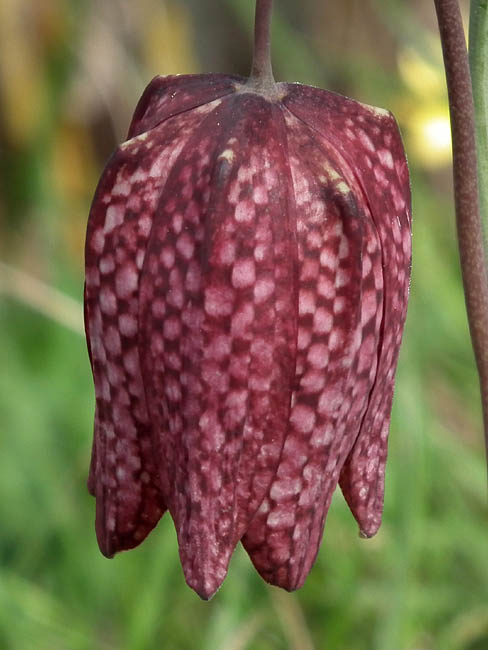
Snakeshead Fritillary Fritillaris meleagris, known as la fritillaire pintade in French, survives in a few dozen places along the Loire and its tributaries, and another dozen in the Brenne. It is a plant of old fashioned water meadows, that is to say, rich pasture along riverbanks which flood annually in the winter. This is a very rare habitat nowadays, and so the plant is also very rare in the wild.

The distinctive chequerboard patterned petals look as if they have been folded into some sort of origami box. If you see one there is no mistaking it for anything else. Our chance discovery of them on the islands in the river at Pont de Ruan is our first sighting of them in the wild. They are available as a garden plant and I have grown them, but sadly lily beetles are very partial to them and they have not survived in our garden.

Susan

Saturday, 24 March 2012

Spring Wild Flowers

For those of you who found our previous photograph of the first cowslips all a bit unsatisfactory, here is a selection of wildflowers photographed over the last week or so to make up for it.

These wild Grape Hyacinth Muscari neglecta were photographed on a roadside bank on the way out of Preuilly on the Chaumussay road. We've also got a couple of little patches in our orchard, and they are native to this area, not garden escapees. The newly emerged Violet Carpenter Bees have been foraging enthusiastically at them for several days.

Cowslip Primula veris, in flower and in focus, on a roadside bank near Chaumussay.

All of a sudden the Sweet Violets Viola odorata are everywhere. The purple form were out first, but a few days ago the white form appeared in the orchard all through the grass. The leaves are tiny and hardly visible - they will get bigger as the season progresses. Many of the white flowered violets have a lovely lavender wash this year, like this one. These too are native to the area and not necessarily garden escapees.
Susan

Friday, 23 March 2012

Trams in Tours

For the past two years driving in Tours has been made more difficult by the construction of the tramway. Tours had trams from 1877, but these had gone by 1949 to be replaced by trolleybuses. Fifty years later it was decided that getting rid of trams may have been a mistake, and planning started on a new tram line which for much of its length followed the old route.

All this means that the main road leading into the city from the south and through the city and across the main non-autoroute bridge has been a virtual no-go area whilst the road was dug up and the tracks laid.

The new tram line is due to open after September 2013, with rolling stock (i.e the trams) to be delivered in July 2012 for testing. However, yesterday morning we followed a couple of trams through Tours, and we're hoping this means they are ahead of schedule.


Simon