Saturday, 11 August 2018

Simon Invades Italy


When we were planning our trip to Switzerland I took the opportunity to plot a route that took us through as many countries as possible. Although actually driving through Italy would have taken us far of our way, my route took us very close the Italian border, with a convenient road to the border.

I should have looked closer - what a cracker of a road!! Regular visitors will recall I like roads with corners, and this one is a belter. It climbs over 700 metres in 9km, much of it in 2km just before the summit. The Roman road still exists, although not having done sufficient research before hand I didn't know about it, and it features in the writing of Mary Shelly and Arthur Conan-Doyle. Photos don't do it justice, nor does the video I recorded using my camera balanced on the dashboard.

Its name? Splugen Passe. if you're in the area, don't miss it!


You can see where we're heading...

Simon Wins!


Friday, 10 August 2018

The Le Guétin Canal Bridge

The Le Guétin Canal Bridge is an aqueduct which carries the Loire Lateral Canal over the river Allier. The viaduct is 343 metres long and 9.33 metres wide, and carried on 18 arches built in 1838 to replace a dangerous crossing which involved a series of locks down from canal level, across a sometimes very fast flowing river, and up the other bank.

It is difficult to convey in a photo how big it is.


We passed the aqueduct on our way to Switzerland, and this was one of the inpromptu stops that turned a normally 7 hour journey into a 10 hour exploration. We weren't in a rush.

Thursday, 9 August 2018

High Speed Archaeology


Regular readers will know that I've been involved with the biodiversity surveying of compulsorily purchased sites as part of the new Paris-Bordeaux high speed train line construction (see links below for my posts on the subject). 

Tools made from early domesticated animal bones 
and for processing animal products such as wool, leather and horn.

But me and my naturalist colleagues aren't the only scientists working on this railway corridor. Archaeologists have been hard at work assessing, digging, studying and reporting on dozens of sites along the route for the past few years. 

Bronze fibulae for fastening garments.

And what they have found is fascinating. If you want a glimpse into their world, and the world of our local past, visit the Museum of Prehistory in Le Grand Pressigny. To quote the director of the museum, 'We didn't find gold, or marble, or mosaic, but traces of daily life'. The temporary exhibition, running until 30 November 2018, features everything from prehistory to the Second World War, beads to bones, pins to pots. Some of the objects are local in origin, others have come from far away, like the hundred odd glass seed beads from Sri Lanka found in the tomb of a Visigoth.

The archaeology in numbers:
  • 130 preliminary reports
  • 30 000 test pits
  • 330 earthmoving machines
  • 850 archaeologists
  • 10 specialist archaeology companies
  • 50 archaeological dig sites

The train line in numbers:
  • 14 000 posts for overhead lines
  • 1 100 000 concrete sleepers
  • 150 points
  • 70 million metres of rails
  • 500 works of art

With 300 kilometres of track and more than 3500 hectares of land area taken up the route of the high speed train line provided an exceptional opportunity for archaeologists to enrich their knowledge of the human occupation of this area from prehistoric times to our own. The digs were undertaken from 2009 to 2013, in the Regions of Centre-Val de Loire and Nouvelle-Aquitaine, in six départements (Indre-et-Loire, Vienne, Deux-Sèvres, Charente, Charente-Maritime and Gironde).

The book of the archaeological work.

Amongst the sites featured in the exhibition are traces of prehistoric hunters, the first farmers, Celtic farms, a Gallo-Roman villa and medieval underground refuges. Evidence of the daily life of metalworkers and farmers is revealed. One of the most significant sites discovered enabled an indepth study of Neolithic and Bronze Age funerary practices for the first time.

The route of the high speed line.

As well as the human artefacts there were also fossil discoveries along the way, with ferns, insects, ammonites and crocodiles from hundreds of millions of years ago.

A cache of arms of mixed date, probably buried to avoid restrictions on having weapons in private possession during the German occupation of World War Two.

The exhibition has already had a season in Bordeaux, and from Le Grand Pressigny it will move to Angouleme, and then Poitiers. Each exhibition will be slightly different, displaying some different objects and focusing on the sites closest to the town hosting the exhibition.

Further Reading:
Biodiversity Surveying Along the High Speed Line

What to do With an Abandoned Vineyard

Biodiversity Surveying Along the LGV

Wednesday, 8 August 2018

Dad visits the Chapel

Yesterday Susan wote about the repair works on the Chapelle de Tous les Saints in Preuilly.

About an hour after that appeared on your screens we collected the keys to the chapel so we could show my Dad the progress that has been made. He has followed the work through the blog, and so showing him the interior for the first time was a proper treat.

You can really see the work that has gone into the vaulted ceiling

Susan explains the Danse Macabre

Looking at the swift box entrances

Dad has now left Preuilly for London. It was great having him here and being with him in Switzerland, but don't fear: you will see plenty of photos of him over the next few months.

Tuesday, 7 August 2018

Repairing the Roof of the Chapelle de Tous les Saints


As part of the Chapelle de Tous les Saints restoration project the roof has been redone. I was lucky enough to get up on the scaffolding with the architect and took these photos.

Vapour permeable membrane above the rafters and under the battens.

The roof now has a vapour permeable membrane, fitted by draping over the rafters and sitting under the battens. It acts as a secondary protective layer for the precious, newly restored painted oak vaulted ceiling inside. Primarily its purpose is to prevent snow which might blow in under the tiles from melting and soaking the ceiling, which would cause damage.

Partially retiled roof.

The flat terracotta tiles were salvaged and reused on the repaired roof. In the photo above you can see the change of angle known as the 'cow tail' which ensures water is projected off the roof and safely away from the building. There is no gutter as the building relies on rain water to keep the soil it sits on sufficiently moist so there is no shrinkage or heaving to cause distortion or cracking in the walls.

 Tiles slotted in to the battens.

The tiles are not nailed on, but stay in place due to the weight of other tiles on top and being slotted in to the battens.

 Scaffolding around the little belltower.

Jean-Philippe Bartel, the architect, the roofer and the tinsmith working on the belltower.

When the belltower was uncovered and dismantled it was revealed to have originally been an octagonal structure, not a hexagon. That caused a re-drawing of the plans and some extra cost, but now we have something that reflects the original. It is topped by a handmade copper cockerel.

Copper flashing on the gable ends.

The roofer was very keen that I admire the copper flashing bridging the join between the roofing tiles and the gable ends. The original project specification was to use lime mortar, but it became clear within days of it being applied that it wasn't going to work. The roofer showed me his photos of the week old mortar already cracked. The much more expensive copper strips was the only answer to seal the join.

Copper ventilation 'tile'.

Because of the modern membrane the roof needs ventilation from the membrane to the exterior to ensure vapour escapes. A few copper sheets cut to the dimensions of the tiles and inserted like tiles at intervals over the roof provided a discreet gap for vapour egress without providing an entry point for unwanted nesting birds such as sparrows.

Swift nest box entry points.

More recognisable ventilation tiles are visible on the roof, but they have been cleverly repurposed as the entrances for Common Swift Apus apus nest boxes. The carpenter made nest boxes, which were set in place before the tiles went back on. Any birds that set up home in them can't get into the roof space but can come and go into their own little apartment via what looks like a ventilation opening. The nest boxes were installed too late for any occupants this year, but we are hopeful we might get some in the years to come. These nest boxes were not part of the original project, but once suggested by me, and with lots of helpful advice from SOS Martinets, the architect and building professionals adjusted the work to enable their installation, and funding was found.

The fully restored roof and belltower.

Monday, 6 August 2018

Brocante and other Beasts

Saturday was brocante day in Preuilly. As usual we put in an appearance, but as the weather was far too hot, Susan hates brocantes, and we had my dad with me, it was a brief appearance only, before we retreated to indoors in the dark. It reached mid 30s (mid 90s in the old money) later in the day, so we were well out of it.


The evening before we had taken my father to Amboise to Loire ConneXion, a monthly meet up of Anglos and French people, with conversations in two languages. Susan and I treat it as a networking opportunity, and have met some great people there. The gathering is at le Shaker, a bar on the island in Amboise, facing the chateau.

le Shaker - always good for ice-cream on a hot day.
Some things need concentration...

Dad in Amboise


Sunday, 5 August 2018

A Different Type of Mountain

Mount Ainslie, named after the supervisor of a nearby farm in the 19th century, is the biggest mountain in Canberra at 843metres above sea level. Even Wikipedia can't work up too much enthusiasm for it, describing it as a hill. There is a road leading to a lookout, which gives good views over Canberra, and a footpath to the top which as kids we could just about run up.

Mount Ainslie. The building in front is the Australian War Memorial

It is quite close to the Canberra town centre, so it is where we used to test drive cars when we were buying them to see if they would go up a mountain. Looking at some of the mountains we have seen in Switzerland recently, I am not sure how good a test it really was.

Saturday, 4 August 2018

The Davos-Klosters Card

When I was researching our holiday in Switzerland I discovered information about the Davos-Klosters Card, which is designed to encourage visitors to get out and do things in summer. There are many free activities and discounts available, but best of all (to my mind) was the travel arrangements.

What an excellent idea!! The card is free, and provided by your accommodation provider, although if you're staying in private accommodation or AirBnB you should ask beforehand. Luckily our landlady was fully organised, and after asking about the cards before we left home they were on the table in our apartment when we arrived.

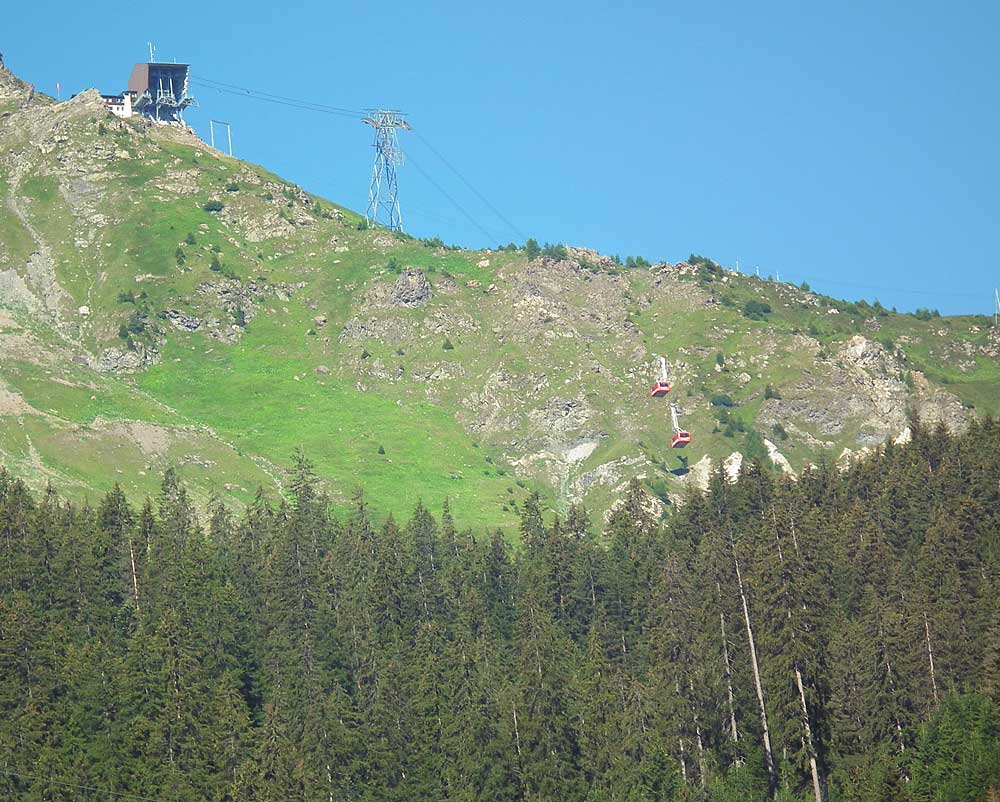
The Parsenn Cable car viewed from our apartment.
We could catch the bus right outside the door and ride to the top of the mountain - all for free.

Although Davos and Klosters are very expensive places, we spent hardly any money on activities, as the card gives free travel on all the funicular railways and cable cars, as well as on the regular trains in the Davos region and local bus services. We rode all of the cable cars except one, and caught local trains. Susan even caught the bus. We also caught the historic train (some of us twice) which was also free.

Rosy and Dad sitting in the funicular that goes to Weissfluhjoch.


We didn't get to ride the vintage bus up to the brewery because that has to be booked and it was full on the Tuesday we were there. We also missed out on the dairy farm visit, paragliding, and downhill mountain biking, but honestly we didn't feel like we had much time to do anything else.

The saving are amazing - this is how much I saved.
 
That is 322 Swiss Francs just for me, which is about 275€. The card is funded out of the tourist tax, which is about 3 euros per person per night. You do have to remember to take your card with you everywhere, but that's no hardship.


We will be writing about all of this stuff in more detail later, but in case you're heading Davos way - don't forget to ask about the card

**********************************************


Today is Preuilly's brocante. We will be putting in our usual (brief) appearance, and then divng off home to get out of the sun.

Friday, 3 August 2018

Hedgehogs in Decline


The presence of a hedgehog in your garden is a good sign that your biodiversity is high. Sensible gardeners welcome these nocturnal insectivores because they also love to eat slugs. But this once common animal is now threatened in France. What is perhaps most alarming is that it is in rural areas that they are declining most.

A hedgehog being filmed for a nature programme at Chenonceau.

Hedgehogs have a naturally high mortality rate. One in five babies doesn't survive to leave the nest. Once out in the big wide world they can succumb to parasites, predators such as weasels and foxes, or not make it through a hard winter. But increasingly the cause of death is not natural. A million are being hit by a cars annually, and a similar number poisoned by pesticides. Some of them drown in swimming pools. Their habitat is being altered and degraded so they have to travel further and further to find food.

A hedgehog in our driveway.

In urban areas the population density of hedgehogs is between 15 and 37 individuals per square kilometre. In rural areas the numbers drop to between 1 and 4 hedgehogs per square kilometre. In the last 20 years the population has declined by two thirds. In the past you could expect a hedgehog to live about 10 years, but now the lifespan is about two years, because they are exposed to more risks.

Ecologists consider the hedgehog both an umbrella and an indicator species. What is happening to them is likely to be happening to other small wild creatures. The National Natural History Museum points out that if we restore habitat such as hedges, natural vegetation and enclosed bocage field systems for hedgehogs then other groups such as insects, snails and spiders benefit.

If you want to help your local hedgehogs the two most important things you can do is not use pesticides, so there is plenty in your garden for them to eat, and provide a 'wild' area of long vegetation and undergrowth that they can safely make a nest in. They like leaves, piles of light wood and twigs, moss and compost to hide and hibernate in. If it is practical (ie if your pets are not allowed out at night and you are not going to attract rats) you can leave out cat or dog food for resident hedgehogs in the autumn. This will help them reach a suitable weight for hibernation and increase their chances of surviving winter.

Thursday, 2 August 2018

And so, Home

We arrived home late on Monday evening, after a brilliant10 days away, mainly in Switzerland, but also visiting parts of France we haven't seen before, and touching on Germany, Austria, Liechtenstein and Italy.


What an excellent holiday, full of wonderous things - mainly whacking great big mountains, although seeing my brother in the marathon was also special. The "mad lady in the box" behaved herself, although she did turn herself off in a huff on Monday after I took the wrong exit on a roundabout because the exit she wanted us to take just wasn't there any more.

We covered 2,390 km, saw heaps of stuff we've never seen before, travelled roads I hadn't even dreamed about,and spent some real quality time with my father. We will be spending some time writing about the holiday, probably on Saturdays. Be prepared for photos of mountains!


We're now looking for cool places to take someone with mobility issues. Any suggestions are welcome!

Wednesday, 1 August 2018

Medieval Mayhem

Every year on the first weekend in August, Chinon hosts a medieval fair. It's fun and lively and if you are in the area, worth spending a few hours enjoying the spectacle. Here are some pictures from last year's event:


Tuesday, 31 July 2018

The High Country


Yesterday was an exciting day, following roads selected from the safety of my office chair in Preuilly with the intention of getting us more or less half way home from Klosters. We will be writing more about the roads we followed in future posts.

 Yes, that is a 4 metre wall of snow.

Our sixth country in seven days.