Thursday, 14 July 2011

Rock and ummmm Samba!!

Bastille Day: We have it early in Preuilly, the festivities happening on July 13th with a sort of symbolic storming of the chateau, led by a Samba Band (we're sticklers for historical accuracy in these parts, don'tcha know).


After parading the streets we ended up with fireworks and le rock'n'roll dancing (aka bal populaire)

Today is a quiet day.

Simon

Wednesday, 13 July 2011

The Gardens at La Châtonnière

Although we visited after the main flush of roses was finished, and this is a garden where the rose predominates, there was still a lot to catch the eye and charm.


This privately owned château is close to Villandry and Azay-le-Rideau, but I think a bit overlooked because people stick to the big name châteaux. It is very obviously a garden in the 'English' style of billowing plants and floral abundance, so it is a shame more people don't visit it. Anyone who likes a somewhat less fiercely controlled garden than Villandry presents, but admires the formal nature of the garden's structure will love la Châtonnière for its combination of geometry and romantic abandon.

Susan

Tuesday, 12 July 2011

The French Cheese Board

At lunch or dinner you are always offered a cheese course in French restaurants, and most French people will take it.

Even in the most out of the way rural places, such as a restaurant in the middle of the Brenne, cheese is taken seriously. The cheese board here is expanded to a full on cheese trolley, and the choice is extensive. It includes all the local goat cheeses and many cow's milk cheeses from far and wide in France.

The waitress in the picture is called Camille. Her name badge says she is a stagiare, meaning she is a trainee (or more properly, an apprentice) doing work experience. The government provides financial incentives to restaurants to employ young people under the age of 19 for two years and train them up in the business. Waitressing is a proper profession in France, and Camille will learn all about how to present and serve food both on the job and in formal training at the Centre de Formation d'Apprentis (Apprentice Training Centre) . Camille will have chosen her profession because she cares about food and waiters are part of the restaurant team all working towards providing the diner with good food at a fair price (un bon rapport de prix et qualité, a very common French expression of praise for a restaurant they have enjoyed).

Susan

Monday, 11 July 2011

A Mill Restoration Project

Pont de Ruan is a typically pretty village in the Loire Valley area. Its star attraction is a large and picturesque mill complex, currently in the throes of restoration. The village is situated on the Indre River, a medium sized river with many mills, which is part of the Loire system. The project has received European funding and is co-ordinated through the Communauté des Communes (ie local government).

The original mill was constructed in 1285 and for most of its life was a flour mill. In the 19th and 20th centuries, up until 1972, the waterwheels powered an ice making factory.

The twin undershot wheels (below) were both turning when we visited, although the building housing them was encased in scaffolding.

Because the river Indre has been divided into many channels here, with complicated arrangements to control flow to feed several mills, there are a number of islands. This one (below) covered in ash trees, is stablised in the ancient tradition. The trees are carefully cut and trained so that their roots provide buttressing and revetements (a bit like traditional hedge laying) to ensure the island doesn't wash away. You can see this system of bank stabilisation along the canals of the Marais Poitevin too, to our west, also using ash.

A view of the mill on the other side of the river (below) across the millpond.

A bridge out on to an island with picnic tables (below). The tables are chained to the trees, and at first I assumed it was to stop vandals throwing them into the river, but then it occurred to me that it was more likely to stop them being washed away in a flood. Vandalism of that nature is quite rare in the Loire.

Susan

Sunday, 10 July 2011

Look Out for Lizards

In early to mid-July (or even earlier this year) you sometimes find small leathery eggs in warm sandy places. These have been laid by Common Wall Lizards Podarcis muralis (les lézards des murailles in French). When they are first laid they are quite small, but they swell with the growing baby lizard inside until they are about 14mm long.

These were found by our neighbours, and brought over to me
to identify.
If they survive predation they will hatch into tiny lizards about 20mm long. We see them scurrying all over the place in the garden, on the walls of the house, in the courtyard. We find they are quite prone to coming inside, where they are almost impossible to catch and put outside. We rescued one from the laundry tub last year and had several abortive attempts at convincing one who had taken up residence in the fireplace that it would be better off outside.

Susan

Saturday, 9 July 2011

Tour de France 2011

Usual madness...

A couple of new caravanne cars:
and lots of shouting and stuff.

This year we were stood at the top of the climb out of the Cher River valley at Faverolles sur Cher. This meant that instead of the whooshing of two years ago, we had serious riding up hills faces.

Mum and Dad were most impressed (although my mother confessed to being a bit confused by it all). We really enjoyed the fete atmosphere, even though the buvette was chaotic. (No-one, including the officials, had quite worked out how it operated: as one explained to Susan "well - we don't get the Tour de France every day"). Alongside the beer and sausage tents there was a crepe tent, some food tasting, stunt bicycles, a decorate your bike contest for the kids, stationary bike races (rolling road things) and various community and artisan food stalls.

And now the movie:
Yes, if you know where to look and stop on the correct frame of the coverage, you can see us. No, you won't recognise us - in fact, not even my mother would recognise me, and she was there....

Simon

Friday, 8 July 2011

Ghost Sign 2

This was photographed in Loches - it appears there are two adverts, one over the other.

One is for a patisserie, the other (maybe painted over the top) I cannot work out.


Today we are off to Faverolles to watch the Tour De France. They have a fete and special marché today, with buvettes and everything. I hope they are doing a diet buvette.

Simon

Thursday, 7 July 2011

It Does My Heart Good

Having reached a certain age and being part of the French health system, certain people have started taking what would normally be considered an unhealthy interest in my insides. Because of my mother's heart problems (and the fact that I obviously enjoy food) our health insurer, which is privately managed but part of the state health insurance system, decided that is where they would start.

On Tuesday I had an all day appointment at the Centre de Réadaptation Cardio-Vasculaire in Ballan-Miré, just south of Tours. This meant leaving home at 06.45 for an 08.00 start (far too early, really) and a series of tests:

08.30 Blood test
09.00 Breakfast
09.30 Ultrasound (echographie vasculaire)
10.00 Dietitican (enquête alimentaire)
12.00 Consultation médicale
12.30 Stress test (this means being hooked up to a machine and riding a bicycle)
1.00 Lunch

The afternoon was mainly sitting around waiting for various test results and re-visiting the dietitian and doctor to get the bad news.

Susan came with me to help with the language issues. Although I understand a lot of what is being said it helps to have two sets of ears and confer on meaning, and quite frankly, when it comes to speaking French I am still at the garbled stage when under pressure. We were both well impressed with the hospital. It is set in large landscaped grounds (18 ha, or about 45 acres) with a number of duckponds and benches set under trees from which to view them.

The restaurant was very stylish - proper damask tablecloths and napkins, waiters in waistcoats, and silver service. Lunch was 4 courses (including cheese but no wine) and no disincentive to have to visit again.

The good news is that my body is - as I knew all along - a finely tuned machine and my heart is a masterpiece of the watchmakers art (resting heart rate 53, which surprised even me). I have to curb my enthusiasm for eating (which is also something I knew), but apart from that all is good.

Simon

Wednesday, 6 July 2011

Bonne Maman® Sablés des Près

This new biscuit by Bonne Maman® is proving to be a real hit. We really like them, but often when I go to the supermarket there is just empty shelf above their price ticket. This is partly due to the fact that Bonne Maman® are running a special which gives 1€ off if you buy three packets, but it is also because everyone likes them.

They are not very sweet, and are great with a cup of coffee, or tucked into a bowl of red fruit compote and vanilla icecream. Sablés des près translates as 'shortbread from the meadow', and they contain sesame, poppy and sunflower seeds. We bought our first packet by chance at SuperU in Saint-Aignan, because we needed a snack. We've been seeking them out ever since.

The Bonne Maman® biscuit recipes are simple and traditionally based. The factory is supplied with milk from local dairy farms and they use fresh eggs not powder. No synthetic flavourings, colourings or preservatives are added. The sablés des près packet lists beurre frais (not palm oil, I am very pleased to report).

Bonne Maman® is the most famous range made by Andros, a family owned company based in Lot. They make high quality jams, bottled fruits and biscuits that we often buy. They are a famously secretive bunch, never giving interviews. The Bonne Maman® products are distinctively packaged, and reuse of their jars for homemade conserves or as trendy vases or drinking vessels is actively encouraged by the company. The jams are 10% of Andros' total business, taking 35% of the French market and selling 68 million jars a year, made from 20 000 tonnes of fruit (most of it fresh, unlike some of their rivals). The biscuits gain market share year on year against the giants like LU (Kraft Foods). A third of their jam is now exported all over the world, but only 10% of their biscuit production is sent out of France. Bonne Maman® products are significantly more expensive than their rivals, with jam working out at about 11€ / kg (compared to 7€ / kg on average), but consumers know and trust this quality product so are prepared to pay the premium. The supermarkets love the products because they provide a good margin.

The Bonne Maman® range was launched in 1971, because Andros company founder Jean Gervoson realised that most women now worked outside the home. Although they no longer had time to make jam, there was still a desire for homemade jam, and Gervoson set out to provide a product that was as close as possible to homemade. He named the new range in honour of his grandmother, whose recipe book provided some of the inspiration. The product packaging has not changed in 40 years, and the simple white label with text and no picture is deliberately reminiscent of the handwritten labels our mothers and grandmothers used. With their gingham patterned (vichy in French) lids these quietly understated pots of jam are instantly recognisable on the shelf even in the biggest supermarket- a stroke of marketing genius.

Susan

Tuesday, 5 July 2011

Bathroomingtoo

In addition to chosing a bronzy/metallic/rust coloured tile for the bathroom (better than I describe them) we decided we needed a highlight on the floor. We chose some small glass tiles which are a combination of flat mirror, patterned mirror and dark glass which are meant for walls and come in a gauze backed square. We cut the square up into strips of two tiles, and laid them in a line from the door. Sounds easy, but glass tiles dont snap they shatter, so we had to cut them with a diamond blade.

As a picture paints a thousands words....
Once that was done it was time to call the plumber again. There was some confusion and tribulations as he didn't turn up the first day, turned up the second day in the 10 minutes between the end of lunch and us getting back from lunch, then arrived at the third time lucky, but with only the hot water ballon rather than with the ballon and instructions to fit it and plumb in the bath. This meant time was getting short as my parents were due to arrive last Thursday and we wanted the bathroom usable.

As the plumbing hadn't been done by Wednesday we sorted out temporary plumbings (a plastic basin, electric kettle, and 20 litre water carrier. I went off to Paris on Thursday to collect the AP's (see Coot Club) and then the plumber rang to ask if we were in. Mickael - who did the first lot of plumbing - arrived and fitted the hotwater ballon (under Susan's supervision)

and the bath!!!
Exciting isn't the word for it, I tell you.

Simon

Monday, 4 July 2011

Bathroomtime

Last time I wrote about the upstairs bathroom we had just started painting.

This was a bit of a process as the paint had to go on the sloping ceiling behind the beams, without too much going on the beams. I spent a couple of days working my way around the room and ended up with something that didn't completely offend my eyes. I know no-one else will notice the flaws (at least they had better not) and that when I am in the bath with my glasses off I won't be able to see them, but just knowing they are there upsets me.

After the ceiling was painted we started on the walls. A lot of time was spent discussing colours as we needed something to go with the very expensive sliding cupboard doors (as mentioned here) and the tiles we bought last year. In the end we chose BricoDepot Khaki Vert - a colour that looks green or brown, depending on the angle you look at it. The paint didn't fully behave: modern paint has so much plasticizer in it that it goes on in a sheet - and peels off in a sheet if it gets damaged. Eventually that too was sorted.

The two colours of one paint.
It can also look very brown
After that it was tiling time. The tiles are from Lapayre and were exactly what we were looking for. We discovered later that if you can work out what the manufacturer's name for the tiles are (Lapeyre invents all its own names) you can buy them slightly cheaper elsewhere (Bo Karo are particularly good in this respect; especially when it comes to plinthe, which was half price.)

Starting to tile - you can see how much
the dust just hangs in the air.

Simon

Sunday, 3 July 2011

Frog Fest

Yesterday we visited the Etang de Ribaloche in the Forêt de Preuilly. The water level gets lower and lower as the drought continues, concentrating the frog population. As you walk past they shoot off the bank and into the safety of the water. It's like sychronised swimmers diving in down the line.


Susan

Saturday, 2 July 2011

Monster of the Deep

This is something I didn't expect to see in the moat surrounding Chenonceau:

In fact, it isn't something you ever expect to see. Twenty seconds later it was gone: a shoal of little fish swan too close and it shot forward, scattering them all. I don't know what the result was, but they do have a reputation as fearsome hunters, even little (about 40cm long) one's like this.

For those who can't identify it, here is a clue:


Simon

Friday, 1 July 2011

Things to do in July, in and around Preuilly

Check out Ethni'cité - guided visits, lectures and workshops in troglodyte St Rémy-sur-Creuse.

Saturday 2 - l'Association Nomade has organised a meal to follow a session with the author Alain Borer in Saint Aigny (near le Blanc) at 18.30, in conjunction with l'Association Baguette de Coudrier. Telephone 02 54 84 04 67 to reserve your place. Alain Borer speaks English.

Saturday 2 - Festival des Barroudeurs 2011, the always excellent fun music festival at Barrou on the Vienne.

Sunday 3 - Fête Chasse Nature, Preuilly-sur-Claise. Open to the public 9 am, Messe de Saint Hubert 10.30 am (a mass dedicated to the patron saint of hunting), regional hunting horn competition, stands and exhibitors, local and regional artists, hot and cold food, parking and entry free.

Sunday 10 - Les Amis du Chatelier (the Friends of Chatelier Chateau) are hosting a concert of classical, jazz and gypsy music by the Ensemble quatuor Todoroff. La Grange des Protestantes, 5.30pm, for further information telephone 06 99 01 62 62.
Saturday 23 - l'Association Nomade's La Champ des Livres project has organised a book sale all day Au Panier d'Alice in la Celle Guenand. There will be workshops run throughout the day on how to speak better and the author Nathalie Desperches-Boukhatem will be signing her book of watercolours, drawings and writings on the characters and countryside of the area around Loches, Reflet et visages de Touraine.

Saturday 30 - the Café Franco-anglais is meeting Au Panier d'Alice in la Celle Guenand 16.00 - 18.00. Participants should bring an extract from a book, a song, a recipe, a personal story, a painting, a postcard, a photo, an event or a piece of history from their country to present and the group will discuss in French and English according to ability. It's all extremely informal, so come along if you are anglophone and would like a chance to practice your French in a friendly and supportive atmosphere. There is a 6€ charge to cover refreshments.

Susan

(Completely random images.)

Thursday, 30 June 2011

Cheery Little Devil

This is our first ripe tomato of the year.

If I could work out how to grow chillis this shape my fortune would be made.

Simon

Wednesday, 29 June 2011

It's Dry

We were at Villandry yesterday, and although the gardens are as amazing as ever you can see we have been having a dry time of it: compare this photo with one taken a year ago.

Luckily it was cooler yesterday - "only" 28 degrees C (82F), compared to 38 degrees (just over 100 in the old money) on Monday. Célestine was a lot happier on the road, especially as on Monday we were driving along the Loire River levee with no shade, whereas yesterday we were cruising along the shady Indre river by Azay le Rideau. By comparison, today's predicted high is a perfectly acceptable 23C (73F)

We were threatened with storms and torrential rain yesterday evening. Regular readers will no doubt not be amazed to hear we had one very light shower accompanied by massive thunder and lightning.

Simon

Tuesday, 28 June 2011

Clafoutis Bakeoff

It's probably a bit late in the season to be writing about clafoutis - my sour cherries were all picked by 5 June this year. Nevertheless, the latest summer edition of Régal ('Feast') features no less than three clafoutis recipes, on pages 60, 76 and a whole page article on the subject on page 114 (which I have shamelessly cribbed for most of the information in this post).

Unlike the Limousin griottes, Tourangelle sour cherries are
pale fleshed and red skinned, and known locally as guignes.
In the interests of scientific research and Simon's stomach, I decided to make all three recipes and see how they all turned out. They ranged from a family home cooking style classic to one credited to a big name chef. Both the cheffy version and the classic had a bit of butter in the batter, and the cheffy version and the one presumably created by a magazine staffer contained cream (the classic restricted itself to whole milk). Cooking times and temperatures varied from 150 - 180°C and 25 - 40 minutes. Apart from that, the recipes were much the same as my usual one and much the same as each other.

The cheffy version didn't live up to its promise of cherry flavour impact.
Clafoutis is a dialect word from central France, dating to the middle of the 9th century. It's a contraction of the old French claufir (from the Latin clavo figere), which translates as 'to fix with nails'. It's also derived from the word foutre, in the sense of 'to stuff full'.

The original recipe for this cake (in the Limousin, where it comes from, it is referred to as a gâteau) is a type of thick batter poured on the black sour cherries known as griottes noires du Limousin (ie a type of Morello cherry). Once upon a time it was cooked in the bread oven, after the bread was baked. The cherries are not stoned because to do so would result in the loss of a great deal of juice during cooking. The stones also enhance the flavour, by boosting the cherry flavour and adding a woody note. A good clafoutis rises during cooking, but inevitably drops once cool.

The family classic looked a bit stodgy, but was easily the best of them all.
The aim is to contrast the creamy batter and the juicy cherries. These days you can get all creative and make savoury clafoutis, with tomatoes, peas, carrots or fennel. Nevertheless, a cherry flavoured clafoutis remains a must during the French summertime.

The basic ingredients are flour, eggs, sugar, milk, fruit and if you like, a dash of eau-de-vie de cerises. It's quick and easy to prepare, often traditionally using the windfall cherries, and is best eaten warm.

Not sure this recipe went through the Régal
test kitchen before publishing.
Another speciality of the Limousin, the flognarde, is a winter version, with the batter poured over apples, pears, dried fruit or nuts. The tartouillat from Burgundy and the millard from the Auvergne are both dishes made from flour, eggs, sugar, milk and cherries, bearing a remarkable resemblance to clafoutis. An early 20th century food writer from the Périgord, which borders the Limousin, suggested a mixture of grapes, sliced apple, dark plums and sultanas.

Susan

Monday, 27 June 2011

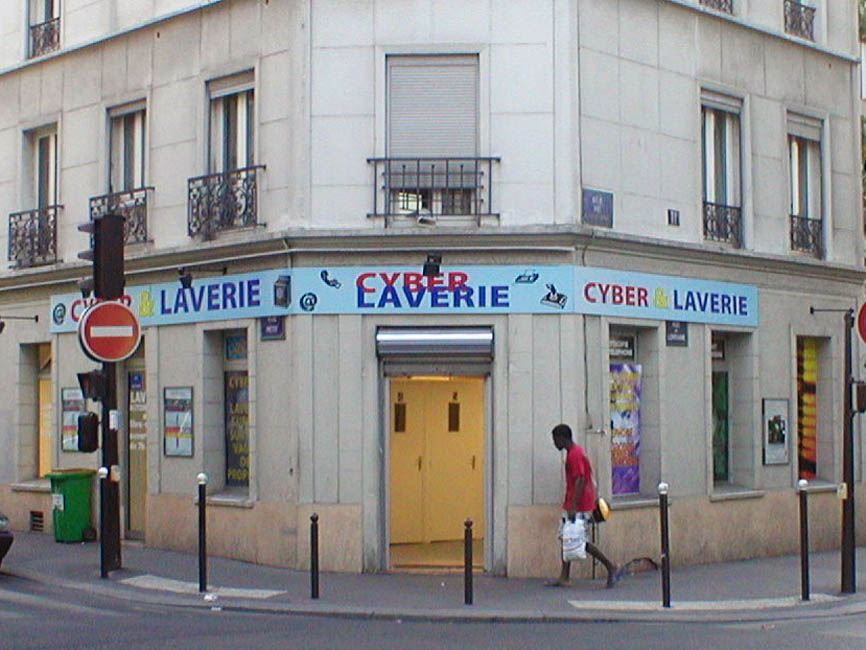
Cyber Laverie

This has to be one of the best ideas I have seen for a long time!


Simon

Sunday, 26 June 2011

Moulin Fort

I have spent quite a lot of time at Chenonceau lately, and while Susan is inside the château I usually sit near (or in) Célestine.

In the carpark at Chenonceau.
Célestine always attracts attention
The last couple of visits I have gone off for a wander along the river or through the village, and on one such wander I ended up at the Moulin Fort at Chisseaux. Not the mill itself - according to Google Maps that would appear to have been on an island (not sure how that would work, really, as there doesn't ever appear to have been a bridge to the island) but the northern bank.

I rather suspect that the actual mill was on the southern bank associated with the weir, as the map shows a stream that looks suspiciously like a mill race, and usually a weir is necessary to keep water levels high enough to make a mill usable all the year round.

The weir and lock at Moulin Fort
Also associated is a lock, dating from when the river was used for transport. These days the only transport on the river is the occasional canoe, and tourist sightseeing boats which run a very short course down under the chateau and back.

I have tried to discover more about this mill, but the only references on the internet are about a pair of camping sites - either side of the river - which share its name.

It's a nice place for a wander though.

Simon

Saturday, 25 June 2011

Sit!

These wonderfully characterful statues of hunting dogs line the entrance to the Logis Royal in Loches.

They are representations of 15th century hunting dogs of the sort used to chase or bring game down and stand as a testiment to the Valois kings love of hunting.

We visit so often during the season that we now have Cartes Ambassadeurs for the Historic Monuments owned by the département of Indre et Loire (like the Cité Royale de Loches). These cards are an annual fee of €10 and let you in for free or a discount to all 5 sites.


Susan