Saturday, 12 July 2008

Moving the Bath, part 2

(Cont) Once the bath was filling the space where we would normally climb down off the first (or for you North Americans, second) floor, we had a little problem. We needed to be on the ground floor to deal with a half lowered bath.

Luckily, our second ladder is just long enough to reach one of the bedroom windows.

Once we were at ground level we had to do some more thinking and planning.

We decided that if I could take the weight of the bath off the ladder, Adrian could slide the ladder shut and we could lower the whole combination to the floor. Amazingly, this worked with very little confusion and only a little(!) physical excertion.

Next step was to cap the pipes as they entered the bathroom. Unfortunately, they are right hard against the wall, so we were unable to get a pipe cutter to work. We decided that a blowtorch migh be a good idea - melt the solder on the joints, leaving us with nice clean pipes to work with. Unfortunately I do not have a blowtorch, but Alan and Jane were due for drinks...... Luckily Alan DOES have a blowtorch, so in return for a couple of beers we had the tools to do the job.

After Alan and Jane had left, Adrian and I once again climbed the ladder (now back in its more sensible position). At this stage we were pretty relaxed...

and it turns out, justifyably so. Fifteen minutes later, the pipes were capped, and we could turn the water back on. We didn't even burn the house down!

Next morning we put the bath on our new trolly (sack truck), rolled it into the garage, and the job was done.

Simon

Friday, 11 July 2008

Moving the Bath, part 1

The one thing (Ok - I will admit it - one of the many things) that has been playing on my mind is the weighty problem of the bath upstairs.

The situation as it was when we arrived back in Preuilly was that the bathroom wall had disappeared, and the hot water pipe to the bath had been disconnected and capped. The floor was rotten through, and there was no room to reach the water pipes as they came through the floor, being, as they were, underneath the bath in a back corner. As I had extra manpower with me (in the form of Adrian and family) now was the time to act.

Once we had turned off the water at the mains the first thing was to create more room, and this was facilitated by disconnecting and removing the very attractive green hand basin and stand. This went without a hitch.

Next step was to cut the pipes to and from the bath so we could move it. This was also quite simple, although the wastewater and overflow were resistant to change. They were plastic piping, so being hit with a hammer sorted that out fairly quickly. We then dragged the bath away from the wall - except that it wasn't giving up that easily. It had been tiled in along its length and the rolled top cemented into a groove in the wall. Once again, injudicious use of a hammer had that little issue resolved in a matter of minutes. We then lifted the lip of the bath off the wall, and could consider where the bath was going next.

We rolled the bath onto its side to remove the taps and spout, then completed the roll so that the bath was upside down. It was at the stage that we discovered that the legs (which we had contemplated attaching the ropes for lowering the bath, even though we hadn't worked out the mechanics of that step yet) were attached, but not totally convincingly, by rusted in bolts. They certainly gave no indication of being anywhere strong enough to have the weight of the bath hung off them.

At this stage it was time for a think, so we stopped and thought.

As the taps were no more, the bath had a pair of symmetrical holes and we passed the rope through these. we had decided that we would use one of our ladders as a slide, so we pushed the bath (upside down) over the lip where the staircase used to be. We then had a handy place to slide the ladder. All we had to do then was let the bath slide gracefully down the ladder to a gentle stop almost (but not quite) against the wall. It was at the stage that Adrian and I checked with each other as to how confident of a controlled slide we were.

It became evident that even though we were fairly sure that gravity would bring the bath down the ladder, neither of us were confident about control. We grabbed my crowbar (bar du mine, in French), wrapped the rope around it to act as a brake, braced it either side of the stairwell, and pushed the bath until we reached tipping point.

All that was then left to do was push a little more, ease off the rope, take our feet off the edge of the bath - and let Mr Newton's discovery do the rest.

(You mqy hqve to click on this imqge to open it in q new window in order to see it in its full glory. This is new technology qnd I qm chqllenged)

I am posting this from the library (which has just changed its opening days and times) and have more to post on the bath. as soon as I work through some technical stuff, there will be part 2.

Simon

Thursday, 10 July 2008

The Circus hits Town

Wow.

What a do!

Maybe not the most sophisticated afternoon's entertainment, but a real barrel of laughs.

For those who have not experienced the excitement of Tour de France day (hi Susan and Ken), this is how the day goes:

First you get together for lunch with some friends. In this case it was Adrian, Carolyn and Corey from Australia, and Bengt and Susanne from Sweden. After a BBQ of Chili prawns, mergeuz sausages, various salads and a splash of gamay we wandered down the bottom of our street (struggling uphill struck us as a silly idea).

After watching the gendarmes stop the traffic (we had a barrier at the end of our street, how cool!) you wait around for ever in the sun, watching your neighbours watching you.....

After a while a couple of police bikes zoom past (in fact, many police bikes zoom past)

There is then a pause during which the occasional sponsors car, official car or police bike wizzes past.

After an hour the official "caravanne" blasts past - all pumping music, dancing girls and free gifts. I now have so many bags, hats that dont fit me, free copies of newpapers, minipackets of sweets, laundry detergent, keyrings........... The one that impressed most was the man from Vittel misting the bystanders with cold water.


After the caravanne has past there is a wait of about an hour, interspersed with more officials, police bikes, photographers on bikes, and rumours of impending arrival of cyclists. Then the street sweeper arrives.

There is then a couple of cars and vans making announcements you can't hear properly and wouldn't understand anyway telling you how far away the cyclists are. And then the cyclists arrive.

First the leaders, surrounded by camera motorbikes and cars with spare bikes on the roof.


There is a pause of about 5 - 10 minutes, then the peleton (all those not leading the section) arrives and screams past.

They are followed by support vehicles carrying spare bikes, first aid cars and breakdown trucks (and more police on bikes)

And then the day is over. Two hours of standing in the sun, getting carried away and waving at cars full of policemen, and wondering about why it makes you feel you have witnessed something so special.

Simon

Wednesday, 9 July 2008

Tour de France day

Today is Tour de France day.

The plan is to have a bbq with whoever is around and then wander down the road to watch the cyclist power by. Or we may wander up the road and watch them (hopefully) struggling up the hill out of town.
Do I watch them coast down here:
Or pedal up here:


Either way, it is a 50 metres walk, so that's not too bad. Hopefully, more news and pictures tomorrow. This presupposes the library stays open until 6.00pm this evening.

Simon

Tuesday, 8 July 2008

Beetles Chew and Bugs Suck

Although both theses beasts present in scarlet and black stripes, one is a beetle (on the left) and one is a bug (on the right).The rather hairy beetle was photographed in June in a friend's garden at Roux, near Preuilly-sur-Claise. It is Trichodes alvearius, a common beetle of flowers, especially umbellifers (although in this case, on a hollyhock). Both adults and larvae are carnivorous and predate bees and their larvae. I confirmed the species using a key sent to me by my friend John (who spent his holidays in the 1990s surveying water and reed beetles in la Brenne). The key was in German, but I'm sure the challenge has made me a better person.

The bug is Graphosoma italicum, also abundant on umbellifers - this one is on Rough Chervil. According to my friend Big Ger, Interpretation and Infrastructure Officer at RSPB Rainham Marshes, this guy is wearing Dundee United strip. Curiously my field guide doesn't mention this connection, but does point out that the colour is a warning of foul taste. The photograph was taken in May at Montrésor, one of the 'plus beaux villages de France' and always a good place for a spot of demoiselle watching.

Susan

PS Can someone tell me whether the 't' in Montrésor is sounded or not? I had always assumed it was, thinking it was 'trésor' as in 'Trésor public', (and therefore Treasure Mountain) but our blogger 'neighbour' Ken's post on Montrichard set me wondering.

The naming of names:
Trichodes alvearius - 'trichodes' = 'hairy'.
Le Clairon des abeilles, le Clairon commun ou le Clairon des ruches - 'bee bugle', 'common bugle' or 'hive bugle'.

Graphosoma italicum - 'Italian lined body'
La Punaise arlequin - 'harlequin bug'.

Rough Chervil
Chaerophyllum temulentum - 'chaero' = 'to rejoice', 'phyllum' = 'leaf' - this is a 'Lego word' according to Wordsmith ie a word created using combining forms; 'temulentum' = 'drunken'. (No, I've not tested it, and the bug wasn't behaving inappropriately in public.)
Le Cerfeuil penché - 'leaning chervil'.

Monday, 7 July 2008

Amiens Cathedral

Recently we took my parents up to the north of France, mainly to see the World War II D-Day landing beaches (aka Operation Overlord sites) and the World War I cemeteries. A good place to base oneself for visiting these places is the city of Amiens in Picardy, and indeed Amiens is well worth visiting just for its own sake. It has a magnificent cathedral for one thing - the biggest and tallest in France, and deservedly a World Heritage Site.

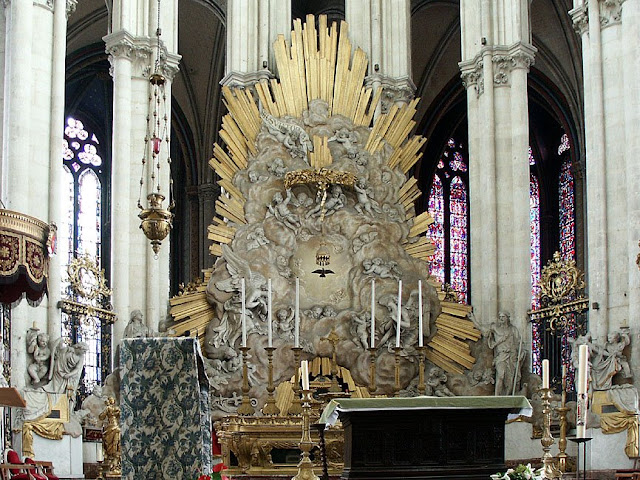
Amiens Cathedral is big. Really big. And packed with so much detail you don't know where to look next in order to take it all in and not miss any of the characterful carving (in stone on the front, in wood in the choir) or the outrageous Baroque confections that make up the high altar, the pulpit and some of the tombs. The detail is from every century since the Cathedral was begun in 1220 and the quality is superb. So is the space - the place is huge, swallowing all this detail and still being awe-inspiring the way a Cathedral should be.

Look at the great airy spire, with its attenuated angels keeping watch. This is the real thing (unlike Notre Dame de Paris, whose similar looking spire is a 19th century addition). In French this style of lead covered timber spire is called a fleche (ie arrow).

Look at this demonstration that more is more. (You can go round the back of this distinctly OTT but undeniably skillful arrangement and find that the artisans had thought of that too - the back is painted more simply, but maintains the trompe l'oeil.)


Look at the affecting scene being played out on the end of one of the choir stalls. For the type of single, relatively brief visit the average tourist is likely to make the choir is, in my opinion, the single best part of Amiens Cathedral and the 16th century choir carvings alone makes it worth a visit. You can get right up close to little vignettes like this one we photographed. At this level, the carvings are unpainted, but higher up, in the choir screen, they are polychrome masterpieces, even more detailed than the stalls.

Susan

**************************************

For details of our private guided tours of chateaux, wineries, markets and more please visit the Loire Valley Time Travel website. We would be delighted to design a tour for you.

Sunday, 6 July 2008

Les Amandes - Almonds

The French consume a lot of nuts, and three sorts in particular are grown in France - almonds, walnuts and hazelnuts. Almonds are especially widely used as they are one of the mainstays of the French pâtissier's art. All over France, almond paste or powder appears in yesterday's croissant; as marzipan, macarons or nougat; in biscuits and cakes of all sorts; and, in restaurants, swimming in the beurre noisette with fish. Almonds are not grown in the Touraine, which is walnut country, but almond trees are seen in many gardens to the south of us, in the Charente. The flavour can be sweet (milky fresh blanched almonds), moreishly nutty (unblanched dried almonds) or somewhat overpowering (almond extract). Excitingly, the flavour of almonds, like the kernels of other stone fruits, comes from highly aromatic chemicals which include cyanide. Almonds must be quite closely related to peaches, because on the tree, still clothed in their fleshy outer layer, the crop looks like rather poorly performing peaches.
I made this almond caramel tart from a recipe given on David Lebovitz's blog. It is one that he apparently made often at Chez Panisse, the restaurant run by the highly influential Alice Waters in Berkeley, California. His instructions cannot be faulted.

Susan

(Thanks to Ken for pointing out a couple of errors in this entry, which I have now corrected.)

Friday, 4 July 2008

More big boys toys

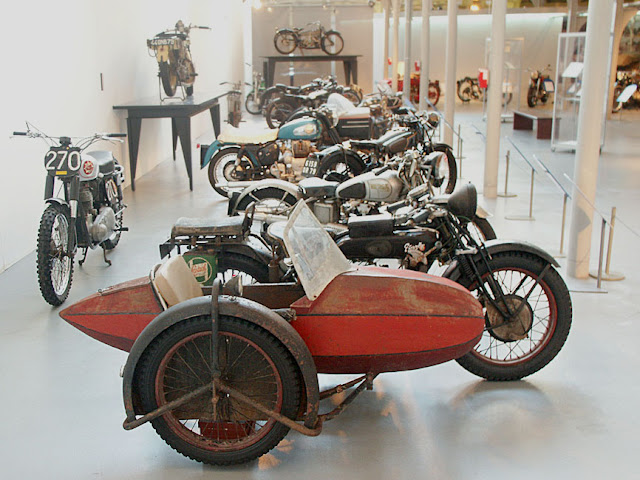
As well at having some beautiful cars, The Musee Auto Velo has a large collection of Motorbikes. This year they have an collection on display from a private collection.

I know little about these bikes, except for the fact that some of them are very pretty.

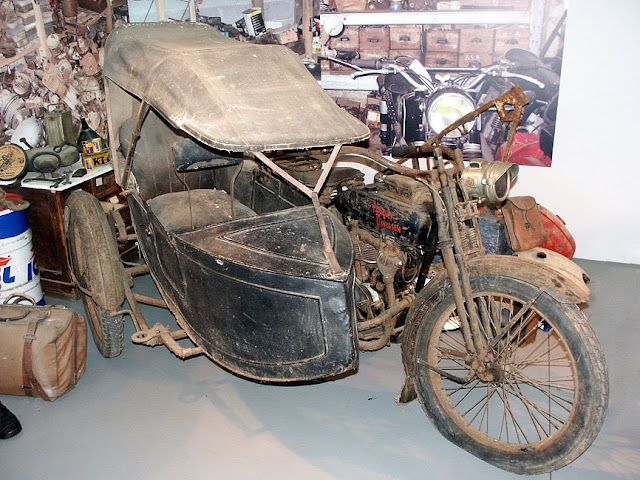
A 1917 Harley Davidson

An Indian and sidecar

A Norton. I like Nortons, but know nothing about them.


Simon

Thursday, 3 July 2008

Cèdre du Liban - Cedar of Lebanon

Cedar of Lebanon Cedrus libani has featured before on this blog, and not so long ago. Since it is so commonly seen in gardens and parks in France, and since there seemed be some interest in the tree, I thought I would share another nice specimen with you.
A close up of the cones.

A close up of the needles.
This tree is growing in the park of the Château de la Celle-Guenand. The château grounds are not obviously open to the general passing public, but we were very kindly invited in by the owner, who was up on the roof with the builder, engaged in some very serious repair work. Even though our own roof is now finished, we take an interest in the traditional craftsmanship that goes into the local slate and tile roofs, so we stopped to photograph and fell into conversation. We will post photos of the château itself and the building works at a later date.

Me and Dad indulging in a bit of tree-hugging.
Susan

Wednesday, 2 July 2008

Some different pictures of Preuilly

Looking back over the blog, I see I have posted pictures of some of the sites in Preuilly more than once.

Just to celebrate, this is another angle on Preuilly's most obvious feature, taken from the little alleyway that runs, almost hidden, down the side of the church and underneath the flying buttresses. In this you can see the full glory of the "Burgundian" tiles.
For some reason I cannot fathom, photos of the water mill on the Claise are conspicuous only by their absence. So to redress the balance;
The waterlillies are just about to blossom in this photo, taken on the 20th of May this year. Who could tell, looking at this photo, that a week before the photo was taken the river was in full spate and no sign of the lilles was visible.

When we first went to Preuilly, the Plan d'Eau had concrete electricity pylons across it. Now it has goalposts. I'm not sure why, maybe it's to attract the local kids (all 14 of them if I can believe the evidence of my own eyes) away from playing on the sportsground.
At the moment, it looks like the Preuilly website has disappeared. I don't know if this is permanent or why it has happened. Next time I am in town I will have to find someone to ask.

Simon

Tuesday, 1 July 2008

Wild Pink

This gorgeous flower is growing wild on the cliffs at Angles sur l'Anglin. Clove-scented and a bit straggly, it is tucked in on a sunny ledge overlooking the river. I think it is the rather rare Oeillet de Grenoble or Cheddar Pink Dianthus gratianopolitanus, but Pinks, the ancestors of modern carnations, are difficult to accurately identify and there is always the possibility that it is a garden escapee.
The rugged chalky cliff is just the right sort of habitat for a Cheddar Pink though. This is a plant of limestone cliffs, such as in much of France, but the plant is confined to a single gorge in Britain. Somewhat unusually, Cheddar Pinks are pollinated by butterflies and by both diurnal and nocturnal moths.

Susan

The naming of names:
  • Cheddar Pink - the Cheddar Gorge is this plant's stronghold in Britain; 'pink' because it's, well, pink - no denying it! (And yes, the cheese is named after the same area.)
  • Dianthus gratianopolitanus - from 'dios' (god) and 'anthos' (plant); Saint Gratian was the first Bishop of Tours, there was also a Roman Emperor Gratian and the name means 'pleasing' or 'agreable'; Angelo Politanus was a poet and scholar, tutor to Lorenzo d'Medici's children, but I have no idea what connection, if any, to the plant he may have.
  • Oeillet de Grenoble - 'Grenoble eyelet'. Grenoble is the main city in the French Alps.

Monday, 30 June 2008

A Surprise Visit

As I was sweeping the house (a continual task in an old house made of limestone and occupied by a man intent on demolishing walls) I was surprised to see a bundle of dust wriggling its way across the floor.

This "poor little fella" (© Rolf Harris) had managed to get his head completely entangled in a dust ball and wasn't at all happy, striking out at all and sundry. He almost managed to be scary - not a bad effort for a non-venomous snake only 10 inches long and as thick as my little finger.

I used a broom to shoo him onto a shovel and trap him there while I carried him to the garden. Just as well I am a tough Aussie used to snakes.

Just let no-one say we don't live in the country

Simon

Note from Susan: For those of you interested in such things, the visitor is a juvenile Western Whip Snake Coluber viridiflavus (Couleuvre verte et jaune). A photograph of an adult can be seen in my post about Snakes in France.

Sunday, 29 June 2008

Big Boys Toys

In May I went to the Musée Auto-Vélo in Chatellerault's old arms factory with Susan's parents.

I was surprised (and not a little excited) to see they have some seriously good cars in there, a brace of Bugattis included. I am not a car expert by any stretch of the imagination, but I do appreciate beauty - and some of these cars are beautiful.
A Bugatti (Type 44?)
I am fairly confident this is a Bugatti type 35

Maybach DS8 Zeppelin: 8 Litre V12 200 hp (150 kW) weighing 2.3tonnes

OK - I accept that the Zeppelin is a hefty brute, and not exactly beautiful, but it does have a hydraulic jack on each wheel and a clutchless gearbox. It is huge - just the sort of car you need for running peasants off the road - and it looks the part!

1929 Voisin C14 coach - just how stylish is that?

A Peugeot, possibly type 58 (or not - according to what I can find on the interwebby thing, the type 58 was a pre WWI car of a really old pattern) There are very few (ie almost no) resources on the Musée Auto-Vélo on the net, which is a pity. I can't find a list of the cars they have, nor, apparently, have any car enthusiasts ever visited the museum with a camera. Even the publicity literature they produce to hide in the main tourist office doesn't present it in a terribly enticing light. The day we went there we were the only people visiting, and my main reason for visiting was to see the walkway between the chimneys - the museum was a bonus.

Simon