Saturday, 15 September 2012

Checking the Lines

When I was on a walk the other day I saw this helicopter flying low over the Claise Valley. Usually a low flying helicopter is bad news for someone, because most times it means a medi-evacuation for a poor unfortunate who needs a hospital faster (or smoother) than an ambulance can get there.

So this was going to be a blog about medical evacuation - except that is isn't, because when I looked at my photos later I saw it was a helicopter hired by ERDF (the electricity people) to fly low following electricity lines and looking for problems.


There is often a notice on the town notice board warning people of these flights, I assume either to alert you to the fact that naked sunbathing may not go un-noticed, or to calm the nerves of the black helicopter brigade.

For the technically minded people amongst you it is a Bell 206 B Jet Ranger III, immatriculation F-GJGV from Touraine-Helicoptre.

Simon

Friday, 14 September 2012

A Little Light Butchery

A few weeks ago I bought a piece of cote de boeuf (beef rib roast) from the butcher in Preuilly's high street, la Grande rue. This is somewhat extravagant for us. It cost €21.69, weighing 1.16kg and being €18.70/kg, but I blame Ken and Alexander.
Simon saws away.
Ken because he and Walt blogged about their new mobile butcher charcuterie service and buying big juicy pieces of rib eye at the front gate; and Alexander because he brought an impressively sized piece of beef to Martine's party - which I promptly ruined by cooking too long at too low a heat. I figured I was sadly out of practice with cooking this sort of cut and had better do something about it. I felt really guilty about not doing Alexander's beef justice (although he managed to dent his own cred as well by also bringing to the party some truly terrible homemade rosé!)
A perfect fit.
When I got it home I realised the piece I had bought was slightly too large for the pan I wanted to cook it in. I had nothing else suitable - all my other pans were either too lightweight or way too big. Thus we decided to engage in a bit of butchery, and Simon got out the hacksaw and set to work on the end of the rib. It only needed a few centimetres removed, something he achieved quickly and easily.
Served with homegrown potatoes, ratatouille and pumpkin (from Tim & Pauline).
I seasoned the meat with freshly ground 5 baies (a pepper mix of black, white, pink, green and coriander) and heated the pan to smoking. Five minutes searing on each side and 5 minutes resting - it was delicious. I can hold my head up again, and we had several days worth of roast beef sandwiches as a bonus.
Yum

Susan

Thursday, 13 September 2012

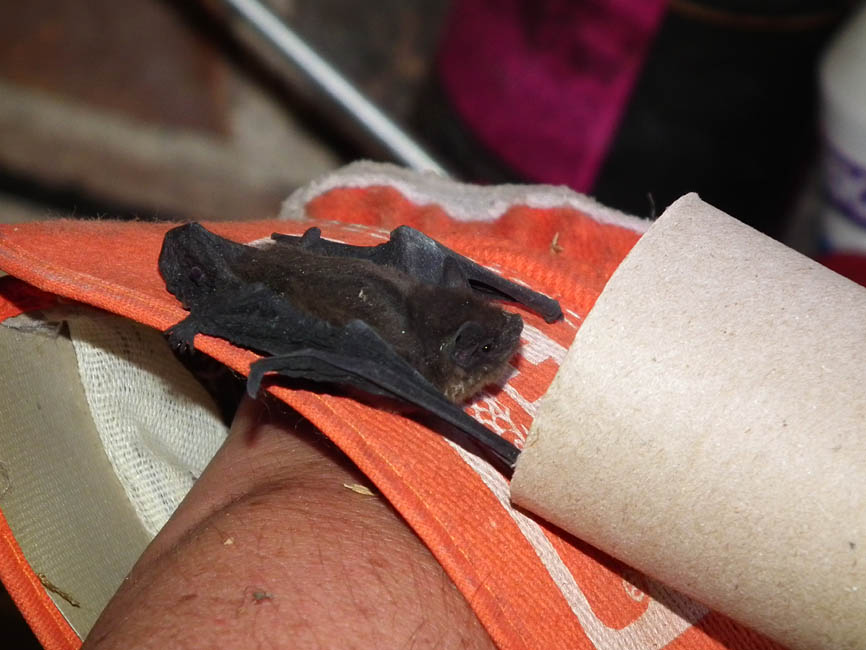
A Tiny Bat

One evening in late July I went out to lock the garage and discovered a bat 'legging' it across the driveway. They can move remarkably rapidly on the ground by swinging their wings forward and using the hooked thumbs as pivot points, waddling behind with their hind feet. Nevertheless, it appeared to be injured, with the left wing being held awkwardly.

I rushed inside to get the bat rescue gear (gloves and a toilet roll), my camera, and called Simon, so he could come and see the bat. I could only find a huge leather work glove, which meant that when I picked up the bat by gently encouraging it on to the glove, it kept wanting to snuggle down under the capacious wrist band. You are not supposed to touch bats when you rescue them, so this wasn't ideal. Eventually I managed to get it to settle in a crevice in the stones of our granary, but several times it determinedly climbed down and legged it across the grass. I was worried about one of the many neighbourhood cats spotting it. As small mammal specialists they would make very short work of an injured and grounded bat.

I was interested to note that whenever it encountered a spiderweb that it got entangled in it stopped and carefully removed all the strands. It was clearly small enough to be seriously impeded by the sticky filaments. It reminded me that when I worked for the National Trust we always made sure that house staff knew that the triangular sticky insect monitoring traps were not to be used anywhere that a bat might be tempted down to eat the trapped insects. We had heard of a few cases where the bat itself got trapped on the sticky surface of the cardboard.

We can only speculate that it had been roosting for the day under the wooden palisade gable of our garage. The palings are in poor condition and are now rather loose. They flap a bit in the wind and maybe it got knocked from his perch. Unlike the previous bat we had to rescue, who was outraged at us accidentally knocking it to the ground when we removed a piece of rotten lime mortar, this little chap was entirely passive and unaggressive. It just looked around and sniffed the air a bit, but did not appear distressed by being handled or attempt to bite.

Very sadly, in the morning, I found a little brown furry body in the driveway. I took the opportunity to measure it and confirm the identity. It was a pipistrelle, only 3.5cm from nose to rump, with a 2.5cm tail. This is only just within the size range for an adult pipistrelle, so I assume it was one of this year's youngsters. Tim pointed out to me that bats dehydrate very quickly and that it is a good idea to offer them a drink by placing a straw holding water in front of them (a thumb over the end will hold the water in the straw and allow the bat to lap water from the other end). I wish I'd thought to do that now.

The little body is now in a tomato pot, providing fertilizer and decomposing to bones so I can examine the teeth later and determine which species of pipistrelle it is.

Susan

Wednesday, 12 September 2012

Any Ideas?

Late summer, and all over Touraine the hay bales are once again on the move.

Except for this one, which has either been customised for a purpose which is beyond me, or sacrificed with a bamboo spear in some heathen French ritual.

Any ideas?

Simon

Tuesday, 11 September 2012

Journées du Patrimoine

Grain merchant's stencil.
The annual open house weekend, known in France as les Journées du Patrimoine (heritage days) is coming up on 15-16 September. Amongst the many places you could visit is Preuilly's little museum in the Poterne. As local museums go it's not at all bad, with many objects that refer back to Preuilly's past from prehistoric times to the Second World War. Because it is staffed by young volunteers it is only open during the summer holidays and the journées du patrimoine.

Bushel grain measures.
The objects from the museum in the photos have a special meaning for us. Regular readers will be aware that our property is a former grain merchant's. In the first half of the 20th century it was run by the Poupineau Bardon family. The grain measures were also gifted by the family connected to our place.

Susan

Monday, 10 September 2012

La Danse Macabre

Just recently I got an email from someone out of the blue. I didn't know them but they were planning to holiday in the area and were researching local sites with wall paintings with a view to visiting them. She had come across a snippet of information about the Chapelle de Tous-les-Saints in Preuilly-sur-Claise and knew that it had wall paintings. She'd seen the photos on the town website, and our blog post on the chapel. Sadly, I had to tell her that the building is in too dangerous a state to let people visit, but it did remind me that I have been meaning to write about the wall paintings for ages. Quite by chance, the same week, I was tipped off that one can see the paintings by peering under the door of the chapel, and so by poking the camera under the door, I've even managed to get some photos. The next step was to spend an afternoon in the library researching the local history articles.

The Danse Macabre of the Women.
The history of the chapel and its wall paintings over the most recent hundred years is a disturbing tale of under resourced high minded altruisim by private individuals on the one hand and shameful inaction (or worse) on the part of the local authorities.

The wall paintings were only rediscovered in 1957, by accident, when the building was on the point of demolition. A visiting architect and his companion idly picked off some render on the interior walls and realised there were significant medieval paintings underneath. The building had been hastily listed as a national monument in 1953 and a local heritage group provided the town council with a modest grant for its maintenance. The grant was not used and the charity asked to be reimbursed - a request which was ignored! Not only that, but the council lobbied to have the building declassified and actively attempted to demolish one gable end!! Finally the architect, Henry Lhéritier de Chézelle, acquired the chapel privately and used his own money to stablise the walls and make it watertight. When his health failed and he could no longer continue the work, his children tried to raise the money necessary to finish the restoration. Although the townsfolk were supportive, and local tradesmen offered their skills for free ('to pay back all the petty vandalism that we did in the chapel when we were kids') the council continued to allow the building to deteriorate after it reverted to their care.

The Orchestra of the Dead.
The significance of this chapel lies in the presence of a danse macabre painted on the interior walls. Its state of preservation is quite poor. The technique used to create it partly explains the fragility of the work - as always with wall paintings, which are done with pigments mixed with glue on a dry wall. It is not a fresco, which are done on fresh damp render. In addition, the faces of the characters portrayed have been systematically hacked away. This act of vandalism probably dates from 1562 when Protestant troops took Preuilly in the Wars of Religion. Their iconoclasm is responsible for the damage to numerous works of art.

Later the paintings were covered by a uniform layer of lime render. To ensure its attachment, the plasterers had to create a key by chipping the walls all over with a pick. This operation had the twofold but contradictory effect of protecting the paintings from light, but damaging them with pick marks. Since their rediscovery the danse macabre has sustained other damage from various acts of ill will, making the reading of the story more and more difficult.

The Danse Macabre of the Men.
Nevertheless it is still possible to determine the general structure. The danse macabre of Preuilly comprises:
  • on the right, as you enter, 9 visible panels of 160 x 50 cm representing the Danse Macabre of the Women. The western gable, with the main entrance, was destroyed then recontructed, so the first few panels have practically disappeared. The female characters are the Queen, the Abbess, the Wife, the Maiden, the Old Woman, the Child, the Shepherdess, the Lover, the Nun, the Widow and the Village Woman.
  • on the left, panels of the same dimensions, representing the Danse Macabre of the Men. The male characters are the Monk, the Archbishop, the Legate, the Lawyer, the Schoolmaster, the Minstrel, the Bailiff, the Emperor, and the Pope.
  • on the left of the former altar is the Orchestra of the Dead, made up of 4 musicians - one holding some bagpipes, another a portable organ, one plays a psaltery (a harplike instrument) and the fourth is a flautist. This Orchestra of the Dead seems to appear as a motif in 1485.
  • on a higher level on each side of the altar one can, with difficulty, distinguish 2 characters. One is perhaps the clergyman who generally accompanies the Danse Macabre.

In the order the characters are represented, Preuilly's Danse Macabre doesn't show any particular differences to an established tradition. In fact, the genre is extremely codified because the design of the danse was widely known due to several very successful publications of the day. The first to have been widely distributed was that made by a Parisian bookseller Guyot Marchant and illustrated by the Rouges brothers, appearing in 1485. It reproduced the fresco from the original Danse Macabre, in the Cemetery of les Innocents in Paris. The following year, when it was republished, Guyot Marchant added a Danse Macabre of the Women, which clearly inspired the one in Preuilly.

Detail showing the Queen and the Abbess, both being approached by Death.
The characters are outlined in black, and painted in yellow and red ochre. (An ochre quarry was found near Saint-Georges-sur-la Prée in Berry.) Each of the panels shows 2 characters - one living and one dead. The dead are here represented in the form of eviscerated cadavers. On the level above the panels is a poem in gothic lettering to accompany each scene.

The poor state of preservation means that no indepth analysis of the style can be made. On the other hand, it is possible to suggest a date of creation, due to several indicators. The most significant comes from the presence of the Danse Macabre of the Women, which excludes a date prior to 1486. The lively costumes evoke the end of the 15th century. Therefore, it seems likely that the wall paintings, along with the building itself, were constructed in the last 2 decades of the 15th century.

La Chapelle de Tous-les-Saints.
The Danse Macabre de la Chapelle de Tous-les-Saints represents the signature of an era. It carries an exceptional testimony of the state of mind, fears, anxieties and religiosity of the populace at the end of the Middle Ages. Death stalked the land in the form of plague, war and famine without respite, and without respect for social class, intellect or personality. This wall painting, despite being very altered by time and man, is precious nonetheless, because of its rarity (there being fewer than a dozen danse macabre extant in France).

The responsibility for the care of the work is today in the hands of the local council. They must take it seriously and ensure the building remains safe (the tie-beam supporting the roof carpentry is broken, for instance, and should be repaired). They should also take steps to acquire the funding to conserve the paintings - it seems it would be available, if only the council would act to prepare an application! Some sections of the Danse Macabre are still sealed under a layer of render. Wouldn't it be great if we could get a professional in to study these unseen sections and maybe know a bit more about something which is an original and precious part of Preuilly, and France's heritage?

At the very least, in the days leading up to the annual Journées du Patrimoine, it seems such a shame that this little treasure is not on the list of buildings open for people to see and appreciate, even if only once a year.

Susan

Source: Reignaud-Bauchet, A-M et Walter, B, La Danse macabre de la Chapelle de Tous-les-Saints a Preuilly, Les Cahiers de la Poterne, 2003.

Sunday, 9 September 2012

Autos Enjouées

Yesterday we went to Autos Enjouées at Joué-les-Tours.

We have never been to the parc du Château des Bretonnières before, but even if it wasn't full of old cars it would be worth seeing. They have an aquatic centre with sailing, a number of walks wth various orchid locations marked, and lot of open green spaces - all in a satellite town of Tours that frequently gets overlooked.

An identity parade of Tractions.
However, yesterday it was cars we went to see and there was plenty to feast the eyes on. Of course, the majority were French cars (including at least one marque new to us - more later) but there was also plenty of Americana and British cars.

Hands up - all those who thought a 2CV hot rod was a good idea.
Today I have concentrated on photos of Citroëns, but over the next week or two we will have some more exotic and esoteric stuff.

I like black DS's
The party continues today, so if you're in the area do drop in. It's free, there are beer tents and pizza vans, and lots of beardy car types if you feel the need for a chat. The website is here, and the programme is downloadable here.

Simon

Saturday, 8 September 2012

What to do about Asian Hornets

What should you do if you think you might have seen a Yellow-legged Asian Hornet (frelon asiatique or frelon à pattes jaunes) or an active nest?
  • notify the mairie or communauté de communes.
  • once notified, the mairie will contact FDGDON 37 (Féderation Départemental des Groupements de Défense contre les Organismes Nuisibles).
  • FDGDON 37 will make contact with you and confirm whether you do indeed have frelons à pattes jaunes. To do this, a qualified person will make an identification from photos or dead specimens supplied by you or if necessary, visit your premises.
  • reporting every individual Asian Hornet is important, as it helps to locate the nests.
  • all the records are centralised to establish a database of this invasive species and monitor its distribution.
Yellow-legged Asian Hornets are recognisable by their yellow feet and black abdomen with a wide orangey band.

Yellow-legged Asian Hornet.
Note how dark overall it is, with a black thorax, not brown.
Note that the abdomen is mainly black, with plain yellow bands.
What should you do if there is a nest?

To destroy inhabited nests it is advisable to call a specialist business (applicateur hygiéniste). A list of professionals who adhere to a code of best practice can be obtained from FDGDON 37 (email: contact@fdgdon37.fr).

Beware! It is dangerous to destroy the nest yourself.
  • once destroyed, the pest controller will inform FDGDON 37.
  • FDGDON 37 will inform your mairie.

For further information download the leaflet (téléchargez la plaquette d'information sur le frelon asiatique) available on this website (in French, with photos). You can also go to my previous post on Asian Hornets or the Muséum National de l'Histoire Naturelle factsheet (in French).

Susan

Source: The text in this post has been translated from the FDGDON 37 information leaflet, which local authorities are putting on their websites or displaying on their town notice boards. The photos and their captions in the post are mine.

Not an Asian Hornet.
This is a very large hoverfly.
Note the overall yellow, not dark, appearance.

Not an Asian Hornet.
This is a large potter wasp.
Note the extreme 'wasp waist'.

Not an Asian Hornet.
This is a European Hornet.
Note the brown thorax and mainly yellow abdomen.

Friday, 7 September 2012

New Season's Apples are In

Apple jelly production has commenced, with a batch from our Melrose apple and using my snazzy new jelly strainer from Lakeland for the first time. The one I borrowed last year from Tim and Pauline for making quince jelly had a wire frame and was a bit fiddly to erect. This new model is plastic and clips quite neatly together.

For instructions on how to make apple jelly see my post from last year, which includes instructions on how to cope if you don't have a Lakeland jelly strainer.

Susan

Thursday, 6 September 2012

Holy Spiralling Spiranthes Batman!

Autumn Lady's-tresses.
Yesterday I mentioned that I had been on an outing to Luzé to try to find the rare and tiny orchid Autumn Lady's-tresses Spiranthes spiralis. There were none to be seen, because of the dry weather, and apparently at least one of the known colonies has been destroyed by a careless farmer. There are only 21 sites that occur in Indre et Loire, and all but 3 of those sites only have a single plant. They are rare, endangered and protected throughout their range, having been pushed out of their habitat by urbanisation, tourism (especially at the coast), beautification of wasteground, the abandonment of grazing and the consequent growth of scrub and plantations of trees. Their genetic pool is now very limited because pollen is not being transferred from group to group - very few of the colonies are situated close enough for pollinators to visit more than one - in other words the metapopulation has been fragmented. Only about a third of the plants flower in any one year, but they are long lived for an orchid (10 - 20 years).

The day before yesterday I said we had started swimming in John and Alice's pool. They live about 10 minutes drive from us, in a hamlet outside Bossay-sur-Claise. They have a grassy carparking area at the side of their garden, which we duly parked on prior to swimming yesterday. It was only on our return to the car that I noticed a single weedy little spike of tiny white flowers going up the stem in a spiral - right in front of the car!

Part of the colony in John and Alice's lawn.
This gives you a good idea of how almost invisible they are.


This year's bulb grows leaves,
beside last year's bulb, which flowers.
When I looked I realised there were Autumn Lady's-tresses spread over an area of a few square metres - at least 40 flower spikes!! We had managed, by sheer luck, not to run over a single one.

You can see why both the genus and
species name mean 'spiralling (flower)'
The light wasn't very good, so photographing them was difficult. Getting down on one's knees to do supermacro with the Finepix did mean that we were wafted with their strong sweet perfume though.

A close up. They are well worth
looking at through magnification.

When I got home I emailed Marc, who immediately emailed back wanting map references and directions. We think it is a previously unrecorded colony! So exciting!!

Susan

Wednesday, 5 September 2012

A Botany Outing to Luzé

On 1 September l'Association de botanique et mycologie de Sainte-Maure-de-Touraine had an outing to some forest around Luzé. The original intent was to look at Autumn Lady's-tresses orchids Spiranthes spiralis, but with the hot dry weather* they have not emerged this year. Marc gave us a quick rundown on what to look out for, just in case there were some lurking in the grass, but we didn't see any. They wouldn't have been very easy to spot even if they had been there - only 15cm high at most, with tiny white flowers, growing amongst quite rank grass.

Small Spreadwing Lestes virens male. They are tiny
compared to the other spreadwing species.
We met at the church in Luzé then moved to a site halfway between Luzé and Marigny-Marmande. It was a forested hunting reserve with plenty of Besom Heath Erica scoparia undergrowth and wide rides (allées in French) that we could botanise in.

European Tortoise Bug Eurygaster maura.
As it turned out, the botany was limited but challenging, with a selection of umbellifers which were not easy to sort out. Amongst the ubiquitous and easy to recognise Wild Carrot Carota daucus, there were numerous patches of Cambridge Milk-parsley Selinum carvifolia, Hog's-fennel Peucedanum officinale and French Hog's-fennel P. gallicum. I won't bore you with the details, because they are very difficult to photograph well and I am not sure I have correctly identified all my photos. Umbellifers (Apiaceae) are one of the groups I studied at university, and I love them, but you need quite a bit of practice with some of them to be confident of your identifications.

There was a nice selection of knapweed, thistle and related plants, including the lovely little Saw-wort Serratula tinctoria and Meadow Thistle Cirsium dissectum (known in French as la Cirse d'Angleterre - 'the English Thistle'). Both Saw-wort's scientific name and its French name, Serratule des teinturiers indicate that it was a source of dye, so it is interesting that the English name does not seem to reflect that. I really must unearth my copy of Flora Britannica from whatever box in the grainterie it is in...

The taxonomically fiendish Common Knapweed.
Common Knapweed was there, as it is everywhere in Europe. Here, I call it Centaurea jacea and leave it at that, but taxonomically it is endlessly argued over. It has a gazillion subspecies and varieties, and is the cause of international disagreements. For instance, in France, we have C. jacea subsp nigra amongst the list of many possibilities. In Britain, this same plant is known as C. nigra ie it is elevated to full species, and C. jacea does not occur. Me - I'm not gettin' involved...

Also in abundance the charming lavender buttons of Devil's-bit Scabious Succisa pratensis - another reason for unearthing Flora Britannica, the book that can answer these sorts of culturally related questions like why 'devil's-bit' ? (and it is the same in French - le Mors-du-diable). Along one of the rides was a little group of Alder Buckthorn Frangula alnus with small marble sized black fruits. In French Alder Buckthorn is called Bourdaine and you can sometimes buy a very strong dark honey that comes from the flowers of this plant.

A female Praying Mantis consumes a female bush-cricket Ruspolia nitidula.
There was a nice range of insects to keep us entertained once we'd sorted out the major botanical challenges. Plenty of red and black Poplar Leaf Beetles Chrysomela populi, and two species of spreadwing damselflies (known in Britain as emerald damselflies). Praying mantises Mantis religiosa were everywhere down one of the rides and lots of Peacock Inachis io butterflies down another.

Swallowtail caterpillar.
The best sight of all though was a Swallowtail caterpillar Papilio machaon, resting on a French Hog's-fennel stem. This will make all my British lep friends sick with envy, as there it is a very rare species, completely dependent on an equally rare umbellifer, Milk-parsley Peucedanum palustre. This is what happens when a species population falls to critically low numbers on the edge of its range - the genetic pool is so small that little quirks like only eating a single plant become much more significant. Here in France, Swallowtail caterpillars are not fussy - they will eat anything from garden carrots to fennel to any of the various Peucedanum spp and many other umbellifers besides. Milk-parsley isn't even an important food plant for them here, let alone the only one.

Susan

*We are on Level 3 water restrictions again along the Claise and Aigronne catchments, which of course, includes Preuilly. Level 3 is the highest level of restriction.

Tuesday, 4 September 2012

Less Chat, More Swimming, svp!

Laurent and Tristan, with Simon in the background.
Yesterday was the last open day for the year at Preuilly's swimming pool. The local council feels it is too expensive to run the pool heating and employ the maitre-nageur ('swim master') all year round, so the pool is only open for the summer school holidays (July and August) and a few weekends in June. The entrance fee is a modest €2.50 for adults (or €22 for a carnet of 10 tickets). It's a shame the season is so short, as this year we have finally got our act together and started going regularly.

Looking up the river from the pool to the Abbey.
This is thanks to a mixture of goading and gentle encouragement from our friends Huub and Ingrid, and to the great atmosphere at this friendly, underused public pool.

Looking across the pool to the chateau. (That's me in the pool...)
The maitre-nageur this year was Laurent, and between him and Jean-Michel, the campsite manager, the pool and neighbouring campsite have been managed impeccably. It was the first year someone was onsite at all times, ensuring that everything ran smoothly and improving the ambiance and practicality for campers. Even the engineers who look after the heating system were friendly and delighted if you stopped for a chat and to admire their work. Laurent was extremely popular with the swimmers and we wish him well for the new adventure he moves on to. We are all hoping he will return for next year's season.

Arrête de causer ! Nagez !
Until then, we will be moving on to our friends Alice and John's pool.

Susan

Monday, 3 September 2012

Sorting Out the Vines

On a recent visit with clients to la Domaine de la Chaise in Saint-Georges-sur-Cher the owner and winemaker Christophe Davault gave us an impromptu primer on how to tell grape varieties apart in the field.

Grape varieties are notoriously difficult to tell apart, but people like Christophe, who have worked with them all their lives, can do so at a glance. He says you need to look at the leaves and the wood. By wood he means the annual growth above the graft. Below the graft is the rootstock and will look much the same for all the varieties. He has planted examples of 5 varieties along a barn wall in his farmyard, and he explained the differences to us as follows:

Cot
Cot - known as Malbec outside of the Loire Valley. This is the original red grape grown in the Touraine in pre-phylloxera days. Cot leaves have 3 shallow lobes, pointed teeth and an open V shaped petiolar sinus (where the stem arrives). The leaves are rough, with dark veins. The wood is brown.

Chenin blanc.
Chenin Blanc - sometimes called Pineau de la Loire in the Touraine, it is one of the most iconic of the Loire Valley varieties, believed to have been brought from Hungary in the 4th century by Saint Martin. The new buds have a pinkish tinge and young leaves are downy and bronzed. Chenin blanc leaves are 3 or 5 shallow lobed with rounded teeth and a lyre shaped just overlapping petiolar sinus. The leaves are smooth, with pinkish veins. The wood is green.

Cabernet franc.
Cabernet Franc - the leaves have a tooth, referred to as a 'tongue' (langue) in French, in the lateral sinuses (the deep indentations between lobes). They are large leaves, with fine veins. In the spring the young shoot tips are bronze and the undersides of the leaves downy. There are 5 deep lobes with slightly jagged wavy edges.

Sauvignon blanc.
Sauvignon Blanc - the leaves are small and fairly smooth with rounded teeth and 5 fairly deep lobes and a closed lyre shaped petiolar sinus. The wood is green and the leaf veins quite fine and pale green.

Gamay.
Gamay - the leaves are 3 shallow lobed, with a V shaped petiolar sinus and rounded teeth. The surface of the leaves is a bit rough, with quite fine green veins. The wood is brown.

These are the main varieties Christophe grows, in the Touraine and now the new Touraine-Chenonceaux appellations. He also grows some Pineau d'Aunis and Grolleau, both used in rosé.

Susan

Apologies to Christophe if I've got any of this wrong.

Sunday, 2 September 2012

Party Dress

On Friday night Célestine and I did our first wedding. It wasn't the full-on wedding thing (taking people to/from the mairie, church, reception, hotel, etc, etc, etc). Just collecting the happy couple from the reception and driving to their hotel, a distance of 85km (just under 55 miles).

For this, Célestine had to wear a party dress.

I wore a suit. I knew where my suit was, but I had to wear a t-shirt with it because I have no idea where my ties are - they were packed up when we left London and they haven't yet seen the light of day. With any luck it will stay that way.

Simon