Showing posts sorted by relevance for query descartes. Sort by date Show all posts

Thursday, 26 March 2020

Walking from Descartes


On Monday 9 March our walking group set out from the camping ground carpark in Descartes and walked down one side of the River Creuse, then back up the other, past the weir and the paper mill. The river was in spate and there was plenty of historic industrial history to be had. Here are some pictures of the outing.

One of several lovely cast iron park benches in the public garden. 
I'm sure these must have been custom made for Descartes, presumably in the 19th century.
19C cast iron park bench, Descartes.  Indre et Loire, France. Photographed by Susan Walter. Tour the Loire Valley with a classic car and a private guide.

The rushing water has brought a log jam of debris stuck at the bridge.
Log jam of debris by the bridge at Descartes.  Indre et Loire, France. Photographed by Susan Walter. Tour the Loire Valley with a classic car and a private guide.

 The weir on the Creuse at the paper mill at Descartes.
Weir on the Creuse at the papermill, Descartes.  Indre et Loire, France. Photographed by Susan Walter. Tour the Loire Valley with a classic car and a private guide.

Walking along the left bank of the Creuse.
Walking along the banks of the Creuse, Descartes.  Indre et Loire, France. Photographed by Susan Walter. Tour the Loire Valley with a classic car and a private guide.
Photo courtesy of Alison Juestel.
There are at least six species of moss on this rock we passed.
Mossy rock.  Indre et Loire, France. Photographed by Susan Walter. Tour the Loire Valley with a classic car and a private guide.

Descartes papermill.  Indre et Loire, France. Photographed by Susan Walter. Tour the Loire Valley with a classic car and a private guide.

Mystery tower opposite the paper mill. No one seems to know anything about this tower, but it looks like a 19th century lantern to me, maybe a navigation aid relating to the weir.
Tower on the Creuse River opposite the weir and paper mill, Descartes.  Indre et Loire, France. Photographed by Susan Walter. Tour the Loire Valley with a classic car and a private guide.

Ash Fraxinus exelsior (Fr. Frêne) coming into flower.
Ash coming into leaf. March.  Indre et Loire, France. Photographed by Susan Walter. Tour the Loire Valley with a classic car and a private guide.

Flood markers on the bridge over the Creuse.
Flood markers on the bridge over the Creuse River at Descartes.  Indre et Loire, France. Photographed by Susan Walter. Tour the Loire Valley with a classic car and a private guide.

Alison, Dominique, Laura, Karen, Anne-Marie, Aline, Pierre and Fabrice contemplate the rushing water at the fish ladder and weir.
Walkers contemplating the fish ladder on the Creuse River at Descartes.  Indre et Loire, France. Photographed by Susan Walter. Tour the Loire Valley with a classic car and a private guide.
Photograph courtesy of David Henderson.


************************************************

For details of our private guided tours of chateaux, gardens, wineries, markets and more please visit the Loire Valley Time Travel website. We would be delighted to design a tour for you.

We are also on Instagram, so check us out to see a regularly updated selection of our very best photos. 

Tuesday, 24 March 2020

The Fish Ladder at Descartes


The weir at Descartes is situated on the Creuse 260 kilometres from the Loire Estuary. The device to measure the flow there was installed in 2007. Since the removal of the weir at Maisons Rouges in  1999, this is the first barrier on the Creuse up river from the sea.

The weir, photographed from the bridge downstream. The papermill is on the left.
The weir at Descartes, taken from the bridge downstream.  Indre et Loire, France. Photographed by Susan Walter. Tour the Loire Valley with a classic car and a private guide.

Following the observation that fish were now blocked at Descartes after the removal of the downstream weir, it was decided to build a new fish ladder (Fr. passe à poissons).

It is installed in the old navigation lock on the right bank, next to the papermill. It is a pass with successive basins with double vertical slots of the "surface jet" type. Consisting of eleven basins, it breaks down the 3.20 metre fall into eleven 30 centimetre falls. The height of fall downstream between the last basin and the Creuse is regulated by a spillway valve controlled at the downstream level of the watercourse to ensure the pass remains useable by the fish.

Fabrice, Pierre and Jane contemplate the fish ladder.
Fish ladder at the papermill, Descartes.  Indre et Loire, France. Photographed by Susan Walter. Tour the Loire Valley with a classic car and a private guide.

Located in the centre of the dam, an eel ramp was built into the old fish pass. It is an inclined ramp covered with an "evergreen" bottom substrate that is suitable for eel creep behaviour. Since this fishway is not equipped with a monitoring device, the eel count at Descartes is not representative of the migrating population. 

Pierre and Dominique contemplate the structure.
Fish ladder in the weir at the papermill, Descartes.  Indre et Loire, France. Photographed by Susan Walter. Tour the Loire Valley with a classic car and a private guide.

The migration monitoring station is located at the upstream end of the fishway. It is equipped with a double fish passage recording device to count the fish going through in each set of slots. The count and some pictures of fish passing through can be seen on the LOGRAMI website.

Last year 39 salmon (Fr. saumons) were recorded, 169 shad (Fr. aloses), and 47 sea lampreys (Fr. lamproies marines). It was rather a low count because of the dry. This year, already, there have been 10 salmon, 42 shad and 14 lampreys. The bumper year for salmon and lampreys was 2015, with 204 and 23 740 respectively. Shad had a good year in 2018 with 869 passing through the fish ladder. Not all the eels use the ramp either. A few use the fish ladder to go upstream. So far 8 this year, and 8 in total last year. Barbel, bream, chub and roach also use the fish pass but are not counted.

The eel ramp in the middle.
Eel ramp in the weir at the papermill, Descartes.  Indre et Loire, France. Photographed by Susan Walter. Tour the Loire Valley with a classic car and a private guide.

Thanks to David Henderson for sending me details of the fish ladder, including the link to LOGRAMI.

Note that the outing to the fish ladder took place on Monday 9 March, before the current Covid19 lockdown. Our walking groups are not meeting during the lockdown.


************************************************

Covid19 Update: We've had a week of lockdown. The weekend was sad and scary and full of mostly bad news. Yesterday by contrast seemed more peaceful and calm. Two things are really striking if you do venture out into the street. First, there is even less traffic than normal and it is very quiet. Everyone is commenting on how much wildlife they can suddenly hear. The second thing, and the thing which actually makes it weird, is that no one is stopping to chat in the street or at the shops. Even when you encounter someone you know it's all a bit sombre and as if there is nothing of any consequence to say. So people greet each other awkwardly then go about their business. 

I went to the farm shop on the edge of town yesterday and I'm pleased to report that neither I, nor Dottie, who was working there, have Covid19. The new seasons strawberries are in and they smelled delicious, we agreed. But they were €5 a punnet, so I declined them. I also went to the pharmacy and got my prescriptions refilled. Betablockers no problem, but I was only given a month's supply of statins. There doesn't appear to be a shortage of paracetamol and I bought a couple of boxes. My favourite hand cream though has run out. Looks like it's lots of people's favourite, and with the amount of hand washing and hand sanitizer we are all using, a good hand cream to follow up is essential.

****************************************************

For details of our private guided tours of chateaux, gardens, wineries, markets and more please visit the Loire Valley Time Travel website. We would be delighted to design a tour for you.

We are also on Instagram, so check us out to see a regularly updated selection of our very best photos. 

Monday, 2 February 2009

The Border at Descartes

Twenty kilometres (twelve miles) from Preuilly sur Claise is the town of Descartes. I first went there with my mate Bryan when we were looking at houses in 2006, to have lunch and to be told that there was nothing in my price range and I was being unrealistic.

Since then I have been to Descartes a number of times, once to try and sort out my electricity, and once with Susan to try find an internet cafe when we were trying to transfer the car to our name. We have also driven through a number of times, but we have never stopped to have a look around because we are always on a mission when we head that way.

We still haven't stopped in Descartes and had a proper look around (we are told there is a good Moroccan restaurant in Descartes that used to be in Preuilly), but on the way back to Preuilly one day I did stop the car long enough to have a look at what looks like a defunct railway crossing that I had noticed but never really looked at on the road into Descartes.

It turns out it is the barrier that Barbara mention in a comment on our post about the bridge at la Guerche. So here is where the border between German Occupied France and "la Zone Libre" used to be between 15th December 1940 and 11 November 1942, the date the Germans effectively took full control of all France.

I know the inscription on the stonework looks huge (and it is), but my defence for not seeing it is that I am always driving, and although we have driven into Descartes along this road, I don't think we have ever driven out of town this way and the inscription faces the town.

Footnote: Researching this post I found an interesting note on Wikipedia - "Australia maintained, until the end of the war, full diplomatic relations with the Vichy Regime." This amazes me.

Simon

--------------------------------------------------------------------------------

Meanwhile in London:
This is what we woke up to today. Our trains are still running*, but the buses in central London and a fair slice of the underground aren't. Susan is going to work dressed in homage to Scott of the Antarctic, and I am staying indoors with the internet researching aqua-thermal heating. (*Susan has just got back from the station saying our trains aren't running now, so she is going to try again in a hour.)

Simon

Update: Susan got to work, but was the only person in her office to do so. As it is still snowing, she came home early. It looks pretty, but snow is for looking at, not for walking in

Tuesday, 22 June 2021

A Rare Memorial

You don't see many memorials in France to events that took place early in World War II, but there are a few in the Loire Valley. One such is to a young tank driver who was killed at Descartes. The early days of the War are not talked about much. The French prefer more often to highlight the Resistance and the struggles for liberation which came at the end of the War. The events leading up to the surrender are presented as not very glorious, even humiliating. Soldiers are even sometimes presented as cowards who fled from the enemy. 

Second World War memorial, Descartes, Indre et Loire, France. Photo by Loire Valley Time Travel.
Second World War memorial to Lieutenant René Mennesson at Descartes "fatally hit in his tank" on 22 June 1940.

While Marshal Pétain was in the process of accepting Hitler's armistice conditions, the fighting continued. On the morning of  22 June 1940, at the top of the hill above Descartes, a small Renault tank advanced alone. It was stopped and set on fire by a shell. Its occupant, Lieutenant Mennesson, was burned alive inside the tank. 

World War II memorial, Indre et Loire, France. Photo by Loire Valley Time Travel.
Memorial to Private Anghelos Hajopoulos, on the road between Descartes and Ligueil.

Also at Descartes, a couple of kilometres from the other memorial, is one to a young career soldier, Private First Class Anghelos Hajopoulos, of the Moroccan Division. He was lying in a ditch at a bend in the road and with his single machine gun, put seventeen Germans out of action, including one officer, before being shot down in his turn.


A total of fifteen men died in a few hours between the road to Ligueil and the suburbs of Buxeuil. At least one of them had been rescued earlier in the year off the beaches of Dunkerque, been taken to England, then subsequently returned to France. Civilians were also killed by bombardments or stray bullets. The same day the armistice was signed in Rethondes.    But what drove these soldiers to fight so valiantly when all seemed lost and the highest echelons of the State were negotiating with the Nazis? Militarily, this operation had only a limited value, the goal was quite different. It was necessary to stop the German column coming from Ligueil for twenty-four hours, to allow the gold reserve from the Bank of France to be evacuated from Poitiers. This mission was accomplished since the Germans took thirty-six hours to cover the 13 kms which separate Ligueil from La Haye-Descartes.

************************************************

For details of our private guided tours of chateaux, gardens, wineries, markets and more please visit the Loire Valley Time Travel website. We would be delighted to design a tour for you.

We are also on Instagram, so check us out to see a regularly updated selection of our very best photos. 

Friday, 8 May 2020

A Memorial to the Free French


Today is Victory in Europe Day, a public holiday in France, but since we are still in lockdown, public ceremonies have been cancelled or limited to just a few officials. Many people will still have the sacrifices of those times in mind though, with the lockdown having brought some memories to the surface in the minds of some of the older people of my acquaintance. Today is the 75th anniversary of the end of the Second World War.

On 22 June 1940 the French army blew up the 17th century bridge over the Creuse at Descartes and destroyed two arches on the Descartes side. Following the armistice the Creuse became the border between the occupied and free zones. This border disappeared once the German forces occupied the whole of France in November 1942.

A memorial by the sculptor Paulette Richon to the Free French Forces who fell liberating Descartes.
Memorial to the Free French Forces on the end of the bridge over the Creuse in Descartes. Sculptor Paulette Richon.  Indre et Loire, France. Photographed by Susan Walter. Tour the Loire Valley with a classic car and a private guide.

The Free French Forces blew up the bridge on the Buxeuil side on 31 August 1944, possibly preventing a massacre such as occurred in Maillé. A memorial carved by Paulette Richon was erected in honour of the Free French who fell during this action to liberate Descartes. A foot bridge was constructed to cross the gap created by the destroyed arch.

Descartes was liberated on 1 September 1944. The bridge was not fully repaired until 1958. 


************************************************

For details of our private guided tours of chateaux, gardens, wineries, markets and more please visit the Loire Valley Time Travel website. We would be delighted to design a tour for you.

We are also on Instagram, so check us out to see a regularly updated selection of our very best photos. 

Friday, 18 November 2022

Walking Around Descartes

 On Thursday 10 November Joel led a 10 kilometre walk around Descartes.

Park, Descartes, Indre et Loire, France. Photo by Loire Valley Time Travel.
The attractive park on the river in Descartes.

Raised barrage and paper factory, Descartes, Indre et Loire, France. Photo by Loire Valley Time Travel.
The barrage on the Creuse River at the papermill was lowered last year, allowing to river to flow more naturally and completely changing the character of the river. There was considerable public opposition, but from a nature conservation point of view it was the right thing to do.

Big Sheath Mushroom Volvopluteus glioicephalus, Indre et Loire, France. Photo by Loire Valley Time Travel.
Big Sheath Mushroom Volvopluteus glioicephalus (Fr. Volvaire gluante). You can see the volva (like a sheath at the bottom of the stem) that give this species its name.

Scarletina Neoboletus luridiformis, Indre et Loire, France. Photo by Loire Valley Time Travel.
Scarletina Bolete Neoboletus luridiformis (Fr. Bolet à pied rouge), showing the important diagnostic character of no red layer between the flesh of the cap and the tubes.

White Saddle Mushroom Helvella crispa, Indre et Loire, France. Photo by Loire Valley Time Travel.
White Saddle Mushroom Helvella crispa (Fr. Helvelle crépue). This was a new species in its natural habitat for me.

Wednesday, 11 February 2026

A Descartes Memorial

There's a plaque in Descartes, in a slightly out of the way car park, that we have noticed, but never stopped to read.


In the 1930s, André Goupille was a veterinarian living with his family in La Haye-Descartes (now Descartes). When France was divided during the Second World War, the German demarcation line passed close to their home. Because of his profession, André held a permanent pass allowing him to cross the line. From 1940 onward, he organized a clandestine network to help people cross, involving his wife Jeanne, their four teenage children, and their housekeeper, Odette Metais. Together, they assisted approximately 2,000 individuals, including Jews fleeing persecution, escaped prisoners of war, Allied pilots, and members of the Resistance. They also transported messages and intelligence to London and sometimes sheltered refugees for several days.

Their courage is documented by letters of gratitude from those they helped, including Jewish refugees who had escaped from Drancy. In January 1942, André was arrested for carrying incriminating documents but managed to secure his release by claiming they were linked to black-market activities. He then continued his work from the southern zone, joined later by Jeanne. After the German invasion of the southern zone, their resistance activities expanded to include receiving parachute drops.

In February 1944, the entire group was arrested and deported to Nazi concentration camps. Remarkably, all survived. In 2000, Yad Vashem honored André and Jeanne Goupille, their children, and Odette Metais as Righteous Among the Nations.

Pierre and Denise Renard also lived in La Haye-Descartes during the Second World War. Pierre was involved in the French Resistance and helped escaped prisoners of war and downed Allied airmen cross into the southern zone. His actions expanded when a local hotel owner informed him that the Freudman family, Belgian Jews seeking refuge in France, had been abandoned by smugglers after being robbed of their money.

Pierre rescued the family—two parents and their two-year-old twin daughters—and brought them to his home, where they were temporarily hidden in a small hut in the courtyard. Denise, a schoolteacher, cared for them and ensured they had food and basic necessities. One morning before dawn, she provided the family with supplies and forged identity papers before bidding them farewell. Pierre then guided them by indirect routes across the demarcation line and placed them on a bus bound for Vichy. The following day, he visited them to make sure they were safe.

Pierre Renard sought no reward for his actions, motivated solely by resistance to the occupation and compassion for the persecuted. In 1944, he was arrested by the Gestapo and deported to Dachau. Though he survived the camp, he died shortly after the war due to illness and suffering. In 1969, Yad Vashem recognized Pierre and Denise Renard as Righteous Among the Nations.


Friday, 8 January 2010

Car Troubles

As you know, we have two cars:

One is a 1999 Renault Megane Scenic, and the other is a 1953 Citroën Traction Avant 11b. Both are brilliant cars in their own way: the Scenic is comfortable, economical and carries a huge load, and Célestine is... well, Célestine, 'nuff said. Both also spent three very cold weeks not being used while we were in Australia.

Guess which car has taken being left alone such a long time the more personally? Yup, the Renault. We must admit Célestine spends her time in the garage under a car cover, but it's cold (seriously cold) even there, maybe not quite as cold as the front courtyard where the Renault sits, but you would still expect the modern car to be more dependable.

The Renault, recharging on the new patch of cobbles.
On Tuesday we had an appointment to take Célestine into M.Musseau's garage for a service: just a general grease, oil change, check the fanbelt and antifreeze, and also to fit a new tyre. The idea was for us to drive both cars to Descartes, leave Célestine with M.Musseau and drive the Renault home. Célestine started first time (which surprised me so much I promptly stalled her), but the Scenic?

Nothing - lots of grinding noises, and laboured wheezing, but no start, We tried the battery booster, we recharged the battery with our new super duper dual voltage battery charger with start function, but no action. We suspect it is the glow plugs (bougies de pré-chauffage), but it could also be the battery is on its last legs. Or even (and this is the most likely scenario) both. We did eventually get both cars running at the same time and Célestine was delivered to Descartes on time.

Whilst Célestine was in with the garagiste, the Renault spent the night in our garage having the battery charged on a long slow recharge. That is just as well, as Tuesday night was the night we had the snow and I doubt if it would have started at all when time came to drive to Dscartes to collect Célestine on Wednesday afternoon.

Looking down our street on Wednesday morning.
The road to Descartes is the cleared road at the
foot of the hill. Luckily the snow had cleared
somewhat by the time we went to collect Célestine
We picked up Célestine with her new tyre fitted, oil changed, lubrication points greased and brakes bled on Wednesday afternoon - the snow was still lying around and looking pretty, but the roads had all been gritted and were clear, if a little icy. I was slightly worried about road-holding in the icy conditions, but we all arrived home safely.

Célestine arrives home in the snow
We have arranged to take the Renault over to Descartes this morning to be looked at, so hopefully soon we will have easy wintertime starting on both cars. It's at times like this I remember why I was so pleased to have no car at all when we lived in London.

Simon

Thursday, 24 September 2009

I am learning all the time!

I mentioned yesterday that Célestine and I were having some issues.

I decided to have a shot at sorting them out, so after a cup of coffee I fitted up my work lights in the garage, and started having a think whilst jiggling things on the motor (sometimes it works).

The "old" fuel filter. In three weeks
it totally blocked up
My first issue was why there was no fuel being pulled into the new filter I had fitted, so I got bold, removed the line out from the filter and started sucking. I managed to get fuel coming into the filter without getting any in my mouth (a miracle), then refitted the hose.

I then tried starting the car - no luck.

At that stage I emailed the garage in Descartes who fitted the alternator. Twenty minutes later I received a reply about priming the pump, and also saying that if I emailed back, he would come out to Preuilly.

My next step was to remove the air filter and splash some fuel directly into the carburettor. HOORAY!! Car started, but then stopped. I was amazed at this because I had been trying to 24 hours to start the car, and the battery still wasn't dead.

I kept splashing fuel into the carburettor in the hope that the pump would force some fuel in and all would be well. It wasn't.

I mailed this information back to the garage, and after lunch M. Musseau arrived. He did all sorts of stuff, including cleaning and rebuilding the carburettor, cleaning out hoses and testing the pump. He got the car working, but only by putting a fuel line into a jerrycan - the fuel tank was seized solid.

And that is how I drove it to Descartes: jerrycan strapped to the front passenger's seat, with the fuel pipe sneaking across my legs, and through the heater vent to the fuel pump.

It was a nice day for a drive though - even if I did have an open jerrycan sitting next to me while I was doing it. I found that I was grinning like the Cheshire Cat even in those conditions. I also learnt that if you leave the ignition on for a long time the ignition coil overheats, and the car won't start - and that the old coil in the boot still works.

When we got to descartes the car went straight over the inspection pit. We checked out the noisy exhaust as well as the fuel tank fittings. M. Musseau will be removing the tank, cleaning it, and treating the inside with a "product" (not sure if it's an epoxy or something more modern). He will also weld a crack in the exhaust pipe. I like M. Musseau's attitude: he likes the car, therefore I am allowed into the workshop and into the inspection pit, and even if I don't fully comprehend, he tells me stuff.

Célestine's underside. Marvel at that huge flat floorpan
I have to say a huge thank you to John, who followed me to Descartes and bought me home again.

Simon

Sunday, 10 April 2011

Chapeau à Descartes

Or, at least, hats off to one orchid loving roadside maintenance person.

I had to spend an hour in Descartes the other day, while I waited for new front tyres to be fitted to our less glamorous car. I walked into the centre of town from the garage and on my way spotted a bank that had been strimmed back to the dirt in a frenzy of spring gardening neatness. All except a flourishing Lizard Orchid leaf rosette, which had clearly been carefully strimmed around.

Lizard Orchid in Descartes saved from
the strimmer.
Later in the day I mentioned this to my friend Pauline. Her mower man, Fréderic was there when I visited, whizzing around the lawn on the ride-on, dodging the canes she had put in to mark the orchids in the grass. She told me that he has been rather struck by this practice and has started mowing around the orchids in his own lawn too. She also said that Descartes is particularly conscious of its status as a ville fleurie, especially now that it has gained its third flower.

All this made me think I'd better go and check on the state of the orchid patch by the mediatheque in Preuilly. So far, so good. The commune hasn't mowed, and there are about 50 orchid leaf rosettes in amongst the wild thyme. But what really surprised me was that one of the Spider Orchids was actually flowering. None of the Early Spider Orchids in our orchard is closer than 10 days or a fortnight away from flowering I reckon.

One little Spider Orchid, gamely flowering on the
mediatheque naturestrip.
It looks like an ordinary Early Spider to me, but just to make absolutely sure it isn't the rare, very early flowering Small Spider Orchid, I have called in the local expert. Monsieur Pelle's response when I told him where I found it was 'Oh la !' and he is coming over on Monday morning to check it out.

Susan

Friday, 12 March 2010

Rubbish

The other day I was in the Mairie asking about something and I picked up a slip of paper that said:

Exceptionnellement, les personnes absentes lors de la 1ère distribution de sacs pubelles pourront venir le jeudi 11 mars de 8h30 à 12h00 à la Salle des Fêtes.

Last chance! Those absent at the 1st distribution of bin bags can come on Thursday, 11 March from 8:30 to 12:00 at the Village Hall.

In Preuilly we don't have to buy our rubbish sacks in the supermarket. They are distributed by the commune on behalf of the local waste collection company, SMICTOM. Our division of SMICTOM services the Sud Lochois, or the area around and to the south of Loches. Their head quarters are in Descartes, and their motto is au pays de Descartes, je pense donc je trie ('in the country of Descartes, I think, therefore I sort'). SMICTOM stands for Syndicat Mixte de Collecte et de Traitement des Ordures Ménagères (Joint Syndicate for the Collection and Treatment of Household Waste). Anything that has the Green Dot symbol to show that the manufacture is a member of a scheme to recover the packaging under the European Waste Management Directive should be put in the yellow sack, as should anything with the triangle of three arrows which is the international recyclable symbol.

At the Salle des Fêtes the deputy mayor, Monsieur Thoreau, and Jean-Paul Charrier, one of the senior councillors, and a couple of assistants were handing out rubbish sacks. My name was ticked on the list of residents, the deputy mayor double checked that we lived here all year now and that there was just the two of us in the household. He asked me how I was (in English, to practice), to which my response (in French, to practice), was 'très froid', then he commented on my fingerless gloves and we all discussed items of clothing that we found particularly practical in the cold weather (les vêtements de chasse found favour with everyone as hard wearing, warm and practical, whether one hunted or not). Jean-Paul asked after Célestine. Collecting one's rubbish sacks is clearly one of the many communal networking opportunities.

Our rubbish bag allocation is 5 rolls of black bags for general rubbish, and 3 rolls of sacs jaunes (yellow bags) for anything that can be recycled, except glass, which is too heavy to go in the bags and must be disposed of by the householder in the special bins placed in several locations around town. I think we've been given a total of 100 black bags and 60 recycling bags. French rubbish sacks have an integrated string for tying them up when full. It's a really clever design. A flat plastic thread runs down the length of the bags, perforated like the bags are so they can be separated for use. Each bag has its own piece of string, attached at the bottom, ready to be snapped off and tied round the top.

Our rubbish is put out in the street on Wednesday night for collection at about 5am on Thursday morning. We don't put a bin out - the rubbish goes out just in its colour coded bags and sits on the corner of the driveway along with two of our neighbours' - an arrangement to save the garbage men time. We could have a wheelie bin if we wanted to, but there is no requirement to do so here, and the streets are so narrow they would be rather a hazard. Some people leave their rubbish bags on their front window sill, so the garbage man riding shotgun doesn't even have to get down from the truck to pick it up.

Susan

Thursday, 1 October 2009

Events in and around Preuilly for October 2009

Friday 2 - Descartes - Café Philo 20.30 - 22.30 at the Café du Commerce
Philosophy evening

Saturday 3 - Abilly - Soirée Théâtrale
One man show by Agnès Brion at the Salle des Fêtes

Saturday 10 – Cinéma

Sunday 11 - Le Petit Pressigny - Fête " l'Art and Lard"

Sunday 11 - Yzeures su Creuse - Randonnée des Vendanges
grape harvest walk

Friday 16 - Descartes - Atelier Philo 16.30 - 18.00 at the Maison Musée René Descartes
Philosophy workshop

Saturday 17 – Diner dansant – APE de écoles publiques
Dinner dance.

Sunday 18 - Forêt de Preuilly - Randonnée des Châtaignes at 14.00
A walk aroud the chestnut trees in the Communal forest. Meet at the Aire du Ribaloche

Saturday 24 – Diner dansant – ACPG (anciens combattants et prisonniers de guerre)
Dinner dance for the Old Soldiers and Prisoners of War

Market days in Preuilly are Thursdays and Saturdays. The market is held in Place des Halles in the morning.

On Saturday nights there is a pizza van in Place des Halles.

Also in October: Walnuts - pick them up for free from under any walnut tree on public land.

A female Roe Deer (doe or chevrette) at Montpoupon
Wildlife to look out for in October: Beware of deer and wild boar on the roads if you are driving at dawn, dusk or at night.

Friday, 20 November 2020

I Think, Therefore I Mask


Statue of Descartes in his birth town, masked during Covid19 lockdown. Indre et Loire. France. Photo by Loire Valley Time Travel.
Statue of Descartes in his birth town, masked during Covid19 lockdown.

In the land of Descartes, we think, therefore we wear a mask. In the now eponymously named town of his birth his statue wears a mask. I suspect it was put there on the instructions of the Town Hall, which is just out of shot, behind on the right.


************************************************

For details of our private guided tours of chateaux, gardens, wineries, markets and more please visit the Loire Valley Time Travel website. We would be delighted to design a tour for you.

We are also on Instagram, so check us out to see a regularly updated selection of our very best photos. 

Sunday, 5 July 2009

Giant Kiwi in Descartes

Yesterday morning we had our first appointment with our new accountant and business advisor, Dominique. He lives in Descartes and our meeting was held at the table in his charming courtyard. He was recommended to us by Alex and Nicole from Les Limornières. They thought he would be perfect for us, and indeed, he seems so. We showed him our business proposal and after quizzing us a bit, he was enthusiastic and sympathetic to our approach. His word of caution was that it will all succeed or fail on the success or failure of our website, as this will be our primary means of attracting clients. We now have to provide him with some personal documentation, design the website and come back to him to go through the business registration process.

When we arrived, his wife Annette greeted us and said Dominique was off washing the car, as they were going on a picnic this afternoon with a group of Spanish exchange students that they are involved in hosting. Turns out Annette and I already know one another, as we have met at the Trésorie Public, where she works and I have paid several bills. When we got up to leave, Annette called 'wait, wait!' through the window and ran out with a jar of confiture de cerises.

Visiting Descartes also gave us a chance to photograph the giant Kiwi that adorns one of the roundabouts in town. I have no idea why it is there, but it is skillfully constructed and very amusing.

In the afternoon we went up to Sylvie and Pierre-Yves to pick up a bag of colle carrelage (tile glue). They have several bags left over after having their tomettes (terracotta tiles) laid, and we are just about to start laying ours. The glue goes off after a time, so they are happy to sell their excess to us at a bargain price. Then we had to go to Châtellerault to pick up grouting for the tiles (more on which later) and the tools needed for laying them.

Then we thought we would pay a quick visit to the chimneys at the old arms factory, but gave up on the endeavour after half an hour of going around in circles. The Pont Henri IV is partly closed and also the bridge downstream. Central Châtellerault along both sides of the River Vienne is a maze of narrow one way streets. We did eventually manage to cross the river, and we could see the chimneys, but just couldn't work out how to get to them.

Susan

Wednesday, 6 January 2021

The South Touraine Population Decline

According to the French National Bureau of Statistics (INSEE) the South Touraine overall has lost 1189 inhabitants between the census of 2013 and the census of 2018, but there are a few communities out of the 67 in our corner of central France that have gained inhabitants.  The average municipality is made up of 767 inhabitants, down from 785 in 2013. Preuilly sur Claise has 1025 inhabitants.

Small town on a fair day, Indre et Loire, France. Photo by Loire Valley Time Travel.
Preuilly sur Claise.
 

Even Loches, the biggest population centre of our area, has had a net loss of people. Although an attractive residential choice, the aging population means that more people died than were born. The population is now 6232, down by over a hundred people from the last census. The mayor isn't surprised, but he points out that new incoming residents outweigh people who move away. This is actually causing a slight housing problem, which he hopes to solve by repurposing centrally located buildings such as the former police station and Alfred de Vigny school into residential properties. He is looking forward to an influx during 2021 of 40 public finance civil servants transferred or recruited there with their families.

Loches market, Indre et Loire, France. Photo by Loire Valley Time Travel.
Loches.
 

The municipality with the biggest percentage drop in population is Boussay, down to 215 people now. The place with the biggest percentage gain is Tauxigny Saint Bauld, a phenomenon which can be explained by geography. It is midway between the Tours conurbation and Loches, close to a big industrial zone and major arterial roads. The town offers lots of leisure activities and clubs, and housing is cheap. Other small towns which have attracted good numbers of new inhabitants compared to their size are Le Louroux, Chemillé sur Indrois and Saint Senoch. 

Descartes, Indre et Loire, France. Photo by Loire Valley Time Travel.
Descartes.
 

The two most attractive municipalities in terms of net migration are Preuilly sur Claise and Abilly. However, Preuilly has the worst natural balance figures, with deaths far outweighing births. Our mayor, Jean-Paul Charrier, acknowledges that we have a very elderly population, resulting in a lot of houses coming on the market when people die. But the town is attracting incomers because of its history, architecture and good location, which brings professionals and those in the arts.

Cycle car, Indre et Loire, France. Photo by Loire Valley Time Travel.
Ligueil.
 

The smallest municipality in the South Touraine is Villedomain, with 117 inhabitants. Chanceaux près Loches, Esves le Moutier and La Guerche don't have that many more inhabitants, all under 200. The three largest municipalities are Loches (6232 inhabitants), Descartes (3427 inhabitants), and Ligueil (2159 inhabitants), all of them holding their own statistically in terms of population.


************************************************

For details of our private guided tours of chateaux, gardens, wineries, markets and more please visit the Loire Valley Time Travel website. We would be delighted to design a tour for you.

We are also on Instagram, so check us out to see a regularly updated selection of our very best photos. 

Friday, 21 January 2022

Walking From Descartes

On Monday 17 January we walked a 7 kilometre circuit from Descartes. Here are some photos.

Fancy hens, Indre et Loire, France. Photo by Loire Valley Time Travel.
Fancy chooks.

Walking up a lane, Indre et Loire, France. Photo by Loire Valley Time Travel.
Walking up a lane above Descartes.

Chateau du Bois d'Aix gates, Indre et Loire, France. Photo by Loire Valley Time Travel.
The new gates at the Chateau du Bois d'Aix.

House in a valley, Indre et Loire, France. Photo by Loire Valley Time Travel.
A substantial old house in a valley.

Wednesday, 21 December 2022

Foresters Sound the Alarm

This is a reworked version of a post that was originally published in September 2015.

*******************************************************

Six million cubic metres of wood are produced in the Centre-Val de Loire region annually.

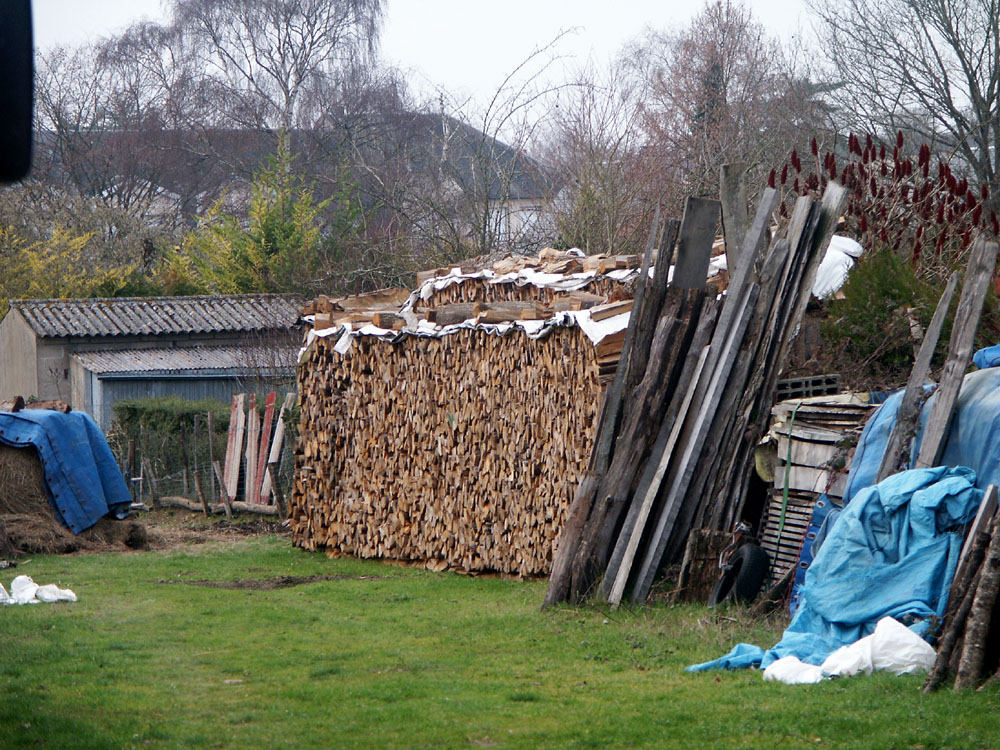
A private firewood pile.
 
Whilst the market for lumber has stagnated, with prices not having changed for 30 years [I suspect that this is no longer the case, and that prices have increased in recent years], the market for wood as a bio-fuel has really taken off in the last few years [and everything in this post about bio-fuels still applies].

Firewood in the Forest of Preuilly.
 
This has led to concerns expressed by the President of the Union of Private Foresters that without a unified management plan the Touraine risks deforestation. He has told his 440 members that if they opportunistically cut their woods for fuel without succession planning, bio-fuel is a mirage. Wood has already been in short supply for several years.

A parcel in the Forest of Preuilly managed for both lumber and firewood.
 
The development of power plants using wood-chip (Saint-Pierre-des-Corps, Orleans that partially serves the Touraine, and [maybe] soon Descartes) led some owners to develop coppice which allows a short rotation cycle. Long term though it exhausts the soil because it consumes a lot of nitrogen. The president of the Private Foresters Union, Antoine Reille, believes that the supply of wood chip is not well managed and wood that is still wet is often being burned. Although he doesn't say so, I suspect that there is also a problem with much smaller diameter wood now having a commercial value and being removed, whereas before it would have been left to rot and replenish the soil, even on sites that are being clearfelled.

A parcel of young oak trees in the Forest of Preuilly.
 
Reille is not ignoring the delicate balancing act required to ensure cash flow in the short, medium and long term. Coppice will make useable firewood in 25 years, a standard oak tree takes 80 years. But he feels that the market is only going to expand and there should be a sensible overarching management plan for the private forests.

A walking trail in the section of the Preuilly Forest put aside for leisure activities.
 
The Arbocentre Wood Energy Sector Manager is more optimistic. He acknowledges how tempting it is to seize the opportunity offered by bio-fuel. He believes the way forward is to set up a simple management plan and code of forestry practice. Included in this must be plots that are currently being stripped bare with no succession plan and profits must be reinvested in the forests of the future so there is no risk of deforestation.

He also thinks the demand for bio-fuel will slow down. At the moment the two existing power plants consume 30 000 tonnes of wood and don't have much potential for increasing that. In addition any increase won't be at the sort of rate the foresters have experienced in the recent past. The market took off very rapidly but it's a recent phenomenon of only 5 years. The evolution will be slower. 


I should point out that all the photos here were taken by us in the Forest of Preuilly, which is mostly managed by the very professional Office for National Forests and none of the issues discussed above apply. Also probably none of the wood shown above will be destined for wood chip, it will be to supply private households with wood burning stoves. There are private parcels in the forest though and I can't vouch for the management approach to all of them. 

I should also point out that the Descartes bio-fuel power plant that would have consumed more than six times the other two put together as well as waste from the paper mill was due to have opened soon after this post was originally written but seems never to have got off the ground.