Monday, 12 September 2016

Eclade de Moules


At the end of August, when who knew how many more long and hot days we had, we were invited to dinner at Marie-José and Philippe's. We were warned it would be quelque chose d'un peu sauvage, which I took to mean extremely informal. It turned out to be éclade de moules, a dish I had seen prepared on the television but never encountered before in real life. Marie-José comes from the Ile d'Oléron just off the Atlantic coast, so she grew up with this dish in its native territory. I thought the mussels were delicious, with their smokey tang. Here is step by step of how it was done:

Step 1: Preparation
Scrub the mussels. Lay out on the ground in an open area of the garden the cast iron central disk from a sundial that you found years ago at an abandoned chateau. Cover it with a layer of fig and vine leaves. One by one select the mussels, debeard them and place carefully on the leaves. Start in the middle and work your way out concentrically. The mussels must be placed resting on one another slightly, straight side down so that when they open a bit with the cooking they don't get cinders inside them. Discard any broken mussels or any that are open and don't close when given a sharp tap, just as you would normally.

Step 2: Pine Needles
Cover the circle of mussels with a thick layer of dried pine needles that you have previously gathered from under the pine trees in the garden and stored in old dog kibble sacks.

Step 3: Set Alight
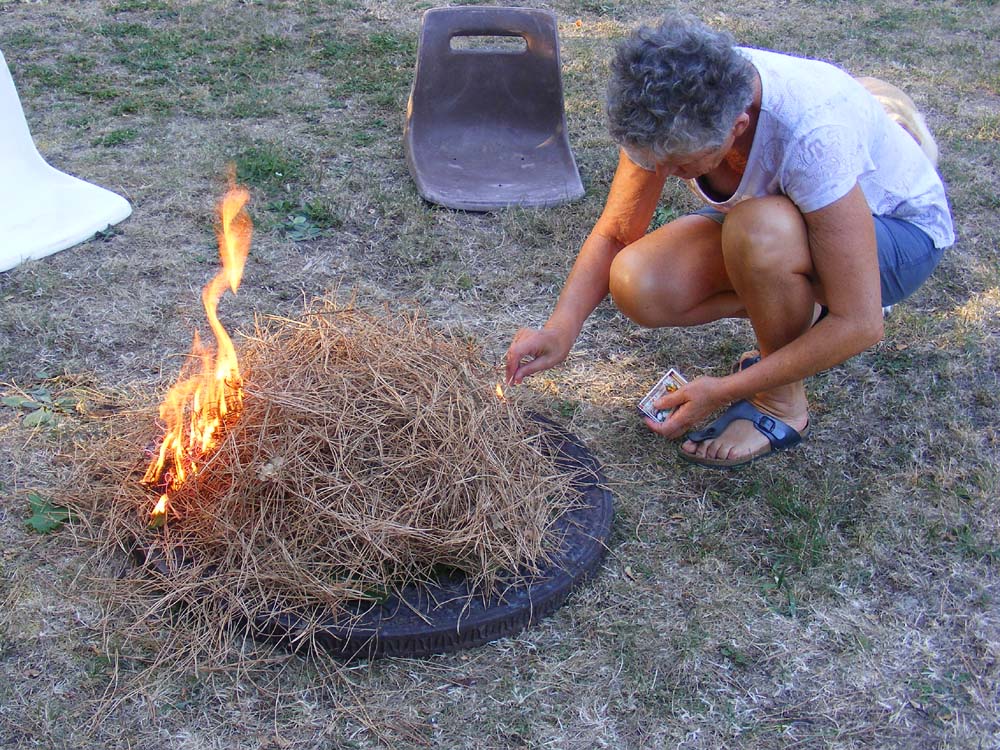
Set the pine needles alight in several places. Step back and wait several minutes until the flames have died away and all the pine needles are burnt.
Step 4: Fan
Fan the mussels with a plastic stackable chair that has lost its legs to get rid of any remaining pine needles and as much of the cinders as possible. Try not to flap cinders onto your bare feet, the tablecloth or into people's drinks.

Step 5: Remove poultry
Encourage the chook to stop hanging around by bribing it with grain as necessary. The chook is the sole survivor of a fox attack on the chook house two years ago and she has attitude.

Step 6: Eat
Sit around the mussels and take one at a time. Extract them from their shell and eat. The shells will often slide apart sideways. Sometimes they will crumble, which results in you having to pick bits of fragile shell off your mussel before consuming. The mussels are eaten with buttered pieces of baguette. It's a messy business and your fingers get covered in soot.

Step 7: Relax
Once all the mussels are finished, lean back in your chair, relax and discuss such subjects as Wuthering Heights, the extent and depth of troglodyte caves under Preuilly and the shooting club at La Roche Posay. Eventually, get up and wash hands. The remains of the meal are swept up with a dustpan and brush and put in the rubbish. Dessert is served.

Step 8 Star Gaze
Sit until dark then look at the bats and stars for a while before your guests go home.


Further Reading: Quite by coincidence Susan from Our French Oasis discovered this method of cooking mussels and had them the same night as we did, at a seasonal restaurant close to where she lives in the Charente Maritime. There on the mainland the dish is called la terrée de moules.

Sunday, 11 September 2016

Gum Trees


These are fairly typical looking Eucalypts or Gum Trees, photographed in the mountains of New South Wales. There are over 700 species of Eucalyptus, virtually all of them native to Australia, although a number of species are now grown all over the world. I can't remember which particular species these ones are. 

It is mainly the Gum Trees that give the Australian bush its characteristic appearance. Economically they have become important globally. Most of the paper worldwide is made from Eucalyptus pulp, for example. If you've never tried Eucalyptus honey, you've missed out on a treat. Tasmanian Blue Gum Eucalyptus globulus is the most widely available because it grows all over the world, but I like Stringybark, River Red Gum, Ironbark and Yellow Box honeys too -- all Eucalypts.

Saturday, 10 September 2016

The Painted Church of Antigny


The church at Antigny in the Gartempe valley in the Vienne, to our south-west, is so amazing, with so many details worth looking at, that I fear I will not do it justice in a brief blog post. It is one of a string of painted churches along this section of the Gartempe, the most famous of which is Saint Savin. Don't get me wrong, Antigny is no Sistine Chapel (although it does share some characteristics with Leonardo's Last Supper). The thing about the church at Antigny is that many of the most extraordinary paintings are at eye level or just above, not up so high you really need binoculars to appreciate the detail. The paintings are in a limited palette of colours and vernacular in style. They are not frescoes (ie painted on damp plaster) but wall paintings (ie painted on dry plaster). Perhaps the most significant thing about them is that although I think they have been wholly or partly covered in render at some point, they have not been damaged by being hacked at with a pick to create a key for the later render, unlike many rediscovered wall paintings. The restoration in 2005 revealed at least six layers of wall paintings and successive renders.

The lanterne des morts, opposite the church in the former cemetery. 
Lanternes like this are somewhat of a peculiarity of the Poitou area.

The visible paintings date from two different periods, with late 12th century works on the north wall of the nave and the rest from the 14th century. But the paintings are not the only things worth looking at in this church. Yes, there's more! The architecture of the church itself is a bit unusual, with a large porch to the southern side, called a caquetoire ('cacklehouse'), also known in the Poitevin dialect as a balé, and by the front door a slab of stone resting on four short carved pillars which was for resting a coffin or body on before it went into the church for a funeral, called an édicule. The coffin rest has two grooves at one end and a circular depression at the other, probably for draining away fluid seeping from shrouded bodies on the slab, in the days before coffins were commonplace. The church is solid looking, with a square tower ornamented with fleurons.
 The church at Antigny, with its rather squat square tower. The porch is on the right.

The church was built in the 11th century on the site of a Merovingian cemetery, and was subsequently remodelled in the 15th and 18th centuries.  The nave is covered by a timber vault in oak. The wall paintings have been recently restored and many new details have been revealed. The chapel, dedicated to Saint Catherine, was built in 1421 by Renaud de Mauléon, Lord of Bois-Morand. The interior decor was commissioned by Jean de Moussy (1433 - 1510) also Lord of Bois-Morand (son-in-law?). In the 18th century the porch was constructed to extend the chapel.

 Detail of wall paintings in the side chapel: above, the story of the three living and the three dead; below, Christ carrying the cross.

The chapel attached to the church at Antigny, the oratory at the chateau of Bois-Morand (privately owned and not open to the public) and the Chapel of Saint Catherine at Jouhet were all decorated at the end of the 15th century on the orders of Jean de Moussy. They depict the life of Jesus, the Last Judgement, the story of the three living and the three dead and Christ in Majesty.

An archer, a detail of a partly destroyed depiction of the martyrdom of Saint Sebastian.

The Day of Judgement, with the dead rising from their coffins below, being assessed for entry into Heaven on the left by Abraham, assisted by the Archangel Michael weighing souls. There is some intriguing but not uncommon imagery in the centre. Mary is expressing milk and Christ bare chested, with a sword pointing at his head. John the Baptist is kneeling on the right.

Some scenes from the life of Christ: top left, the shepherds receive the news of Christ's birth; top centre, the three magi visit the infant Christ; top right, the massacre of the innocents; bottom left, Judas betrays Christ to the soldiers with a kiss; bottom centre left, the seated figure is Christ and I think the figure behind him is Mary, but I'm not sure what story is being illustrated in this panel; bottom centre right, Christ on the cross; bottom right, Christ being held while Pontius Pilate washes his hands.

Christ in the tomb. I notice he has no genitalia, but the sword wound in his side is clearly shown.

The last supper. The lamb on the central platter caused us some amusement.


**************************************

For details of our private guided tours of chateaux, wineries, markets and more please visit the Loire Valley Time Travel website. We would be delighted to design a tour for you.

Friday, 9 September 2016

What do Peacocks Eat?


Answer: Common Nettle Urtica dioica and sometimes Wild Hop Humulus lupulus.

So I'm talking about the abundant and widely distributed butterfly Aglais io, known as le Paon-du-jour (the Day Peacock) in French and the Peacock in English.

I love the little orange tootsies and the star spangled body.

Here in the Touraine it is nice to keep a little patch of nettles in an abandoned corner of your garden. You will most likely be rewarded for your slovenly gardening habits by a host of spiky black caterpillars diligently munching away sometime between May and September. These ones, of mixed ages, were photographed yesterday near our orchard.

 The caterpillars in this nettle patch ranged considerably in size (and therefore age).

They will overwinter as chrysalises suspended from a nettle or a nearby plant, then once the weather warms up next year, probably in June, they will emerge. If you have a garden shed then their parents may hibernate in there and emerge even earlier in the year. Sunny days in February will see the adults out and about. Their ability to overwinter in different life stages and their diet of a common 'weed' contributes to their breeding rate (three generations a year usually) and their ubiquity in gardens throughout the year in all but the coldest gloomiest weather.

An adult Peacock butterfly.

Thursday, 8 September 2016

Dora l'Exploratrice


Here is the not quite eleven year old daughter of some friends exploring the woods. From the top of her rock she was making quite a passable imitation of a wolf howling. Sadly she got no response (other than us telling her to come on as we were going on down the hill).

Wednesday, 7 September 2016

Anchors Aweigh

Two months ago we blogged about an MG with an impressive bonnet ornament.

Last week we may have gone one better:


This was on a 1939 4¼ litre Bentley Drophead Coupé by Van den Plas. I assume the ornament is a representation of the Schneider Trophy winning 1927 Supermarine S.5 racing seaplane, a design that ultimately led to the Supermarine Spitfire as shown on the MG.

A view of the car

This was spotted (along with some others) in the car park at Cheverny, and was participating in the "Jersey Old Motor Club" tour of chateaux of the Loire Valley.

Tuesday, 6 September 2016

Au Revoir to Good Friends


A gluten free feast.

Our friends Colin and Elizabeth have sold their house in Braye sous Faye. All their belongings are packed up and are heading for the UK. We will miss them for their kindness, generosity, good company and good advice.

The cake.

Lots of other people will miss them too, so Gaynor organised a party at her place so we could celebrate our friendship. Everyone contributed food and Jean made a cake. Jim stood up and made a speech. He has a fine singing voice and cleverly reworded Aulde Lang Syne to fit the situation.

Elizabeth, Gayle, Colin and Nick as they listen to Jim speaking for all of us.

Colin and Elizabeth will be back to visit I am sure. They know they have places to stay all over the Touraine.

Jim putting into words what we all felt.

Meanwhile, we will all be keeping an eye on their blog to see how the next part of the adventure turns out.

Colin and Elizabeth cut the cake.

And every time any of us open a bag of redcurrants from the freezer we will think of Colin and Elizabeth.
The group photo.
From top to bottom, left to right: Chris T, Annie, Tom, Niall, Sweetpea, Gaynor, Pauline C, Mike, Antoinette, Simon, Dennis, Gayle, Angela, Liz, Pauline McA, Chris H, Nick, me, Tim F, Jean, Colin, Elizabeth and Tim B.

For those of you who asked, here are the recipes for the carrot dip and orange punch that I brought.

Update: Here is a link to Colin and Elizabeth's blog post on the evening.

Monday, 5 September 2016

Salted Caramel Icecream


David says make the salted butter caramel first, 
but I suggest making it while the icecream mixture chills overnight.

Salted caramel icecream is called crème glacée au caramel au beurre salé in France. The worldwide spread of the concept of salted caramel is a 20th century one. It's a great favourite with almost everybody so I decided to give the icecream a go at home. I used David Lebovitz's recipe, which looks complicated, but isn't really. The result was delicious. I even served it up to French people and they loved it.

 The salted caramel custard.

In the 14th century people relied heavily on the ability of salt to preserve food. In 1343 Philippe VI formalised and tightened the gabelle, a tax on salt. In effect salt became a royal monopoly and was stored in warehouses known as greniers à sel. Anyone who bought salt was taxed and all salt had a traceable chain of supply. However, Brittany was an independent duchy at this time, and did not have a salt tax. Salt there was very reasonably priced and no one stinted in its use. In Brittany one could afford to salt butter to aid its preservation, whereas in France salt was too precious to use in butter. So to this day, in the north west everyone eats salted butter, whereas unsalted butter is favoured everywhere else.

 Ready to eat.

Breton cooks have long made salted butter caramel for domestic consumption, but it wasn't until 1977 that it was 'discovered' by a wider audience. A French chocolatier based in Quiberon started entering his salted butter caramel bonbons in competitions and they were an immediate hit. Nowadays salted caramel is available as many different products, including icecream, all over the world.

Yum.

Everybody loves salted caramel icecream.

Sunday, 4 September 2016

Silver Gulls


Silver Gull Chroicocephalus novaehollandiae is the most common Australian gull species. It is mostly coastal, but can be seen inland as well (shopping centres and rubbish dumps are favoured habitats). As gulls go it is teeny weeny. An adult will be 40 - 45 cm from beak to tail tips, with a wingspan of under a metre. Compare this to the European Herring Gull Larus argentatus, which is about 65 cm long with a wingspan of a metre and a half. Young Silver Gulls have a dark beak, which goes redder and redder as they mature. The brighter the colour the older the bird. They are scavengers and will eat worms, insects, crustaceans and fish.


Our posts on Sunday have an Australian theme. To read more of them click on 'Australia' in the Index in the right side bar.

Saturday, 3 September 2016

The Chapel of Saint Catherine, Jouhet


This 15th century funerary chapel is one of a series of painted churches along the Gartempe river. The most famous of these is the Abbey of Saint Savin, which we have visited several times. But we had never visited any of the others until recently.

The chapel is a rectangle about 6 metres long and 3 metres wide inside. It probably replaces a much older building, possibly 13th century but maybe Roman or even pre-Roman. The older building was possibly in ruins when in 1476 the local priest Pierre du Boschage raised the money to build the current building. His building was extremely modest, barrel vaulted and lit by two narrow windows in the apse. One enters by an arched doorway with an ogee shaped niche for a statue above. 

Antoinette, me and Niall about to enter the chapel.

The wall paintings were commissioned by Jean de Moussy in 1502 when he was 70 years old. He indicated that he wished to be buried at Jouhet, and the paintings must therefore date to the early 16th century. He died in 1510 and he and later several other members of his family were buried here. In the 19th century it became the sepulchre for the Auboutet family, and there is a gravestone in the centre of the floor dedicated to a member of this family.

The chapel at Jouhet is related to the fabulous painted church at Antigny and the paintings there were also commissioned by Jean de Moussy. Several of the themes at Jouhet are the same as those at Antigny, such as the story of the three living and the three dead, Christ in majesty, and the last judgement. In addition there are panels showing the story of Adam and Eve and the birth of Jesus. Several of the painted stories run the full length of the north or south sides ie they are just under 6 metres long (in bands about 1.5 metres high). The paintings are underlined by a half-round moulding. Both walls are designed to be read like a cartoon from left to right. The iconography of the northern wall is dark and negative, that of the south, light, the story of the world saved and the second coming. Eve on the northern wall is offset by Mary on the southern wall. I think it is telling that it is the southern wall where the patrons have chosen to have themselves represented. 

The sunny side: top left the bull of St Luke, top right souls emerging from their graves on the day of judgement; bottom left the annunciation, bottom centre left the nativity, bottom centre the adoration of the shepherds, bottom right the magi/kings, including the kneeling figure of Jean de Moussy (blackened).

The paintings are in fairly good condition (having been conserved in 2005), although the writing on the scrolls (presumbably dialogue between the characters) is no longer legible and the ends of each story cycle have been damaged. However some elements are very clear, such as Christ on the cross. The colour palette is restrained -- yellow ochre, red, pink, white and blue black. The backgrounds range from flowery grass or cloth hangings in the lower levels to starry skies in the upper levels, with masonry in between. The level of detail in the flower strewn ground and the pointing of the masonry was only revealed after conservation. The blackening of certain faces can be explained by the presence of pigments containing metal salts, which react and change colour over time.

The painters would have been travelling professionals working up and down the valley of the Gartempe, hence the similarities between aspects of this chapel and the church at Antigny and the abbey at Saint Savin. The artists would certainly have known and referenced the earlier work at the Abbey and you can see resemblances in the Christ figures in both places.

The shady side: top left God creating Eve from Adam's rib, top centre Eve taking the apple from the serpent, top right the eagle of St John and the lion of St Mark; bottom left the three living, bottom centre Christ on the cross, bottom right the three dead.

The chapel is kept locked and if you wish to visit it you must go up to the café about 100 metres away and ask for the key. Admission is a euro per person. Don't forget to return the key after your visit. The café is closed on Mondays.

Friday, 2 September 2016

Charity Cherry and Almond Cake


As regular readers may know, we belong to a cake club. Jane from Le Grand Pressigny also belongs and periodically she collars other cake club members and asks them to bake a cake for one of her charity events. Having put my name down on the list I then had to decide what to make.

Eventually I picked the Cherry and Almond Cake from the Clandestine Cake Club summer holiday baking challenge. I doubled the recipe to make two so we could keep one and one could go to Jane. Once the cakes were in the oven it was very clear which one would be given away. The streusel topping on one of the cakes sank without trace whilst the other one turned out perfectly. I think because our oven is so large it heats very unevenly, and the cakes must have been at different stages when the topping went on after 20 minutes of cooking. 

Oh well...I decorated both of them with dribbly water icing and home made home grown pickled cherries. I thought the charity cake turned out rather well (and the one we kept was by no means inedible -- it just had a slightly odd conglomeration of almonds and crumble embedded in the centre of the cake).

Jane's English Tea Room raised €400 which will go towards funding community events in Le Grand Pressigny. She very kindly organised someone to collect my cake and bring back my cake box so I didn't have to take the time to go over to her house, which I appreciated.

Further reading: Jim Craig featured the English Tea Room on his blog post about the annual l'Art et la Matière event in Le Grand Pressigny.

Thursday, 1 September 2016

Here we go round the Blackberry Bush

 ...except it wasn't meant to be the world's most ginormous blackberry bush, it was meant to be a chateau.

Touraine Insolite can be a useful web site, although there is some woo on there (UFO's, monsters etc). The other day I was skimming the internet looking for the origins of the local towns named after saints and Touraine Insolite came up amongst the search results for Saint Flovier. I was amazed to discover that a clump of trees we drive past on our way to Loches is actually a 12th century chateau.

Needless to say, this required investigation, so on Monday Susan and I took a walk to see what could be seen. The answer is "not a lot", although the moat is still full of water, and you can certainly see where it has been.

I was expecting to see this (or at least something recognisable as this):


and saw this:
 

If you squint and hold your head at a certain angle you can sort of make out the tower in the lower photo, but I have no idea how much is actually still standing. It is marked on the IGN maps as "ruins", so I assume something still survives.

Read more about the Chateau de Roulet here.

The black and white photos are taken from Touraine Insolite. I assume they are from a historical or archaeological archive, but I don't know which one.

Wednesday, 31 August 2016

Round-leaved Fluellen


On a recent walk through a field that had the remains of a wheat crop scattered across it I took the opportunity to photograph some of the so called arable weeds (Fr. plantes messicoles). My friend Ingrid who was with me at the time asked me if I was photographing plants new to me or plants I didn't already have good photos of. As it happened I had encountered these 'weeds' before, but one in particular is extremely difficult to photograph. The flowers are very delicate and fall off if you so much as touch the plant. They are also quite small and ground hugging. Photographing them required getting down on hands and knees.


You might be able to guess by looking at the flowers that this little plant is related to toadflaxes, also 'weeds', some of which tumble over limestone walls, others which line the roadsides in autumn. And they are related to garden snapdragons, but much, much tinier.


Round-leaved Fluellen Kickxia spuria has slightly sticky woolly leaves and stretches out across the chalky soil. The exquisite little yellow flowers with purple lips and a curved spur are sparsely distributed along the prostrate stems. It is an uncommon plant of calcareous arable land. Although arable weeds are in general declining due to modern farming methods, it is believed that this has never been an abundant plant and that its population is stable. In French it is known as the Fausse velvote.

This is a little known and little noticed arable weed. The most famous of the arable weeds of course is the Field Poppy Papaver rhoeas, still a common sight here (although nothing like it would have been in the past).


Tuesday, 30 August 2016

I Bet They Are Delicious...


While my sister Kathy and her husband John were here in June we went to Lake Blizon in the Brenne to do the walk along the lake edge and check out the birds and other nature. We ran into a young French wildlife photographer, Charles Cherrier, visiting from the Lyon area, and he pointed out the Louisiana Crawfish Procambarus clarkii (Fr. écrevisse de Louisiane) that had become trapped in the étang (lake) overflow. He said their introduction to the lake has been a disaster. They are a top level predator and eat everything, including the native crayfish.

He laughed when I suggested we solve the problem by eating them. Frankly I'm amazed that he, as a Frenchman, hadn't already thought of it, but maybe the idea fell outside of what is traditional, so wouldn't take off (like goat meat).

Silhouetted against the habitat.

Louisiana Crawfish is a freshwater crayfish native to Mexico and the south-east of the United States. As its English name suggests, it is abundant in Louisiana. It is the most adaptable of all the crayfish species, and as such has become the most widely distributed species globally.

Unlike the native European species, it is able to tolerate periods of dry, for four months or more, and stagnant, brackish or dirty water. As a result it is able to colonise a great variety of habitats, including underground, damp grassland, seasonally flooded land, marshes, swamps, lakes and permanent water courses.

Underside.

It is easily recognised by the red spots on its claws and body. They grow to about 12 cm long, with claws about the same length. By six months old they weigh 50 grams and can live six years in the wild. The population can disperse quite quickly from an intitial point of introduction, with individuals able to travel four kilometres overnight.

Although they are carnivores by preference, they eat a lot of decaying vegetable matter because it is easier to catch. When they hunt live prey they concentrate on species with relatively slow reactions, such as tadpoles, dragonfly and mayfly larvae, and snails, rather than fish and mosquito larvae which have lightning fast reactions. Louisiana Crawfish are also quite happy to be cannibals.

Front end.

Their habit of swarming contributes to the turbidity of the water, and within ten years of arriving at a site, 99% of the aquatic vegetation will have gone, 70% of the insect larvae and molluscs and more than 80% of the amphibians.

In the US Louisiana Crawfish is by far the most common species farmed commercially for human consumption. It became the dominant species of fresh water crayfish in the world in the 1970s and 80s, after being introduced to Spain, France and Italy to be farmed, and to Kenya to control the snails which carry bilharzia. However, whilst very popular in its native Louisiana and in Cajun cuisine, it is considered by Europeans to be less flavoursome than the European native species, particularly that of the European Crayfish Astacus astacus (Fr. écrevisse à pattes rouges).

Etang overflow, where the crayfish get swept by the force of the water then trapped against the grill.

These days in Europe the Louisiana Crawfish is considered an invasive species. Aggressive and robust it reduces the quality of fresh water. Even if it does not succeed in catching and killing other invertebrate species in the water, it often inflicts wounds such as amputating the tails of tadpoles, rendering them vulnerable to later predation. The species also carries the fungal disease Crayfish Plague which has decimated the population of native crayfish, especially White-clawed Crayfish Austropotamobius pallipes (Fr. écrevisse à pattes blanches). In Poitou-Charentes to the south-west of us for example, the population of the native species has fallen 70%. In addition they dig burrows up to two metres long, degrading banks, altering drainage, making leaks in dams and irrigation channels.

With its short lifecycle and rapid rate of reproduction the Louisiana Crawfish out competes the native White Clawed Crayfish in disturbed habitats such as those modified by man, for example, rice paddies. In mature habitats though the White Clawed Crayfish, with its longer life span and slower reproductive rate, can hold its own.

In France there could be two or three tonnes of Louisiana Crawfish per hectare, despite predation by Black Kites, Grey Herons and storks (the last of which will reportedly eat so many that their feet and skin goes bright red).

To limit their further expansion of range, it is illegal to transport them live and fishing for them is very controlled. Fishermen often propagate them because they use them for bait. To kill them twist their telson (in the middle of the tail) and pull out their gut, which can impart a bitter taste to the flesh.

The only successful control measure seems to be to introduce fish species that will predate the crayfish, such as eels, burbot, perch, pike and especially largemouth bass.


Guide d'identification des écrevisse en France-métropolitaine (Crayfish in Metropolitan France Identification Guide), which gives lots of good advice (in French) about what to do once you've spotted a crayfish. It all depends on whether it is native or introduced of course, and each of the nine possible species has a description with photo. Also a description with photos of how to kill the pest species.

Monday, 29 August 2016

Robbed!


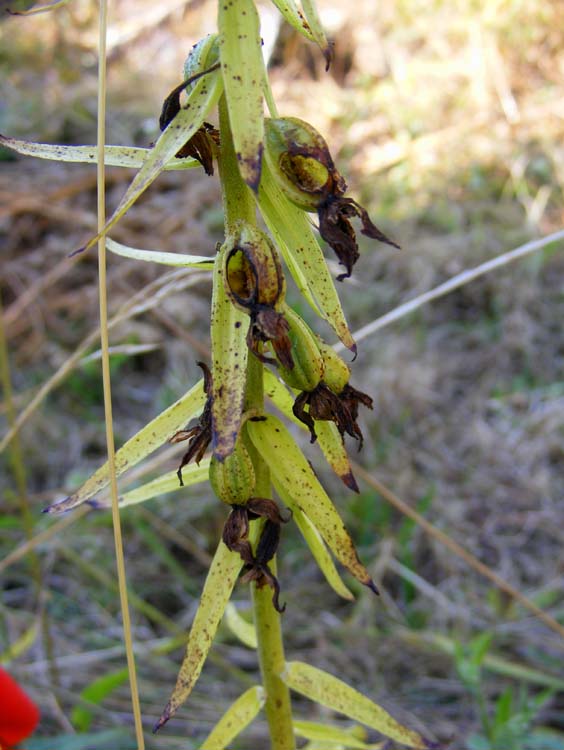
Look at that!! Holes chewed in each of the seed capsules of my Broad-leaved Helleborine Epipactis helleborine subsp helleborine! I have no idea what is responsible, but presumably they were after the seeds inside. I don't know, I spend all summer mowing carefully around this plant, which has rather inconveniently established itself right in front of the compost bins. I had been hoping it would scatter seeds and form a small colony, but I might as well have just mowed it off in June because it was a nuisance...

Harumph. I just hope the culprit is some star species that will pose for photos at some appropriate moment...

Photo take mid-August.

Sunday, 28 August 2016

Eastern Grey Kangaroo


A typical female Eastern Grey Kangaroo Macropus giganteus might weigh 30kg and be capable of 50 km per hour. It's the kangaroo species you are most likely to see if you visit Australia as it lives in the bush and grassland around the major eastern and southern cities. This one is right at the coast, with the sea in the background of the photo. Eastern Greys are abundant and not endangered, having adapted well to the European colonists activities in Australia. They are usually seen, like this one, either early in the morning or in the evening when the light is failing. They are grazers, eating a variety of grasses.