Wednesday, 4 March 2015

Bat Surveying in the Touraine Loire Valley

When my friend Jean Claude asked me if I wished to go on a bat survey I accepted with alacrity. I like bats and see them often but don't know all that much about them. This was a chance to hang out with professional bat workers.

Chateau de Cingé, winter home to 7 species of bat.
The survey group included three members of the local bat group (including my friend Corinne), someone on a placement with the League pour la Protection des Oiseaux (LPO), me, Jean Claude and his wife Elisabeth. We were joined halfway through by Hélène, who lives at one of the survey sites and Elisabeth had organised a simple but delicious lunch for us.

Daubenton's Bat. 
Virginie's tip for distinguishing this species from its lookalike cousin the Whiskered Bat is that Daubentons have pink noses, Whiskereds have black.
We visited a number of sites, which ranged from the cellars of several chateaux to some holes in the ground. My top tip for anyone who wants to see privately owned chateaux not open to the public -- join a bat survey group! We visited three, one of which caused me to immediately lose interest in bats and spend quite a bit of time photographing architectural details.

Large Mouse-eared Bat.
The bats were photographed by me as quickly as possible without flash but with
Virginie shining her torch on them.
Jean Claude had organised the day and set up meetings and permissions with landowners but the surveying itself was led by the redoutable Virginie, from the local bat group. She is an experienced bat surveyor and was able to spot a bat crammed into the darkest most unfeasibly narrow crevice and identify it to species level at a glance. Just amazing! All species of bat are protected in France, which means you cannot disturb them at roosting sites. The national monitoring programme orchestrated from the Natural History Museum in Bourges. Last year 13 000 individual bats were counted in Indre et Loire.

Holes in the ground ideal for hibernating bats. 
Unusually for this area these former quarries are sandstone, not limestone. Virginie is in the blue hat, Lucie (LPO) next to her. The spaniel belongs to the Chateau de Vinceuil estate manager and was very excited to be bat surveying with her new friends.
Virginie warned us not to disturb the bats as they were hibernating. We had to be quiet, no loud chatting in cellars and caves. We couldn't all go into a cave or cellar at the same time as our body heat would raise the temperature and the hibernating bats would start to wake up. We mustn't shine our torches on sleeping bats for more than a few seconds and of course, no flash photography.

The remains of beetles that have been eaten by a large bat (either Greater Horseshoe or Large Mouse-eared according to Virginie). The discarded wing cases had mostly come from Dor Beetles but there were also some ground beetles and a couple of other families represented.
Most of the bats we saw were tiny, dark brown and extremely difficult to spot in the dim light. They tuck themselves away between stones, in narrow gaps between wooden lintels or hanging from ceilings high up in the dark.

Chateau de Bridoré.
 We saw a total of 35 individuals from 8 species. The plan is to get together again in June for a follow up survey of summer roosts.
Species and numbers seen:
4 Greater Horseshoe Bat (Fr. Grand Rhinolphe) Rhinolophus ferrumequinum.
10 Lesser Horseshoe Bat (Fr. Petit Rhinolphe) R. hipposideros.
5 Daubenton's Bat (Fr. Murin de Daubenton) Myotis daubentonii.
7 Whiskered Bat (Fr. Murin à moustaches) M. mystacinus.
2 Natterer's Bat (Fr. Murin de Natterer) M. nattereri.
2 Large Mouse-eared Bat (Fr. Grand Murin) M. myotis.
1 Barbastelle (Fr. Barbastelle) Barbastella barbastella.
4 Pipistrelle (Fr. Pipistrelle) Pipistrellus sp.

Tuesday, 3 March 2015

Pianos in Stations

SNCF, the French national railway company, installed pianos in selected stations all over France in 2014. They were for any passing member of the public to play, and play them they did. The piano seat was rarely empty in Tours Centre or Paris Montparnasse last year when I passed through.

 Someone in transit at Paris Montparnasse railway station playing the piano. 
He was rather good.
The one in Montparnasse was apparently not as popular with shop owners as it was with the public. They complained that too many players were really bad and the noise was awful. As a compromise the piano was moved around the station so no one got to suffer for too long.

Keen pianists could record their efforts and post them on the internet for judging at the end of the year. The winner of the competition was 12 year old Jean Cotro from Tours, chosen from 900 entries.To see his video click here.

Monday, 2 March 2015

Filming in Preuilly

As we left for Paris last month we noticed big coaches and pantechnicons parked outside the médiatheque and across the road at the cemetery in Preuilly. Clearly some filming was in progress. We snapped some photos as we drove by, but it was only on reading the newspaper that we found out what it was all about.
To quote (in translation) the article:

On 3 February an unusual buzz animated the town of Preuilly. Some big trucks were parked opposite the mediatheque. The reason for these strange sights? Sylvain Desclous was shooting a scene from his film Vendeur ('Salesman').
This screenwriter has already made 6 short films. Vendeur is his first feature film. The theme of the film showcases salesmanship as a trade but it is mainly a pretext for the evocation of the father-son relationship, of affection and conflict, separation and reunion.

The film was shot in Marseille, Paris and several municipalities in the northern Touraine, but Sylvain Desclous was particularly keen to shoot some of the important scenes in Preuilly-sur-Claise. As a child he spent his summer holidays in the village, at his grandparent's place in the Faubourg Saint Nicolas, and where some of the family still reside.
Preuilly contributed to the logistics. A dozen locals were recruited from the local populace. They were able to share for an afternoon the cinematic artistic sentiments. 

This film is supported by the Centre Region through the Ciclic Agency. The main roles are played by Gilbert Melki, Pio Marmai and Sara Giraudeau. Romain Bouteille is involved in the distribution.

Sunday, 1 March 2015

Here and There: Catholic Churches

 Above, the Catholic church, dedicated to Saint Stephen, which opened for business in 1909 in the small Australian town that I grew up in. Below, the Abbey of Saint Pierre in Preuilly sur Claise, consecrated 1009.
**************************************
A la cuisine hier: The Parthenaise beef has been combined with beer, carrots, onions, celery, bay leaves, salt and pepper and slow cooked on our wood stove. It was quite good, but not outstanding. I think not enough connective tissue.

Saturday, 28 February 2015

The Model Maréchal

While we were in Paris we visited the Army Museum, which is vast. The thing that first drew us there was the display of models made by Vauban of the fortifications he built for Louis XIV.

We had previous seen some Vauban models at the Musée des Beaux Arts in Lille (which has the second biggest collection) and had intended to see the rest at a display at the Grand Palais in 2012 (but didn't when we saw the queue out the door in perishing weather). We have also seen a number of the fortifications: at Lille, Calais, and Ile-Saint-Martin, where we stayed in a campsite built against the walls (as seen in the photo at the bottom of this post).

Maréchal Vauban (more properly Sébastien Le Prestre de Vauban) was born in 1633 at Saint-Léger-de-Foucherets, France (now Saint-Léger-Vauban) the son of a family of the petty nobility. As a young man he enlisted as a Cadet in the army of the Prince de Condé, a rebel fighting against France. After being captured by royal troops in 1653 he changed sides, and in 1655 joined the newly-formed engineer corps in the army of Louis XIV. He proved himself to be a good soldier and brilliant engineer and had rapid promotion.

Vauban's statue - at the opposide end of les Invalides to the square named in his honour.
After the rebellion Vauban undertook his first fortification work, working on various places in Alsace-Lorraine (near the German border). In Nancy, he was involved in the demolition of fortifications, and saw new fortifications constructed at Alt-Breisach, on the Rhine.

When war broke out again it was against the Spanish in the Low Countries, and Vauban found himself on the front lines once more. He played an important part in the capture of the cities of Tournai, Douai and Lille, and was rewarded with a pension, a position in the Royal Guards and the governorship of the citadel of Lille, which he had constructed.

Ile Saint Martin from the sea - the models are about 1:600 and incredibly detailed.
He assumed the duties of the Commisary General of Fortifications and after the war in the Spanish Netherlands. His new duties took him all over France, inspecting existing fortifications and identifying new sites to be fortified. He became a trusted advisor of the king and worked closely with Louvois, Louis XIV's war minister. In this period of peace Vauban visited Roussillon to work on the fortifications there, but was also asked to advise the Duke of Savoy, at that point an ally of France, on fortifying his territory. This was unfortunate for France, which later went to war with the Duke.

Louis XIV went to war with the Dutch between 1672 and 1679, during which time Vauban proved himself as good at laying seige to towns as he was designing their defences. After the Dutch War, Vauban again set to work fortifying the new conquests and securing France's frontiers. He designed several fortresses during this time including Strasbourg, Luxembourg and Landau.

With the War of the Grand Alliance, Vauban gained the rank of Lieutenant-General and directed the siege of Philippsburg in 1688. After seeing much action during the war, he set about designing his last fortification work, the impressive Neuf-Brisach. This was a fortress town that was designed from scratch by Vauban, the inhabitants coming from the nearby town of Alt-Breisach, which had to be destroyed as a result of a treaty.

In 1703 Vauban was made a Maréchal of France, but was recalled from service later that year. In his retirement he wrote a treatise on fortification and siege warfare, which was reproduced in many different European languages and used for many years to come. In 1707 he published a controversial paper condemning the French government's unfair tax system and proposed a better system. His reforms were rejected by the king, and Vauban died shortly afterwards in 1707.

Ile-Saint Martin from inland. The campsite we visited in 2013 was just inside the nearest buttress.
Vaubin is commemorated by the over 300 citadels and fortified cities he improved the defences of, including Antibes (Fort Carré), Arras, Auxonne, Barraux, Bayonne, Belfort, Bergues, Citadel of Besançon, Bitche, Blaye, Briançon, Bouillon, Calais, Cambrai, Colmars-les-Alpes, Collioure, Douai, Entrevaux, Givet, Gravelines, Hendaye, Huningue, Joux, Kehl, Landau, Le Palais (Belle-Île), La Rochelle, Le Quesnoy, Lille, Lusignan, Le Perthus (Fort de Bellegarde), Luxembourg, Maastricht, Maubeuge, Metz, Mont-Dauphin, Mont-Louis, Montmédy, Namur, Neuf-Brisach, Perpignan, Plouezoc'h, Château du Taureau, Rocroi, Saarlouis, Saint-Jean-Pied-de-Port, Saint-Omer, Sedan, Toul, Valenciennes, Verdun, Villefranche-de-Conflent (town and Fort Liberia), and Ypres.

He directed the building of 37 new fortresses, and fortified military harbours, including Ambleteuse, Brest, Dunkerque, Freiburg im Breisgau, Lille (Citadel of Lille), Rochefort, Saint-Jean-de-Luz (Fort Socoa), Saint-Martin-de-Ré, Toulon, Wimereux, Le Portel, and Cézembre.

Vauban is also commemorated in Paris by statues and is buried near to Napoleon, a singular honour for a man employed by Louis XIV.

************************************************** 
A la cuisine hier: I made chocolate pots and had a small disaster. As I poured the hot water in to the bain marie I heard a crack, but couldn't see any damage to any of the jars and there was no sign of chocolate custard leaking. So I put the tray into the oven and cooked the pots. Once they were done I lifted each jar out of the water and onto a towel to dry. Number 4 made it to the towel, but its bottom hit the towel while I was still holding the pot up in the air. The entire base of the jar had broken off and there was chocolate custard everywhere.
*************************************************
Firewood Logistics: Our firewood supplier, who was due to make a delivery yesterday morning, rang at 8.30 am. He was worried that with all the rain the wood was very wet and would not burn well. He suggested I leave it out in the sun to dry off for the day. I didn't have anywhere to put it that gets the sun at this time of year, so he left me half a stere and said to leave it out to catch the breeze but to be sure to take it in to the garage before evening or it would get damp all over again in the night air. We agreed for rest of the delivery to stay at his place for a few days in the hopes that we get some fine weather and he will deliver it next week.
 ************************************************
If any of our readers are a " registered elector who is a British citizen living overseas" - that is a British citizen who is registered to vote in British elections at their French address, can you please get in touch? I have paperwork that needs an attestation.

Friday, 27 February 2015

Musée de Cluny

Officially these days the Cluny museum is la Musée national du Moyen Age (the National Museum of the Middle Ages). It is a superb museum, and makes it into my top three Paris museums (the other two are the Louvre and the Orangerie, since you ask, and if you want my top five, add the Petit Palais and either the Rodin Museum or the Musée Jacquemart-André).

For all that, until our early February visit this year, we had not been there for 13 years. I was shocked at how long ago it was!

The building is the former Hotel de Cluny, that is, the town house belonging to the Benedictine abbey of Cluny in Burgundy, which itself stands on the foundations of some Roman baths. The museum is not large, but it is a rabbit warren of complicated levels, passageways and linked rooms, and it doesn't have a cafe. Its collections of tapestries, carved wood, stone and above all, ivory, stained glass and objects such as reliquaries are outstanding. They are also displayed so you can get right up close to objects. With things like the stained glass this is especially fun. Stained glass in situ is always up high. So being able to see tiny details is a real thrill.

I've chosen some personal favourites from the permanent collection to show you below. Simon would choose different objects, more stone and wood I am sure.

If people know anything about the Cluny it is the Lady and the Unicorn Tapestries. They are justly world famous for the charm of their subject matter, the completeness of the set and the quality of the weaving. This one below is the last of the six, and the most mysterious. The others appear to represent the five senses, but the meaning of this one is uncertain. What does 'A mon seul desir' represent? In fact we know almost nothing about the tapestries. Stylistically they come from the late 15th century, but even stylistically they are unique in certain aspects. We have some hints about who commissioned them, but nothing certain. You could spend hours looking at all the detail and teasing out the riddles. I highly recommend the fictionalised account of their creation, The Lady and the Unicorn by Tracy Chevalier. You'll learn a lot about tapestry weaving and life in Europe in the late Middle Ages.

I chose the carved ivory casket with gilded copper fittings below not because it is the finest ivory carving in the collection, but because it is a secular object. By the early 14th century, when this was made, both men and women of aristocratic birth were addicted to courtly romance stories. All sorts of personal objects were decorated for the first time in centuries with scenes not from the Bible but with vignettes from tales with titles such as Assaut du Chateau d'Amour (Assault of the Chateau of Love). The Chateau d'Amour was defended by women who threw flowers...

More unicorns. The Cluny's collection includes three aquamaniles, for pouring water for handwashing before a meal. The one below is made of a copper alloy but they were often ceramic. This one is a unicorn and they were often in the form of fantastic animals or beautiful women. It is German and dates from the late 13th or early 14th century.

This instruction manual created to teach a late medieval German princeling how to fight is unexpectedly charming. The page at which it is open seems to be regularly changed. On the day we were there it was open with a fairly standard knightly thrust and parry manoeuvre being demonstrated on the right. The left is intriguing though. A girl armed with a slingshot is getting ready to bop a boy with a club, who is inexplicably standing in a hole... 

I chose the tapestry below (detail) not because it is one of my favourites, but because it has been so widely reproduced. You see small mass produced copies a couple of metres across hanging in private homes, restaurants and winery tasting rooms. The real tapestry, known as Les Vendanges (The Vintage) and dating from around 1500, is probably about 6 metres by 4 metres, so the characters are nearly life size and it depicts the grape harvest on the right and wine making on the left (which is what my detail shows). The reproductions often only show one half or the other (and of course are not actually tapestries, but jacquard loom woven). This tapestry seems to have sparked a fashion for scenes of the vendanges on tapestries and there are a number of other later examples of the genre.

The tapestry below was chosen because the series of over 20 tapestries from Auxerre telling the legend of Saint Stephen (Saint Etienne) that it belongs to is amazing and because the detail shown in this photo may reassure those who have been perturbed by the kerfuffle over the current restoration project at the Cathedral of Chartres. One of the many criticisms levelled at the restoration is that the newly painted trompe l'oeil marbling on some of the columns is completely inappropriate and unauthentic. However, I was immediately struck by some of the architectural detail in some of the scenes of these tapestries -- the columns in this one are fairly clearly woven depictions of painted decoration intended to mimic marble. This series of tapestries is also a costume historian's dream come true. You have no idea how many possible versions and combinations of leg and footwear are displayed on the dozens of characters portrayed. I could spend hours studying this series.

On the exterior of the building, looking up from the courtyard I was also struck by how similar the cat like creature under the first floor balustrade (below) is to the ones over the door at Ussé.


Thursday, 26 February 2015

Yet More Metro Movies

I said I love the Métro and mentioned that it is the respect for its own heritage that I really like. Here are yet more examples:

The purple plaque talks about the ceramic frames for adverts, which were made in the town of Gien especially for the Paris Métro, and its predecessors CMP and Nord-Sud. It also mentions the white tiles which many of the stations have on their walls. These are deeply faceted to try and disperse light from what was originally very dim lighting

There are purple heritage plaques at many of the metro stations, and we have blogged about them before (here, and here)

I have also made a little video of the journey between Bastille métro and Gare d'Austerlitz station on one of the new trains serving line 5. I cut out a little of the trip through the tunnel between Bastille and Quai de la Rapée, but it really does show how close the stations are to one another. The video isn't perfectly framed: it was filmed on the sly holding the camera at waist level so I don't have any real idea where I was pointing it. It should give you a decent idea of what metro travel is like if you have never done it.


****************************** 
A la cuisine hier: Galettes (otherwise known as buckwheat pancakes).
****************************************
Au supermarché hier: Good news local British expats -- Auchan now stocks currants (raisins de Corinthe). They are, of course, in ridiculously small plastic boxes for a ridiculously large amount of money -- but frankly, who needs currants? I've never understood what they were for.

Auchan was featuring different beef breeds yesterday, so I bought Charentaise shin, Limousin stewing steak and ribs and Parthenaise stewing steak. This last is a rare breed I'd never heard of, from Parthenay in Deux Sevres, to our west.

Wednesday, 25 February 2015

Ninth Annual Coucou

Nine years....

2015

2014             2013             2012             2011             2010             2009             2008             2007

This is easily the earliest of the cowslip photos we have taken for our annual post, two weeks earlier than the previous earliest cowslip photo, and over a month earlier than in 2009. I am not sure if the fact that we have been doing this for nine years is more amazing than how early this year the photo is or not.
*****************************************
A Historical Update: We've had an email from someone who was browsing the blog and realised that we mentioned his grandfather. The post that got his attention was the one about us buying two pieces of old correspondence relating to Désiré Poupineau selling potatoes. Seed and grain merchant Poupineau was the owner of our house and barn in the mid-20th century, and he was offering to sell potatoes to Louis Menin, the grandfather of the reader who wrote to us. For all the additional information he provided please revisit the original post.

Tuesday, 24 February 2015

Cars in Paris

The people who own these cars looked as if they would be having an interesting time over the next few years, as the city moves to ban the more polluting type of cars from central Paris. Beginning in July this year, trucks and buses registered before 2001 will be banned from entering the city during the day (8.00 - 20.00). Next July, the ban will extend to all cars registered before 1997 and motorcycles registered before 2000. By 2020 the bans will extend to 24 hours and will include all vehicles built before 2011.


Both the cars were seen in the Marais area of Paris earlier this month, and appear to be in daily use. Until last Friday the Mayor had been quiet about the possibilty or otherwise of allowances being made for classic cars, which was a pity. Seeing these cars in use cheers a lot of people up, and brings back a lot of memories. When we are in Célestine or Claudette we have a lot of conversations with people whose families owned similar cars. It also meant that Paris would have lost more of its identity as the city began to look increasingly like any other city filled with plastic blobs.

However, last Friday Madame Anne Hidalgo (the Maire) issued a statement to say that VL (light vehicles - that's cars and motorbikes to you and I) built before 1984 will be exempt as "l’impact environnemental, en mobilité et en accidentologie des véhicules de collection est infinitésimal dû au km parcouru" (basically they are saying that people in old cars don't drive far enough or have enough accidents to make any difference). Which is good.

The main change is that the Autolib and other electric car rental schemes should become incredibly popular, and scenes like this increasingly familiar.


For those people who want to see more old cars, our RetroMobile album is here.

PS - Simon's advice is buy any cheap but functioning pre 1984 Renault 4l you see, as these will now increase in value. 

Monday, 23 February 2015

Bastille Market

Simon has made a video of the market at Bastille in Paris. If you know what to look for, every now and then you will catch a glimpse of me shopping.


Sunday, 22 February 2015

Here and There: Pubs

Above, one of two pubs in the small Australian town I grew up in. Referred to locally as The Brick, the Pittsworth Hotel Motel has 9 rooms for accommodation, serves lunch (12 - 2 pm) and dinner (6 - 8 pm) daily and has a lounge and a sports bar with betting shop open. It has live music or karaoke on Friday evenings, when it stays open until 1am. It also operates a wine and liquor store (known in Australia as a drive-in bottle shop).  The clientele is primarily working men, but on the weekends families as well.

Below, L'Esperance has 4 rooms for accommodation, serves a daily changing weekday lunch (12 - 2 pm) set menu and has a bar which is open all day. It is the lunch destination of choice for the local working men, cheap and cheerful.

Saturday, 21 February 2015

Flowers for the Fallen

For years when we went to Paris we stayed in the 19th, near the wonderful Parc de Buttes-Chaumont. But last year the family run hotel we used was sold to Ibis and the price of rooms doubled. We decided to look for somewhere else to base ourselves in Paris.

Boulevard Richard-Lenoir, I assume where the policeman was killed.
Last year our friend Liselle treated herself to a very nice apartment just off Place des Vosges and when we went up to spend some time with her we looked for somewhere close by but affordable. We found what we wanted in the Bastille area, just a few streets away from her. It was a ridiculously small apartment, barely bigger than a hotel room, but the price was much less and we liked the location very much. Consequently, on our last trip to Paris a couple of weeks ago we rented a bigger apartment, but in the same street.

This memorial site is further down Boulevard Richard-Lenoir
(perhaps where the jogger was shot?)
Our new Paris base is in an ordinary Parisian residential area. It has one of the best markets in the city and lots of great independent shops (food, clothing, music especially). Just our scene.

It is also where the offices of Charlie Hebdo were. Our apartment was no more than a few hundred metres away from horrific scenes of violence and terror.

It's no wonder the gunmen initially went to the wrong building -- mourners equally seem unclear about which one housed the Charlie Hebdo offices. There are three very similar looking buildings on the corner and huge piles of flowers and mementoes outside each. All appear to be blocks of flats, and you would never know there were offices inside on the lower floors.

Rue Nicolas-Appert. 

Someone has changed the name of the street as their means of commenting on the event.
It is distinctly creepy walking these streets and seeing flowers, notes, cartoons and mementoes strewn everywhere by hundreds of people who felt they had to mark the tragic event. It's creepy because the event was so violent, and yet this is such an ordinary neighbourhood.

Many people have left not flowers but notes, poems and cartoons to express their feelings.
The memory of that killing spree won't put us off staying again in the area. It remains a nice comfortable ordinary neighbourhood, but now with a recent past that saddens. Soon the police on guard, the barricades and the piles of flowers will be gone. Many people going about their business in the area won't even think about the vicious rampage that went on here. But many will remember it all their lives. 


*****************************************************

The Foire au Safran is on in Preuilly sur Claise today. It is held in the communal gymnasium, and is a great place to pick up local (and not so local) produce. Susan always buys her vanilla pods and other spices direct from the man who brings them in from Réunion

Friday, 20 February 2015

More on the Metro

I really like the Paris Metro, and the more I travel on it, the stronger that like becomes. One of the reasons it appeals so much is the way it acknowledges its history and surroundings in the variety of the stations.

Whereas London Underground stations are getting more and more anonymous as period details are hidden behind plastic panels and corporate branding is slapped across everything, in Paris not only are original decorative items being replaced (where necessary) like for like, but some stations are being given an completely individual look.

Until recently my favorite was easily line 11 at Arts et Metier and its Captain Nemo inspired copper submarine steampunk stylings, but now it has competition at Cluny - La Sorbonne. This is a recent makeover, because I am sure that last time we visited the station it was dingy, dark and not stylish. Now, judge for yourself.

 Another advantage the Paris Metro has over the London system is one of price. If you buy a one way ticket for cash a single journey on London Underground will cost £4.80  - 6€49 (if you put it on your oystercard, £2.80 - 3€78). A one way single ticket that covers zones 1 and 2 in Paris is 1€80, almost 1/4 the cost. If you buy 10 single tickets that comes down to 1€41 a trip.

Finally, on the metro you can look through the driver's window, a bonus if you're into that sort of thing. (No, that's a reflection, Susan isn't driving)


Paris Metro? Love it.

Thursday, 19 February 2015

Pont de Bir-Hakeim

The Pont de Passy was constructed in 1903-1905 and allows Boulevard de Grenelle to cross the Seine in Paris and connect the districts of Bir-Hakeim (15th arrondissement) on the left bank to Passy (16th arrondissement) on the right. Above the road bridge is a dramatic viaduct to take the Métro line.

An old postcard showing the newly finished Passy Viaduct.
The bridge island hops with a monumental stone arch set on the Ile aux Cygnes marking the mid-point. On the tip of the island there is a striking equestrian statue. We assumed it was of Mars because it is close to the Champ de Mars, but it is much more entertaining than that. The work is by a Danish sculptor and is a gift from Denmark to France. It actually represents Joan of Arc, but is called La France Renaissante. When the statue was installed in the 1950s Joan was considered too warlike, too 'emphatic' an icon, and so after much argument and controversy, in order to avoid a diplomatic incident the name of the statue was changed and it was finally put in position, despite ongoing strong opposition to the work.  

What the bridge looks like now. 
Both the old and modern views are from the Quai Branly looking across to Passy.
After the Second World War the name of the bridge was changed to Pont de Bir-Hakeim to honor those who fought in this crucial battle. Bir-Hakeim is to France what Tobruk, part of the same North Africa campaign, is to Australia. The plaque says 'At Bir-Hakeim from 27 May to 11 June 1942 the First Brigade of the Free French Forces repulsed the furious assaults of two enemy divisions and affirmed to the world that France had never stopped fighting'. The soldiers were mostly French Legionnaires and a thoroughly romantic and courageous bunch of chaps (and chapesses) they were. Check out the Wikipedia entry for an account of the battle and be sure to click on the links for the individuals present.  

The plaque on the bridge commemorating the bravery of the French soldiers at the Battle of Bir-Hakeim.
From the Pont de Bir-Hakeim, if you look downstream to the other end of the Ile aux Cygnes you can see a quarter sized replica of the Statue of Liberty. 

A replica of the Statue of Liberty, looking towards her big sister in New York.
If you look across the river in the other direction you can see a big brown thing. 

The Eiffel Tower.

Wednesday, 18 February 2015

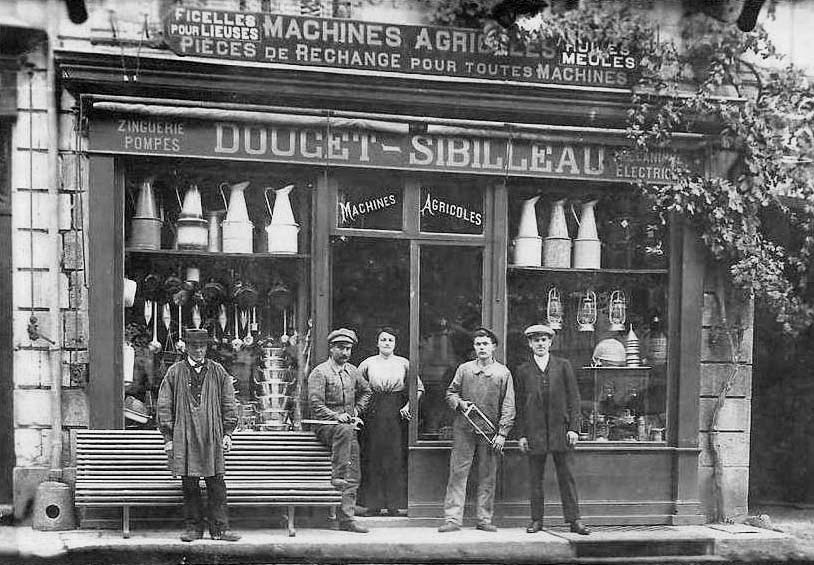
Past and Present: The Hardware and Machinery Store and the Veterinary Surgery

 Simon found this old photo of an early 20th century business in Preuilly and has matched it with a photo of the current guise of the same building on the market place.
************************************************
Eye News: Simon had a check up with the ophthalmo yesterday. He is allowed to stop his eyedrops and his cataract operation has been scheduled for April. This is all a big relief, although juggling his op, the arrival of his family and work still has to be negociated.
*******************************************
A la cuisine hier: Lamb steaks rubbed with salt, pepper, olive oil, rosemary and garlic and seared, served with mashed potato and a green salad.